ABSTRACT
INTRODUCTION
NANOSCALE
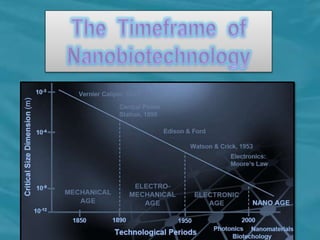
TIMEFRAME OF NANOBIOTECH
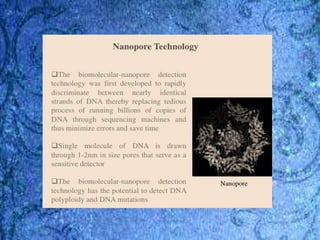
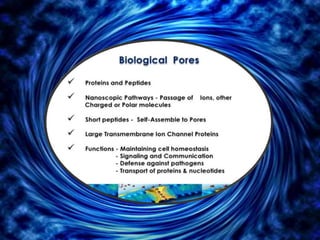
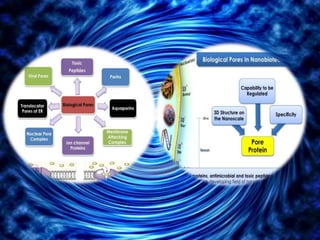
NANOPORES AND NANOPARTICLES
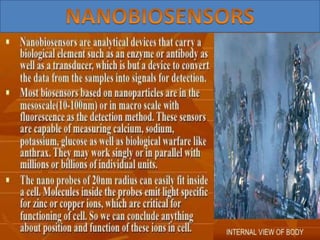
NANOSENSORS
NANOELECTRONICS
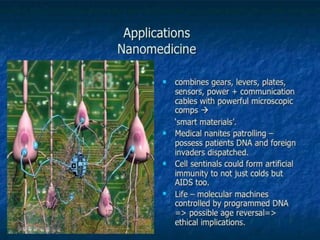
NANOMEDICINCE
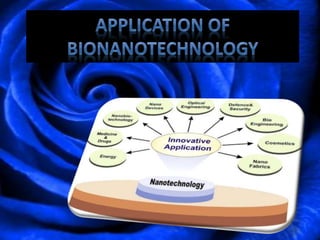
APPLICATION OF NANOBIOTECH
NANO DEVICES
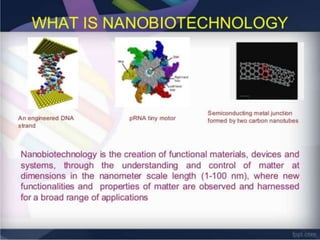
• Bionanotechnology is a division of
nanotechnology which uses biological starting
materials, and it keeps exciting opportunities to
bring high-impact advances in the field of
bioengineering and medicine.
• Currently one of the two progressive areas are
the biotechnology and nanotechnology, and
these two progressive fields combination will
form an interesting new field coined as
‘Bionanotechnology’.
• Bionanotechnology has become an fantastic field of
research and an area of technology development. It
offers at the nanoscale (100,000 times smaller than
the diameter of the average human hair) the ability
to provide insight into the structural features of
biological systems such as cell or tissue as well as to
develop nanobiomaterials/ medical units for
diagnostics, therapeutics and tissue regeneration.
• Ongoing work on bionanotechnology includes
development of nanoprobes that can characterize
the nanoscale structure and function of cells. This
article information is all about the current status of
bionanotechnology and its applications.
Reserchers learn from biology to create new
micronanoscale devices to better understand life
Processes at the nanoscale.
Nano.the Greek word for “dwarf” indicates one
billionth of something.So, a nanometre is simply a
billionth of a metre.
The nanotechnology talks between 1 and
100nm.Some examples are, the dia of one hydrogen
atom is 0.1nm, width of DNA molecule is 2.5nm and
glucose is just below 1nm in size.
• Bionanotechnology is just a rapidly developing area of
scientific and technological opportunity that applies the
tools and processes of nano/microfabrication to build
devices for studying biosystems.
• It is also regarded as the area of study where
nanotechnology has applications in the field of biology
and medical sciences. It became one of the booming
and exciting research fields throughout the globe.
Nevertheless, in the past few years, there also have
been some great discoveries and inventions had
occured in these type of studies.
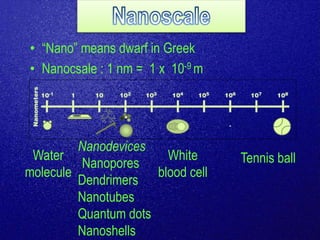
• “Nano” means dwarf in Greek
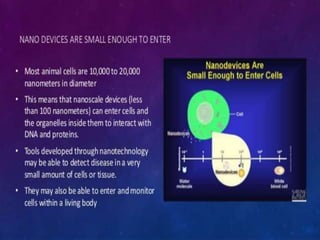
• Nanocsale : 1 nm = 1 x 10⁻⁹ m
Water
molecule
Nanodevices
Nanopores
Dendrimers
Nanotubes
Quantum dots
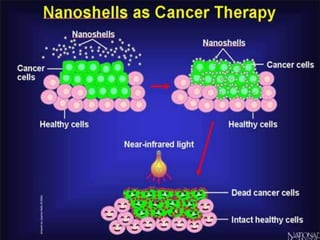
Nanoshells
White
blood cell
Tennis ball
Applications of Different Nanoparticles
in Medicine
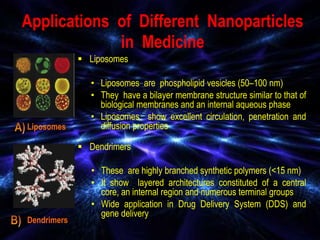
 Liposomes
• Liposomes are phospholipid vesicles (50–100 nm)
• They have a bilayer membrane structure similar to that of
biological membranes and an internal aqueous phase
• Liposomes show excellent circulation, penetration and
diffusion properties
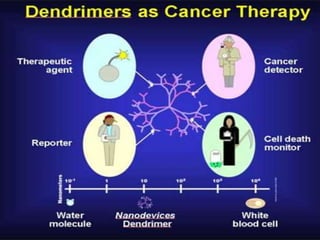
 Dendrimers
• These are highly branched synthetic polymers (<15 nm)
• It show layered architectures constituted of a central
core, an internal region and numerous terminal groups
• Wide application in Drug Delivery System (DDS) and
gene delivery
Liposomes
Dendrimers
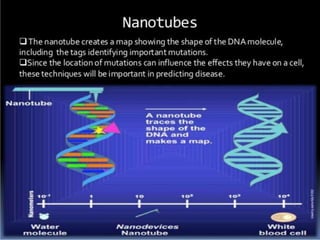
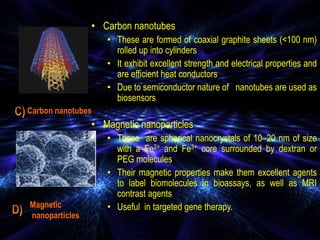
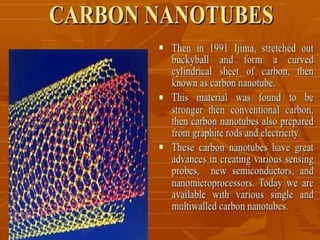
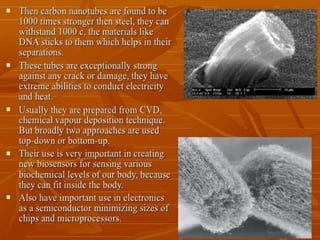
• Carbon nanotubes
• These are formed of coaxial graphite sheets (<100 nm)
rolled up into cylinders
• It exhibit excellent strength and electrical properties and
are efficient heat conductors
• Due to semiconductor nature of nanotubes are used as
biosensors
• Magnetic nanoparticles
• These are spherical nanocrystals of 10–20 nm of size
with a Fe2+ and Fe3+ core surrounded by dextran or
PEG molecules
• Their magnetic properties make them excellent agents
to label biomolecules in bioassays, as well as MRI
contrast agents
• Useful in targeted gene therapy.
Carbon nanotubes
Magnetic
nanoparticles
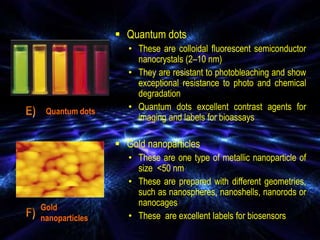
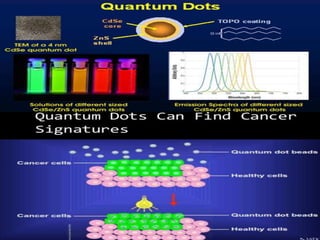
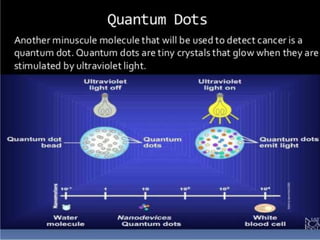
 Quantum dots
• These are colloidal fluorescent semiconductor
nanocrystals (2–10 nm)
• They are resistant to photobleaching and show
exceptional resistance to photo and chemical
degradation
• Quantum dots excellent contrast agents for
imaging and labels for bioassays
 Gold nanoparticles
• These are one type of metallic nanoparticle of
size <50 nm
• These are prepared with different geometries,
such as nanospheres, nanoshells, nanorods or
nanocages
• These are excellent labels for biosensors
Quantum dots
Gold
nanoparticles
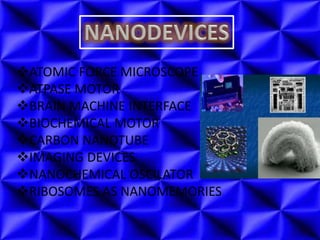
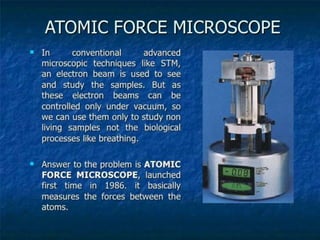
ATOMIC FORCE MICROSCOPE
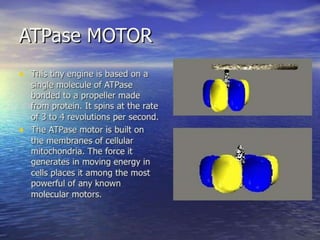
ATPASE MOTOR
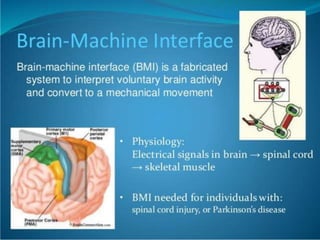
BRAIN MACHINE INTERFACE
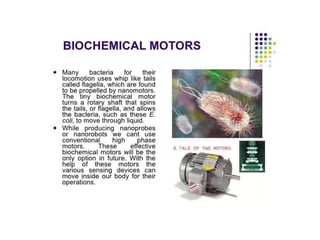
BIOCHEMICAL MOTOR
CARBON NANOTUBE
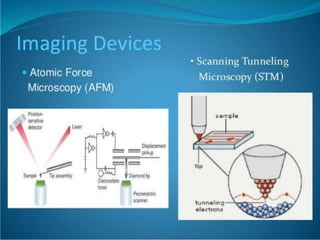
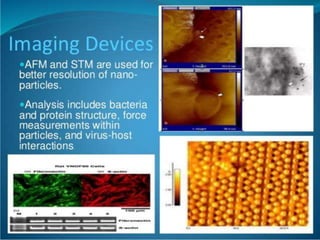
IMAGING DEVICES
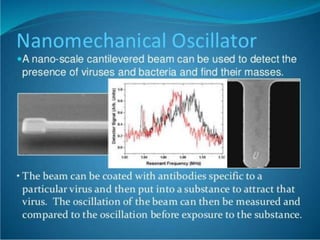
NANOCHEMICAL OSCILATOR
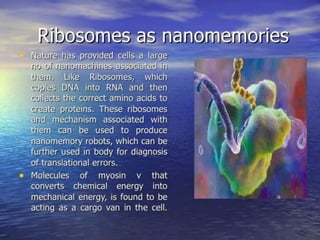
RIBOSOMES AS NANOMEMORIES
NANOBIOTECHNOLOGY
NANOBIOTECHNOLOGY
NANOBIOTECHNOLOGY
NANOBIOTECHNOLOGY
NANOBIOTECHNOLOGY
NANOBIOTECHNOLOGY
NANOBIOTECHNOLOGY
NANOBIOTECHNOLOGY
NANOBIOTECHNOLOGY
NANOBIOTECHNOLOGY
NANOBIOTECHNOLOGY
NANOBIOTECHNOLOGY
NANOBIOTECHNOLOGY
NANOBIOTECHNOLOGY
NANOBIOTECHNOLOGY
NANOBIOTECHNOLOGY
NANOBIOTECHNOLOGY
NANOBIOTECHNOLOGY

NANOBIOTECHNOLOGY

  • 3.
    ABSTRACT INTRODUCTION NANOSCALE TIMEFRAME OF NANOBIOTECH NANOPORESAND NANOPARTICLES NANOSENSORS NANOELECTRONICS NANOMEDICINCE APPLICATION OF NANOBIOTECH NANO DEVICES
  • 4.
    • Bionanotechnology isa division of nanotechnology which uses biological starting materials, and it keeps exciting opportunities to bring high-impact advances in the field of bioengineering and medicine. • Currently one of the two progressive areas are the biotechnology and nanotechnology, and these two progressive fields combination will form an interesting new field coined as ‘Bionanotechnology’.
  • 5.
    • Bionanotechnology hasbecome an fantastic field of research and an area of technology development. It offers at the nanoscale (100,000 times smaller than the diameter of the average human hair) the ability to provide insight into the structural features of biological systems such as cell or tissue as well as to develop nanobiomaterials/ medical units for diagnostics, therapeutics and tissue regeneration. • Ongoing work on bionanotechnology includes development of nanoprobes that can characterize the nanoscale structure and function of cells. This article information is all about the current status of bionanotechnology and its applications.
  • 7.
    Reserchers learn frombiology to create new micronanoscale devices to better understand life Processes at the nanoscale. Nano.the Greek word for “dwarf” indicates one billionth of something.So, a nanometre is simply a billionth of a metre. The nanotechnology talks between 1 and 100nm.Some examples are, the dia of one hydrogen atom is 0.1nm, width of DNA molecule is 2.5nm and glucose is just below 1nm in size.
  • 8.
    • Bionanotechnology isjust a rapidly developing area of scientific and technological opportunity that applies the tools and processes of nano/microfabrication to build devices for studying biosystems. • It is also regarded as the area of study where nanotechnology has applications in the field of biology and medical sciences. It became one of the booming and exciting research fields throughout the globe. Nevertheless, in the past few years, there also have been some great discoveries and inventions had occured in these type of studies.
  • 9.
    • “Nano” meansdwarf in Greek • Nanocsale : 1 nm = 1 x 10⁻⁹ m Water molecule Nanodevices Nanopores Dendrimers Nanotubes Quantum dots Nanoshells White blood cell Tennis ball
  • 30.
    Applications of DifferentNanoparticles in Medicine  Liposomes • Liposomes are phospholipid vesicles (50–100 nm) • They have a bilayer membrane structure similar to that of biological membranes and an internal aqueous phase • Liposomes show excellent circulation, penetration and diffusion properties  Dendrimers • These are highly branched synthetic polymers (<15 nm) • It show layered architectures constituted of a central core, an internal region and numerous terminal groups • Wide application in Drug Delivery System (DDS) and gene delivery Liposomes Dendrimers
  • 31.
    • Carbon nanotubes •These are formed of coaxial graphite sheets (<100 nm) rolled up into cylinders • It exhibit excellent strength and electrical properties and are efficient heat conductors • Due to semiconductor nature of nanotubes are used as biosensors • Magnetic nanoparticles • These are spherical nanocrystals of 10–20 nm of size with a Fe2+ and Fe3+ core surrounded by dextran or PEG molecules • Their magnetic properties make them excellent agents to label biomolecules in bioassays, as well as MRI contrast agents • Useful in targeted gene therapy. Carbon nanotubes Magnetic nanoparticles
  • 34.
     Quantum dots •These are colloidal fluorescent semiconductor nanocrystals (2–10 nm) • They are resistant to photobleaching and show exceptional resistance to photo and chemical degradation • Quantum dots excellent contrast agents for imaging and labels for bioassays  Gold nanoparticles • These are one type of metallic nanoparticle of size <50 nm • These are prepared with different geometries, such as nanospheres, nanoshells, nanorods or nanocages • These are excellent labels for biosensors Quantum dots Gold nanoparticles
  • 42.
    ATOMIC FORCE MICROSCOPE ATPASEMOTOR BRAIN MACHINE INTERFACE BIOCHEMICAL MOTOR CARBON NANOTUBE IMAGING DEVICES NANOCHEMICAL OSCILATOR RIBOSOMES AS NANOMEMORIES