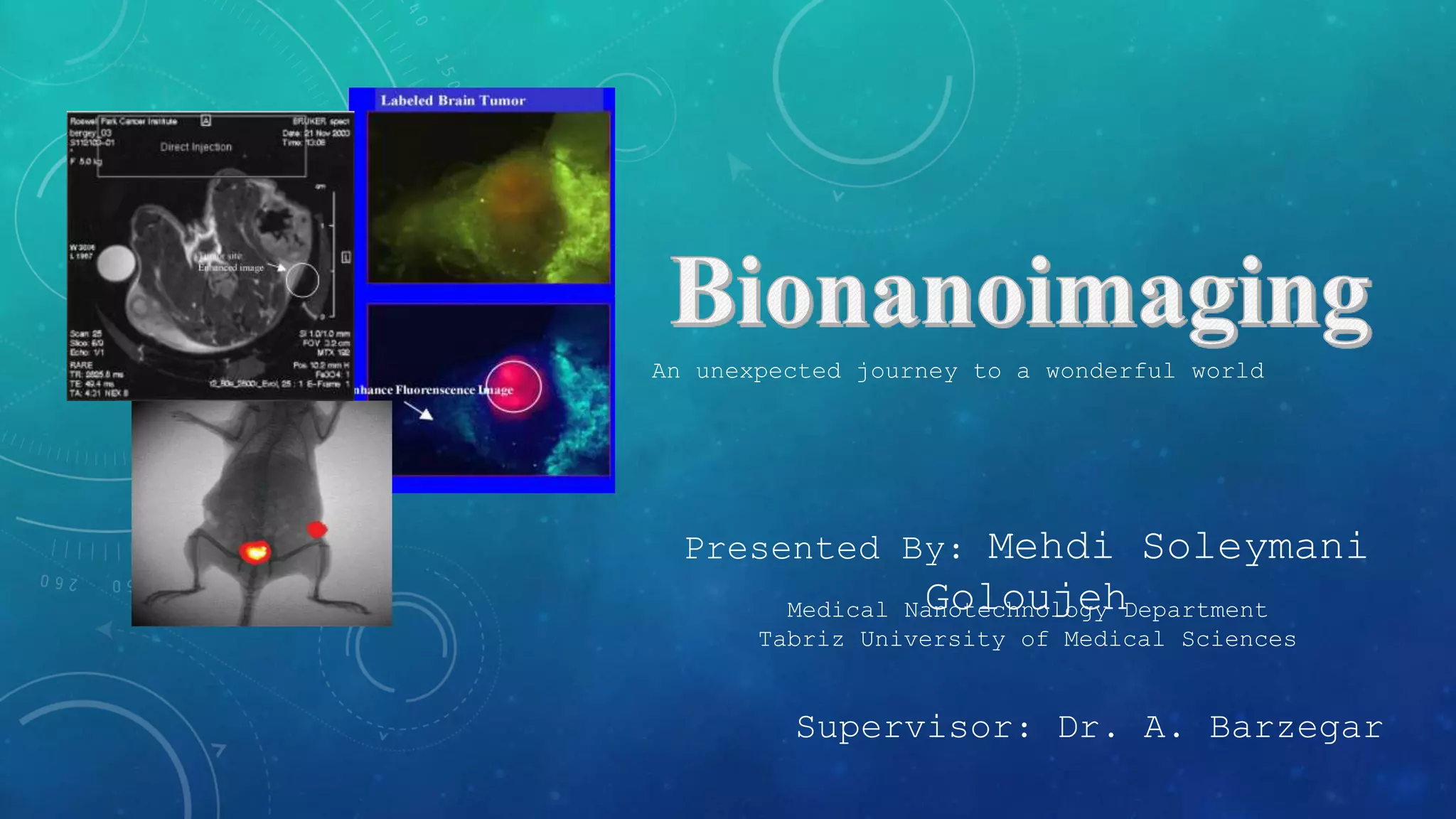


An unexpected journey to a wonderful world 
Presented By: Mehdi Soleymani 
Goloujeh 
Medical Nanotechnology Department 
Tabriz University of Medical Sciences 
Supervisor: Dr. A. Barzegar
Presentation Layout: 
 Introduction 
 Classifications 
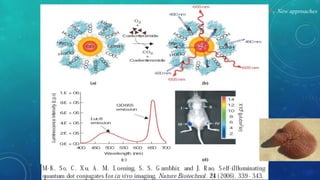
New approaches 
Future trends 
Conclusions 
Mehdi Soleymani Goloujeh 
Medical Nanotechnology Department 
2
Mehdi Soleymani Goloujeh 
Medical Nanotechnology Department 
 Introduction to Bionanoimaging 
 Introduction 
3
4 
Bionanoimaging 
An unexpected journey to a wonderful world 
Nowadays we use in cancer detection, 
molecular imaging, MRI & US 
Some facilities and materials are 
prerequisite to reach our goals 
So we should classify Mehdi Soleymani these Goloujeh 
materials to 
Medical Nanotechnology Department 
 Introduction to Bionanoimaging
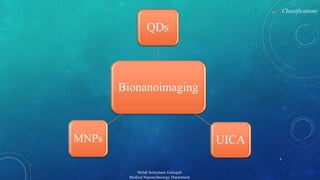
QDs 
Mehdi Soleymani Goloujeh 
Medical Nanotechnology Department 
 Classifications 
Bionanoimaging 
MNPs UICA 
5
Quantum Dots 
Mehdi Soleymani Goloujeh 
Medical Nanotechnology Department 
6
QUANTUM DOTS 
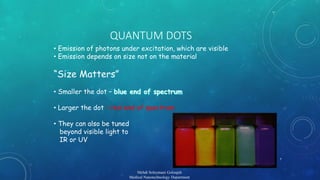
• Emission of photons under excitation, which are visible 
• Emission depends on size not on the material 
“Size Matters” 
• Smaller the dot – 
• Larger the dot – red end of spectrum 
• They can also be tuned 
beyond visible light to 
IR or UV 
7 
Mehdi Soleymani Goloujeh 
Medical Nanotechnology Department
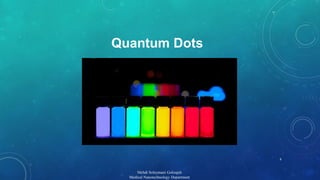
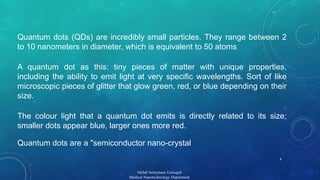
Quantum dots (QDs) are incredibly small particles. They range between 2 
to 10 nanometers in diameter, which is equivalent to 50 atoms 
A quantum dot as this: tiny pieces of matter with unique properties, 
including the ability to emit light at very specific wavelengths. Sort of like 
microscopic pieces of glitter that glow green, red, or blue depending on their 
size. 
The colour light that a quantum dot emits is directly related to its size; 
smaller dots appear blue, larger ones more red. 
Quantum dots are a "semiconductor nano-crystal 
Mehdi Soleymani Goloujeh 
Medical Nanotechnology Department 
8
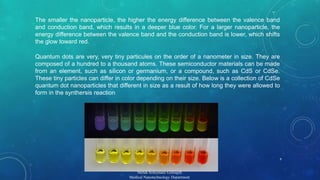
The smaller the nanoparticle, the higher the energy difference between the valence band 
and conduction band, which results in a deeper blue color. For a larger nanoparticle, the 
energy difference between the valence band and the conduction band is lower, which shifts 
the glow toward red. 
Quantum dots are very, very tiny particules on the order of a nanometer in size. They are 
composed of a hundred to a thousand atoms. These semiconductor materials can be made 
from an element, such as silicon or germanium, or a compound, such as CdS or CdSe. 
These tiny particles can differ in color depending on their size. Below is a collection of CdSe 
quantum dot nanoparticles that different in size as a result of how long they were allowed to 
form in the synthersis reaction 
9 
Mehdi Soleymani Goloujeh 
Medical Nanotechnology Department
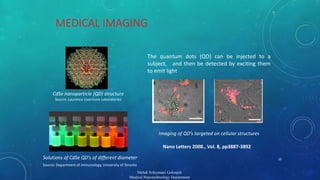
MEDICAL IMAGING 
The quantum dots (QD) can be injected to a 
subject, and then be detected by exciting them 
to emit light 
CdSe nanoparticle (QD) structure 
Source: Laurence Livermore Laboratories 
Solutions of CdSe QD’s of different diameter 
Source: Department of immunology, University of Toronto 
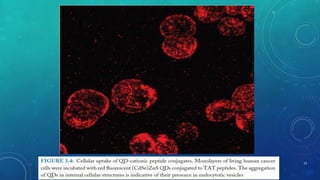
Imaging of QD’s targeted on cellular structures 
Nano Letters 2008., Vol. 8, pp3887-3892 
10 
Mehdi Soleymani Goloujeh 
Medical Nanotechnology Department
QD LOCALIZATION OF A TUMOR 
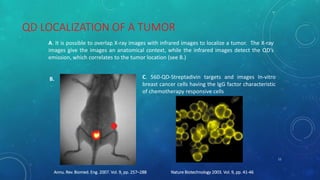
A. It is possible to overlap X-ray images with infrared images to localize a tumor. The X-ray 
images give the images an anatomical context, while the infrared images detect the QD’s 
emission, which correlates to the tumor location (see B.) 
B. C. 560-QD-Streptadivin targets and images In-vitro 
breast cancer cells having the IgG factor characteristic 
of chemotherapy responsive cells 
Annu. Rev. Biomed. Eng. 2007. Vol. 9, pp. 257–288 
Nature Biotechnology 2003. Vol. 9, pp. 41-46 
11
12 
Mehdi Soleymani Goloujeh 
Medical Nanotechnology Department
Mehdi Soleymani Goloujeh 
Medical Nanotechnology Department 
13
14 
Mehdi Soleymani Goloujeh 
Medical Nanotechnology Department
15 
Mehdi Soleymani Goloujeh 
Medical Nanotechnology Department
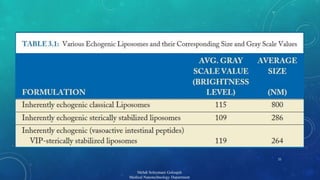
ULTRASOUND CONTRAST AGENTS 
 Ultrasound is currently a well-established technology enabling real-time imaging of the 
Mehdi Soleymani Goloujeh 
Medical Nanotechnology Department 
human body 
 Traditional ultrasound, however, has its own limitation including increase in 
attenuation with increasing insonating frequency, yielding low resolution of thicker 
structures, and thus prohibiting deeper scans 
 A possible solution to overcoming the issues of deep scans and achieving improved 
resolution is the use of contrast agents (CA) for ultrasound imaging [25, 26]. The 
ultrasound imaging contrast agents (UICA) can be classified into liposomes, polymeric 
nanosomes, and these are further classified according to the type of ultrasound agent 
encapsulated in them. 
16
17 
Mehdi Soleymani Goloujeh 
Medical Nanotechnology Department
18 
Mehdi Soleymani Goloujeh 
Medical Nanotechnology Department
19 
Mehdi Soleymani Goloujeh 
Medical Nanotechnology Department
20 
Mehdi Soleymani Goloujeh 
Medical Nanotechnology Department
21 
Mehdi Soleymani Goloujeh 
Medical Nanotechnology Department
22 
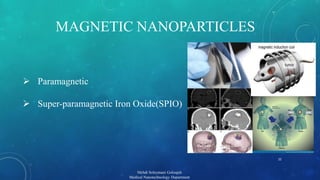
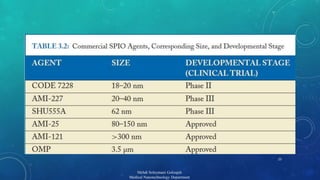
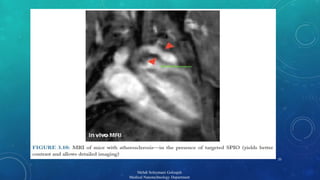
MAGNETIC NANOPARTICLES 
Mehdi Soleymani Goloujeh 
Medical Nanotechnology Department 
 Paramagnetic 
 Super-paramagnetic Iron Oxide(SPIO)
23 
Mehdi Soleymani Goloujeh 
Medical Nanotechnology Department
24 
Applications: 
 Passive Targeting 
 Active Targeting 
 Cell Tracking 
 Magnetic Relaxation Switching(MRS) 
Mehdi Soleymani Goloujeh 
Medical Nanotechnology Department
25 
Mehdi Soleymani Goloujeh 
Medical Nanotechnology Department
Mehdi Soleymani Goloujeh 
Medical Nanotechnology Department 
 New approaches 
26 
 New Developments
27 
Mehdi Soleymani Goloujeh 
Medical Nanotechnology Department 
 New approaches
Experiences 
Insights Documents 
Mehdi Soleymani Goloujeh 
Medical Nanotechnology Department 
 Future trends 
28 
Science-fiction 
Jules Verne Stories 
Imaginations 
Thoughts
C O O H 
C O O H 
H O O C 
O H 
C O O H 
C O O H 
C O O H 
H O O C 
O H 
H O O C 
H O O C 
C O O H 
H O 
C O O H 
H O O C 
C O O 
50 μm 
Fe3O4 NPs 
H 
H O 
C O O H 
H O O 
H O O C 
O H 
O H 
C O O H 
H O O C 
H O O C 
H O O C 
C O O H 
C O O H 
H O O C 
O H 
H O O C 
H O O C 
O H 
H O O C O H 
C O O H 
i 
 Conclusions 
29 
Mehdi Soleymani Goloujeh 
 Conclusions 
Medical Nanotechnology Department
30

Bionanoimaging

  • 1.
    An unexpected journeyto a wonderful world Presented By: Mehdi Soleymani Goloujeh Medical Nanotechnology Department Tabriz University of Medical Sciences Supervisor: Dr. A. Barzegar
  • 2.
    Presentation Layout: Introduction  Classifications New approaches Future trends Conclusions Mehdi Soleymani Goloujeh Medical Nanotechnology Department 2
  • 3.
    Mehdi Soleymani Goloujeh Medical Nanotechnology Department  Introduction to Bionanoimaging  Introduction 3
  • 4.
    4 Bionanoimaging Anunexpected journey to a wonderful world Nowadays we use in cancer detection, molecular imaging, MRI & US Some facilities and materials are prerequisite to reach our goals So we should classify Mehdi Soleymani these Goloujeh materials to Medical Nanotechnology Department  Introduction to Bionanoimaging
  • 5.
    QDs Mehdi SoleymaniGoloujeh Medical Nanotechnology Department  Classifications Bionanoimaging MNPs UICA 5
  • 6.
    Quantum Dots MehdiSoleymani Goloujeh Medical Nanotechnology Department 6
  • 7.
    QUANTUM DOTS •Emission of photons under excitation, which are visible • Emission depends on size not on the material “Size Matters” • Smaller the dot – • Larger the dot – red end of spectrum • They can also be tuned beyond visible light to IR or UV 7 Mehdi Soleymani Goloujeh Medical Nanotechnology Department
  • 8.
    Quantum dots (QDs)are incredibly small particles. They range between 2 to 10 nanometers in diameter, which is equivalent to 50 atoms A quantum dot as this: tiny pieces of matter with unique properties, including the ability to emit light at very specific wavelengths. Sort of like microscopic pieces of glitter that glow green, red, or blue depending on their size. The colour light that a quantum dot emits is directly related to its size; smaller dots appear blue, larger ones more red. Quantum dots are a "semiconductor nano-crystal Mehdi Soleymani Goloujeh Medical Nanotechnology Department 8
  • 9.
    The smaller thenanoparticle, the higher the energy difference between the valence band and conduction band, which results in a deeper blue color. For a larger nanoparticle, the energy difference between the valence band and the conduction band is lower, which shifts the glow toward red. Quantum dots are very, very tiny particules on the order of a nanometer in size. They are composed of a hundred to a thousand atoms. These semiconductor materials can be made from an element, such as silicon or germanium, or a compound, such as CdS or CdSe. These tiny particles can differ in color depending on their size. Below is a collection of CdSe quantum dot nanoparticles that different in size as a result of how long they were allowed to form in the synthersis reaction 9 Mehdi Soleymani Goloujeh Medical Nanotechnology Department
  • 10.
    MEDICAL IMAGING Thequantum dots (QD) can be injected to a subject, and then be detected by exciting them to emit light CdSe nanoparticle (QD) structure Source: Laurence Livermore Laboratories Solutions of CdSe QD’s of different diameter Source: Department of immunology, University of Toronto Imaging of QD’s targeted on cellular structures Nano Letters 2008., Vol. 8, pp3887-3892 10 Mehdi Soleymani Goloujeh Medical Nanotechnology Department
  • 11.
    QD LOCALIZATION OFA TUMOR A. It is possible to overlap X-ray images with infrared images to localize a tumor. The X-ray images give the images an anatomical context, while the infrared images detect the QD’s emission, which correlates to the tumor location (see B.) B. C. 560-QD-Streptadivin targets and images In-vitro breast cancer cells having the IgG factor characteristic of chemotherapy responsive cells Annu. Rev. Biomed. Eng. 2007. Vol. 9, pp. 257–288 Nature Biotechnology 2003. Vol. 9, pp. 41-46 11
  • 12.
    12 Mehdi SoleymaniGoloujeh Medical Nanotechnology Department
  • 13.
    Mehdi Soleymani Goloujeh Medical Nanotechnology Department 13
  • 14.
    14 Mehdi SoleymaniGoloujeh Medical Nanotechnology Department
  • 15.
    15 Mehdi SoleymaniGoloujeh Medical Nanotechnology Department
  • 16.
    ULTRASOUND CONTRAST AGENTS  Ultrasound is currently a well-established technology enabling real-time imaging of the Mehdi Soleymani Goloujeh Medical Nanotechnology Department human body  Traditional ultrasound, however, has its own limitation including increase in attenuation with increasing insonating frequency, yielding low resolution of thicker structures, and thus prohibiting deeper scans  A possible solution to overcoming the issues of deep scans and achieving improved resolution is the use of contrast agents (CA) for ultrasound imaging [25, 26]. The ultrasound imaging contrast agents (UICA) can be classified into liposomes, polymeric nanosomes, and these are further classified according to the type of ultrasound agent encapsulated in them. 16
  • 17.
    17 Mehdi SoleymaniGoloujeh Medical Nanotechnology Department
  • 18.
    18 Mehdi SoleymaniGoloujeh Medical Nanotechnology Department
  • 19.
    19 Mehdi SoleymaniGoloujeh Medical Nanotechnology Department
  • 20.
    20 Mehdi SoleymaniGoloujeh Medical Nanotechnology Department
  • 21.
    21 Mehdi SoleymaniGoloujeh Medical Nanotechnology Department
  • 22.
    22 MAGNETIC NANOPARTICLES Mehdi Soleymani Goloujeh Medical Nanotechnology Department  Paramagnetic  Super-paramagnetic Iron Oxide(SPIO)
  • 23.
    23 Mehdi SoleymaniGoloujeh Medical Nanotechnology Department
  • 24.
    24 Applications: Passive Targeting  Active Targeting  Cell Tracking  Magnetic Relaxation Switching(MRS) Mehdi Soleymani Goloujeh Medical Nanotechnology Department
  • 25.
    25 Mehdi SoleymaniGoloujeh Medical Nanotechnology Department
  • 26.
    Mehdi Soleymani Goloujeh Medical Nanotechnology Department  New approaches 26  New Developments
  • 27.
    27 Mehdi SoleymaniGoloujeh Medical Nanotechnology Department  New approaches
  • 28.
    Experiences Insights Documents Mehdi Soleymani Goloujeh Medical Nanotechnology Department  Future trends 28 Science-fiction Jules Verne Stories Imaginations Thoughts
  • 29.
    C O OH C O O H H O O C O H C O O H C O O H C O O H H O O C O H H O O C H O O C C O O H H O C O O H H O O C C O O 50 μm Fe3O4 NPs H H O C O O H H O O H O O C O H O H C O O H H O O C H O O C H O O C C O O H C O O H H O O C O H H O O C H O O C O H H O O C O H C O O H i  Conclusions 29 Mehdi Soleymani Goloujeh  Conclusions Medical Nanotechnology Department
  • 30.