Wright “Or Is That Right”
      Everytime…
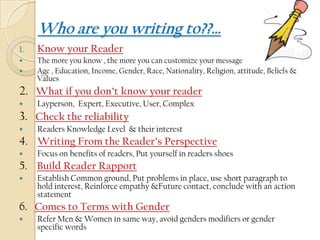
Who are you writing to??…
1.   Know your Reader
    The more you know , the more you can customize your message
    Age , Education, Income, Gender, Race, Nationality, Religion, attitude, Beliefs &
     Values
2. What if you don’t know your reader
    Layperson, Expert, Executive, User, Complex
3. Check the reliability
    Readers Knowledge Level & their interest
4. Writing From the Reader’s Perspective
    Focus on benefits of readers, Put yourself in readers shoes
5. Build Reader Rapport
    Establish Common ground, Put problems in place, use short paragraph to
     hold interest, Reinforce empathy &Future contact, conclude with an action
     statement
6. Comes to Terms with Gender
    Refer Men & Women in same way, avoid genders modifiers or gender
     specific words
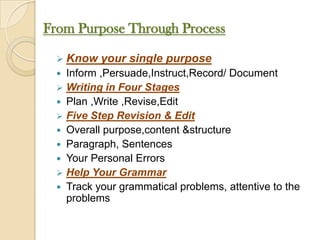
From Purpose Through Process

   Know   your single purpose
   Inform ,Persuade,Instruct,Record/ Document
   Writing in Four Stages
   Plan ,Write ,Revise,Edit
   Five Step Revision & Edit
   Overall purpose,content &structure
   Paragraph, Sentences
   Your Personal Errors
   Help Your Grammar
   Track your grammatical problems, attentive to the
    problems
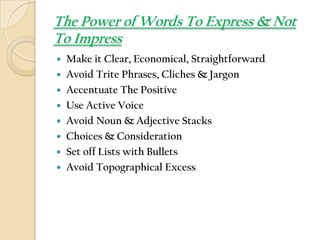
The Power of Words To Express & Not
To Impress
   Make it Clear, Economical, Straightforward
   Avoid Trite Phrases, Cliches & Jargon
   Accentuate The Positive
   Use Active Voice
   Avoid Noun & Adjective Stacks
   Choices & Consideration
   Set off Lists with Bullets
   Avoid Topographical Excess
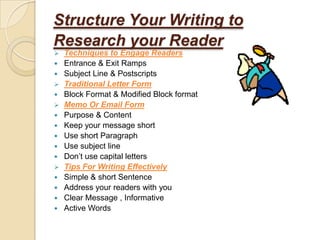
Structure Your Writing to
Research your Reader
   Techniques to Engage Readers
   Entrance & Exit Ramps
   Subject Line & Postscripts
   Traditional Letter Form
   Block Format & Modified Block format
   Memo Or Email Form
   Purpose & Content
   Keep your message short
   Use short Paragraph
   Use subject line
   Don’t use capital letters
   Tips For Writing Effectively
   Simple & short Sentence
   Address your readers with you
   Clear Message , Informative
   Active Words
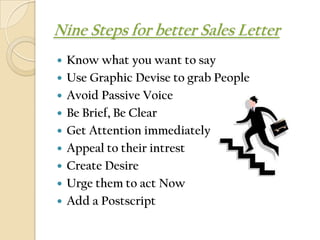
Nine Steps for better Sales Letter
   Know what you want to say
   Use Graphic Devise to grab People
   Avoid Passive Voice
   Be Brief, Be Clear
   Get Attention immediately
   Appeal to their intrest
   Create Desire
   Urge them to act Now
   Add a Postscript
The Power of Visual , White Space, &
Headings
 Visuals:Into the head through the eyes
 When, Where & how to use visuals
 Whit Space: Making the Most of Nothing
 Use of Margins, listing quotes, space b/w
  paragraphs
 Headings: Signposts & Signals
 Major , Minor & Sub heading, Paragraph Headings
How to Start & Stop
 Gaining Attention
 Start Strong-finish Strong, Degrees of attention,
 Effective Opening
 Context, Purpose , organization(Attractive)
 Holding Your Readers
 Ending Strong
 Briefly Summarize, Repeat your major
  points, stress on the importance of topic, Provide
  Recommendations.
Zero Based Writing
 Move    From Assumptions to Perspective
 Avoid unnecessary technical terms,
 Master Process Writing
 Description & instruction-discuss description
  first then instruction
 Write Clear, Practical Descriptions
 Where to start from, what to be included, what
  should be , what is the appropriate point.
 Write Simple Instructions
 Complete , Precise, Simple, Direct, Organized,
  Layout
Dealing With Tough Situations

 Breaking   Bad News
 Be positive, Give Reason
 Strategy for Delivering Bad News
 Establish good news, present negative
  message with reason & Explain the positive
  aspect
 Reacting to Predicament
 State your reason, recognize readers
  objection, be assertive, Avoid offending, be
  respectful & sensitive to your positions.
Persuading Your Readers
   How to Persuade in Three Difficult Steps
   Establish common Ground, State the problem &
    Solution, End with Strong Action Close,
   Ten Rules of Persuasion
   Know your readers
   Know what u can accomplish
   Anticipate objection,
   Stress Rewards
   Be Familiar
   Be Clear
   Ask for what you want
   Control the tone
   Clinch your argument & give them something to
    remember
 Use a Problem/ Solution Format
 Offer Several Solutions-Helps to hook the readers
 Write Powerful Proposals
 Use memorable title, highlights the need, problem
  or opportunity, support statements by fact &
  quotes, keep proposal concise,
 Conclusion
 Conclude with power: what do u expect from them
  & give them something to remember
Reports, Reports, Reports
 Types of Report
 Occasional Report, Activity Report, Status Report
  or Progress Report, Formal Report
 Basics for all Report
 Objectives, Readers, Scope of
  Coverage, Information Equation-drawing & building
  interest in your report
 Evaluating your Report
 Before Submitting read it from the perspective of
  the recipients
 Reports: The Bottom Line
 Your purpose is to inform persuade , connect with
  readers & compel them to read & understand
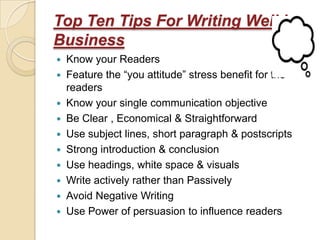
Top Ten Tips For Writing Well in
Business
 Know your Readers
 Feature the “you attitude” stress benefit for the
  readers
 Know your single communication objective
 Be Clear , Economical & Straightforward
 Use subject lines, short paragraph & postscripts
 Strong introduction & conclusion
 Use headings, white space & visuals
 Write actively rather than Passively
 Avoid Negative Writing
 Use Power of persuasion to influence readers
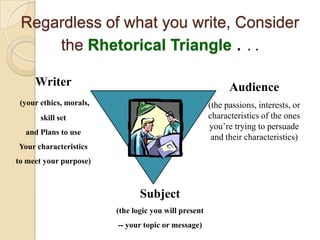
Regardless of what you write, Consider
     the Rhetorical Triangle . . .

     Writer                                                  Audience
 (your ethics, morals,                                 (the passions, interests, or
       skill set                                       characteristics of the ones
                                                       you’re trying to persuade
  and Plans to use
                                                        and their characteristics)
Your characteristics
to meet your purpose)


                                Subject
                         (the logic you will present
                         -- your topic or message)
Before you Leave…………
Never Give Something to disagree with,
 never give anything to think about

Ppt on business writing

  • 1.
    Wright “Or IsThat Right” Everytime…
  • 2.
    Who are youwriting to??… 1. Know your Reader  The more you know , the more you can customize your message  Age , Education, Income, Gender, Race, Nationality, Religion, attitude, Beliefs & Values 2. What if you don’t know your reader  Layperson, Expert, Executive, User, Complex 3. Check the reliability  Readers Knowledge Level & their interest 4. Writing From the Reader’s Perspective  Focus on benefits of readers, Put yourself in readers shoes 5. Build Reader Rapport  Establish Common ground, Put problems in place, use short paragraph to hold interest, Reinforce empathy &Future contact, conclude with an action statement 6. Comes to Terms with Gender  Refer Men & Women in same way, avoid genders modifiers or gender specific words
  • 3.
    From Purpose ThroughProcess  Know your single purpose  Inform ,Persuade,Instruct,Record/ Document  Writing in Four Stages  Plan ,Write ,Revise,Edit  Five Step Revision & Edit  Overall purpose,content &structure  Paragraph, Sentences  Your Personal Errors  Help Your Grammar  Track your grammatical problems, attentive to the problems
  • 4.
    The Power ofWords To Express & Not To Impress  Make it Clear, Economical, Straightforward  Avoid Trite Phrases, Cliches & Jargon  Accentuate The Positive  Use Active Voice  Avoid Noun & Adjective Stacks  Choices & Consideration  Set off Lists with Bullets  Avoid Topographical Excess
  • 5.
    Structure Your Writingto Research your Reader  Techniques to Engage Readers  Entrance & Exit Ramps  Subject Line & Postscripts  Traditional Letter Form  Block Format & Modified Block format  Memo Or Email Form  Purpose & Content  Keep your message short  Use short Paragraph  Use subject line  Don’t use capital letters  Tips For Writing Effectively  Simple & short Sentence  Address your readers with you  Clear Message , Informative  Active Words
  • 6.
    Nine Steps forbetter Sales Letter  Know what you want to say  Use Graphic Devise to grab People  Avoid Passive Voice  Be Brief, Be Clear  Get Attention immediately  Appeal to their intrest  Create Desire  Urge them to act Now  Add a Postscript
  • 7.
    The Power ofVisual , White Space, & Headings  Visuals:Into the head through the eyes  When, Where & how to use visuals  Whit Space: Making the Most of Nothing  Use of Margins, listing quotes, space b/w paragraphs  Headings: Signposts & Signals  Major , Minor & Sub heading, Paragraph Headings
  • 8.
    How to Start& Stop  Gaining Attention  Start Strong-finish Strong, Degrees of attention,  Effective Opening  Context, Purpose , organization(Attractive)  Holding Your Readers  Ending Strong  Briefly Summarize, Repeat your major points, stress on the importance of topic, Provide Recommendations.
  • 9.
    Zero Based Writing Move From Assumptions to Perspective  Avoid unnecessary technical terms,  Master Process Writing  Description & instruction-discuss description first then instruction  Write Clear, Practical Descriptions  Where to start from, what to be included, what should be , what is the appropriate point.  Write Simple Instructions  Complete , Precise, Simple, Direct, Organized, Layout
  • 10.
    Dealing With ToughSituations  Breaking Bad News  Be positive, Give Reason  Strategy for Delivering Bad News  Establish good news, present negative message with reason & Explain the positive aspect  Reacting to Predicament  State your reason, recognize readers objection, be assertive, Avoid offending, be respectful & sensitive to your positions.
  • 11.
    Persuading Your Readers  How to Persuade in Three Difficult Steps  Establish common Ground, State the problem & Solution, End with Strong Action Close,  Ten Rules of Persuasion  Know your readers  Know what u can accomplish  Anticipate objection,  Stress Rewards  Be Familiar  Be Clear  Ask for what you want  Control the tone  Clinch your argument & give them something to remember
  • 12.
     Use aProblem/ Solution Format  Offer Several Solutions-Helps to hook the readers  Write Powerful Proposals  Use memorable title, highlights the need, problem or opportunity, support statements by fact & quotes, keep proposal concise,  Conclusion  Conclude with power: what do u expect from them & give them something to remember
  • 13.
    Reports, Reports, Reports Types of Report  Occasional Report, Activity Report, Status Report or Progress Report, Formal Report  Basics for all Report  Objectives, Readers, Scope of Coverage, Information Equation-drawing & building interest in your report  Evaluating your Report  Before Submitting read it from the perspective of the recipients  Reports: The Bottom Line  Your purpose is to inform persuade , connect with readers & compel them to read & understand
  • 14.
    Top Ten TipsFor Writing Well in Business  Know your Readers  Feature the “you attitude” stress benefit for the readers  Know your single communication objective  Be Clear , Economical & Straightforward  Use subject lines, short paragraph & postscripts  Strong introduction & conclusion  Use headings, white space & visuals  Write actively rather than Passively  Avoid Negative Writing  Use Power of persuasion to influence readers
  • 15.
    Regardless of whatyou write, Consider the Rhetorical Triangle . . . Writer Audience (your ethics, morals, (the passions, interests, or skill set characteristics of the ones you’re trying to persuade and Plans to use and their characteristics) Your characteristics to meet your purpose) Subject (the logic you will present -- your topic or message)
  • 16.
    Before you Leave………… NeverGive Something to disagree with, never give anything to think about