

The Process Of Preparing
Effective Business Message
Effective Business Communication
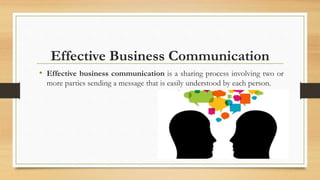
• Effective business communication is a sharing process involving two or
more parties sending a message that is easily understood by each person.
Why preparing for effective business message?
• Every communication process starts with a message.
• Message plays a crucial role at every step of communication cycle.
• Message is what initiates a communication process.
PLANNING STEPS
• Identify your purpose
• Analyze your audience
• Choose your ideas
• Collect data to support your ideas
• Organize your message.
Step 1: Identify your purpose
It is important to determine first the specific reason of writing. The reason of
writing a message could be:
• Mainly informational, such as announcement etc.
• Persuasive, such as promotion of product or sending applications for personal
reasons, etc.
• Negotiating
• Creating goodwill.
Step 2: Analyze Your Audience
It is important to adapt the message according to the receivers views, mental
filters, needs, and culture. While preparing a message the care must be taken for
the following aspects:
• Member of a group, such as business or professional person; laborer,
colleague, or subordinate; woman or man.
• New or long time customer; young, middle-aged, or elderly.
• Receivers educational level, attitudes and probable values.
Step 3: Choose Your Idea
With the purpose and receiver in mind, the next step is to choose the idea for
message.
• The idea of writing a message depends on the background, situation, cultural
context and location of the receiver (national or international).
Step 4: Collect Your Data
After deciding about the idea to be included in the message, it is important to
determine if the same requires specific facts, figures quotations, or other types
of evidence to support the main idea of the message. It is important to know
and take care of:
• Company’s policies, procedures, and product detail if needed to support the
main idea.
• Enclose, if needed, a brochure, table, picture, or product sample.
Step 5: Organize Your Message
• Before you write the first draft of the letter, outline your message (mentally
or on paper). The order in which the idea is presented is as important as the
ideas themselves.
• Disorganized, rambling messages often seem careless, confusing, and
unimportant.
• Different approaches of organizing the business messages are necessary for
different cultures.
Conclusion
• After study this process we conclude that if you are preparing any business
messages it should be simply structured.
• To make it effective use better Performa.
The process of preparing effective business message

The process of preparing effective business message

  • 1.
    The Process OfPreparing Effective Business Message
  • 2.
    Effective Business Communication •Effective business communication is a sharing process involving two or more parties sending a message that is easily understood by each person.
  • 3.
    Why preparing foreffective business message? • Every communication process starts with a message. • Message plays a crucial role at every step of communication cycle. • Message is what initiates a communication process.
  • 4.
    PLANNING STEPS • Identifyyour purpose • Analyze your audience • Choose your ideas • Collect data to support your ideas • Organize your message.
  • 5.
    Step 1: Identifyyour purpose It is important to determine first the specific reason of writing. The reason of writing a message could be: • Mainly informational, such as announcement etc. • Persuasive, such as promotion of product or sending applications for personal reasons, etc. • Negotiating • Creating goodwill.
  • 6.
    Step 2: AnalyzeYour Audience It is important to adapt the message according to the receivers views, mental filters, needs, and culture. While preparing a message the care must be taken for the following aspects: • Member of a group, such as business or professional person; laborer, colleague, or subordinate; woman or man. • New or long time customer; young, middle-aged, or elderly. • Receivers educational level, attitudes and probable values.
  • 7.
    Step 3: ChooseYour Idea With the purpose and receiver in mind, the next step is to choose the idea for message. • The idea of writing a message depends on the background, situation, cultural context and location of the receiver (national or international).
  • 8.
    Step 4: CollectYour Data After deciding about the idea to be included in the message, it is important to determine if the same requires specific facts, figures quotations, or other types of evidence to support the main idea of the message. It is important to know and take care of: • Company’s policies, procedures, and product detail if needed to support the main idea. • Enclose, if needed, a brochure, table, picture, or product sample.
  • 9.
    Step 5: OrganizeYour Message • Before you write the first draft of the letter, outline your message (mentally or on paper). The order in which the idea is presented is as important as the ideas themselves. • Disorganized, rambling messages often seem careless, confusing, and unimportant. • Different approaches of organizing the business messages are necessary for different cultures.
  • 10.
    Conclusion • After studythis process we conclude that if you are preparing any business messages it should be simply structured. • To make it effective use better Performa.