Interpersonal Skills and
Business Writing
Table of Contents
Definition of Interpersonal Skills 3
Concepts You Need to Apply in Project 1 4-9
Writing the Refund Letter, Memo Report, and Email 10-12
Business Prose Style Principles 13-18
2
Put simply, interpersonal skills in business environments refer to
an employee’s ability to get along with other people while getting
his/her job done.
Interpersonal skills include everything from how you communicate;
how you listen; your attitude and manners; to how you dress.
Interpersonal skills are closely related to intercultural skills which
is the knowledge of social expectations and customs of another
culture and the ability to adjust your interpersonal skills accordingly.
Definition of Interpersonal Skills
3
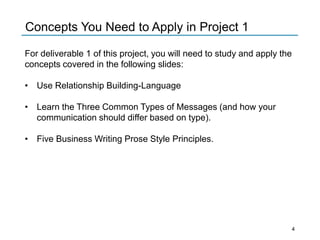
For deliverable 1 of this project, you will need to study and apply the
concepts covered in the following slides:
• Use Relationship Building-Language
• Learn the Three Common Types of Messages (and how your
communication should differ based on type).
• Five Business Writing Prose Style Principles.
Concepts You Need to Apply in Project 1
4
The way in which you write and respond
to others can foster positive workplace
relationships or negative ones.
Your prose style can show respect or
disrespect for others and reveal positive
or negative intentions
Simply adding please, thank you,
expressing appreciation, and
displaying respect for other people’s
time goes a long way to build and
preserve good workplace relationships.
Use relationship-building language.
5
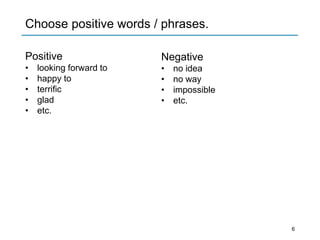
Positive
• looking forward to
• happy to
• terrific
• glad
• etc.
Negative
• no idea
• no way
• impossible
• etc.
Choose positive words / phrases.
6
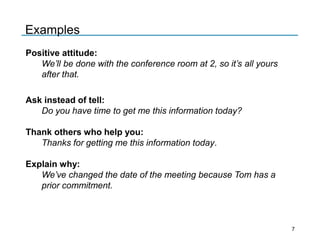
Positive attitude:
We’ll be done with the conference room at 2, so it’s all yours
after that.
Ask instead of tell:
Do you have time to get me this information today?
Thank others who help you:
Thanks for getting me this information today.
Explain why:
We’ve changed the date of the meeting because Tom has a
prior commitment.
Examples
7
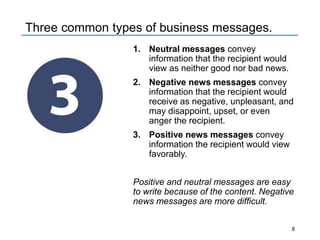
1. Neutral messages convey
information that the recipient would
view as neither good nor bad news.
2. Negative news messages convey
information that the recipient would
receive as negative, unpleasant, and
may disappoint, upset, or even
anger the recipient.
3. Positive news messages convey
information the recipient would view
favorably.
Positive and neutral messages are easy
to write because of the content. Negative
news messages are more difficult.
Three common types of business messages.
8
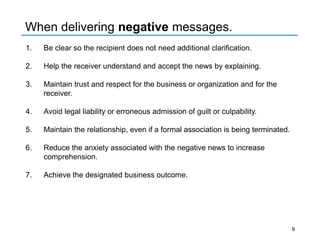
1. Be clear so the recipient does not need additional clarification.
2. Help the receiver understand and accept the news by explaining.
3. Maintain trust and respect for the business or organization and for the
receiver.
4. Avoid legal liability or erroneous admission of guilt or culpability.
5. Maintain the relationship, even if a formal association is being terminated.
6. Reduce the anxiety associated with the negative news to increase
comprehension.
7. Achieve the designated business outcome.
When delivering negative messages.
9
The refund letter is mostly a positive message.
Analyze the case study closely, however, before composing your
letter.
A key challenge is to issue the refund and state why you are issuing
it without admitting or implying that your business is liable for the
problem this customer encountered or blaming the customer.
Use standard conventions to format your letter.
Case study: writing the refund letter.
10
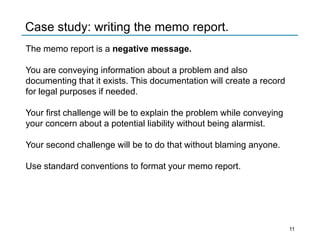
The memo report is a negative message.
You are conveying information about a problem and also
documenting that it exists. This documentation will create a record
for legal purposes if needed.
Your first challenge will be to explain the problem while conveying
your concern about a potential liability without being alarmist.
Your second challenge will be to do that without blaming anyone.
Use standard conventions to format your memo report.
Case study: writing the memo report.
11
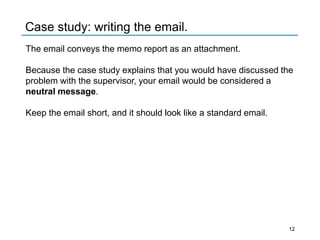
The email conveys the memo report as an attachment.
Because the case study explains that you would have discussed the
problem with the supervisor, your email would be considered a
neutral message.
Keep the email short, and it should look like a standard email.
Case study: writing the email.
12
1. Write concisely.
2. Use action verbs.
3. Use active voice.
4. Writer shorter
sentences and
paragraphs.
5. Use business jargon
appropriately
Five business prose style principles.
13
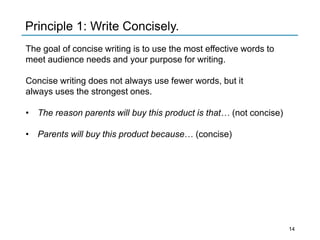
The goal of concise writing is to use the most effective words to
meet audience needs and your purpose for writing.
Concise writing does not always use fewer words, but it
always uses the strongest ones.
• The reason parents will buy this product is that… (not concise)
• Parents will buy this product because… (concise)
Principle 1: Write Concisely.
14
Action verbs make your writing more concise, direct, and easier to
understand.
• We need an impending study that will ascertain the feasibility of
our obtaining a solution. (action is unclear)
• We need to study the feasibility of this solution.(action is clear)
Principle 2: Use Action Verbs
15
In active voice, who is doing the action is the subject of the
sentence.
• Our team discovered the problem yesterday.
In passive voice, the action or object of the action is the subject of
the sentence and who is doing the action is either missing or stated
as a “by” phrase.
• The problem was discovered yesterday.
• The problem was discovered yesterday by our team.
Principle 3: Use Active Voice
16
Typically, modern business prose style uses shorter sentences and
paragraphs.
The average sentence length is between 14 and 20 words, but avoid
applying this average as a rigid rule. Vary sentence length to
improve cadence.
Keep paragraphs to one topic even if the paragraph is only two or
three sentences.
Principle 4: Use Shorter Sentences and Paragraphs
17
Jargon is industry or discipline specific terminology.
Use jargon when the audience is knowledgeable about how the term
is both being defined and used.
When your audience would not have this knowledge, then jargon
creates a problem with being clear.
Principle 5: Use Business Jargon Appropriately
18

Engl313 project1_slidedoc1 Spring 2020

  • 1.
  • 2.
    Table of Contents Definitionof Interpersonal Skills 3 Concepts You Need to Apply in Project 1 4-9 Writing the Refund Letter, Memo Report, and Email 10-12 Business Prose Style Principles 13-18 2
  • 3.
    Put simply, interpersonalskills in business environments refer to an employee’s ability to get along with other people while getting his/her job done. Interpersonal skills include everything from how you communicate; how you listen; your attitude and manners; to how you dress. Interpersonal skills are closely related to intercultural skills which is the knowledge of social expectations and customs of another culture and the ability to adjust your interpersonal skills accordingly. Definition of Interpersonal Skills 3
  • 4.
    For deliverable 1of this project, you will need to study and apply the concepts covered in the following slides: • Use Relationship Building-Language • Learn the Three Common Types of Messages (and how your communication should differ based on type). • Five Business Writing Prose Style Principles. Concepts You Need to Apply in Project 1 4
  • 5.
    The way inwhich you write and respond to others can foster positive workplace relationships or negative ones. Your prose style can show respect or disrespect for others and reveal positive or negative intentions Simply adding please, thank you, expressing appreciation, and displaying respect for other people’s time goes a long way to build and preserve good workplace relationships. Use relationship-building language. 5
  • 6.
    Positive • looking forwardto • happy to • terrific • glad • etc. Negative • no idea • no way • impossible • etc. Choose positive words / phrases. 6
  • 7.
    Positive attitude: We’ll bedone with the conference room at 2, so it’s all yours after that. Ask instead of tell: Do you have time to get me this information today? Thank others who help you: Thanks for getting me this information today. Explain why: We’ve changed the date of the meeting because Tom has a prior commitment. Examples 7
  • 8.
    1. Neutral messagesconvey information that the recipient would view as neither good nor bad news. 2. Negative news messages convey information that the recipient would receive as negative, unpleasant, and may disappoint, upset, or even anger the recipient. 3. Positive news messages convey information the recipient would view favorably. Positive and neutral messages are easy to write because of the content. Negative news messages are more difficult. Three common types of business messages. 8
  • 9.
    1. Be clearso the recipient does not need additional clarification. 2. Help the receiver understand and accept the news by explaining. 3. Maintain trust and respect for the business or organization and for the receiver. 4. Avoid legal liability or erroneous admission of guilt or culpability. 5. Maintain the relationship, even if a formal association is being terminated. 6. Reduce the anxiety associated with the negative news to increase comprehension. 7. Achieve the designated business outcome. When delivering negative messages. 9
  • 10.
    The refund letteris mostly a positive message. Analyze the case study closely, however, before composing your letter. A key challenge is to issue the refund and state why you are issuing it without admitting or implying that your business is liable for the problem this customer encountered or blaming the customer. Use standard conventions to format your letter. Case study: writing the refund letter. 10
  • 11.
    The memo reportis a negative message. You are conveying information about a problem and also documenting that it exists. This documentation will create a record for legal purposes if needed. Your first challenge will be to explain the problem while conveying your concern about a potential liability without being alarmist. Your second challenge will be to do that without blaming anyone. Use standard conventions to format your memo report. Case study: writing the memo report. 11
  • 12.
    The email conveysthe memo report as an attachment. Because the case study explains that you would have discussed the problem with the supervisor, your email would be considered a neutral message. Keep the email short, and it should look like a standard email. Case study: writing the email. 12
  • 13.
    1. Write concisely. 2.Use action verbs. 3. Use active voice. 4. Writer shorter sentences and paragraphs. 5. Use business jargon appropriately Five business prose style principles. 13
  • 14.
    The goal ofconcise writing is to use the most effective words to meet audience needs and your purpose for writing. Concise writing does not always use fewer words, but it always uses the strongest ones. • The reason parents will buy this product is that… (not concise) • Parents will buy this product because… (concise) Principle 1: Write Concisely. 14
  • 15.
    Action verbs makeyour writing more concise, direct, and easier to understand. • We need an impending study that will ascertain the feasibility of our obtaining a solution. (action is unclear) • We need to study the feasibility of this solution.(action is clear) Principle 2: Use Action Verbs 15
  • 16.
    In active voice,who is doing the action is the subject of the sentence. • Our team discovered the problem yesterday. In passive voice, the action or object of the action is the subject of the sentence and who is doing the action is either missing or stated as a “by” phrase. • The problem was discovered yesterday. • The problem was discovered yesterday by our team. Principle 3: Use Active Voice 16
  • 17.
    Typically, modern businessprose style uses shorter sentences and paragraphs. The average sentence length is between 14 and 20 words, but avoid applying this average as a rigid rule. Vary sentence length to improve cadence. Keep paragraphs to one topic even if the paragraph is only two or three sentences. Principle 4: Use Shorter Sentences and Paragraphs 17
  • 18.
    Jargon is industryor discipline specific terminology. Use jargon when the audience is knowledgeable about how the term is both being defined and used. When your audience would not have this knowledge, then jargon creates a problem with being clear. Principle 5: Use Business Jargon Appropriately 18