PowerPoint Presentation by Charlie CookPowerPoint Presentation by Charlie Cook
Copyright © 2005 Prentice Hall, Inc.Copyright © 2005 Prentice Hall, Inc.
All rights reserved.All rights reserved.
8th
edition
Steven P. Robbins
Mary Coulter
Copyright © 2005 Prentice Hall, Inc. All
rights reserved. 16–2
L E A R N I N G O U T L I N E
Follow this Learning Outline as you read and study this chapter.
What Is Motivation?
• Define motivation.
• Explain motivation as a need-satisfying process.
Early Theories of Motivation
• Describe the five levels in Maslow’s hierarchy and how
Maslow’s hierarchy can be used in motivational efforts.
• Discuss how Theory X and Theory Y managers approach
motivation.
• Describe Herzberg’s motivation-hygiene theory.
• Explain Herzberg’s views of satisfaction and
dissatisfaction.
Copyright © 2005 Prentice Hall, Inc. All
rights reserved. 16–3
L E A R N I N G O U T L I N E (cont’d)
Follow this Learning Outline as you read and study this chapter.
Contemporary Theories of Motivation
• Describe the three needs McClelland proposed as being
present in work settings.
• Explain how goal-setting and reinforcement theories
explain employee motivation.
• Describe the job characteristics model as a way to design
motivating jobs.
• Discuss the motivation implications of equity theory.
• Contrast distributive and procedural justice.
• Explain the three key linkages in expectancy theory and
their role in motivation.
Copyright © 2005 Prentice Hall, Inc. All
rights reserved. 16–4
L E A R N I N G O U T L I N E (cont’d)
Follow this Learning Outline as you read and study this chapter.
Current Issues in Motivation
• Describe the cross-cultural challenges of motivation.
• Discuss the challenges managers face in motivating
unique groups of workers.
• Describe open-book management and employee
recognition, pay-for-performance, and stock option
programs.
Copyright © 2005 Prentice Hall, Inc. All
rights reserved. 16–5
What Is Motivation?
• Motivation
The processes that account for an individual’s
willingness to exert high levels of effort to reach
organizational goals, conditioned by the effort’s
ability to satisfy some individual need.
 Effort: a measure of intensity or drive.
 Direction: toward organizational goals
 Need: personalized reason to exert effort
Motivation works best when individual needs are
compatible with organizational goals.
Copyright © 2005 Prentice Hall, Inc. All
rights reserved. 16–6
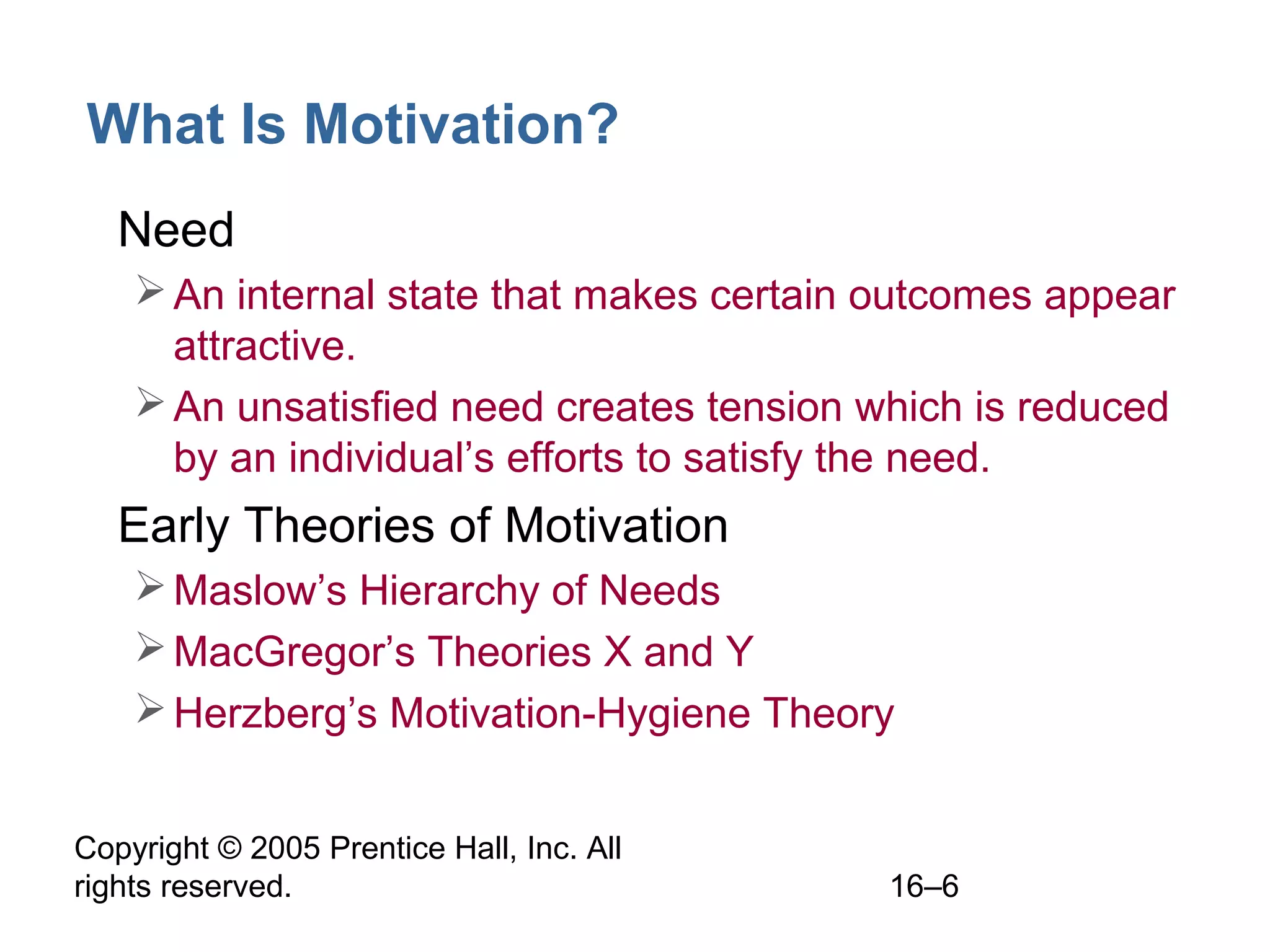
What Is Motivation?
• Need
An internal state that makes certain outcomes appear
attractive.
An unsatisfied need creates tension which is reduced
by an individual’s efforts to satisfy the need.
• Early Theories of Motivation
Maslow’s Hierarchy of Needs
MacGregor’s Theories X and Y
Herzberg’s Motivation-Hygiene Theory
Copyright © 2005 Prentice Hall, Inc. All
rights reserved. 16–7
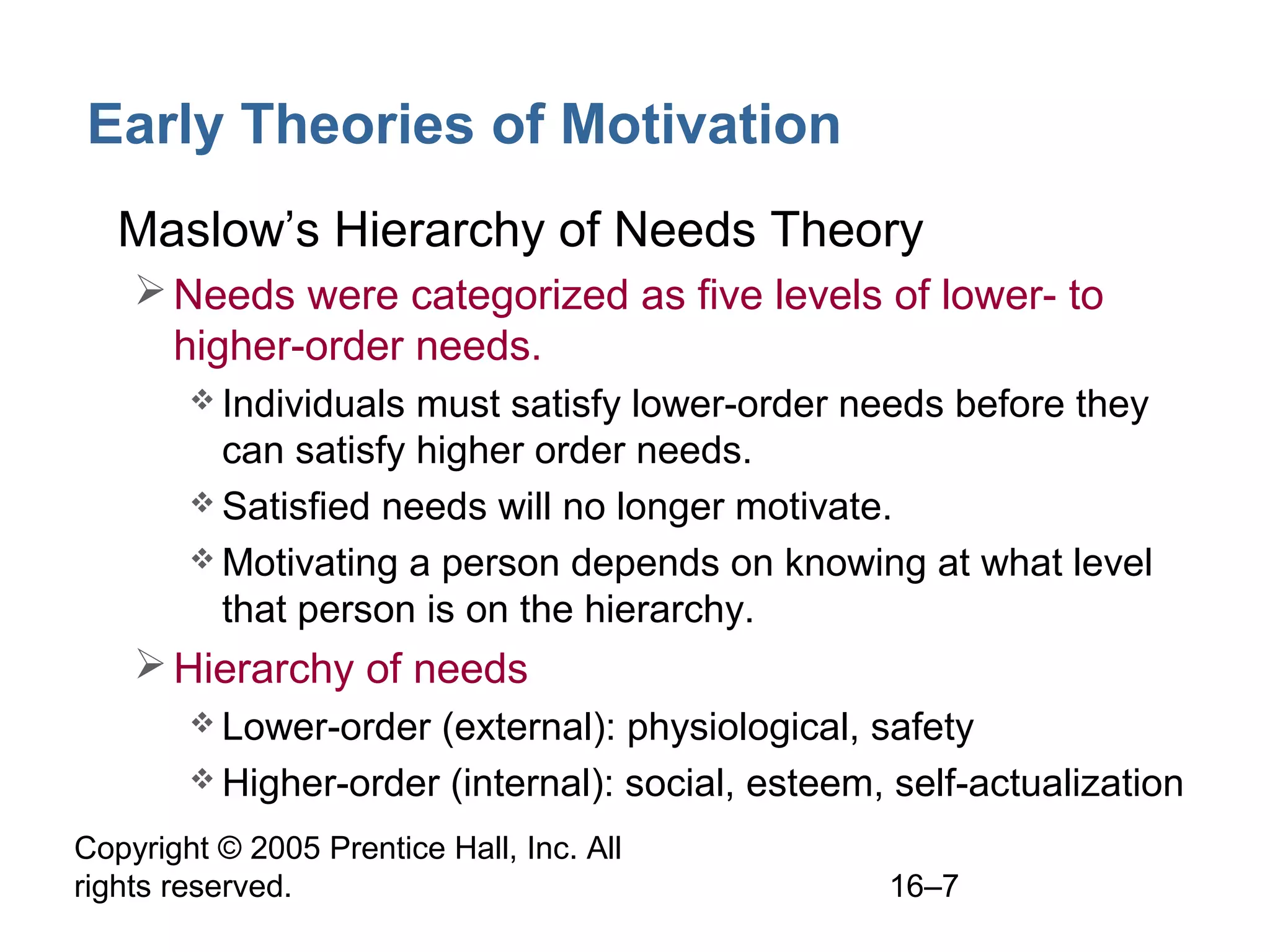
Early Theories of Motivation
• Maslow’s Hierarchy of Needs Theory
Needs were categorized as five levels of lower- to
higher-order needs.
 Individuals must satisfy lower-order needs before they
can satisfy higher order needs.
 Satisfied needs will no longer motivate.
 Motivating a person depends on knowing at what level
that person is on the hierarchy.
Hierarchy of needs
 Lower-order (external): physiological, safety
 Higher-order (internal): social, esteem, self-actualization
Copyright © 2005 Prentice Hall, Inc. All
rights reserved. 16–8
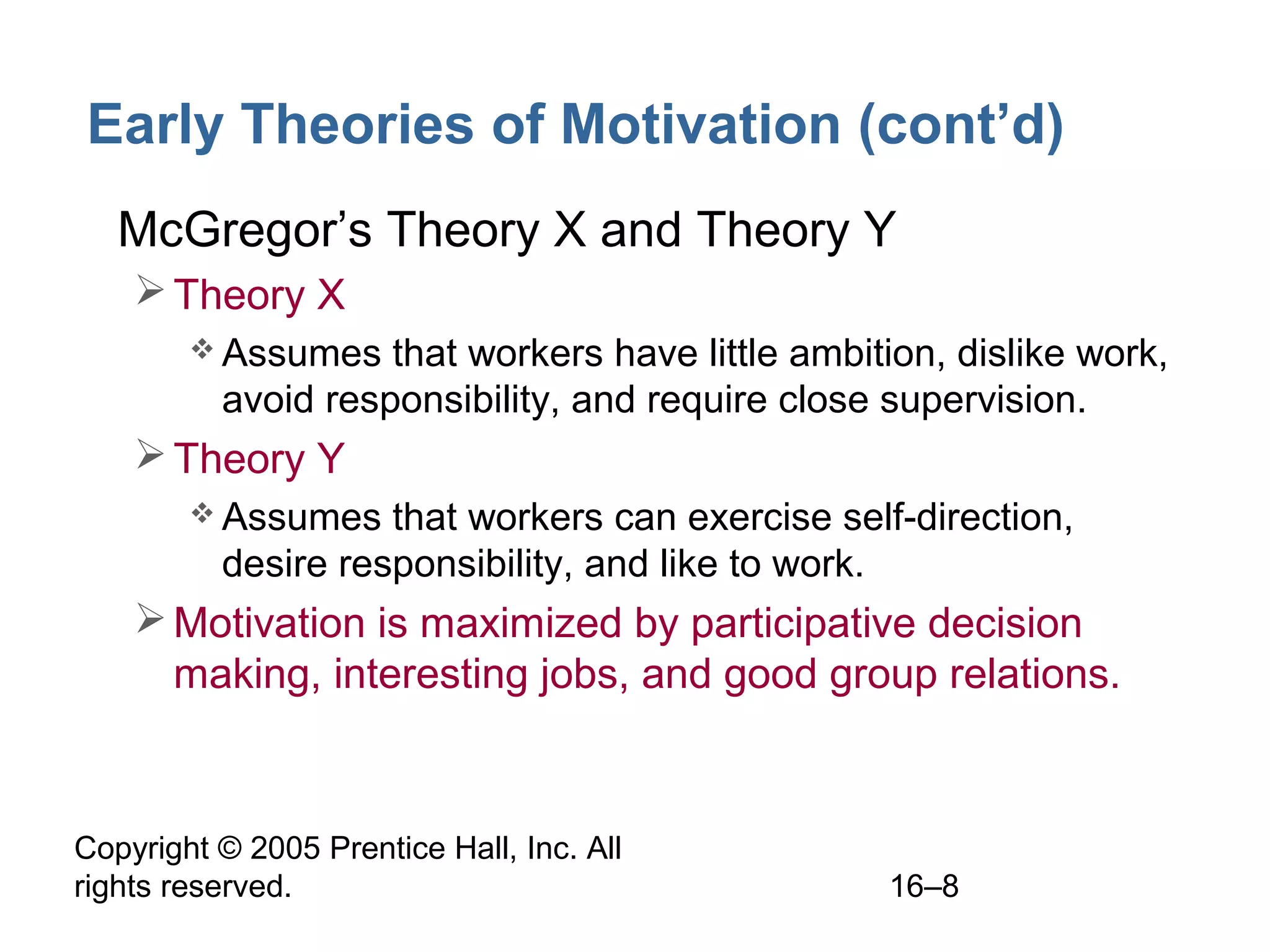
Early Theories of Motivation (cont’d)
• McGregor’s Theory X and Theory Y
Theory X
 Assumes that workers have little ambition, dislike work,
avoid responsibility, and require close supervision.
Theory Y
 Assumes that workers can exercise self-direction,
desire responsibility, and like to work.
Motivation is maximized by participative decision
making, interesting jobs, and good group relations.
Copyright © 2005 Prentice Hall, Inc. All
rights reserved. 16–9
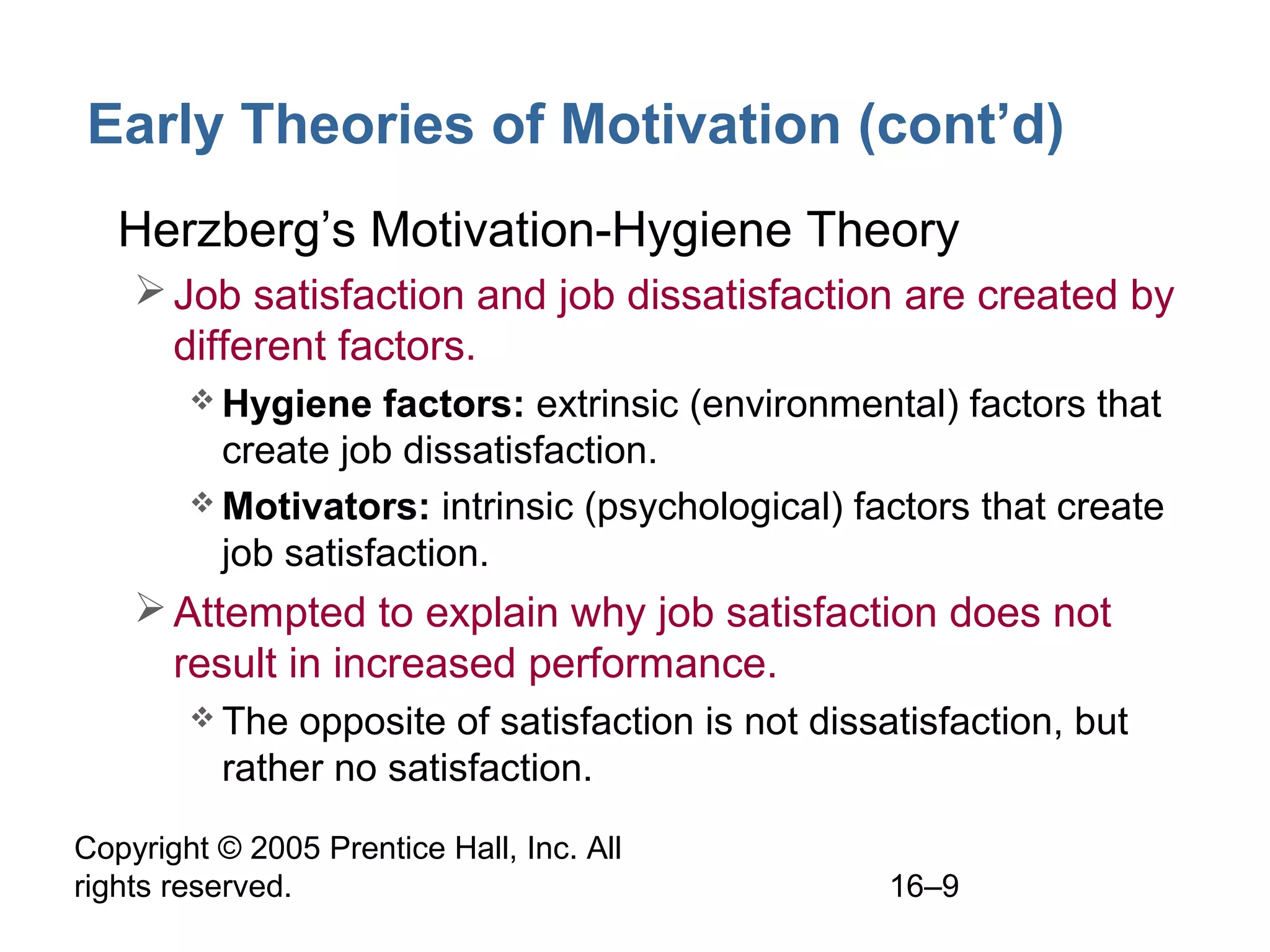
Early Theories of Motivation (cont’d)
• Herzberg’s Motivation-Hygiene Theory
Job satisfaction and job dissatisfaction are created by
different factors.
 Hygiene factors: extrinsic (environmental) factors that
create job dissatisfaction.
 Motivators: intrinsic (psychological) factors that create
job satisfaction.
Attempted to explain why job satisfaction does not
result in increased performance.
 The opposite of satisfaction is not dissatisfaction, but
rather no satisfaction.
Copyright © 2005 Prentice Hall, Inc. All
rights reserved. 16–10
Contemporary Theories of Motivation
• Three-Needs Theory
• Goal-Setting Theory
• Reinforcement Theory
• Designing Motivating Jobs
• Equity Theory
• Expectancy Theory
Copyright © 2005 Prentice Hall, Inc. All
rights reserved. 16–11
Motivation and Needs
• Three-Needs Theory
There are three major acquired needs that are major
motives in work.
Need for achievement (nAch)
 The drive to excel and succeed
Need for power (nPow)
 The need to influence the behavior of others
Need of affiliation (nAff)
 The desire for interpersonal relationships
Copyright © 2005 Prentice Hall, Inc. All
rights reserved. 16–12
Motivation and Goals
• Goal-Setting Theory
Proposes that setting goals that are accepted,
specific, and challenging yet achievable will result in
higher performance than having no or easy goals.
• Benefits of Participation in Goal-Setting
Increases the acceptance of goals.
Fosters commitment to difficult, public goals.
Provides for self-feedback (internal locus of control)
that guides behavior and motivates performance (self-
efficacy).
Copyright © 2005 Prentice Hall, Inc. All
rights reserved. 16–13
Motivation and Behavior
• Reinforcement Theory
Assumes that a desired behavior is a function of its
consequences, is externally caused, and if reinforced,
is likely to be repeated.
 Positive reinforcement is preferred for its long-term
effects on performance
 Ignoring undesired behavior is better than punishment
which may create additional dysfunctional behaviors.
Copyright © 2005 Prentice Hall, Inc. All
rights reserved. 16–14
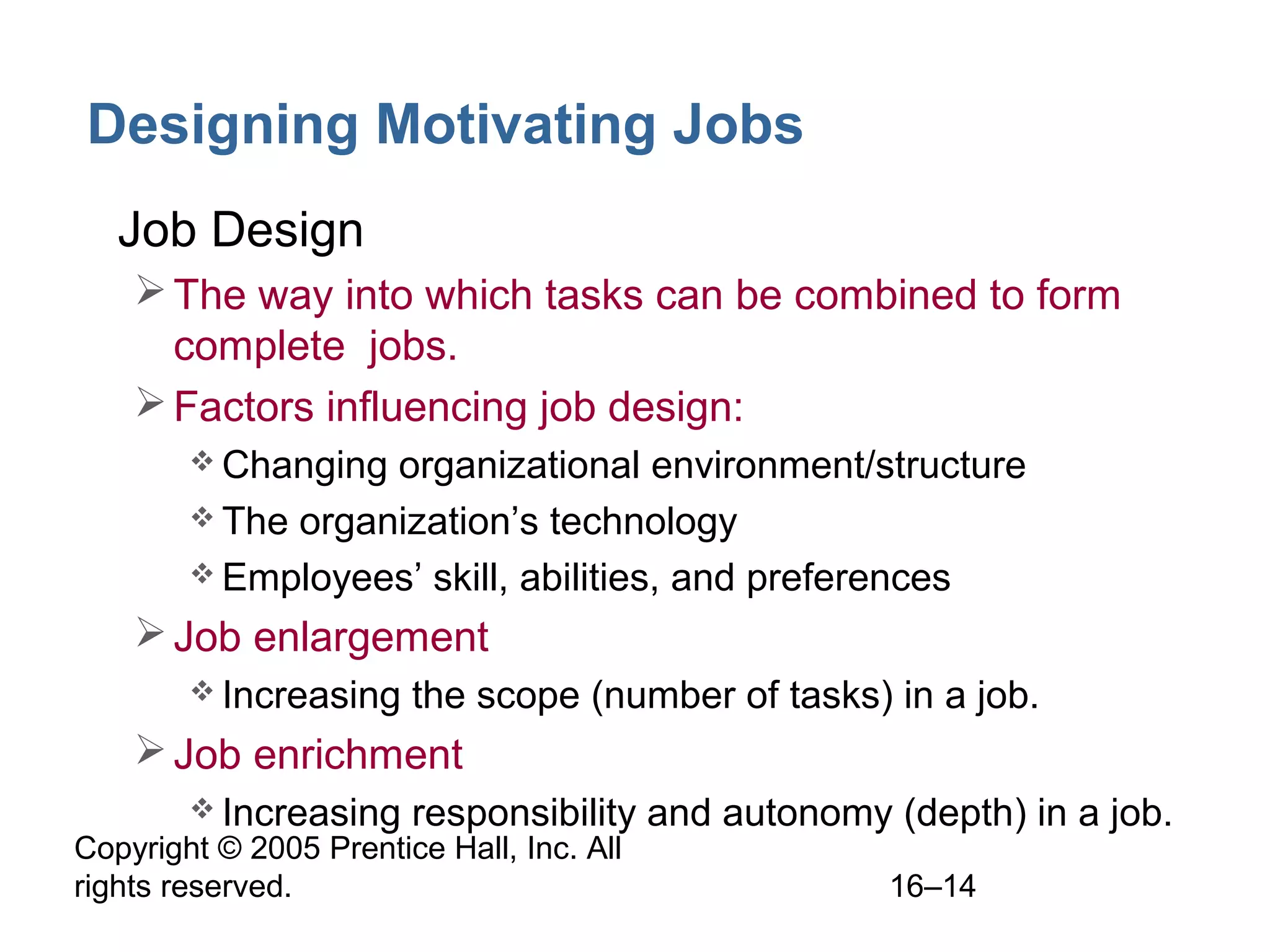
Designing Motivating Jobs
• Job Design
The way into which tasks can be combined to form
complete jobs.
Factors influencing job design:
 Changing organizational environment/structure
 The organization’s technology
 Employees’ skill, abilities, and preferences
Job enlargement
 Increasing the scope (number of tasks) in a job.
Job enrichment
 Increasing responsibility and autonomy (depth) in a job.
Copyright © 2005 Prentice Hall, Inc. All
rights reserved. 16–15
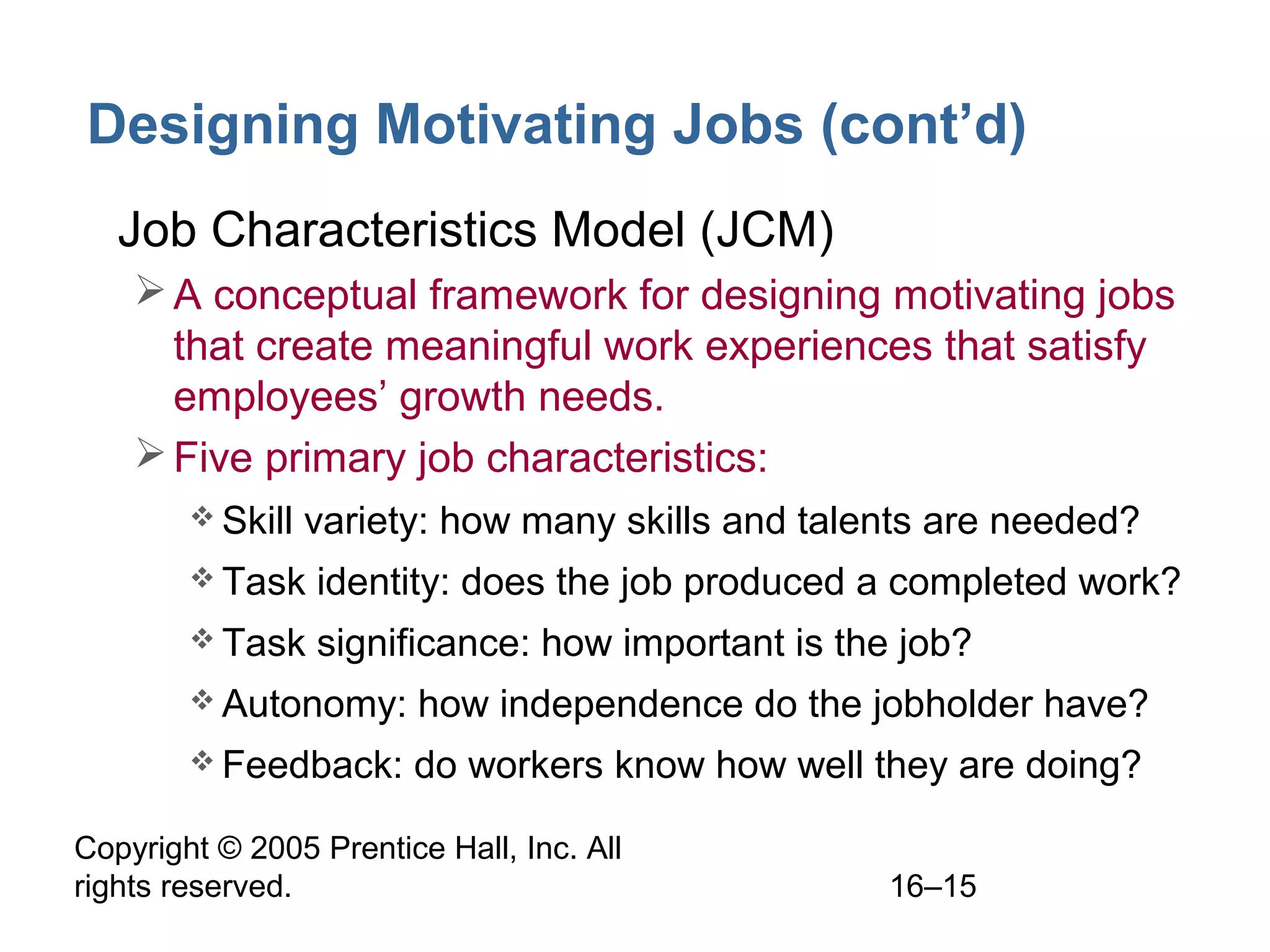
Designing Motivating Jobs (cont’d)
• Job Characteristics Model (JCM)
A conceptual framework for designing motivating jobs
that create meaningful work experiences that satisfy
employees’ growth needs.
Five primary job characteristics:
 Skill variety: how many skills and talents are needed?
 Task identity: does the job produced a completed work?
 Task significance: how important is the job?
 Autonomy: how independence do the jobholder have?
 Feedback: do workers know how well they are doing?
Copyright © 2005 Prentice Hall, Inc. All
rights reserved. 16–16
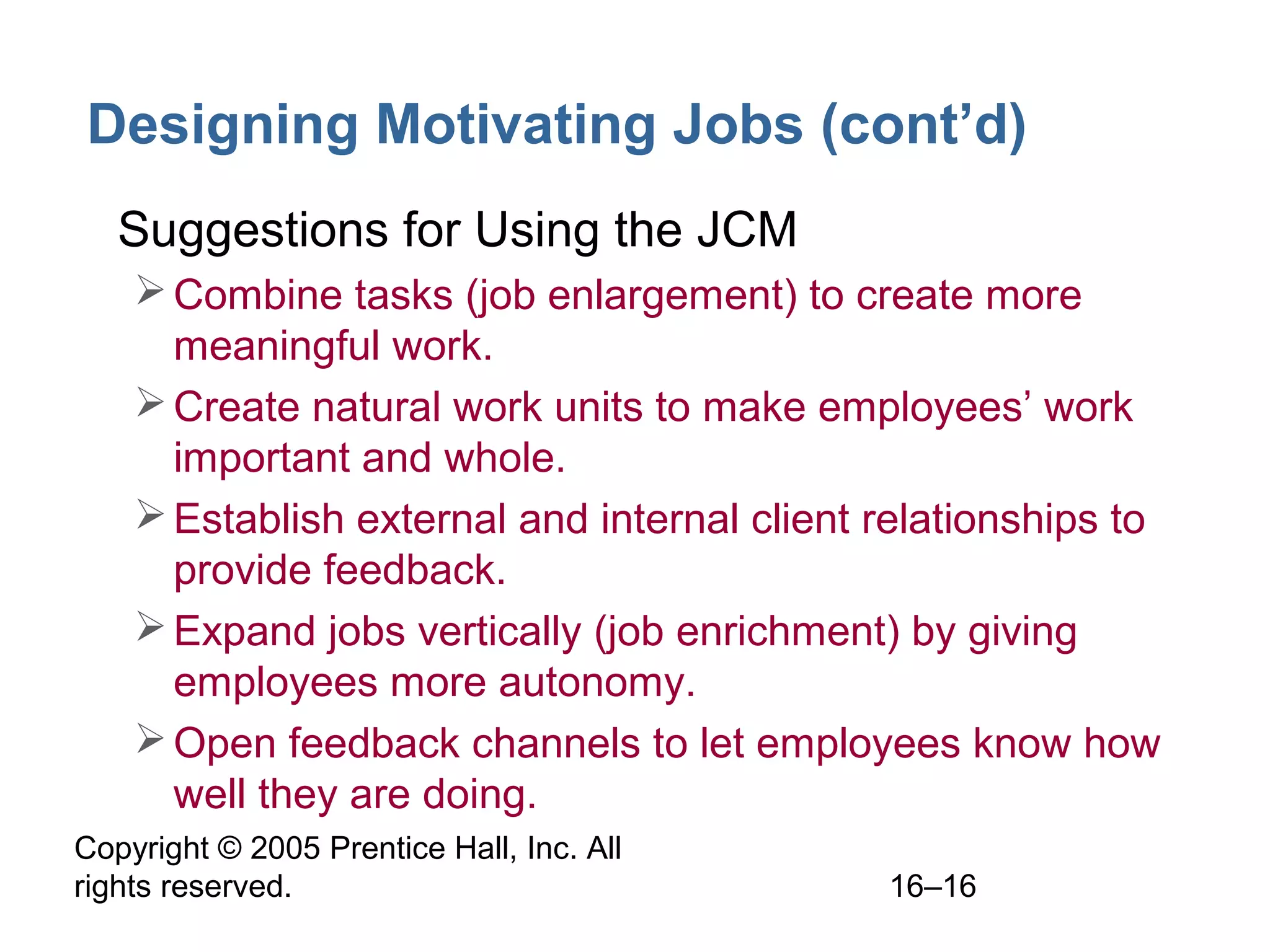
Designing Motivating Jobs (cont’d)
• Suggestions for Using the JCM
Combine tasks (job enlargement) to create more
meaningful work.
Create natural work units to make employees’ work
important and whole.
Establish external and internal client relationships to
provide feedback.
Expand jobs vertically (job enrichment) by giving
employees more autonomy.
Open feedback channels to let employees know how
well they are doing.
Copyright © 2005 Prentice Hall, Inc. All
rights reserved. 16–17
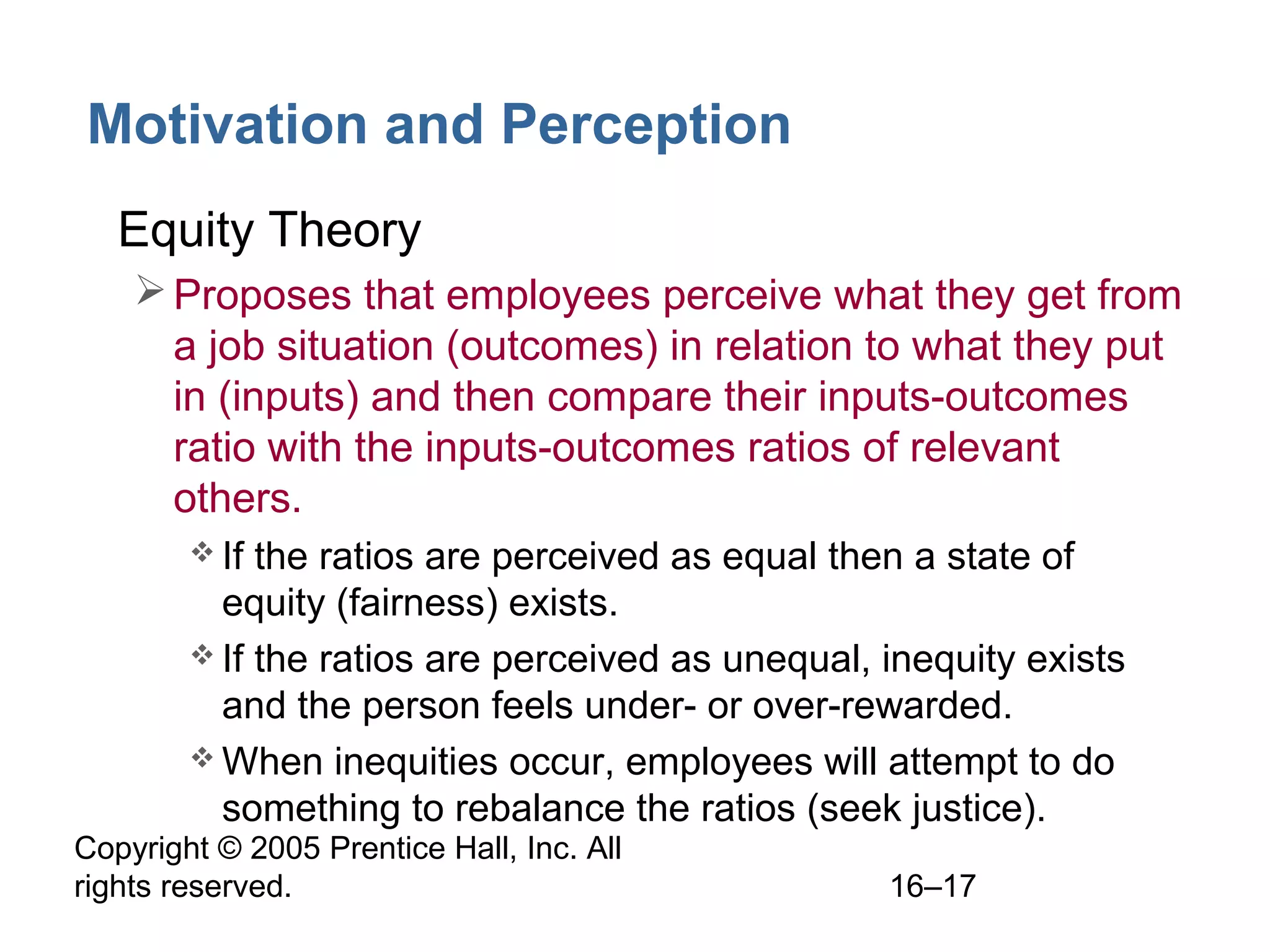
Motivation and Perception
• Equity Theory
Proposes that employees perceive what they get from
a job situation (outcomes) in relation to what they put
in (inputs) and then compare their inputs-outcomes
ratio with the inputs-outcomes ratios of relevant
others.
 If the ratios are perceived as equal then a state of
equity (fairness) exists.
 If the ratios are perceived as unequal, inequity exists
and the person feels under- or over-rewarded.
 When inequities occur, employees will attempt to do
something to rebalance the ratios (seek justice).
Copyright © 2005 Prentice Hall, Inc. All
rights reserved. 16–18
Motivation and Perception (cont’d)
• Equity Theory (cont’d)
Employee responses to perceived inequities:
 Distort own or others’ ratios.
 Induce others to change their own inputs or outcomes.
 Change own inputs (increase or decrease efforts) or
outcomes (seek greater rewards).
 Choose a different comparison (referent) other (person,
systems, or self).
 Quit their job.
Employees are concerned with both the absolute and
relative nature of organizational rewards.
Copyright © 2005 Prentice Hall, Inc. All
rights reserved. 16–19
Motivation and Perception (cont’d)
• Equity Theory (cont’d)
Distributive justice
 The perceived fairness of the amount and allocation of
rewards among individuals (i.e., who received what).
– Influences an employee’s satisfaction.
Distributive
 The perceived fairness of the process use to determine
the distribution of rewards (i.e., how who received
what).
– Affects an employee’s organizational commitment.
Copyright © 2005 Prentice Hall, Inc. All
rights reserved. 16–20
Motivation, Perception, and Behavior
• Expectancy Theory
States that an individual tends to act in a certain way
based on the expectation that the act will be followed
by a given outcome and on the attractiveness of that
outcome to the individual.
Key to the theory is understanding and managing
employee goals and the linkages among and between
effort, performance and rewards.
 Effort: employee abilities and training/development
 Performance: valid appraisal systems
 Rewards (goals): understanding employee needs
Copyright © 2005 Prentice Hall, Inc. All
rights reserved. 16–21
Motivation, Perception, and Behavior
(cont’d)
• Expectancy Relationships
Expectancy (effort-performance linkage)
 The perceived probability that an individual’s effort will
result in a certain level of performance.
Instrumentality
 The perception that a particular level of performance will
result in the attaining a desired outcome (reward).
Valence
 The attractiveness/importance of the performance
reward (outcome) to the individual.
Copyright © 2005 Prentice Hall, Inc. All
rights reserved. 16–22
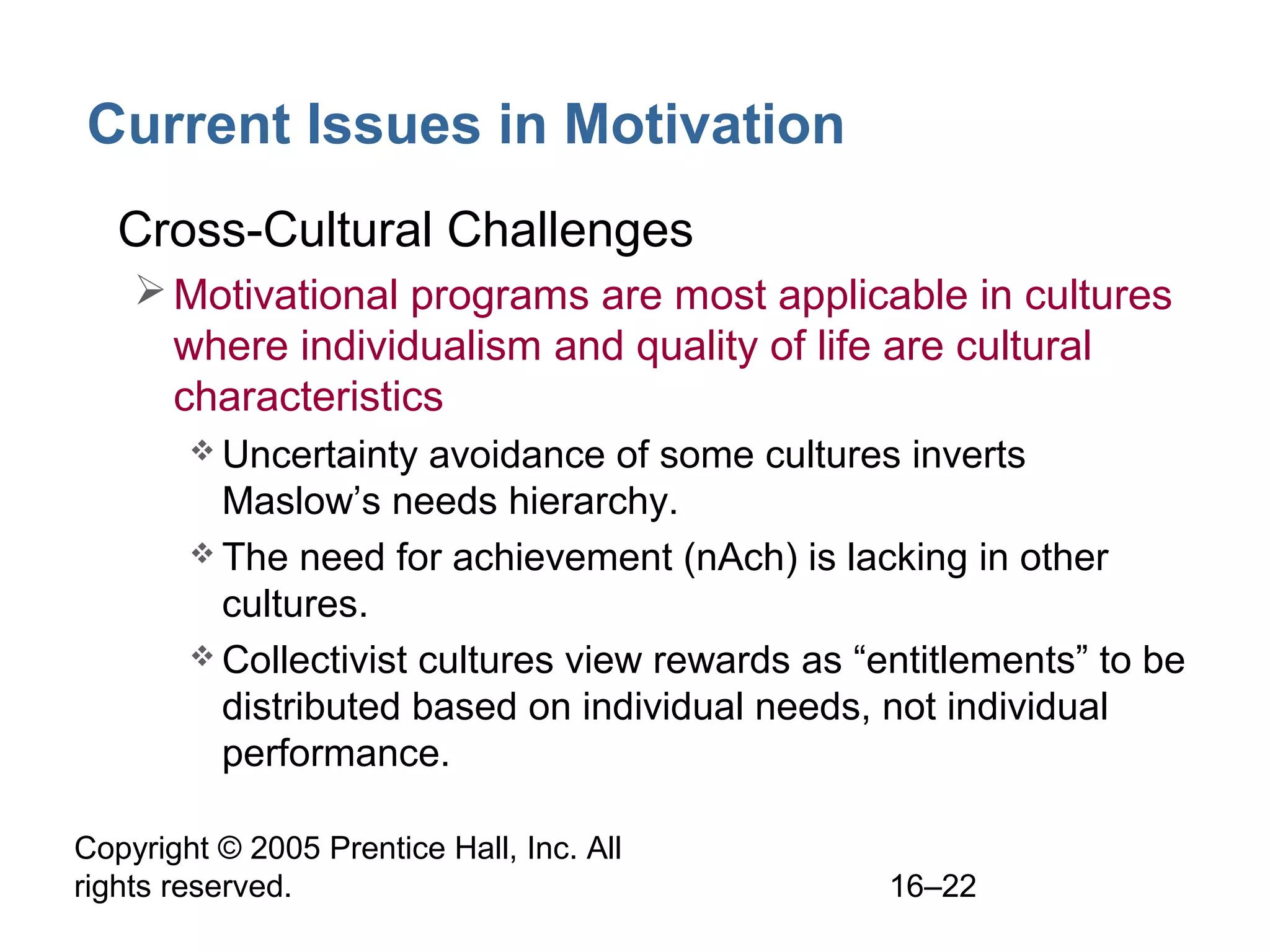
Current Issues in Motivation
• Cross-Cultural Challenges
Motivational programs are most applicable in cultures
where individualism and quality of life are cultural
characteristics
 Uncertainty avoidance of some cultures inverts
Maslow’s needs hierarchy.
 The need for achievement (nAch) is lacking in other
cultures.
 Collectivist cultures view rewards as “entitlements” to be
distributed based on individual needs, not individual
performance.
Copyright © 2005 Prentice Hall, Inc. All
rights reserved. 16–23
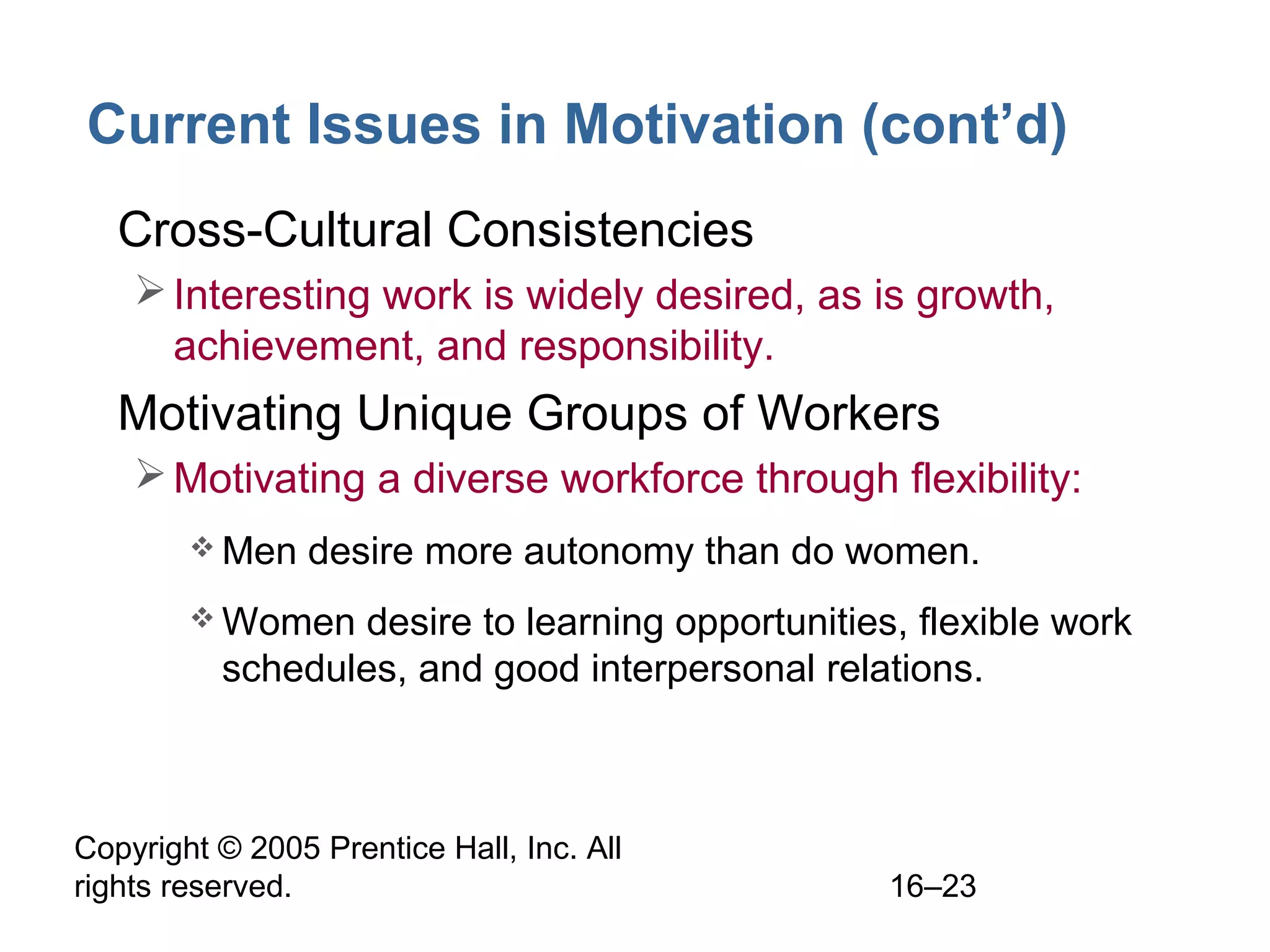
Current Issues in Motivation (cont’d)
• Cross-Cultural Consistencies
Interesting work is widely desired, as is growth,
achievement, and responsibility.
• Motivating Unique Groups of Workers
Motivating a diverse workforce through flexibility:
 Men desire more autonomy than do women.
 Women desire to learning opportunities, flexible work
schedules, and good interpersonal relations.
Copyright © 2005 Prentice Hall, Inc. All
rights reserved. 16–24
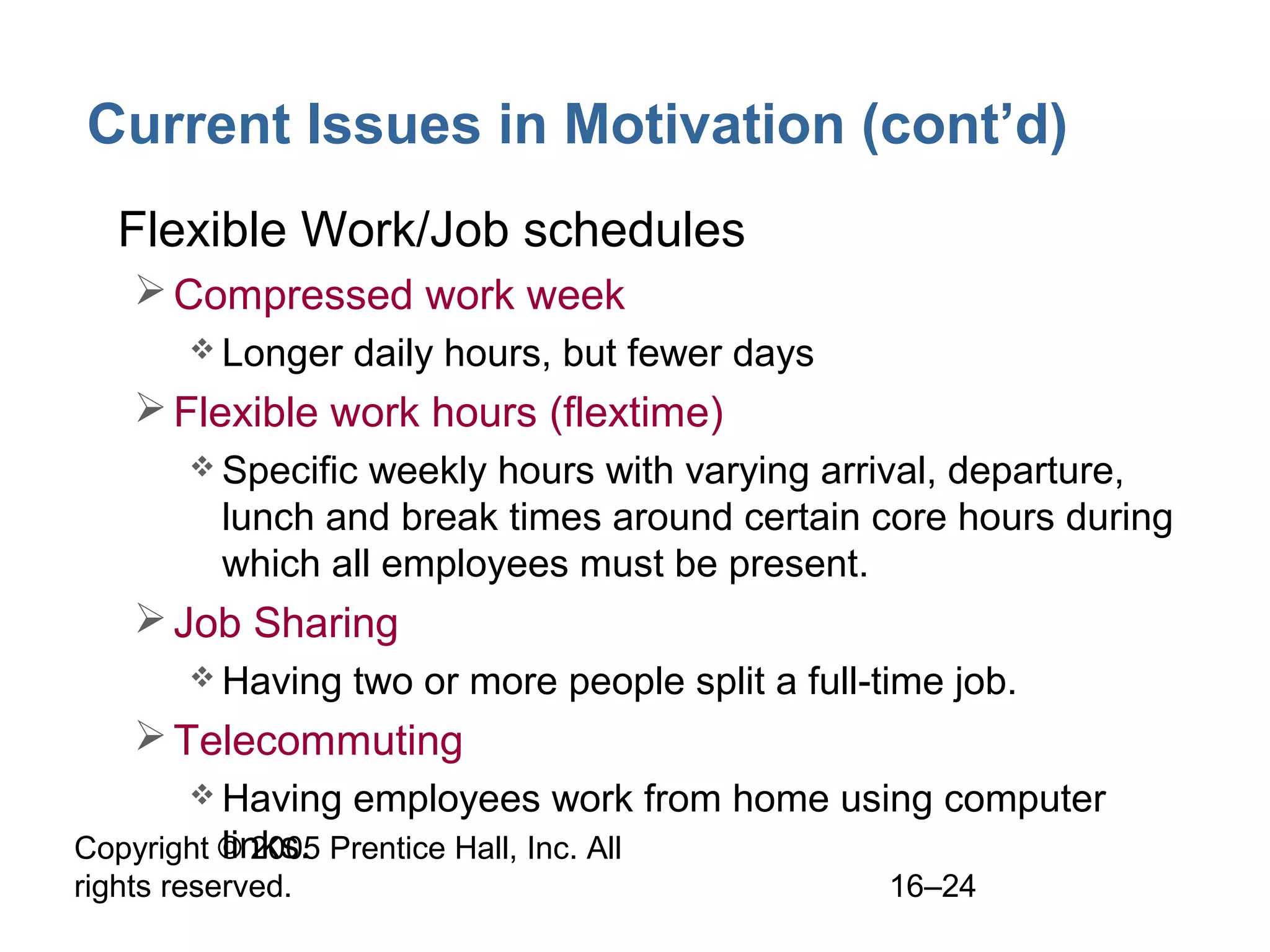
Current Issues in Motivation (cont’d)
• Flexible Work/Job schedules
Compressed work week
 Longer daily hours, but fewer days
Flexible work hours (flextime)
 Specific weekly hours with varying arrival, departure,
lunch and break times around certain core hours during
which all employees must be present.
Job Sharing
 Having two or more people split a full-time job.
Telecommuting
 Having employees work from home using computer
links.
Copyright © 2005 Prentice Hall, Inc. All
rights reserved. 16–25
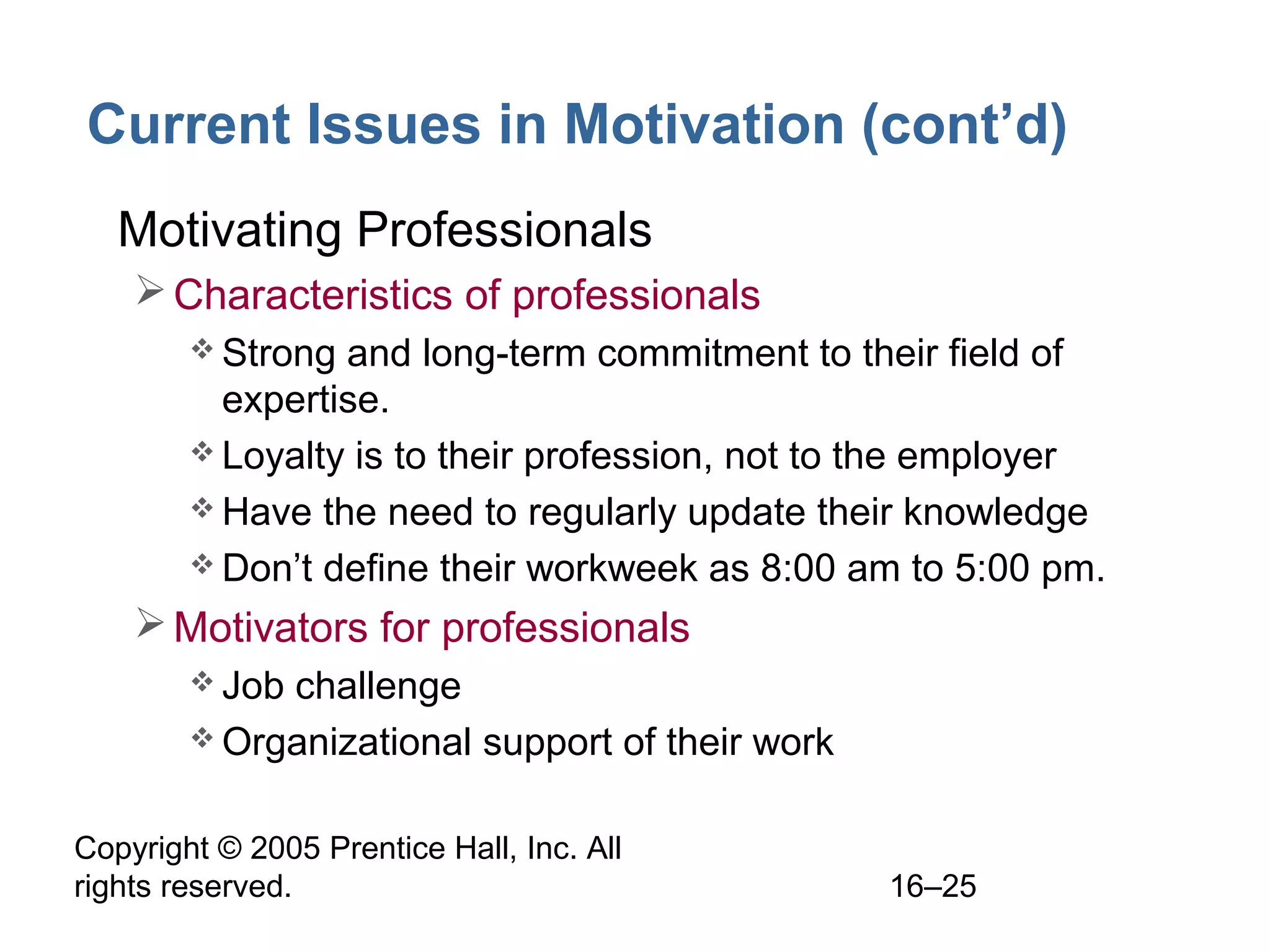
Current Issues in Motivation (cont’d)
• Motivating Professionals
Characteristics of professionals
 Strong and long-term commitment to their field of
expertise.
 Loyalty is to their profession, not to the employer
 Have the need to regularly update their knowledge
 Don’t define their workweek as 8:00 am to 5:00 pm.
Motivators for professionals
 Job challenge
 Organizational support of their work
Copyright © 2005 Prentice Hall, Inc. All
rights reserved. 16–26
Current Issues in Motivation (cont’d)
• Motivating Contingent Workers
Opportunity to become a permanent employee.
Opportunity for training
Equity in compensation and benefits
• Motivating Low-Skilled, Minimum-Wage
Employees
Employee recognition programs
Providing sincere praise
Copyright © 2005 Prentice Hall, Inc. All
rights reserved. 16–27
Current Issues in Motivation (cont’d)
• Designing Appropriate Rewards Programs
Open-book management
 Involving employees in workplace decision by opening
up the financial statements of the employer.
Employee recognition programs
 Giving personal attention and expressing interest,
approval, and appreciation for a job well done.
Pay-for-performance
 Variable compensation plans that reward employees on
the basis of their performance:
– Piece rates, wage incentives, profit-sharing, and lump-sum
bonuses
Copyright © 2005 Prentice Hall, Inc. All
rights reserved. 16–28
Current Issues in Motivation (cont’d)
• Designing Appropriate Rewards Programs
(cont’d)
Stock option programs
 Using financial instruments (in lieu of monetary
compensation) that give employees the right to
purchase shares of company stock at a set (option)
price.
 Options have value if the stock price rises above the set
price; they are worthless if the stock price falls below
the option price.
Copyright © 2005 Prentice Hall, Inc. All
rights reserved. 16–29
From Theory to Practice:
Guidelines for Motivating Employees
• Recognize individual
differences
• Match people to jobs
• Use goals
• Ensure that goals are
perceived as attainable
• Individualize rewards
• Link rewards to
performance
• Check the system for
equity
• Use recognition
• Don’t ignore money

Management ch16

  • 1.
    PowerPoint Presentation byCharlie CookPowerPoint Presentation by Charlie Cook Copyright © 2005 Prentice Hall, Inc.Copyright © 2005 Prentice Hall, Inc. All rights reserved.All rights reserved. 8th edition Steven P. Robbins Mary Coulter
  • 2.
    Copyright © 2005Prentice Hall, Inc. All rights reserved. 16–2 L E A R N I N G O U T L I N E Follow this Learning Outline as you read and study this chapter. What Is Motivation? • Define motivation. • Explain motivation as a need-satisfying process. Early Theories of Motivation • Describe the five levels in Maslow’s hierarchy and how Maslow’s hierarchy can be used in motivational efforts. • Discuss how Theory X and Theory Y managers approach motivation. • Describe Herzberg’s motivation-hygiene theory. • Explain Herzberg’s views of satisfaction and dissatisfaction.
  • 3.
    Copyright © 2005Prentice Hall, Inc. All rights reserved. 16–3 L E A R N I N G O U T L I N E (cont’d) Follow this Learning Outline as you read and study this chapter. Contemporary Theories of Motivation • Describe the three needs McClelland proposed as being present in work settings. • Explain how goal-setting and reinforcement theories explain employee motivation. • Describe the job characteristics model as a way to design motivating jobs. • Discuss the motivation implications of equity theory. • Contrast distributive and procedural justice. • Explain the three key linkages in expectancy theory and their role in motivation.
  • 4.
    Copyright © 2005Prentice Hall, Inc. All rights reserved. 16–4 L E A R N I N G O U T L I N E (cont’d) Follow this Learning Outline as you read and study this chapter. Current Issues in Motivation • Describe the cross-cultural challenges of motivation. • Discuss the challenges managers face in motivating unique groups of workers. • Describe open-book management and employee recognition, pay-for-performance, and stock option programs.
  • 5.
    Copyright © 2005Prentice Hall, Inc. All rights reserved. 16–5 What Is Motivation? • Motivation The processes that account for an individual’s willingness to exert high levels of effort to reach organizational goals, conditioned by the effort’s ability to satisfy some individual need.  Effort: a measure of intensity or drive.  Direction: toward organizational goals  Need: personalized reason to exert effort Motivation works best when individual needs are compatible with organizational goals.
  • 6.
    Copyright © 2005Prentice Hall, Inc. All rights reserved. 16–6 What Is Motivation? • Need An internal state that makes certain outcomes appear attractive. An unsatisfied need creates tension which is reduced by an individual’s efforts to satisfy the need. • Early Theories of Motivation Maslow’s Hierarchy of Needs MacGregor’s Theories X and Y Herzberg’s Motivation-Hygiene Theory
  • 7.
    Copyright © 2005Prentice Hall, Inc. All rights reserved. 16–7 Early Theories of Motivation • Maslow’s Hierarchy of Needs Theory Needs were categorized as five levels of lower- to higher-order needs.  Individuals must satisfy lower-order needs before they can satisfy higher order needs.  Satisfied needs will no longer motivate.  Motivating a person depends on knowing at what level that person is on the hierarchy. Hierarchy of needs  Lower-order (external): physiological, safety  Higher-order (internal): social, esteem, self-actualization
  • 8.
    Copyright © 2005Prentice Hall, Inc. All rights reserved. 16–8 Early Theories of Motivation (cont’d) • McGregor’s Theory X and Theory Y Theory X  Assumes that workers have little ambition, dislike work, avoid responsibility, and require close supervision. Theory Y  Assumes that workers can exercise self-direction, desire responsibility, and like to work. Motivation is maximized by participative decision making, interesting jobs, and good group relations.
  • 9.
    Copyright © 2005Prentice Hall, Inc. All rights reserved. 16–9 Early Theories of Motivation (cont’d) • Herzberg’s Motivation-Hygiene Theory Job satisfaction and job dissatisfaction are created by different factors.  Hygiene factors: extrinsic (environmental) factors that create job dissatisfaction.  Motivators: intrinsic (psychological) factors that create job satisfaction. Attempted to explain why job satisfaction does not result in increased performance.  The opposite of satisfaction is not dissatisfaction, but rather no satisfaction.
  • 10.
    Copyright © 2005Prentice Hall, Inc. All rights reserved. 16–10 Contemporary Theories of Motivation • Three-Needs Theory • Goal-Setting Theory • Reinforcement Theory • Designing Motivating Jobs • Equity Theory • Expectancy Theory
  • 11.
    Copyright © 2005Prentice Hall, Inc. All rights reserved. 16–11 Motivation and Needs • Three-Needs Theory There are three major acquired needs that are major motives in work. Need for achievement (nAch)  The drive to excel and succeed Need for power (nPow)  The need to influence the behavior of others Need of affiliation (nAff)  The desire for interpersonal relationships
  • 12.
    Copyright © 2005Prentice Hall, Inc. All rights reserved. 16–12 Motivation and Goals • Goal-Setting Theory Proposes that setting goals that are accepted, specific, and challenging yet achievable will result in higher performance than having no or easy goals. • Benefits of Participation in Goal-Setting Increases the acceptance of goals. Fosters commitment to difficult, public goals. Provides for self-feedback (internal locus of control) that guides behavior and motivates performance (self- efficacy).
  • 13.
    Copyright © 2005Prentice Hall, Inc. All rights reserved. 16–13 Motivation and Behavior • Reinforcement Theory Assumes that a desired behavior is a function of its consequences, is externally caused, and if reinforced, is likely to be repeated.  Positive reinforcement is preferred for its long-term effects on performance  Ignoring undesired behavior is better than punishment which may create additional dysfunctional behaviors.
  • 14.
    Copyright © 2005Prentice Hall, Inc. All rights reserved. 16–14 Designing Motivating Jobs • Job Design The way into which tasks can be combined to form complete jobs. Factors influencing job design:  Changing organizational environment/structure  The organization’s technology  Employees’ skill, abilities, and preferences Job enlargement  Increasing the scope (number of tasks) in a job. Job enrichment  Increasing responsibility and autonomy (depth) in a job.
  • 15.
    Copyright © 2005Prentice Hall, Inc. All rights reserved. 16–15 Designing Motivating Jobs (cont’d) • Job Characteristics Model (JCM) A conceptual framework for designing motivating jobs that create meaningful work experiences that satisfy employees’ growth needs. Five primary job characteristics:  Skill variety: how many skills and talents are needed?  Task identity: does the job produced a completed work?  Task significance: how important is the job?  Autonomy: how independence do the jobholder have?  Feedback: do workers know how well they are doing?
  • 16.
    Copyright © 2005Prentice Hall, Inc. All rights reserved. 16–16 Designing Motivating Jobs (cont’d) • Suggestions for Using the JCM Combine tasks (job enlargement) to create more meaningful work. Create natural work units to make employees’ work important and whole. Establish external and internal client relationships to provide feedback. Expand jobs vertically (job enrichment) by giving employees more autonomy. Open feedback channels to let employees know how well they are doing.
  • 17.
    Copyright © 2005Prentice Hall, Inc. All rights reserved. 16–17 Motivation and Perception • Equity Theory Proposes that employees perceive what they get from a job situation (outcomes) in relation to what they put in (inputs) and then compare their inputs-outcomes ratio with the inputs-outcomes ratios of relevant others.  If the ratios are perceived as equal then a state of equity (fairness) exists.  If the ratios are perceived as unequal, inequity exists and the person feels under- or over-rewarded.  When inequities occur, employees will attempt to do something to rebalance the ratios (seek justice).
  • 18.
    Copyright © 2005Prentice Hall, Inc. All rights reserved. 16–18 Motivation and Perception (cont’d) • Equity Theory (cont’d) Employee responses to perceived inequities:  Distort own or others’ ratios.  Induce others to change their own inputs or outcomes.  Change own inputs (increase or decrease efforts) or outcomes (seek greater rewards).  Choose a different comparison (referent) other (person, systems, or self).  Quit their job. Employees are concerned with both the absolute and relative nature of organizational rewards.
  • 19.
    Copyright © 2005Prentice Hall, Inc. All rights reserved. 16–19 Motivation and Perception (cont’d) • Equity Theory (cont’d) Distributive justice  The perceived fairness of the amount and allocation of rewards among individuals (i.e., who received what). – Influences an employee’s satisfaction. Distributive  The perceived fairness of the process use to determine the distribution of rewards (i.e., how who received what). – Affects an employee’s organizational commitment.
  • 20.
    Copyright © 2005Prentice Hall, Inc. All rights reserved. 16–20 Motivation, Perception, and Behavior • Expectancy Theory States that an individual tends to act in a certain way based on the expectation that the act will be followed by a given outcome and on the attractiveness of that outcome to the individual. Key to the theory is understanding and managing employee goals and the linkages among and between effort, performance and rewards.  Effort: employee abilities and training/development  Performance: valid appraisal systems  Rewards (goals): understanding employee needs
  • 21.
    Copyright © 2005Prentice Hall, Inc. All rights reserved. 16–21 Motivation, Perception, and Behavior (cont’d) • Expectancy Relationships Expectancy (effort-performance linkage)  The perceived probability that an individual’s effort will result in a certain level of performance. Instrumentality  The perception that a particular level of performance will result in the attaining a desired outcome (reward). Valence  The attractiveness/importance of the performance reward (outcome) to the individual.
  • 22.
    Copyright © 2005Prentice Hall, Inc. All rights reserved. 16–22 Current Issues in Motivation • Cross-Cultural Challenges Motivational programs are most applicable in cultures where individualism and quality of life are cultural characteristics  Uncertainty avoidance of some cultures inverts Maslow’s needs hierarchy.  The need for achievement (nAch) is lacking in other cultures.  Collectivist cultures view rewards as “entitlements” to be distributed based on individual needs, not individual performance.
  • 23.
    Copyright © 2005Prentice Hall, Inc. All rights reserved. 16–23 Current Issues in Motivation (cont’d) • Cross-Cultural Consistencies Interesting work is widely desired, as is growth, achievement, and responsibility. • Motivating Unique Groups of Workers Motivating a diverse workforce through flexibility:  Men desire more autonomy than do women.  Women desire to learning opportunities, flexible work schedules, and good interpersonal relations.
  • 24.
    Copyright © 2005Prentice Hall, Inc. All rights reserved. 16–24 Current Issues in Motivation (cont’d) • Flexible Work/Job schedules Compressed work week  Longer daily hours, but fewer days Flexible work hours (flextime)  Specific weekly hours with varying arrival, departure, lunch and break times around certain core hours during which all employees must be present. Job Sharing  Having two or more people split a full-time job. Telecommuting  Having employees work from home using computer links.
  • 25.
    Copyright © 2005Prentice Hall, Inc. All rights reserved. 16–25 Current Issues in Motivation (cont’d) • Motivating Professionals Characteristics of professionals  Strong and long-term commitment to their field of expertise.  Loyalty is to their profession, not to the employer  Have the need to regularly update their knowledge  Don’t define their workweek as 8:00 am to 5:00 pm. Motivators for professionals  Job challenge  Organizational support of their work
  • 26.
    Copyright © 2005Prentice Hall, Inc. All rights reserved. 16–26 Current Issues in Motivation (cont’d) • Motivating Contingent Workers Opportunity to become a permanent employee. Opportunity for training Equity in compensation and benefits • Motivating Low-Skilled, Minimum-Wage Employees Employee recognition programs Providing sincere praise
  • 27.
    Copyright © 2005Prentice Hall, Inc. All rights reserved. 16–27 Current Issues in Motivation (cont’d) • Designing Appropriate Rewards Programs Open-book management  Involving employees in workplace decision by opening up the financial statements of the employer. Employee recognition programs  Giving personal attention and expressing interest, approval, and appreciation for a job well done. Pay-for-performance  Variable compensation plans that reward employees on the basis of their performance: – Piece rates, wage incentives, profit-sharing, and lump-sum bonuses
  • 28.
    Copyright © 2005Prentice Hall, Inc. All rights reserved. 16–28 Current Issues in Motivation (cont’d) • Designing Appropriate Rewards Programs (cont’d) Stock option programs  Using financial instruments (in lieu of monetary compensation) that give employees the right to purchase shares of company stock at a set (option) price.  Options have value if the stock price rises above the set price; they are worthless if the stock price falls below the option price.
  • 29.
    Copyright © 2005Prentice Hall, Inc. All rights reserved. 16–29 From Theory to Practice: Guidelines for Motivating Employees • Recognize individual differences • Match people to jobs • Use goals • Ensure that goals are perceived as attainable • Individualize rewards • Link rewards to performance • Check the system for equity • Use recognition • Don’t ignore money