THE Three Step Process FOR BUSINESS WRITING
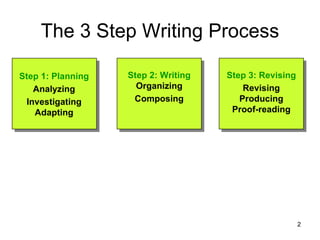
The 3 Step Writing Process Step 1: Planning Analyzing Investigating Adapting Step 2: Writing Organizing Composing Step 3: Revising Revising Producing Proof-reading
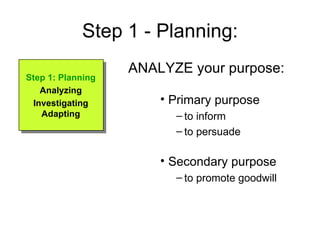
Step 1 - Planning: ANALYZE your purpose:  Primary purpose to inform to persuade Secondary purpose to promote goodwill Step 1: Planning Analyzing Investigating Adapting
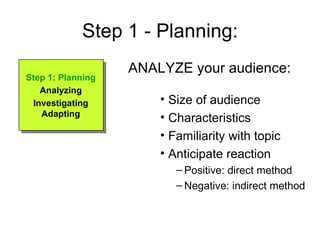
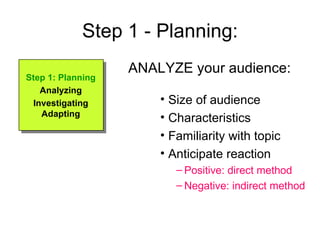
Step 1 - Planning: ANALYZE your audience:  Size of audience Characteristics Familiarity with topic Anticipate reaction  Positive: direct method  Negative: indirect method Step 1: Planning Analyzing Investigating Adapting
Step 1 - Planning: INVESTIGATE needs:  Decide what audience needs to know Gather all relevant information Step 1: Planning Analyzing Investigating Adapting
Step 1 - Planning: ADAPT to your audience:  Appropriate channel Vocabulary Tone Step 1: Planning Analyzing Investigating Adapting
Class Activity: As the manager of a successful local restaurant, you have been asked to speak to a group of college students on Career Day.
Activity Continued Complete Step 1 – Planning Process: 1. Analyze your purpose (inform, persuade, goodwill) 2. Analyze your audience, including characteristics, familiarity with topic, and probable reaction 3. Determine what the audience’s needs are, and what information you should gather 4. Decide how you will adapt your message to the audience
Step 1 - Planning: ADAPT to your audience:  Appropriate channel Vocabulary Tone Step 1: Planning Analyzing Investigating Adapting
Selecting a Channel The channel is the manner in which the message is sent. EXAMPLES: conversation letter speech fax lecture email phone call report web site brochure
Selecting a Channel SOME FACTORS: Who is the audience How important is the message How formal is the situation Is speed important Is feedback required Is a permanent record required Are there legal requirements What are the costs involved
Choosing Appropriate Channels: What channel is best to announce decreased benefits coverage for 250 employees? E-mail,   memo, speech What channel is best for a sales message  promoting a new product to customers? Letter, brochure, web site, meeting (press conference), conversation, sales call What channel is best for responding to routine customer inquiries? Web, form letter, e-mail, telephone
Step 1 - Planning: ANALYZE your audience:  Size of audience Characteristics Familiarity with topic Anticipate reaction   Positive: direct method  Negative: indirect method Step 1: Planning Analyzing Investigating Adapting
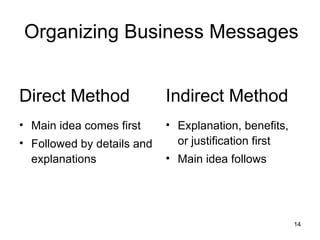
Organizing Business Messages Direct Method Main idea comes first Followed by details and explanations Indirect Method Explanation, benefits, or justification first Main idea follows
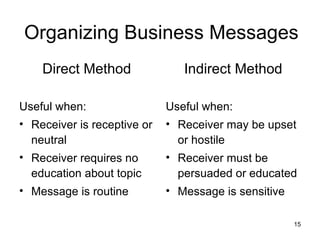
Organizing Business Messages Direct Method Useful when: Receiver is receptive or neutral Receiver requires no education about topic Message is routine Indirect Method Useful when: Receiver may be upset or hostile Receiver must be persuaded or educated Message is sensitive
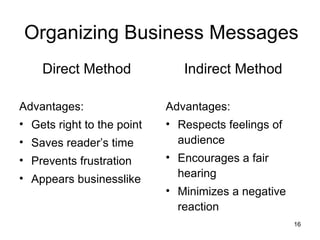
Organizing Business Messages Direct Method Advantages: Gets right to the point  Saves reader’s time Prevents frustration Appears businesslike Indirect Method Advantages: Respects feelings of audience Encourages a fair hearing Minimizes a negative reaction
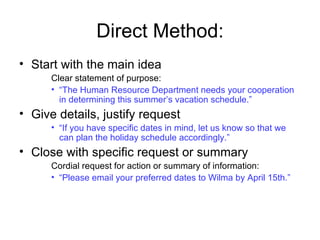
Direct Method: Start with the main idea Clear statement of purpose: “ The Human Resource Department needs your cooperation in determining this summer’s vacation schedule.”   Give details, justify request “ If you have specific dates in mind, let us know so that we can plan the holiday schedule accordingly.” Close with specific request or summary Cordial request for action or summary of information: “ Please email your preferred dates to Wilma by April 15th.”

3 step process

  • 1.
    THE Three StepProcess FOR BUSINESS WRITING
  • 2.
    The 3 StepWriting Process Step 1: Planning Analyzing Investigating Adapting Step 2: Writing Organizing Composing Step 3: Revising Revising Producing Proof-reading
  • 3.
    Step 1 -Planning: ANALYZE your purpose: Primary purpose to inform to persuade Secondary purpose to promote goodwill Step 1: Planning Analyzing Investigating Adapting
  • 4.
    Step 1 -Planning: ANALYZE your audience: Size of audience Characteristics Familiarity with topic Anticipate reaction Positive: direct method Negative: indirect method Step 1: Planning Analyzing Investigating Adapting
  • 5.
    Step 1 -Planning: INVESTIGATE needs: Decide what audience needs to know Gather all relevant information Step 1: Planning Analyzing Investigating Adapting
  • 6.
    Step 1 -Planning: ADAPT to your audience: Appropriate channel Vocabulary Tone Step 1: Planning Analyzing Investigating Adapting
  • 7.
    Class Activity: Asthe manager of a successful local restaurant, you have been asked to speak to a group of college students on Career Day.
  • 8.
    Activity Continued CompleteStep 1 – Planning Process: 1. Analyze your purpose (inform, persuade, goodwill) 2. Analyze your audience, including characteristics, familiarity with topic, and probable reaction 3. Determine what the audience’s needs are, and what information you should gather 4. Decide how you will adapt your message to the audience
  • 9.
    Step 1 -Planning: ADAPT to your audience: Appropriate channel Vocabulary Tone Step 1: Planning Analyzing Investigating Adapting
  • 10.
    Selecting a ChannelThe channel is the manner in which the message is sent. EXAMPLES: conversation letter speech fax lecture email phone call report web site brochure
  • 11.
    Selecting a ChannelSOME FACTORS: Who is the audience How important is the message How formal is the situation Is speed important Is feedback required Is a permanent record required Are there legal requirements What are the costs involved
  • 12.
    Choosing Appropriate Channels:What channel is best to announce decreased benefits coverage for 250 employees? E-mail, memo, speech What channel is best for a sales message promoting a new product to customers? Letter, brochure, web site, meeting (press conference), conversation, sales call What channel is best for responding to routine customer inquiries? Web, form letter, e-mail, telephone
  • 13.
    Step 1 -Planning: ANALYZE your audience: Size of audience Characteristics Familiarity with topic Anticipate reaction Positive: direct method Negative: indirect method Step 1: Planning Analyzing Investigating Adapting
  • 14.
    Organizing Business MessagesDirect Method Main idea comes first Followed by details and explanations Indirect Method Explanation, benefits, or justification first Main idea follows
  • 15.
    Organizing Business MessagesDirect Method Useful when: Receiver is receptive or neutral Receiver requires no education about topic Message is routine Indirect Method Useful when: Receiver may be upset or hostile Receiver must be persuaded or educated Message is sensitive
  • 16.
    Organizing Business MessagesDirect Method Advantages: Gets right to the point Saves reader’s time Prevents frustration Appears businesslike Indirect Method Advantages: Respects feelings of audience Encourages a fair hearing Minimizes a negative reaction
  • 17.
    Direct Method: Startwith the main idea Clear statement of purpose: “ The Human Resource Department needs your cooperation in determining this summer’s vacation schedule.” Give details, justify request “ If you have specific dates in mind, let us know so that we can plan the holiday schedule accordingly.” Close with specific request or summary Cordial request for action or summary of information: “ Please email your preferred dates to Wilma by April 15th.”