Welcome
Sponsored by:- DEBAT ISLAM VS KRISTIAN http://www. debatagung .com
Good Business Writing Skills presented by  Malathy Thiagarajah Organized by NET BALI SDN BHD
Good Communication is the lifeblood of successful organisations
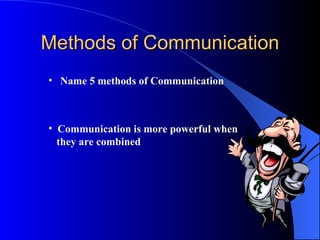
Methods of Communication Name 5 methods of Communication Communication is more powerful when they are combined
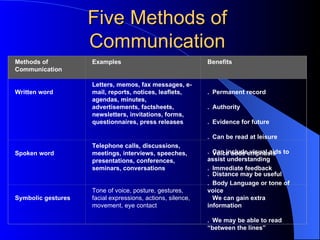
Five Methods of Communication Methods of Communication Examples Benefits   Written word   Letters, memos, fax messages, e-mail, reports, notices, leaflets, agendas, minutes, advertisements, factsheets, newsletters, invitations, forms, questionnaires, press releases 1 .      Permanent record 2.      Authority 3.      Evidence for future 4.      Can be read at leisure 5.      Can include visual aids to assist understanding  6.      Distance may be useful   Spoken word   Telephone calls, discussions, meetings, interviews, speeches, presentations, conferences, seminars, conversations 1.      Voice adds emphasis 2.      Immediate feedback 3.      Body Language or tone of voice   Symbolic gestures   Tone of voice, posture, gestures, facial expressions, actions, silence, movement, eye contact 1.      We can gain extra information  2.      We may be able to read “between the lines”
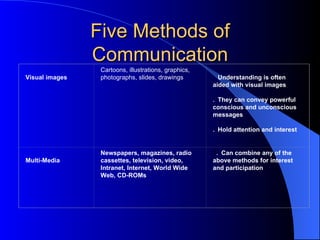
Five Methods of Communication   Visual images   Cartoons, illustrations, graphics, photographs, slides, drawings 1.      Understanding is often aided with visual images 2.      They can convey powerful conscious and unconscious messages 3.      Hold attention and interest   Multi-Media     Newspapers, magazines, radio cassettes, television, video, Intranet, Internet, World Wide Web, CD-ROMs 1 .      Can combine any of the above methods for interest and participation  
Getting Grips with Grammar Oh No. Grammar!
Mind Your Grammar ! Clause Sentence Verb Noun Adjective Adverb Conjunction Pronoun Preposition Infinite Interjection
Subject-Verb Agreement
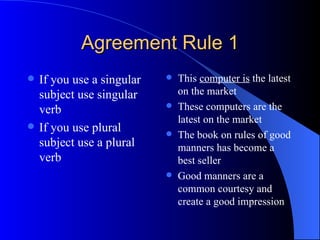
Agreement Rule 1 If you use a singular subject use singular verb If you use plural subject use a plural verb This  computer is  the latest on the market These computers are the latest on the market The book on rules of good manners has become a best seller Good manners are a common courtesy and create a good impression
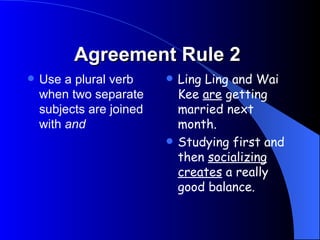
  Agreement Rule 2   Use a plural verb when two separate subjects are joined with  and  Ling Ling and Wai Kee  are  getting married next month. Studying first and then  socializing creates  a really good balance.
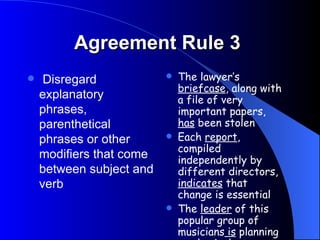
Agreement Rule 3     Disregard explanatory phrases, parenthetical phrases or other modifiers that come between subject and verb The lawyer’s  briefcase , along with a file of very important papers,  has  been stolen Each  report , compiled independently by different directors,  indicates  that change is essential The  leader  of this popular group of musicians  is  planning a solo single
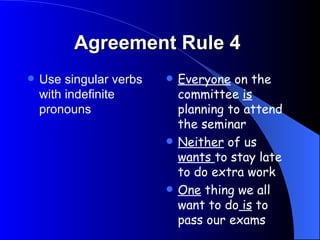
Agreement Rule 4   Use singular verbs with indefinite pronouns Everyone  on the committee  is  planning to attend the seminar Neither  of us  wants  to stay late to do extra work One  thing we all want to do  is  to pass our exams
The Dictionary is your Lifeline
What about Punctuation? Do we have to ?
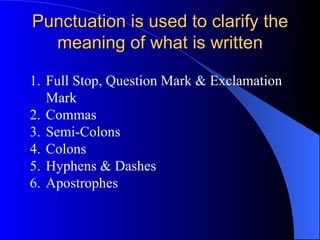
Punctuation is used to clarify the meaning of what is written Full Stop, Question Mark & Exclamation Mark Commas Semi-Colons Colons Hyphens & Dashes Apostrophes
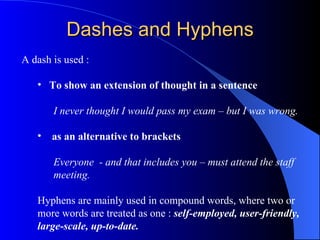
Dashes and Hyphens A dash is used : To show an extension of thought in a sentence I never thought I would pass my exam – but I was wrong. as an alternative to brackets Everyone  - and that includes you – must attend the staff  meeting. Hyphens are mainly used in compound words, where two or more words are treated as one :  self-employed, user-friendly, large-scale, up-to-date.
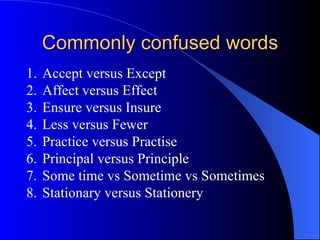
Commonly confused words Accept versus Except Affect versus Effect Ensure versus Insure Less versus Fewer Practice versus Practise Principal versus Principle Some time vs Sometime vs Sometimes Stationary versus Stationery
BUSINESS LETTERS
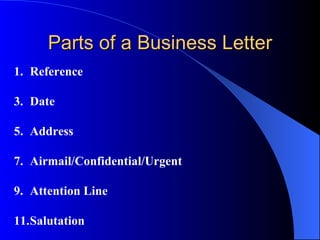
Parts of a Business Letter Reference Date Address Airmail/Confidential/Urgent Attention Line Salutation
Format Full-Block Format (flush left) Semi-Block Format (writer’s address, date & signature at the right hand side) Simplified Format (similar to the full block format but omits salutations & closing) Indented Paragraph Format ( para begin 5 spaces from left)
Parts of a Business Letter Heading Complimentary Close Signature Section Signing on someone’s behalf Enclosures Copies Continuation Sheets
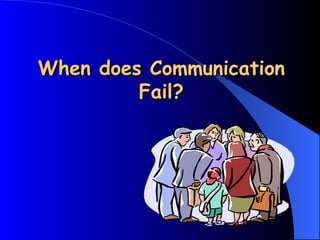
When does Communication Fail?
When does Communication Fail? You sex   has been changed. You were addressed Mr instead of Mrs or Miss. The structure of the document has been given little thought. It is all jumbled up. The purpose of the communication is not clearly stated.  The document is written in a very formal style, full of long-winded jargon and  technical terms. Important information has been omitted. You have to make a phone  call for clarification . The tone is all wrong – maybe critical, condescending or intimidating   There are errors in spelling, punctuation and grammar
Remember ! Accurate Brief Clear
KISS! Keep It Short and  Simple
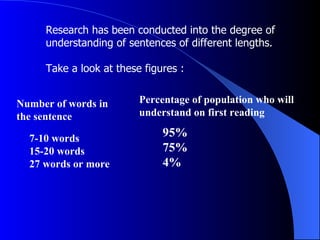
Research has been conducted into the degree of  understanding of sentences of different lengths. Take a look at these figures : Number of words in  the sentence Percentage of population who will understand on first reading 7-10 words 15-20 words 27 words or more 95% 75% 4%
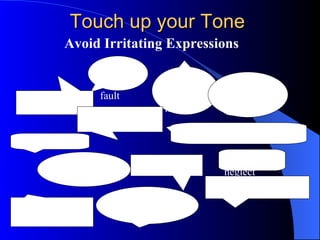
Touch up your Tone Avoid Irritating Expressions Your failure to reply It is not our fault Your neglect You did not see You should know   We must insist You  failed to You should not expect to You cannot expect You have ignored We take issue Your complaint Your refusal to co-operate                                      
Positive Language Not Negative Language If you do not return your Form  before 1 st  August you will be too late to attend the conference Please return your form by 31 st  July so that we can register your name for the conference
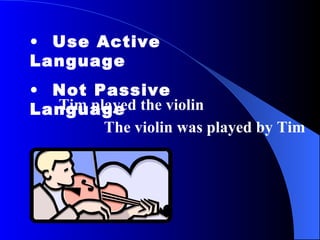
Use Active Language Not Passive Language Tim played the violin The violin was played by Tim
Five Cs of Good  Business Writing Clarity Conciseness Courtesy Completeness Correctness
Clarity ? Be Specific Avoid vague expressions Use familiar words
Conciseness ? Avoid unnecessary explanations Avoid wordiness, repetition, long words Use simple expressions instead of jargon
Courtesy ? Use “You” language rather than “We”  or “I” Be tactful Avoid Irritating expressions
Completeness Include dates, times, names & numbers Double check all details carefully Proofread and spell check
Correctness Use correct spelling and punctuation Use correct grammar Adapt your language to your reader
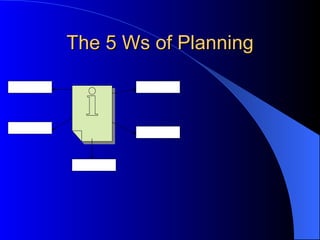
The 5 Ws of Planning Who ? What ? Why ? Where ? When ?                          
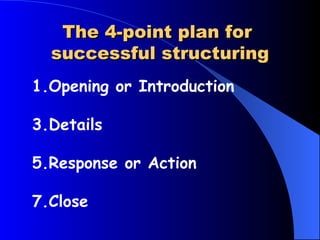
The 4-point plan for  successful structuring Opening or Introduction Details Response or Action Close
Opening or Introduction (background & basics) Why are you writing? Refer to a previous letter, contract or document
Details  (facts & figures) Give instructions. Ask for information. Provide all relevant details. Separate into paragraphs for separate theme Make sure the paragraphs flow logically
Response or Action What action do you want the reader to take? What action will you take? Give a deadline if necessary
Tips for Better Letters Choose simple words Use short sentences Avoid wordiness Use appropriate tone Be precise Ensure accuracy
Tips for Better Letters Check consistency Use your initiative Structure the message logically Proofread carefully
Close Perhaps a summary or conclusion is necessary? Sometimes all is that is needed is a simple, relevant closing sentence.
List down the Categories of Business Letters
Tips for Writing Better Letters
Why are Memos Written?
Why Memos? To instruct or to inform staff To request action To remind someone or something To make suggestions To report on progress To provide information of any kind
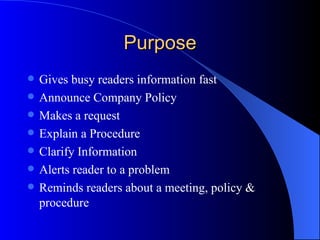
Purpose Gives busy readers information fast Announce Company Policy Makes a request Explain a Procedure Clarify Information Alerts reader to a problem Reminds readers about a meeting, policy & procedure
Clear, direct and focused way on day-to-day activities, like sales & profits, product  information, policies and schedule changes,  progress reports, orders and personnel  direction.
Format 8 ½ inches x 11 inches sheet of paper To  From Date SUBJECT
Structure Introduction Body  Conclusion
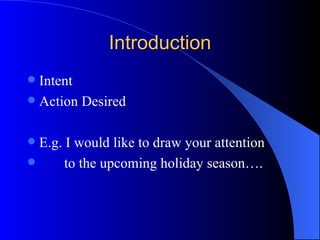
Introduction Intent Action Desired E.g. I would like to draw your attention to the upcoming holiday season….
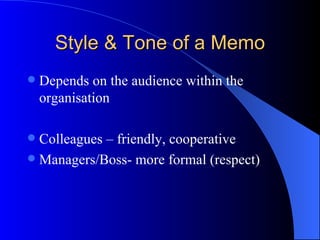
Style & Tone of a Memo Depends on the audience within the organisation Colleagues – friendly, cooperative Managers/Boss- more formal (respect)
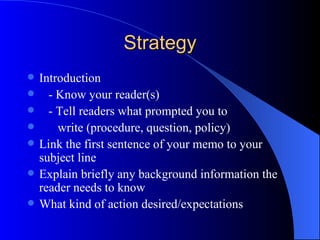
Strategy Introduction - Know your reader(s) - Tell readers what prompted you to write (procedure, question, policy) Link the first sentence of your memo to your subject line Explain briefly any background information the reader needs to know What kind of action desired/expectations
Body/Discussion Inform why a problem/procedure is important  Indicate why changes are necessary Give precise dates, times, location and costs
Conclusion Ask readers to call you if they have any questions Request a reply - in writing over the telephone, via e-mail, or in person – by a specific date Provide a list of recommendations that the readers are to accept, revise or reject
Useful Strategies Use 3Cs  - Capture : attention of the reader - Convince : that you are saying    something that is useful for the reader & organisation Stress “YOU” - working together, friendly approach, informal
Useful Strategies Anticipate questions (wear the reader’s shoes) Use attachment for details
Be diplomatic Edit carefully  Respond quickly
Question : Memo Question ??? Are expressions “Thank You” and “Kind Regards” necessary at the end of a memo?
Tips for Better Memos Make a plan first before writing your memo Ensure your message is as clear as possible Separate the message into points Take time to improve your presentation Use numbered points and sub-headings
Tips for Better Memos Use language which is simple Keep your message brief and simple and businesslike Ensure your tone of your message is appropriate Adopt the personal ‘you’ and ‘I’ Keep your tone positive
Creative and Persuasive Writing
Sales Letters
AIDA Principles Attention Interest  Desire Action
Attention ? Attract reader’s attention Aim to sell or persuade  readers Striking heading, a question or a challenging statement
Interest ? Mention something to interest reader Health, image, economy, fear, future prospects Appeal
Desire ? Arouse reader’s desire Describe benefits rather than features Emphasis what is unique, topical or new Give guarantees or evidence of testing Perhaps, give incentive to reply early
Action ? Make audience want to buy, find out more or make a call Make it clear what the reader should do next
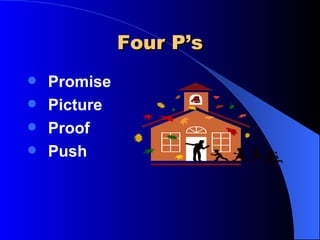
Four P’s Promise Picture Proof Push
Four Ps Promise the reader certain benefits Create a picture showing how the reader will gain those benefits Offer proof that you can deliver the benefits Provide a push to action
What are Circulars? What are Notices ?
Tips for Circulars  Singular Salutation is used Avoid words such as “all of you” or  “all customers” or “all employees” Only month and year may be shown GOLDEN RULE : Write as if you are speaking to ONE Person
Tips for Better Notices Keep notice short Break up longer text using headings & bullet points Use two or three colours, different print style, font size but don’t overdo it Clear heading giving gist of content Include name and title of person with date
Business Reports List down the Type of Reports TASK
Routine Reports Representatives’ report on sales visits Managers’ reports on the work of their departments Equipment and maintenance reports Progress reports to superiors Safety reports Accident reports
Special Reports Informational Reports  generally give data, facts & information. Purpose : to inform Analytical Reports  provide information and then analyse the material, most probably providing recommendation for action
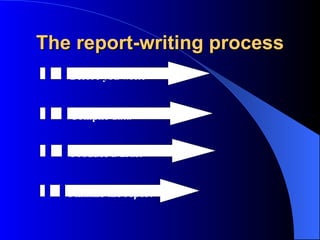
The report-writing process Before you write Compile data Produce a draft Finalize the report
What are the stages in Report Writing?
Stage 1 : Before you write What is the purpose of this report? What is the problem to be solved What do I hope to accomplish Does the report aim to inform or analyse? Who is going to read the reports? What does the read need to know?
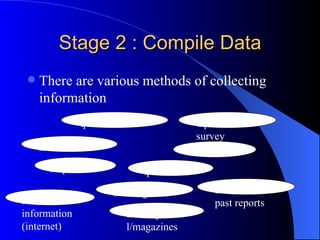
Stage 2 : Compile Data There are various methods of collecting information                   Public information (internet) interviews inspections questionnaire Opinion survey Books/journal/magazines visits Reference to past reports meetings quotations
Stage 3 : Produce the draft Terms of Reference Procedure Findings Conclusions Recommendations
Stage 4 : Finalise your report Is all the information in the right section? Is the wording and language used consistent? Is everything reported accurately and clearly? Is the writing as brief and clear as possible? Does the report say exactly what you want it to say?
Report Writing in Practise
DEBAT ISLAM VS KRISTIAN http://www. debatagung .com
Thank You  and  Close

Effective Business Writing Skills

  • 1.
  • 2.
    Sponsored by:- DEBATISLAM VS KRISTIAN http://www. debatagung .com
  • 3.
    Good Business WritingSkills presented by Malathy Thiagarajah Organized by NET BALI SDN BHD
  • 4.
    Good Communication isthe lifeblood of successful organisations
  • 5.
    Methods of CommunicationName 5 methods of Communication Communication is more powerful when they are combined
  • 6.
    Five Methods ofCommunication Methods of Communication Examples Benefits   Written word   Letters, memos, fax messages, e-mail, reports, notices, leaflets, agendas, minutes, advertisements, factsheets, newsletters, invitations, forms, questionnaires, press releases 1 .     Permanent record 2.     Authority 3.     Evidence for future 4.     Can be read at leisure 5.     Can include visual aids to assist understanding 6.     Distance may be useful   Spoken word   Telephone calls, discussions, meetings, interviews, speeches, presentations, conferences, seminars, conversations 1.     Voice adds emphasis 2.     Immediate feedback 3.     Body Language or tone of voice   Symbolic gestures   Tone of voice, posture, gestures, facial expressions, actions, silence, movement, eye contact 1.     We can gain extra information 2.     We may be able to read “between the lines”
  • 7.
    Five Methods ofCommunication   Visual images   Cartoons, illustrations, graphics, photographs, slides, drawings 1.     Understanding is often aided with visual images 2.     They can convey powerful conscious and unconscious messages 3.     Hold attention and interest   Multi-Media     Newspapers, magazines, radio cassettes, television, video, Intranet, Internet, World Wide Web, CD-ROMs 1 .     Can combine any of the above methods for interest and participation  
  • 8.
    Getting Grips withGrammar Oh No. Grammar!
  • 9.
    Mind Your Grammar! Clause Sentence Verb Noun Adjective Adverb Conjunction Pronoun Preposition Infinite Interjection
  • 10.
  • 11.
    Agreement Rule 1If you use a singular subject use singular verb If you use plural subject use a plural verb This computer is the latest on the market These computers are the latest on the market The book on rules of good manners has become a best seller Good manners are a common courtesy and create a good impression
  • 12.
      Agreement Rule2 Use a plural verb when two separate subjects are joined with and Ling Ling and Wai Kee are getting married next month. Studying first and then socializing creates a really good balance.
  • 13.
    Agreement Rule 3   Disregard explanatory phrases, parenthetical phrases or other modifiers that come between subject and verb The lawyer’s briefcase , along with a file of very important papers, has been stolen Each report , compiled independently by different directors, indicates that change is essential The leader of this popular group of musicians is planning a solo single
  • 14.
    Agreement Rule 4 Use singular verbs with indefinite pronouns Everyone on the committee is planning to attend the seminar Neither of us wants to stay late to do extra work One thing we all want to do is to pass our exams
  • 15.
    The Dictionary isyour Lifeline
  • 16.
    What about Punctuation?Do we have to ?
  • 17.
    Punctuation is usedto clarify the meaning of what is written Full Stop, Question Mark & Exclamation Mark Commas Semi-Colons Colons Hyphens & Dashes Apostrophes
  • 18.
    Dashes and HyphensA dash is used : To show an extension of thought in a sentence I never thought I would pass my exam – but I was wrong. as an alternative to brackets Everyone - and that includes you – must attend the staff meeting. Hyphens are mainly used in compound words, where two or more words are treated as one : self-employed, user-friendly, large-scale, up-to-date.
  • 19.
    Commonly confused wordsAccept versus Except Affect versus Effect Ensure versus Insure Less versus Fewer Practice versus Practise Principal versus Principle Some time vs Sometime vs Sometimes Stationary versus Stationery
  • 20.
  • 21.
    Parts of aBusiness Letter Reference Date Address Airmail/Confidential/Urgent Attention Line Salutation
  • 22.
    Format Full-Block Format(flush left) Semi-Block Format (writer’s address, date & signature at the right hand side) Simplified Format (similar to the full block format but omits salutations & closing) Indented Paragraph Format ( para begin 5 spaces from left)
  • 23.
    Parts of aBusiness Letter Heading Complimentary Close Signature Section Signing on someone’s behalf Enclosures Copies Continuation Sheets
  • 24.
  • 25.
    When does CommunicationFail? You sex has been changed. You were addressed Mr instead of Mrs or Miss. The structure of the document has been given little thought. It is all jumbled up. The purpose of the communication is not clearly stated. The document is written in a very formal style, full of long-winded jargon and technical terms. Important information has been omitted. You have to make a phone call for clarification . The tone is all wrong – maybe critical, condescending or intimidating There are errors in spelling, punctuation and grammar
  • 26.
  • 27.
    KISS! Keep ItShort and Simple
  • 28.
    Research has beenconducted into the degree of understanding of sentences of different lengths. Take a look at these figures : Number of words in the sentence Percentage of population who will understand on first reading 7-10 words 15-20 words 27 words or more 95% 75% 4%
  • 29.
    Touch up yourTone Avoid Irritating Expressions Your failure to reply It is not our fault Your neglect You did not see You should know   We must insist You failed to You should not expect to You cannot expect You have ignored We take issue Your complaint Your refusal to co-operate                                      
  • 30.
    Positive Language NotNegative Language If you do not return your Form before 1 st August you will be too late to attend the conference Please return your form by 31 st July so that we can register your name for the conference
  • 31.
    Use Active LanguageNot Passive Language Tim played the violin The violin was played by Tim
  • 32.
    Five Cs ofGood Business Writing Clarity Conciseness Courtesy Completeness Correctness
  • 33.
    Clarity ? BeSpecific Avoid vague expressions Use familiar words
  • 34.
    Conciseness ? Avoidunnecessary explanations Avoid wordiness, repetition, long words Use simple expressions instead of jargon
  • 35.
    Courtesy ? Use“You” language rather than “We” or “I” Be tactful Avoid Irritating expressions
  • 36.
    Completeness Include dates,times, names & numbers Double check all details carefully Proofread and spell check
  • 37.
    Correctness Use correctspelling and punctuation Use correct grammar Adapt your language to your reader
  • 38.
    The 5 Wsof Planning Who ? What ? Why ? Where ? When ?                          
  • 39.
    The 4-point planfor successful structuring Opening or Introduction Details Response or Action Close
  • 40.
    Opening or Introduction(background & basics) Why are you writing? Refer to a previous letter, contract or document
  • 41.
    Details (facts& figures) Give instructions. Ask for information. Provide all relevant details. Separate into paragraphs for separate theme Make sure the paragraphs flow logically
  • 42.
    Response or ActionWhat action do you want the reader to take? What action will you take? Give a deadline if necessary
  • 43.
    Tips for BetterLetters Choose simple words Use short sentences Avoid wordiness Use appropriate tone Be precise Ensure accuracy
  • 44.
    Tips for BetterLetters Check consistency Use your initiative Structure the message logically Proofread carefully
  • 45.
    Close Perhaps asummary or conclusion is necessary? Sometimes all is that is needed is a simple, relevant closing sentence.
  • 46.
    List down theCategories of Business Letters
  • 47.
    Tips for WritingBetter Letters
  • 48.
    Why are MemosWritten?
  • 49.
    Why Memos? Toinstruct or to inform staff To request action To remind someone or something To make suggestions To report on progress To provide information of any kind
  • 50.
    Purpose Gives busyreaders information fast Announce Company Policy Makes a request Explain a Procedure Clarify Information Alerts reader to a problem Reminds readers about a meeting, policy & procedure
  • 51.
    Clear, direct andfocused way on day-to-day activities, like sales & profits, product information, policies and schedule changes, progress reports, orders and personnel direction.
  • 52.
    Format 8 ½inches x 11 inches sheet of paper To From Date SUBJECT
  • 53.
  • 54.
    Introduction Intent ActionDesired E.g. I would like to draw your attention to the upcoming holiday season….
  • 55.
    Style & Toneof a Memo Depends on the audience within the organisation Colleagues – friendly, cooperative Managers/Boss- more formal (respect)
  • 56.
    Strategy Introduction -Know your reader(s) - Tell readers what prompted you to write (procedure, question, policy) Link the first sentence of your memo to your subject line Explain briefly any background information the reader needs to know What kind of action desired/expectations
  • 57.
    Body/Discussion Inform whya problem/procedure is important Indicate why changes are necessary Give precise dates, times, location and costs
  • 58.
    Conclusion Ask readersto call you if they have any questions Request a reply - in writing over the telephone, via e-mail, or in person – by a specific date Provide a list of recommendations that the readers are to accept, revise or reject
  • 59.
    Useful Strategies Use3Cs - Capture : attention of the reader - Convince : that you are saying something that is useful for the reader & organisation Stress “YOU” - working together, friendly approach, informal
  • 60.
    Useful Strategies Anticipatequestions (wear the reader’s shoes) Use attachment for details
  • 61.
    Be diplomatic Editcarefully Respond quickly
  • 62.
    Question : MemoQuestion ??? Are expressions “Thank You” and “Kind Regards” necessary at the end of a memo?
  • 63.
    Tips for BetterMemos Make a plan first before writing your memo Ensure your message is as clear as possible Separate the message into points Take time to improve your presentation Use numbered points and sub-headings
  • 64.
    Tips for BetterMemos Use language which is simple Keep your message brief and simple and businesslike Ensure your tone of your message is appropriate Adopt the personal ‘you’ and ‘I’ Keep your tone positive
  • 65.
  • 66.
  • 67.
    AIDA Principles AttentionInterest Desire Action
  • 68.
    Attention ? Attractreader’s attention Aim to sell or persuade readers Striking heading, a question or a challenging statement
  • 69.
    Interest ? Mentionsomething to interest reader Health, image, economy, fear, future prospects Appeal
  • 70.
    Desire ? Arousereader’s desire Describe benefits rather than features Emphasis what is unique, topical or new Give guarantees or evidence of testing Perhaps, give incentive to reply early
  • 71.
    Action ? Makeaudience want to buy, find out more or make a call Make it clear what the reader should do next
  • 72.
    Four P’s PromisePicture Proof Push
  • 73.
    Four Ps Promisethe reader certain benefits Create a picture showing how the reader will gain those benefits Offer proof that you can deliver the benefits Provide a push to action
  • 74.
    What are Circulars?What are Notices ?
  • 75.
    Tips for Circulars Singular Salutation is used Avoid words such as “all of you” or “all customers” or “all employees” Only month and year may be shown GOLDEN RULE : Write as if you are speaking to ONE Person
  • 76.
    Tips for BetterNotices Keep notice short Break up longer text using headings & bullet points Use two or three colours, different print style, font size but don’t overdo it Clear heading giving gist of content Include name and title of person with date
  • 77.
    Business Reports Listdown the Type of Reports TASK
  • 78.
    Routine Reports Representatives’report on sales visits Managers’ reports on the work of their departments Equipment and maintenance reports Progress reports to superiors Safety reports Accident reports
  • 79.
    Special Reports InformationalReports generally give data, facts & information. Purpose : to inform Analytical Reports provide information and then analyse the material, most probably providing recommendation for action
  • 80.
    The report-writing processBefore you write Compile data Produce a draft Finalize the report
  • 81.
    What are thestages in Report Writing?
  • 82.
    Stage 1 :Before you write What is the purpose of this report? What is the problem to be solved What do I hope to accomplish Does the report aim to inform or analyse? Who is going to read the reports? What does the read need to know?
  • 83.
    Stage 2 :Compile Data There are various methods of collecting information                   Public information (internet) interviews inspections questionnaire Opinion survey Books/journal/magazines visits Reference to past reports meetings quotations
  • 84.
    Stage 3 :Produce the draft Terms of Reference Procedure Findings Conclusions Recommendations
  • 85.
    Stage 4 :Finalise your report Is all the information in the right section? Is the wording and language used consistent? Is everything reported accurately and clearly? Is the writing as brief and clear as possible? Does the report say exactly what you want it to say?
  • 86.
  • 87.
    DEBAT ISLAM VSKRISTIAN http://www. debatagung .com
  • 88.
    Thank You and Close