PowerPoint Presentation by Charlie CookPowerPoint Presentation by Charlie Cook
Copyright © 2005 Prentice Hall, Inc.Copyright © 2005 Prentice Hall, Inc.
All rights reserved.All rights reserved.
8th
edition
Steven P. Robbins
Mary Coulter
Copyright © 2005 Prentice Hall, Inc. All
rights reserved. 14–2
L E A R N I N G O U T L I N E
Follow this Learning Outline as you read and study this chapter.
Why Look at Individual Behavior?
• Describe the focus and the goals of organizational
behavior.
• Explain why the concept of an organization as an iceberg
is important to understanding organizational behavior.
• Define the five important employee behaviors that
managers want to explain, predict, and influence.
Attitudes
• Describe the three components of an attitude.
• Discuss three job-related attitudes.
• Describe the impact of job satisfaction has on employee
behavior.
Copyright © 2005 Prentice Hall, Inc. All
rights reserved. 14–3
L E A R N I N G O U T L I N E (cont’d)
Follow this Learning Outline as you read and study this chapter.
Attitudes (cont’d)
• Explain how individuals reconcile inconsistencies
between attitudes and behavior.
Personality
• Contrast the MBTI and the big-five model of personality.
• Describe the five personality traits that have proved to be
most powerful in explaining individual behavior in
organizations.
• Tell how emotions and emotional intelligence impact
behavior.
Copyright © 2005 Prentice Hall, Inc. All
rights reserved. 14–4
L E A R N I N G O U T L I N E (cont’d)
Follow this Learning Outline as you read and study this chapter.
Perception
• Explain how an understanding of perception can help
managers better understand individual behavior.
• Describe the key elements of attribution theory.
• Discuss how the fundamental attribution error and self-
serving bias can distort attributions.
• Name three shortcuts used in judging others.
Learning
• Explain how operant conditioning helps managers
understand, predict, and influence behavior.
• Describe the implications of social learning theory for
managing people at work.
• Discuss how managers can shape behavior.
Copyright © 2005 Prentice Hall, Inc. All
rights reserved. 14–5
Understanding Individual Behavior
• Organizational Behavior (OB)
The actions of people at work
• Dual Focus of OB
Individual behavior
 Attitudes, personality, perception, learning, and
motivation
Group behavior
 Norms, roles, team building, leadership, and conflict
• Goals of OB
To explain, predict and influence behavior
Copyright © 2005 Prentice Hall, Inc. All
rights reserved. 14–6
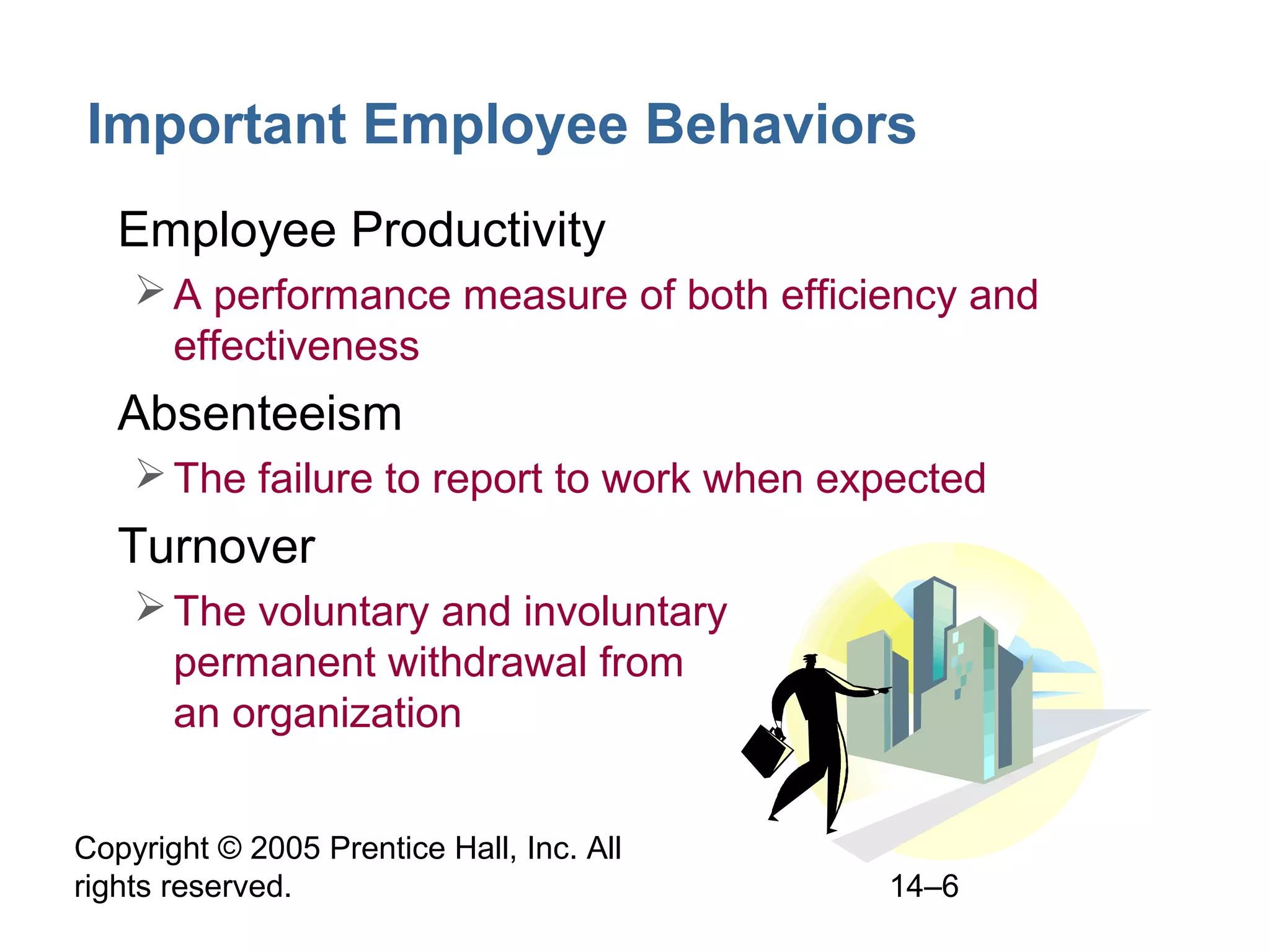
Important Employee Behaviors
• Employee Productivity
A performance measure of both efficiency and
effectiveness
• Absenteeism
The failure to report to work when expected
• Turnover
The voluntary and involuntary
permanent withdrawal from
an organization
Copyright © 2005 Prentice Hall, Inc. All
rights reserved. 14–7
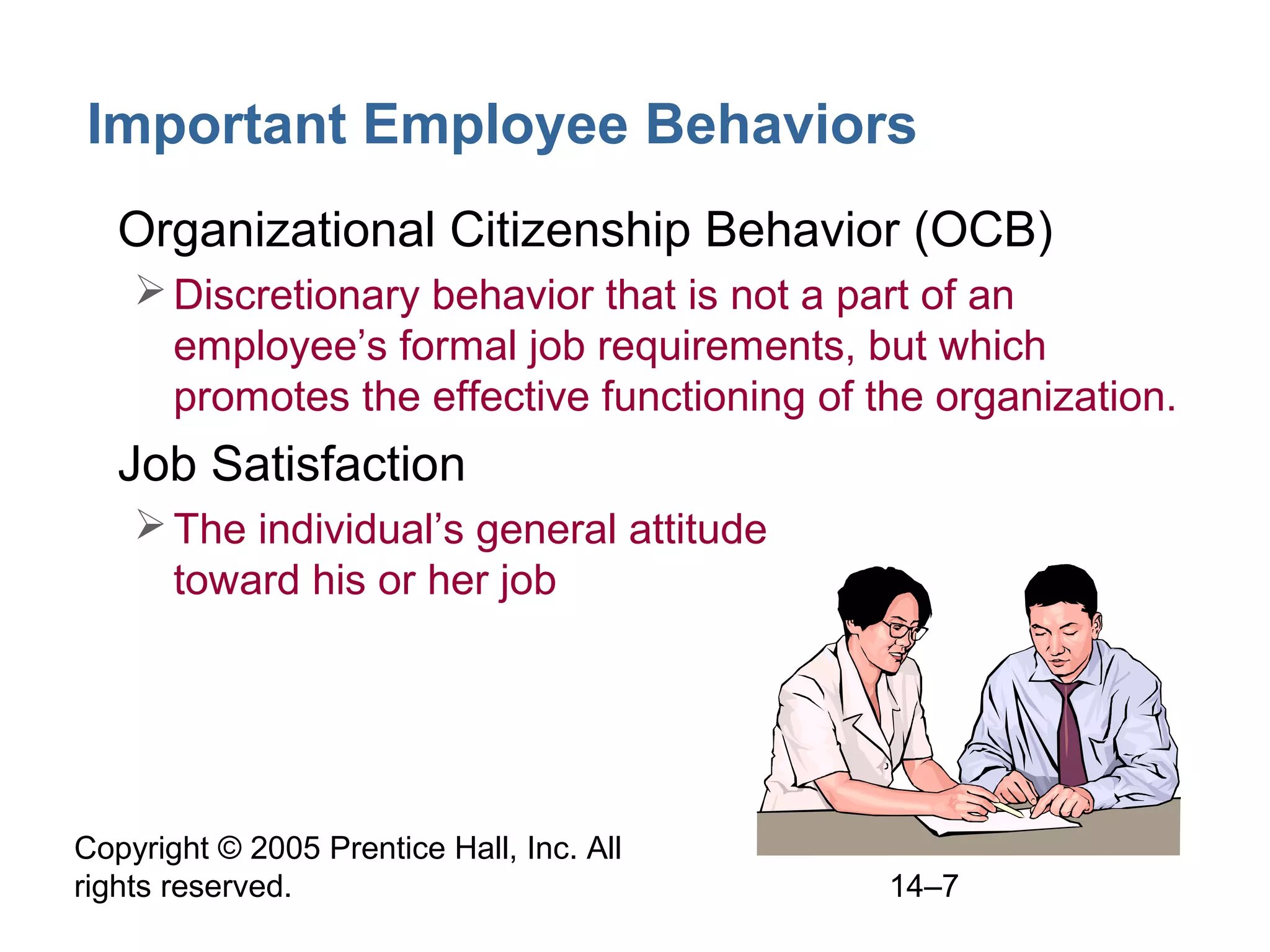
Important Employee Behaviors
• Organizational Citizenship Behavior (OCB)
Discretionary behavior that is not a part of an
employee’s formal job requirements, but which
promotes the effective functioning of the organization.
• Job Satisfaction
The individual’s general attitude
toward his or her job
Copyright © 2005 Prentice Hall, Inc. All
rights reserved. 14–8
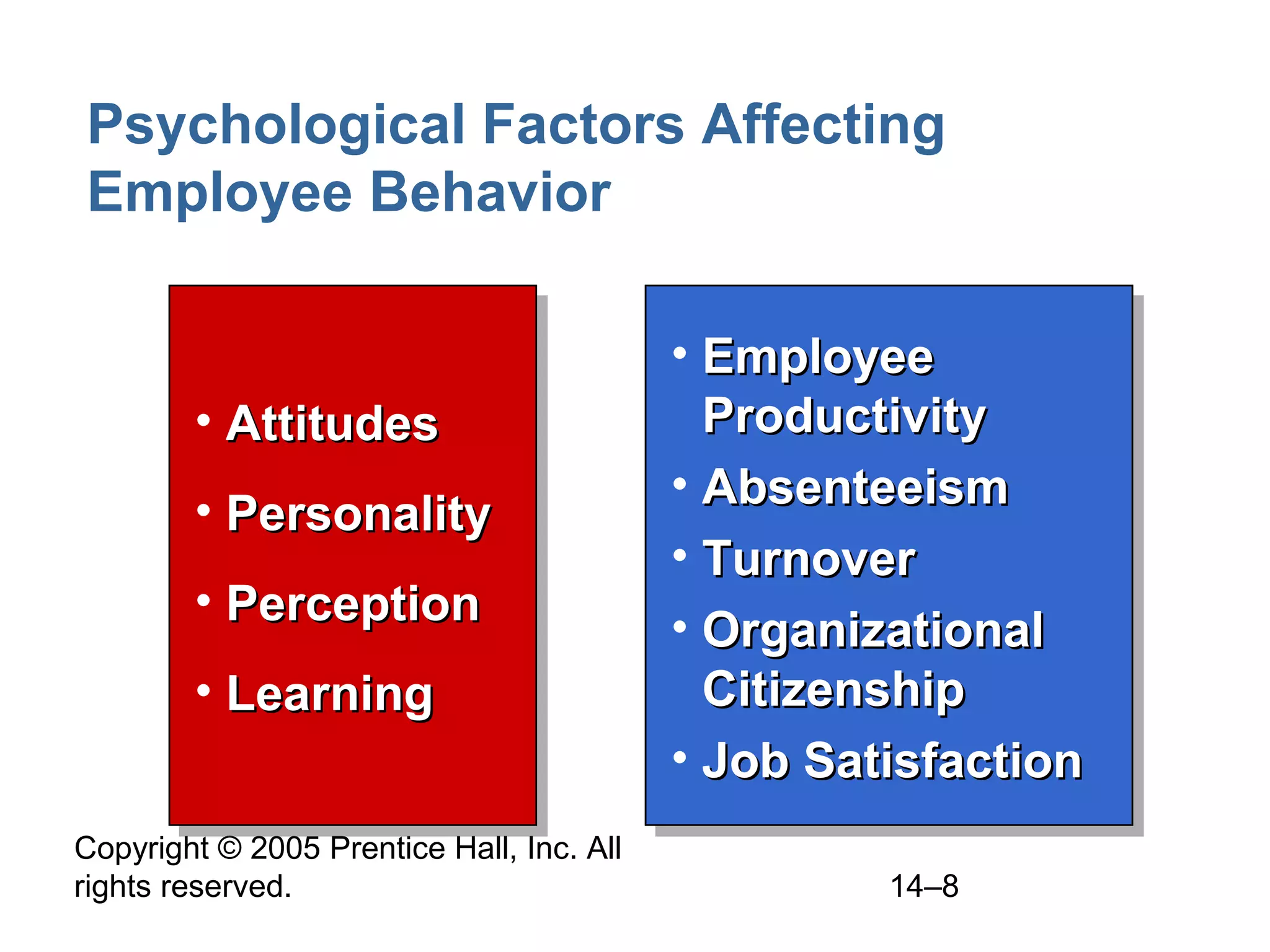
Psychological Factors Affecting
Employee Behavior
• AttitudesAttitudes
• PersonalityPersonality
• PerceptionPerception
• LearningLearning
• AttitudesAttitudes
• PersonalityPersonality
• PerceptionPerception
• LearningLearning
• EmployeeEmployee
ProductivityProductivity
• AbsenteeismAbsenteeism
• TurnoverTurnover
• OrganizationalOrganizational
CitizenshipCitizenship
• Job SatisfactionJob Satisfaction
• EmployeeEmployee
ProductivityProductivity
• AbsenteeismAbsenteeism
• TurnoverTurnover
• OrganizationalOrganizational
CitizenshipCitizenship
• Job SatisfactionJob Satisfaction
Copyright © 2005 Prentice Hall, Inc. All
rights reserved. 14–9
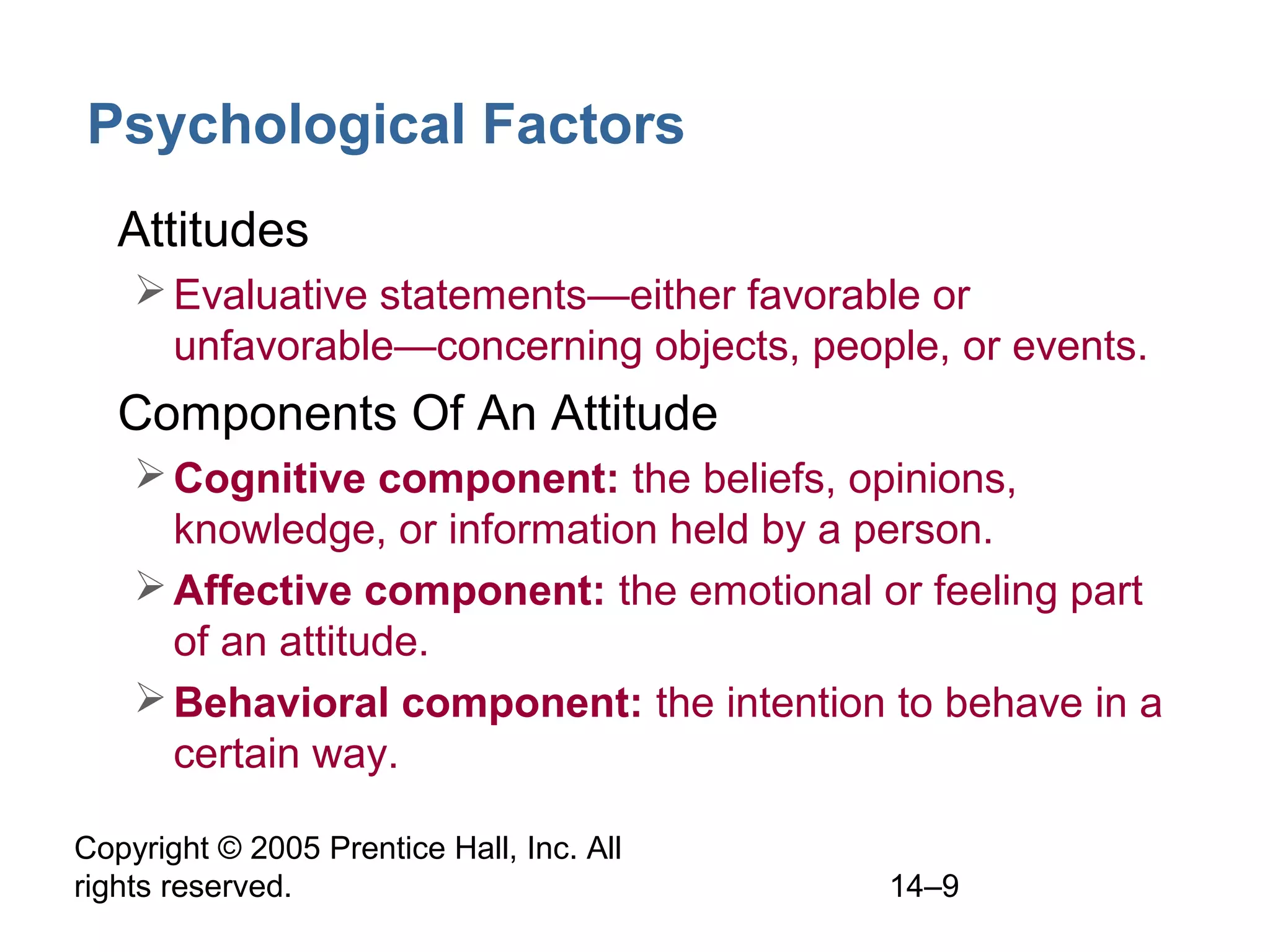
Psychological Factors
• Attitudes
Evaluative statements—either favorable or
unfavorable—concerning objects, people, or events.
• Components Of An Attitude
Cognitive component: the beliefs, opinions,
knowledge, or information held by a person.
Affective component: the emotional or feeling part
of an attitude.
Behavioral component: the intention to behave in a
certain way.
Copyright © 2005 Prentice Hall, Inc. All
rights reserved. 14–10
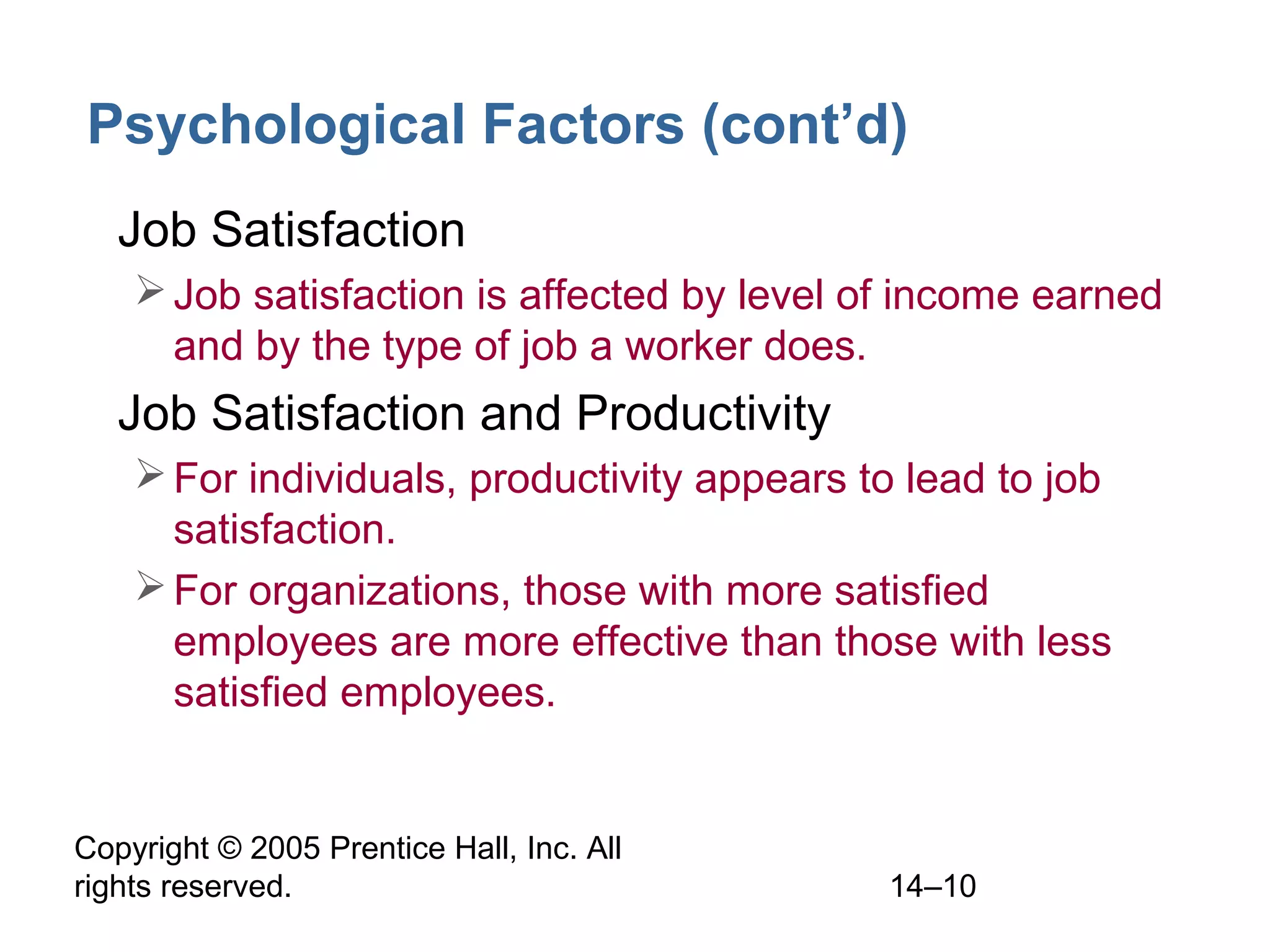
Psychological Factors (cont’d)
• Job Satisfaction
Job satisfaction is affected by level of income earned
and by the type of job a worker does.
• Job Satisfaction and Productivity
For individuals, productivity appears to lead to job
satisfaction.
For organizations, those with more satisfied
employees are more effective than those with less
satisfied employees.
Copyright © 2005 Prentice Hall, Inc. All
rights reserved. 14–11
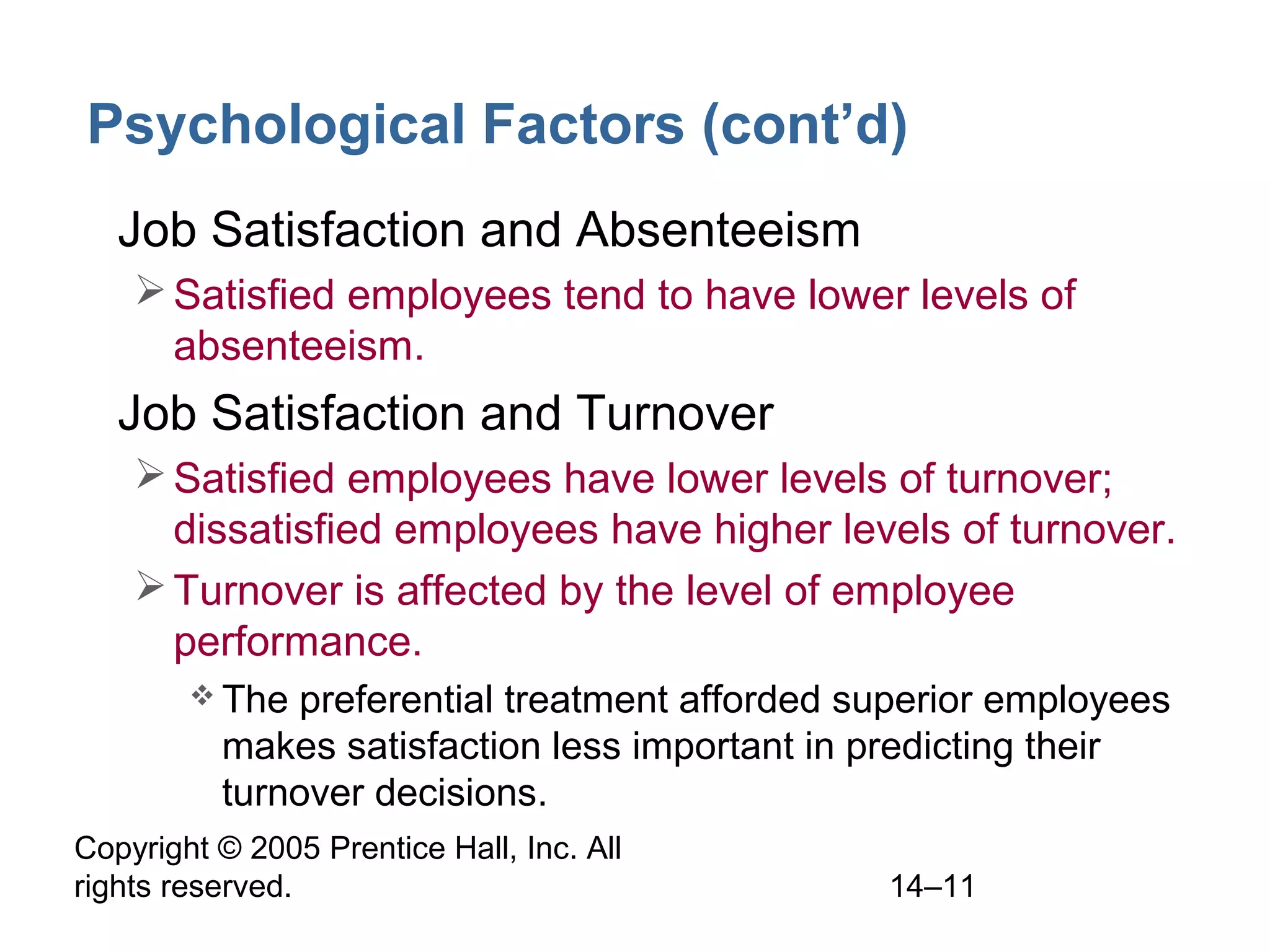
Psychological Factors (cont’d)
• Job Satisfaction and Absenteeism
Satisfied employees tend to have lower levels of
absenteeism.
• Job Satisfaction and Turnover
Satisfied employees have lower levels of turnover;
dissatisfied employees have higher levels of turnover.
Turnover is affected by the level of employee
performance.
 The preferential treatment afforded superior employees
makes satisfaction less important in predicting their
turnover decisions.
Copyright © 2005 Prentice Hall, Inc. All
rights reserved. 14–12
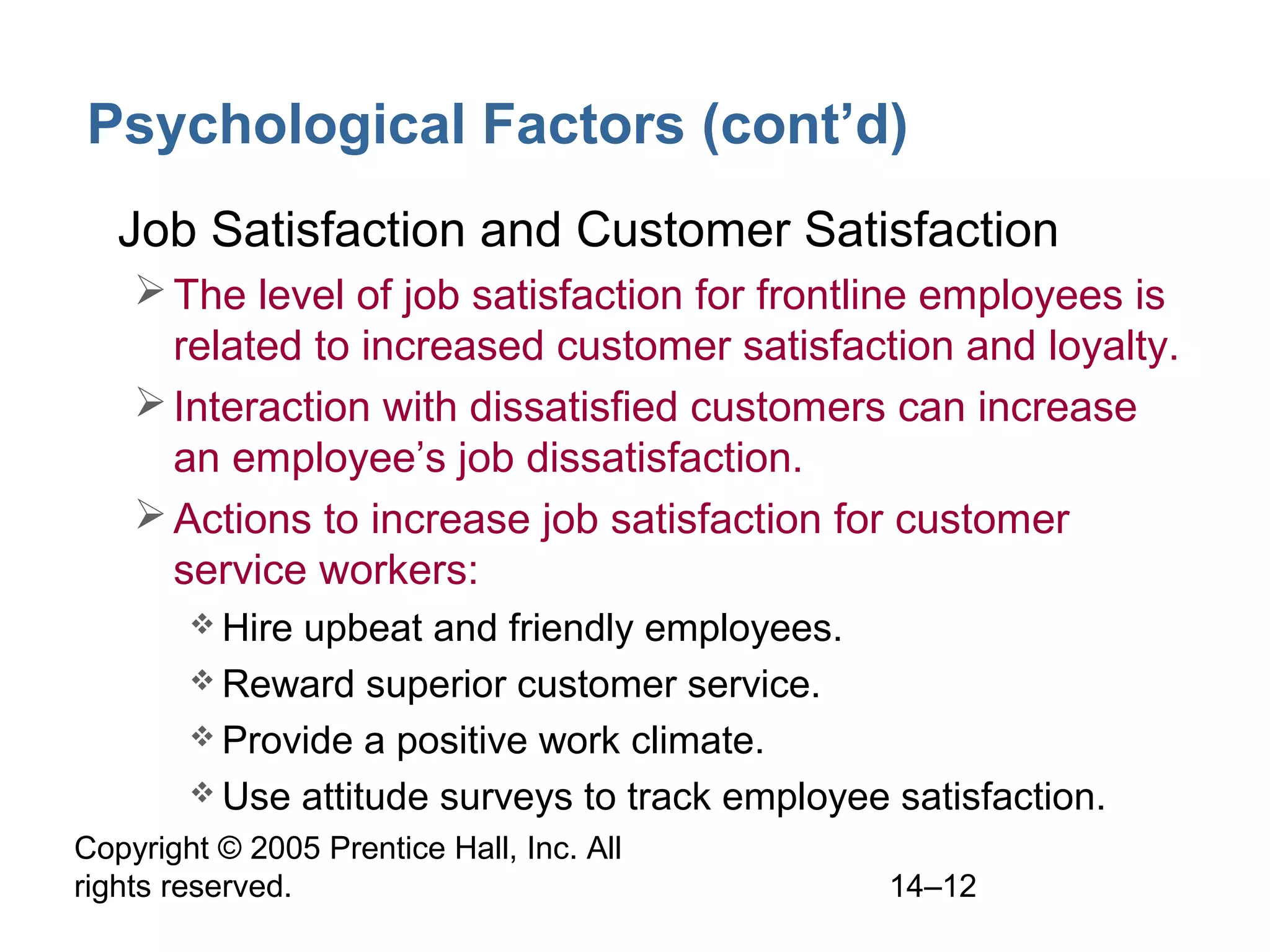
Psychological Factors (cont’d)
• Job Satisfaction and Customer Satisfaction
The level of job satisfaction for frontline employees is
related to increased customer satisfaction and loyalty.
Interaction with dissatisfied customers can increase
an employee’s job dissatisfaction.
Actions to increase job satisfaction for customer
service workers:
 Hire upbeat and friendly employees.
 Reward superior customer service.
 Provide a positive work climate.
 Use attitude surveys to track employee satisfaction.
Copyright © 2005 Prentice Hall, Inc. All
rights reserved. 14–13
Psychological Factors (cont’d)
• Job Involvement
The degree to which an employee identifies with his
or her job, actively participates in it, and considers his
or her performance to be important to his or her self-
worth.
 High levels of commitment are related to fewer
absences and lower resignation rates.
Copyright © 2005 Prentice Hall, Inc. All
rights reserved. 14–14
Psychological Factors (cont’d)
• Organizational Commitment
Is the degree to which an employee identifies with a
particular organization and its goals and wishes to
maintain membership in the organization.
Leads to lower levels of both absenteeism and
turnover.
Could be becoming an outmoded measure as the
number of workers who change employers increases.
Copyright © 2005 Prentice Hall, Inc. All
rights reserved. 14–15
Psychological Factors (cont’d)
• Perceived Organizational Support
Is the general belief of employees that their
organization values their contribution and cares about
their well-being.
Represents the commitment of the organization to the
employee.
Providing high levels of support increases job
satisfaction and lower turnover.
Copyright © 2005 Prentice Hall, Inc. All
rights reserved. 14–16
Attitude Surveys
• Attitude Surveys
A instrument/document that presents employees with
a set of statements or questions eliciting how they
feel about their jobs, work groups, supervisors, or
their organization.
Provide management with feedback on employee
perceptions of the organization and their jobs.
Copyright © 2005 Prentice Hall, Inc. All
rights reserved. 14–17
Attitudes and Consistency
• People seek consistency in two ways:
Consistency among their attitudes.
Consistency between their attitudes and behaviors.
• If an inconsistency arises, individuals:
Alter their attitudes
or
Alter their behavior
or
Develop a rationalization for the inconsistency
Copyright © 2005 Prentice Hall, Inc. All
rights reserved. 14–18
Cognitive Dissonance Theory
• Cognitive Dissonance
Any incompatibility or inconsistency between attitudes
or between behavior and attitudes.
 Any form of inconsistency is uncomfortable and
individuals will try to reduce the dissonance.
The intensity of the desire to reduce the dissonance is
influenced by:
 The importance of the factors creating the dissonance.
 The degree to which an individual believes that the
factors causing the dissonance are controllable.
 Rewards available to compensate for the dissonance.
Copyright © 2005 Prentice Hall, Inc. All
rights reserved. 14–19
The Importance of Attitudes
• Implication for Managers
Attitudes warn of potential behavioral problems:
 Managers should do things that generate the positive
attitudes that reduce absenteeism and turnover.
Attitudes influence behaviors of employees:
 Managers should focus on helping employees become
more productive to increase job satisfaction.
Employees will try to reduce dissonance unless:
 Managers identify the external sources of dissonance.
 Managers provide rewards compensating for the
dissonance.
Copyright © 2005 Prentice Hall, Inc. All
rights reserved. 14–20
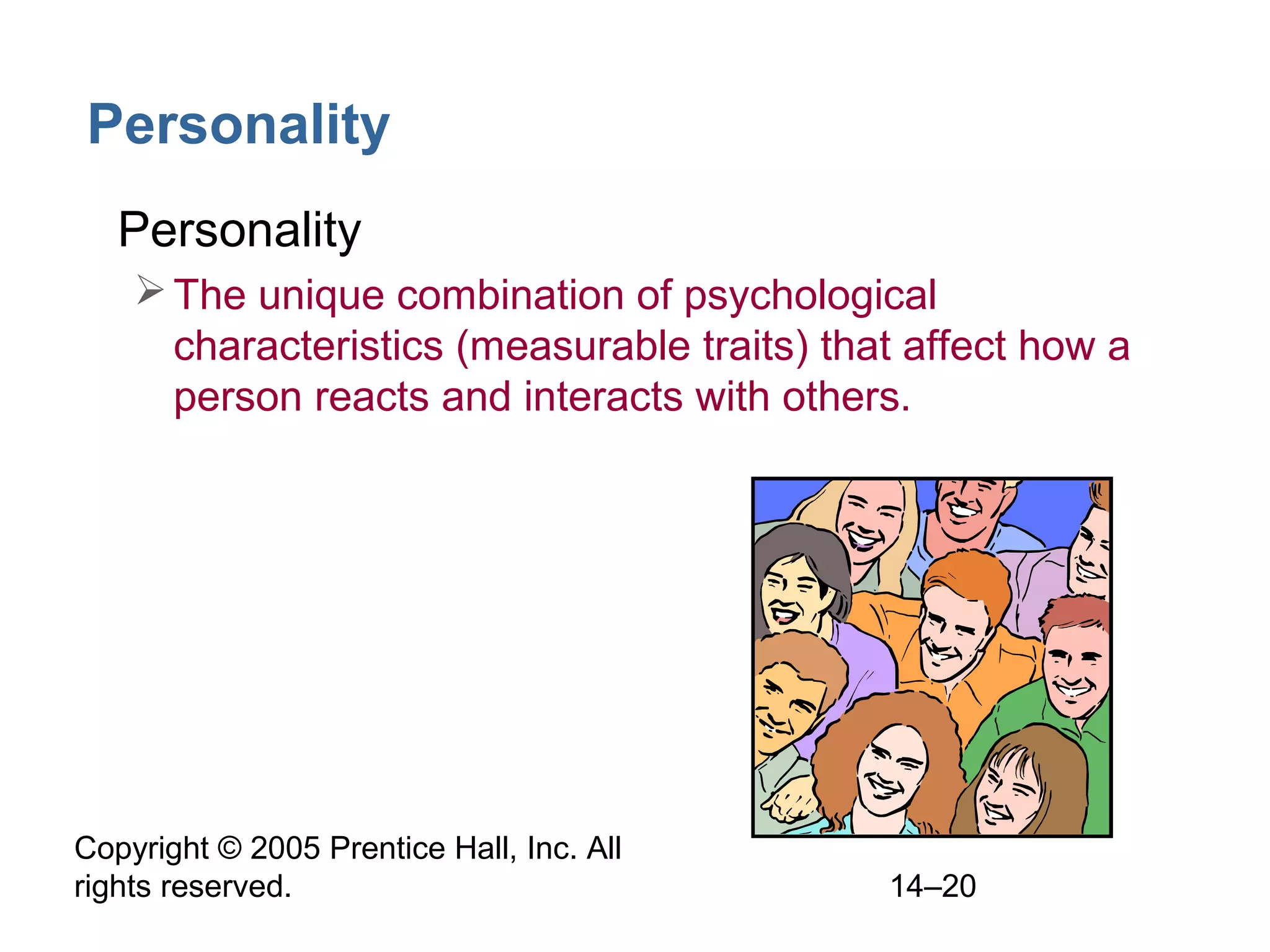
Personality
• Personality
The unique combination of psychological
characteristics (measurable traits) that affect how a
person reacts and interacts with others.
Copyright © 2005 Prentice Hall, Inc. All
rights reserved. 14–21
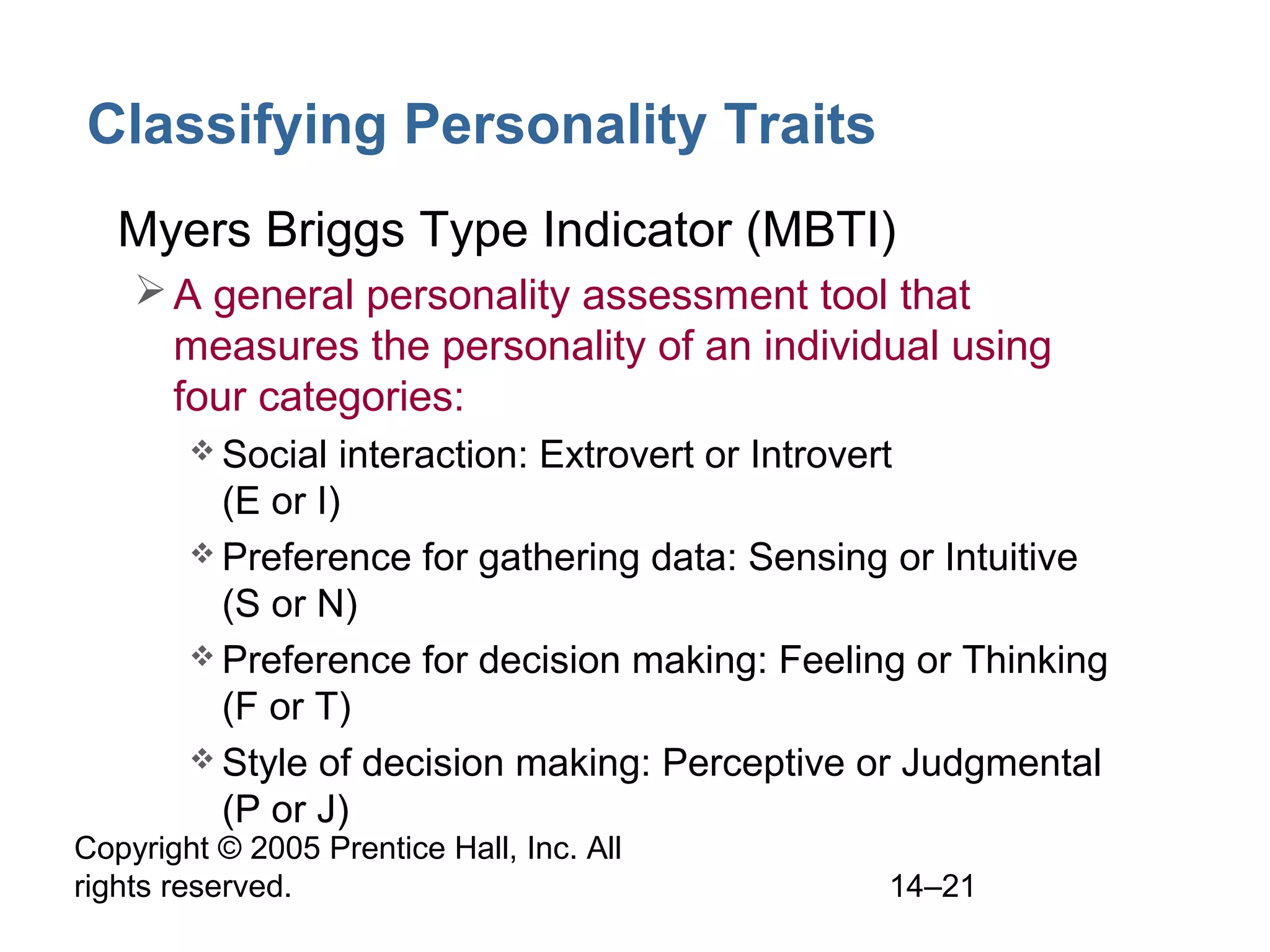
Classifying Personality Traits
• Myers Briggs Type Indicator (MBTI)
A general personality assessment tool that
measures the personality of an individual using
four categories:
 Social interaction: Extrovert or Introvert
(E or I)
 Preference for gathering data: Sensing or Intuitive
(S or N)
 Preference for decision making: Feeling or Thinking
(F or T)
 Style of decision making: Perceptive or Judgmental
(P or J)
Copyright © 2005 Prentice Hall, Inc. All
rights reserved. 14–22
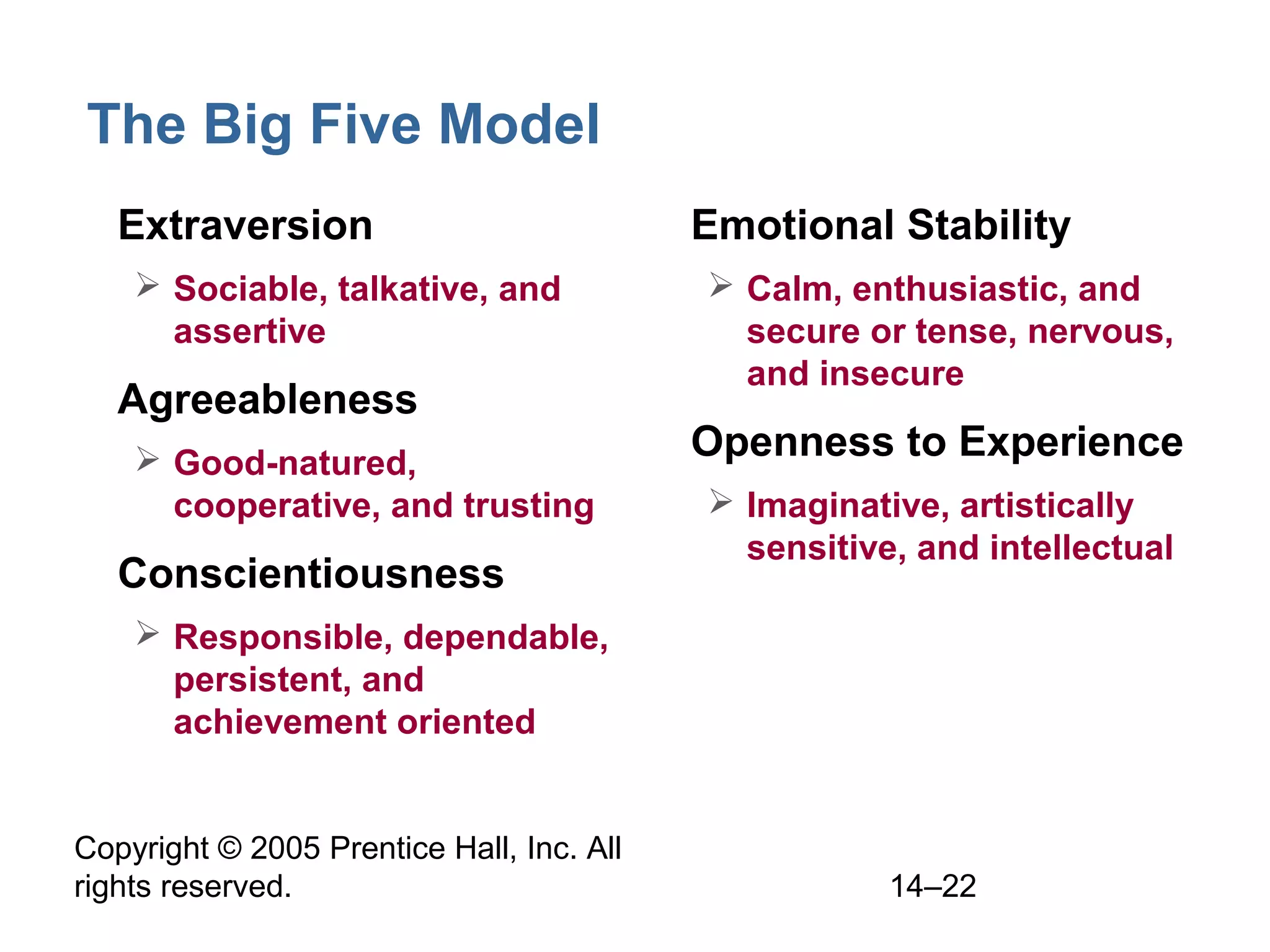
The Big Five Model
• Extraversion
 Sociable, talkative, and
assertive
• Agreeableness
 Good-natured,
cooperative, and trusting
• Conscientiousness
 Responsible, dependable,
persistent, and
achievement oriented
• Emotional Stability
 Calm, enthusiastic, and
secure or tense, nervous,
and insecure
• Openness to Experience
 Imaginative, artistically
sensitive, and intellectual
Copyright © 2005 Prentice Hall, Inc. All
rights reserved. 14–23
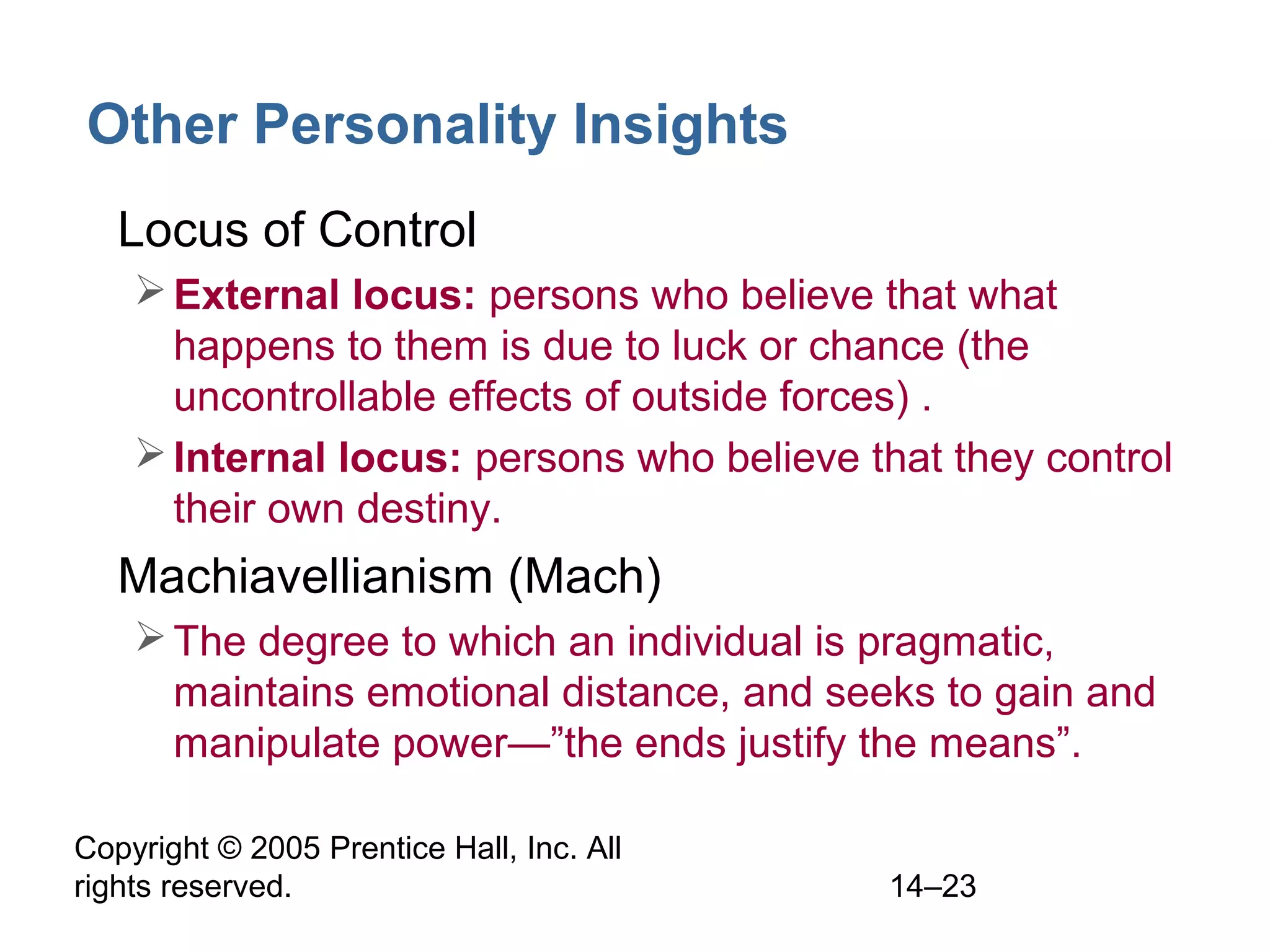
Other Personality Insights
• Locus of Control
External locus: persons who believe that what
happens to them is due to luck or chance (the
uncontrollable effects of outside forces) .
Internal locus: persons who believe that they control
their own destiny.
• Machiavellianism (Mach)
The degree to which an individual is pragmatic,
maintains emotional distance, and seeks to gain and
manipulate power—”the ends justify the means”.
Copyright © 2005 Prentice Hall, Inc. All
rights reserved. 14–24
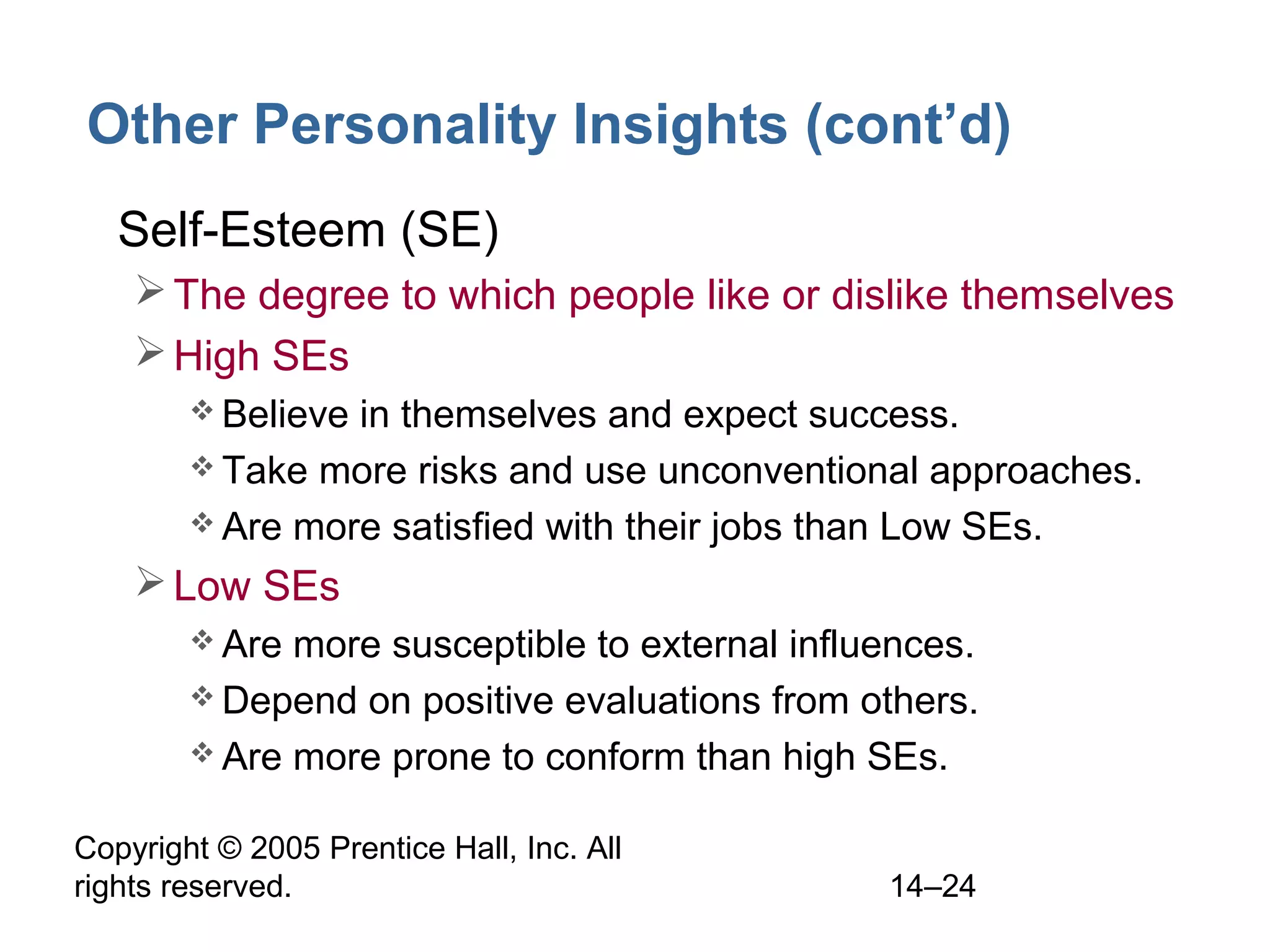
Other Personality Insights (cont’d)
• Self-Esteem (SE)
The degree to which people like or dislike themselves
High SEs
 Believe in themselves and expect success.
 Take more risks and use unconventional approaches.
 Are more satisfied with their jobs than Low SEs.
Low SEs
 Are more susceptible to external influences.
 Depend on positive evaluations from others.
 Are more prone to conform than high SEs.
Copyright © 2005 Prentice Hall, Inc. All
rights reserved. 14–25
Other Personality Insights (cont’d)
• Self-Monitoring
An individual’s ability to adjust his or her behavior to
external, situational factors.
High self-monitors:
 Are sensitive to external cues and behave differently in
different situations.
 Can present contradictory public persona and private
selves.
Low self-monitors
 Do not adjust their behavior to the situation.
 Are behaviorally consistent in public and private.
Copyright © 2005 Prentice Hall, Inc. All
rights reserved. 14–26
Other Personality Insights (cont’d)
• Risk-Taking
The propensity (willingness) to take risks.
 High risk-takers take less time and require less
information than low risk-takers when making a
decision.
Organizational effectiveness is maximized when the
risk-taking propensity of a manager is aligned with
the specific demands of the job assigned to the
manager.
Copyright © 2005 Prentice Hall, Inc. All
rights reserved. 14–27
Emotions and Intelligence
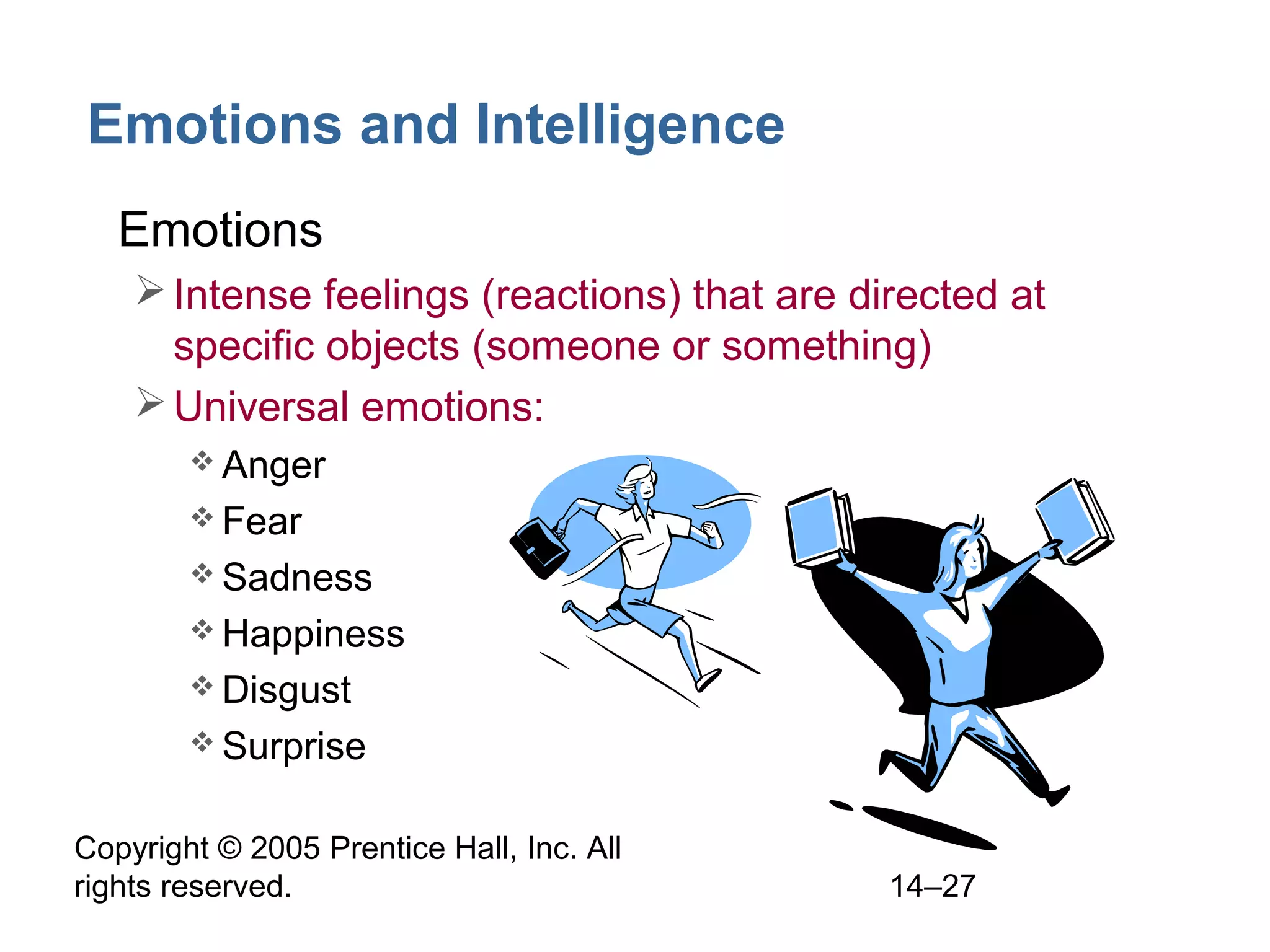
• Emotions
Intense feelings (reactions) that are directed at
specific objects (someone or something)
Universal emotions:
 Anger
 Fear
 Sadness
 Happiness
 Disgust
 Surprise
Copyright © 2005 Prentice Hall, Inc. All
rights reserved. 14–28
Emotions and Intelligence
• Emotional Intelligence (EI)
An assortment of noncognitive skills, capabilities, and
competencies that influence a person’s ability to
succeed in coping with environmental demands and
pressures.
Dimensions of EI:
 Self-awareness: knowing what you’re feeling
 Self-management: managing emotions and impulses
 Self-motivation: persisting despite setbacks and failures
 Empathy: sensing how others are feeling
 Social skills: handling the emotions of others
Copyright © 2005 Prentice Hall, Inc. All
rights reserved. 14–29
Understanding Personality Differences
• Personality-Job Fit Theory (Holland)
An employee’s job satisfaction and likelihood of
turnover depends on the compatibility of the
employee’s personality and occupation.
Key points of the theory:
 There are differences in personalities.
 There are different types of jobs.
 Job satisfaction and turnover are related to the match
between personality and job for an individual.
Copyright © 2005 Prentice Hall, Inc. All
rights reserved. 14–30
Perception
• Perception
A process by which individuals give meaning (reality)
to their environment by organizing and interpreting
their sensory impressions.
• Factors influencing perception:
The perceiver’s personal characteristics—interests,
biases and expectations
The target’s characteristics—distinctiveness, contrast,
and similarity)
The situation (context) factors—place, time, location
—draw attention or distract from the target
Copyright © 2005 Prentice Hall, Inc. All
rights reserved. 14–31
How We Perceive People
• Attribution Theory
How the actions of individuals are perceived by others
depends on what meaning (causation) we attribute to a
given behavior.
 Internally caused behavior: under the individual’s control
 Externally caused behavior: due to outside factors
Determining the source of behaviors:
 Distinctiveness: different behaviors in different situations
 Consensus: behaviors similar to others in same situation
 Consistency: regularity of the same behavior
Copyright © 2005 Prentice Hall, Inc. All
rights reserved. 14–32
How We Perceive People (cont’d)
• Attribution Theory (cont’d)
Fundamental attribution error
 The tendency to underestimate the influence of external
factors and to overestimate the influence of internal or
personal factors.
Self-serving bias
 The tendency of individuals to attribute their successes to
internal factors while blaming personal failures on
external factors.
Copyright © 2005 Prentice Hall, Inc. All
rights reserved. 14–33
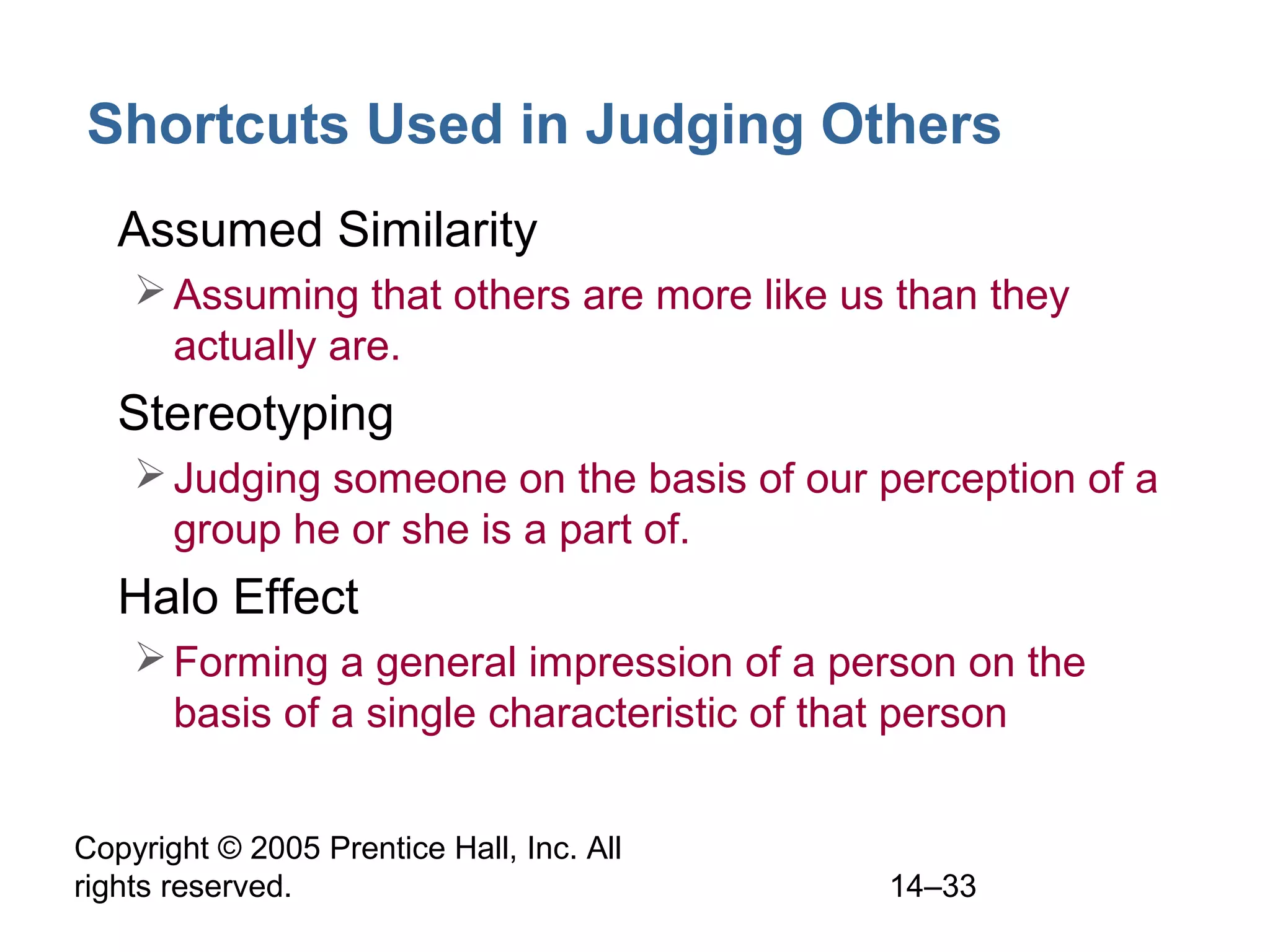
Shortcuts Used in Judging Others
• Assumed Similarity
Assuming that others are more like us than they
actually are.
• Stereotyping
Judging someone on the basis of our perception of a
group he or she is a part of.
• Halo Effect
Forming a general impression of a person on the
basis of a single characteristic of that person
Copyright © 2005 Prentice Hall, Inc. All
rights reserved. 14–34
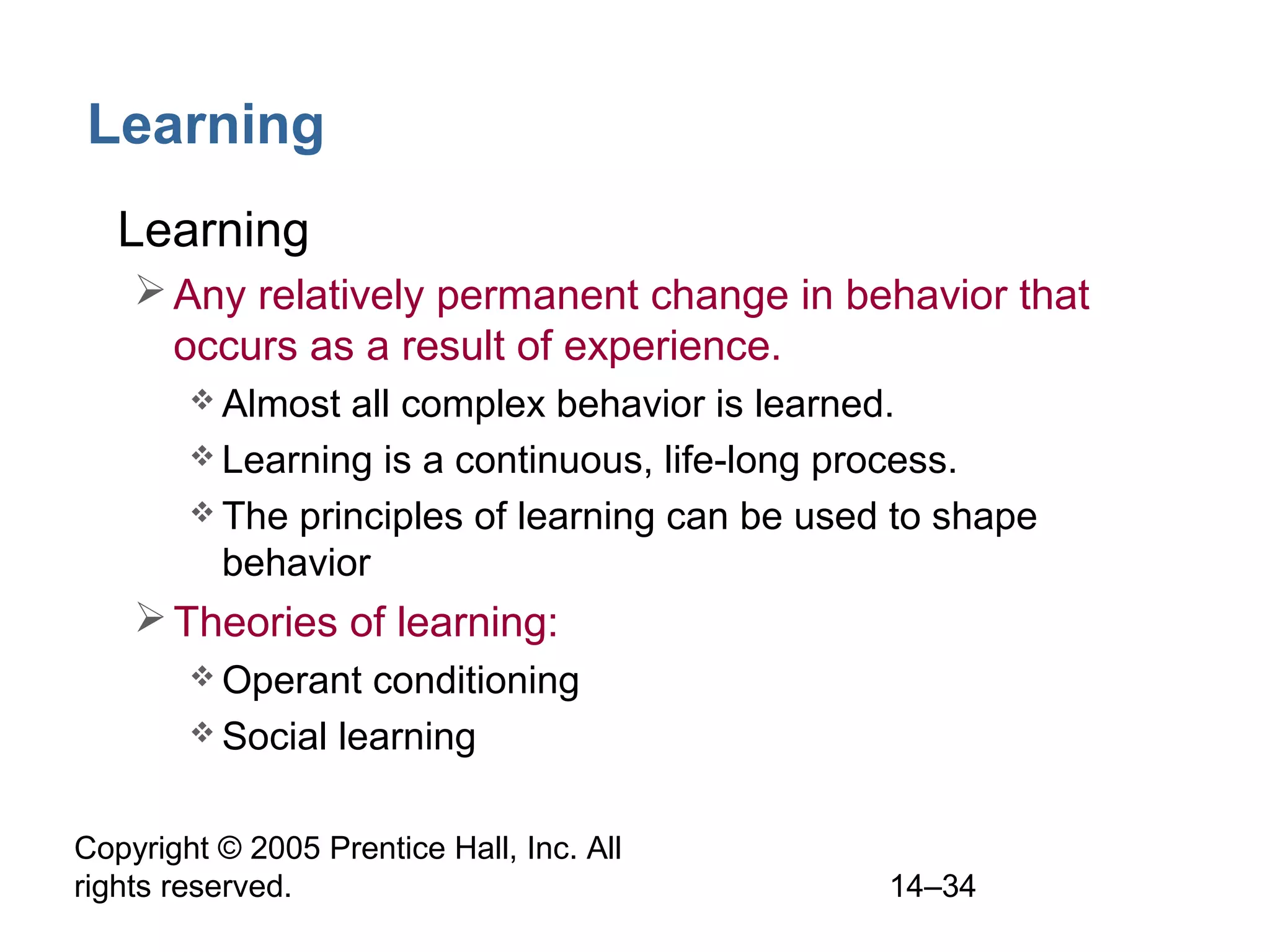
Learning
• Learning
Any relatively permanent change in behavior that
occurs as a result of experience.
 Almost all complex behavior is learned.
 Learning is a continuous, life-long process.
 The principles of learning can be used to shape
behavior
Theories of learning:
 Operant conditioning
 Social learning
Copyright © 2005 Prentice Hall, Inc. All
rights reserved. 14–35
Learning (cont’d)
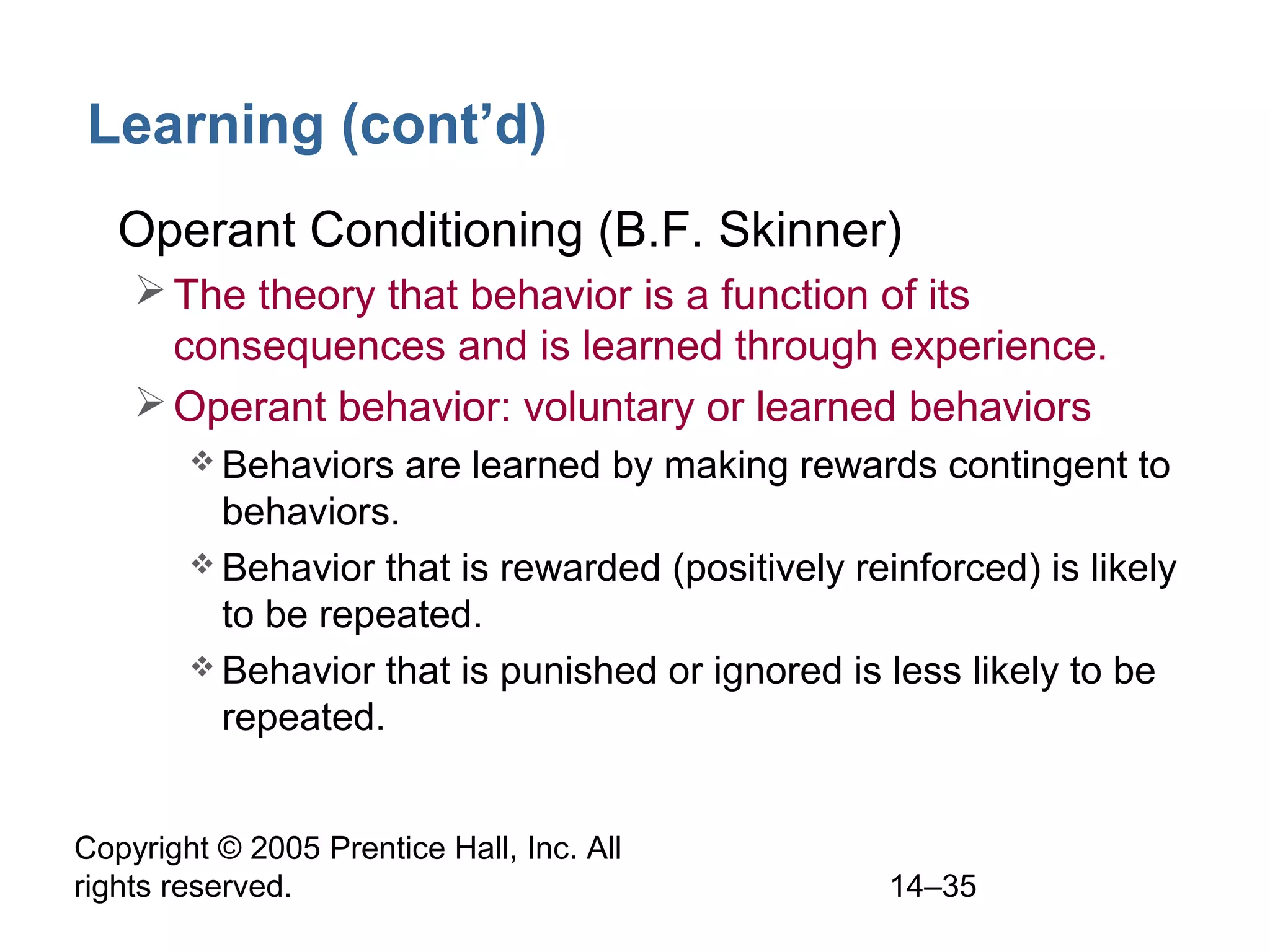
• Operant Conditioning (B.F. Skinner)
The theory that behavior is a function of its
consequences and is learned through experience.
Operant behavior: voluntary or learned behaviors
 Behaviors are learned by making rewards contingent to
behaviors.
 Behavior that is rewarded (positively reinforced) is likely
to be repeated.
 Behavior that is punished or ignored is less likely to be
repeated.
Copyright © 2005 Prentice Hall, Inc. All
rights reserved. 14–36
Learning (cont’d)
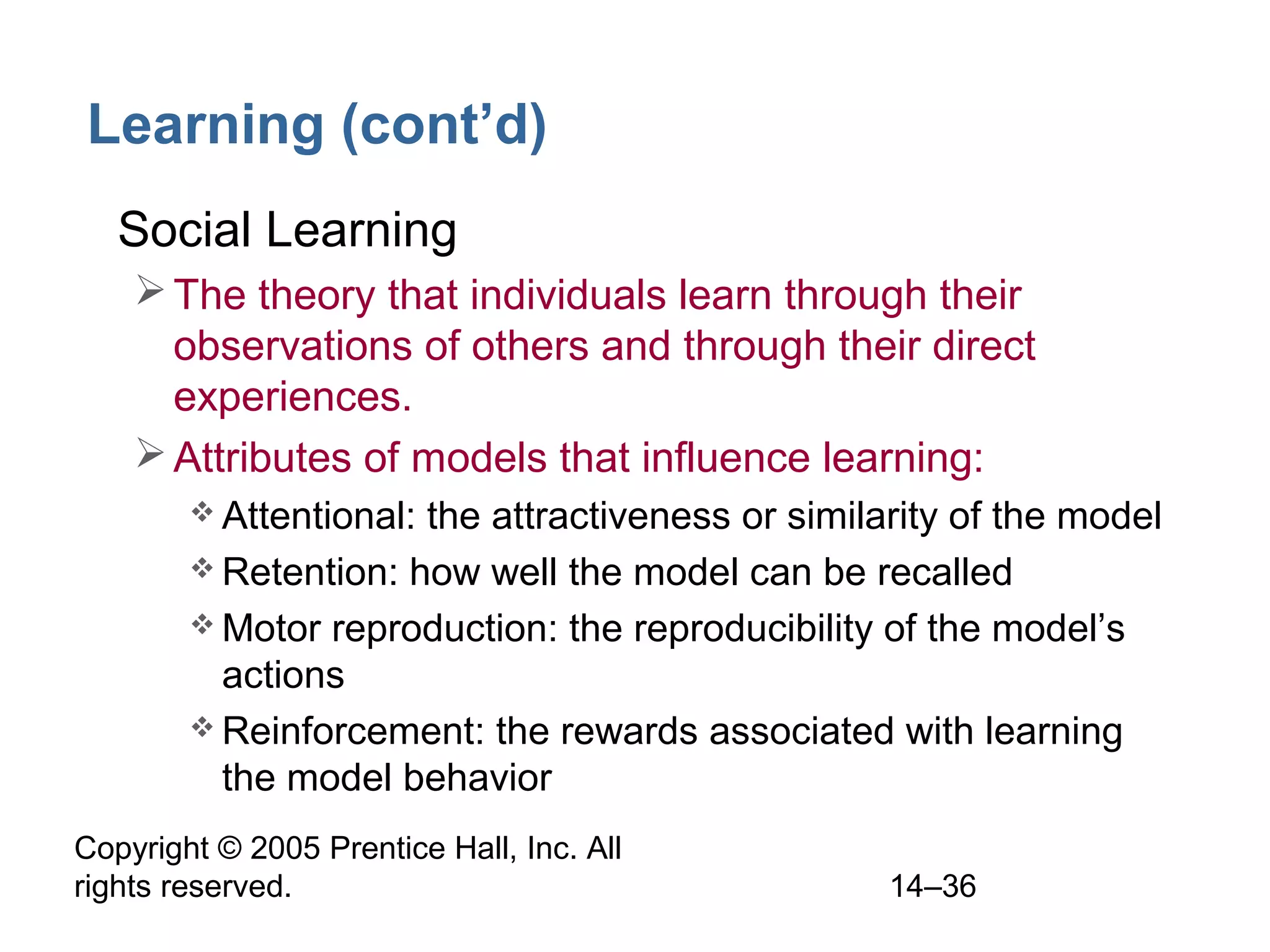
• Social Learning
The theory that individuals learn through their
observations of others and through their direct
experiences.
Attributes of models that influence learning:
 Attentional: the attractiveness or similarity of the model
 Retention: how well the model can be recalled
 Motor reproduction: the reproducibility of the model’s
actions
 Reinforcement: the rewards associated with learning
the model behavior
Copyright © 2005 Prentice Hall, Inc. All
rights reserved. 14–37
Learning (cont’d)
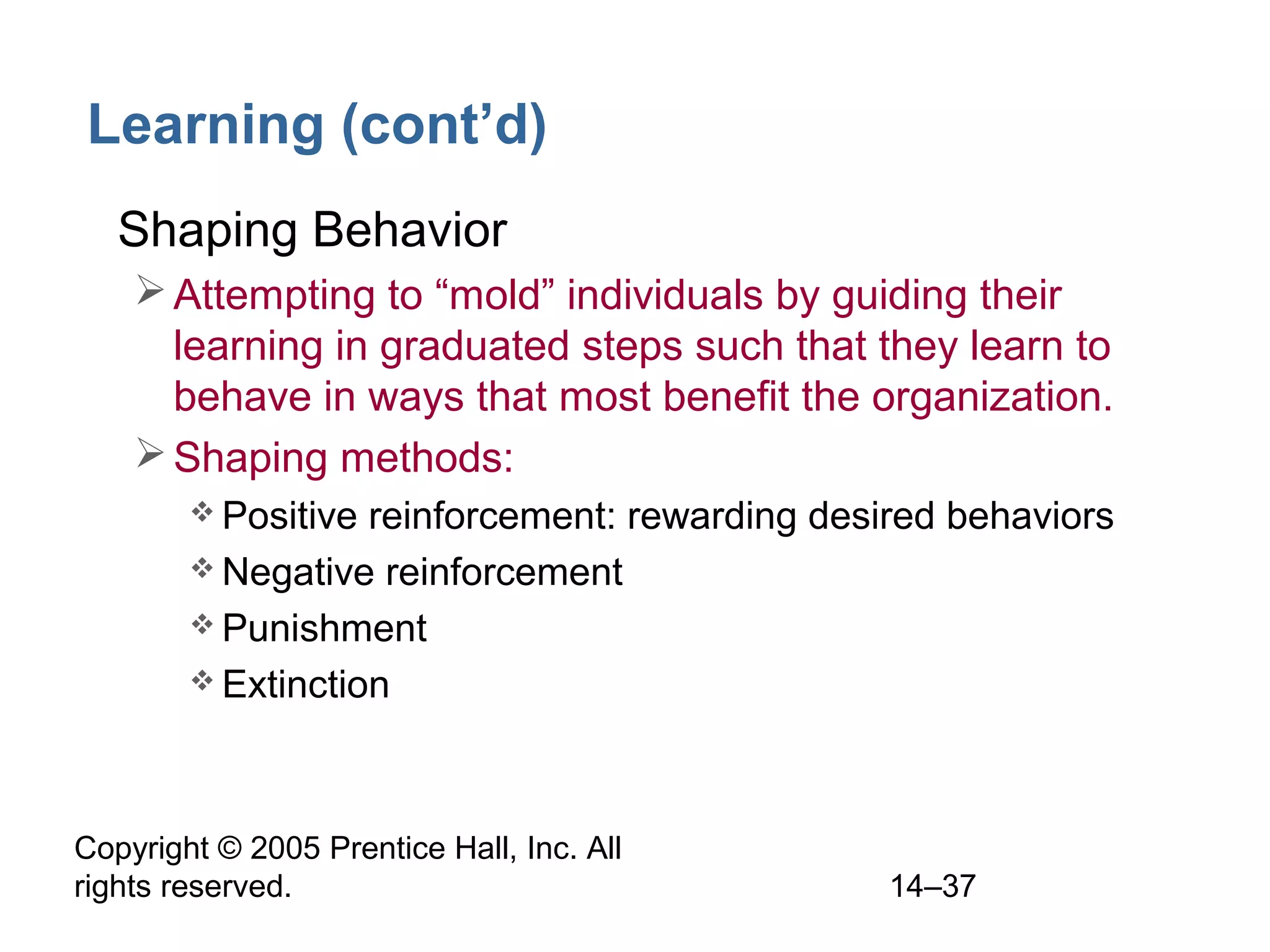
• Shaping Behavior
Attempting to “mold” individuals by guiding their
learning in graduated steps such that they learn to
behave in ways that most benefit the organization.
Shaping methods:
 Positive reinforcement: rewarding desired behaviors
 Negative reinforcement
 Punishment
 Extinction
Copyright © 2005 Prentice Hall, Inc. All
rights reserved. 14–38
Learning (cont’d)
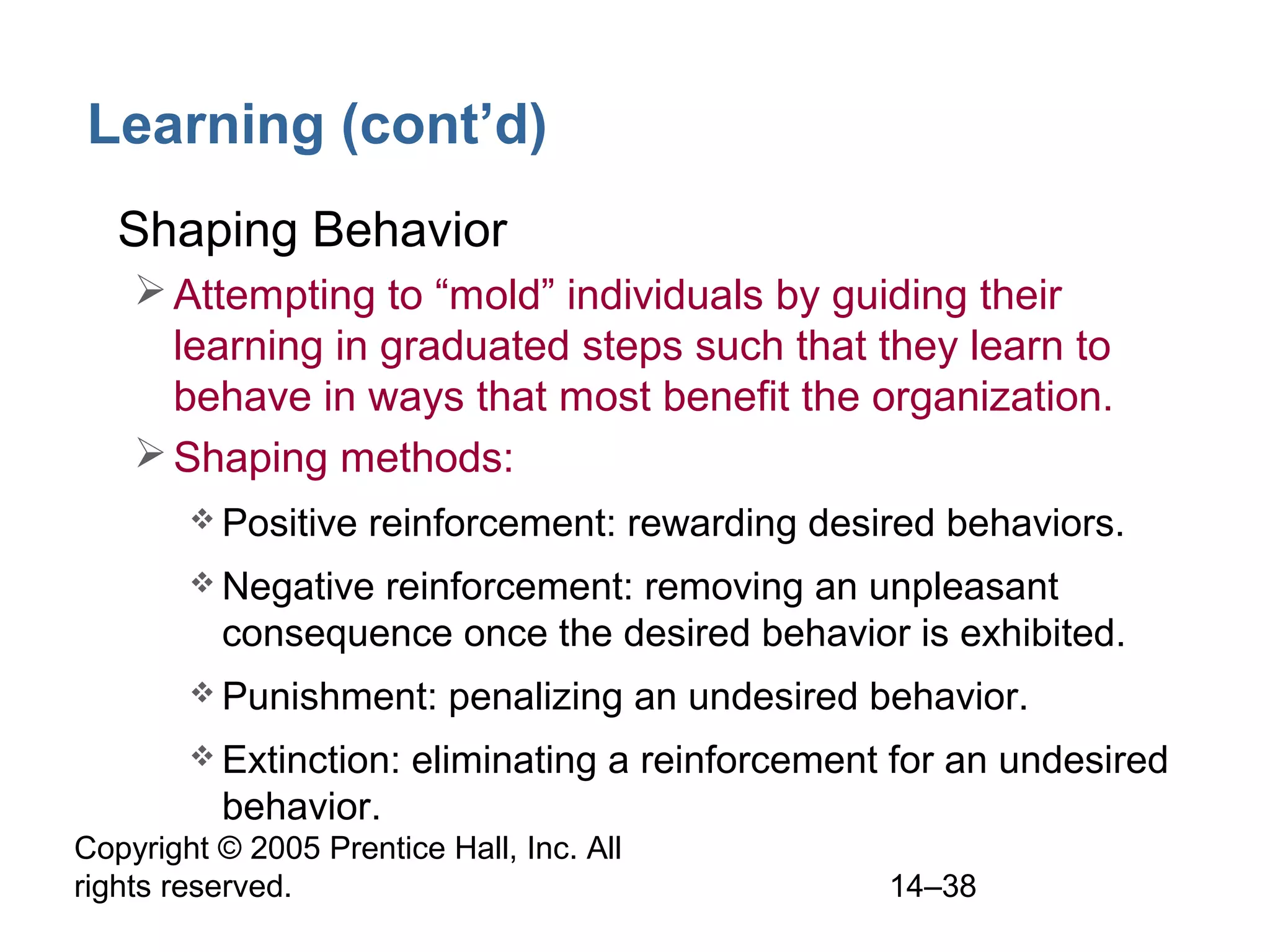
• Shaping Behavior
Attempting to “mold” individuals by guiding their
learning in graduated steps such that they learn to
behave in ways that most benefit the organization.
Shaping methods:
 Positive reinforcement: rewarding desired behaviors.
 Negative reinforcement: removing an unpleasant
consequence once the desired behavior is exhibited.
 Punishment: penalizing an undesired behavior.
 Extinction: eliminating a reinforcement for an undesired
behavior.

Management ch14

  • 1.
    PowerPoint Presentation byCharlie CookPowerPoint Presentation by Charlie Cook Copyright © 2005 Prentice Hall, Inc.Copyright © 2005 Prentice Hall, Inc. All rights reserved.All rights reserved. 8th edition Steven P. Robbins Mary Coulter
  • 2.
    Copyright © 2005Prentice Hall, Inc. All rights reserved. 14–2 L E A R N I N G O U T L I N E Follow this Learning Outline as you read and study this chapter. Why Look at Individual Behavior? • Describe the focus and the goals of organizational behavior. • Explain why the concept of an organization as an iceberg is important to understanding organizational behavior. • Define the five important employee behaviors that managers want to explain, predict, and influence. Attitudes • Describe the three components of an attitude. • Discuss three job-related attitudes. • Describe the impact of job satisfaction has on employee behavior.
  • 3.
    Copyright © 2005Prentice Hall, Inc. All rights reserved. 14–3 L E A R N I N G O U T L I N E (cont’d) Follow this Learning Outline as you read and study this chapter. Attitudes (cont’d) • Explain how individuals reconcile inconsistencies between attitudes and behavior. Personality • Contrast the MBTI and the big-five model of personality. • Describe the five personality traits that have proved to be most powerful in explaining individual behavior in organizations. • Tell how emotions and emotional intelligence impact behavior.
  • 4.
    Copyright © 2005Prentice Hall, Inc. All rights reserved. 14–4 L E A R N I N G O U T L I N E (cont’d) Follow this Learning Outline as you read and study this chapter. Perception • Explain how an understanding of perception can help managers better understand individual behavior. • Describe the key elements of attribution theory. • Discuss how the fundamental attribution error and self- serving bias can distort attributions. • Name three shortcuts used in judging others. Learning • Explain how operant conditioning helps managers understand, predict, and influence behavior. • Describe the implications of social learning theory for managing people at work. • Discuss how managers can shape behavior.
  • 5.
    Copyright © 2005Prentice Hall, Inc. All rights reserved. 14–5 Understanding Individual Behavior • Organizational Behavior (OB) The actions of people at work • Dual Focus of OB Individual behavior  Attitudes, personality, perception, learning, and motivation Group behavior  Norms, roles, team building, leadership, and conflict • Goals of OB To explain, predict and influence behavior
  • 6.
    Copyright © 2005Prentice Hall, Inc. All rights reserved. 14–6 Important Employee Behaviors • Employee Productivity A performance measure of both efficiency and effectiveness • Absenteeism The failure to report to work when expected • Turnover The voluntary and involuntary permanent withdrawal from an organization
  • 7.
    Copyright © 2005Prentice Hall, Inc. All rights reserved. 14–7 Important Employee Behaviors • Organizational Citizenship Behavior (OCB) Discretionary behavior that is not a part of an employee’s formal job requirements, but which promotes the effective functioning of the organization. • Job Satisfaction The individual’s general attitude toward his or her job
  • 8.
    Copyright © 2005Prentice Hall, Inc. All rights reserved. 14–8 Psychological Factors Affecting Employee Behavior • AttitudesAttitudes • PersonalityPersonality • PerceptionPerception • LearningLearning • AttitudesAttitudes • PersonalityPersonality • PerceptionPerception • LearningLearning • EmployeeEmployee ProductivityProductivity • AbsenteeismAbsenteeism • TurnoverTurnover • OrganizationalOrganizational CitizenshipCitizenship • Job SatisfactionJob Satisfaction • EmployeeEmployee ProductivityProductivity • AbsenteeismAbsenteeism • TurnoverTurnover • OrganizationalOrganizational CitizenshipCitizenship • Job SatisfactionJob Satisfaction
  • 9.
    Copyright © 2005Prentice Hall, Inc. All rights reserved. 14–9 Psychological Factors • Attitudes Evaluative statements—either favorable or unfavorable—concerning objects, people, or events. • Components Of An Attitude Cognitive component: the beliefs, opinions, knowledge, or information held by a person. Affective component: the emotional or feeling part of an attitude. Behavioral component: the intention to behave in a certain way.
  • 10.
    Copyright © 2005Prentice Hall, Inc. All rights reserved. 14–10 Psychological Factors (cont’d) • Job Satisfaction Job satisfaction is affected by level of income earned and by the type of job a worker does. • Job Satisfaction and Productivity For individuals, productivity appears to lead to job satisfaction. For organizations, those with more satisfied employees are more effective than those with less satisfied employees.
  • 11.
    Copyright © 2005Prentice Hall, Inc. All rights reserved. 14–11 Psychological Factors (cont’d) • Job Satisfaction and Absenteeism Satisfied employees tend to have lower levels of absenteeism. • Job Satisfaction and Turnover Satisfied employees have lower levels of turnover; dissatisfied employees have higher levels of turnover. Turnover is affected by the level of employee performance.  The preferential treatment afforded superior employees makes satisfaction less important in predicting their turnover decisions.
  • 12.
    Copyright © 2005Prentice Hall, Inc. All rights reserved. 14–12 Psychological Factors (cont’d) • Job Satisfaction and Customer Satisfaction The level of job satisfaction for frontline employees is related to increased customer satisfaction and loyalty. Interaction with dissatisfied customers can increase an employee’s job dissatisfaction. Actions to increase job satisfaction for customer service workers:  Hire upbeat and friendly employees.  Reward superior customer service.  Provide a positive work climate.  Use attitude surveys to track employee satisfaction.
  • 13.
    Copyright © 2005Prentice Hall, Inc. All rights reserved. 14–13 Psychological Factors (cont’d) • Job Involvement The degree to which an employee identifies with his or her job, actively participates in it, and considers his or her performance to be important to his or her self- worth.  High levels of commitment are related to fewer absences and lower resignation rates.
  • 14.
    Copyright © 2005Prentice Hall, Inc. All rights reserved. 14–14 Psychological Factors (cont’d) • Organizational Commitment Is the degree to which an employee identifies with a particular organization and its goals and wishes to maintain membership in the organization. Leads to lower levels of both absenteeism and turnover. Could be becoming an outmoded measure as the number of workers who change employers increases.
  • 15.
    Copyright © 2005Prentice Hall, Inc. All rights reserved. 14–15 Psychological Factors (cont’d) • Perceived Organizational Support Is the general belief of employees that their organization values their contribution and cares about their well-being. Represents the commitment of the organization to the employee. Providing high levels of support increases job satisfaction and lower turnover.
  • 16.
    Copyright © 2005Prentice Hall, Inc. All rights reserved. 14–16 Attitude Surveys • Attitude Surveys A instrument/document that presents employees with a set of statements or questions eliciting how they feel about their jobs, work groups, supervisors, or their organization. Provide management with feedback on employee perceptions of the organization and their jobs.
  • 17.
    Copyright © 2005Prentice Hall, Inc. All rights reserved. 14–17 Attitudes and Consistency • People seek consistency in two ways: Consistency among their attitudes. Consistency between their attitudes and behaviors. • If an inconsistency arises, individuals: Alter their attitudes or Alter their behavior or Develop a rationalization for the inconsistency
  • 18.
    Copyright © 2005Prentice Hall, Inc. All rights reserved. 14–18 Cognitive Dissonance Theory • Cognitive Dissonance Any incompatibility or inconsistency between attitudes or between behavior and attitudes.  Any form of inconsistency is uncomfortable and individuals will try to reduce the dissonance. The intensity of the desire to reduce the dissonance is influenced by:  The importance of the factors creating the dissonance.  The degree to which an individual believes that the factors causing the dissonance are controllable.  Rewards available to compensate for the dissonance.
  • 19.
    Copyright © 2005Prentice Hall, Inc. All rights reserved. 14–19 The Importance of Attitudes • Implication for Managers Attitudes warn of potential behavioral problems:  Managers should do things that generate the positive attitudes that reduce absenteeism and turnover. Attitudes influence behaviors of employees:  Managers should focus on helping employees become more productive to increase job satisfaction. Employees will try to reduce dissonance unless:  Managers identify the external sources of dissonance.  Managers provide rewards compensating for the dissonance.
  • 20.
    Copyright © 2005Prentice Hall, Inc. All rights reserved. 14–20 Personality • Personality The unique combination of psychological characteristics (measurable traits) that affect how a person reacts and interacts with others.
  • 21.
    Copyright © 2005Prentice Hall, Inc. All rights reserved. 14–21 Classifying Personality Traits • Myers Briggs Type Indicator (MBTI) A general personality assessment tool that measures the personality of an individual using four categories:  Social interaction: Extrovert or Introvert (E or I)  Preference for gathering data: Sensing or Intuitive (S or N)  Preference for decision making: Feeling or Thinking (F or T)  Style of decision making: Perceptive or Judgmental (P or J)
  • 22.
    Copyright © 2005Prentice Hall, Inc. All rights reserved. 14–22 The Big Five Model • Extraversion  Sociable, talkative, and assertive • Agreeableness  Good-natured, cooperative, and trusting • Conscientiousness  Responsible, dependable, persistent, and achievement oriented • Emotional Stability  Calm, enthusiastic, and secure or tense, nervous, and insecure • Openness to Experience  Imaginative, artistically sensitive, and intellectual
  • 23.
    Copyright © 2005Prentice Hall, Inc. All rights reserved. 14–23 Other Personality Insights • Locus of Control External locus: persons who believe that what happens to them is due to luck or chance (the uncontrollable effects of outside forces) . Internal locus: persons who believe that they control their own destiny. • Machiavellianism (Mach) The degree to which an individual is pragmatic, maintains emotional distance, and seeks to gain and manipulate power—”the ends justify the means”.
  • 24.
    Copyright © 2005Prentice Hall, Inc. All rights reserved. 14–24 Other Personality Insights (cont’d) • Self-Esteem (SE) The degree to which people like or dislike themselves High SEs  Believe in themselves and expect success.  Take more risks and use unconventional approaches.  Are more satisfied with their jobs than Low SEs. Low SEs  Are more susceptible to external influences.  Depend on positive evaluations from others.  Are more prone to conform than high SEs.
  • 25.
    Copyright © 2005Prentice Hall, Inc. All rights reserved. 14–25 Other Personality Insights (cont’d) • Self-Monitoring An individual’s ability to adjust his or her behavior to external, situational factors. High self-monitors:  Are sensitive to external cues and behave differently in different situations.  Can present contradictory public persona and private selves. Low self-monitors  Do not adjust their behavior to the situation.  Are behaviorally consistent in public and private.
  • 26.
    Copyright © 2005Prentice Hall, Inc. All rights reserved. 14–26 Other Personality Insights (cont’d) • Risk-Taking The propensity (willingness) to take risks.  High risk-takers take less time and require less information than low risk-takers when making a decision. Organizational effectiveness is maximized when the risk-taking propensity of a manager is aligned with the specific demands of the job assigned to the manager.
  • 27.
    Copyright © 2005Prentice Hall, Inc. All rights reserved. 14–27 Emotions and Intelligence • Emotions Intense feelings (reactions) that are directed at specific objects (someone or something) Universal emotions:  Anger  Fear  Sadness  Happiness  Disgust  Surprise
  • 28.
    Copyright © 2005Prentice Hall, Inc. All rights reserved. 14–28 Emotions and Intelligence • Emotional Intelligence (EI) An assortment of noncognitive skills, capabilities, and competencies that influence a person’s ability to succeed in coping with environmental demands and pressures. Dimensions of EI:  Self-awareness: knowing what you’re feeling  Self-management: managing emotions and impulses  Self-motivation: persisting despite setbacks and failures  Empathy: sensing how others are feeling  Social skills: handling the emotions of others
  • 29.
    Copyright © 2005Prentice Hall, Inc. All rights reserved. 14–29 Understanding Personality Differences • Personality-Job Fit Theory (Holland) An employee’s job satisfaction and likelihood of turnover depends on the compatibility of the employee’s personality and occupation. Key points of the theory:  There are differences in personalities.  There are different types of jobs.  Job satisfaction and turnover are related to the match between personality and job for an individual.
  • 30.
    Copyright © 2005Prentice Hall, Inc. All rights reserved. 14–30 Perception • Perception A process by which individuals give meaning (reality) to their environment by organizing and interpreting their sensory impressions. • Factors influencing perception: The perceiver’s personal characteristics—interests, biases and expectations The target’s characteristics—distinctiveness, contrast, and similarity) The situation (context) factors—place, time, location —draw attention or distract from the target
  • 31.
    Copyright © 2005Prentice Hall, Inc. All rights reserved. 14–31 How We Perceive People • Attribution Theory How the actions of individuals are perceived by others depends on what meaning (causation) we attribute to a given behavior.  Internally caused behavior: under the individual’s control  Externally caused behavior: due to outside factors Determining the source of behaviors:  Distinctiveness: different behaviors in different situations  Consensus: behaviors similar to others in same situation  Consistency: regularity of the same behavior
  • 32.
    Copyright © 2005Prentice Hall, Inc. All rights reserved. 14–32 How We Perceive People (cont’d) • Attribution Theory (cont’d) Fundamental attribution error  The tendency to underestimate the influence of external factors and to overestimate the influence of internal or personal factors. Self-serving bias  The tendency of individuals to attribute their successes to internal factors while blaming personal failures on external factors.
  • 33.
    Copyright © 2005Prentice Hall, Inc. All rights reserved. 14–33 Shortcuts Used in Judging Others • Assumed Similarity Assuming that others are more like us than they actually are. • Stereotyping Judging someone on the basis of our perception of a group he or she is a part of. • Halo Effect Forming a general impression of a person on the basis of a single characteristic of that person
  • 34.
    Copyright © 2005Prentice Hall, Inc. All rights reserved. 14–34 Learning • Learning Any relatively permanent change in behavior that occurs as a result of experience.  Almost all complex behavior is learned.  Learning is a continuous, life-long process.  The principles of learning can be used to shape behavior Theories of learning:  Operant conditioning  Social learning
  • 35.
    Copyright © 2005Prentice Hall, Inc. All rights reserved. 14–35 Learning (cont’d) • Operant Conditioning (B.F. Skinner) The theory that behavior is a function of its consequences and is learned through experience. Operant behavior: voluntary or learned behaviors  Behaviors are learned by making rewards contingent to behaviors.  Behavior that is rewarded (positively reinforced) is likely to be repeated.  Behavior that is punished or ignored is less likely to be repeated.
  • 36.
    Copyright © 2005Prentice Hall, Inc. All rights reserved. 14–36 Learning (cont’d) • Social Learning The theory that individuals learn through their observations of others and through their direct experiences. Attributes of models that influence learning:  Attentional: the attractiveness or similarity of the model  Retention: how well the model can be recalled  Motor reproduction: the reproducibility of the model’s actions  Reinforcement: the rewards associated with learning the model behavior
  • 37.
    Copyright © 2005Prentice Hall, Inc. All rights reserved. 14–37 Learning (cont’d) • Shaping Behavior Attempting to “mold” individuals by guiding their learning in graduated steps such that they learn to behave in ways that most benefit the organization. Shaping methods:  Positive reinforcement: rewarding desired behaviors  Negative reinforcement  Punishment  Extinction
  • 38.
    Copyright © 2005Prentice Hall, Inc. All rights reserved. 14–38 Learning (cont’d) • Shaping Behavior Attempting to “mold” individuals by guiding their learning in graduated steps such that they learn to behave in ways that most benefit the organization. Shaping methods:  Positive reinforcement: rewarding desired behaviors.  Negative reinforcement: removing an unpleasant consequence once the desired behavior is exhibited.  Punishment: penalizing an undesired behavior.  Extinction: eliminating a reinforcement for an undesired behavior.