Topic:
Three Step
Writing Process
Importance of Written Communication
in Business
 There are different forms of
communication in business, such as
verbal, nonverbal and written. Each
of these communication forms is
significant. However, written
communication usually requires more
thought and effort. Writing must be
concise, informative and easy to read
as both an informative and
instructional tool.
 Written communication is also important for business
advertising. Small companies need to promote their
businesses to potential consumers and business
customers. Written advertisements include direct mail
pieces such as sales letters and brochures, magazine
display ads, fliers, Internet ads and catalogs. Advertising
is designed to attract attention then compel people to
purchase products.
What is three step Writing Process?
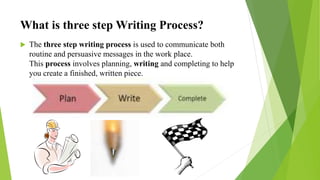
 The three step writing process is used to communicate both
routine and persuasive messages in the work place.
This process involves planning, writing and completing to help
you create a finished, written piece.
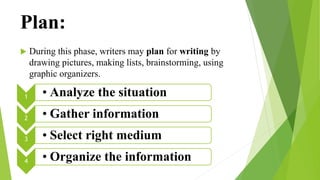
Plan:
 During this phase, writers may plan for writing by
drawing pictures, making lists, brainstorming, using
graphic organizers.
1 • Analyze the situation
2 • Gather information
3 • Select right medium
4 • Organize the information
1. Analyze Your Situation
Chapter 4 - 7
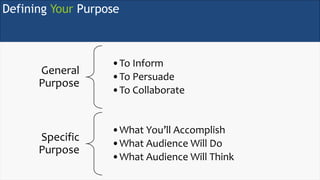
Defining Your Purpose
General
Purpose
•To Inform
•To Persuade
•To Collaborate
Specific
Purpose
•What You’ll Accomplish
•What Audience Will Do
•What Audience Will Think
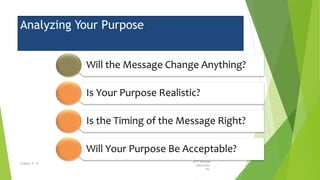
Analyzing Your Purpose
Copyright ©
2017 Pearson
Education,
Inc.
Chapter 4 - 8
Will the Message Change Anything?
Is Your Purpose Realistic?
Is the Timing of the Message Right?
Will Your Purpose Be Acceptable?
Copyright ©
2017 Pearson
Education,
Inc.
Chapter 4 - 9
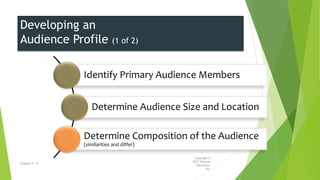
Developing an
Audience Profile (1 of 2)
Identify Primary Audience Members
Determine Audience Size and Location
Determine Composition of the Audience
(similarities and differ)
Copyright ©
2017 Pearson
Education,
Inc.
Chapter 4 - 10
Developing an
Audience Profile (2 of 2)
Gauge Their Level of Understanding
Check Their Expectations/Preferences
Forecast Their Probable Reaction
2. Gathering Information
 (LO 3) Discuss information-gathering options for simple messages, and identify
three attributes of quality information.
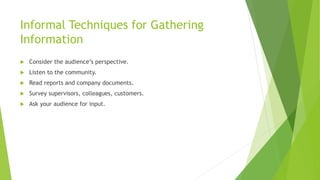
Informal Techniques for Gathering
Information
 Consider the audience’s perspective.
 Listen to the community.
 Read reports and company documents.
 Survey supervisors, colleagues, customers.
 Ask your audience for input.
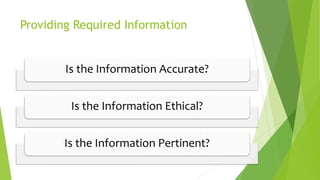
Providing Required Information
Is the Information Accurate?
Is the Information Ethical?
Is the Information Pertinent?
3. Selecting the right medium
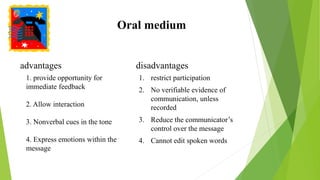
Oral medium
advantages disadvantages
1. restrict participation
2. No verifiable evidence of
communication, unless
recorded
3. Reduce the communicator’s
control over the message
4. Cannot edit spoken words
1. provide opportunity for
immediate feedback
2. Allow interaction
3. Nonverbal cues in the tone
4. Express emotions within the
message
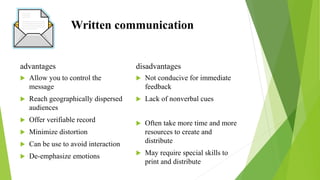
Written communication
advantages
 Allow you to control the
message
 Reach geographically dispersed
audiences
 Offer verifiable record
 Minimize distortion
 Can be use to avoid interaction
 De-emphasize emotions
disadvantages
 Not conducive for immediate
feedback
 Lack of nonverbal cues
 Often take more time and more
resources to create and
distribute
 May require special skills to
print and distribute
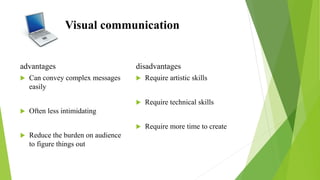
Visual communication
advantages
 Can convey complex messages
easily
 Often less intimidating
 Reduce the burden on audience
to figure things out
disadvantages
 Require artistic skills
 Require technical skills
 Require more time to create
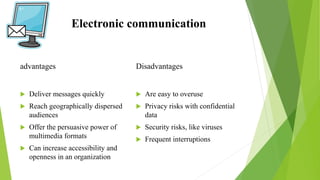
Electronic communication
advantages
 Deliver messages quickly
 Reach geographically dispersed
audiences
 Offer the persuasive power of
multimedia formats
 Can increase accessibility and
openness in an organization
Disadvantages
 Are easy to overuse
 Privacy risks with confidential
data
 Security risks, like viruses
 Frequent interruptions
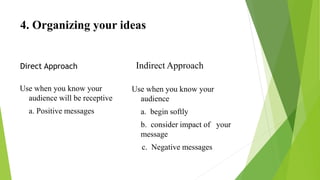
4. Organizing your ideas
Direct Approach
Use when you know your
audience will be receptive
a. Positive messages
Indirect Approach
Use when you know your
audience
a. begin softly
b. consider impact of your
message
c. Negative messages
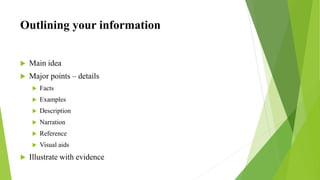
Outlining your information
 Main idea
 Major points – details
 Facts
 Examples
 Description
 Narration
 Reference
 Visual aids
 Illustrate with evidence
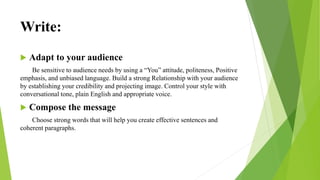
Write:
 Adapt to your audience
Be sensitive to audience needs by using a “You” attitude, politeness, Positive
emphasis, and unbiased language. Build a strong Relationship with your audience
by establishing your credibility and projecting image. Control your style with
conversational tone, plain English and appropriate voice.
 Compose the message
Choose strong words that will help you create effective sentences and
coherent paragraphs.
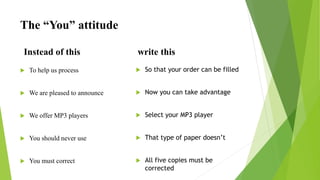
The “You” attitude
Instead of this
 To help us process
 We are pleased to announce
 We offer MP3 players
 You should never use
 You must correct
write this
 So that your order can be filled
 Now you can take advantage
 Select your MP3 player
 That type of paper doesn’t
 All five copies must be
corrected
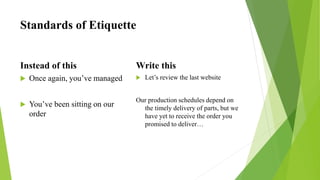
Standards of Etiquette
Instead of this
 Once again, you’ve managed
 You’ve been sitting on our
order
Write this
 Let’s review the last website
Our production schedules depend on
the timely delivery of parts, but we
have yet to receive the order you
promised to deliver…
Emphasizing the Positive
Instead of this
 It is impossible to repair
 We apologize for inconveniencing
you
 We wasted $300,000
Write this
 Your computer can be ready
 The rennovations that are under
way will help us serve you better
 Our $300,000 advertisement did
not pay off;
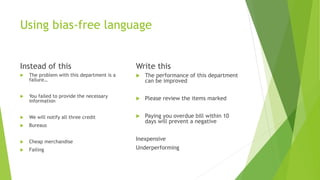
Using bias-free language
Instead of this
 The problem with this department is a
failure…
 You failed to provide the necessary
information
 We will notify all three credit
 Bureaus
 Cheap merchandise
 Failing
Write this
 The performance of this department
can be improved
 Please review the items marked
 Paying you overdue bill within 10
days will prevent a negative
Inexpensive
Underperforming
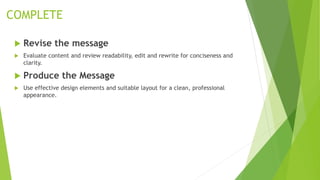
COMPLETE
 Revise the message
 Evaluate content and review readability, edit and rewrite for conciseness and
clarity.
 Produce the Message
 Use effective design elements and suitable layout for a clean, professional
appearance.
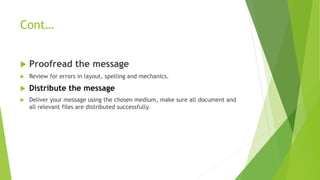
Cont…
 Proofread the message
 Review for errors in layout, spelling and mechanics.
 Distribute the message
 Deliver your message using the chosen medium, make sure all document and
all relevant files are distributed successfully.
End

Three step writing process

  • 1.
  • 2.
    Importance of WrittenCommunication in Business  There are different forms of communication in business, such as verbal, nonverbal and written. Each of these communication forms is significant. However, written communication usually requires more thought and effort. Writing must be concise, informative and easy to read as both an informative and instructional tool.
  • 3.
     Written communicationis also important for business advertising. Small companies need to promote their businesses to potential consumers and business customers. Written advertisements include direct mail pieces such as sales letters and brochures, magazine display ads, fliers, Internet ads and catalogs. Advertising is designed to attract attention then compel people to purchase products.
  • 4.
    What is threestep Writing Process?  The three step writing process is used to communicate both routine and persuasive messages in the work place. This process involves planning, writing and completing to help you create a finished, written piece.
  • 5.
    Plan:  During thisphase, writers may plan for writing by drawing pictures, making lists, brainstorming, using graphic organizers. 1 • Analyze the situation 2 • Gather information 3 • Select right medium 4 • Organize the information
  • 6.
    1. Analyze YourSituation
  • 7.
    Chapter 4 -7 Defining Your Purpose General Purpose •To Inform •To Persuade •To Collaborate Specific Purpose •What You’ll Accomplish •What Audience Will Do •What Audience Will Think
  • 8.
    Analyzing Your Purpose Copyright© 2017 Pearson Education, Inc. Chapter 4 - 8 Will the Message Change Anything? Is Your Purpose Realistic? Is the Timing of the Message Right? Will Your Purpose Be Acceptable?
  • 9.
    Copyright © 2017 Pearson Education, Inc. Chapter4 - 9 Developing an Audience Profile (1 of 2) Identify Primary Audience Members Determine Audience Size and Location Determine Composition of the Audience (similarities and differ)
  • 10.
    Copyright © 2017 Pearson Education, Inc. Chapter4 - 10 Developing an Audience Profile (2 of 2) Gauge Their Level of Understanding Check Their Expectations/Preferences Forecast Their Probable Reaction
  • 11.
    2. Gathering Information (LO 3) Discuss information-gathering options for simple messages, and identify three attributes of quality information.
  • 12.
    Informal Techniques forGathering Information  Consider the audience’s perspective.  Listen to the community.  Read reports and company documents.  Survey supervisors, colleagues, customers.  Ask your audience for input.
  • 13.
    Providing Required Information Isthe Information Accurate? Is the Information Ethical? Is the Information Pertinent?
  • 14.
    3. Selecting theright medium
  • 15.
    Oral medium advantages disadvantages 1.restrict participation 2. No verifiable evidence of communication, unless recorded 3. Reduce the communicator’s control over the message 4. Cannot edit spoken words 1. provide opportunity for immediate feedback 2. Allow interaction 3. Nonverbal cues in the tone 4. Express emotions within the message
  • 16.
    Written communication advantages  Allowyou to control the message  Reach geographically dispersed audiences  Offer verifiable record  Minimize distortion  Can be use to avoid interaction  De-emphasize emotions disadvantages  Not conducive for immediate feedback  Lack of nonverbal cues  Often take more time and more resources to create and distribute  May require special skills to print and distribute
  • 17.
    Visual communication advantages  Canconvey complex messages easily  Often less intimidating  Reduce the burden on audience to figure things out disadvantages  Require artistic skills  Require technical skills  Require more time to create
  • 18.
    Electronic communication advantages  Delivermessages quickly  Reach geographically dispersed audiences  Offer the persuasive power of multimedia formats  Can increase accessibility and openness in an organization Disadvantages  Are easy to overuse  Privacy risks with confidential data  Security risks, like viruses  Frequent interruptions
  • 19.
    4. Organizing yourideas Direct Approach Use when you know your audience will be receptive a. Positive messages Indirect Approach Use when you know your audience a. begin softly b. consider impact of your message c. Negative messages
  • 20.
    Outlining your information Main idea  Major points – details  Facts  Examples  Description  Narration  Reference  Visual aids  Illustrate with evidence
  • 21.
    Write:  Adapt toyour audience Be sensitive to audience needs by using a “You” attitude, politeness, Positive emphasis, and unbiased language. Build a strong Relationship with your audience by establishing your credibility and projecting image. Control your style with conversational tone, plain English and appropriate voice.  Compose the message Choose strong words that will help you create effective sentences and coherent paragraphs.
  • 22.
    The “You” attitude Insteadof this  To help us process  We are pleased to announce  We offer MP3 players  You should never use  You must correct write this  So that your order can be filled  Now you can take advantage  Select your MP3 player  That type of paper doesn’t  All five copies must be corrected
  • 23.
    Standards of Etiquette Insteadof this  Once again, you’ve managed  You’ve been sitting on our order Write this  Let’s review the last website Our production schedules depend on the timely delivery of parts, but we have yet to receive the order you promised to deliver…
  • 24.
    Emphasizing the Positive Insteadof this  It is impossible to repair  We apologize for inconveniencing you  We wasted $300,000 Write this  Your computer can be ready  The rennovations that are under way will help us serve you better  Our $300,000 advertisement did not pay off;
  • 25.
    Using bias-free language Insteadof this  The problem with this department is a failure…  You failed to provide the necessary information  We will notify all three credit  Bureaus  Cheap merchandise  Failing Write this  The performance of this department can be improved  Please review the items marked  Paying you overdue bill within 10 days will prevent a negative Inexpensive Underperforming
  • 26.
    COMPLETE  Revise themessage  Evaluate content and review readability, edit and rewrite for conciseness and clarity.  Produce the Message  Use effective design elements and suitable layout for a clean, professional appearance.
  • 27.
    Cont…  Proofread themessage  Review for errors in layout, spelling and mechanics.  Distribute the message  Deliver your message using the chosen medium, make sure all document and all relevant files are distributed successfully.
  • 28.