Lecture 1
LECTURER
AMNA A. REHMAN
Effective Communication in
Business
What is Communication?
Communication is the process of sending and receiving messages.
Communication is the process of exchanging information, data, ideas
and opinions
Two way process for exchanging ideas or information
Business Communication
Business Communication is the communication that facilitates business deals/activities in and
out side of the organization.
Business communication is the communication required in order to make business deals.
Effective Communication in
Business
The communication that is used within formal business environment and produces desired
results and outputs is called effective communication
Effective business communication is the act of influencing and inducing others to act in the
manner intended by the speaker or writer/ speaker
If the desired objective of communication is achieved, we can say that it is “effective
communication”.
If your communication get the proper response from the receiver it means you have effectively
conveyed the message.
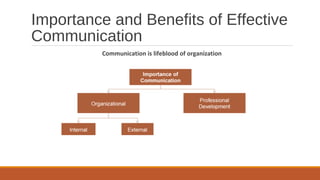
Importance and Benefits of Effective
Communication
Communication is lifeblood of organization
Communication at Internal Level
Downward Communication
It is what the employees gets from the management. Organizational decisions are usually made
at the top and then flow down to the people who will carry them out.
Upward Communication
It is what the management gets from employees. To solve problems and make intelligent
decisions, managers must learn what’s going on in the organization. E.g. suggestions, feedbacks.
Horizontal Communication
Communication also flows from one department to another, either laterally or diagonally. E.g.
Peer to peer communication
Importance At External Level
Communication relates an enterprise to its external environment:
Micro- Level
◦ 1-customer
◦ 2-supplier
◦ 3-stockholders
◦ 4-distributor
◦ 5-competitor
Macro Level
◦ 1-Technological
◦ 2-Legal/Political
◦ 3- Economic
◦ 4. Socio Cultural
Professional Development
The lack of effective communication skills have a negative impact on the personal as well as
professional life of a person.
A valuable requirement of the job.
Essential For Promotion
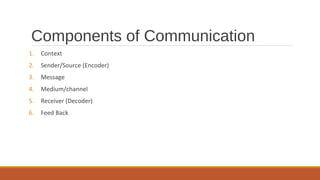
Components of Communication
1. Context
2. Sender/Source (Encoder)
3. Message
4. Medium/channel
5. Receiver (Decoder)
6. Feed Back
Context
Every message stars with Context.
The situation in which your message is delivered is the context. This
may include the surrounding environment or broader culture
(corporate culture, international cultures, and so on).
Sender/Source (Encoder)
As the source of the message, you need to be clear about why you're communicating, and what
you want to communicate. You also need to be confident that the information you're
communicating is useful and accurate.
When you are sending the message, you are the “Encoder” .
This is the process of transferring the information you want to communicate into a form that can
be sent and correctly decoded at the other end.
Message
Message is basically the basic idea/thought/information that you want to communicate.
The message may be Verbal (Written or Spoken) or Non-Verbal ( Symbols, Pictures or oral).
This is very much important component of communication
Your message should be or MUST be clear and easy to understand
You must be well aware about your receiver.
While preparing a message you should keep in mind how your receiver will interpret the
message
You should also keep in mind your relationship with the receiver while preparing message.
Channel/Medium
Medium is basically channel through which your message reaches to receiver & channel vary
from situation to situation.
Examples: face-to-face meetings, telephone and videoconferencing
Written channels includes letters, emails, memos and reports.
Different channels have different strengths and weaknesses. For example, it's not particularly
effective to give a long list of directions verbally, while you'll quickly cause problems if you give
someone negative feedback using email.
Receiver (Decoder)
It is the person to whom the message is sent.
Feed Back
Feedback is basically the response/reaction of Receiver after receiving the message.
Sender always need feedback to examine the success or failure of the message/communication
process.
Concepts and problems of
communication
1. Convention of Meaning
2. Perception of Reality
3. Values, Attitude, Opinion
Conventions of Meaning
A fundamental principle of communication is that the symbols the sender uses to communicate
message must have essentially the same meaning in both the sender’s and receiver’s mind.
Miscommunication occurs when the sender and receiver have different meanings for the
symbols used.
Denotative Meaning
Primary, common and original meaning
Connotative Meaning
Secondary, culturally assigned and narrowly acceptable meaning
Perception of Reality
World around us provides special experience to every individual
We make our own abstraction, inferences and evaluations of world around us
Abstraction is focusing on something while omitting others.
On many occasions abstracting is necessary. However, you should be cautious about “slanted”
statements.
Differences in abstracting take place not only when persons describe events but also when they
describe people and objects.
Slanting is unfair in factual reporting.
When presenting some particular facts, you include your own biased ideas into it, you make slanting
statement.
Try not to let personal preferences affect your factual reporting of information.
Perception of Reality cont…
Inferring
Conclusions made by reasoning from evidence are called inferences.
We make assumptions and draw conclusions even though we are not able to immediately verify
the evidence.
Some inferences are both necessary and desirable; others are risky, even dangerous.
Necessary Inferences
When we reach a foreign country, we are sure that we will be treated politely.
we post a letter, we infer that it will reach its destination.
Values, Attitude, Opinion
A speaker/writer should communicate keeping in mind the addressee’s attitude, cultural values
and personal opinions.
◦A receiver’s attitude toward a message can determine whether it is accepted, rejected,
distorted or avoided.
◦Favorable or Unfavorable Information
◦Senders’ credibility
◦ People react favorably when the message the receive agree with their mental filters
◦ Closed Minds
◦ Stereotyping
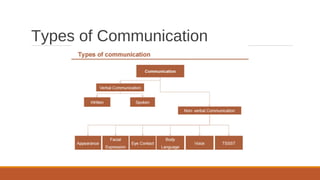
Types of Communication
Non-verbal Communication
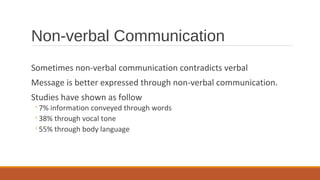
Sometimes non-verbal communication contradicts verbal
Message is better expressed through non-verbal communication.
Studies have shown as follow
◦7% information conveyed through words
◦38% through vocal tone
◦55% through body language
Appearance
When you are speaking to one person face to face, Personal Appearance and Appearance of
your surrounding convey nonverbal message.
Personal Appearance
Clothing, hairstyle, neatness, jewelry, cosmetics, body size
Appearance Of Surrounding
Room size, location, furnishings, machines, architecture, wall decoration, lighting and the other
related features wherever people communicate.
Effect on written messages
The format, neatness, and language of written message sends a nonverbal message to the
reader.
Facial expression
A facial expression results from one or more motions or positions of the muscles of the face.
Seven universally recognized emotions shown through facial expressions: fear, anger, surprise,
contempt, disgust, happiness, and sadness
Eye Contact
Maintain eye contact 70% to 80% of the time.
Make everyone feel included and important.
Look at the person you're speaking to you.
If you're addressing a small or large group, break the room into three parts. Focus on one
individual, make a point, shift your gaze to another part of the room, make a point, and do the
same for the rest of the room.
Body Language
Posture, Gestures & Body Movements convey message & add to or subtract your oral message.
Gesture
A body gesture is a movement made with a limb, especially the hands, to express, confirm,
emphasize or back up the speaker’s attitude or intention.
Posture
Body posture is the bearing or the position of the speaker’s body. when the speaker is slouched
or erect, his or her legs crossed or arms folded, such postures convey a degree of formality or
relaxation.
Voice
Pitch: It is how thick and how thin your voice is.
Rate: It is the number of words you speak in one minute.
Volume: It is how loud and quiet you speak.
Tone: It is the intonation of where you rise and where you drop your voice.
Vocal Quality: It is the natural quality of the voice one has.
Time, Space, Silence, Smell, Touch
Time
Late, in time, on time
Space
◦ At least 4 Ft Public speaking
◦ At least 1 Ft in Formal speaking
◦ 0-12 Inches in Intimate speaking
Silence
It may carry negative or positive or neutral response depending on cultural differences.
Smell
Fragrance, air freshener and body perfume carry various messages.
Touch
It carry kindness, sympathy, motivation and other meaning depending on the culture varieties.

Lecture 1 ( Business English )

  • 1.
  • 2.
    Effective Communication in Business Whatis Communication? Communication is the process of sending and receiving messages. Communication is the process of exchanging information, data, ideas and opinions Two way process for exchanging ideas or information
  • 3.
    Business Communication Business Communicationis the communication that facilitates business deals/activities in and out side of the organization. Business communication is the communication required in order to make business deals.
  • 4.
    Effective Communication in Business Thecommunication that is used within formal business environment and produces desired results and outputs is called effective communication Effective business communication is the act of influencing and inducing others to act in the manner intended by the speaker or writer/ speaker If the desired objective of communication is achieved, we can say that it is “effective communication”. If your communication get the proper response from the receiver it means you have effectively conveyed the message.
  • 5.
    Importance and Benefitsof Effective Communication Communication is lifeblood of organization
  • 6.
    Communication at InternalLevel Downward Communication It is what the employees gets from the management. Organizational decisions are usually made at the top and then flow down to the people who will carry them out. Upward Communication It is what the management gets from employees. To solve problems and make intelligent decisions, managers must learn what’s going on in the organization. E.g. suggestions, feedbacks. Horizontal Communication Communication also flows from one department to another, either laterally or diagonally. E.g. Peer to peer communication
  • 7.
    Importance At ExternalLevel Communication relates an enterprise to its external environment: Micro- Level ◦ 1-customer ◦ 2-supplier ◦ 3-stockholders ◦ 4-distributor ◦ 5-competitor Macro Level ◦ 1-Technological ◦ 2-Legal/Political ◦ 3- Economic ◦ 4. Socio Cultural
  • 8.
    Professional Development The lackof effective communication skills have a negative impact on the personal as well as professional life of a person. A valuable requirement of the job. Essential For Promotion
  • 11.
    Components of Communication 1.Context 2. Sender/Source (Encoder) 3. Message 4. Medium/channel 5. Receiver (Decoder) 6. Feed Back
  • 12.
    Context Every message starswith Context. The situation in which your message is delivered is the context. This may include the surrounding environment or broader culture (corporate culture, international cultures, and so on).
  • 13.
    Sender/Source (Encoder) As thesource of the message, you need to be clear about why you're communicating, and what you want to communicate. You also need to be confident that the information you're communicating is useful and accurate. When you are sending the message, you are the “Encoder” . This is the process of transferring the information you want to communicate into a form that can be sent and correctly decoded at the other end.
  • 14.
    Message Message is basicallythe basic idea/thought/information that you want to communicate. The message may be Verbal (Written or Spoken) or Non-Verbal ( Symbols, Pictures or oral). This is very much important component of communication Your message should be or MUST be clear and easy to understand You must be well aware about your receiver. While preparing a message you should keep in mind how your receiver will interpret the message You should also keep in mind your relationship with the receiver while preparing message.
  • 15.
    Channel/Medium Medium is basicallychannel through which your message reaches to receiver & channel vary from situation to situation. Examples: face-to-face meetings, telephone and videoconferencing Written channels includes letters, emails, memos and reports. Different channels have different strengths and weaknesses. For example, it's not particularly effective to give a long list of directions verbally, while you'll quickly cause problems if you give someone negative feedback using email.
  • 16.
    Receiver (Decoder) It isthe person to whom the message is sent. Feed Back Feedback is basically the response/reaction of Receiver after receiving the message. Sender always need feedback to examine the success or failure of the message/communication process.
  • 17.
    Concepts and problemsof communication 1. Convention of Meaning 2. Perception of Reality 3. Values, Attitude, Opinion
  • 18.
    Conventions of Meaning Afundamental principle of communication is that the symbols the sender uses to communicate message must have essentially the same meaning in both the sender’s and receiver’s mind. Miscommunication occurs when the sender and receiver have different meanings for the symbols used. Denotative Meaning Primary, common and original meaning Connotative Meaning Secondary, culturally assigned and narrowly acceptable meaning
  • 19.
    Perception of Reality Worldaround us provides special experience to every individual We make our own abstraction, inferences and evaluations of world around us Abstraction is focusing on something while omitting others. On many occasions abstracting is necessary. However, you should be cautious about “slanted” statements. Differences in abstracting take place not only when persons describe events but also when they describe people and objects. Slanting is unfair in factual reporting. When presenting some particular facts, you include your own biased ideas into it, you make slanting statement. Try not to let personal preferences affect your factual reporting of information.
  • 20.
    Perception of Realitycont… Inferring Conclusions made by reasoning from evidence are called inferences. We make assumptions and draw conclusions even though we are not able to immediately verify the evidence. Some inferences are both necessary and desirable; others are risky, even dangerous. Necessary Inferences When we reach a foreign country, we are sure that we will be treated politely. we post a letter, we infer that it will reach its destination.
  • 21.
    Values, Attitude, Opinion Aspeaker/writer should communicate keeping in mind the addressee’s attitude, cultural values and personal opinions. ◦A receiver’s attitude toward a message can determine whether it is accepted, rejected, distorted or avoided. ◦Favorable or Unfavorable Information ◦Senders’ credibility ◦ People react favorably when the message the receive agree with their mental filters ◦ Closed Minds ◦ Stereotyping
  • 22.
  • 23.
    Non-verbal Communication Sometimes non-verbalcommunication contradicts verbal Message is better expressed through non-verbal communication. Studies have shown as follow ◦7% information conveyed through words ◦38% through vocal tone ◦55% through body language
  • 24.
    Appearance When you arespeaking to one person face to face, Personal Appearance and Appearance of your surrounding convey nonverbal message. Personal Appearance Clothing, hairstyle, neatness, jewelry, cosmetics, body size Appearance Of Surrounding Room size, location, furnishings, machines, architecture, wall decoration, lighting and the other related features wherever people communicate. Effect on written messages The format, neatness, and language of written message sends a nonverbal message to the reader.
  • 25.
    Facial expression A facialexpression results from one or more motions or positions of the muscles of the face. Seven universally recognized emotions shown through facial expressions: fear, anger, surprise, contempt, disgust, happiness, and sadness
  • 26.
    Eye Contact Maintain eyecontact 70% to 80% of the time. Make everyone feel included and important. Look at the person you're speaking to you. If you're addressing a small or large group, break the room into three parts. Focus on one individual, make a point, shift your gaze to another part of the room, make a point, and do the same for the rest of the room.
  • 27.
    Body Language Posture, Gestures& Body Movements convey message & add to or subtract your oral message. Gesture A body gesture is a movement made with a limb, especially the hands, to express, confirm, emphasize or back up the speaker’s attitude or intention. Posture Body posture is the bearing or the position of the speaker’s body. when the speaker is slouched or erect, his or her legs crossed or arms folded, such postures convey a degree of formality or relaxation.
  • 28.
    Voice Pitch: It ishow thick and how thin your voice is. Rate: It is the number of words you speak in one minute. Volume: It is how loud and quiet you speak. Tone: It is the intonation of where you rise and where you drop your voice. Vocal Quality: It is the natural quality of the voice one has.
  • 29.
    Time, Space, Silence,Smell, Touch Time Late, in time, on time Space ◦ At least 4 Ft Public speaking ◦ At least 1 Ft in Formal speaking ◦ 0-12 Inches in Intimate speaking Silence It may carry negative or positive or neutral response depending on cultural differences. Smell Fragrance, air freshener and body perfume carry various messages. Touch It carry kindness, sympathy, motivation and other meaning depending on the culture varieties.