An Introduction to
Knowledge Graphs
for Information Architects
Information Architecture Conference
March 30, 2023
Heather Hedden
Semantic Web Company
© Semantic Web Company 2023
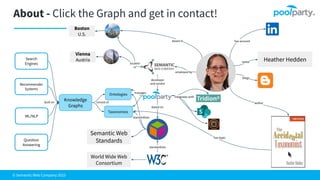
About - Click the Graph and get in contact!
consist of
Heather Hedden
employed by
name
blogs
author
developer
and vendor
based on
Semantic Web
Standards
Boston
U.S.
Vienna
Austria
standardizes
has topic
World Wide Web
Consortium
Ontologies
Taxonomies
Knowledge
Graphs
standardizes
based in
Recommender
Systems
Search
Engines
Question
Answering
ML/NLP
built on
located
in
has account
manages
integrates with
© Semantic Web Company 2023
Outline
▸ Knowledge Graph Background
▹ Information architecture domain relevance
▹ Problems & solutions for connecting information
▹ Knowledge graphs defined and history
▸ Knowledge Graph Components
▹ Data stored in a graph database
▹ Taxonomies
▹ Ontologies
▸ Knowledge Graph Building and Applications
▹ Building knowledge graphs
▹ Applications based on knowledge graphs
3
Knowledge Graph
Background
© Semantic Web Company 2023
Information Architecture Domain
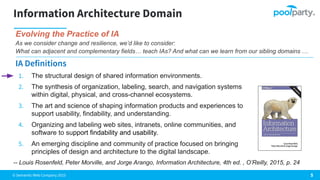
IA Definitions
1. The structural design of shared information environments.
2. The synthesis of organization, labeling, search, and navigation systems
within digital, physical, and cross-channel ecosystems.
3. The art and science of shaping information products and experiences to
support usability, findability, and understanding.
4. Organizing and labeling web sites, intranets, online communities, and
software to support findability and usability.
5. An emerging discipline and community of practice focused on bringing
principles of design and architecture to the digital landscape.
5
-- Louis Rosenfeld, Peter Morville, and Jorge Arango, Information Architecture, 4th ed. , O’Reilly, 2015, p. 24
Evolving the Practice of IA
As we consider change and resilience, we’d like to consider:
What can adjacent and complementary fields… teach IAs? And what can we learn from our sibling domains …
© Semantic Web Company 2023
Information Architecture Domain
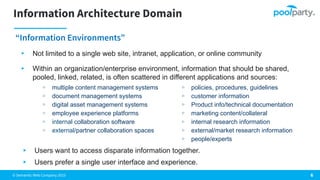
“Information Environments”
6
▸ Not limited to a single web site, intranet, application, or online community
▸ Within an organization/enterprise environment, information that should be shared,
pooled, linked, related, is often scattered in different applications and sources:
▹ policies, procedures, guidelines
▹ customer information
▹ Product info/technical documentation
▹ marketing content/collateral
▹ internal research information
▹ external/market research information
▹ people/experts
▹ multiple content management systems
▹ document management systems
▹ digital asset management systems
▹ employee experience platforms
▹ internal collaboration software
▹ external/partner collaboration spaces
▸ Users want to access disparate information together.
▸ Users prefer a single user interface and experience.
© Semantic Web Company 2023
Information Architecture Domain
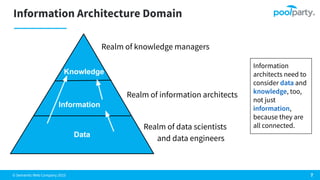
Realm of knowledge managers
Realm of information architects
Realm of data scientists
and data engineers
7
Data
Information
Knowledge
Information
architects need to
consider data and
knowledge, too,
not just
information,
because they are
all connected.
© Semantic Web Company 2023
Problems & Solutions for Connecting Information
8
Problems
▸ Data and content silos
▸ Heterogeneous sources
▸ Mix of unstructured
and structured data
▸ Mix of data and content
▸ Same things with
different names
▸ Localized meanings
▸ Change
Provided by
▸ Data-centric architecture
▸ Ontologies
▸ Knowledge graphs
Results in
▸ Knowledge discovery
▸ Better decisions
▸ User/customer satisfaction
Solutions
▸ Sharing data
▸ Reusing data
▸ Linking data
▸ Linking content
▸ Semantic links
▸ Unified views
Causing
▸ Inefficiencies
▸ Missed opportunities
▸ Poor decisions
▸ Poor user experience
© Semantic Web Company 2023
Problems & Solutions for Connecting Information
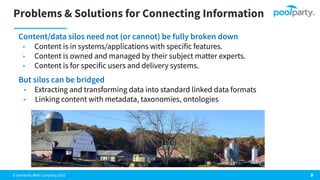
Content/data silos need not (or cannot) be fully broken down
▸ Content is in systems/applications with specific features.
▸ Content is owned and managed by their subject matter experts.
▸ Content is for specific users and delivery systems.
9
But silos can be bridged
▸ Extracting and transforming data into standard linked data formats
▸ Linking content with metadata, taxonomies, ontologies
© Semantic Web Company 2023
Problems & Solutions for Connecting Information
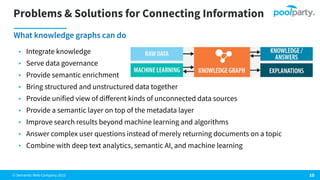
What knowledge graphs can do
▸ Integrate knowledge
▸ Serve data governance
▸ Provide semantic enrichment
▸ Bring structured and unstructured data together
▸ Provide unified view of different kinds of unconnected data sources
▸ Provide a semantic layer on top of the metadata layer
▸ Improve search results beyond machine learning and algorithms
▸ Answer complex user questions instead of merely returning documents on a topic
▸ Combine with deep text analytics, semantic AI, and machine learning
10
© Semantic Web Company 2023
Problems & Solutions for Connecting Information
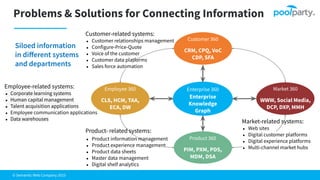
Employee-related systems:
● Corporate learning systems
● Human capital management
● Talent acquisition applications
● Employee communication applications
● Data warehouses
Customer 360
CRM, CPQ, VoC
CDP, SFA
Product 360
PIM, PXM, PDS,
MDM, DSA
Market 360
WWW, Social Media,
DCP, DXP, MMH
Enterprise 360
Enterprise
Knowledge
Graph
Employee 360
CLS, HCM, TAA,
ECA, DW
Customer-related systems:
● Customer relationships management
● Configure-Price-Quote
● Voice of the customer
● Customer data platforms
● Sales force automation
Product- related systems:
● Product information management
● Product experience management
● Product data sheets
● Master data management
● Digital shelf analytics
Market-related systems:
● Web sites
● Digital customer platforms
● Digital experience platforms
● Multi-channel market hubs
Siloed information
in different systems
and departments
© Semantic Web Company 2023
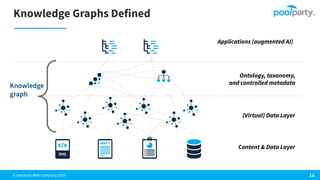
Knowledge Graphs Defined
12
Applications (augmented AI)
Ontology, taxonomy,
and controlled metadata
(Virtual) Data Layer
Content & Data Layer
Knowledge
graph
© Semantic Web Company 2023
Knowledge Graphs Defined
What is a knowledge graph?
13
▸ A model of a knowledge domain combined with instance data
▸ Represents unified information across a domain or an organization,
enriched with context and semantics.
▸ Contains business objects and topics that are closely linked, classified,
and connected to existing data and documents.
▸ A layer between the actual content and the querying layer.
▸ Both machine-readable and human-readable through some form of display.
▸ Gets its name from knowledge base + graph database
and optional graph visualizations.
© Semantic Web Company 2023
Knowledge Graphs Defined
14
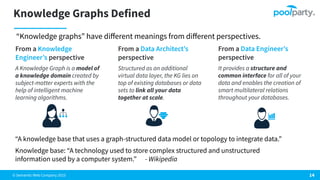
From a Knowledge
Engineerʼs perspective
A Knowledge Graph is a model of
a knowledge domain created by
subject-matter experts with the
help of intelligent machine
learning algorithms.
From a Data Architectʼs
perspective
Structured as an additional
virtual data layer, the KG lies on
top of existing databases or data
sets to link all your data
together at scale.
From a Data Engineerʼs
perspective
It provides a structure and
common interface for all of your
data and enables the creation of
smart multilateral relations
throughout your databases.
“Knowledge graphs” have different meanings from different perspectives.
“A knowledge base that uses a graph-structured data model or topology to integrate data.”
Knowledge base: “A technology used to store complex structured and unstructured
information used by a computer system.” - Wikipedia
© Semantic Web Company 2023
Knowledge Graphs History
▸ “Knowledge Graphs” project for mathematics by researchers of the University of Groningen and
University of Twente , Netherlands, 1982
▸ Rise of topic-specific knowledge bases: e.g. Wordnet in 1985; Geonames in 2005
▸ General graph-based knowledge repositories, DBpedia (based on linked data) in 2006, Freebase in 2007
▸ Google introduced its Knowledge Graph (based on Freebase) to improve search results value in 2012.
▸ Large data-heavy companies adopted knowledge graphs: Airbnb, Amazon, Apple, Bank of America,
Bloomberg, Facebook, Genentech, Goldman Sachs, JPMorgan Chase, LinkedIn, Microsoft, Uber, Wells Fargo
▸ Knowledge graphs became a topic at various conferences by 2019.
▸ Enterprise knowledge graphs become the focus.
15
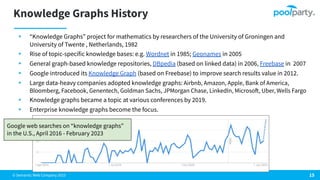
Google web searches on “knowledge graphs”
in the U.S., April 2016 - February 2023
Knowledge Graph
Components
© Semantic Web Company 2023
Knowledge Graph Components
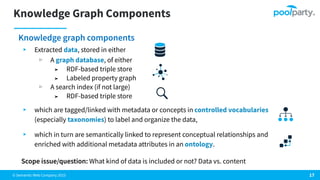
Knowledge graph components
▸ Extracted data, stored in either
▹ A graph database, of either
➤ RDF-based triple store
➤ Labeled property graph
▹ A search index (if not large)
➤ RDF-based triple store
▸ which are tagged/linked with metadata or concepts in controlled vocabularies
(especially taxonomies) to label and organize the data,
▸ which in turn are semantically linked to represent conceptual relationships and
enriched with additional metadata attributes in an ontology.
17
Scope issue/question: What kind of data is included or not? Data vs. content
© Semantic Web Company 2023
Knowledge Graph Components
18
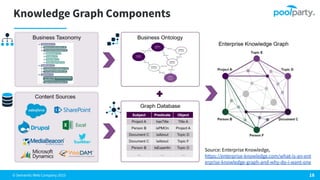
Source: Enterprise Knowledge,
https://enterprise-knowledge.com/what-is-an-ent
erprise-knowledge-graph-and-why-do-i-want-one
© Semantic Web Company 2023
KG Components: Data in a Graph Database
19
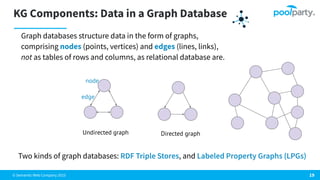
Graph databases structure data in the form of graphs,
comprising nodes (points, vertices) and edges (lines, links),
not as tables of rows and columns, as relational database are.
Undirected graph Directed graph
node
edge
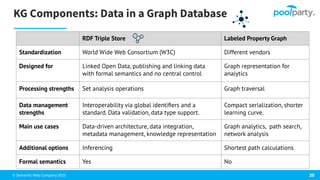
Two kinds of graph databases: RDF Triple Stores, and Labeled Property Graphs (LPGs)
© Semantic Web Company 2023
KG Components: Data in a Graph Database
20
RDF Triple Store Labeled Property Graph
Standardization World Wide Web Consortium (W3C) Different vendors
Designed for Linked Open Data, publishing and linking data
with formal semantics and no central control
Graph representation for
analytics
Processing strengths Set analysis operations Graph traversal
Data management
strengths
Interoperability via global identifiers and a
standard. Data validation, data type support.
Compact serialization, shorter
learning curve.
Main use cases Data-driven architecture, data integration,
metadata management, knowledge representation
Graph analytics, path search,
network analysis
Additional options Inferencing Shortest path calculations
Formal semantics Yes No
© Semantic Web Company 2023
KG Components: Data in a Graph Database
21
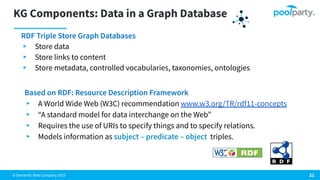
RDF Triple Store Graph Databases
▸ Store data
▸ Store links to content
▸ Store metadata, controlled vocabularies, taxonomies, ontologies
Based on RDF: Resource Description Framework
▸ A World Wide Web (W3C) recommendation www.w3.org/TR/rdf11-concepts
▸ “A standard model for data interchange on the Web”
▸ Requires the use of URIs to specify things and to specify relations.
▸ Models information as subject – predicate – object triples.
© Semantic Web Company 2023
KG Components: Taxonomies
22
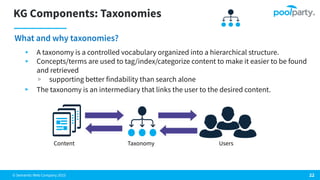
What and why taxonomies?
▸ A taxonomy is a controlled vocabulary organized into a hierarchical structure.
▸ Concepts/terms are used to tag/index/categorize content to make it easier to be found
and retrieved
▹ supporting better findability than search alone
▸ The taxonomy is an intermediary that links the user to the desired content.
Content Taxonomy Users
© Semantic Web Company 2023
KG Components: Taxonomies
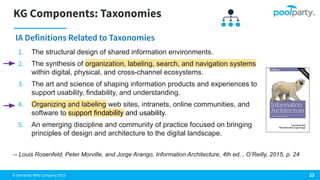
IA Definitions Related to Taxonomies
1. The structural design of shared information environments.
2. The synthesis of organization, labeling, search, and navigation systems
within digital, physical, and cross-channel ecosystems.
3. The art and science of shaping information products and experiences to
support usability, findability, and understanding.
4. Organizing and labeling web sites, intranets, online communities, and
software to support findability and usability.
5. An emerging discipline and community of practice focused on bringing
principles of design and architecture to the digital landscape.
23
-- Louis Rosenfeld, Peter Morville, and Jorge Arango, Information Architecture, 4th ed. , O’Reilly, 2015, p. 24
© Semantic Web Company 2023
KG Components: Taxonomies
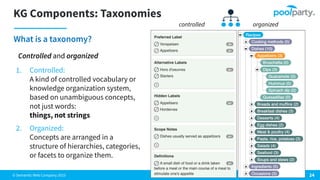
What is a taxonomy?
Controlled and organized
1. Controlled:
A kind of controlled vocabulary or
knowledge organization system,
based on unambiguous concepts,
not just words:
things, not strings
2. Organized:
Concepts are arranged in a
structure of hierarchies, categories,
or facets to organize them.
24
organized
controlled
© Semantic Web Company 2023
KG Components: Taxonomies
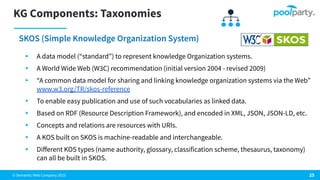
SKOS (Simple Knowledge Organization System)
25
▸ A data model (“standard”) to represent knowledge Organization systems.
▸ A World Wide Web (W3C) recommendation (initial version 2004 - revised 2009)
▸ “A common data model for sharing and linking knowledge organization systems via the Web”
www.w3.org/TR/skos-reference
▸ To enable easy publication and use of such vocabularies as linked data.
▸ Based on RDF (Resource Description Framework), and encoded in XML, JSON, JSON-LD, etc.
▸ Concepts and relations are resources with URIs.
▸ A KOS built on SKOS is machine-readable and interchangeable.
▸ Different KOS types (name authority, glossary, classification scheme, thesaurus, taxonomy)
can all be built in SKOS.
© Semantic Web Company 2023
KG Components: Taxonomies
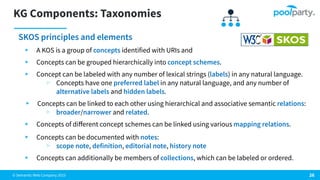
SKOS principles and elements
▸ A KOS is a group of concepts identified with URIs and
▸ Concepts can be grouped hierarchically into concept schemes.
▸ Concept can be labeled with any number of lexical strings (labels) in any natural language.
▹ Concepts have one preferred label in any natural language, and any number of
alternative labels and hidden labels.
▸ Concepts can be linked to each other using hierarchical and associative semantic relations:
▹ broader/narrower and related.
▸ Concepts of different concept schemes can be linked using various mapping relations.
▸ Concepts can be documented with notes:
▹ scope note, definition, editorial note, history note
▸ Concepts can additionally be members of collections, which can be labeled or ordered.
26
© Semantic Web Company 2023
KG Components: Taxonomies
27
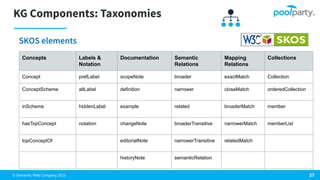
SKOS elements
Concepts Labels &
Notation
Documentation Semantic
Relations
Mapping
Relations
Collections
Concept prefLabel scopeNote broader exactMatch Collection
ConceptScheme altLabel definition narrower closeMatch orderedCollection
inScheme hiddenLabel example related broaderMatch member
hasTopConcept notation changeNote broaderTransitive narrowerMatch memberList
topConceptOf editorialNote narrowerTransitive relatedMatch
historyNote semanticRelation
© Semantic Web Company 2023
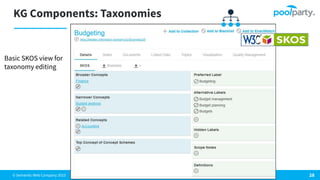
KG Components: Taxonomies
28
Basic SKOS view for
taxonomy editing
© Semantic Web Company 2023
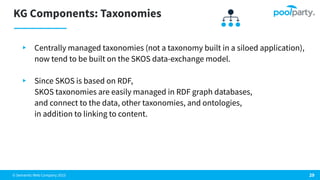
KG Components: Taxonomies
29
▸ Centrally managed taxonomies (not a taxonomy built in a siloed application),
now tend to be built on the SKOS data-exchange model.
▸ Since SKOS is based on RDF,
SKOS taxonomies are easily managed in RDF graph databases,
and connect to the data, other taxonomies, and ontologies,
in addition to linking to content.
© Semantic Web Company 2023
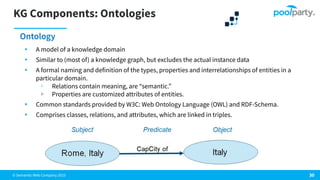
KG Components: Ontologies
Ontology
▸ A model of a knowledge domain
▸ Similar to (most of) a knowledge graph, but excludes the actual instance data
▸ A formal naming and definition of the types, properties and interrelationships of entities in a
particular domain.
▹ Relations contain meaning, are “semantic.”
▹ Properties are customized attributes of entities.
▸ Common standards provided by W3C: Web Ontology Language (OWL) and RDF-Schema.
▸ Comprises classes, relations, and attributes, which are linked in triples.
30
© Semantic Web Company 2023
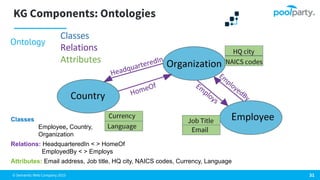
KG Components: Ontologies
Ontology
31
Classes
Employee, Country,
Organization
Relations: HeadquarteredIn < > HomeOf
EmployedBy < > Employs
Attributes: Email address, Job title, HQ city, NAICS codes, Currency, Language
© Semantic Web Company 2023
KG Components: Ontologies
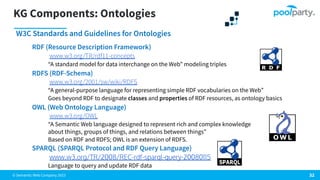
W3C Standards and Guidelines for Ontologies
RDF (Resource Description Framework)
www.w3.org/TR/rdf11-concepts
“A standard model for data interchange on the Web” modeling triples
RDFS (RDF-Schema)
www.w3.org/2001/sw/wiki/RDFS
“A general-purpose language for representing simple RDF vocabularies on the Web”
Goes beyond RDF to designate classes and properties of RDF resources, as ontology basics
OWL (Web Ontology Language)
www.w3.org/OWL
“A Semantic Web language designed to represent rich and complex knowledge
about things, groups of things, and relations between things”
Based on RDF and RDFS; OWL is an extension of RDFS.
SPARQL (SPARQL Protocol and RDF Query Language)
www.w3.org/TR/2008/REC-rdf-sparql-query-20080115
Language to query and update RDF data
32
© Semantic Web Company 2023
KG Components: Ontologies
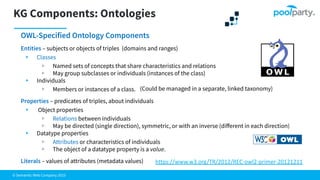
OWL-Specified Ontology Components
Entities – subjects or objects of triples (domains and ranges)
▸ Classes
▹ Named sets of concepts that share characteristics and relations
▹ May group subclasses or individuals (instances of the class)
▸ Individuals
▹ Members or instances of a class.
Properties – predicates of triples, about individuals
▸ Object properties
▹ Relations between individuals
▹ May be directed (single direction), symmetric, or with an inverse (different in each direction)
▸ Datatype properties
▹ Attributes or characteristics of individuals
▹ The object of a datatype property is a value.
Literals – values of attributes (metadata values)
33
https://www.w3.org/TR/2012/REC-owl2-primer-20121211
(Could be managed in a separate, linked taxonomy)
© Semantic Web Company 2023
34
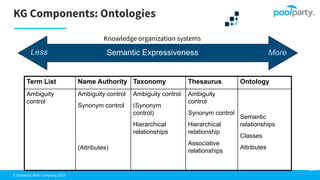
Term List Name Authority Taxonomy Thesaurus Ontology
Ambiguity
control
Ambiguity control
Synonym control
(Attributes)
Ambiguity control
(Synonym
control)
Hierarchical
relationships
Ambiguity
control
Synonym control
Hierarchical
relationship
Associative
relationships
Semantic
relationships
Classes
Attributes
Less More
Semantic Expressiveness
KG Components: Ontologies
Knowledge organization systems
© Semantic Web Company 2023
35
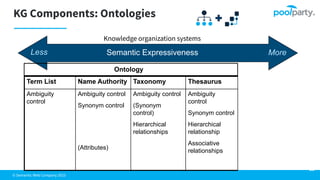
Term List Name Authority Taxonomy Thesaurus
Ambiguity
control
Ambiguity control
Synonym control
(Attributes)
Ambiguity control
(Synonym
control)
Hierarchical
relationships
Ambiguity
control
Synonym control
Hierarchical
relationship
Associative
relationships
Less More
KG Components: Ontologies
Ontology
Semantic Expressiveness
Knowledge organization systems
© Semantic Web Company 2023
KG Components: Ontologies
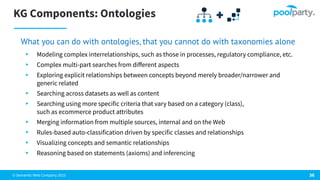
What you can do with ontologies, that you cannot do with taxonomies alone
▸ Modeling complex interrelationships, such as those in processes, regulatory compliance, etc.
▸ Complex multi-part searches from different aspects
▸ Exploring explicit relationships between concepts beyond merely broader/narrower and
generic related
▸ Searching across datasets as well as content
▸ Searching using more specific criteria that vary based on a category (class),
such as ecommerce product attributes
▸ Merging information from multiple sources, internal and on the Web
▸ Rules-based auto-classification driven by specific classes and relationships
▸ Visualizing concepts and semantic relationships
▸ Reasoning based on statements (axioms) and inferencing
36
Knowledge Graph
Building and Applications
© Semantic Web Company 2023
Building Knowledge Graphs
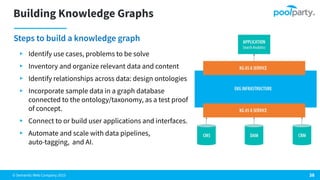
Steps to build a knowledge graph
38
▸ Identify use cases, problems to be solve
▸ Inventory and organize relevant data and content
▸ Identify relationships across data: design ontologies
▸ Incorporate sample data in a graph database
connected to the ontology/taxonomy, as a test proof
of concept.
▸ Connect to or build user applications and interfaces.
▸ Automate and scale with data pipelines,
auto-tagging, and AI.
© Semantic Web Company 2023
Building Knowledge Graphs
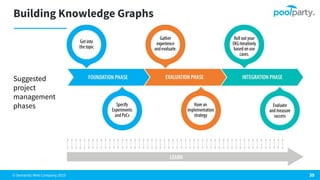
39
Suggested
project
management
phases
© Semantic Web Company 2023
Building Knowledge Graphs
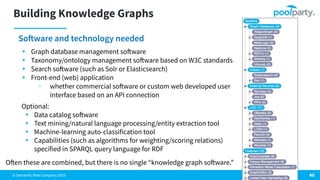
Software and technology needed
▸ Graph database management software
▸ Taxonomy/ontology management software based on W3C standards
▸ Search software (such as Solr or Elasticsearch)
▸ Front-end (web) application
▹ whether commercial software or custom web developed user
interface based on an API connection
40
Optional:
▸ Data catalog software
▸ Text mining/natural language processing/entity extraction tool
▸ Machine-learning auto-classification tool
▸ Capabilities (such as algorithms for weighting/scoring relations)
specified in SPARQL query language for RDF
Often these are combined, but there is no single “knowledge graph software.”
© Semantic Web Company 2023
Building Knowledge Graphs
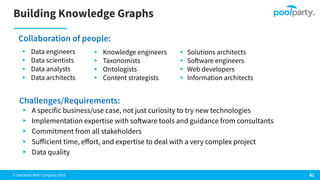
Collaboration of people:
▸ Data engineers
▸ Data scientists
▸ Data analysts
▸ Data architects
41
Challenges/Requirements:
▸ A specific business/use case, not just curiosity to try new technologies
▸ Implementation expertise with software tools and guidance from consultants
▸ Commitment from all stakeholders
▸ Sufficient time, effort, and expertise to deal with a very complex project
▸ Data quality
▸ Knowledge engineers
▸ Taxonomists
▸ Ontologists
▸ Content strategists
▸ Solutions architects
▸ Software engineers
▸ Web developers
▸ Information architects
© Semantic Web Company 2023
Knowledge Graph Applications
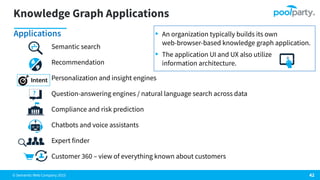
Applications
Semantic search
Recommendation
Personalization and insight engines
Question-answering engines / natural language search across data
Compliance and risk prediction
Chatbots and voice assistants
Expert finder
Customer 360 – view of everything known about customers
42
▸ An organization typically builds its own
web-browser-based knowledge graph application.
▸ The application UI and UX also utilize
information architecture.
© Semantic Web Company 2023
Knowledge Graph Applications
IA Definitions
1. The structural design of shared information environments.
2. The synthesis of organization, labeling, search, and navigation systems
within digital, physical, and cross-channel ecosystems.
3. The art and science of shaping information products and experiences to
support usability, findability, and understanding.
4. Organizing and labeling web sites, intranets, online communities, and
software to support findability and usability.
5. An emerging discipline and community of practice focused on bringing
principles of design and architecture to the digital landscape.
43
-- Louis Rosenfeld, Peter Morville, and Jorge Arango, Information Architecture, 4th ed. , O’Reilly, 2015, p. 24
© Semantic Web Company 2023
Knowledge Graph Applications
44
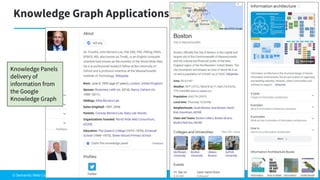
Knowledge Panels
delivery of
information from
the Google
Knowledge Graph
© Semantic Web Company 2023
Knowledge Graph Applications
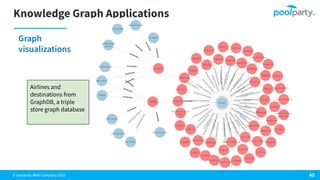
Graph
visualizations
45
Airlines and
destinations from
GraphDB, a triple
store graph database
© Semantic Web Company 2023
Knowledge Graph Applications
Sample Applications
▸ Healthdirect Australia - public website health symptom checker
https://www.healthdirect.gov.au/symptom-checker
▸ Semantic Web Companyʼs HR Recommender proto-type
https://hr-recommender.poolparty.biz/hr-recommender/overview
▸ Semantic Web Companyʼs Wine & Cheese Harmonizer
https://ppil-dev.semantic-web.at/PPIL
▸ QAnswer
https://www.qanswer.eu
46
© Semantic Web Company 2023
Knowledge Graph Applications
47
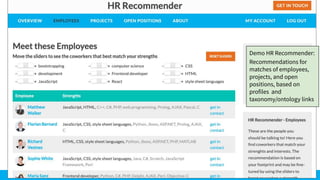
Demo HR Recommender:
Recommendations for
matches of employees,
projects, and open
positions, based on
profiles and
taxonomy/ontology links
© Semantic Web Company 2023
Knowledge Graph Applications
48
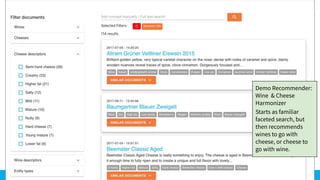
Demo Recommender:
Wine & Cheese
Harmonizer
Starts as familiar
faceted search, but
then recommends
wines to go with
cheese, or cheese to
go with wine.
© Semantic Web Company 2023
Knowledge Graph Applications
49
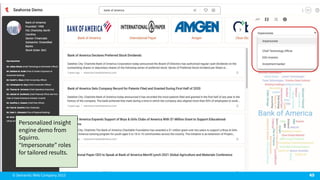
Personalized insight
engine demo from
Squirro.
“Impersonate” roles
for tailored results.
© Semantic Web Company 2023
Conclusions
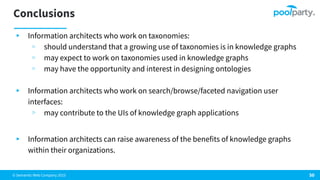
▸ Information architects who work on taxonomies:
▹ should understand that a growing use of taxonomies is in knowledge graphs
▹ may expect to work on taxonomies used in knowledge graphs
▹ may have the opportunity and interest in designing ontologies
▸ Information architects who work on search/browse/faceted navigation user
interfaces:
▹ may contribute to the UIs of knowledge graph applications
▸ Information architects can raise awareness of the benefits of knowledge graphs
within their organizations.
50
© Semantic Web Company 2023
Knowledge Graph Resources
▸ The Knowledge Graph Conference, New York, NY, and hybrid virtual, May 8-12, 2023
▸ The Knowledge Graph Conference Slack Channel community and other resources
▸ “Unlocking Digital Transformation with Knowledge Graphs,” webinar recording,
Andreas Blumauer (Semantic Web Company) and Bram Wessel (Factor), April 7, 2022
▸ “How to Build a Knowledge Graph in Four Steps: The Roadmap From Metadata to AI”
by Lulit Tesfaye, September 9, 2019, Enterprise Knowledge Blog.
▸ The Knowledge Graph Cookbook, by Andreas Blumauer and
Helmut Nagy, 2020, paperback or free as ebook.
www.poolparty.biz/the-knowledge-graph-cookbook
51
© Semantic Web Company 2023
Questions/Contact
52
Heather Hedden
Product Communications Specialist, Americas
Knowledge Manager
Semantic Web Company Inc.
One Boston Place, Suite 2600
Boston, MA 02108
857-400-0183
heather.hedden@semantic-web.com
www.linkedin.com/in/hedden
Semantic Web Company www.semantic-web.com
PoolParty software www.poolparty.biz

Introduction to Knowledge Graphs for Information Architects.pdf

  • 1.
    An Introduction to KnowledgeGraphs for Information Architects Information Architecture Conference March 30, 2023 Heather Hedden Semantic Web Company
  • 2.
    © Semantic WebCompany 2023 About - Click the Graph and get in contact! consist of Heather Hedden employed by name blogs author developer and vendor based on Semantic Web Standards Boston U.S. Vienna Austria standardizes has topic World Wide Web Consortium Ontologies Taxonomies Knowledge Graphs standardizes based in Recommender Systems Search Engines Question Answering ML/NLP built on located in has account manages integrates with
  • 3.
    © Semantic WebCompany 2023 Outline ▸ Knowledge Graph Background ▹ Information architecture domain relevance ▹ Problems & solutions for connecting information ▹ Knowledge graphs defined and history ▸ Knowledge Graph Components ▹ Data stored in a graph database ▹ Taxonomies ▹ Ontologies ▸ Knowledge Graph Building and Applications ▹ Building knowledge graphs ▹ Applications based on knowledge graphs 3
  • 4.
  • 5.
    © Semantic WebCompany 2023 Information Architecture Domain IA Definitions 1. The structural design of shared information environments. 2. The synthesis of organization, labeling, search, and navigation systems within digital, physical, and cross-channel ecosystems. 3. The art and science of shaping information products and experiences to support usability, findability, and understanding. 4. Organizing and labeling web sites, intranets, online communities, and software to support findability and usability. 5. An emerging discipline and community of practice focused on bringing principles of design and architecture to the digital landscape. 5 -- Louis Rosenfeld, Peter Morville, and Jorge Arango, Information Architecture, 4th ed. , O’Reilly, 2015, p. 24 Evolving the Practice of IA As we consider change and resilience, we’d like to consider: What can adjacent and complementary fields… teach IAs? And what can we learn from our sibling domains …
  • 6.
    © Semantic WebCompany 2023 Information Architecture Domain “Information Environments” 6 ▸ Not limited to a single web site, intranet, application, or online community ▸ Within an organization/enterprise environment, information that should be shared, pooled, linked, related, is often scattered in different applications and sources: ▹ policies, procedures, guidelines ▹ customer information ▹ Product info/technical documentation ▹ marketing content/collateral ▹ internal research information ▹ external/market research information ▹ people/experts ▹ multiple content management systems ▹ document management systems ▹ digital asset management systems ▹ employee experience platforms ▹ internal collaboration software ▹ external/partner collaboration spaces ▸ Users want to access disparate information together. ▸ Users prefer a single user interface and experience.
  • 7.
    © Semantic WebCompany 2023 Information Architecture Domain Realm of knowledge managers Realm of information architects Realm of data scientists and data engineers 7 Data Information Knowledge Information architects need to consider data and knowledge, too, not just information, because they are all connected.
  • 8.
    © Semantic WebCompany 2023 Problems & Solutions for Connecting Information 8 Problems ▸ Data and content silos ▸ Heterogeneous sources ▸ Mix of unstructured and structured data ▸ Mix of data and content ▸ Same things with different names ▸ Localized meanings ▸ Change Provided by ▸ Data-centric architecture ▸ Ontologies ▸ Knowledge graphs Results in ▸ Knowledge discovery ▸ Better decisions ▸ User/customer satisfaction Solutions ▸ Sharing data ▸ Reusing data ▸ Linking data ▸ Linking content ▸ Semantic links ▸ Unified views Causing ▸ Inefficiencies ▸ Missed opportunities ▸ Poor decisions ▸ Poor user experience
  • 9.
    © Semantic WebCompany 2023 Problems & Solutions for Connecting Information Content/data silos need not (or cannot) be fully broken down ▸ Content is in systems/applications with specific features. ▸ Content is owned and managed by their subject matter experts. ▸ Content is for specific users and delivery systems. 9 But silos can be bridged ▸ Extracting and transforming data into standard linked data formats ▸ Linking content with metadata, taxonomies, ontologies
  • 10.
    © Semantic WebCompany 2023 Problems & Solutions for Connecting Information What knowledge graphs can do ▸ Integrate knowledge ▸ Serve data governance ▸ Provide semantic enrichment ▸ Bring structured and unstructured data together ▸ Provide unified view of different kinds of unconnected data sources ▸ Provide a semantic layer on top of the metadata layer ▸ Improve search results beyond machine learning and algorithms ▸ Answer complex user questions instead of merely returning documents on a topic ▸ Combine with deep text analytics, semantic AI, and machine learning 10
  • 11.
    © Semantic WebCompany 2023 Problems & Solutions for Connecting Information Employee-related systems: ● Corporate learning systems ● Human capital management ● Talent acquisition applications ● Employee communication applications ● Data warehouses Customer 360 CRM, CPQ, VoC CDP, SFA Product 360 PIM, PXM, PDS, MDM, DSA Market 360 WWW, Social Media, DCP, DXP, MMH Enterprise 360 Enterprise Knowledge Graph Employee 360 CLS, HCM, TAA, ECA, DW Customer-related systems: ● Customer relationships management ● Configure-Price-Quote ● Voice of the customer ● Customer data platforms ● Sales force automation Product- related systems: ● Product information management ● Product experience management ● Product data sheets ● Master data management ● Digital shelf analytics Market-related systems: ● Web sites ● Digital customer platforms ● Digital experience platforms ● Multi-channel market hubs Siloed information in different systems and departments
  • 12.
    © Semantic WebCompany 2023 Knowledge Graphs Defined 12 Applications (augmented AI) Ontology, taxonomy, and controlled metadata (Virtual) Data Layer Content & Data Layer Knowledge graph
  • 13.
    © Semantic WebCompany 2023 Knowledge Graphs Defined What is a knowledge graph? 13 ▸ A model of a knowledge domain combined with instance data ▸ Represents unified information across a domain or an organization, enriched with context and semantics. ▸ Contains business objects and topics that are closely linked, classified, and connected to existing data and documents. ▸ A layer between the actual content and the querying layer. ▸ Both machine-readable and human-readable through some form of display. ▸ Gets its name from knowledge base + graph database and optional graph visualizations.
  • 14.
    © Semantic WebCompany 2023 Knowledge Graphs Defined 14 From a Knowledge Engineerʼs perspective A Knowledge Graph is a model of a knowledge domain created by subject-matter experts with the help of intelligent machine learning algorithms. From a Data Architectʼs perspective Structured as an additional virtual data layer, the KG lies on top of existing databases or data sets to link all your data together at scale. From a Data Engineerʼs perspective It provides a structure and common interface for all of your data and enables the creation of smart multilateral relations throughout your databases. “Knowledge graphs” have different meanings from different perspectives. “A knowledge base that uses a graph-structured data model or topology to integrate data.” Knowledge base: “A technology used to store complex structured and unstructured information used by a computer system.” - Wikipedia
  • 15.
    © Semantic WebCompany 2023 Knowledge Graphs History ▸ “Knowledge Graphs” project for mathematics by researchers of the University of Groningen and University of Twente , Netherlands, 1982 ▸ Rise of topic-specific knowledge bases: e.g. Wordnet in 1985; Geonames in 2005 ▸ General graph-based knowledge repositories, DBpedia (based on linked data) in 2006, Freebase in 2007 ▸ Google introduced its Knowledge Graph (based on Freebase) to improve search results value in 2012. ▸ Large data-heavy companies adopted knowledge graphs: Airbnb, Amazon, Apple, Bank of America, Bloomberg, Facebook, Genentech, Goldman Sachs, JPMorgan Chase, LinkedIn, Microsoft, Uber, Wells Fargo ▸ Knowledge graphs became a topic at various conferences by 2019. ▸ Enterprise knowledge graphs become the focus. 15 Google web searches on “knowledge graphs” in the U.S., April 2016 - February 2023
  • 16.
  • 17.
    © Semantic WebCompany 2023 Knowledge Graph Components Knowledge graph components ▸ Extracted data, stored in either ▹ A graph database, of either ➤ RDF-based triple store ➤ Labeled property graph ▹ A search index (if not large) ➤ RDF-based triple store ▸ which are tagged/linked with metadata or concepts in controlled vocabularies (especially taxonomies) to label and organize the data, ▸ which in turn are semantically linked to represent conceptual relationships and enriched with additional metadata attributes in an ontology. 17 Scope issue/question: What kind of data is included or not? Data vs. content
  • 18.
    © Semantic WebCompany 2023 Knowledge Graph Components 18 Source: Enterprise Knowledge, https://enterprise-knowledge.com/what-is-an-ent erprise-knowledge-graph-and-why-do-i-want-one
  • 19.
    © Semantic WebCompany 2023 KG Components: Data in a Graph Database 19 Graph databases structure data in the form of graphs, comprising nodes (points, vertices) and edges (lines, links), not as tables of rows and columns, as relational database are. Undirected graph Directed graph node edge Two kinds of graph databases: RDF Triple Stores, and Labeled Property Graphs (LPGs)
  • 20.
    © Semantic WebCompany 2023 KG Components: Data in a Graph Database 20 RDF Triple Store Labeled Property Graph Standardization World Wide Web Consortium (W3C) Different vendors Designed for Linked Open Data, publishing and linking data with formal semantics and no central control Graph representation for analytics Processing strengths Set analysis operations Graph traversal Data management strengths Interoperability via global identifiers and a standard. Data validation, data type support. Compact serialization, shorter learning curve. Main use cases Data-driven architecture, data integration, metadata management, knowledge representation Graph analytics, path search, network analysis Additional options Inferencing Shortest path calculations Formal semantics Yes No
  • 21.
    © Semantic WebCompany 2023 KG Components: Data in a Graph Database 21 RDF Triple Store Graph Databases ▸ Store data ▸ Store links to content ▸ Store metadata, controlled vocabularies, taxonomies, ontologies Based on RDF: Resource Description Framework ▸ A World Wide Web (W3C) recommendation www.w3.org/TR/rdf11-concepts ▸ “A standard model for data interchange on the Web” ▸ Requires the use of URIs to specify things and to specify relations. ▸ Models information as subject – predicate – object triples.
  • 22.
    © Semantic WebCompany 2023 KG Components: Taxonomies 22 What and why taxonomies? ▸ A taxonomy is a controlled vocabulary organized into a hierarchical structure. ▸ Concepts/terms are used to tag/index/categorize content to make it easier to be found and retrieved ▹ supporting better findability than search alone ▸ The taxonomy is an intermediary that links the user to the desired content. Content Taxonomy Users
  • 23.
    © Semantic WebCompany 2023 KG Components: Taxonomies IA Definitions Related to Taxonomies 1. The structural design of shared information environments. 2. The synthesis of organization, labeling, search, and navigation systems within digital, physical, and cross-channel ecosystems. 3. The art and science of shaping information products and experiences to support usability, findability, and understanding. 4. Organizing and labeling web sites, intranets, online communities, and software to support findability and usability. 5. An emerging discipline and community of practice focused on bringing principles of design and architecture to the digital landscape. 23 -- Louis Rosenfeld, Peter Morville, and Jorge Arango, Information Architecture, 4th ed. , O’Reilly, 2015, p. 24
  • 24.
    © Semantic WebCompany 2023 KG Components: Taxonomies What is a taxonomy? Controlled and organized 1. Controlled: A kind of controlled vocabulary or knowledge organization system, based on unambiguous concepts, not just words: things, not strings 2. Organized: Concepts are arranged in a structure of hierarchies, categories, or facets to organize them. 24 organized controlled
  • 25.
    © Semantic WebCompany 2023 KG Components: Taxonomies SKOS (Simple Knowledge Organization System) 25 ▸ A data model (“standard”) to represent knowledge Organization systems. ▸ A World Wide Web (W3C) recommendation (initial version 2004 - revised 2009) ▸ “A common data model for sharing and linking knowledge organization systems via the Web” www.w3.org/TR/skos-reference ▸ To enable easy publication and use of such vocabularies as linked data. ▸ Based on RDF (Resource Description Framework), and encoded in XML, JSON, JSON-LD, etc. ▸ Concepts and relations are resources with URIs. ▸ A KOS built on SKOS is machine-readable and interchangeable. ▸ Different KOS types (name authority, glossary, classification scheme, thesaurus, taxonomy) can all be built in SKOS.
  • 26.
    © Semantic WebCompany 2023 KG Components: Taxonomies SKOS principles and elements ▸ A KOS is a group of concepts identified with URIs and ▸ Concepts can be grouped hierarchically into concept schemes. ▸ Concept can be labeled with any number of lexical strings (labels) in any natural language. ▹ Concepts have one preferred label in any natural language, and any number of alternative labels and hidden labels. ▸ Concepts can be linked to each other using hierarchical and associative semantic relations: ▹ broader/narrower and related. ▸ Concepts of different concept schemes can be linked using various mapping relations. ▸ Concepts can be documented with notes: ▹ scope note, definition, editorial note, history note ▸ Concepts can additionally be members of collections, which can be labeled or ordered. 26
  • 27.
    © Semantic WebCompany 2023 KG Components: Taxonomies 27 SKOS elements Concepts Labels & Notation Documentation Semantic Relations Mapping Relations Collections Concept prefLabel scopeNote broader exactMatch Collection ConceptScheme altLabel definition narrower closeMatch orderedCollection inScheme hiddenLabel example related broaderMatch member hasTopConcept notation changeNote broaderTransitive narrowerMatch memberList topConceptOf editorialNote narrowerTransitive relatedMatch historyNote semanticRelation
  • 28.
    © Semantic WebCompany 2023 KG Components: Taxonomies 28 Basic SKOS view for taxonomy editing
  • 29.
    © Semantic WebCompany 2023 KG Components: Taxonomies 29 ▸ Centrally managed taxonomies (not a taxonomy built in a siloed application), now tend to be built on the SKOS data-exchange model. ▸ Since SKOS is based on RDF, SKOS taxonomies are easily managed in RDF graph databases, and connect to the data, other taxonomies, and ontologies, in addition to linking to content.
  • 30.
    © Semantic WebCompany 2023 KG Components: Ontologies Ontology ▸ A model of a knowledge domain ▸ Similar to (most of) a knowledge graph, but excludes the actual instance data ▸ A formal naming and definition of the types, properties and interrelationships of entities in a particular domain. ▹ Relations contain meaning, are “semantic.” ▹ Properties are customized attributes of entities. ▸ Common standards provided by W3C: Web Ontology Language (OWL) and RDF-Schema. ▸ Comprises classes, relations, and attributes, which are linked in triples. 30
  • 31.
    © Semantic WebCompany 2023 KG Components: Ontologies Ontology 31 Classes Employee, Country, Organization Relations: HeadquarteredIn < > HomeOf EmployedBy < > Employs Attributes: Email address, Job title, HQ city, NAICS codes, Currency, Language
  • 32.
    © Semantic WebCompany 2023 KG Components: Ontologies W3C Standards and Guidelines for Ontologies RDF (Resource Description Framework) www.w3.org/TR/rdf11-concepts “A standard model for data interchange on the Web” modeling triples RDFS (RDF-Schema) www.w3.org/2001/sw/wiki/RDFS “A general-purpose language for representing simple RDF vocabularies on the Web” Goes beyond RDF to designate classes and properties of RDF resources, as ontology basics OWL (Web Ontology Language) www.w3.org/OWL “A Semantic Web language designed to represent rich and complex knowledge about things, groups of things, and relations between things” Based on RDF and RDFS; OWL is an extension of RDFS. SPARQL (SPARQL Protocol and RDF Query Language) www.w3.org/TR/2008/REC-rdf-sparql-query-20080115 Language to query and update RDF data 32
  • 33.
    © Semantic WebCompany 2023 KG Components: Ontologies OWL-Specified Ontology Components Entities – subjects or objects of triples (domains and ranges) ▸ Classes ▹ Named sets of concepts that share characteristics and relations ▹ May group subclasses or individuals (instances of the class) ▸ Individuals ▹ Members or instances of a class. Properties – predicates of triples, about individuals ▸ Object properties ▹ Relations between individuals ▹ May be directed (single direction), symmetric, or with an inverse (different in each direction) ▸ Datatype properties ▹ Attributes or characteristics of individuals ▹ The object of a datatype property is a value. Literals – values of attributes (metadata values) 33 https://www.w3.org/TR/2012/REC-owl2-primer-20121211 (Could be managed in a separate, linked taxonomy)
  • 34.
    © Semantic WebCompany 2023 34 Term List Name Authority Taxonomy Thesaurus Ontology Ambiguity control Ambiguity control Synonym control (Attributes) Ambiguity control (Synonym control) Hierarchical relationships Ambiguity control Synonym control Hierarchical relationship Associative relationships Semantic relationships Classes Attributes Less More Semantic Expressiveness KG Components: Ontologies Knowledge organization systems
  • 35.
    © Semantic WebCompany 2023 35 Term List Name Authority Taxonomy Thesaurus Ambiguity control Ambiguity control Synonym control (Attributes) Ambiguity control (Synonym control) Hierarchical relationships Ambiguity control Synonym control Hierarchical relationship Associative relationships Less More KG Components: Ontologies Ontology Semantic Expressiveness Knowledge organization systems
  • 36.
    © Semantic WebCompany 2023 KG Components: Ontologies What you can do with ontologies, that you cannot do with taxonomies alone ▸ Modeling complex interrelationships, such as those in processes, regulatory compliance, etc. ▸ Complex multi-part searches from different aspects ▸ Exploring explicit relationships between concepts beyond merely broader/narrower and generic related ▸ Searching across datasets as well as content ▸ Searching using more specific criteria that vary based on a category (class), such as ecommerce product attributes ▸ Merging information from multiple sources, internal and on the Web ▸ Rules-based auto-classification driven by specific classes and relationships ▸ Visualizing concepts and semantic relationships ▸ Reasoning based on statements (axioms) and inferencing 36
  • 37.
  • 38.
    © Semantic WebCompany 2023 Building Knowledge Graphs Steps to build a knowledge graph 38 ▸ Identify use cases, problems to be solve ▸ Inventory and organize relevant data and content ▸ Identify relationships across data: design ontologies ▸ Incorporate sample data in a graph database connected to the ontology/taxonomy, as a test proof of concept. ▸ Connect to or build user applications and interfaces. ▸ Automate and scale with data pipelines, auto-tagging, and AI.
  • 39.
    © Semantic WebCompany 2023 Building Knowledge Graphs 39 Suggested project management phases
  • 40.
    © Semantic WebCompany 2023 Building Knowledge Graphs Software and technology needed ▸ Graph database management software ▸ Taxonomy/ontology management software based on W3C standards ▸ Search software (such as Solr or Elasticsearch) ▸ Front-end (web) application ▹ whether commercial software or custom web developed user interface based on an API connection 40 Optional: ▸ Data catalog software ▸ Text mining/natural language processing/entity extraction tool ▸ Machine-learning auto-classification tool ▸ Capabilities (such as algorithms for weighting/scoring relations) specified in SPARQL query language for RDF Often these are combined, but there is no single “knowledge graph software.”
  • 41.
    © Semantic WebCompany 2023 Building Knowledge Graphs Collaboration of people: ▸ Data engineers ▸ Data scientists ▸ Data analysts ▸ Data architects 41 Challenges/Requirements: ▸ A specific business/use case, not just curiosity to try new technologies ▸ Implementation expertise with software tools and guidance from consultants ▸ Commitment from all stakeholders ▸ Sufficient time, effort, and expertise to deal with a very complex project ▸ Data quality ▸ Knowledge engineers ▸ Taxonomists ▸ Ontologists ▸ Content strategists ▸ Solutions architects ▸ Software engineers ▸ Web developers ▸ Information architects
  • 42.
    © Semantic WebCompany 2023 Knowledge Graph Applications Applications Semantic search Recommendation Personalization and insight engines Question-answering engines / natural language search across data Compliance and risk prediction Chatbots and voice assistants Expert finder Customer 360 – view of everything known about customers 42 ▸ An organization typically builds its own web-browser-based knowledge graph application. ▸ The application UI and UX also utilize information architecture.
  • 43.
    © Semantic WebCompany 2023 Knowledge Graph Applications IA Definitions 1. The structural design of shared information environments. 2. The synthesis of organization, labeling, search, and navigation systems within digital, physical, and cross-channel ecosystems. 3. The art and science of shaping information products and experiences to support usability, findability, and understanding. 4. Organizing and labeling web sites, intranets, online communities, and software to support findability and usability. 5. An emerging discipline and community of practice focused on bringing principles of design and architecture to the digital landscape. 43 -- Louis Rosenfeld, Peter Morville, and Jorge Arango, Information Architecture, 4th ed. , O’Reilly, 2015, p. 24
  • 44.
    © Semantic WebCompany 2023 Knowledge Graph Applications 44 Knowledge Panels delivery of information from the Google Knowledge Graph
  • 45.
    © Semantic WebCompany 2023 Knowledge Graph Applications Graph visualizations 45 Airlines and destinations from GraphDB, a triple store graph database
  • 46.
    © Semantic WebCompany 2023 Knowledge Graph Applications Sample Applications ▸ Healthdirect Australia - public website health symptom checker https://www.healthdirect.gov.au/symptom-checker ▸ Semantic Web Companyʼs HR Recommender proto-type https://hr-recommender.poolparty.biz/hr-recommender/overview ▸ Semantic Web Companyʼs Wine & Cheese Harmonizer https://ppil-dev.semantic-web.at/PPIL ▸ QAnswer https://www.qanswer.eu 46
  • 47.
    © Semantic WebCompany 2023 Knowledge Graph Applications 47 Demo HR Recommender: Recommendations for matches of employees, projects, and open positions, based on profiles and taxonomy/ontology links
  • 48.
    © Semantic WebCompany 2023 Knowledge Graph Applications 48 Demo Recommender: Wine & Cheese Harmonizer Starts as familiar faceted search, but then recommends wines to go with cheese, or cheese to go with wine.
  • 49.
    © Semantic WebCompany 2023 Knowledge Graph Applications 49 Personalized insight engine demo from Squirro. “Impersonate” roles for tailored results.
  • 50.
    © Semantic WebCompany 2023 Conclusions ▸ Information architects who work on taxonomies: ▹ should understand that a growing use of taxonomies is in knowledge graphs ▹ may expect to work on taxonomies used in knowledge graphs ▹ may have the opportunity and interest in designing ontologies ▸ Information architects who work on search/browse/faceted navigation user interfaces: ▹ may contribute to the UIs of knowledge graph applications ▸ Information architects can raise awareness of the benefits of knowledge graphs within their organizations. 50
  • 51.
    © Semantic WebCompany 2023 Knowledge Graph Resources ▸ The Knowledge Graph Conference, New York, NY, and hybrid virtual, May 8-12, 2023 ▸ The Knowledge Graph Conference Slack Channel community and other resources ▸ “Unlocking Digital Transformation with Knowledge Graphs,” webinar recording, Andreas Blumauer (Semantic Web Company) and Bram Wessel (Factor), April 7, 2022 ▸ “How to Build a Knowledge Graph in Four Steps: The Roadmap From Metadata to AI” by Lulit Tesfaye, September 9, 2019, Enterprise Knowledge Blog. ▸ The Knowledge Graph Cookbook, by Andreas Blumauer and Helmut Nagy, 2020, paperback or free as ebook. www.poolparty.biz/the-knowledge-graph-cookbook 51
  • 52.
    © Semantic WebCompany 2023 Questions/Contact 52 Heather Hedden Product Communications Specialist, Americas Knowledge Manager Semantic Web Company Inc. One Boston Place, Suite 2600 Boston, MA 02108 857-400-0183 heather.hedden@semantic-web.com www.linkedin.com/in/hedden Semantic Web Company www.semantic-web.com PoolParty software www.poolparty.biz