Property Graph vs RDF
Comparison
Outline
o Introduction
o RDF Model
o Property Graph Model
o Model Comparison
o Database Engines
o Q&A
Why Different Databases?
Database management systems are about series of
compromises in terms of performance, complexity, query style,
data types, scalability, transactions, consistency, etc.
There is no database management system that meets all needs.
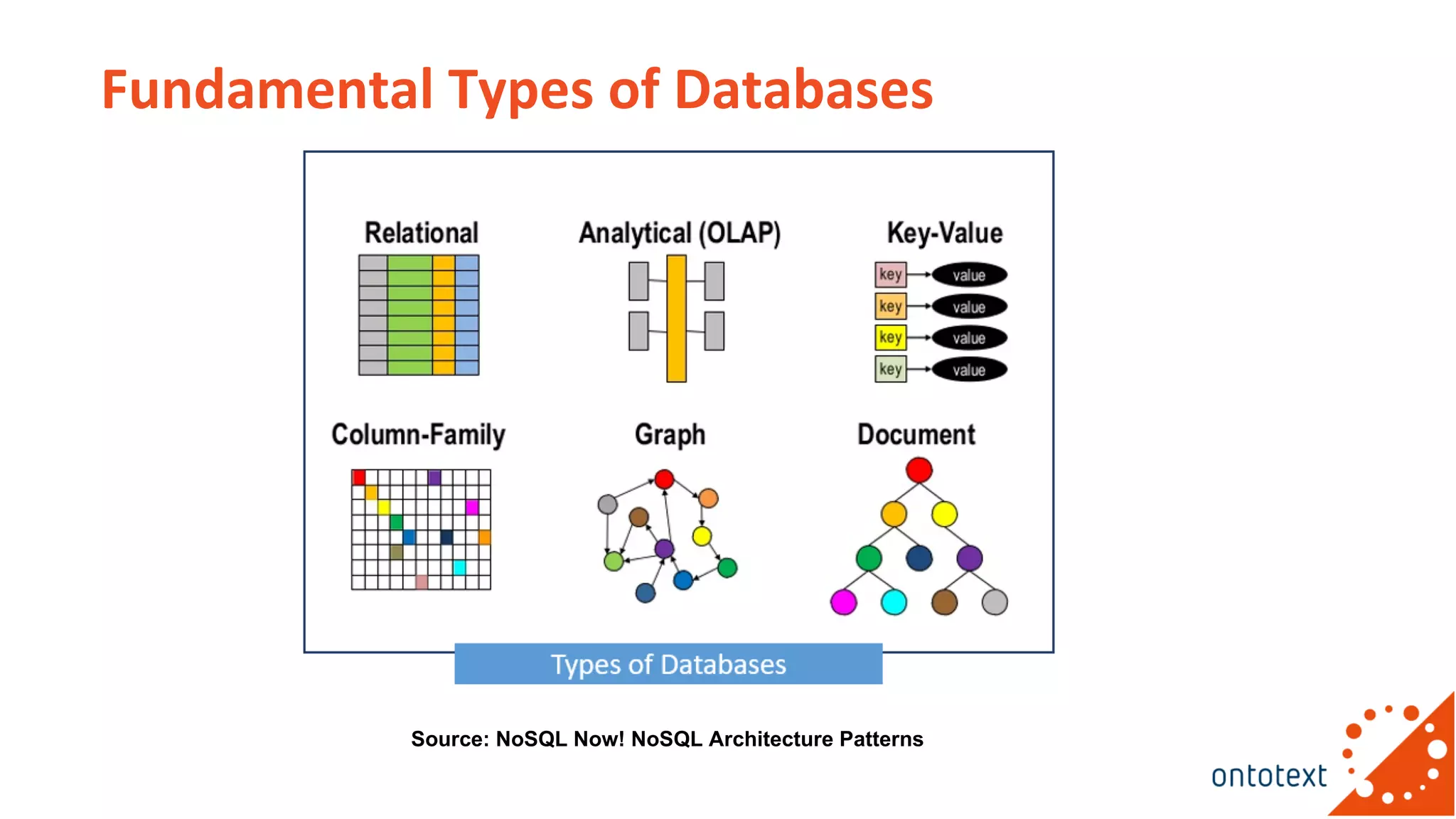
Fundamental Types of Databases
Source: NoSQL Now! NoSQL Architecture Patterns
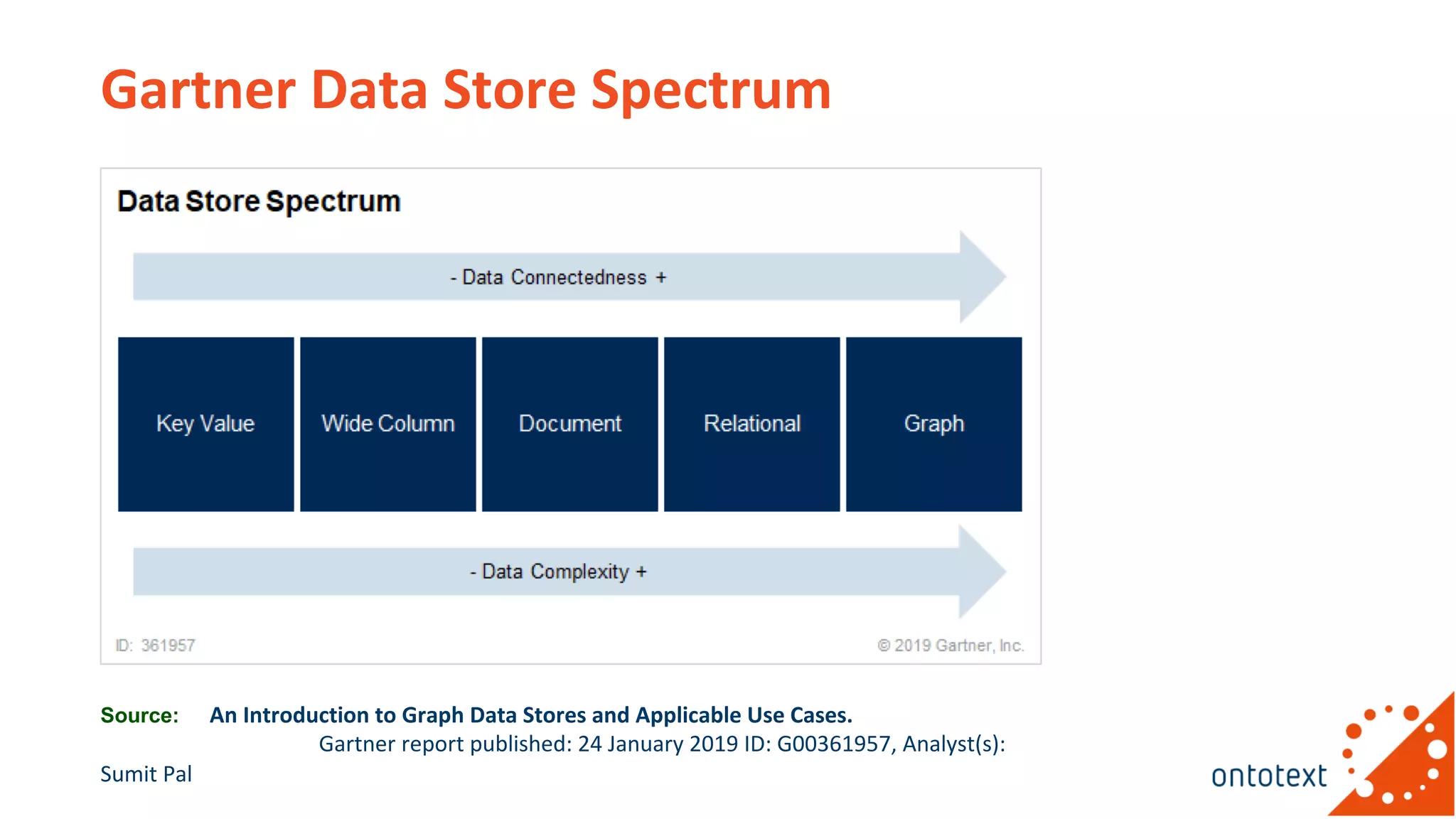
Gartner Data Store Spectrum
Source: An Introduction to Graph Data Stores and Applicable Use Cases.
Gartner report published: 24 January 2019 ID: G00361957, Analyst(s):
Sumit Pal
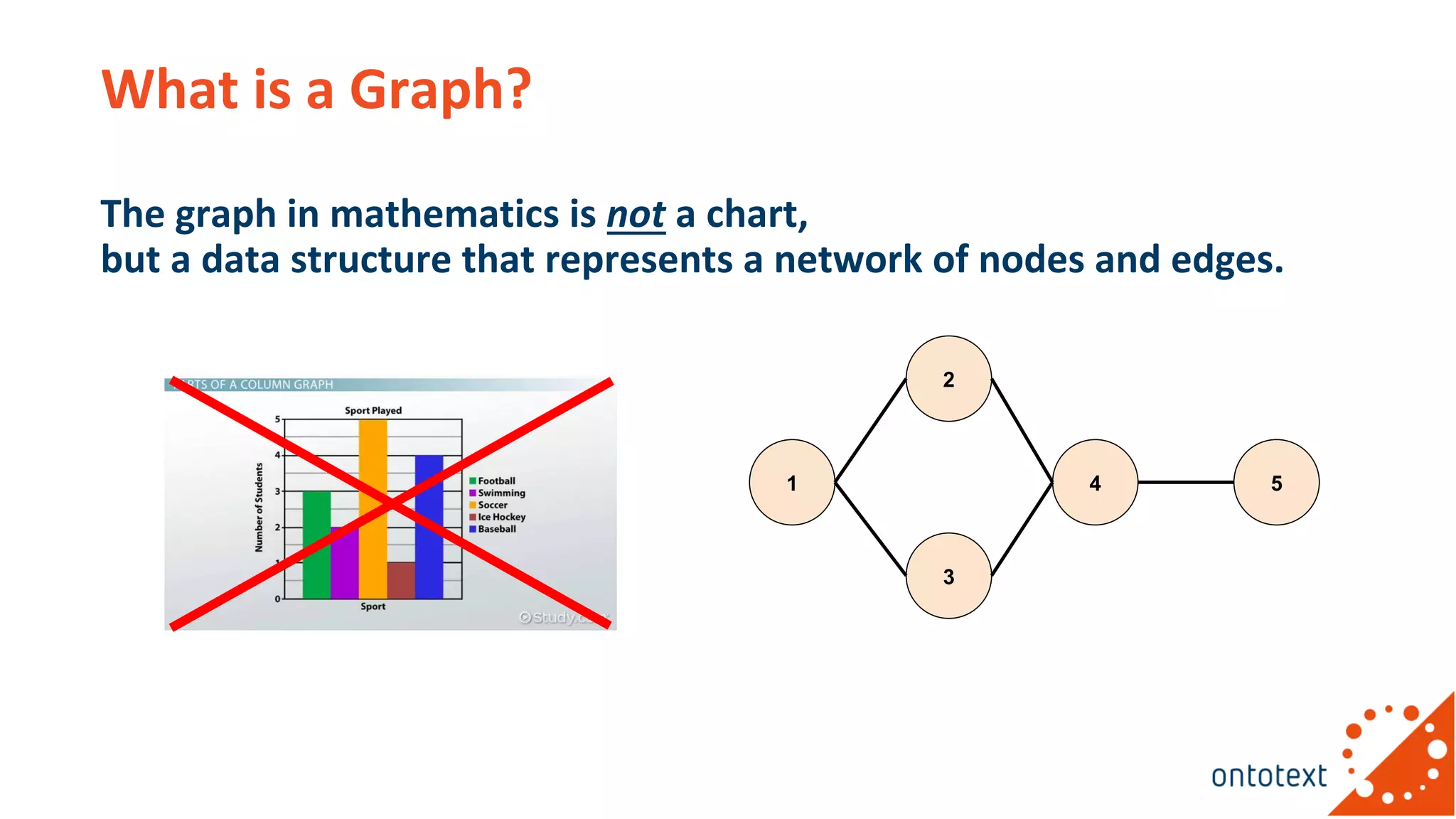
What is a Graph?
The graph in mathematics is not a chart,
but a data structure that represents a network of nodes and edges.
1
2
3
4 5
Outline
o Introduction
o RDF Model
o Property Graph Model
o Model Comparison
o Database Engines
o Q&A
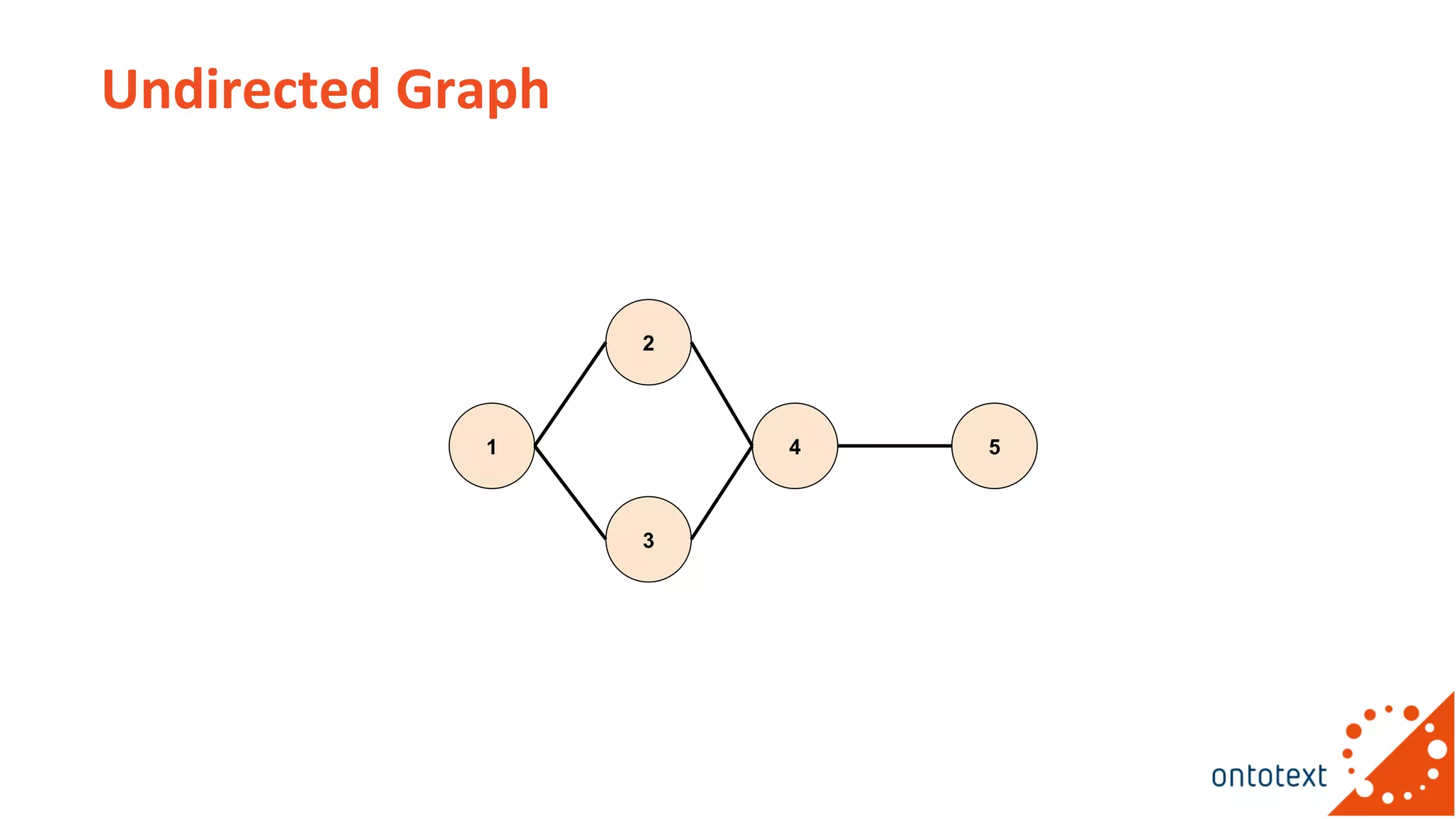
Undirected Graph
1
2
3
4 5
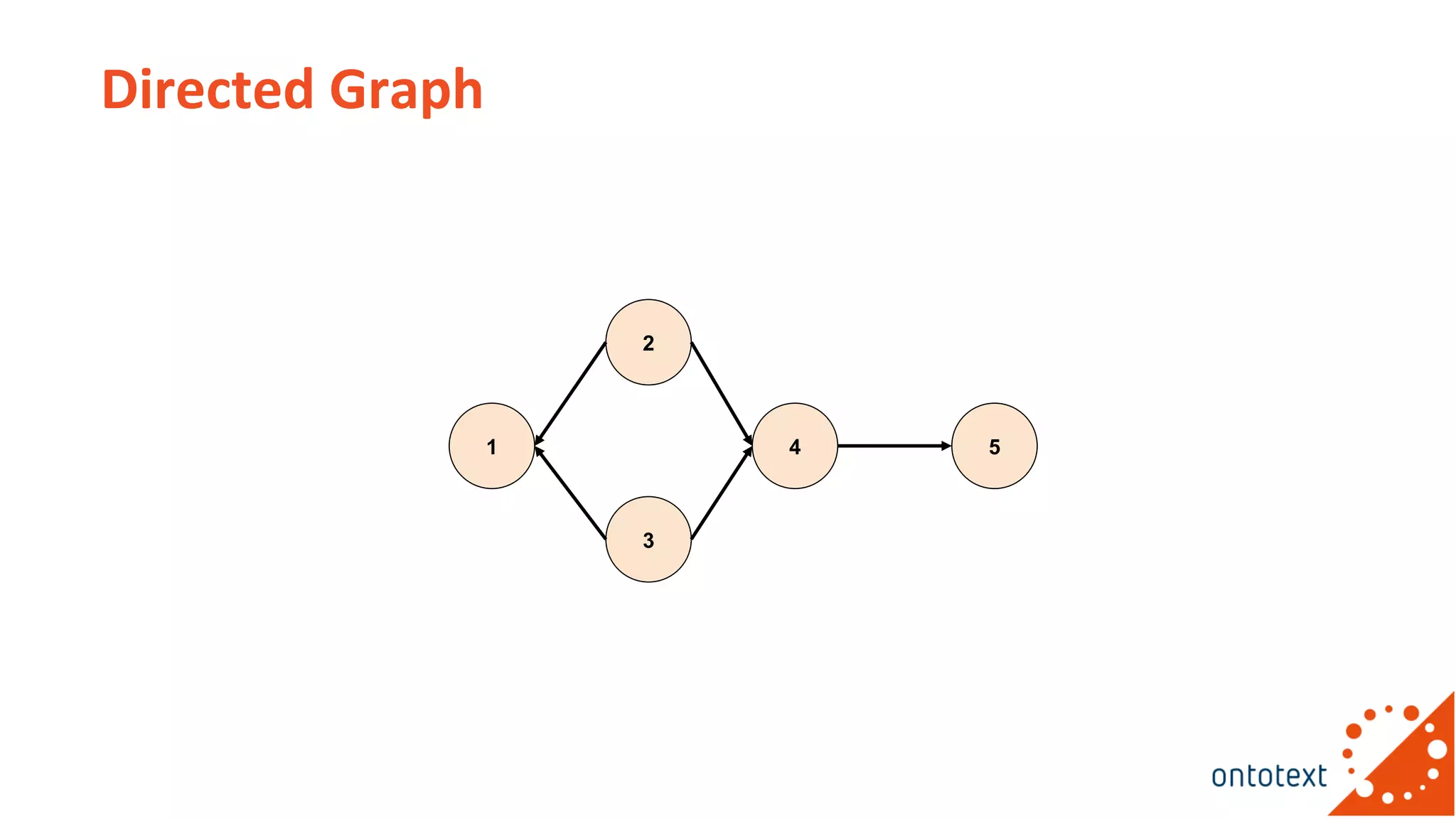
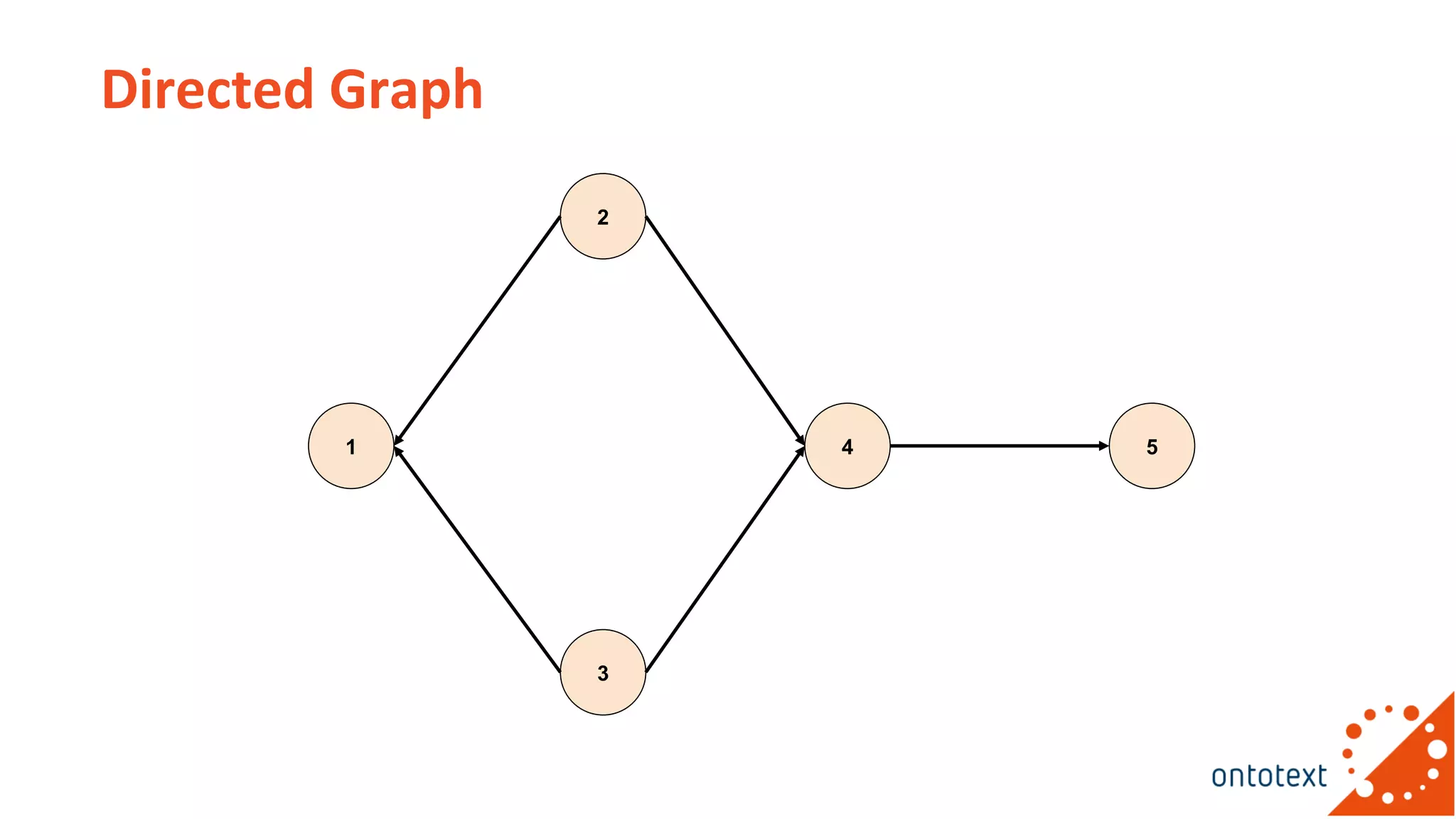
Directed Graph
1
2
3
4 5
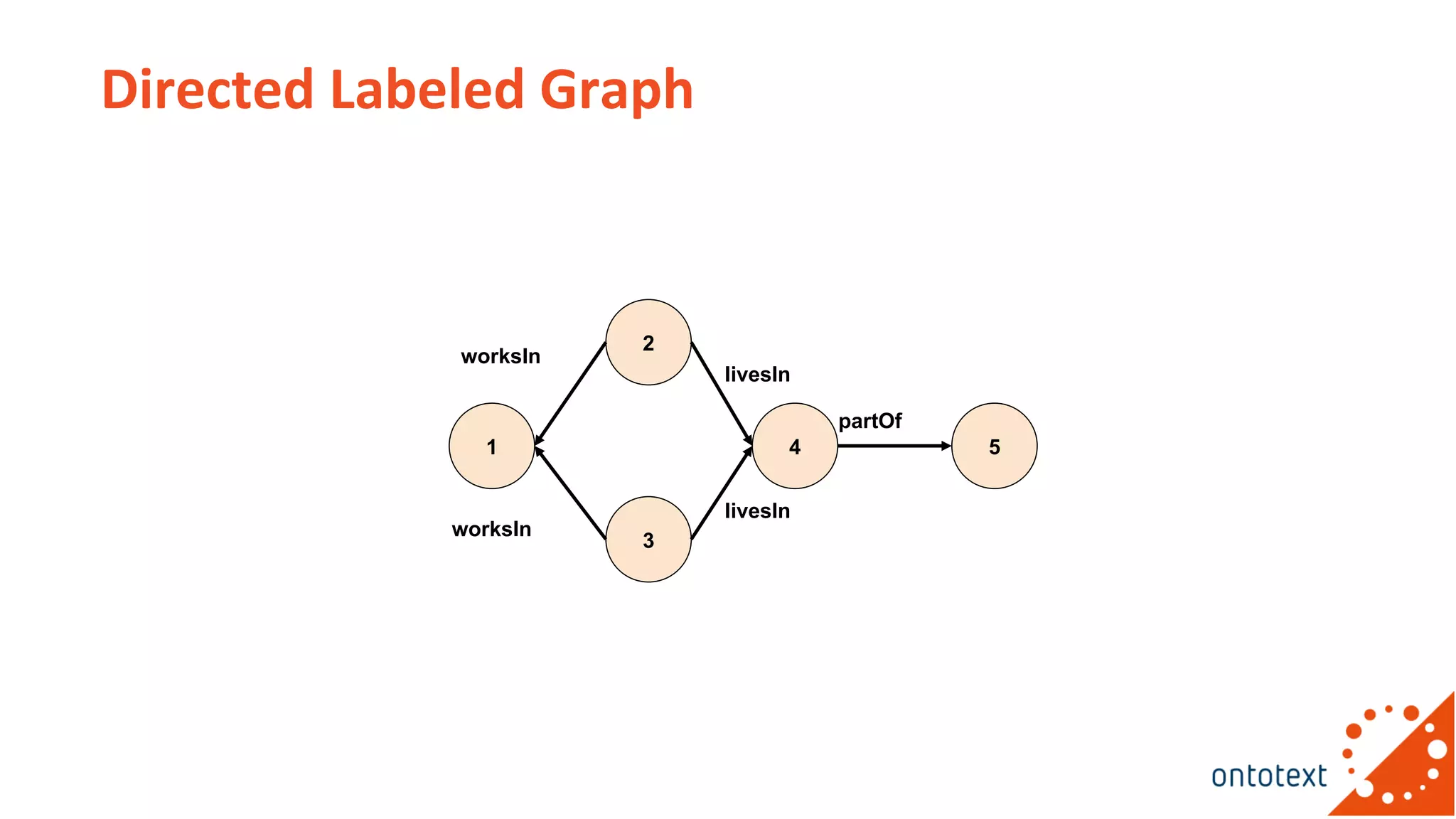
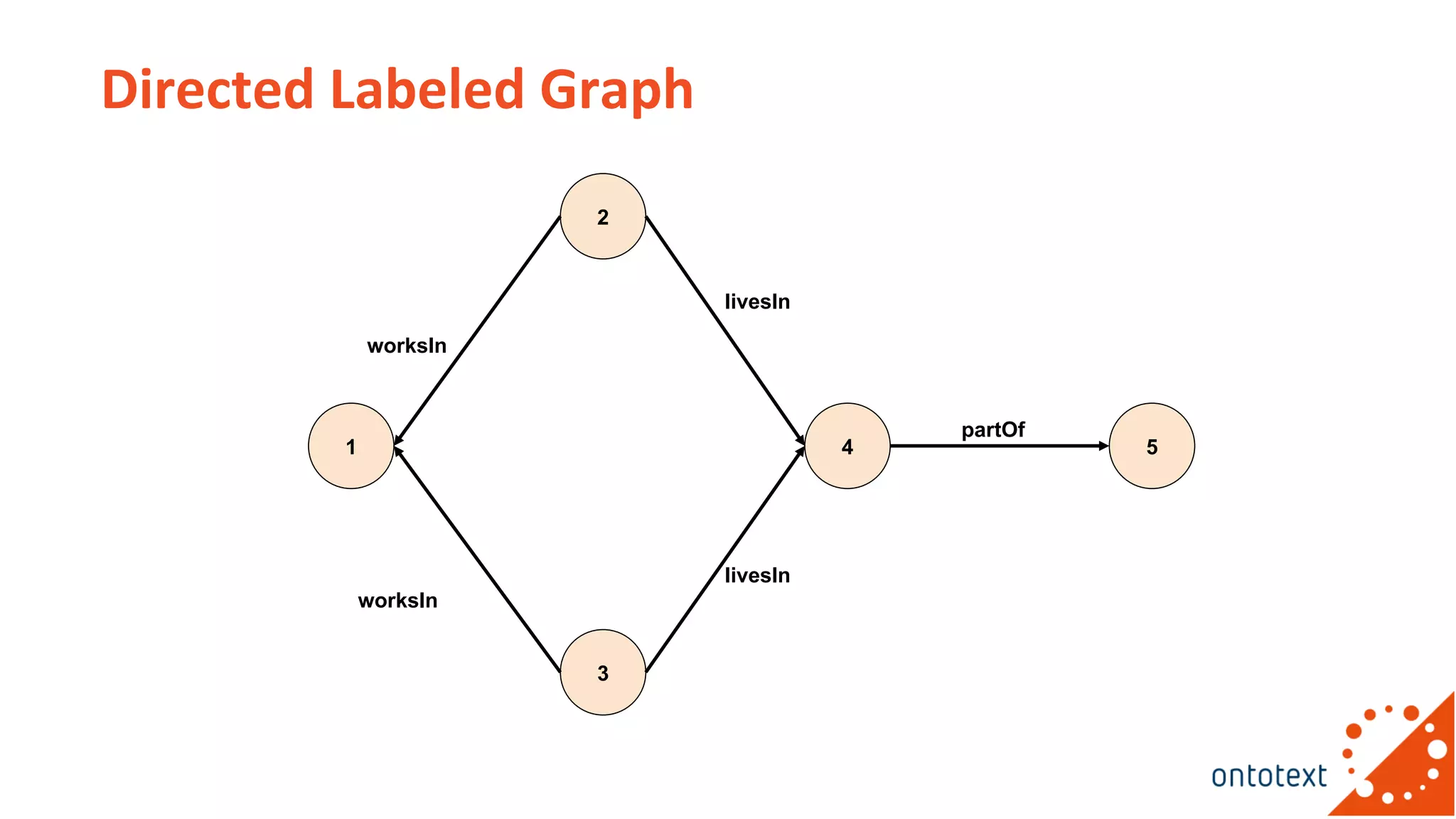
Directed Labeled Graph
1
2
3
4
livesIn
livesIn
5
partOf
worksIn
worksIn
knows
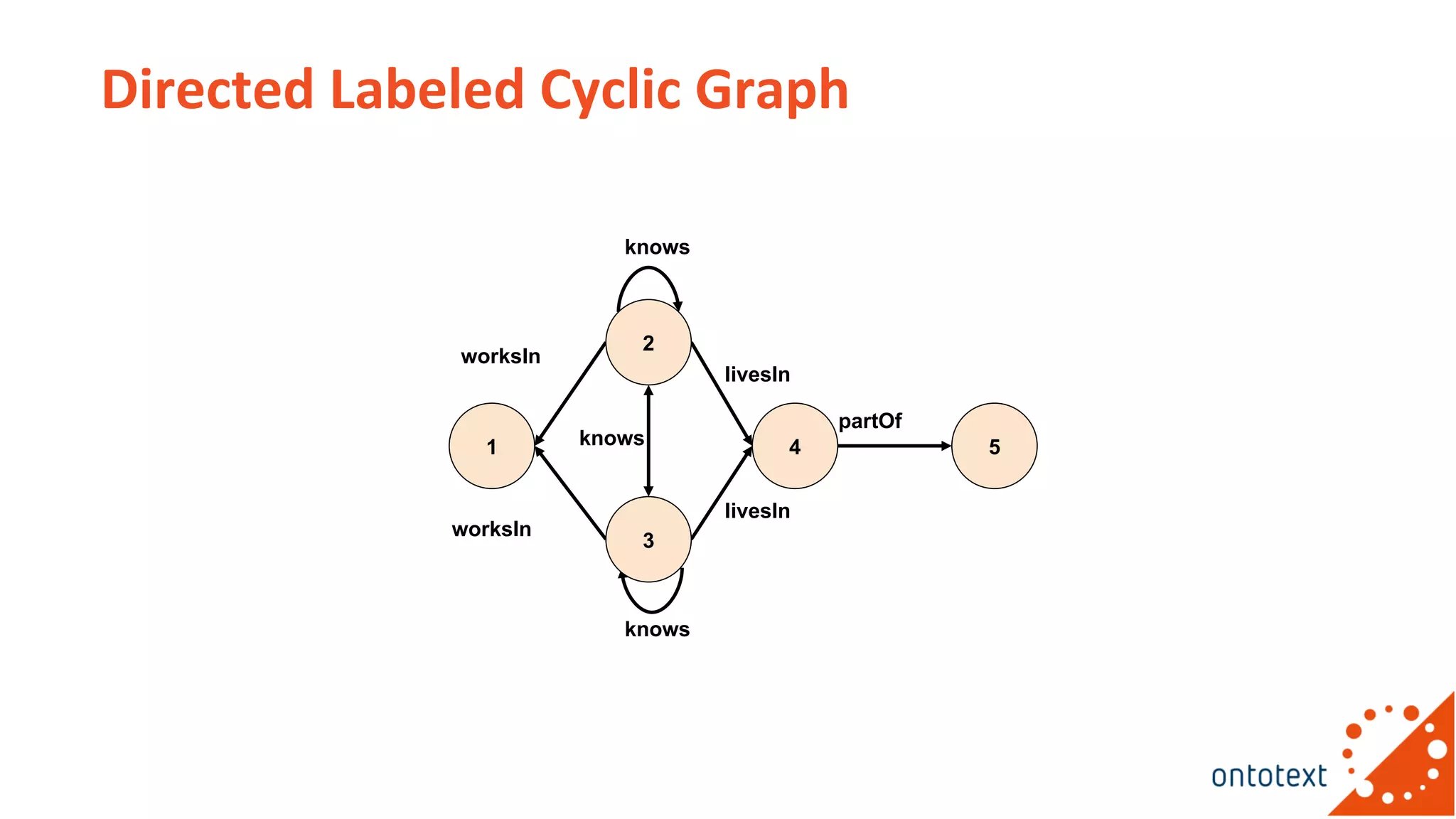
Directed Labeled Cyclic Graph
1 4
livesIn
livesIn
knows
3
2
knows
worksIn
worksIn
5
partOf
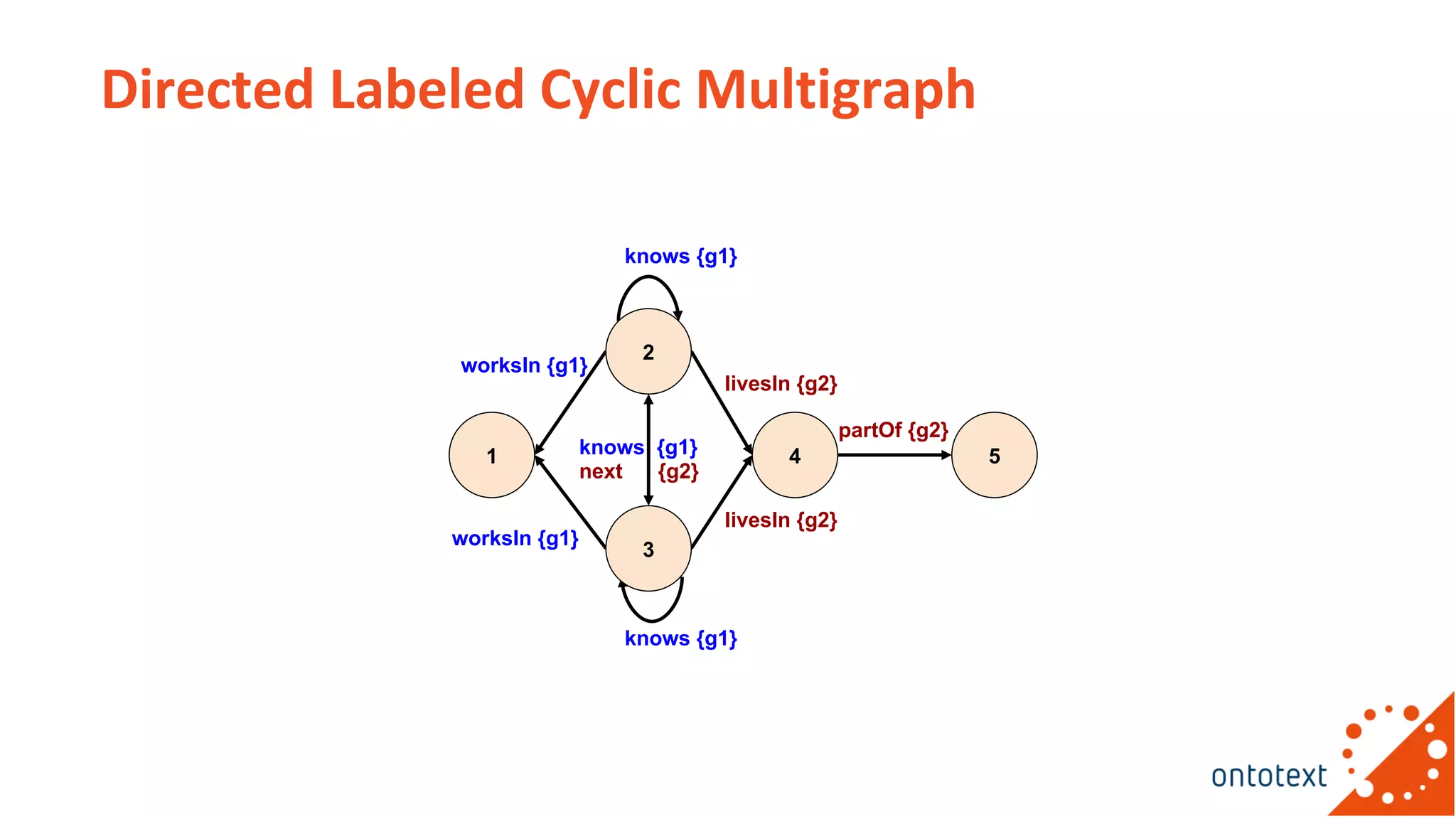
Directed Labeled Cyclic Multigraph
1 4
3
2
knows {g1}
worksIn {g1}
livesIn {g2}
livesIn {g2}
knows {g1}
knows {g1}
next {g2}
worksIn {g1}
5
partOf {g2}
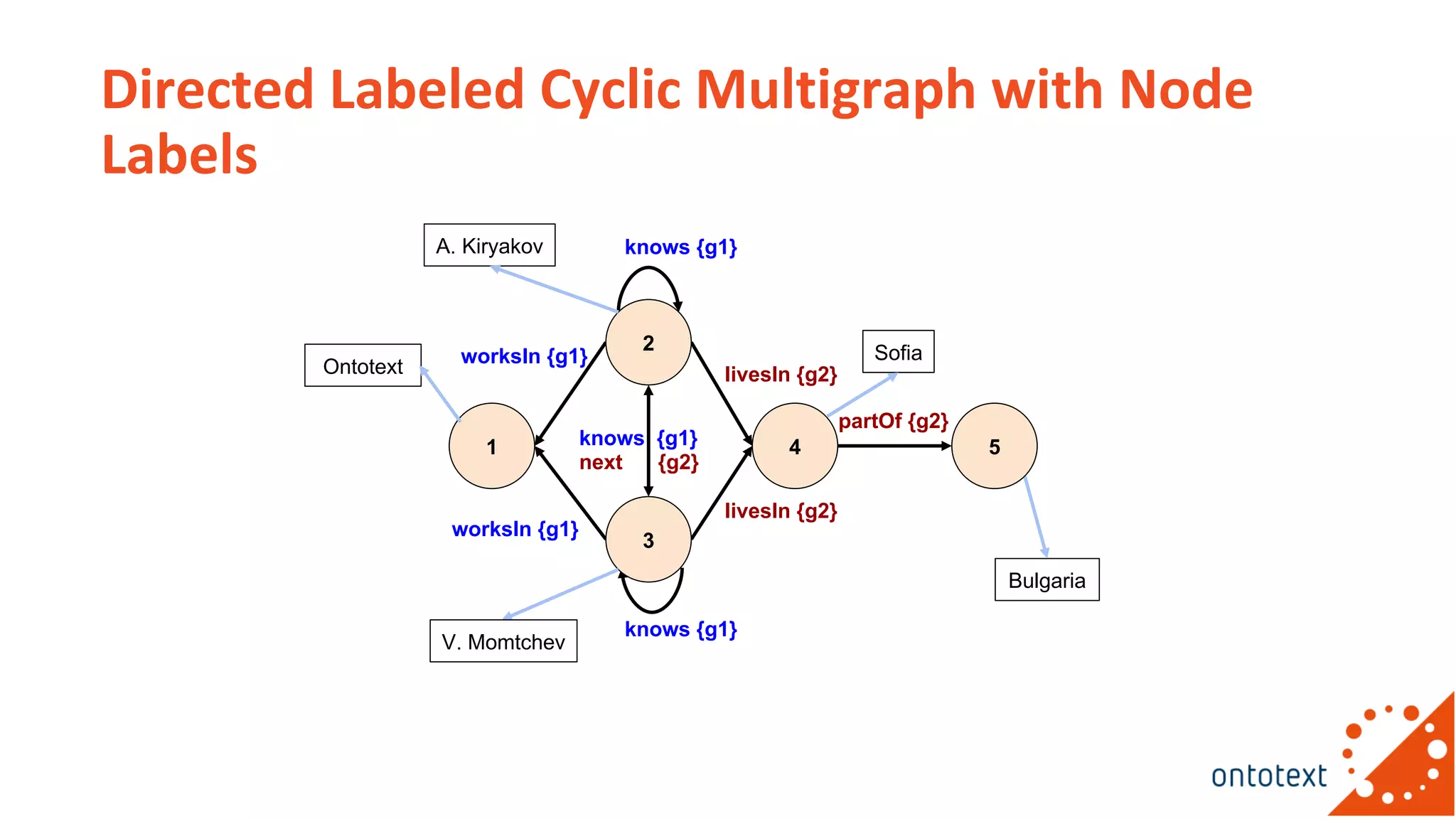
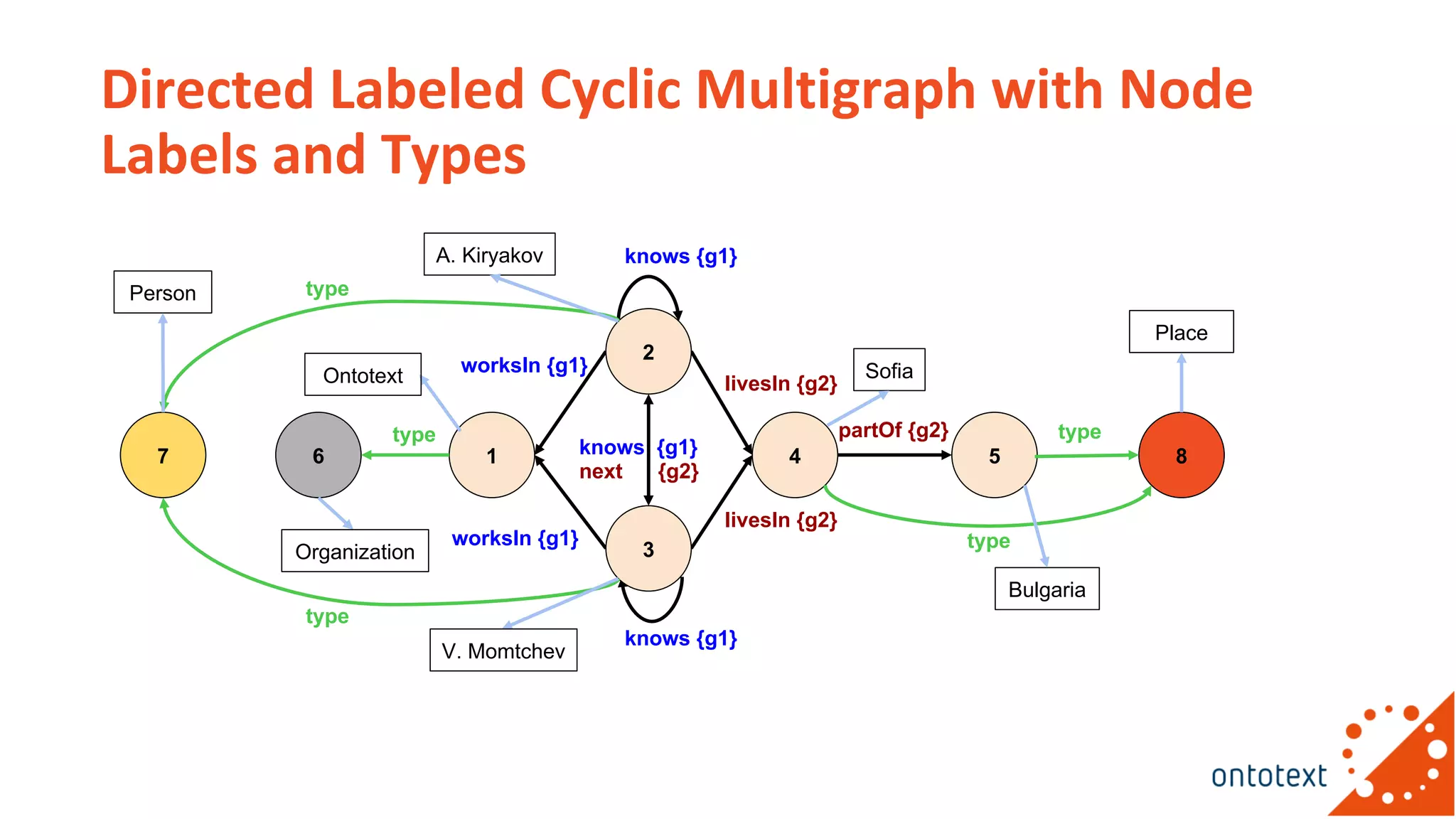
Directed Labeled Cyclic Multigraph with Node
Labels
1 4
3
2
knows {g1}
worksIn {g1}
livesIn {g2}
livesIn {g2}
knows {g1}
knows {g1}
next {g2}
worksIn {g1}
Bulgaria
A. Kiryakov
Sofia
Ontotext
V. Momtchev
5
partOf {g2}
Directed Labeled Cyclic Multigraph with Node
Labels and Types
1 4 5
3
2
knows {g1}
livesIn {g2}
knows {g1}
knows {g1}
next {g2}
67 8
type
type
type
livesIn {g2}
Bulgaria
A. Kiryakov
type
worksIn {g1}
type
worksIn {g1}
partOf {g2}
Person
Place
Ontotext
V. Momtchev
Organization
Sofia
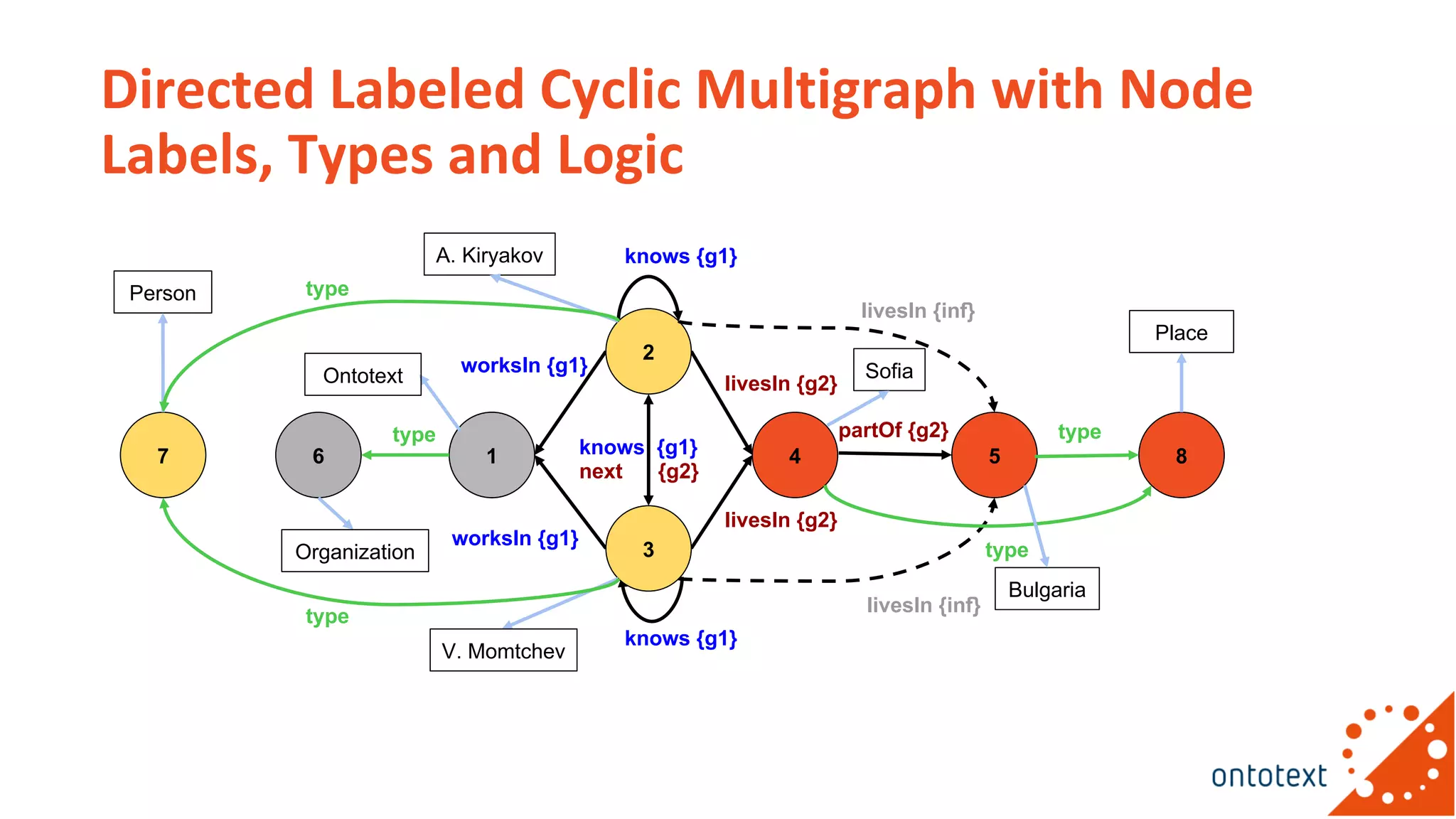
Directed Labeled Cyclic Multigraph with Node
Labels, Types and Logic
1 4 5
3
2
livesIn {inf}
livesIn {inf}
knows {g1}
worksIn {g1}
livesIn {g2}
knows {g1}
knows {g1}
next {g2}
167
type
8
type
type
partOf {g2}
livesIn {g2}
Bulgaria
A. Kiryakov
Sofia
Person
Place
Ontotext
V. Momtchev
Organization
worksIn {g1}
type
type
partOf {g2}
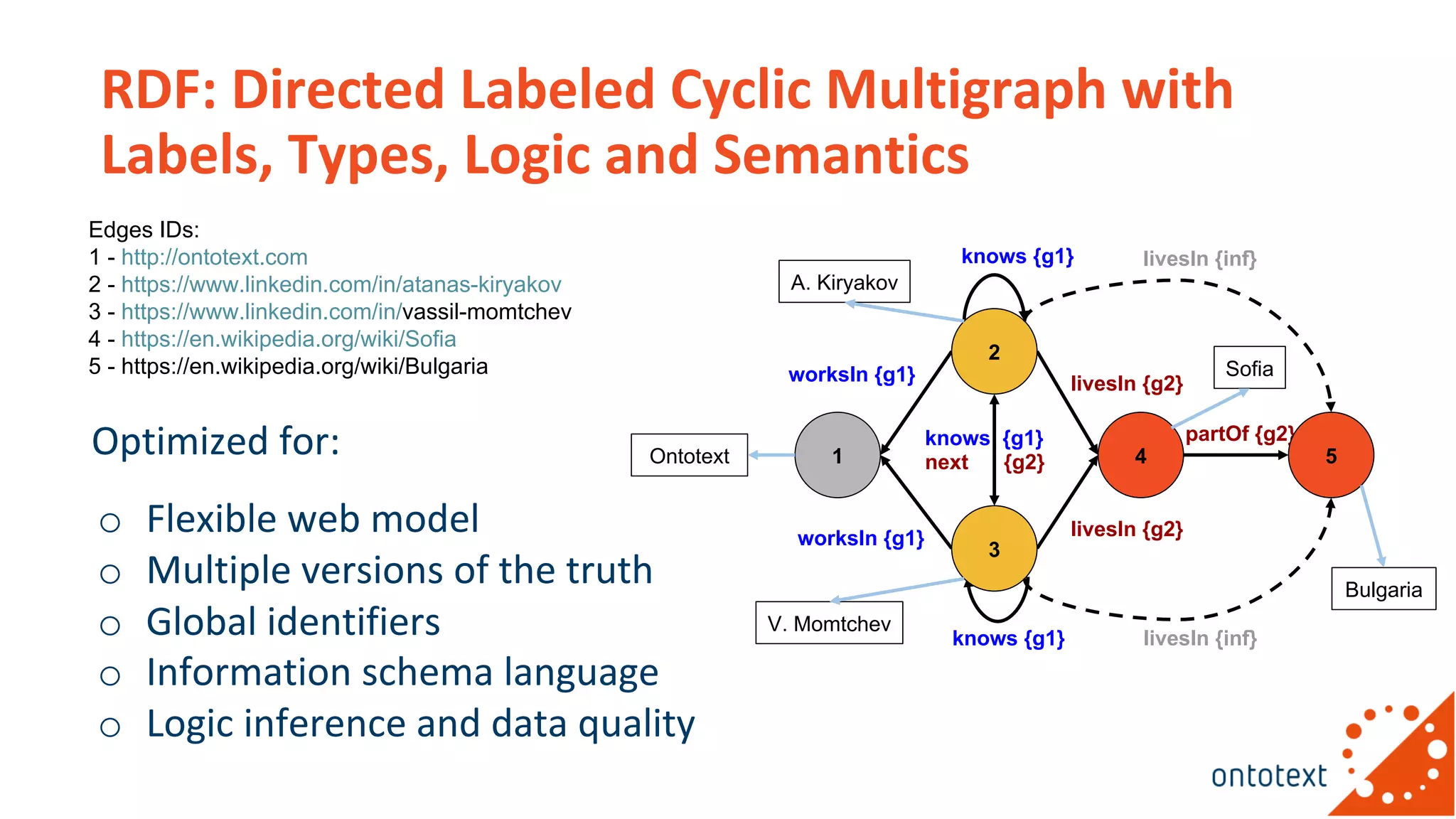
RDF: Directed Labeled Cyclic Multigraph with
Labels, Types, Logic and Semantics
1 4 5
3
2
Edges IDs:
1 - http://ontotext.com
2 - https://www.linkedin.com/in/atanas-kiryakov
3 - https://www.linkedin.com/in/vassil-momtchev
4 - https://en.wikipedia.org/wiki/Sofia
5 - https://en.wikipedia.org/wiki/Bulgaria
Optimized for:
o Flexible web model
o Multiple versions of the truth
o Global identifiers
o Information schema language
o Logic inference and data quality
Bulgaria
Ontotext
A. Kiryakov
V. Momtchev
Sofia
livesIn {inf}
livesIn {inf}
worksIn {g1}
knows {g1}
worksIn {g1}
livesIn {g2}
livesIn {g2}
knows {g1}
knows {g1}
next {g2}
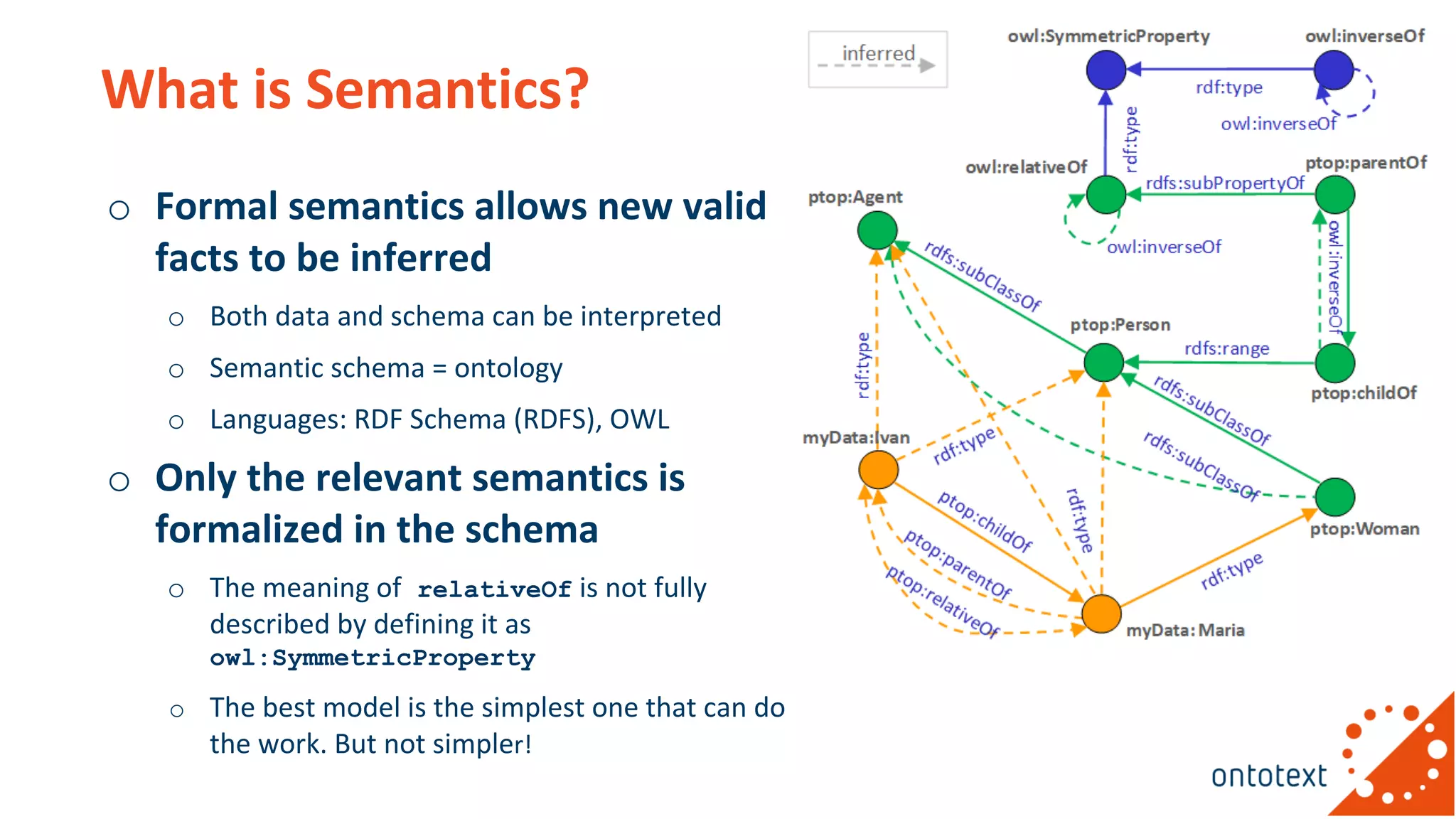
What is Semantics?
o Formal semantics allows new valid
facts to be inferred
o Both data and schema can be interpreted
o Semantic schema = ontology
o Languages: RDF Schema (RDFS), OWL
o Only the relevant semantics is
formalized in the schema
o The meaning of relativeOf is not fully
described by defining it as
owl:SymmetricProperty
o The best model is the simplest one that can do
the work. But not simpler!
What is Semantics Good For?
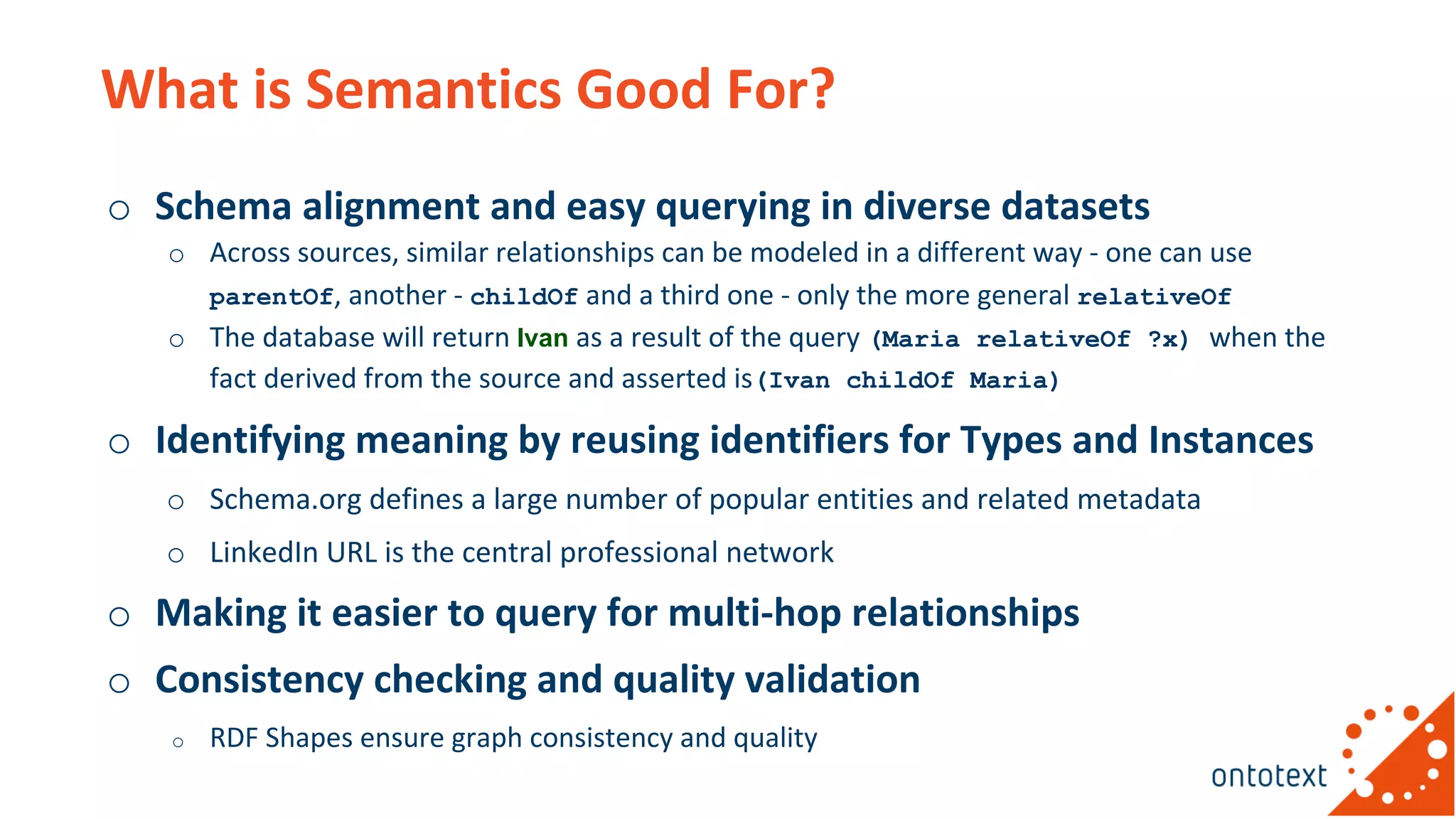
o Schema alignment and easy querying in diverse datasets
o Across sources, similar relationships can be modeled in a different way - one can use
parentOf, another - childOf and a third one - only the more general relativeOf
o The database will return Ivan as a result of the query (Maria relativeOf ?x) when the
fact derived from the source and asserted is(Ivan childOf Maria)
o Identifying meaning by reusing identifiers for Types and Instances
o Schema.org defines a large number of popular entities and related metadata
o LinkedIn URL is the central professional network
o Making it easier to query for multi-hop relationships
o Consistency checking and quality validation
o RDF Shapes ensure graph consistency and quality
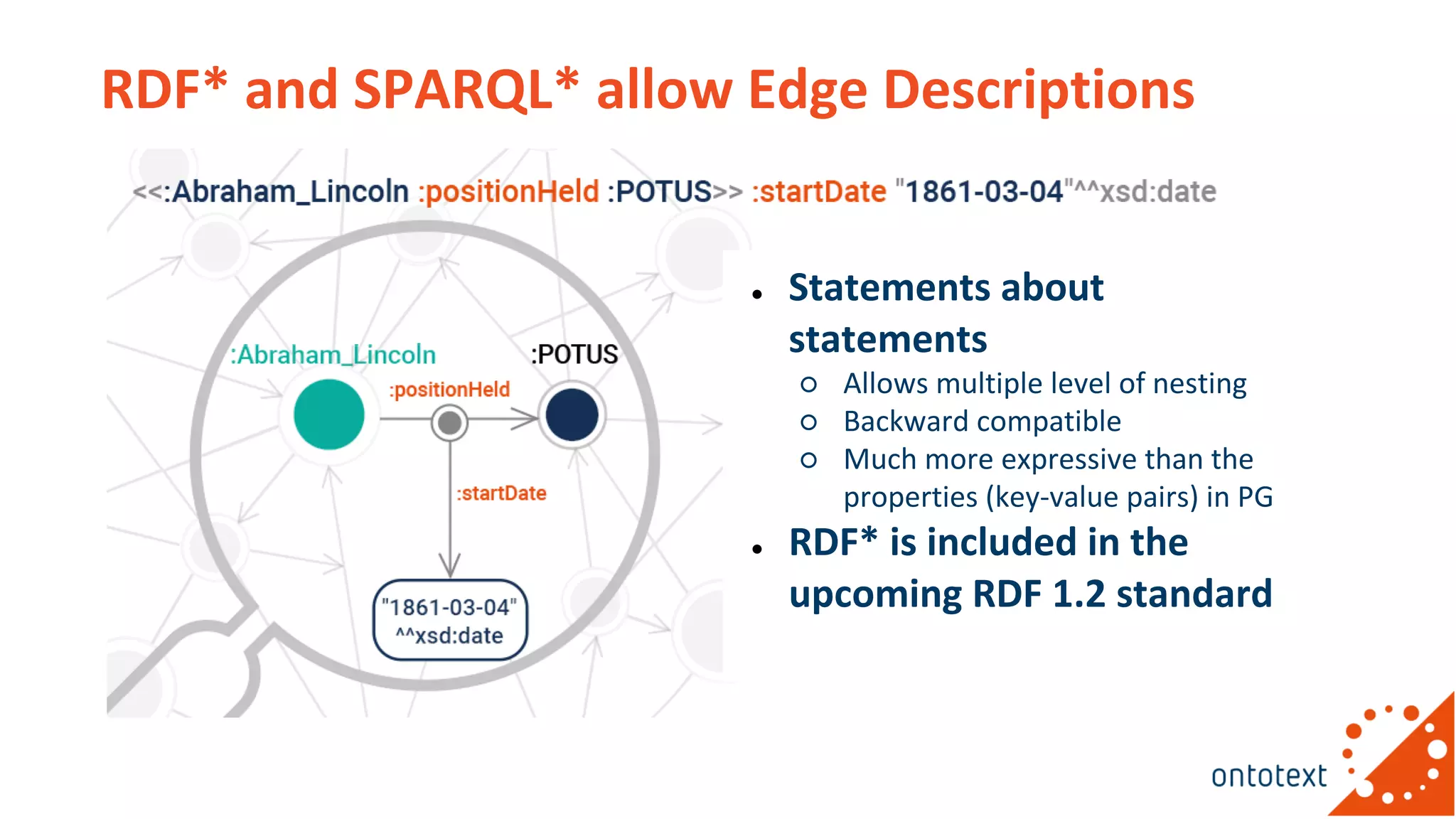
RDF* and SPARQL* allow Edge Descriptions
● Statements about
statements
○ Allows multiple level of nesting
○ Backward compatible
○ Much more expressive than the
properties (key-value pairs) in PG
● RDF* is included in the
upcoming RDF 1.2 standard
Outline
o Introduction
o RDF Model
o Property Graph Model
o Model Comparison
o Database Engines
o Q&A
Directed Graph
1
2
3
4 5
partOf
worksIn
Directed Labeled Graph
1
2
3
4 5
worksIn
livesIn
livesIn
worksIn
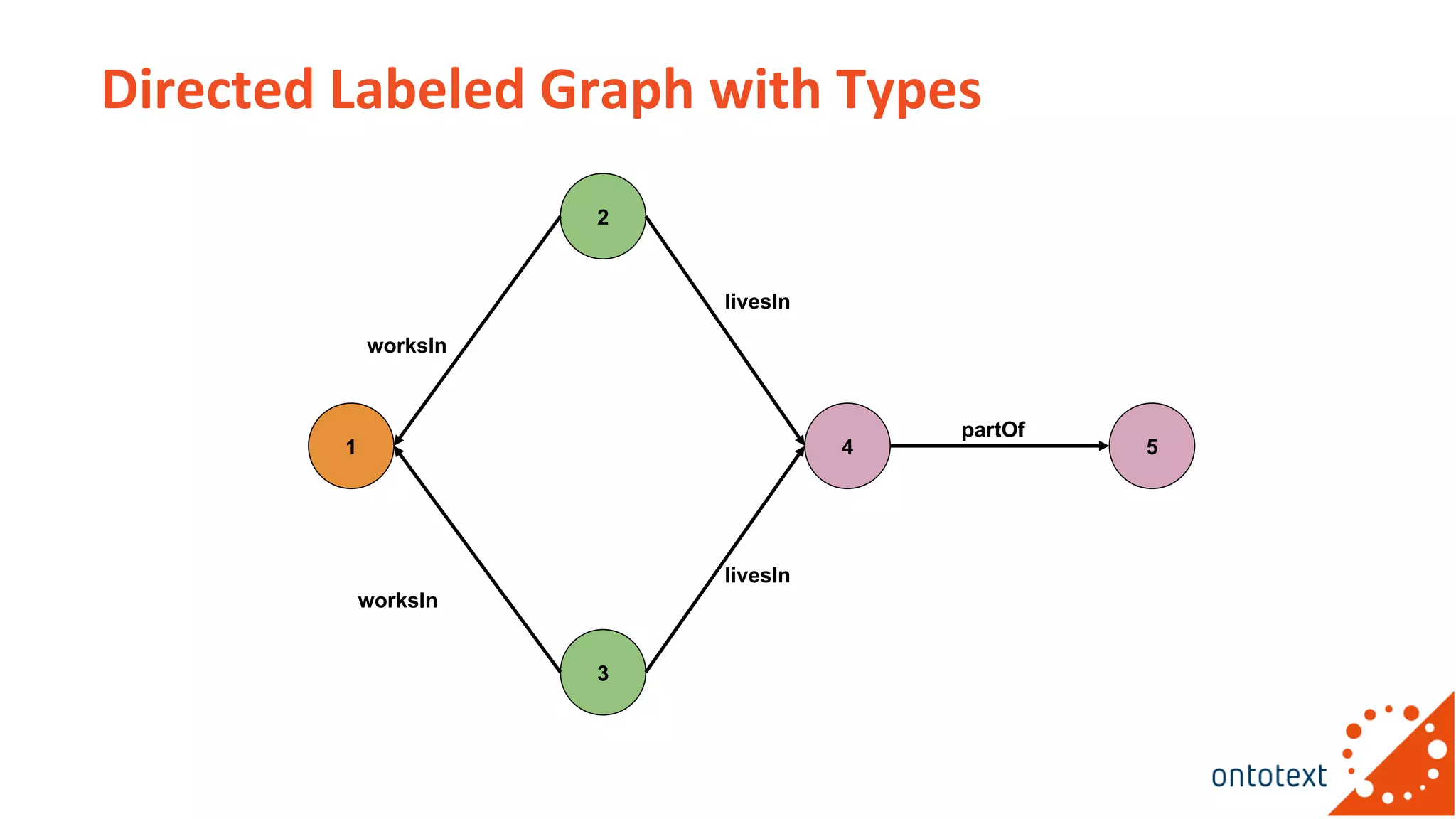
Directed Labeled Graph with Types
1
2
3
4 5
worksIn
livesIn
livesIn
partOf
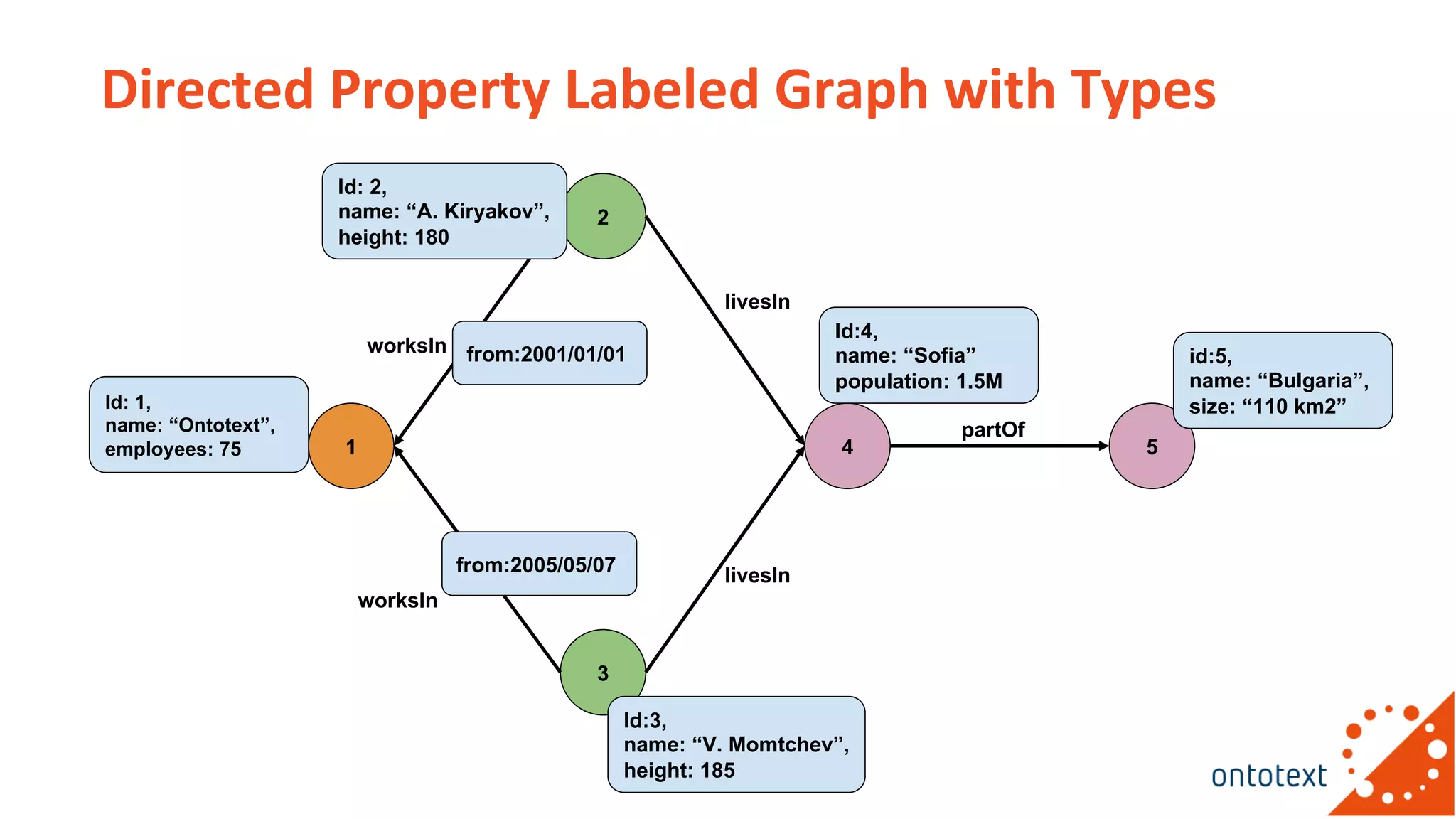
Directed Property Labeled Graph with Types
1
2
3
4 5
Id: 1,
name: “Ontotext”,
employees: 75
Id: 2,
name: “A. Kiryakov”,
height: 180
Id:3,
name: “V. Momtchev”,
height: 185
Id:4,
name: “Sofia”
population: 1.5M
id:5,
name: “Bulgaria”,
size: “110 km2”
from:2001/01/01
from:2005/05/07
worksIn
worksIn
livesIn
livesIn
partOf
Outline
o Introduction
o RDF Model
o Property Graph Model
o Model Comparison
o Database Engines
o Q&A
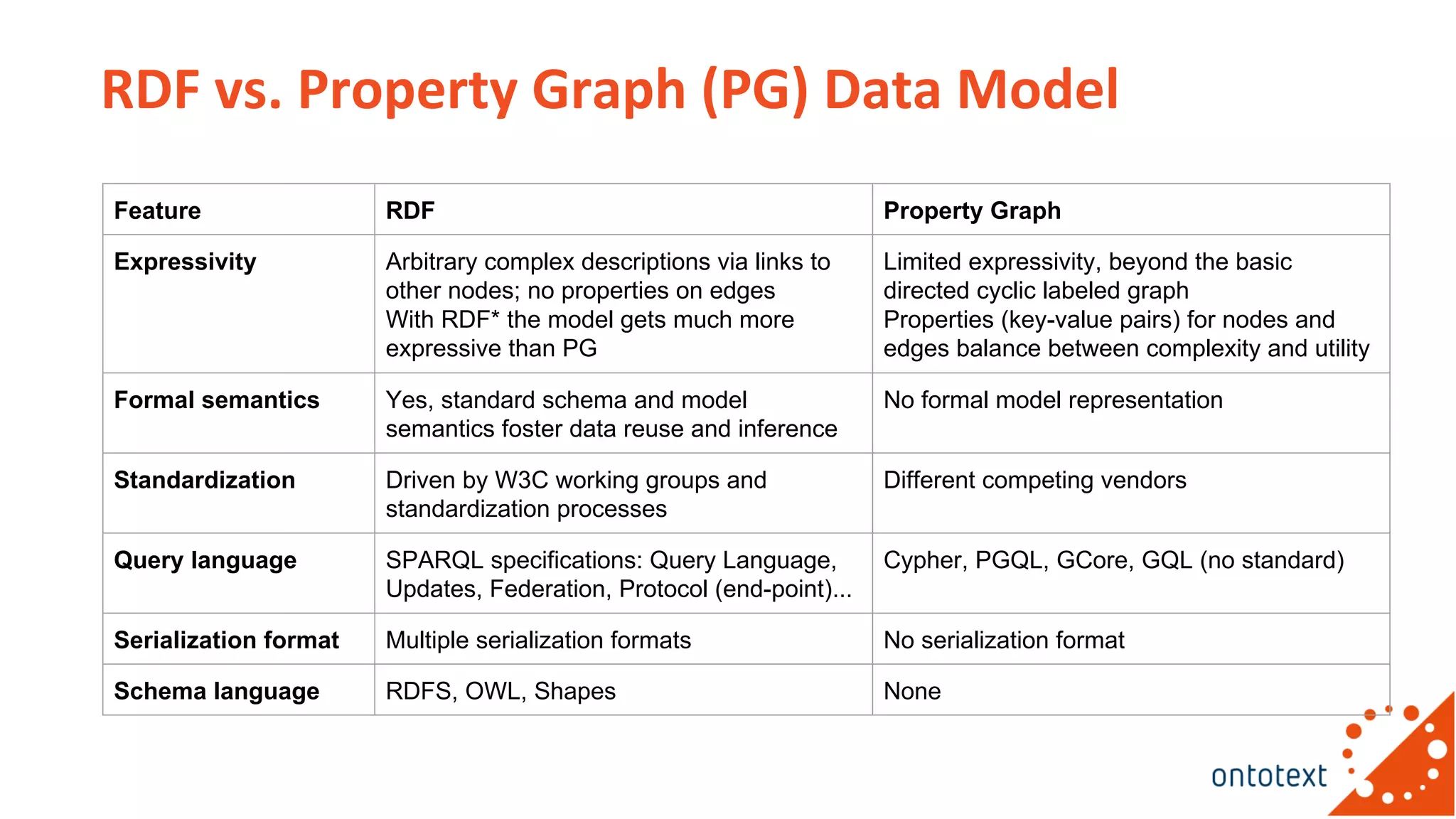
RDF vs. Property Graph (PG) Data Model
Feature RDF Property Graph
Expressivity Arbitrary complex descriptions via links to
other nodes; no properties on edges
With RDF* the model gets much more
expressive than PG
Limited expressivity, beyond the basic
directed cyclic labeled graph
Properties (key-value pairs) for nodes and
edges balance between complexity and utility
Formal semantics Yes, standard schema and model
semantics foster data reuse and inference
No formal model representation
Standardization Driven by W3C working groups and
standardization processes
Different competing vendors
Query language SPARQL specifications: Query Language,
Updates, Federation, Protocol (end-point)...
Cypher, PGQL, GCore, GQL (no standard)
Serialization format Multiple serialization formats No serialization format
Schema language RDFS, OWL, Shapes None
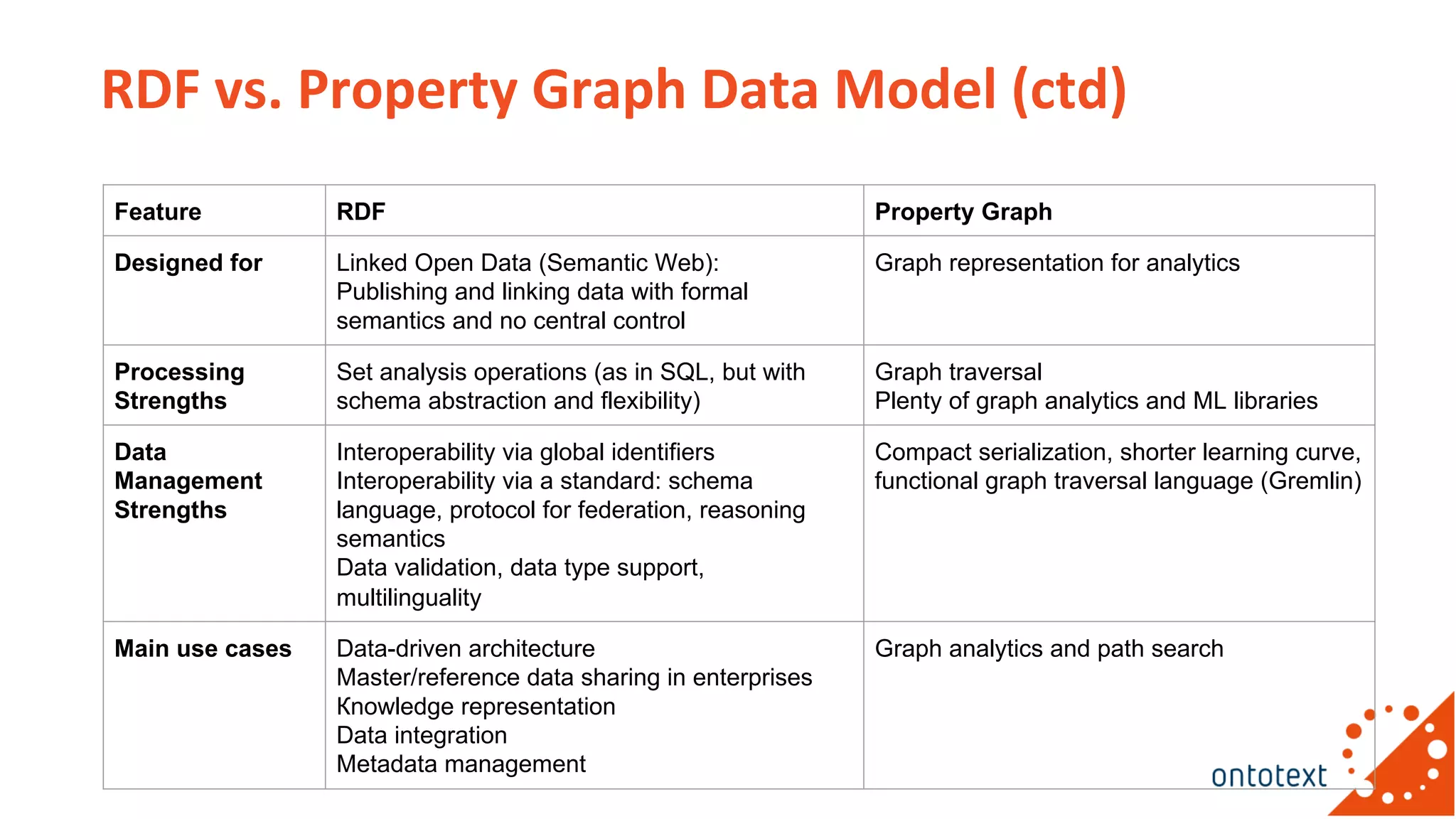
RDF vs. Property Graph Data Model (ctd)
Feature RDF Property Graph
Designed for Linked Open Data (Semantic Web):
Publishing and linking data with formal
semantics and no central control
Graph representation for analytics
Processing
Strengths
Set analysis operations (as in SQL, but with
schema abstraction and flexibility)
Graph traversal
Plenty of graph analytics and ML libraries
Data
Management
Strengths
Interoperability via global identifiers
Interoperability via a standard: schema
language, protocol for federation, reasoning
semantics
Data validation, data type support,
multilinguality
Compact serialization, shorter learning curve,
functional graph traversal language (Gremlin)
Main use cases Data-driven architecture
Master/reference data sharing in enterprises
Кnowledge representation
Data integration
Metadata management
Graph analytics and path search
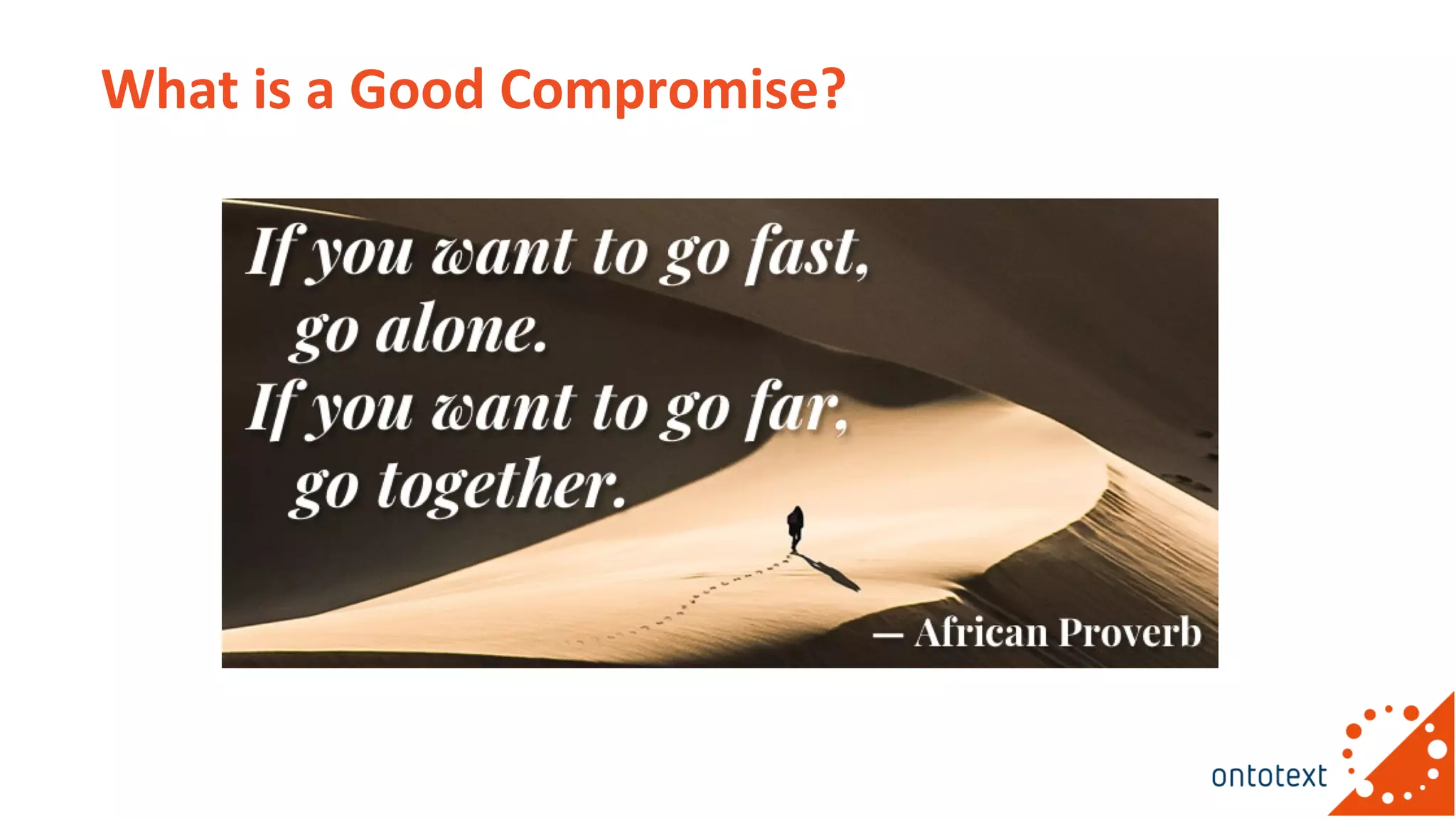
What is a Good Compromise?
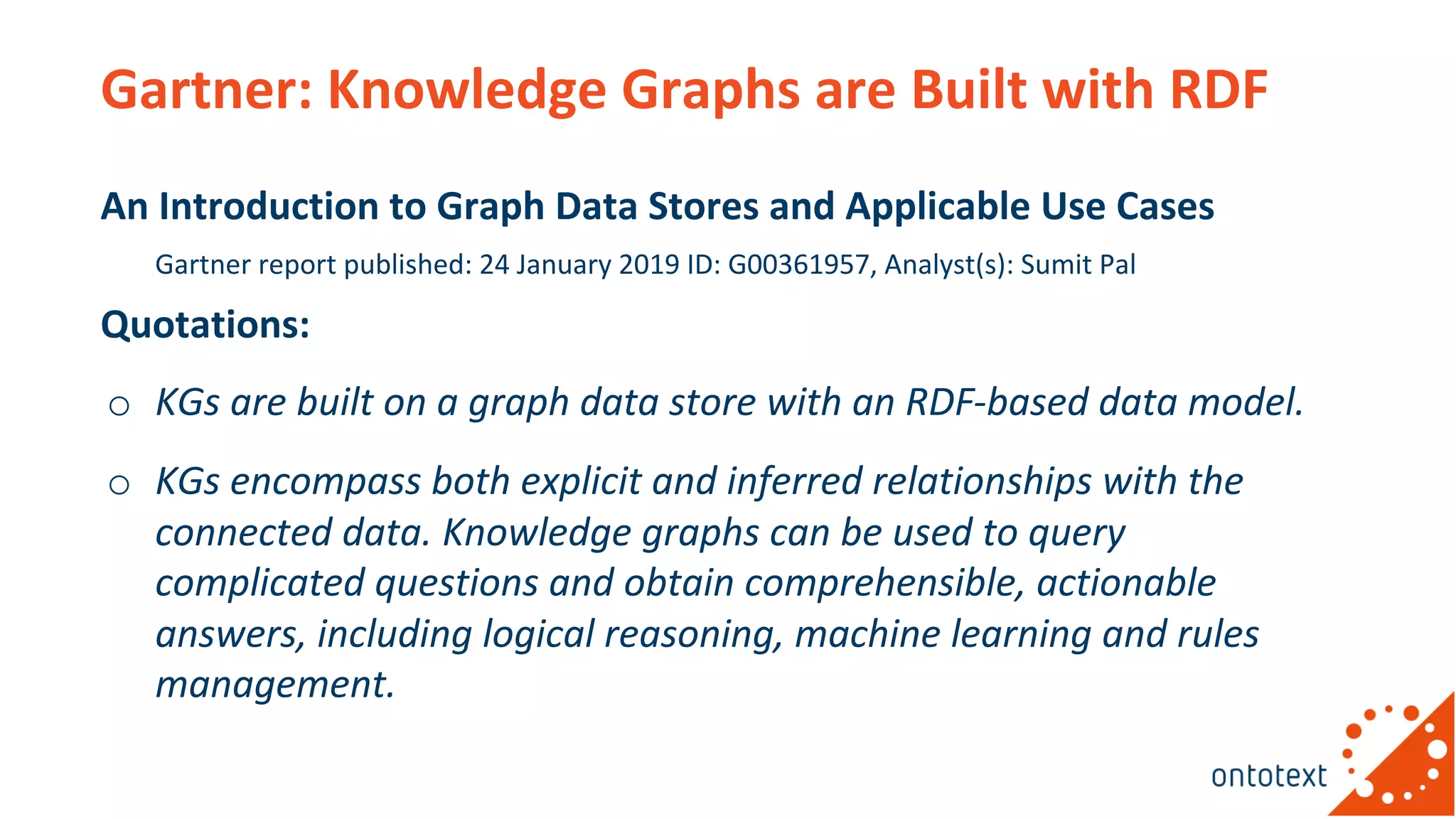
Gartner: Knowledge Graphs are Built with RDF
An Introduction to Graph Data Stores and Applicable Use Cases
Gartner report published: 24 January 2019 ID: G00361957, Analyst(s): Sumit Pal
Quotations:
o KGs are built on a graph data store with an RDF-based data model.
o KGs encompass both explicit and inferred relationships with the
connected data. Knowledge graphs can be used to query
complicated questions and obtain comprehensible, actionable
answers, including logical reasoning, machine learning and rules
management.
Outline
o Introduction
o RDF Model
o Property Graph Model
o Model Comparison
o Database Engines
o Q&A
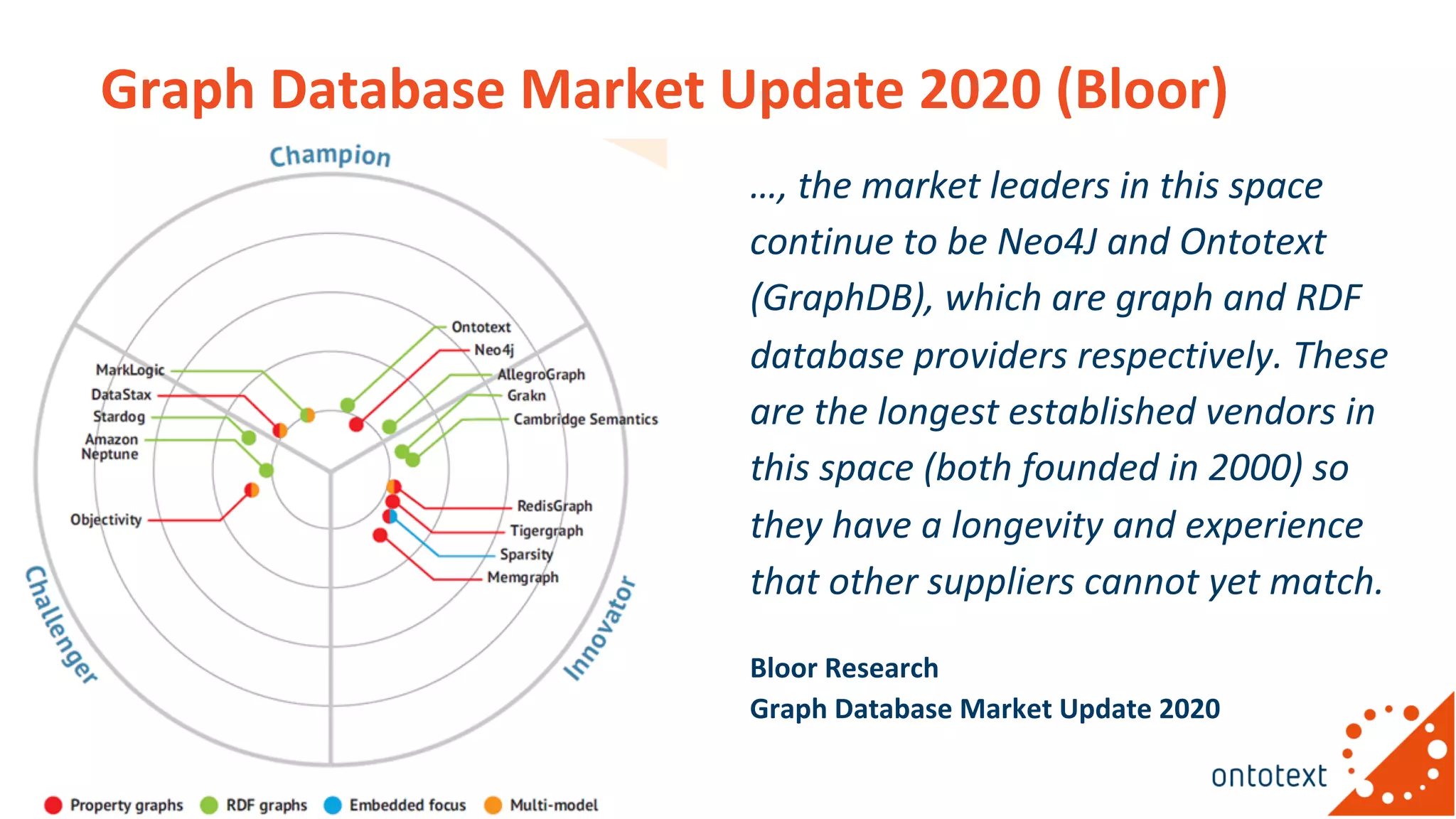
Graph Database Market Update 2020 (Bloor)
…, the market leaders in this space
continue to be Neo4J and Ontotext
(GraphDB), which are graph and RDF
database providers respectively. These
are the longest established vendors in
this space (both founded in 2000) so
they have a longevity and experience
that other suppliers cannot yet match.
Bloor Research
Graph Database Market Update 2020
Get your GraphDB Today:
https://ontotext.com/products/graphdb/
FactForge: Hub for open data and news about People and Organizations
http://factforge.net/
Experience the technology with NOW: Semantic News Portal
http://now.ontotext.com
Thank you
for your attention!

Property graph vs. RDF Triplestore comparison in 2020

  • 1.
    Property Graph vsRDF Comparison
  • 2.
    Outline o Introduction o RDFModel o Property Graph Model o Model Comparison o Database Engines o Q&A
  • 3.
    Why Different Databases? Databasemanagement systems are about series of compromises in terms of performance, complexity, query style, data types, scalability, transactions, consistency, etc. There is no database management system that meets all needs.
  • 4.
    Fundamental Types ofDatabases Source: NoSQL Now! NoSQL Architecture Patterns
  • 5.
    Gartner Data StoreSpectrum Source: An Introduction to Graph Data Stores and Applicable Use Cases. Gartner report published: 24 January 2019 ID: G00361957, Analyst(s): Sumit Pal
  • 6.
    What is aGraph? The graph in mathematics is not a chart, but a data structure that represents a network of nodes and edges. 1 2 3 4 5
  • 7.
    Outline o Introduction o RDFModel o Property Graph Model o Model Comparison o Database Engines o Q&A
  • 8.
  • 9.
  • 10.
  • 11.
    knows Directed Labeled CyclicGraph 1 4 livesIn livesIn knows 3 2 knows worksIn worksIn 5 partOf
  • 12.
    Directed Labeled CyclicMultigraph 1 4 3 2 knows {g1} worksIn {g1} livesIn {g2} livesIn {g2} knows {g1} knows {g1} next {g2} worksIn {g1} 5 partOf {g2}
  • 13.
    Directed Labeled CyclicMultigraph with Node Labels 1 4 3 2 knows {g1} worksIn {g1} livesIn {g2} livesIn {g2} knows {g1} knows {g1} next {g2} worksIn {g1} Bulgaria A. Kiryakov Sofia Ontotext V. Momtchev 5 partOf {g2}
  • 14.
    Directed Labeled CyclicMultigraph with Node Labels and Types 1 4 5 3 2 knows {g1} livesIn {g2} knows {g1} knows {g1} next {g2} 67 8 type type type livesIn {g2} Bulgaria A. Kiryakov type worksIn {g1} type worksIn {g1} partOf {g2} Person Place Ontotext V. Momtchev Organization Sofia
  • 15.
    Directed Labeled CyclicMultigraph with Node Labels, Types and Logic 1 4 5 3 2 livesIn {inf} livesIn {inf} knows {g1} worksIn {g1} livesIn {g2} knows {g1} knows {g1} next {g2} 167 type 8 type type partOf {g2} livesIn {g2} Bulgaria A. Kiryakov Sofia Person Place Ontotext V. Momtchev Organization worksIn {g1} type type
  • 16.
    partOf {g2} RDF: DirectedLabeled Cyclic Multigraph with Labels, Types, Logic and Semantics 1 4 5 3 2 Edges IDs: 1 - http://ontotext.com 2 - https://www.linkedin.com/in/atanas-kiryakov 3 - https://www.linkedin.com/in/vassil-momtchev 4 - https://en.wikipedia.org/wiki/Sofia 5 - https://en.wikipedia.org/wiki/Bulgaria Optimized for: o Flexible web model o Multiple versions of the truth o Global identifiers o Information schema language o Logic inference and data quality Bulgaria Ontotext A. Kiryakov V. Momtchev Sofia livesIn {inf} livesIn {inf} worksIn {g1} knows {g1} worksIn {g1} livesIn {g2} livesIn {g2} knows {g1} knows {g1} next {g2}
  • 17.
    What is Semantics? oFormal semantics allows new valid facts to be inferred o Both data and schema can be interpreted o Semantic schema = ontology o Languages: RDF Schema (RDFS), OWL o Only the relevant semantics is formalized in the schema o The meaning of relativeOf is not fully described by defining it as owl:SymmetricProperty o The best model is the simplest one that can do the work. But not simpler!
  • 18.
    What is SemanticsGood For? o Schema alignment and easy querying in diverse datasets o Across sources, similar relationships can be modeled in a different way - one can use parentOf, another - childOf and a third one - only the more general relativeOf o The database will return Ivan as a result of the query (Maria relativeOf ?x) when the fact derived from the source and asserted is(Ivan childOf Maria) o Identifying meaning by reusing identifiers for Types and Instances o Schema.org defines a large number of popular entities and related metadata o LinkedIn URL is the central professional network o Making it easier to query for multi-hop relationships o Consistency checking and quality validation o RDF Shapes ensure graph consistency and quality
  • 19.
    RDF* and SPARQL*allow Edge Descriptions ● Statements about statements ○ Allows multiple level of nesting ○ Backward compatible ○ Much more expressive than the properties (key-value pairs) in PG ● RDF* is included in the upcoming RDF 1.2 standard
  • 20.
    Outline o Introduction o RDFModel o Property Graph Model o Model Comparison o Database Engines o Q&A
  • 21.
  • 22.
  • 23.
    worksIn Directed Labeled Graphwith Types 1 2 3 4 5 worksIn livesIn livesIn partOf
  • 24.
    Directed Property LabeledGraph with Types 1 2 3 4 5 Id: 1, name: “Ontotext”, employees: 75 Id: 2, name: “A. Kiryakov”, height: 180 Id:3, name: “V. Momtchev”, height: 185 Id:4, name: “Sofia” population: 1.5M id:5, name: “Bulgaria”, size: “110 km2” from:2001/01/01 from:2005/05/07 worksIn worksIn livesIn livesIn partOf
  • 25.
    Outline o Introduction o RDFModel o Property Graph Model o Model Comparison o Database Engines o Q&A
  • 26.
    RDF vs. PropertyGraph (PG) Data Model Feature RDF Property Graph Expressivity Arbitrary complex descriptions via links to other nodes; no properties on edges With RDF* the model gets much more expressive than PG Limited expressivity, beyond the basic directed cyclic labeled graph Properties (key-value pairs) for nodes and edges balance between complexity and utility Formal semantics Yes, standard schema and model semantics foster data reuse and inference No formal model representation Standardization Driven by W3C working groups and standardization processes Different competing vendors Query language SPARQL specifications: Query Language, Updates, Federation, Protocol (end-point)... Cypher, PGQL, GCore, GQL (no standard) Serialization format Multiple serialization formats No serialization format Schema language RDFS, OWL, Shapes None
  • 27.
    RDF vs. PropertyGraph Data Model (ctd) Feature RDF Property Graph Designed for Linked Open Data (Semantic Web): Publishing and linking data with formal semantics and no central control Graph representation for analytics Processing Strengths Set analysis operations (as in SQL, but with schema abstraction and flexibility) Graph traversal Plenty of graph analytics and ML libraries Data Management Strengths Interoperability via global identifiers Interoperability via a standard: schema language, protocol for federation, reasoning semantics Data validation, data type support, multilinguality Compact serialization, shorter learning curve, functional graph traversal language (Gremlin) Main use cases Data-driven architecture Master/reference data sharing in enterprises Кnowledge representation Data integration Metadata management Graph analytics and path search
  • 28.
    What is aGood Compromise?
  • 29.
    Gartner: Knowledge Graphsare Built with RDF An Introduction to Graph Data Stores and Applicable Use Cases Gartner report published: 24 January 2019 ID: G00361957, Analyst(s): Sumit Pal Quotations: o KGs are built on a graph data store with an RDF-based data model. o KGs encompass both explicit and inferred relationships with the connected data. Knowledge graphs can be used to query complicated questions and obtain comprehensible, actionable answers, including logical reasoning, machine learning and rules management.
  • 30.
    Outline o Introduction o RDFModel o Property Graph Model o Model Comparison o Database Engines o Q&A
  • 32.
    Graph Database MarketUpdate 2020 (Bloor) …, the market leaders in this space continue to be Neo4J and Ontotext (GraphDB), which are graph and RDF database providers respectively. These are the longest established vendors in this space (both founded in 2000) so they have a longevity and experience that other suppliers cannot yet match. Bloor Research Graph Database Market Update 2020
  • 33.
    Get your GraphDBToday: https://ontotext.com/products/graphdb/ FactForge: Hub for open data and news about People and Organizations http://factforge.net/ Experience the technology with NOW: Semantic News Portal http://now.ontotext.com Thank you for your attention!