COMPUTER APPLICATIONS
CLASS X (Code 165)
TOPIC:
UNIT 1: Introduction to Internet
By
HIMANSHU PATHAK
Contents
• Introduction to Internet
• World Wide Web
• Web Server & Web Client
• Websites and Webpages
• Newsgroups & Blogs
• Email
• Uploading & Downloading
Introduction
• Internet is a global communication system
that links together thousands of individual
networks.
• It allows exchange of information between
two or more computers on a network.
• Thus internet helps in transfer of messages
through mail, chat, video & audio conference,
etc.
Cont…
• Internet was evolved in 1969, under the
project called ARPANET (Advanced Research
Projects Agency Network) to connect
computers at different universities and U.S.
defense.
• In 1990s the internet working of ARPANET,
NSFnet and other private networks resulted
into Internet.
• Therefore, ‘Internet is a global network of
computer networks’ or ‘network of networks’
Working of Internet
• All computers on the Internet, communicate with
one another using TCP/IP, which is a basic protocol
(i.e. set of rules) of the Internet.
• TCP/IP (Transmission Control Protocol/Internet
Protocol) manages the transmission of
data/file/document on the Internet by breaking the
data/file/document into small pieces or parts called
packets or datagrams.
• Each packet contains actual data and address part,
i.e. addresses of destination and source up to 1500
characters.
What can I do on the Internet?
• One of the best features of the Internet is the ability to
communicate almost instantly with anyone in the world.
• There are many other things you can do on the Internet:
– Sending emails
– Looking up news, weather, health, sports results, and
government information.
– shop for anything .
– Doing all your banking, taxes and business online.
– Sharing your photo and video collection, and seeing the
shared collections of others.
– Downloading and watching movies, reading book reviews or
watching sports.
How do I connect to the Internet?
• There are a number of different ways to access
the internet:
– Old fashioned dial-up, which makes telephone calls to
an ISP and uses coded screeches and squeals to
transmit data.
– DSL (Digital Subscriber Line), which uses a special
modem to transform your existing phone line into a
high-speed phone line. DSL is the most common type
of broadband connection
– 3G/4G which uses mobile phone networks to connect
you to the internet.
World Wide Web
• The World Wide Web (WWW) or web is an internet
based service, which uses common set of rules
known as protocols, to distribute documents across
the Internet in a standard way.
• World Wide Web, which is also known as a Web, is a
collection of websites or web pages stored in web
servers and connected to local computers through
the internet.
• Users can access the content of these sites from any
part of the world over the internet using their
devices such as computers, laptops, cell phones, etc
Cont…
• The World Wide Web. Or ‘Web’ is a part of the
Internet.
• The Web is viewed through web browser software
such as Google chrome, Internet Explorer, Mozilla
Firefox etc.
• The Web was invented in 1991 by Tim Berners-Lee,
while consulting at CERN (European Organization for
Nuclear Research) in Switzerland.
• The Web is a distributed information system.
• Information in the Web is connected by hyperlinks.
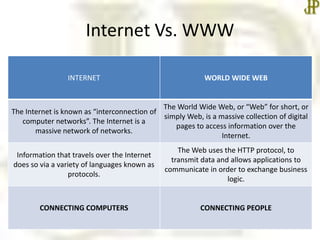
Internet Vs. WWW
INTERNET WORLD WIDE WEB
The Internet is known as “interconnection of
computer networks”. The Internet is a
massive network of networks.
The World Wide Web, or “Web” for short, or
simply Web, is a massive collection of digital
pages to access information over the
Internet.
Information that travels over the Internet
does so via a variety of languages known as
protocols.
The Web uses the HTTP protocol, to
transmit data and allows applications to
communicate in order to exchange business
logic.
CONNECTING COMPUTERS CONNECTING PEOPLE
Web Server
• A web server is a system that delivers content or
services to end users over the internet.
• Web server is a computer where the web
content is stored.
• Basically web server is used to host the web sites
but there exists other web servers also such as
gaming, storage, FTP, email etc.
• Web site is collection of web pages while web
server is a software that respond to the request
for web resources.
Web Client
• A Web client typically refers to the Web
browser in the user's machine or mobile
device.
• Web client/web browser is a computer
applications running on a user's computer and
connect to a server.
• Web client is web browser, for e.g.. chrome,
mozilla, internet explorer, edge etc.
Web-browser
• A web browser is a software program that
allows a user to locate, access, and display
web pages.
• Web browsers are used primarily for
displaying and accessing websites on the
internet.
• Browsers translate web pages and websites
delivered using Hypertext Transfer Protocol
(HTTP) into human-readable content.
Website & WebPages
• Webpage, as the name suggests, is a
document or a single page of the website
displayed in a web browser.
• A collection of web pages which are grouped
together and usually connected together in
various ways. Often called a "web site" or a
"site.“
• When you click a link provided by a search
engine, you are accessing a web page.
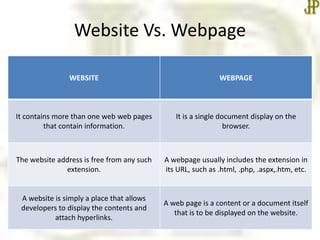
Website Vs. Webpage
WEBSITE WEBPAGE
It contains more than one web web pages
that contain information.
It is a single document display on the
browser.
The website address is free from any such
extension.
A webpage usually includes the extension in
its URL, such as .html, .php, .aspx,.htm, etc.
A website is simply a place that allows
developers to display the contents and
attach hyperlinks.
A web page is a content or a document itself
that is to be displayed on the website.
Web Address
• A website address, also known as a URL (uniform
resource locator), is an Internet name that points
to a location where a file, directory or website
page is hosted.
• A URL contains the following information:
– The protocol used to access the resource.
– The location of the server (whether by IP address or
domain name).
– The port number on the server (optional).
Cont…
• Examples of protocols used are http and https.
• Next, a unique name obtained by a domain name
registration service is used.
• The domain is listed after the unique name, and
a port number is listed or assumed at the end.
• If no number is listed at the end of the address
the default port is used based on the protocol in
the web address.
• Note:- A website address can be obtained from a
web hosting provider such as GoDaddy
E-mail Address
• An email address is a designation for an
electronic mailbox that sends and receives
messages, known as email, on a computer network.
• Since the 1980s, all email addresses follow the same
format: @.
• Every email address has two main parts:
a username and domain name.
• The username comes first, followed by an at (@)
symbol, followed by the domain name.
• In the example below, “him.786" is the username
and “gmail.com" is the domain name.
– him.786@gmail.com
Newsgroups Vs. Blogs
• Newsgroups are similar to e-mails except that
instead of sending our message to someone’s
mailbox, the message is posted on a bulletin board
where anyone can read it and respond.
• A blog is a type of website usually maintained by an
individual with regular entries of news on a
particular subject, description of events, graphics or
videos.
• Using newsgroup, people can share their views on
any topic according to their interest. Blogs are
virtual diaries creates by individuals and stored on
the Internet.
Uploading/downloading Files
• Downloading means receiving data or a file from the
Internet on your computer.
• Examples of downloading include when you
download a file you will start the download by
clicking a link to that file.
• Uploading means sending data or a file from your
computer to somewhere on the Internet.
• Examples of uploading include sending email,
posting photos on a social media site and using your
webcam. Even clicking on a link on a web page sends
a tiny data upload.
Cont…
• When a message is sent (typically through
the SMTP), the sending mail server checks for
another mail server on the Internet that
corresponds with the domain name of the
recipient's address.
• For example:
– if someone sends a message to a user at gmail.com, the
mail server will first make sure there is a mail server
responding at gmail.com.
– If so, it will check with the mail server to see if the
username is valid.
– If the user exists, the message will be delivered.
Today we learn
• Basics of Internet
• Concepts of WWW.
• In the next class, we will see Unit 1: Internet
Protocols in detail.
•Thanks

Introduction to internet

  • 1.
    COMPUTER APPLICATIONS CLASS X(Code 165) TOPIC: UNIT 1: Introduction to Internet By HIMANSHU PATHAK
  • 2.
    Contents • Introduction toInternet • World Wide Web • Web Server & Web Client • Websites and Webpages • Newsgroups & Blogs • Email • Uploading & Downloading
  • 3.
    Introduction • Internet isa global communication system that links together thousands of individual networks. • It allows exchange of information between two or more computers on a network. • Thus internet helps in transfer of messages through mail, chat, video & audio conference, etc.
  • 4.
    Cont… • Internet wasevolved in 1969, under the project called ARPANET (Advanced Research Projects Agency Network) to connect computers at different universities and U.S. defense. • In 1990s the internet working of ARPANET, NSFnet and other private networks resulted into Internet. • Therefore, ‘Internet is a global network of computer networks’ or ‘network of networks’
  • 5.
    Working of Internet •All computers on the Internet, communicate with one another using TCP/IP, which is a basic protocol (i.e. set of rules) of the Internet. • TCP/IP (Transmission Control Protocol/Internet Protocol) manages the transmission of data/file/document on the Internet by breaking the data/file/document into small pieces or parts called packets or datagrams. • Each packet contains actual data and address part, i.e. addresses of destination and source up to 1500 characters.
  • 6.
    What can Ido on the Internet? • One of the best features of the Internet is the ability to communicate almost instantly with anyone in the world. • There are many other things you can do on the Internet: – Sending emails – Looking up news, weather, health, sports results, and government information. – shop for anything . – Doing all your banking, taxes and business online. – Sharing your photo and video collection, and seeing the shared collections of others. – Downloading and watching movies, reading book reviews or watching sports.
  • 7.
    How do Iconnect to the Internet? • There are a number of different ways to access the internet: – Old fashioned dial-up, which makes telephone calls to an ISP and uses coded screeches and squeals to transmit data. – DSL (Digital Subscriber Line), which uses a special modem to transform your existing phone line into a high-speed phone line. DSL is the most common type of broadband connection – 3G/4G which uses mobile phone networks to connect you to the internet.
  • 8.
    World Wide Web •The World Wide Web (WWW) or web is an internet based service, which uses common set of rules known as protocols, to distribute documents across the Internet in a standard way. • World Wide Web, which is also known as a Web, is a collection of websites or web pages stored in web servers and connected to local computers through the internet. • Users can access the content of these sites from any part of the world over the internet using their devices such as computers, laptops, cell phones, etc
  • 9.
    Cont… • The WorldWide Web. Or ‘Web’ is a part of the Internet. • The Web is viewed through web browser software such as Google chrome, Internet Explorer, Mozilla Firefox etc. • The Web was invented in 1991 by Tim Berners-Lee, while consulting at CERN (European Organization for Nuclear Research) in Switzerland. • The Web is a distributed information system. • Information in the Web is connected by hyperlinks.
  • 10.
    Internet Vs. WWW INTERNETWORLD WIDE WEB The Internet is known as “interconnection of computer networks”. The Internet is a massive network of networks. The World Wide Web, or “Web” for short, or simply Web, is a massive collection of digital pages to access information over the Internet. Information that travels over the Internet does so via a variety of languages known as protocols. The Web uses the HTTP protocol, to transmit data and allows applications to communicate in order to exchange business logic. CONNECTING COMPUTERS CONNECTING PEOPLE
  • 11.
    Web Server • Aweb server is a system that delivers content or services to end users over the internet. • Web server is a computer where the web content is stored. • Basically web server is used to host the web sites but there exists other web servers also such as gaming, storage, FTP, email etc. • Web site is collection of web pages while web server is a software that respond to the request for web resources.
  • 12.
    Web Client • AWeb client typically refers to the Web browser in the user's machine or mobile device. • Web client/web browser is a computer applications running on a user's computer and connect to a server. • Web client is web browser, for e.g.. chrome, mozilla, internet explorer, edge etc.
  • 13.
    Web-browser • A webbrowser is a software program that allows a user to locate, access, and display web pages. • Web browsers are used primarily for displaying and accessing websites on the internet. • Browsers translate web pages and websites delivered using Hypertext Transfer Protocol (HTTP) into human-readable content.
  • 14.
    Website & WebPages •Webpage, as the name suggests, is a document or a single page of the website displayed in a web browser. • A collection of web pages which are grouped together and usually connected together in various ways. Often called a "web site" or a "site.“ • When you click a link provided by a search engine, you are accessing a web page.
  • 15.
    Website Vs. Webpage WEBSITEWEBPAGE It contains more than one web web pages that contain information. It is a single document display on the browser. The website address is free from any such extension. A webpage usually includes the extension in its URL, such as .html, .php, .aspx,.htm, etc. A website is simply a place that allows developers to display the contents and attach hyperlinks. A web page is a content or a document itself that is to be displayed on the website.
  • 16.
    Web Address • Awebsite address, also known as a URL (uniform resource locator), is an Internet name that points to a location where a file, directory or website page is hosted. • A URL contains the following information: – The protocol used to access the resource. – The location of the server (whether by IP address or domain name). – The port number on the server (optional).
  • 17.
    Cont… • Examples ofprotocols used are http and https. • Next, a unique name obtained by a domain name registration service is used. • The domain is listed after the unique name, and a port number is listed or assumed at the end. • If no number is listed at the end of the address the default port is used based on the protocol in the web address. • Note:- A website address can be obtained from a web hosting provider such as GoDaddy
  • 18.
    E-mail Address • Anemail address is a designation for an electronic mailbox that sends and receives messages, known as email, on a computer network. • Since the 1980s, all email addresses follow the same format: @. • Every email address has two main parts: a username and domain name. • The username comes first, followed by an at (@) symbol, followed by the domain name. • In the example below, “him.786" is the username and “gmail.com" is the domain name. – him.786@gmail.com
  • 19.
    Newsgroups Vs. Blogs •Newsgroups are similar to e-mails except that instead of sending our message to someone’s mailbox, the message is posted on a bulletin board where anyone can read it and respond. • A blog is a type of website usually maintained by an individual with regular entries of news on a particular subject, description of events, graphics or videos. • Using newsgroup, people can share their views on any topic according to their interest. Blogs are virtual diaries creates by individuals and stored on the Internet.
  • 20.
    Uploading/downloading Files • Downloadingmeans receiving data or a file from the Internet on your computer. • Examples of downloading include when you download a file you will start the download by clicking a link to that file. • Uploading means sending data or a file from your computer to somewhere on the Internet. • Examples of uploading include sending email, posting photos on a social media site and using your webcam. Even clicking on a link on a web page sends a tiny data upload.
  • 21.
    Cont… • When amessage is sent (typically through the SMTP), the sending mail server checks for another mail server on the Internet that corresponds with the domain name of the recipient's address. • For example: – if someone sends a message to a user at gmail.com, the mail server will first make sure there is a mail server responding at gmail.com. – If so, it will check with the mail server to see if the username is valid. – If the user exists, the message will be delivered.
  • 22.
    Today we learn •Basics of Internet • Concepts of WWW. • In the next class, we will see Unit 1: Internet Protocols in detail. •Thanks