BUSINESS DATAANALYTICS USING EXCEL
M.VADIVEL
ASSISTANT PROFESSOR
SRI RAMAKRISHNA COLLEGE OF ARTS AND SCIENCE,
COIMBATORE
UNIT – I
BUSINESS ANALYTICS BASICS
DEFINITION OF ANALYTICS
Analytics is the scientific process of discovering
and communicating the meaningful patterns which can
be found in data.
It is concerned with turning raw data into insight
for making better decisions.
According to Wayne Winston: “using data for
better decision making.”
How is data analytics used in business?
Data Scientists and Analysts use data analytics
techniques in their research, and businesses
also use it to inform their decisions. Data analysis
can help companies better understand their
customers, evaluate their ad campaigns, personalize
content, create content strategies and develop
products.
Evolution of Business Analytics
 The advent of business computers back in the 1970s
led to a range of applications tailored for corporate
use. This probably led Gartner to define 'Business
analytics' as a range of solutions 'used to build
analysis models and simulations to create scenarios,
understand realities and predict future states
Why do we need analytics ?
 Data analytics is important because it helps
businesses optimize their performances.
 A company can also use data analytics to make
better business decisions and help analyze customer
trends and satisfaction, which can lead to new—and
better—products and services
Why do we need business analytics ?
 Business analytics help organizations to reduce
risks. By helping them make the right decisions
based on available data such as customer
preferences, trends, and so on, it can help businesses
to reduce short and long-term risk.
Four Major Fields
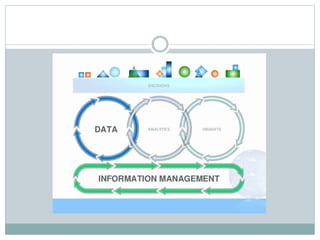
1. Information Management
2. Descriptive Analytics
3. Predictive Analytics
4. Prescriptive Analytics
Four major fields:
1. Information Management
Information management deals with storing, extracting, transforming, and
loading data and information from operational databases into data warehouses.
Once the information is made available in data warehouses.
2. Descriptive Analytics
Business Analysts can use a series of descriptive analytics tools to
understand what has happened in the organization regarding its key performance
indicators.
3. Predictive Analytics
Predictive Analytics tools can be used to forecast and estimate future
behavior based on past performance.
4. Prescriptive Analytics
Prescriptive Analytics to identify the best courses of actions and optimal
decisions.
What is Data Analytics?
Scope of Business Analytics
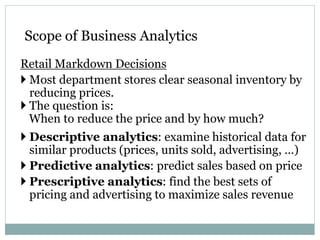
Retail Markdown Decisions
 Most department stores clear seasonal inventory by
reducing prices.
 The question is:
When to reduce the price and by how much?
 Descriptive analytics: examine historical data for
similar products (prices, units sold, advertising, …)
 Predictive analytics: predict sales based on price
 Prescriptive analytics: find the best sets of
pricing and advertising to maximize sales revenue
Scope of Business Analytics
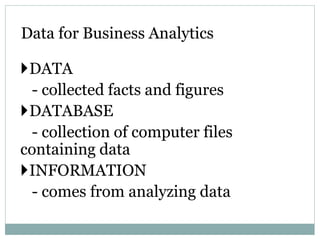
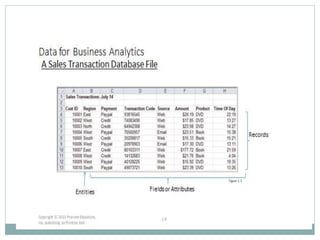
DATA
- collected facts and figures
DATABASE
- collection of computer files
containing data
INFORMATION
- comes from analyzing data
Data for Business Analytics
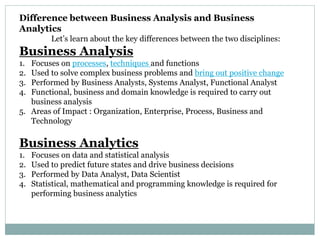
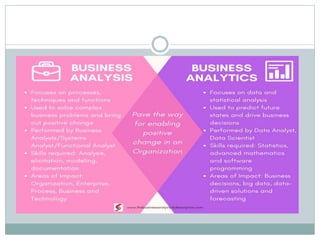
Difference between Business Analysis and Business
Analytics
Let’s learn about the key differences between the two disciplines:
Business Analysis
1. Focuses on processes, techniques and functions
2. Used to solve complex business problems and bring out positive change
3. Performed by Business Analysts, Systems Analyst, Functional Analyst
4. Functional, business and domain knowledge is required to carry out
business analysis
5. Areas of Impact : Organization, Enterprise, Process, Business and
Technology
Business Analytics
1. Focuses on data and statistical analysis
2. Used to predict future states and drive business decisions
3. Performed by Data Analyst, Data Scientist
4. Statistical, mathematical and programming knowledge is required for
performing business analytics
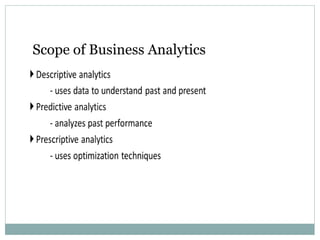
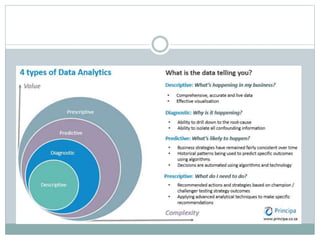
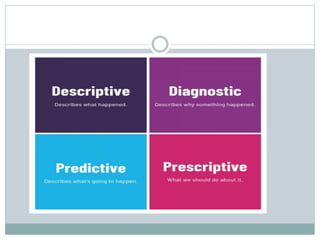
1. Descriptive Analytics: Describing or summarising the
existing data using existing business intelligence tools to
better understand what is going on or what has happened.
2. Diagnostic Analytics: Focus on past performance to
determine what happened and why. The result of the
analysis is often an analytic dashboard.
3. Predictive Analytics: Emphasizes on predicting the
possible outcome using statistical models and machine
learning techniques.
4. Prescriptive Analytics: It is a type of predictive
analytics that is used to recommend one or more course of
action on analyzing the data.
Tools for Analytics
SLM (Service Life-Cycle Management)
SCM (Supply Chain Management)
ERP (Enterprise Resource Planning)
CRM (Customer Relationship Management)
Tools for Analytics
1. SLM (Service Life-Cycle Management)
LCM is a business management approach that can be used by all types of
business in order to improve their sustainability performance. LCM is about
making life cycle thinking and product sustainability operational for businesses
that are aiming for continuous improvement.
2. Supply chain management (SCM)
Supply chain management (SCM) is the process and activitity of sourcing the raw
materials or components an enterprise needs to create a product or service and
deliver that product or service to customers. The goal of SCM software is to
improve supply chain performance.
3. ERP (Enterprise Resource Planning)
Enterprise resource planning (ERP) refers to a type of software that
organizations use to manage day-to-day business activities such as accounting,
procurement, project management, risk management and compliance, and
supply chain operations.
4. Customer relationship management (CRM)
Customer relationship management (CRM) is a technology for managing all
your company's relationships and interactions with customers and potential
customers. A CRM system helps companies stay connected to customers,
streamline processes, and improve profitability.
BUSINESS ANALYTICS TOOLS
1. SAS Business Analytics (SAS BA)
The high-grade text analytics capabilities of the SAS-based business analytics
software allow users to inspect and transform unorganized text data into
relevant information that analysts can explore to discover meaningful insights.
2. QlikView
QlikView is one of the most preferred tools for business analytics because of
its unique features, such as patented technology and in-memory processing,
facilitating the delivery of ultra-fast business analytics reports.
Splunk
Splunk is one of the most widely used business analytics tools in small and
medium scale industries.
TIBCO Spotfire
TIBCO Spotfire, recognized as one of the most advanced tools for business
analytics, offers powerful and automated analytics solutions that allow data
professionals to run business analytics reports and analysis over a defined time
span.
Conclusion for Tools
today's state-of-the-art analytical tools for business
facilitate efficient data collection, analysis, and
presentation in real-time, empowering enterprises to
identify trends/patterns in vast datasets and create
new business analytics models.
Concepts of Insights
Insight is gained by analyzing data and
information to understand what is going on with
the particular situation.
Introduction to Business Data Analytics

Introduction to Business Data Analytics

  • 1.
    BUSINESS DATAANALYTICS USINGEXCEL M.VADIVEL ASSISTANT PROFESSOR SRI RAMAKRISHNA COLLEGE OF ARTS AND SCIENCE, COIMBATORE
  • 2.
    UNIT – I BUSINESSANALYTICS BASICS
  • 3.
    DEFINITION OF ANALYTICS Analyticsis the scientific process of discovering and communicating the meaningful patterns which can be found in data. It is concerned with turning raw data into insight for making better decisions. According to Wayne Winston: “using data for better decision making.”
  • 4.
    How is dataanalytics used in business?
  • 5.
    How is dataanalytics used in business? Data Scientists and Analysts use data analytics techniques in their research, and businesses also use it to inform their decisions. Data analysis can help companies better understand their customers, evaluate their ad campaigns, personalize content, create content strategies and develop products.
  • 6.
    Evolution of BusinessAnalytics  The advent of business computers back in the 1970s led to a range of applications tailored for corporate use. This probably led Gartner to define 'Business analytics' as a range of solutions 'used to build analysis models and simulations to create scenarios, understand realities and predict future states
  • 7.
    Why do weneed analytics ?
  • 8.
    Why do weneed analytics ?  Data analytics is important because it helps businesses optimize their performances.  A company can also use data analytics to make better business decisions and help analyze customer trends and satisfaction, which can lead to new—and better—products and services
  • 9.
    Why do weneed business analytics ?
  • 10.
    Why do weneed business analytics ?  Business analytics help organizations to reduce risks. By helping them make the right decisions based on available data such as customer preferences, trends, and so on, it can help businesses to reduce short and long-term risk.
  • 11.
    Four Major Fields 1.Information Management 2. Descriptive Analytics 3. Predictive Analytics 4. Prescriptive Analytics
  • 14.
    Four major fields: 1.Information Management Information management deals with storing, extracting, transforming, and loading data and information from operational databases into data warehouses. Once the information is made available in data warehouses. 2. Descriptive Analytics Business Analysts can use a series of descriptive analytics tools to understand what has happened in the organization regarding its key performance indicators. 3. Predictive Analytics Predictive Analytics tools can be used to forecast and estimate future behavior based on past performance. 4. Prescriptive Analytics Prescriptive Analytics to identify the best courses of actions and optimal decisions.
  • 15.
    What is DataAnalytics?
  • 18.
  • 19.
    Retail Markdown Decisions Most department stores clear seasonal inventory by reducing prices.  The question is: When to reduce the price and by how much?  Descriptive analytics: examine historical data for similar products (prices, units sold, advertising, …)  Predictive analytics: predict sales based on price  Prescriptive analytics: find the best sets of pricing and advertising to maximize sales revenue Scope of Business Analytics
  • 20.
    DATA - collected factsand figures DATABASE - collection of computer files containing data INFORMATION - comes from analyzing data Data for Business Analytics
  • 22.
    Difference between BusinessAnalysis and Business Analytics Let’s learn about the key differences between the two disciplines: Business Analysis 1. Focuses on processes, techniques and functions 2. Used to solve complex business problems and bring out positive change 3. Performed by Business Analysts, Systems Analyst, Functional Analyst 4. Functional, business and domain knowledge is required to carry out business analysis 5. Areas of Impact : Organization, Enterprise, Process, Business and Technology Business Analytics 1. Focuses on data and statistical analysis 2. Used to predict future states and drive business decisions 3. Performed by Data Analyst, Data Scientist 4. Statistical, mathematical and programming knowledge is required for performing business analytics
  • 29.
    1. Descriptive Analytics:Describing or summarising the existing data using existing business intelligence tools to better understand what is going on or what has happened. 2. Diagnostic Analytics: Focus on past performance to determine what happened and why. The result of the analysis is often an analytic dashboard. 3. Predictive Analytics: Emphasizes on predicting the possible outcome using statistical models and machine learning techniques. 4. Prescriptive Analytics: It is a type of predictive analytics that is used to recommend one or more course of action on analyzing the data.
  • 30.
    Tools for Analytics SLM(Service Life-Cycle Management) SCM (Supply Chain Management) ERP (Enterprise Resource Planning) CRM (Customer Relationship Management)
  • 31.
    Tools for Analytics 1.SLM (Service Life-Cycle Management) LCM is a business management approach that can be used by all types of business in order to improve their sustainability performance. LCM is about making life cycle thinking and product sustainability operational for businesses that are aiming for continuous improvement. 2. Supply chain management (SCM) Supply chain management (SCM) is the process and activitity of sourcing the raw materials or components an enterprise needs to create a product or service and deliver that product or service to customers. The goal of SCM software is to improve supply chain performance.
  • 32.
    3. ERP (EnterpriseResource Planning) Enterprise resource planning (ERP) refers to a type of software that organizations use to manage day-to-day business activities such as accounting, procurement, project management, risk management and compliance, and supply chain operations. 4. Customer relationship management (CRM) Customer relationship management (CRM) is a technology for managing all your company's relationships and interactions with customers and potential customers. A CRM system helps companies stay connected to customers, streamline processes, and improve profitability.
  • 33.
    BUSINESS ANALYTICS TOOLS 1.SAS Business Analytics (SAS BA) The high-grade text analytics capabilities of the SAS-based business analytics software allow users to inspect and transform unorganized text data into relevant information that analysts can explore to discover meaningful insights. 2. QlikView QlikView is one of the most preferred tools for business analytics because of its unique features, such as patented technology and in-memory processing, facilitating the delivery of ultra-fast business analytics reports.
  • 34.
    Splunk Splunk is oneof the most widely used business analytics tools in small and medium scale industries. TIBCO Spotfire TIBCO Spotfire, recognized as one of the most advanced tools for business analytics, offers powerful and automated analytics solutions that allow data professionals to run business analytics reports and analysis over a defined time span.
  • 35.
    Conclusion for Tools today'sstate-of-the-art analytical tools for business facilitate efficient data collection, analysis, and presentation in real-time, empowering enterprises to identify trends/patterns in vast datasets and create new business analytics models.
  • 36.
    Concepts of Insights Insightis gained by analyzing data and information to understand what is going on with the particular situation.