
ARCHIVING  by Fe Angela M. Verzosa University Archivist, DLSU
Overview  Archives usually consist of unique items, and unlike Libraries, cannot take advantage of standardized organization. Archives preserve records of enduring value; these may be organizational or personal records.  They are not necessarily old, and may come in different formats. Unlike libraries, archival materials are arranged and described in groups.
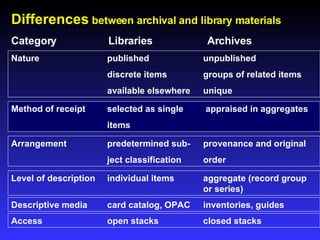
Differences  between archival and library materials Category  Libraries  Archives Nature  published unpublished discrete items groups of related items available elsewhere unique Method of receipt selected as single   appraised in aggregates items  Arrangement predetermined sub- provenance and original ject classification order Level of description individual items aggregate (record group  or series) Descriptive media card catalog, OPAC inventories, guides Access open stacks closed stacks
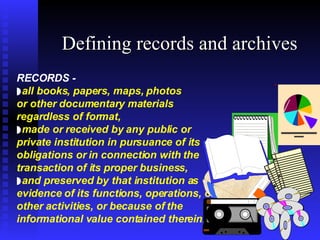
Defining records and archives   RECORDS - all books, papers, maps, photos   or other documentary materials regardless of format,  made or received by any public or private institution in pursuance of its obligations or in connection with the transaction of its proper business,  and preserved by that institution as evidence of its functions, operations, or other activities, or because of the informational value contained therein.
Defining records and archives   ARCHIVES - those records of any PUBLIC  or PRIVATE institutions  which are adjudged worthy of preservation for reference and research purposes and which have been  deposited  or have been selected for deposit  in an archival institution
Development of   archival organization Archival materials have been organized for centuries .   A  case file system  was established in Rome around AD 1200. The  registry system was developed  in the 15th century in Europe. The concept of “ provenance” ( or  “respect des fonds” )  emerged in France in 1840.
Development of   archival organization The principle of  “original order” ( or “ respect pour l’ordre primitif”)  was established by the Prussians in 1880s . The first archival catalogs were lists and inventories. Until the mid-30s, US practice was to catalog at the item level. A special MARC format for archival and manuscript collections was developed.
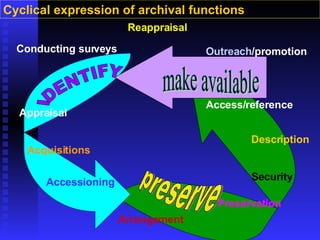
Reappraisal Conducting surveys Appraisal Acquisitions Accessioning Arrangement Preservation Security Description Access/reference Outreach /promotion Cyclical expression of archival functions preserve make available make available IDENTIFY
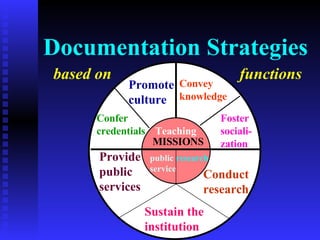
Documentation Strategies based on  functions MISSIONS Teaching research public service Confer credentials Convey knowledge Promote culture Foster sociali- zation Conduct research Provide public services Sustain the institution
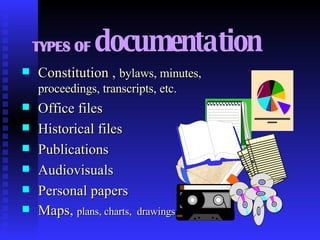
TYPES OF  documentation Constitution ,  bylaws, minutes,  proceedings, transcripts, etc. Office files Historical files Publications Audiovisuals Personal papers Maps,  plans, charts,  drawings
TYPES OF  documentation general correspondence transitory correspondence case files references audiovisual materials cartographic records engineering drawings cards machine-readable records microforms
Other categories  Administrative records  academic records accounting/financial records legal records personnel records personal records
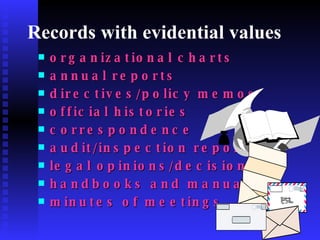
Records with evidential values organizational charts annual reports directives/policy memos official histories correspondence audit/inspection reports legal opinions/decisions handbooks and manuals minutes of meetings
Collecting Priorities records of the governing board records of the administrative offices records of the academic departments theses and dissertations records from student organizations selected papers and publications campus publications
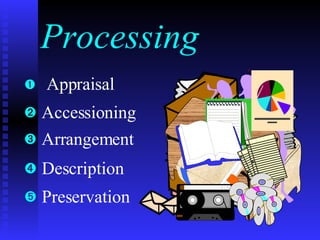
Processing Appraisal Accessioning Arrangement Description Preservation
Appraisal   act of determining the worth of records to their  creator or user in terms of use:  primary  or    secondary in terms of content: evidential or  informational categories: administrative value fiscal   value   legal   value   historical/research   intrinsic value
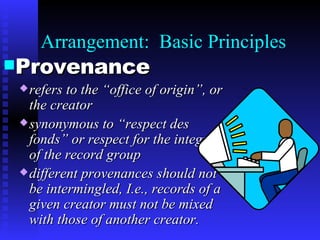
Arrangement:  Basic Principles  Provenance refers to the “office of origin”, or the creator synonymous to “respect des fonds” or respect for the integrity of the record group different provenances should not be intermingled, I.e., records of a given creator must not be mixed with those of another creator.
Original Order also known as “respect pour l’ordre primitif” means order in which the records were  created, or maintained or stored by the creator the original order must be preserved, or restored most evident in organizational records Arrangement:  Basic Principles
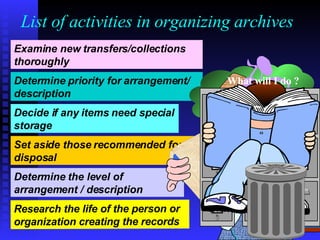
List of activities in organizing archives Determine priority for arrangement/ description Research the life of the person or organization creating the records Decide if any items need special storage Set aside those recommended for disposal Determine the level of arrangement / description Examine new transfers/collections thoroughly What will I do ?
List of activities in organizing archives -continuation Arrange the items - first on paper, then physically Inventory  and describe the records Write the Administrative History  or Biographical Note Prepare the finished descriptive guide / inventory Identify the record series
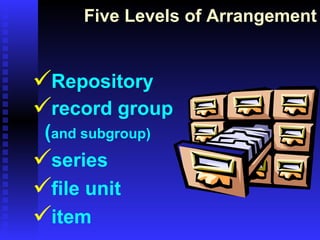
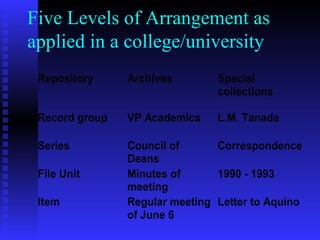
Repository record group ( and subgroup) series file unit item Five Levels of Arrangement
Five Levels of Arrangement as applied in a college/university
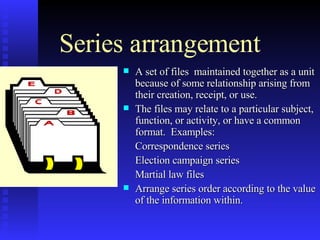
Series arrangement A set of files  maintained together as a unit because of some relationship arising from their creation, receipt, or use. The files may relate to a particular subject, function, or activity, or have a common format.  Examples: Correspondence series Election campaign series Martial law files Arrange series order according to the value of the information within.
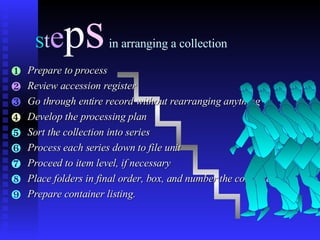
S t e p s   in arranging a collection Prepare to process Review accession register Go through entire record without rearranging anything Develop the processing plan Sort the collection into series Process each series down to file unit Proceed to item level, if necessary Place folders in final order, box, and number the containers. Prepare container listing.
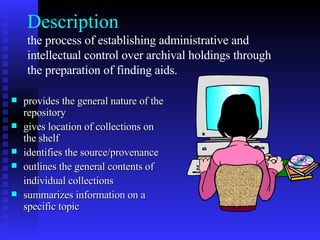
Description the process of establishing   administrative and intellectual control over archival holdings through the preparation of finding aids. provides the general nature of the repository  gives location of collections on  the shelf identifies the source/provenance outlines the general contents of  individual collections summarizes information on a specific topic
Types of Finding Aids Item level  Calendars      Indexes Collection level  Catalogs Container lists  Registers  (for manuscript collections)  Inventories  (for organizational collections) Guides (repository or subject guides)
Good day to all!

Archiving

  • 1.
    ARCHIVING byFe Angela M. Verzosa University Archivist, DLSU
  • 2.
    Overview Archivesusually consist of unique items, and unlike Libraries, cannot take advantage of standardized organization. Archives preserve records of enduring value; these may be organizational or personal records. They are not necessarily old, and may come in different formats. Unlike libraries, archival materials are arranged and described in groups.
  • 3.
    Differences betweenarchival and library materials Category Libraries Archives Nature published unpublished discrete items groups of related items available elsewhere unique Method of receipt selected as single appraised in aggregates items Arrangement predetermined sub- provenance and original ject classification order Level of description individual items aggregate (record group or series) Descriptive media card catalog, OPAC inventories, guides Access open stacks closed stacks
  • 4.
    Defining records andarchives RECORDS - all books, papers, maps, photos or other documentary materials regardless of format, made or received by any public or private institution in pursuance of its obligations or in connection with the transaction of its proper business, and preserved by that institution as evidence of its functions, operations, or other activities, or because of the informational value contained therein.
  • 5.
    Defining records andarchives ARCHIVES - those records of any PUBLIC or PRIVATE institutions which are adjudged worthy of preservation for reference and research purposes and which have been deposited or have been selected for deposit in an archival institution
  • 6.
    Development of archival organization Archival materials have been organized for centuries . A case file system was established in Rome around AD 1200. The registry system was developed in the 15th century in Europe. The concept of “ provenance” ( or “respect des fonds” ) emerged in France in 1840.
  • 7.
    Development of archival organization The principle of “original order” ( or “ respect pour l’ordre primitif”) was established by the Prussians in 1880s . The first archival catalogs were lists and inventories. Until the mid-30s, US practice was to catalog at the item level. A special MARC format for archival and manuscript collections was developed.
  • 8.
    Reappraisal Conducting surveysAppraisal Acquisitions Accessioning Arrangement Preservation Security Description Access/reference Outreach /promotion Cyclical expression of archival functions preserve make available make available IDENTIFY
  • 9.
    Documentation Strategies basedon functions MISSIONS Teaching research public service Confer credentials Convey knowledge Promote culture Foster sociali- zation Conduct research Provide public services Sustain the institution
  • 10.
    TYPES OF documentation Constitution , bylaws, minutes, proceedings, transcripts, etc. Office files Historical files Publications Audiovisuals Personal papers Maps, plans, charts, drawings
  • 11.
    TYPES OF documentation general correspondence transitory correspondence case files references audiovisual materials cartographic records engineering drawings cards machine-readable records microforms
  • 12.
    Other categories Administrative records academic records accounting/financial records legal records personnel records personal records
  • 13.
    Records with evidentialvalues organizational charts annual reports directives/policy memos official histories correspondence audit/inspection reports legal opinions/decisions handbooks and manuals minutes of meetings
  • 14.
    Collecting Priorities recordsof the governing board records of the administrative offices records of the academic departments theses and dissertations records from student organizations selected papers and publications campus publications
  • 15.
    Processing Appraisal AccessioningArrangement Description Preservation
  • 16.
    Appraisal act of determining the worth of records to their creator or user in terms of use: primary or secondary in terms of content: evidential or informational categories: administrative value fiscal value legal value historical/research intrinsic value
  • 17.
    Arrangement: BasicPrinciples Provenance refers to the “office of origin”, or the creator synonymous to “respect des fonds” or respect for the integrity of the record group different provenances should not be intermingled, I.e., records of a given creator must not be mixed with those of another creator.
  • 18.
    Original Order alsoknown as “respect pour l’ordre primitif” means order in which the records were created, or maintained or stored by the creator the original order must be preserved, or restored most evident in organizational records Arrangement: Basic Principles
  • 19.
    List of activitiesin organizing archives Determine priority for arrangement/ description Research the life of the person or organization creating the records Decide if any items need special storage Set aside those recommended for disposal Determine the level of arrangement / description Examine new transfers/collections thoroughly What will I do ?
  • 20.
    List of activitiesin organizing archives -continuation Arrange the items - first on paper, then physically Inventory and describe the records Write the Administrative History or Biographical Note Prepare the finished descriptive guide / inventory Identify the record series
  • 21.
    Repository record group( and subgroup) series file unit item Five Levels of Arrangement
  • 22.
    Five Levels ofArrangement as applied in a college/university
  • 23.
    Series arrangement Aset of files maintained together as a unit because of some relationship arising from their creation, receipt, or use. The files may relate to a particular subject, function, or activity, or have a common format. Examples: Correspondence series Election campaign series Martial law files Arrange series order according to the value of the information within.
  • 24.
    S t ep s in arranging a collection Prepare to process Review accession register Go through entire record without rearranging anything Develop the processing plan Sort the collection into series Process each series down to file unit Proceed to item level, if necessary Place folders in final order, box, and number the containers. Prepare container listing.
  • 25.
    Description the processof establishing administrative and intellectual control over archival holdings through the preparation of finding aids. provides the general nature of the repository gives location of collections on the shelf identifies the source/provenance outlines the general contents of individual collections summarizes information on a specific topic
  • 26.
    Types of FindingAids Item level Calendars Indexes Collection level Catalogs Container lists Registers (for manuscript collections) Inventories (for organizational collections) Guides (repository or subject guides)
  • 27.