INFORMATION CONCEPTS


                       1
Data
   A stream of raw facts about anything
   Examples:.
       Record of all the players in one day cricket
        matches.
       Detailed Marks of all students in a class.
       Business data as obtained from various
        business houses.


                                                       2
Information
    processed data, which is useful to the
    recipient.
   Examples:
       Profit of the company in the current year
       The highest ever score in one day cricket
       First ten toppers in a class
       The top 50 business houses of India.


                                                    3
Then Information is……
WHICH
 Tells something the receiver did not know
 Reduces uncertainty
 Has a surprise value
 Has a real / perceived value in current / prospective
  decision.


                                                      4
INFORMATION CONCEPT:-
 Information differs from data.
 Information has a value in decision making – while
data
 does not have.
  Information Characteristics:-
• Improves representation of an entity.
• Updates knowledge level (Ex: Sales Data)
• Reduces uncertainty
• Aids in decision making.
   Ex: Sales Data progressively become information
   when processed with other data such as target.

                                                       5
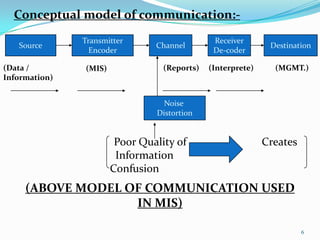
Conceptual model of communication:-
               Transmitter                     Receiver
   Source                       Channel                       Destination
                 Encoder                       De-coder

(Data /        (MIS)              (Reports)   (Interprete)     (MGMT.)
Information)


                                  Noise
                                Distortion


                        Poor Quality of                      Creates
                        Information
                       Confusion
     (ABOVE MODEL OF COMMUNICATION USED
                   IN MIS)

                                                                       6
 Information Presentation:-
 Improve communication through summarization.
 Improve by message routing       copies of circular.
 Curb misuse of information by exercising control on
  the content & distribution.

 Information BIAS:
 Should not be biased while classifying & filtering /
  Communicating information.
 BIAS enters because people try to block sensitive
  information.
 To overcome this, a formal organization structure &
  top management decides information type / received.


                                                         7
 Way information is presented, may create BIAS. Ex: If
  information is presented in alphabetic order & it is
  lengthy.
 INFORMATION : A QUALITY PRODUCT
 Information is a product of data processing.
 Quality of information can be measured on four
   dimensions: (1) Utility (2) Satisfaction (3) BIAS (4)
   Error.
1. UTILITY: Has four facets : (1) Form (2) Time (3)
   Access (4) Possession.
2. SATISFACTION OF USER: Is a common key of
   measuring utility.
3. ERROR: Error creeps in due to
         Incorrect data & collection method.


                                                           8
 Incorrect data processing.
    Loss or Incomplete data.
    Poor data validation or control.
    Deliberate falsification.
 Processing or data to information should be
   allowed only
  after thorough validation.
4. BIAS: If the information is processed out of biased
  data, it will have BIAS.


                                                         9
Information Quality
   Refers to the fitness for use, or its reliability. Some of the attributes, which
    influence the quality of information, are:
            Timeliness
            Accuracy
            Relevance
            Adequacy
            Completeness
            Explicitness
            Exception-based, etc
            Impartiality - no bias
            Validity
            Reliability
            Consistency
            Age-old data is of no use
                                                                                       10
3. Reliability
4. Consistency : Data should have consistent
5. Age : If the information is old, it is not useful today.

 CLASSIFICATION OF INFORMATION:
1. Action vs. No. of action information:-
   Ex: “No stock” report calls for purchase action.
2. Recurring vs. non Recurring information:-
    Ex: Monthly sales report vs. market study information.
3. Internal vs. External information:-
    Ex:-Information generated through internal resources vs.
    information generated through govt. report.
4. Planning information:
    Ex: Needs norms/ standards / specs.


                                                               11
5. Control Information:-
   Ex:Reports giving status of activity with feed back
   mechanism.
6. Knowledge information:-
   Ex: Collection of information through library reports /
   research studies to build up a knowledge base for decision
   making.
 Information can also be classified
   BASED ON USAGE:-
    Organization information:- Used by all in organization.
    Database information :- When multiple use & apply.
    Operational / Functional information:- When the
       information is used for operations.


                                                                12
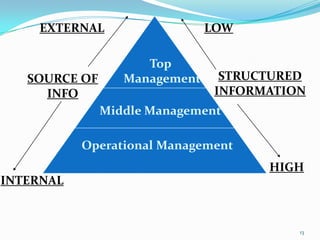
EXTERNAL                   LOW

                     Top
   SOURCE OF      Management     STRUCTURED
     INFO                       INFORMATION
               Middle Management

           Operational Management
                                      HIGH
INTERNAL


                                          13
Types of Information
 Strategic Information
       required by the managers at Strategic level
  managers
 Tactical Information
       required by the managers at Management control
  level managers
 Operational Information
       required by the managers at Operational control
  level managers


                                                     14
Dimension of Information
 Economic dimension
         Cost of information
         Value of information
 Business dimension
 Technical dimension


                                 15
METHODS OF DATA & INFORMATION COLLECTION:-

 Choice of methods have an impact on quality of
  information.
 Methods of data collection & processing is part of MIS.
 Methods of Data & Information Collection
    • Observation:
  = This methods are chosen for data & information
     collection & specific problem.
  = Remaining are routine methods particularly
     irrespective of a problem.
  Ex:Visit customer to assess complaint.
    • Experiment: Ex:Assess market response to new
       packaging. (Thru test marketing)


                                                            16
• Survey: Ex: Market survey, opinion poll.
• Subjective Estimation:Ex: Data pertaining to future
   like life style in 21st Century/ Future of alternative
   energy source.
• Transaction Processing: Ex:Ledgers, Payroll, sales
   report etc.
• Purchased from outside: Ex:Database on specific
  subject, research study etc.
• Publication: Ex: Corporate publication, industry
   publication, NCAER report.
• Government Agencies: Ex: RBI, tax publications
   etc.


                                                            17
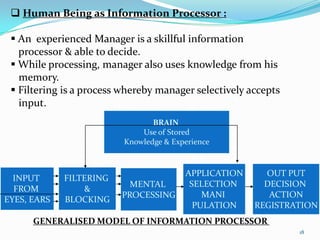
 Human Being as Information Processor :

  An experienced Manager is a skillful information
   processor & able to decide.
  While processing, manager also uses knowledge from his
   memory.
  Filtering is a process whereby manager selectively accepts
   input.
                                 BRAIN
                              Use of Stored
                          Knowledge & Experience


                                         APPLICATION     OUT PUT
  INPUT      FILTERING
                           MENTAL         SELECTION      DECISION
  FROM           &
                         PROCESSING          MANI         ACTION
EYES, EARS   BLOCKING
                                           PULATION    REGISTRATION
      GENERALISED MODEL OF INFORMATION PROCESSOR
                                                                18
 Filtering process blocks the unwanted or inconsistent Data
  which does not match the requirement.

 An inexperienced Manager may Omit Data, Distort Data.

 The information processor establishes filter based on
  experience.

 MIS & THE INFORMATION CONCEPT:

 Goal of MIS : should be a provide information which has
  a surprise value & reduces uncertainty.
 Build knowledge base in the organisation by processing
  various Data from different source.
 Design of MIS should take care of DATA PROB
  Knowing that it may contain BIAS & ERROR., with help
 of validation, checking, controlling procedure in the
  manual & computerised system.                                19
 While designing MIS, due regard should be given to the
  Communication Theory of transmission.
 Special care is needed to handle noise & distortion
 Principles of summarisation & classification should be
  carefully applied giving regard to management levels.
 Care should be taken in the process that no information is
  suppressed or over emphasised.
 MIS should provide specific attention to quality
  parameters.
 MIS should make a distinction between different kind of
  information. (Action vs No-Action etc.)
 MIS needs to give due regard to the information used for
  planning, controlling etc.
 MIS should recognize some aspects of Human Capabilities
  since decision makers are human.


                                                               20
 MIS design should meet the needs of the total organisation
 - For design consideration, it is divided into top, middle,
 supervisory & operational.

 MIS design should ensure input data quality by controlling
 data for validation, reliability, consistency etc.

 Recognizing information may be misused, if falls in wrong
 hands, MIS design should have feature of filtering,
 blocking, suppression, delayed delivered etc.


                                                               21
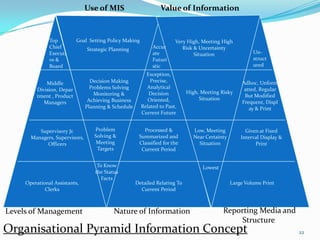
Use of MIS                       Value of Information


               Top          Goal Setting Policy Making                  Very High, Meeting High
               Chief            Strategic Planning            Accur        Risk & Uncertainty
               Executi                                        ate               Situation                Un-
               ve &                                           Futuri                                     struct
               Board                                          stic                                       ured
                                                           Exception,
              Middle              Decision Making            Precise,                               Adhoc, Unform
          Division, Depar         Problems Solving         Analytical                                atted, Regular
                                    Monitoring &            Decision         High, Meeting Risky
          tment , Product                                                                            But Modified
                                 Achieving Business         Oriented,             Situation
             Managers                                                                               Frequent, Displ
                                Planning & Schedule      Related to Past,                              ay & Print
                                                         Current Future


          Supervisory Jr.          Problem               Processed &           Low, Meeting           Given at Fixed
       Managers, Supervisors,      Solving &           Summarized and          Near Certainty       Interval Display &
             Officers               Meeting            Classified for the        Situation                Print
                                    Targets             Current Period


                                     To Know                                       Lowest
                                    the Status
                                      Facts
     Operational Assistants,                          Detailed Relating To                      Large Volume Print
             Clerks                                     Current Period


Levels of Management                        Nature of Information                           Reporting Media and
                                                                                                 Structure
Organisational Pyramid Information Concept                                                                               22

Mis ch04

  • 1.
  • 2.
    Data  A stream of raw facts about anything  Examples:.  Record of all the players in one day cricket matches.  Detailed Marks of all students in a class.  Business data as obtained from various business houses. 2
  • 3.
    Information  processed data, which is useful to the recipient.  Examples:  Profit of the company in the current year  The highest ever score in one day cricket  First ten toppers in a class  The top 50 business houses of India. 3
  • 4.
    Then Information is…… WHICH Tells something the receiver did not know  Reduces uncertainty  Has a surprise value  Has a real / perceived value in current / prospective decision. 4
  • 5.
    INFORMATION CONCEPT:-  Informationdiffers from data.  Information has a value in decision making – while data does not have. Information Characteristics:- • Improves representation of an entity. • Updates knowledge level (Ex: Sales Data) • Reduces uncertainty • Aids in decision making. Ex: Sales Data progressively become information when processed with other data such as target. 5
  • 6.
    Conceptual model ofcommunication:- Transmitter Receiver Source Channel Destination Encoder De-coder (Data / (MIS) (Reports) (Interprete) (MGMT.) Information) Noise Distortion Poor Quality of Creates Information Confusion (ABOVE MODEL OF COMMUNICATION USED IN MIS) 6
  • 7.
     Information Presentation:- Improve communication through summarization.  Improve by message routing copies of circular.  Curb misuse of information by exercising control on the content & distribution.  Information BIAS:  Should not be biased while classifying & filtering / Communicating information.  BIAS enters because people try to block sensitive information.  To overcome this, a formal organization structure & top management decides information type / received. 7
  • 8.
     Way informationis presented, may create BIAS. Ex: If information is presented in alphabetic order & it is lengthy.  INFORMATION : A QUALITY PRODUCT  Information is a product of data processing.  Quality of information can be measured on four dimensions: (1) Utility (2) Satisfaction (3) BIAS (4) Error. 1. UTILITY: Has four facets : (1) Form (2) Time (3) Access (4) Possession. 2. SATISFACTION OF USER: Is a common key of measuring utility. 3. ERROR: Error creeps in due to  Incorrect data & collection method. 8
  • 9.
     Incorrect dataprocessing.  Loss or Incomplete data.  Poor data validation or control.  Deliberate falsification.  Processing or data to information should be allowed only after thorough validation. 4. BIAS: If the information is processed out of biased data, it will have BIAS. 9
  • 10.
    Information Quality  Refers to the fitness for use, or its reliability. Some of the attributes, which influence the quality of information, are:  Timeliness  Accuracy  Relevance  Adequacy  Completeness  Explicitness  Exception-based, etc  Impartiality - no bias  Validity  Reliability  Consistency  Age-old data is of no use 10
  • 11.
    3. Reliability 4. Consistency: Data should have consistent 5. Age : If the information is old, it is not useful today.  CLASSIFICATION OF INFORMATION: 1. Action vs. No. of action information:- Ex: “No stock” report calls for purchase action. 2. Recurring vs. non Recurring information:- Ex: Monthly sales report vs. market study information. 3. Internal vs. External information:- Ex:-Information generated through internal resources vs. information generated through govt. report. 4. Planning information: Ex: Needs norms/ standards / specs. 11
  • 12.
    5. Control Information:- Ex:Reports giving status of activity with feed back mechanism. 6. Knowledge information:- Ex: Collection of information through library reports / research studies to build up a knowledge base for decision making.  Information can also be classified BASED ON USAGE:-  Organization information:- Used by all in organization.  Database information :- When multiple use & apply.  Operational / Functional information:- When the information is used for operations. 12
  • 13.
    EXTERNAL LOW Top SOURCE OF Management STRUCTURED INFO INFORMATION Middle Management Operational Management HIGH INTERNAL 13
  • 14.
    Types of Information Strategic Information required by the managers at Strategic level managers  Tactical Information required by the managers at Management control level managers  Operational Information required by the managers at Operational control level managers 14
  • 15.
    Dimension of Information Economic dimension  Cost of information  Value of information  Business dimension  Technical dimension 15
  • 16.
    METHODS OF DATA& INFORMATION COLLECTION:-  Choice of methods have an impact on quality of information.  Methods of data collection & processing is part of MIS.  Methods of Data & Information Collection • Observation: = This methods are chosen for data & information collection & specific problem. = Remaining are routine methods particularly irrespective of a problem. Ex:Visit customer to assess complaint. • Experiment: Ex:Assess market response to new packaging. (Thru test marketing) 16
  • 17.
    • Survey: Ex:Market survey, opinion poll. • Subjective Estimation:Ex: Data pertaining to future like life style in 21st Century/ Future of alternative energy source. • Transaction Processing: Ex:Ledgers, Payroll, sales report etc. • Purchased from outside: Ex:Database on specific subject, research study etc. • Publication: Ex: Corporate publication, industry publication, NCAER report. • Government Agencies: Ex: RBI, tax publications etc. 17
  • 18.
     Human Beingas Information Processor :  An experienced Manager is a skillful information processor & able to decide.  While processing, manager also uses knowledge from his memory.  Filtering is a process whereby manager selectively accepts input. BRAIN Use of Stored Knowledge & Experience APPLICATION OUT PUT INPUT FILTERING MENTAL SELECTION DECISION FROM & PROCESSING MANI ACTION EYES, EARS BLOCKING PULATION REGISTRATION GENERALISED MODEL OF INFORMATION PROCESSOR 18
  • 19.
     Filtering processblocks the unwanted or inconsistent Data which does not match the requirement.  An inexperienced Manager may Omit Data, Distort Data.  The information processor establishes filter based on experience.  MIS & THE INFORMATION CONCEPT:  Goal of MIS : should be a provide information which has a surprise value & reduces uncertainty.  Build knowledge base in the organisation by processing various Data from different source.  Design of MIS should take care of DATA PROB Knowing that it may contain BIAS & ERROR., with help of validation, checking, controlling procedure in the manual & computerised system. 19
  • 20.
     While designingMIS, due regard should be given to the Communication Theory of transmission.  Special care is needed to handle noise & distortion  Principles of summarisation & classification should be carefully applied giving regard to management levels.  Care should be taken in the process that no information is suppressed or over emphasised.  MIS should provide specific attention to quality parameters.  MIS should make a distinction between different kind of information. (Action vs No-Action etc.)  MIS needs to give due regard to the information used for planning, controlling etc.  MIS should recognize some aspects of Human Capabilities since decision makers are human. 20
  • 21.
     MIS designshould meet the needs of the total organisation - For design consideration, it is divided into top, middle, supervisory & operational.  MIS design should ensure input data quality by controlling data for validation, reliability, consistency etc.  Recognizing information may be misused, if falls in wrong hands, MIS design should have feature of filtering, blocking, suppression, delayed delivered etc. 21
  • 22.
    Use of MIS Value of Information Top Goal Setting Policy Making Very High, Meeting High Chief Strategic Planning Accur Risk & Uncertainty Executi ate Situation Un- ve & Futuri struct Board stic ured Exception, Middle Decision Making Precise, Adhoc, Unform Division, Depar Problems Solving Analytical atted, Regular Monitoring & Decision High, Meeting Risky tment , Product But Modified Achieving Business Oriented, Situation Managers Frequent, Displ Planning & Schedule Related to Past, ay & Print Current Future Supervisory Jr. Problem Processed & Low, Meeting Given at Fixed Managers, Supervisors, Solving & Summarized and Near Certainty Interval Display & Officers Meeting Classified for the Situation Print Targets Current Period To Know Lowest the Status Facts Operational Assistants, Detailed Relating To Large Volume Print Clerks Current Period Levels of Management Nature of Information Reporting Media and Structure Organisational Pyramid Information Concept 22