What Is Management
Information System
(MIS)?
MANAGEMENT INFORMATION SYSTEMS FACILITATE A FIRM’S DAILY OPERATIONS. IT IS PRESENT IN EVERY
ORGANIZATION. RECORD KEEPING IS SIGNIFICANTLY EASIER WITH INFORMATION SYSTEMS. THE PRIMARY ROLE
OF AN INFORMATION SYSTEM IS TO SIMPLIFY WORKFLOW; IT SAVES THE TIME AND ENERGY OF EMPLOYEES.
Information
 If we give you a number 1-212-290-4700, it does not
make any sense on its own. It is just a raw data. However
if we say Tel: +1-212-290-4700, it starts making sense. It
becomes a telephone number. If I gather some more
data and record it meaningfully like −information can be
defined as meaningfully interpreted data.
Address: 350 Fifth Avenue, 34th floor
New York, NY 10118-3299 USA
Tel: +1-212-290-4700
Fax: +1-212-736-1300
Information
 It becomes a very useful information - the address of New York
office of Human Rights Watch, a non-profit, non-governmental
human rights organization.
 So, from a system analyst's point of view, information is a
sequence of symbols that can be construed to a useful message.
 An Information System is a system that gathers data and
disseminates information with the sole purpose of providing
information to its users.
 The main object of an information system is to provide
information to its users. Information systems vary according to the
type of users who use the system
Information Definition
 "Information can be recorded as signs, or transmitted as
signals. Information is any kind of event that affects the
state of a dynamic system that can interpret the
information.
 Conceptually, information is the message (utterance or
expression) being conveyed. Therefore, in a general
sense, information is "Knowledge communicated or
received, concerning a particular fact or circumstance".
Information cannot be predicted and resolves
uncertainty."
Information Vs Data
 Data can be described as unprocessed facts and
figures. Plain collected data as raw facts cannot help in
decision-making. However, data is the raw material that
is organized, structured, and interpreted to create useful
information systems.
 Data is defined as 'groups of non-random symbols in the
form of text, images, voice representing quantities,
action and objects'.
 Information is interpreted data; created from organized,
structured, and processed data in a particular context.
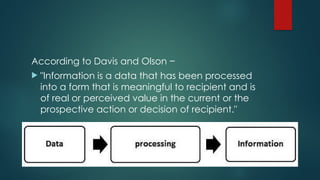
According to Davis and Olson −
 "Information is a data that has been processed
into a form that is meaningful to recipient and is
of real or perceived value in the current or the
prospective action or decision of recipient."
Information, Knowledge and
Business Intelligence
Professor Ray R. Larson of the School of Information at the University of California,
Berkeley, provides an Information Hierarchy, which is −
 Data − The raw material of information.
 Information − Data organized and presented by someone.
 Knowledge − Information read, heard, or seen, and understood.
 Wisdom − Distilled and integrated knowledge and understanding.
Scott Andrews' explains Information Continuum as follows −
 Data − A Fact or a piece of information, or a series thereof.
 Information − Knowledge discerned from data.
 Business Intelligence − Information Management pertaining to an
organization's policy or decision-making, particularly when tied to strategic or
operational objectives.
Information/Data Collection
Techniques
The most popular data collection techniques include −
 Surveys − A questionnaires is prepared to collect the data
from the field.
 Secondary data sources or archival data: Data is collected
through old records, magazines, company website etc.
 Objective measures or tests − An experimental test is
conducted on the subject and the data is collected.
 Interviews − Data is collected by the system analyst by
following a rigid procedure and collecting the answers to a
set of pre-conceived questions through personal interviews.
Classification of Information
 Information can be classified in a number of ways, two
of the most important ways to classify information.
Classification by Characteristic
Based on Anthony's classification of Management, information used in
business for decision-making is generally categorized into three types −
 Strategic Information − Strategic information is concerned with long term
policy decisions that defines the objectives of a business and checks how
well these objectives are met. For example, acquiring a new plant, a new
product, diversification of business etc, comes under strategic information.
 Tactical Information − Tactical information is concerned with the
information needed for exercising control over business resources, like
budgeting, quality control, service level, inventory level, productivity level
etc.
 Operational Information − Operational information is concerned with
plant/business level information and is used to ensure proper conduction
of specific operational tasks as planned/intended. Various operator
specific, machine specific and shift specific jobs for quality control checks
comes under this category.
Classification by Application
In terms of applications, information can be categorized as −
 Planning Information − These are the information needed for establishing
standard norms and specifications in an organization. This information is used
in strategic, tactical, and operation planning of any activity. Examples of
such information are time standards, design standards.
 Control Information − This information is needed for establishing control over
all business activities through feedback mechanism. This information is used
for controlling attainment, nature and utilization of important processes in a
system. When such information reflects a deviation from the established
standards, the system should induce a decision or an action leading to
control.
 Knowledge Information − Knowledge is defined as "information about
information". Knowledge information is acquired through experience and
learning, and collected from archival data and research studies.
 Organizational Information − Organizational information deals with an
organization's environment, culture in the light of its objectives. Karl Weick's
Organizational Information Theory emphasizes that an organization reduces its
equivocality or uncertainty by collecting, managing and using these information
prudently. This information is used by everybody in the organization; examples of
such information are employee and payroll information.
 Functional/Operational Information − This is operation specific information. For
example, daily schedules in a manufacturing plant that refers to the detailed
assignment of jobs to machines or machines to operators. In a service oriented
business, it would be the duty roster of various personnel. This information is mostly
internal to the organization.
 Database Information − Database information construes large quantities of
information that has multiple usage and application. Such information is stored,
retrieved and managed to create databases. For example, material
specification or supplier information is stored for multiple users.
Quality of Information
 Information is a vital resource for the success of any
organization. Future of an organization lies in using and
disseminating information wisely. Good quality
information placed in right context in right time tells us
about opportunities and problems well in advance.
 Good quality information − Quality is a value that would
vary according to the users and uses of the information.
According to Wang and Strong, following are the
dimensions or elements of Information Quality −
 Intrinsic − Accuracy, Objectivity, Believability,
Reputation
 Contextual − Relevancy, Value-Added,
Timeliness, Completeness, Amount of information
 Representational − Interpretability, Format,
Coherence, Compatibility
 Accessibility − Accessibility, Access security
Various authors propose various lists of metrics for assessing
the quality of information. Let us generate a list of the most
essential characteristic features for information quality −
 Reliability − It should be verifiable and dependable.
 Timely − It must be current and it must reach the users
well in time, so that important decisions can be made in
time.
 Relevant − It should be current and valid information
and it should reduce uncertainties.
 Accurate − It should be free of errors and mistakes, true,
and not deceptive.
 Sufficient − It should be adequate in quantity, so that
decisions can be made on its basis.
 Unambiguous − It should be expressed in clear terms. In
other words, in should be comprehensive.
 Complete − It should meet all the needs in the current
context.
 Unbiased − It should be impartial, free from any bias. In
other words, it should have integrity.
 Explicit − It should not need any further explanation.
 Comparable − It should be of uniform collection,
analysis, content, and format.
 Reproducible − It could be used by documented
methods on the same data set to achieve a consistent
result.
Information Need & Objective
Information processing beyond doubt is the dominant industry of the
present century. Following factors states few common factors that
reflect on the needs and objectives of the information processing −
 Increasing impact of information processing for organizational
decision making.
 Dependency of services sector including banking, financial
organization, health care, entertainment, tourism and travel,
education and numerous others on information.
 Changing employment scene world over, shifting base from manual
agricultural to machine-based manufacturing and other industry
related jobs.
 Information revolution and the overall development scenario.
 Growth of IT industry and its strategic importance.
Information Need & Objective
 Strong growth of information services fuelled by
increasing competition and reduced product life cycle.
 Need for sustainable development and quality life.
 Improvement in communication and transportation
brought in by use of information processing.
 Use of information processing in reduction of energy
consumption, reduction in pollution and a better
ecological balance in future.
 Use of information processing in land record
managements, legal delivery system, educational
institutions, natural resource planning, customer relation
management and so on.
 Information is needed to survive in the modern
competitive world.
 Information is needed to create strong information
systems and keep these systems up to date.
Implications of Information in
Business
 Information processing has transformed our
society in numerous ways. From a business
perspective, there has been a huge shift
towards increasingly automated business
processes and communication. Access to
information and capability of information
processing has helped in achieving greater
efficiency in accounting and other business
processes.
A complete business information system,
accomplishes the following functionalities −
 Collection and storage of data.
 Transform these data into business information
useful for decision making.
 Provide controls to safeguard data.
 Automate and streamline reporting.
Uses of information
The following list summarizes the five main uses of information by
businesses an
 Planning − At the planning stage, information is the most important
ingredient in decision making. Information at planning stage
includes that of business resources, assets, liabilities, plants and
machineries, properties, suppliers, customers, competitors, market
and market dynamics, fiscal policy changes of the Government,
emerging technologies, etc.
 Recording − Business processing these days involves recording
information about each transaction or event. This information
collected, stored and updated regularly at the operational level.d
other organizations −
 Controlling − A business need to set up an information filter, so that
only filtered data is presented to the middle and top management.
This ensures efficiency at the operational level and effectiveness at
the tactical and strategic level.
 Measuring − A business measures its performance metrics by
collecting and analyzing sales data, cost of manufacturing, and
profit earned.
 Decision-making − MIS is primarily concerned with managerial
decision-making, theory of organizational behavior, and underlying
human behavior in organizational context. Decision-making
information includes the socio-economic impact of competition,
globalization, democratization, and the effects of all these factors
on an organizational structure.
MIS
 A Management Information System is an information
system that evaluates, analyzes, and processes an
organization's data to produce meaningful and useful
information based on which the management can take
right decisions to ensure future growth of the
organization.
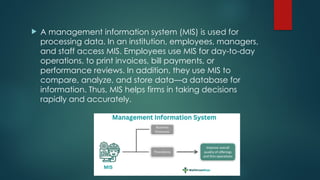
 A management information system (MIS) is used for
processing data. In an institution, employees, managers,
and staff access MIS. Employees use MIS for day-to-day
operations, to print invoices, bill payments, or
performance reviews. In addition, they use MIS to
compare, analyze, and store data—a database for
information. Thus, MIS helps firms in taking decisions
rapidly and accurately.
 Management Information System is an
implementation of the organizational systems and
procedures. To a programmer it is nothing but file
structures and file processing. However, it involves
much more complexity.
 The three components of MIS provide a more
complete and focused definition, where System
suggests integration and holistic view, Information
stands for processed data, and Management is
the ultimate user, the decision makers.
 Management information system can thus be
analyzed as follows −
Management
 Management covers the planning, control, and
administration of the operations of a concern.
The top management handles planning; the
middle management concentrates on
controlling; and the lower management is
concerned with actual administration.
Information
 Information, in MIS, means the processed data
that helps the management in planning,
controlling and operations. Data means all the
facts arising out of the operations of the
concern. Data is processed i.e. recorded,
summarized, compared and finally presented to
the management in the form of MIS report.
System
 Data is processed into information with the help
of a system. A system is made up of inputs,
processing, output and feedback or control.
 Thus MIS means a system for processing data in
order to give proper information to the
management for performing its functions.
Objectives of MIS
 The goals of an MIS are to implement the
organizational structure and dynamics of the
enterprise for the purpose of managing the
organization in a better way and capturing the
potential of the information system for
competitive advantage.
 Capturing Data − Capturing contextual data, or
operational information that will contribute in
decision making from various internal and
external sources of organization.
 Processing Data − The captured data is
processed into information needed for planning,
organizing, coordinating, directing and
controlling functionalities at strategic, tactical
and operational level. Processing data means
−making calculations with the data sorting data
classifying data and summarizing data
Following are the basic objectives
of an MIS −
 Information Storage − Information or processed data
need to be stored for future use.
 Information Retrieval − The system should be able to
retrieve this information from the storage as and when
required by various users.
 Information Propagation − Information or the finished
product of the MIS should be circulated to its users
periodically using the organizational network.
Characteristics of MIS
Following are the characteristics of an MIS −
 It should be based on a long-term planning.
 It should provide a holistic view of the dynamics and the
structure of the organization.
 It should work as a complete and comprehensive system
covering all interconnecting sub-systems within the
organization.
 It should be planned in a top-down way, as the decision
makers or the management should actively take part and
provide clear direction at the development stage of the MIS.
 It should be based on need of strategic, operational and
tactical information of managers of an organization.
 It should also take care of exceptional situations by reporting such
situations.
 It should be able to make forecasts and estimates, and generate
advanced information, thus providing a competitive advantage.
Decision makers can take actions on the basis of such predictions.
 It should create linkage between all sub-systems within the
organization, so that the decision makers can take the right
decision based on an integrated view.
 It should allow easy flow of information through various sub-
systems, thus avoiding redundancy and duplicity of data. It should
simplify the operations with as much practicability as possible.
 Although the MIS is an integrated, complete system, it should be
made in such a flexible way that it could be easily split into smaller
sub-systems as and when required.
 A central database is the backbone of a well-built MIS.
Characteristics of Computerized
MIS
 Following are the characteristics of a well-designed
computerized MIS −
 It should be able to process data accurately and with high
speed, using various techniques like operations research,
simulation, heuristics, etc.
 It should be able to collect, organize, manipulate, and
update large amount of raw data of both related and
unrelated nature, coming from various internal and external
sources at different periods of time.
 It should provide real time information on ongoing events
without any delay.
 It should support various output formats and
follow latest rules and regulations in practice.
 It should provide organized and relevant
information for all levels of management:
strategic, operational, and tactical.
 It should aim at extreme flexibility in data storage
and retrieval.
Nature and Scope of MIS
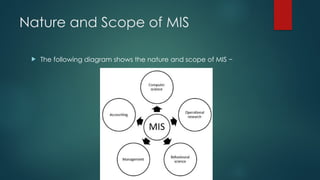
 The following diagram shows the nature and scope of MIS −
12 types of management
information systems
 Process control. ...
 Management reporting system. ...
 Inventory control. ...
 Sales and marketing systems. ...
 Human resource systems. ...
 Accounting and finance systems. ...
 Decision support systems. ...
 Expert systems.
 Initially, employees are given MIS training—MIS interface,
usage, and importance. Then, in some firms, training is
given to customers and clients who use the system
instead of employees.
 The term ‘information system’ is often misunderstood.
There is a misconception that MIS is all about coding and
computer technology. Practically though, MIS is more
than a code. In many scenarios, information systems do
not require any code. MIS is more to do with data
analysis. Fundamentally, an information system is a
common framework that increases the productivity of all
firm employees.
Management Information System
Components
#1 – Data
 Data is crucial for every business. Unfortunately, in the
internet era, firms are bombarded with too much data,
not just relevant data. Firms collect data in files,
documents, cloud storage, hard copies, and soft copy
formats.
 Primarily the MIS stores data in a secure manner. For
example, a bank maintains records of account deposits,
withdrawals, and customer details.
Management Information System
Components
#2 – People
An MIS is designed to be used by firm employees.
managers, accountants, executives, and staff for day-to-
day operations. Ideally, the MIS should be customized
based on the firm needs. The MIS features should suit
common usage.
#3 – Business Processes
Information systems simplify complex processes—the
centralization of operations achieves this.
Management Information System
Components
#4 – Hardware
Hardware is an indispensable component of MIS. Every
system runs on a device, but the processing capabilities
vary.
#5 – Software
MIS software is categorized into two—system software and
application software. The term system software refers to
operating systems like windows and iOS. Application
software is more specific—banking systems, accounting
applications, payroll applications, etc.
Role
The MIS plays the following roles.
 MIS stores data and records vital information.
 Firm employees use MIS software to complete daily operations
and administrative tasks. Therefore, MIS should increase
employee efficiency.
 Larger firms use automation and data generation to conserve
employees’ time and energy. But those systems can be
expensive.
 Again. The success of a system depends more on users than
the software or hardware. Unfortunately, MIS training is often
overlooked.
 An information system is beneficial in strategizing, analysis, and
performance comparison.

What Is Management Information System (MIS).pptx

  • 1.
    What Is Management InformationSystem (MIS)? MANAGEMENT INFORMATION SYSTEMS FACILITATE A FIRM’S DAILY OPERATIONS. IT IS PRESENT IN EVERY ORGANIZATION. RECORD KEEPING IS SIGNIFICANTLY EASIER WITH INFORMATION SYSTEMS. THE PRIMARY ROLE OF AN INFORMATION SYSTEM IS TO SIMPLIFY WORKFLOW; IT SAVES THE TIME AND ENERGY OF EMPLOYEES.
  • 2.
    Information  If wegive you a number 1-212-290-4700, it does not make any sense on its own. It is just a raw data. However if we say Tel: +1-212-290-4700, it starts making sense. It becomes a telephone number. If I gather some more data and record it meaningfully like −information can be defined as meaningfully interpreted data. Address: 350 Fifth Avenue, 34th floor New York, NY 10118-3299 USA Tel: +1-212-290-4700 Fax: +1-212-736-1300
  • 3.
    Information  It becomesa very useful information - the address of New York office of Human Rights Watch, a non-profit, non-governmental human rights organization.  So, from a system analyst's point of view, information is a sequence of symbols that can be construed to a useful message.  An Information System is a system that gathers data and disseminates information with the sole purpose of providing information to its users.  The main object of an information system is to provide information to its users. Information systems vary according to the type of users who use the system
  • 4.
    Information Definition  "Informationcan be recorded as signs, or transmitted as signals. Information is any kind of event that affects the state of a dynamic system that can interpret the information.  Conceptually, information is the message (utterance or expression) being conveyed. Therefore, in a general sense, information is "Knowledge communicated or received, concerning a particular fact or circumstance". Information cannot be predicted and resolves uncertainty."
  • 5.
    Information Vs Data Data can be described as unprocessed facts and figures. Plain collected data as raw facts cannot help in decision-making. However, data is the raw material that is organized, structured, and interpreted to create useful information systems.  Data is defined as 'groups of non-random symbols in the form of text, images, voice representing quantities, action and objects'.  Information is interpreted data; created from organized, structured, and processed data in a particular context.
  • 6.
    According to Davisand Olson −  "Information is a data that has been processed into a form that is meaningful to recipient and is of real or perceived value in the current or the prospective action or decision of recipient."
  • 7.
    Information, Knowledge and BusinessIntelligence Professor Ray R. Larson of the School of Information at the University of California, Berkeley, provides an Information Hierarchy, which is −  Data − The raw material of information.  Information − Data organized and presented by someone.  Knowledge − Information read, heard, or seen, and understood.  Wisdom − Distilled and integrated knowledge and understanding. Scott Andrews' explains Information Continuum as follows −  Data − A Fact or a piece of information, or a series thereof.  Information − Knowledge discerned from data.  Business Intelligence − Information Management pertaining to an organization's policy or decision-making, particularly when tied to strategic or operational objectives.
  • 8.
    Information/Data Collection Techniques The mostpopular data collection techniques include −  Surveys − A questionnaires is prepared to collect the data from the field.  Secondary data sources or archival data: Data is collected through old records, magazines, company website etc.  Objective measures or tests − An experimental test is conducted on the subject and the data is collected.  Interviews − Data is collected by the system analyst by following a rigid procedure and collecting the answers to a set of pre-conceived questions through personal interviews.
  • 9.
    Classification of Information Information can be classified in a number of ways, two of the most important ways to classify information.
  • 10.
    Classification by Characteristic Basedon Anthony's classification of Management, information used in business for decision-making is generally categorized into three types −  Strategic Information − Strategic information is concerned with long term policy decisions that defines the objectives of a business and checks how well these objectives are met. For example, acquiring a new plant, a new product, diversification of business etc, comes under strategic information.  Tactical Information − Tactical information is concerned with the information needed for exercising control over business resources, like budgeting, quality control, service level, inventory level, productivity level etc.  Operational Information − Operational information is concerned with plant/business level information and is used to ensure proper conduction of specific operational tasks as planned/intended. Various operator specific, machine specific and shift specific jobs for quality control checks comes under this category.
  • 11.
    Classification by Application Interms of applications, information can be categorized as −  Planning Information − These are the information needed for establishing standard norms and specifications in an organization. This information is used in strategic, tactical, and operation planning of any activity. Examples of such information are time standards, design standards.  Control Information − This information is needed for establishing control over all business activities through feedback mechanism. This information is used for controlling attainment, nature and utilization of important processes in a system. When such information reflects a deviation from the established standards, the system should induce a decision or an action leading to control.  Knowledge Information − Knowledge is defined as "information about information". Knowledge information is acquired through experience and learning, and collected from archival data and research studies.
  • 12.
     Organizational Information− Organizational information deals with an organization's environment, culture in the light of its objectives. Karl Weick's Organizational Information Theory emphasizes that an organization reduces its equivocality or uncertainty by collecting, managing and using these information prudently. This information is used by everybody in the organization; examples of such information are employee and payroll information.  Functional/Operational Information − This is operation specific information. For example, daily schedules in a manufacturing plant that refers to the detailed assignment of jobs to machines or machines to operators. In a service oriented business, it would be the duty roster of various personnel. This information is mostly internal to the organization.  Database Information − Database information construes large quantities of information that has multiple usage and application. Such information is stored, retrieved and managed to create databases. For example, material specification or supplier information is stored for multiple users.
  • 13.
    Quality of Information Information is a vital resource for the success of any organization. Future of an organization lies in using and disseminating information wisely. Good quality information placed in right context in right time tells us about opportunities and problems well in advance.  Good quality information − Quality is a value that would vary according to the users and uses of the information.
  • 14.
    According to Wangand Strong, following are the dimensions or elements of Information Quality −  Intrinsic − Accuracy, Objectivity, Believability, Reputation  Contextual − Relevancy, Value-Added, Timeliness, Completeness, Amount of information  Representational − Interpretability, Format, Coherence, Compatibility  Accessibility − Accessibility, Access security
  • 15.
    Various authors proposevarious lists of metrics for assessing the quality of information. Let us generate a list of the most essential characteristic features for information quality −  Reliability − It should be verifiable and dependable.  Timely − It must be current and it must reach the users well in time, so that important decisions can be made in time.  Relevant − It should be current and valid information and it should reduce uncertainties.  Accurate − It should be free of errors and mistakes, true, and not deceptive.  Sufficient − It should be adequate in quantity, so that decisions can be made on its basis.
  • 16.
     Unambiguous −It should be expressed in clear terms. In other words, in should be comprehensive.  Complete − It should meet all the needs in the current context.  Unbiased − It should be impartial, free from any bias. In other words, it should have integrity.  Explicit − It should not need any further explanation.  Comparable − It should be of uniform collection, analysis, content, and format.  Reproducible − It could be used by documented methods on the same data set to achieve a consistent result.
  • 17.
    Information Need &Objective Information processing beyond doubt is the dominant industry of the present century. Following factors states few common factors that reflect on the needs and objectives of the information processing −  Increasing impact of information processing for organizational decision making.  Dependency of services sector including banking, financial organization, health care, entertainment, tourism and travel, education and numerous others on information.  Changing employment scene world over, shifting base from manual agricultural to machine-based manufacturing and other industry related jobs.  Information revolution and the overall development scenario.  Growth of IT industry and its strategic importance.
  • 18.
    Information Need &Objective  Strong growth of information services fuelled by increasing competition and reduced product life cycle.  Need for sustainable development and quality life.  Improvement in communication and transportation brought in by use of information processing.  Use of information processing in reduction of energy consumption, reduction in pollution and a better ecological balance in future.  Use of information processing in land record managements, legal delivery system, educational institutions, natural resource planning, customer relation management and so on.
  • 19.
     Information isneeded to survive in the modern competitive world.  Information is needed to create strong information systems and keep these systems up to date.
  • 20.
    Implications of Informationin Business  Information processing has transformed our society in numerous ways. From a business perspective, there has been a huge shift towards increasingly automated business processes and communication. Access to information and capability of information processing has helped in achieving greater efficiency in accounting and other business processes.
  • 21.
    A complete businessinformation system, accomplishes the following functionalities −  Collection and storage of data.  Transform these data into business information useful for decision making.  Provide controls to safeguard data.  Automate and streamline reporting.
  • 22.
    Uses of information Thefollowing list summarizes the five main uses of information by businesses an  Planning − At the planning stage, information is the most important ingredient in decision making. Information at planning stage includes that of business resources, assets, liabilities, plants and machineries, properties, suppliers, customers, competitors, market and market dynamics, fiscal policy changes of the Government, emerging technologies, etc.  Recording − Business processing these days involves recording information about each transaction or event. This information collected, stored and updated regularly at the operational level.d other organizations −
  • 23.
     Controlling −A business need to set up an information filter, so that only filtered data is presented to the middle and top management. This ensures efficiency at the operational level and effectiveness at the tactical and strategic level.  Measuring − A business measures its performance metrics by collecting and analyzing sales data, cost of manufacturing, and profit earned.  Decision-making − MIS is primarily concerned with managerial decision-making, theory of organizational behavior, and underlying human behavior in organizational context. Decision-making information includes the socio-economic impact of competition, globalization, democratization, and the effects of all these factors on an organizational structure.
  • 24.
    MIS  A ManagementInformation System is an information system that evaluates, analyzes, and processes an organization's data to produce meaningful and useful information based on which the management can take right decisions to ensure future growth of the organization.
  • 25.
     A managementinformation system (MIS) is used for processing data. In an institution, employees, managers, and staff access MIS. Employees use MIS for day-to-day operations, to print invoices, bill payments, or performance reviews. In addition, they use MIS to compare, analyze, and store data—a database for information. Thus, MIS helps firms in taking decisions rapidly and accurately.
  • 26.
     Management InformationSystem is an implementation of the organizational systems and procedures. To a programmer it is nothing but file structures and file processing. However, it involves much more complexity.  The three components of MIS provide a more complete and focused definition, where System suggests integration and holistic view, Information stands for processed data, and Management is the ultimate user, the decision makers.  Management information system can thus be analyzed as follows −
  • 27.
    Management  Management coversthe planning, control, and administration of the operations of a concern. The top management handles planning; the middle management concentrates on controlling; and the lower management is concerned with actual administration.
  • 28.
    Information  Information, inMIS, means the processed data that helps the management in planning, controlling and operations. Data means all the facts arising out of the operations of the concern. Data is processed i.e. recorded, summarized, compared and finally presented to the management in the form of MIS report.
  • 29.
    System  Data isprocessed into information with the help of a system. A system is made up of inputs, processing, output and feedback or control.  Thus MIS means a system for processing data in order to give proper information to the management for performing its functions.
  • 30.
    Objectives of MIS The goals of an MIS are to implement the organizational structure and dynamics of the enterprise for the purpose of managing the organization in a better way and capturing the potential of the information system for competitive advantage.
  • 31.
     Capturing Data− Capturing contextual data, or operational information that will contribute in decision making from various internal and external sources of organization.  Processing Data − The captured data is processed into information needed for planning, organizing, coordinating, directing and controlling functionalities at strategic, tactical and operational level. Processing data means −making calculations with the data sorting data classifying data and summarizing data
  • 32.
    Following are thebasic objectives of an MIS −  Information Storage − Information or processed data need to be stored for future use.  Information Retrieval − The system should be able to retrieve this information from the storage as and when required by various users.  Information Propagation − Information or the finished product of the MIS should be circulated to its users periodically using the organizational network.
  • 33.
    Characteristics of MIS Followingare the characteristics of an MIS −  It should be based on a long-term planning.  It should provide a holistic view of the dynamics and the structure of the organization.  It should work as a complete and comprehensive system covering all interconnecting sub-systems within the organization.  It should be planned in a top-down way, as the decision makers or the management should actively take part and provide clear direction at the development stage of the MIS.  It should be based on need of strategic, operational and tactical information of managers of an organization.
  • 34.
     It shouldalso take care of exceptional situations by reporting such situations.  It should be able to make forecasts and estimates, and generate advanced information, thus providing a competitive advantage. Decision makers can take actions on the basis of such predictions.  It should create linkage between all sub-systems within the organization, so that the decision makers can take the right decision based on an integrated view.  It should allow easy flow of information through various sub- systems, thus avoiding redundancy and duplicity of data. It should simplify the operations with as much practicability as possible.  Although the MIS is an integrated, complete system, it should be made in such a flexible way that it could be easily split into smaller sub-systems as and when required.  A central database is the backbone of a well-built MIS.
  • 35.
    Characteristics of Computerized MIS Following are the characteristics of a well-designed computerized MIS −  It should be able to process data accurately and with high speed, using various techniques like operations research, simulation, heuristics, etc.  It should be able to collect, organize, manipulate, and update large amount of raw data of both related and unrelated nature, coming from various internal and external sources at different periods of time.  It should provide real time information on ongoing events without any delay.
  • 36.
     It shouldsupport various output formats and follow latest rules and regulations in practice.  It should provide organized and relevant information for all levels of management: strategic, operational, and tactical.  It should aim at extreme flexibility in data storage and retrieval.
  • 37.
    Nature and Scopeof MIS  The following diagram shows the nature and scope of MIS −
  • 38.
    12 types ofmanagement information systems  Process control. ...  Management reporting system. ...  Inventory control. ...  Sales and marketing systems. ...  Human resource systems. ...  Accounting and finance systems. ...  Decision support systems. ...  Expert systems.
  • 39.
     Initially, employeesare given MIS training—MIS interface, usage, and importance. Then, in some firms, training is given to customers and clients who use the system instead of employees.  The term ‘information system’ is often misunderstood. There is a misconception that MIS is all about coding and computer technology. Practically though, MIS is more than a code. In many scenarios, information systems do not require any code. MIS is more to do with data analysis. Fundamentally, an information system is a common framework that increases the productivity of all firm employees.
  • 40.
    Management Information System Components #1– Data  Data is crucial for every business. Unfortunately, in the internet era, firms are bombarded with too much data, not just relevant data. Firms collect data in files, documents, cloud storage, hard copies, and soft copy formats.  Primarily the MIS stores data in a secure manner. For example, a bank maintains records of account deposits, withdrawals, and customer details.
  • 41.
    Management Information System Components #2– People An MIS is designed to be used by firm employees. managers, accountants, executives, and staff for day-to- day operations. Ideally, the MIS should be customized based on the firm needs. The MIS features should suit common usage. #3 – Business Processes Information systems simplify complex processes—the centralization of operations achieves this.
  • 42.
    Management Information System Components #4– Hardware Hardware is an indispensable component of MIS. Every system runs on a device, but the processing capabilities vary. #5 – Software MIS software is categorized into two—system software and application software. The term system software refers to operating systems like windows and iOS. Application software is more specific—banking systems, accounting applications, payroll applications, etc.
  • 43.
    Role The MIS playsthe following roles.  MIS stores data and records vital information.  Firm employees use MIS software to complete daily operations and administrative tasks. Therefore, MIS should increase employee efficiency.  Larger firms use automation and data generation to conserve employees’ time and energy. But those systems can be expensive.  Again. The success of a system depends more on users than the software or hardware. Unfortunately, MIS training is often overlooked.  An information system is beneficial in strategizing, analysis, and performance comparison.