rDNA Technology
Urjita Sheth
rDNA Technology
• Recombinant DNA (rDNA) technology : is a field of molecular
biology in which scientists "edit" DNA to form new synthetic
molecules, which are often referred to as "chimeras".
• Recombinant DNA : is a form of artificial DNA that is engineered
through the combination, insertion or replacement of one or more
DNA strands, thereby combining DNA sequences that would not
normally occur together
HISTORY
• The Recombinant DNA technique was engineered by Stanley
Norman Cohen and Herbert Boyer in 1973
• They published their findings in a 1974 paper entitled
"Construction of Biologically Functional Bacterial Plasmids in
vitro", in which they described a technique to isolate and amplify
genes or DNA segments and insert them into another cell with
precision, to create a transgenic.
• Recombinant DNA technology was made possible by the discovery
of REs by Werner Arber, Daniel Nathans, and Halminton
Smith, for which they received the 1978 Nobel Prize in Medicine.
• Arber effectively showed geneticists how to "cut" DNA molecules;
soon to follow was the understanding that ligase could be used to
"glue" them together
• Other milestones in the development of recombinant DNA include
the collaboration between Stanley Cohen and Herbert Boyer in
1972, and the 1976 founding of Genentech, the first company to
work with rDNA in its drug development labs.
• In 1978 scientists were able to replicate Somatostatin, the protein
that regulates human growth hormones.
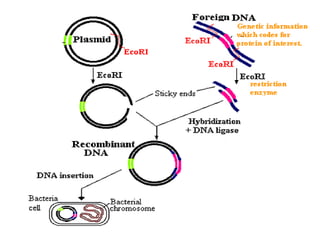
• GENE CLONING is essentially the insertion of the piece of
foreign DNA into cell in such a way that the inserted DNA is
replicated & inherited through the generations
METHOD : GENE CLONING
• The Gene cloning procedure involves:
1. Isolation of Gene
2. Insertion of Gene into other piece of DNA called VECTOR
3. Transfer of rVector into suitable host
4. Selection of those cells which contain desired rVectors
5. Growth of the selected host cell (can be indefinitely)
6. Now, depending upon the application;
– If the ultimate aim is to get amplification of DNA fragment, for
its genetic analysis; vector containing insert DNA is recovered &
DNA fragment is separated
– But at present the main aim of these procedures is the expression
of genes which code for the polypeptide which is either expensive
or difficult to prepare.
rDNA products being used in human therapy
• Many human genes have been cloned in E. coli or in yeast.
• This has made it possible to produce unlimited amounts of human
proteins in vitro.
• Cultured cells (E. coli, yeast, mammalian cells) transformed with a
human gene are being used to manufacture more than 100
products for human therapy. Some examples:
• insulin for diabetics
• factor VIII for males suffering from hemophilia A
• factor IX for hemophilia B
• human growth hormone (HGH)
• erythropoietin (EPO) for treating anemia
• several interleukins
• granulocyte-macrophage colony-stimulating factor (GM-CSF)
for stimulating the bone marrow after a bone marrow transplant
• granulocyte colony-stimulating factor (G-CSF) for stimulating
neutrophil production, e.g., after chemotherapy and for mobilizing
hematopoietic stem cells from the bone marrow into the blood.
• tissue plasminogen activator (TPA) for dissolving blood clots
• adenosine deaminase (ADA) for treating some forms of severe
combined immunodeficiency (SCID)
• parathyroid hormone
• several monoclonal antibodies
• hepatitis B surface antigen (HBsAg) to vaccinate against the
hepatitis B virus
• C1 inhibitor (C1INH) used to treat hereditary angioneurotic edema
(HANE)
• several types of interferons
TOOLS IN GENE CLONING
• GC utilizes certain biological products & biological agents for
achieving its objects, these are known as GC tools or GE tools
• The basic tools of GC are:
1. Restriction endonuclease
2. DNA Ligase
3. A suitable DNA molecule capable of self replication in
selected host called vector
4. A suitable organism that serves as the host for the
propagation of rDNA i.e. vector containing DNA fragment to
be cloned
ENZYMES IN GENE CLONING
• The gene cloning procedure initially developed mainly because of
the two enzymes:
1. Restriction endonuclease : to cut DNA at specific site. These
are also known as molecular scissor.
2. Ligase : to seal the cut or nicks that remain in the rDNA
molecule. It is also referred to as molecular glue.
ADDITIONAL ENZYMES & DNA SEQUENCES:
I. Reverse transcriptase: is used for production of cDNA copies
from mRNA
II. Alkaline phosphatase: for removal of 5’-phosphate from DNA
III. T4 poly ntd kinase: for addition of phosphate group to an end
having a free 5’-OH
IV. SI nuclease: for removal of single stranded protruding ends
( both 3’ & 5’ extensions can be removed )
V. The klenow fragment of E.coli DNA polymerase I: to make
protruding ends double stranded by extending the shorter
strands
VI. Lambda exonuclease: for removal of ntds from 5’ ends ( an
exonuclease removes one ntd from the end at a time from DNA,
but it does not make internal cuts)
VII. E.coli exonuclease III: for removal of ntds from 3’ ends
VIII. Exonuclease Bal 31: for making DNA fragments with blunt
ended shorter from both its ends
IX. Terminal deoxynucleotidyl transferase: for addition of
single stranded sequence at 3’ end to blunt ended fragments
X. Linker & adapter oligo ntd sequences: for modification of
cut ends of fragments
I. LINKERS: used to create cohesive ends either on blunt
ended DNA fragment or on fragment having unmatched or
undefined sequences in their protruding ends
II. ADAPTERS: are short chemically synthesized DNA double
strands, which already have one or both sticky ends.
RESTRICTION ENDONUCLEASE
• Commonly known as molecular scissor
Origin and function
• These are of bacterial origin
• Occurs naturally in bacteria as a weapon against the invading
viruses as it cleaves the foreign DNA , thus Protect bacteria from
bacteriophage infection as restrict virus replication
• Bacterium protects it’s own DNA by methylating those specific
sequence motifs
• Named after the organism from which they were derived
– EcoRI from Escherichia coli
– BamHI from Bacillus amyloliquefaciens
– HpaI from Haemophilus influenza
– Sau3a from Staphyllococcus aureus
• Availability: Over 200 enzymes identified, many available
commercially from biotechnology companies
Classes:
• Type I
– Cuts the DNA on both strands but at a non-specific location at
varying distances from the particular sequence that is
recognized by the restriction enzyme
– Therefore random/imprecise cuts
– Not very useful for rDNA applications
• Type II
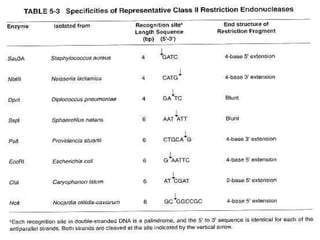
– Cuts both strands of DNA within the particular sequence
recognized by the restriction enzyme
– The class of enzyme most widely used is type II REs which
possess both endonuclease & methylation activity
– It usually recognizes 4 or 6 ntd & normally cut the DNA
sequences within these sequences
– Note that these sequences are pelindromic having rational
symmetry means reads the same in the 5’ 3’ direction on both
strands
– Some enzymes generate “blunt ends” (cut in middle)
– Others generate “sticky ends” (staggered cuts)
– Staggered cut will yield single stranded ends that are identical
or complementary to each other
– Consequently, at low temperature there is tendency for single
strand to associate each other by base pairing causing a
reversible linking together with fragments which have been cut
by same enzyme therefore such fragments are also known as
sticky or cohesive ends.
ISOLATION OF DNA SEQUENCE TO BE CLONED
SHORT GUN APPROACH
• This procedure is commonly employed when dealing with poorly
characterized genome.
• It is the formation of gene library in which the entire genome is cut
down randomly into large pieces of about 10 kbs or more in size using
partial digestion with REs & then these pieces are cloned without any
attempt to select particular sequences.
• Each of these fragment is linked to a vector & cloned into suitable host
cell.
• When bacteria containing these fragments are plated out to give rise
individual colonies, each colony will contain sample of genome & there
is finite chance that desired gene will be present in any one of these
sample provided.
• Enough colonies are produced, one can almost certain that at least one
will contain desired gene.
• Here, the larger the genome & smaller the average fragment size, more
colonies will have to be grown to find any particular gene.
• Calculation shows that for 10 kbs of fragments, 1.5x10³
colonies
are needed for E.coli genome & 2x10⁶
for Homo sapience .
• In later case, number of colonies required are unmanageable &
therefore much larger fragments about 40 kbs in size must be
cloned, but the large fragment require special vector for cloning.
• Inevitably the gene will come from only as a small part of entire
genome [approximately 0.03% in case of E.coli & 0.03x10⁻³ in case
of mammalian gene] so a way must be found to identify the gene &
pull it out from the other part of genome either before or after
cloning
• This job is much easier if the corresponding mRNA will be
available in the fairly pure form
• If the protein for which it codes is the major product of the cell,
then mRNA will already be enriched for desired species
• However the procedure used for enrichment of mRNA from the pool
of gene are
• Size fractionation of mRNA
• In vitro translation of fractions
• Precipitation of translation product with specific Abs or
• To pass it from column containing oligo dT dimers which
selectively forms complementation with polyA tail of mRNA &
allow the mRNA to absorbed on column
• Methods of obtaining mRNA is depends upon the product & is most
difficult step in the cloning, particularly if the gene product is not well
characterized.
• After obtaining purified mRNA, it can be used to direct the synthesis
of cDNA using enzyme Reverse transcriptase
• This results into DNA- RNA hybrid formation
• After removing RNA strand using alkali or RNase, the ssDNA can act
as a template for the synthesis of second strand of cDNA using DNA
polymerase enzyme
• This results in to dsDNA molecule
• To obtain expression of cloned gene, it is necessary to understand the
genetic organization of prokaryotes & eukaryotes.
• In eukaryotes, the coding regions of genes (exons) are generally
broken by non-coding regions (introns)
• From the primary transcript from the nuclear gene the introns must
be removed i.e. RNA processing to form mature translatable mRNA
• The RNA processing step cannot be carried out by prokaryotes so that
a correct translation of cloned genes of eukaryotes is not possible
• Therefore, when bacteria are used as cloning hosts it is preferable to
use synthetic DNA or complementary DNA
Synthetic DNA
• Nucleic acid chemistry has advanced so rapidly that it is now a routine
process in many laboratory to synthesize a long DNA molecule of any
desired ntd sequence
• In order to produce a specific DNA fragment containing coding region
of protein, the DNA sequence is deduced by “reverse translation“ from
the sequence of this protein using an automated DNA synthesis
machine
• This machine will carry out each & every steps automatically
• It requires the supply of the reagents & type sequence of ntd to be
produced
• Consequently, if amino acid sequence of polypeptide is known, than it
may be easier to synthesize a gene & isolate the sequence similar to
natural gene.
• Using such approach it is possible to produce DNA fragment of 20-
100 bases, which can be connected together to make large synthesis
• Since the DNA synthesis procedure is completely under the control of
the investigator ,it is also possible to produce sequences in which one
or more bases have been changed making possible the production of
highly specific mutations.
• Examples of this technique are:
• The artificial synthesis of the gene for stomatostatin, a peptide
hormone with 14 aa &
• the synthesis of the A&B chains of insulin, which were cloned
&expressed in E.coli.
• PRODUCTION OF COMPLEMENTARY DNA
• Specific mRNA molecules isolated from mRNA rich cells or tissues are
used as templates in vitro with the enzyme Reverse Transcriptase,
produce cDNA .
• An example of the use of this method for cloning insulin gene from
rats in Ecoli.
HYBRIDIZATION METHOD
• This method depends on the principle that mRNA forms complex
with cDNA segment from which it has been transcribed
• This method is possible if protein encoding genes do not have
introns
• First the total DNA from organism is isolated, than this dsDNA is
treated with alkali or heat & converted into ssDNA by denaturation
• This strands are mixed with the mRNA transcribed by that genes.
• this complex is isolated & DNA is separated from RNA by RNase
treatment
• the ssDNA thus obtained is converted into dsDNA by using DNA
pol I enzyme
• this method is most suitable for isolating genes which exist in
multiple copies
• mRNA pairs with cDNA protein to form DNA-RNA complex
[hybrid]
• for ex: ribosomal genes
VECTORS
• A vector is a DNA molecule that has ability to replicate in
appropriate host cell & into which the DNA fragment could be
cloned is integrated for cloning & therefore a vector must have
an origin of replication that amplify the fragment DNA
incorporate into the host cell
• The choice of a vector depends on the design of the experimental
system and how the cloned gene will be screened or utilized
subsequently.
• There are two types of vectors
I. Cloning vectors : All vectors used for propagation of DNA
insert into suitable host are called cloning vectors
II. Expression vector: when vector is designed for the
expression i.e. production of proteins specified by DNA
insert than it is termed as expression vector. Such vector
contain control elements like promoter, operator, ribosomal
binding sites ,etc.
• An ideal vector contain following properties
1. It should able to replicate autonomously when the objective of
cloning is to obtain multiple copies of insert DNA fragment & the
replication must be under relaxed condition, so that it can generate
multiple copies of itself within the host cell
2. Vector DNA should be ideally of less than 10kbs in size because
larger DNA molecules are broken down during purification procedure
& also large vector present difficulties during various manipulation
required for gene manipulation
3. It should be easy to isolate & purify means crude techniques of
isolation should be applied
4. It should be easily introduced into host cell
5. It should have suitable marker gene that allows easy detection &/or
selection of transformed host cells
6. If the objective is DNA transfer than it should able to integrate
DNA insert it carries into genome of host cell along with itself
7. Vector should contain unique target side for as many as REs
possible into which the DNA insert can be integrated without
disrupting the essential function
8. The cells transformed with such vector molecule that contain
DNA insert i.e. rVector should be identifiable or selectable from
those transformed by only vector molecule
9. When expression of DNA insert is desired, the vector should at
least contain suitable control elements
• As all the above properties cannot be served by a single vector in
nature, it is required to create useful vector by joining together
segments performing specific function from two or more natural
entities i.e. naturally available vectors
Requirements of a vector to serve as a carrier
molecule
• Most vectors contain a prokaryotic origin of replication allowing
maintenance in bacterial cells.
• Some vectors contain an additional eukaryotic origin of replication
allowing autonomous, episomal replication in eukaryotic cells.
• Multiple unique cloning sites are often included for versatility and
easier library construction.
• Antibiotic resistance genes and/or other selectable markers
enable identification of cells that have acquired the vector construct.
• Some vectors contain inducible or tissue-specific promoters
permitting controlled expression of introduced genes in transfected
cells or transgenic animals.
• Modern vectors contain multi-functional elements designed to permit
a combination of cloning, DNA sequencing, in vitro mutagenesis and
transcription and episomal replication
Main types of vectors
• Plasmid: an extrachromosomal circular DNA molecule that
autonomously replicates inside the bacterial cell; cloning limit: 100 to
10,000 base pairs or 0.1-10 kilobases (kb)
• Bacteriophage: derivatives of bacteriophage lambda; linear DNA
molecules, whose region can be replaced with foreign DNA without
disrupting its life cycle; cloning limit: 8-20 kb
• Cosmid: an extrachromosomal circular DNA molecule that combines
features of plasmids and phage; cloning limit - 35-50 kb
• Bacterial artificial chromosome (BAC): based on bacterial mini-F
plasmids. cloning limit: 75-300 kb
• Yeast artificial chromosome (YAC): an artificial chromosome that
contains telomeres, origin of replication, a yeast centromere, and a
selectable marker for identification in yeast cells; cloning limit: 100-
1000 kb
• yeast 2 micron plasmid,
• retrovirus,
• baculovirus vector…….
CHOICE OF VECTOR
Depends on :
Nature of protocol or experiment
Type of host cell to accommodate rDNA
– Prokaryotic
– Eukaryotic
Plasmid vector
• Covalently closed, circular, double stranded DNA molecules that
occur naturally and replicate extrachromosomally in bacteria
• Plasmid can be considered as a suitable vector if it possess
following properties:
1. It should be easily isolated from the cell
2. It should possess a single RE recognition site for one or more REs
3. Insertion of linear molecule at one of these sites should not alter
its replication properties
4. It should have marker genes which allows easy detection &
selection of transformed cells as rVector containing transformed
cells
5. It should be reintroduced into bacterial cell carrying plasmid with
or without insert
pBR322
• It is one of the most widely used vector & constructed by excising parts of
naturally occurring plasmid using REs & rejoining them in a correct
orientation & a series of manipulation which make it simple to use
• It is named after the scientist who discover this are BOLIVER &
RODRIGNE
• The desirable features offered by resulting plasmid for cloning includes:
1. Origin of replication
• It has been derived from naturally occurring plasmid col E1
• The origin is particularly more useful because it is relaxed i.e. its
replication is not linked to any part of chromosomal DNA &hence
initiation of plasmid replication is more frequent than that of main
chromosomal DNA
• Consequently multiple copies are accumulate within the cell so the process
can be continued still further
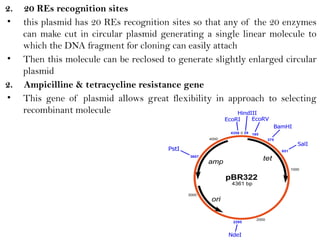
2. 20 REs recognition sites
• this plasmid has 20 REs recognition sites so that any of the 20 enzymes
can make cut in circular plasmid generating a single linear molecule to
which the DNA fragment for cloning can easily attach
• Then this molecule can be reclosed to generate slightly enlarged circular
plasmid
2. Ampicilline & tetracycline resistance gene
• This gene of plasmid allows great flexibility in approach to selecting
recombinant molecule
Selection of cells containing recombinant or non recombinant vector
• The presence of plasmid in a bacterium will confer resistance to antibiotic
& such cells can be selected by growth on the medium containing either
ampicilline or tetracycline
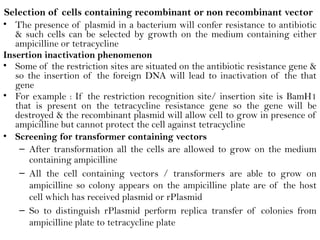
Insertion inactivation phenomenon
• Some of the restriction sites are situated on the antibiotic resistance gene &
so the insertion of the foreign DNA will lead to inactivation of the that
gene
• For example : If the restriction recognition site/ insertion site is BamH1
that is present on the tetracycline resistance gene so the gene will be
destroyed & the recombinant plasmid will allow cell to grow in presence of
ampicilline but cannot protect the cell against tetracycline
• Screening for transformer containing vectors
– After transformation all the cells are allowed to grow on the medium
containing ampicilline
– All the cell containing vectors / transformers are able to grow on
ampicilline so colony appears on the ampicilline plate are of the host
cell which has received plasmid or rPlasmid
– So to distinguish rPlasmid perform replica transfer of colonies from
ampicilline plate to tetracycline plate
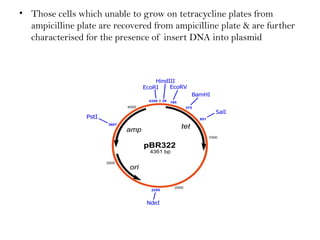
• Those cells which unable to grow on tetracycline plates from
ampicilline plate are recovered from ampicilline plate & are further
characterised for the presence of insert DNA into plasmid
DNA Ligase
• DNA ligase were first time discovered by Martz & Davis in 1972 which can
able to join two fragments of DNA either sticky or blunt
• There are two types of ligases are available from two different sources
– From E.coli
– From T4 phage ligase
JOINING OF DNA
• The process of cloning not only depends on the availability of restriction
enzymes & vector but also on our ability to join length of DNA together
covalently
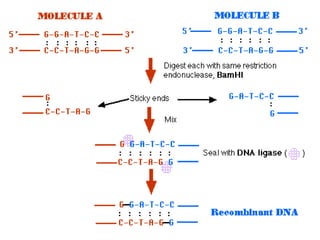
• If the DAN fragments to be joined have been cut using same REs to give
identical cohesive ends ,they will tend to stick together if they collide &
held by H bonding between complementary base pairs
• However, this association is only temporary owing to the weakness of
bonds & the small no. of bases involved
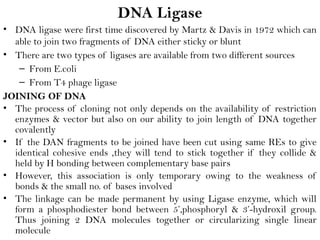
• The linkage can be made permanent by using Ligase enzyme, which will
form a phosphodiester bond between 5’,phosphoryl & 3’-hydroxil group.
Thus joining 2 DNA molecules together or circularizing single linear
molecule
• The main source of Ligase is T4 phage & the enzyme required ATP to
drive the ligation
• In order to stabilize 2 bps of cohesive end, the ligation is carried out at 4۟-
10۠ C temperature with long incubation time to allow for a low rate of
enzyme activity at this temp.
• An imp. Feature of T4 DNA Ligase is its ability to join blunt end of DNA
together, provided the conc. Of insert & enzyme are high enough
• the ligation depends on random collision of DNA having complementary
ends
• The product of mixture of DNA fragments & linear vector molecule will
include not only rVector carrying DNA insert but also,
• recircularized vector without insert
• length of DNA formed by joining of two or more fragments,
• circularized fragments by joining two or more vector molecules linked
together,etc
• By careful choice of conc. of vector & DNA insert, the formation of
plasmid containing single insert can be favoured , but unwanted product
cannot be removed or eliminated completely
• For some purpose this type of ligation is adequate especially when
subsequent step will select for recombinant product .
• However there are ways of excerting more control over the product which
can be formed,
for example,
1) If vector is treated with alkaline phosphatase after restriction, 5’phosphate
group will be removed selectively
Ligase will join 3’&5’ ends of DNA together if 5’ end is phosphorylated
& so here, upon ligation with untreated DNA fragment link can only be
formed b/n
- fragment & fragment &
- fragment & vector
Thus preventing simple recirculrization of vector & increasing the yield of
recombinant molecule
Of course, fragment-vector linkage can only be made through one strand of
DNA, but this is sufficient to hold the molecule together & the remaining
two nicks will be eventually repaired by bacterial host after trasformation
USE OF LINKERS OR ADAPTERS
• But this is not always possible, so in such a cases any incompatible
cohesive ends can be converted to blunt ends either by removing this
protruding ends by SI nucleases or by filling single stranded ends by
using DNA polymerase & all four ntd triphosphates
• Ideally both vector & insert DNA should be cut with same REs or
with a pair to generate identical protruding ends i.e. schizoisomers
• The blunt ended molecules than can be linked using T4 Ligase
• However, this is not usually done, since the resulting recombinant
molecule would probably not contain sites for restriction at the
points where links have been made & so it would be difficult to
remove the insert DNA at the point where links have been made & so
it would be difficult to recover the insert DNA from vector after
cloning
• Consequently, it is far more useful to carry out blunt ended ligation
b/n DNA fragments & linkers which are chemically synthesized
oligontds containing one or more restriction sites
• If vector contain for example, Hind III cleavage site on one
of its antibiotic resistance gene, than the DNA fragment after
conversion to blunt ended form would be ligated to linkers
containing Hind III sites
• Subsequent restriction to fragments plus linkers using Hind
III would generate molecule which could be ligated to vector
• There are so many linkers as well as adapters available
commercially so that it is now possible to overcome the
almost all problems of incompatibility b/n vector & insert
molecule.
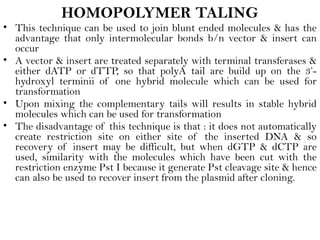
HOMOPOLYMER TALING
• This technique can be used to join blunt ended molecules & has the
advantage that only intermolecular bonds b/n vector & insert can
occur
• A vector & insert are treated separately with terminal transferases &
either dATP or dTTP, so that polyA tail are build up on the 3’-
hydroxyl terminii of one hybrid molecule which can be used for
transformation
• Upon mixing the complementary tails will results in stable hybrid
molecules which can be used for transformation
• The disadvantage of this technique is that : it does not automatically
create restriction site on either site of the inserted DNA & so
recovery of insert may be difficult, but when dGTP & dCTP are
used, similarity with the molecules which have been cut with the
restriction enzyme Pst I because it generate Pst cleavage site & hence
can also be used to recover insert from the plasmid after cloning.
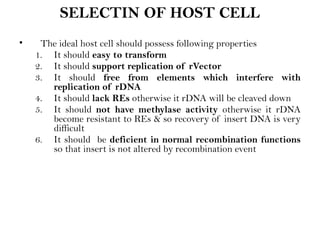
SELECTIN OF HOST CELL
• The ideal host cell should possess following properties
1. It should easy to transform
2. It should support replication of rVector
3. It should free from elements which interfere with
replication of rDNA
4. It should lack REs otherwise it rDNA will be cleaved down
5. It should not have methylase activity otherwise it rDNA
become resistant to REs & so recovery of insert DNA is very
difficult
6. It should be deficient in normal recombination functions
so that insert is not altered by recombination event
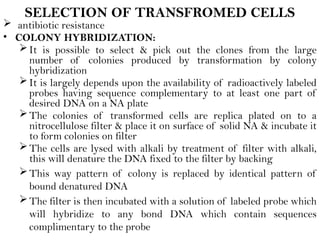
SELECTION OF TRANSFROMED CELLS
 antibiotic resistance
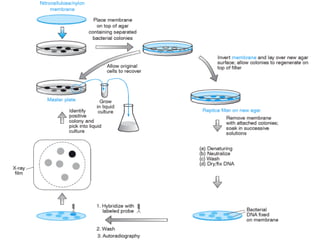
• COLONY HYBRIDIZATION:
It is possible to select & pick out the clones from the large
number of colonies produced by transformation by colony
hybridization
It is largely depends upon the availability of radioactively labeled
probes having sequence complementary to at least one part of
desired DNA on a NA plate
The colonies of transformed cells are replica plated on to a
nitrocellulose filter & place it on surface of solid NA & incubate it
to form colonies on filter
The cells are lysed with alkali by treatment of filter with alkali,
this will denature the DNA fixed to the filter by backing
This way pattern of colony is replaced by identical pattern of
bound denatured DNA
The filter is then incubated with a solution of labeled probe which
will hybridize to any bond DNA which contain sequences
complimentary to the probe
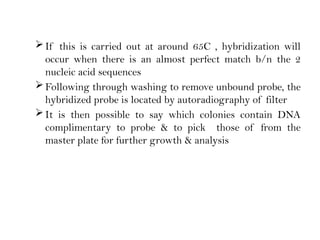
If this is carried out at around 65C , hybridization will
occur when there is an almost perfect match b/n the 2
nucleic acid sequences
Following through washing to remove unbound probe, the
hybridized probe is located by autoradiography of filter
It is then possible to say which colonies contain DNA
complimentary to probe & to pick those of from the
master plate for further growth & analysis
rDNA Technology_1238765467765321489.pptx

rDNA Technology_1238765467765321489.pptx

  • 1.
  • 2.
    rDNA Technology • RecombinantDNA (rDNA) technology : is a field of molecular biology in which scientists "edit" DNA to form new synthetic molecules, which are often referred to as "chimeras". • Recombinant DNA : is a form of artificial DNA that is engineered through the combination, insertion or replacement of one or more DNA strands, thereby combining DNA sequences that would not normally occur together HISTORY • The Recombinant DNA technique was engineered by Stanley Norman Cohen and Herbert Boyer in 1973 • They published their findings in a 1974 paper entitled "Construction of Biologically Functional Bacterial Plasmids in vitro", in which they described a technique to isolate and amplify genes or DNA segments and insert them into another cell with precision, to create a transgenic.
  • 3.
    • Recombinant DNAtechnology was made possible by the discovery of REs by Werner Arber, Daniel Nathans, and Halminton Smith, for which they received the 1978 Nobel Prize in Medicine. • Arber effectively showed geneticists how to "cut" DNA molecules; soon to follow was the understanding that ligase could be used to "glue" them together • Other milestones in the development of recombinant DNA include the collaboration between Stanley Cohen and Herbert Boyer in 1972, and the 1976 founding of Genentech, the first company to work with rDNA in its drug development labs. • In 1978 scientists were able to replicate Somatostatin, the protein that regulates human growth hormones.
  • 4.
    • GENE CLONINGis essentially the insertion of the piece of foreign DNA into cell in such a way that the inserted DNA is replicated & inherited through the generations METHOD : GENE CLONING • The Gene cloning procedure involves: 1. Isolation of Gene 2. Insertion of Gene into other piece of DNA called VECTOR 3. Transfer of rVector into suitable host 4. Selection of those cells which contain desired rVectors 5. Growth of the selected host cell (can be indefinitely) 6. Now, depending upon the application; – If the ultimate aim is to get amplification of DNA fragment, for its genetic analysis; vector containing insert DNA is recovered & DNA fragment is separated – But at present the main aim of these procedures is the expression of genes which code for the polypeptide which is either expensive or difficult to prepare.
  • 6.
    rDNA products beingused in human therapy • Many human genes have been cloned in E. coli or in yeast. • This has made it possible to produce unlimited amounts of human proteins in vitro. • Cultured cells (E. coli, yeast, mammalian cells) transformed with a human gene are being used to manufacture more than 100 products for human therapy. Some examples: • insulin for diabetics • factor VIII for males suffering from hemophilia A • factor IX for hemophilia B • human growth hormone (HGH) • erythropoietin (EPO) for treating anemia • several interleukins • granulocyte-macrophage colony-stimulating factor (GM-CSF) for stimulating the bone marrow after a bone marrow transplant • granulocyte colony-stimulating factor (G-CSF) for stimulating neutrophil production, e.g., after chemotherapy and for mobilizing hematopoietic stem cells from the bone marrow into the blood.
  • 7.
    • tissue plasminogenactivator (TPA) for dissolving blood clots • adenosine deaminase (ADA) for treating some forms of severe combined immunodeficiency (SCID) • parathyroid hormone • several monoclonal antibodies • hepatitis B surface antigen (HBsAg) to vaccinate against the hepatitis B virus • C1 inhibitor (C1INH) used to treat hereditary angioneurotic edema (HANE) • several types of interferons
  • 8.
    TOOLS IN GENECLONING • GC utilizes certain biological products & biological agents for achieving its objects, these are known as GC tools or GE tools • The basic tools of GC are: 1. Restriction endonuclease 2. DNA Ligase 3. A suitable DNA molecule capable of self replication in selected host called vector 4. A suitable organism that serves as the host for the propagation of rDNA i.e. vector containing DNA fragment to be cloned
  • 9.
    ENZYMES IN GENECLONING • The gene cloning procedure initially developed mainly because of the two enzymes: 1. Restriction endonuclease : to cut DNA at specific site. These are also known as molecular scissor. 2. Ligase : to seal the cut or nicks that remain in the rDNA molecule. It is also referred to as molecular glue. ADDITIONAL ENZYMES & DNA SEQUENCES: I. Reverse transcriptase: is used for production of cDNA copies from mRNA II. Alkaline phosphatase: for removal of 5’-phosphate from DNA III. T4 poly ntd kinase: for addition of phosphate group to an end having a free 5’-OH IV. SI nuclease: for removal of single stranded protruding ends ( both 3’ & 5’ extensions can be removed )
  • 10.
    V. The klenowfragment of E.coli DNA polymerase I: to make protruding ends double stranded by extending the shorter strands VI. Lambda exonuclease: for removal of ntds from 5’ ends ( an exonuclease removes one ntd from the end at a time from DNA, but it does not make internal cuts) VII. E.coli exonuclease III: for removal of ntds from 3’ ends VIII. Exonuclease Bal 31: for making DNA fragments with blunt ended shorter from both its ends IX. Terminal deoxynucleotidyl transferase: for addition of single stranded sequence at 3’ end to blunt ended fragments X. Linker & adapter oligo ntd sequences: for modification of cut ends of fragments I. LINKERS: used to create cohesive ends either on blunt ended DNA fragment or on fragment having unmatched or undefined sequences in their protruding ends II. ADAPTERS: are short chemically synthesized DNA double strands, which already have one or both sticky ends.
  • 11.
    RESTRICTION ENDONUCLEASE • Commonlyknown as molecular scissor Origin and function • These are of bacterial origin • Occurs naturally in bacteria as a weapon against the invading viruses as it cleaves the foreign DNA , thus Protect bacteria from bacteriophage infection as restrict virus replication • Bacterium protects it’s own DNA by methylating those specific sequence motifs • Named after the organism from which they were derived – EcoRI from Escherichia coli – BamHI from Bacillus amyloliquefaciens – HpaI from Haemophilus influenza – Sau3a from Staphyllococcus aureus • Availability: Over 200 enzymes identified, many available commercially from biotechnology companies
  • 12.
    Classes: • Type I –Cuts the DNA on both strands but at a non-specific location at varying distances from the particular sequence that is recognized by the restriction enzyme – Therefore random/imprecise cuts – Not very useful for rDNA applications • Type II – Cuts both strands of DNA within the particular sequence recognized by the restriction enzyme – The class of enzyme most widely used is type II REs which possess both endonuclease & methylation activity – It usually recognizes 4 or 6 ntd & normally cut the DNA sequences within these sequences – Note that these sequences are pelindromic having rational symmetry means reads the same in the 5’ 3’ direction on both strands
  • 13.
    – Some enzymesgenerate “blunt ends” (cut in middle) – Others generate “sticky ends” (staggered cuts) – Staggered cut will yield single stranded ends that are identical or complementary to each other – Consequently, at low temperature there is tendency for single strand to associate each other by base pairing causing a reversible linking together with fragments which have been cut by same enzyme therefore such fragments are also known as sticky or cohesive ends.
  • 16.
    ISOLATION OF DNASEQUENCE TO BE CLONED SHORT GUN APPROACH • This procedure is commonly employed when dealing with poorly characterized genome. • It is the formation of gene library in which the entire genome is cut down randomly into large pieces of about 10 kbs or more in size using partial digestion with REs & then these pieces are cloned without any attempt to select particular sequences. • Each of these fragment is linked to a vector & cloned into suitable host cell. • When bacteria containing these fragments are plated out to give rise individual colonies, each colony will contain sample of genome & there is finite chance that desired gene will be present in any one of these sample provided. • Enough colonies are produced, one can almost certain that at least one will contain desired gene. • Here, the larger the genome & smaller the average fragment size, more colonies will have to be grown to find any particular gene.
  • 17.
    • Calculation showsthat for 10 kbs of fragments, 1.5x10³ colonies are needed for E.coli genome & 2x10⁶ for Homo sapience . • In later case, number of colonies required are unmanageable & therefore much larger fragments about 40 kbs in size must be cloned, but the large fragment require special vector for cloning. • Inevitably the gene will come from only as a small part of entire genome [approximately 0.03% in case of E.coli & 0.03x10⁻³ in case of mammalian gene] so a way must be found to identify the gene & pull it out from the other part of genome either before or after cloning • This job is much easier if the corresponding mRNA will be available in the fairly pure form • If the protein for which it codes is the major product of the cell, then mRNA will already be enriched for desired species
  • 18.
    • However theprocedure used for enrichment of mRNA from the pool of gene are • Size fractionation of mRNA • In vitro translation of fractions • Precipitation of translation product with specific Abs or • To pass it from column containing oligo dT dimers which selectively forms complementation with polyA tail of mRNA & allow the mRNA to absorbed on column • Methods of obtaining mRNA is depends upon the product & is most difficult step in the cloning, particularly if the gene product is not well characterized. • After obtaining purified mRNA, it can be used to direct the synthesis of cDNA using enzyme Reverse transcriptase • This results into DNA- RNA hybrid formation • After removing RNA strand using alkali or RNase, the ssDNA can act as a template for the synthesis of second strand of cDNA using DNA polymerase enzyme • This results in to dsDNA molecule
  • 19.
    • To obtainexpression of cloned gene, it is necessary to understand the genetic organization of prokaryotes & eukaryotes. • In eukaryotes, the coding regions of genes (exons) are generally broken by non-coding regions (introns) • From the primary transcript from the nuclear gene the introns must be removed i.e. RNA processing to form mature translatable mRNA • The RNA processing step cannot be carried out by prokaryotes so that a correct translation of cloned genes of eukaryotes is not possible • Therefore, when bacteria are used as cloning hosts it is preferable to use synthetic DNA or complementary DNA
  • 20.
    Synthetic DNA • Nucleicacid chemistry has advanced so rapidly that it is now a routine process in many laboratory to synthesize a long DNA molecule of any desired ntd sequence • In order to produce a specific DNA fragment containing coding region of protein, the DNA sequence is deduced by “reverse translation“ from the sequence of this protein using an automated DNA synthesis machine • This machine will carry out each & every steps automatically • It requires the supply of the reagents & type sequence of ntd to be produced • Consequently, if amino acid sequence of polypeptide is known, than it may be easier to synthesize a gene & isolate the sequence similar to natural gene. • Using such approach it is possible to produce DNA fragment of 20- 100 bases, which can be connected together to make large synthesis • Since the DNA synthesis procedure is completely under the control of the investigator ,it is also possible to produce sequences in which one or more bases have been changed making possible the production of highly specific mutations.
  • 21.
    • Examples ofthis technique are: • The artificial synthesis of the gene for stomatostatin, a peptide hormone with 14 aa & • the synthesis of the A&B chains of insulin, which were cloned &expressed in E.coli. • PRODUCTION OF COMPLEMENTARY DNA • Specific mRNA molecules isolated from mRNA rich cells or tissues are used as templates in vitro with the enzyme Reverse Transcriptase, produce cDNA . • An example of the use of this method for cloning insulin gene from rats in Ecoli.
  • 22.
    HYBRIDIZATION METHOD • Thismethod depends on the principle that mRNA forms complex with cDNA segment from which it has been transcribed • This method is possible if protein encoding genes do not have introns • First the total DNA from organism is isolated, than this dsDNA is treated with alkali or heat & converted into ssDNA by denaturation • This strands are mixed with the mRNA transcribed by that genes. • this complex is isolated & DNA is separated from RNA by RNase treatment • the ssDNA thus obtained is converted into dsDNA by using DNA pol I enzyme • this method is most suitable for isolating genes which exist in multiple copies • mRNA pairs with cDNA protein to form DNA-RNA complex [hybrid] • for ex: ribosomal genes
  • 23.
    VECTORS • A vectoris a DNA molecule that has ability to replicate in appropriate host cell & into which the DNA fragment could be cloned is integrated for cloning & therefore a vector must have an origin of replication that amplify the fragment DNA incorporate into the host cell • The choice of a vector depends on the design of the experimental system and how the cloned gene will be screened or utilized subsequently. • There are two types of vectors I. Cloning vectors : All vectors used for propagation of DNA insert into suitable host are called cloning vectors II. Expression vector: when vector is designed for the expression i.e. production of proteins specified by DNA insert than it is termed as expression vector. Such vector contain control elements like promoter, operator, ribosomal binding sites ,etc.
  • 24.
    • An idealvector contain following properties 1. It should able to replicate autonomously when the objective of cloning is to obtain multiple copies of insert DNA fragment & the replication must be under relaxed condition, so that it can generate multiple copies of itself within the host cell 2. Vector DNA should be ideally of less than 10kbs in size because larger DNA molecules are broken down during purification procedure & also large vector present difficulties during various manipulation required for gene manipulation 3. It should be easy to isolate & purify means crude techniques of isolation should be applied 4. It should be easily introduced into host cell 5. It should have suitable marker gene that allows easy detection &/or selection of transformed host cells 6. If the objective is DNA transfer than it should able to integrate DNA insert it carries into genome of host cell along with itself 7. Vector should contain unique target side for as many as REs possible into which the DNA insert can be integrated without disrupting the essential function
  • 25.
    8. The cellstransformed with such vector molecule that contain DNA insert i.e. rVector should be identifiable or selectable from those transformed by only vector molecule 9. When expression of DNA insert is desired, the vector should at least contain suitable control elements • As all the above properties cannot be served by a single vector in nature, it is required to create useful vector by joining together segments performing specific function from two or more natural entities i.e. naturally available vectors
  • 26.
    Requirements of avector to serve as a carrier molecule • Most vectors contain a prokaryotic origin of replication allowing maintenance in bacterial cells. • Some vectors contain an additional eukaryotic origin of replication allowing autonomous, episomal replication in eukaryotic cells. • Multiple unique cloning sites are often included for versatility and easier library construction. • Antibiotic resistance genes and/or other selectable markers enable identification of cells that have acquired the vector construct. • Some vectors contain inducible or tissue-specific promoters permitting controlled expression of introduced genes in transfected cells or transgenic animals. • Modern vectors contain multi-functional elements designed to permit a combination of cloning, DNA sequencing, in vitro mutagenesis and transcription and episomal replication
  • 27.
    Main types ofvectors • Plasmid: an extrachromosomal circular DNA molecule that autonomously replicates inside the bacterial cell; cloning limit: 100 to 10,000 base pairs or 0.1-10 kilobases (kb) • Bacteriophage: derivatives of bacteriophage lambda; linear DNA molecules, whose region can be replaced with foreign DNA without disrupting its life cycle; cloning limit: 8-20 kb • Cosmid: an extrachromosomal circular DNA molecule that combines features of plasmids and phage; cloning limit - 35-50 kb • Bacterial artificial chromosome (BAC): based on bacterial mini-F plasmids. cloning limit: 75-300 kb • Yeast artificial chromosome (YAC): an artificial chromosome that contains telomeres, origin of replication, a yeast centromere, and a selectable marker for identification in yeast cells; cloning limit: 100- 1000 kb • yeast 2 micron plasmid, • retrovirus, • baculovirus vector…….
  • 28.
    CHOICE OF VECTOR Dependson : Nature of protocol or experiment Type of host cell to accommodate rDNA – Prokaryotic – Eukaryotic
  • 29.
    Plasmid vector • Covalentlyclosed, circular, double stranded DNA molecules that occur naturally and replicate extrachromosomally in bacteria • Plasmid can be considered as a suitable vector if it possess following properties: 1. It should be easily isolated from the cell 2. It should possess a single RE recognition site for one or more REs 3. Insertion of linear molecule at one of these sites should not alter its replication properties 4. It should have marker genes which allows easy detection & selection of transformed cells as rVector containing transformed cells 5. It should be reintroduced into bacterial cell carrying plasmid with or without insert
  • 30.
    pBR322 • It isone of the most widely used vector & constructed by excising parts of naturally occurring plasmid using REs & rejoining them in a correct orientation & a series of manipulation which make it simple to use • It is named after the scientist who discover this are BOLIVER & RODRIGNE • The desirable features offered by resulting plasmid for cloning includes: 1. Origin of replication • It has been derived from naturally occurring plasmid col E1 • The origin is particularly more useful because it is relaxed i.e. its replication is not linked to any part of chromosomal DNA &hence initiation of plasmid replication is more frequent than that of main chromosomal DNA • Consequently multiple copies are accumulate within the cell so the process can be continued still further
  • 31.
    2. 20 REsrecognition sites • this plasmid has 20 REs recognition sites so that any of the 20 enzymes can make cut in circular plasmid generating a single linear molecule to which the DNA fragment for cloning can easily attach • Then this molecule can be reclosed to generate slightly enlarged circular plasmid 2. Ampicilline & tetracycline resistance gene • This gene of plasmid allows great flexibility in approach to selecting recombinant molecule
  • 32.
    Selection of cellscontaining recombinant or non recombinant vector • The presence of plasmid in a bacterium will confer resistance to antibiotic & such cells can be selected by growth on the medium containing either ampicilline or tetracycline Insertion inactivation phenomenon • Some of the restriction sites are situated on the antibiotic resistance gene & so the insertion of the foreign DNA will lead to inactivation of the that gene • For example : If the restriction recognition site/ insertion site is BamH1 that is present on the tetracycline resistance gene so the gene will be destroyed & the recombinant plasmid will allow cell to grow in presence of ampicilline but cannot protect the cell against tetracycline • Screening for transformer containing vectors – After transformation all the cells are allowed to grow on the medium containing ampicilline – All the cell containing vectors / transformers are able to grow on ampicilline so colony appears on the ampicilline plate are of the host cell which has received plasmid or rPlasmid – So to distinguish rPlasmid perform replica transfer of colonies from ampicilline plate to tetracycline plate
  • 33.
    • Those cellswhich unable to grow on tetracycline plates from ampicilline plate are recovered from ampicilline plate & are further characterised for the presence of insert DNA into plasmid
  • 34.
    DNA Ligase • DNAligase were first time discovered by Martz & Davis in 1972 which can able to join two fragments of DNA either sticky or blunt • There are two types of ligases are available from two different sources – From E.coli – From T4 phage ligase JOINING OF DNA • The process of cloning not only depends on the availability of restriction enzymes & vector but also on our ability to join length of DNA together covalently • If the DAN fragments to be joined have been cut using same REs to give identical cohesive ends ,they will tend to stick together if they collide & held by H bonding between complementary base pairs • However, this association is only temporary owing to the weakness of bonds & the small no. of bases involved • The linkage can be made permanent by using Ligase enzyme, which will form a phosphodiester bond between 5’,phosphoryl & 3’-hydroxil group. Thus joining 2 DNA molecules together or circularizing single linear molecule
  • 35.
    • The mainsource of Ligase is T4 phage & the enzyme required ATP to drive the ligation • In order to stabilize 2 bps of cohesive end, the ligation is carried out at 4۟- 10۠ C temperature with long incubation time to allow for a low rate of enzyme activity at this temp. • An imp. Feature of T4 DNA Ligase is its ability to join blunt end of DNA together, provided the conc. Of insert & enzyme are high enough • the ligation depends on random collision of DNA having complementary ends • The product of mixture of DNA fragments & linear vector molecule will include not only rVector carrying DNA insert but also, • recircularized vector without insert • length of DNA formed by joining of two or more fragments, • circularized fragments by joining two or more vector molecules linked together,etc • By careful choice of conc. of vector & DNA insert, the formation of plasmid containing single insert can be favoured , but unwanted product cannot be removed or eliminated completely • For some purpose this type of ligation is adequate especially when subsequent step will select for recombinant product .
  • 36.
    • However thereare ways of excerting more control over the product which can be formed, for example, 1) If vector is treated with alkaline phosphatase after restriction, 5’phosphate group will be removed selectively Ligase will join 3’&5’ ends of DNA together if 5’ end is phosphorylated & so here, upon ligation with untreated DNA fragment link can only be formed b/n - fragment & fragment & - fragment & vector Thus preventing simple recirculrization of vector & increasing the yield of recombinant molecule Of course, fragment-vector linkage can only be made through one strand of DNA, but this is sufficient to hold the molecule together & the remaining two nicks will be eventually repaired by bacterial host after trasformation
  • 37.
    USE OF LINKERSOR ADAPTERS • But this is not always possible, so in such a cases any incompatible cohesive ends can be converted to blunt ends either by removing this protruding ends by SI nucleases or by filling single stranded ends by using DNA polymerase & all four ntd triphosphates • Ideally both vector & insert DNA should be cut with same REs or with a pair to generate identical protruding ends i.e. schizoisomers • The blunt ended molecules than can be linked using T4 Ligase • However, this is not usually done, since the resulting recombinant molecule would probably not contain sites for restriction at the points where links have been made & so it would be difficult to remove the insert DNA at the point where links have been made & so it would be difficult to recover the insert DNA from vector after cloning • Consequently, it is far more useful to carry out blunt ended ligation b/n DNA fragments & linkers which are chemically synthesized oligontds containing one or more restriction sites
  • 38.
    • If vectorcontain for example, Hind III cleavage site on one of its antibiotic resistance gene, than the DNA fragment after conversion to blunt ended form would be ligated to linkers containing Hind III sites • Subsequent restriction to fragments plus linkers using Hind III would generate molecule which could be ligated to vector • There are so many linkers as well as adapters available commercially so that it is now possible to overcome the almost all problems of incompatibility b/n vector & insert molecule.
  • 39.
    HOMOPOLYMER TALING • Thistechnique can be used to join blunt ended molecules & has the advantage that only intermolecular bonds b/n vector & insert can occur • A vector & insert are treated separately with terminal transferases & either dATP or dTTP, so that polyA tail are build up on the 3’- hydroxyl terminii of one hybrid molecule which can be used for transformation • Upon mixing the complementary tails will results in stable hybrid molecules which can be used for transformation • The disadvantage of this technique is that : it does not automatically create restriction site on either site of the inserted DNA & so recovery of insert may be difficult, but when dGTP & dCTP are used, similarity with the molecules which have been cut with the restriction enzyme Pst I because it generate Pst cleavage site & hence can also be used to recover insert from the plasmid after cloning.
  • 40.
    SELECTIN OF HOSTCELL • The ideal host cell should possess following properties 1. It should easy to transform 2. It should support replication of rVector 3. It should free from elements which interfere with replication of rDNA 4. It should lack REs otherwise it rDNA will be cleaved down 5. It should not have methylase activity otherwise it rDNA become resistant to REs & so recovery of insert DNA is very difficult 6. It should be deficient in normal recombination functions so that insert is not altered by recombination event
  • 41.
    SELECTION OF TRANSFROMEDCELLS  antibiotic resistance • COLONY HYBRIDIZATION: It is possible to select & pick out the clones from the large number of colonies produced by transformation by colony hybridization It is largely depends upon the availability of radioactively labeled probes having sequence complementary to at least one part of desired DNA on a NA plate The colonies of transformed cells are replica plated on to a nitrocellulose filter & place it on surface of solid NA & incubate it to form colonies on filter The cells are lysed with alkali by treatment of filter with alkali, this will denature the DNA fixed to the filter by backing This way pattern of colony is replaced by identical pattern of bound denatured DNA The filter is then incubated with a solution of labeled probe which will hybridize to any bond DNA which contain sequences complimentary to the probe
  • 42.
    If this iscarried out at around 65C , hybridization will occur when there is an almost perfect match b/n the 2 nucleic acid sequences Following through washing to remove unbound probe, the hybridized probe is located by autoradiography of filter It is then possible to say which colonies contain DNA complimentary to probe & to pick those of from the master plate for further growth & analysis