Introduction to Corporate Finance Options Prepared by Ying Pan Tong Niu Charlie Giurleo I.Murat Coskun
Introduction Basic concept - History - Current markets & Regulator - Characteristics & Terminology Types of Options - Call options - Put options Valuation - Payoff method - Binomial tree method Strategies - Bullish strategy - Bearish strategy - Neutral strategy Q&A & REWARDS! Options
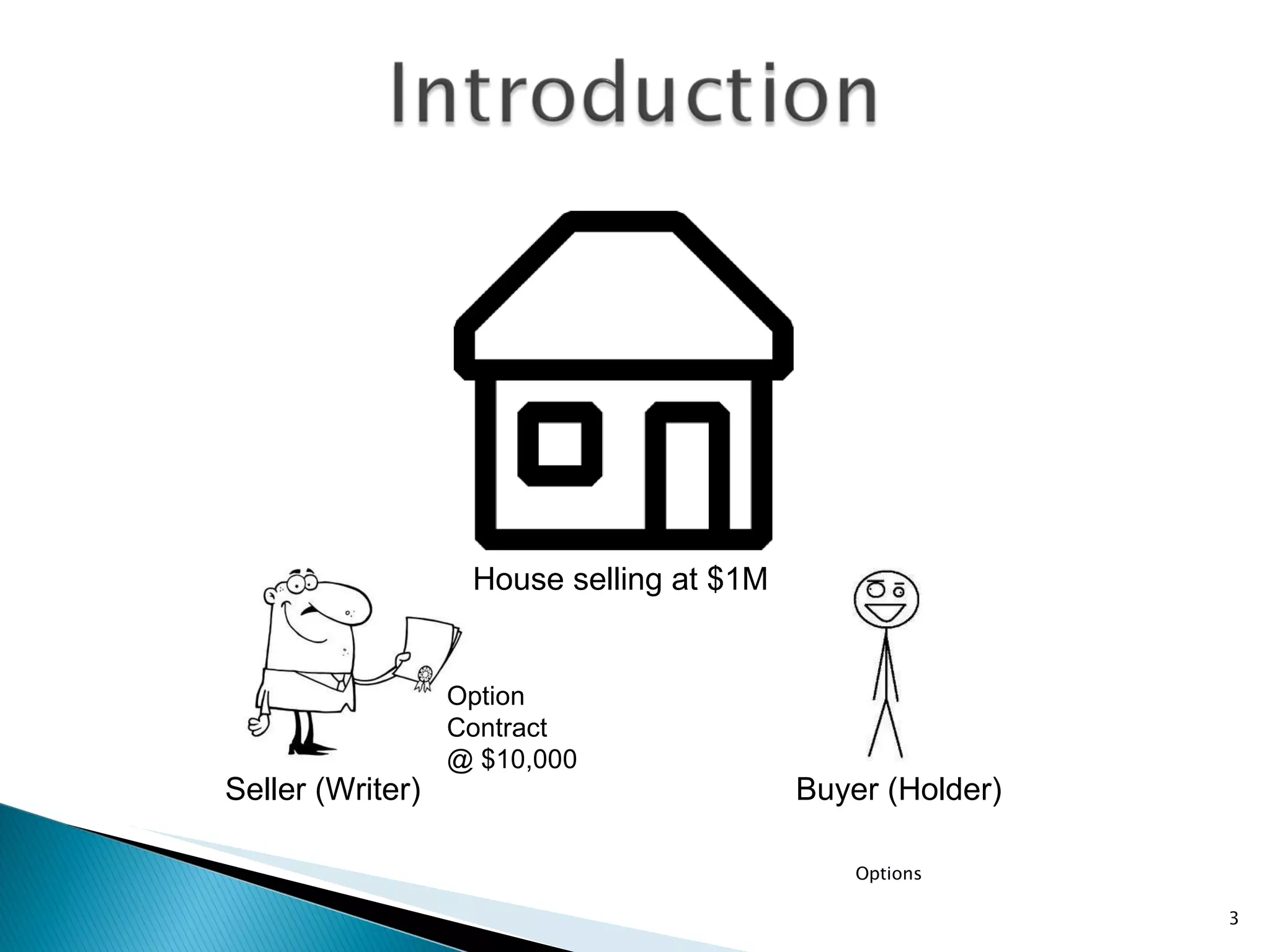
Options House selling at $1M Option  Contract @ $10,000 Seller (Writer) Buyer (Holder)
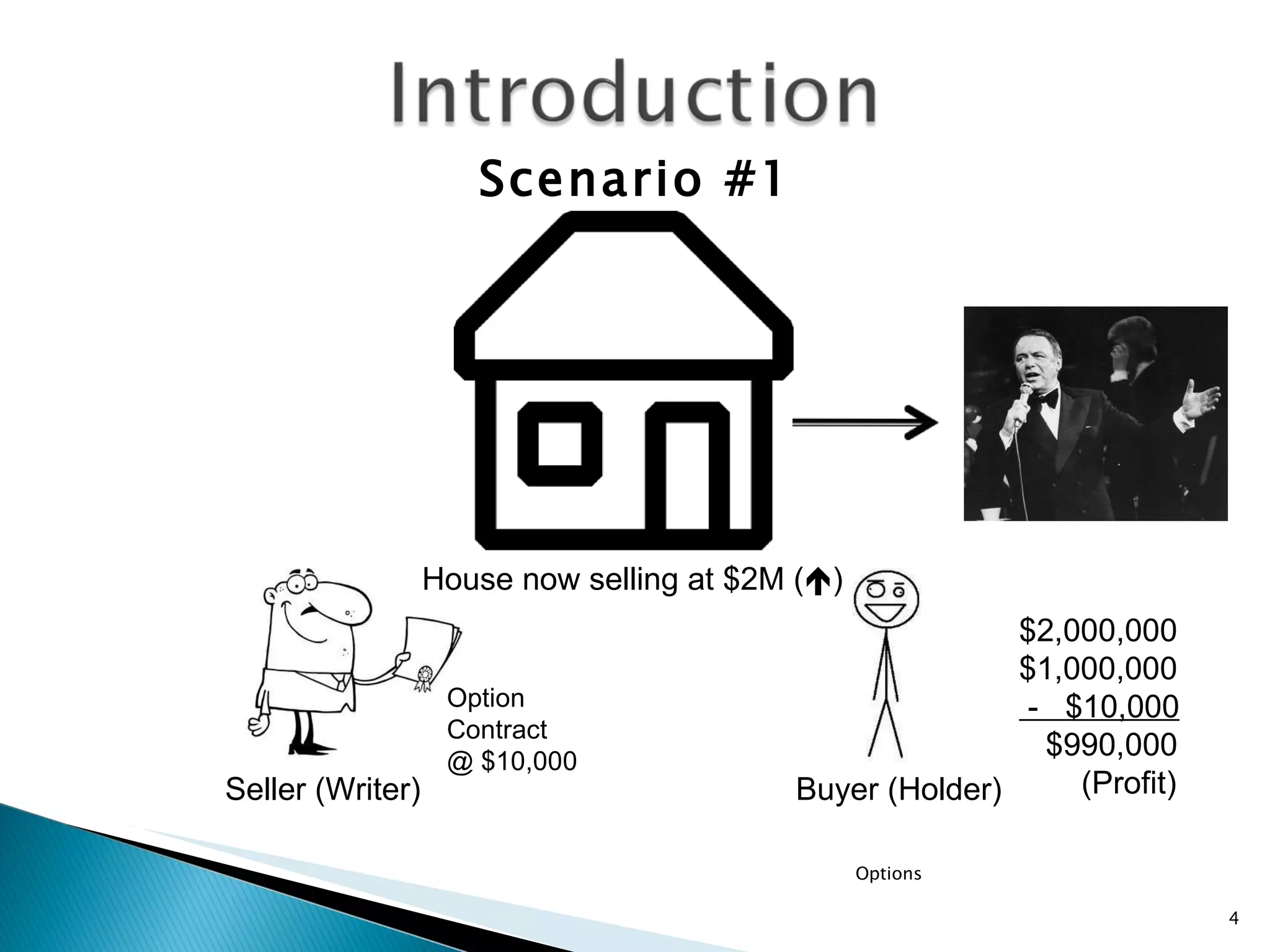
Options House now selling at $2M (  ) Seller (Writer) Buyer (Holder) Scenario #1 Option  Contract @ $10,000 $2,000,000 $1,000,000 -  $10,000 $990,000 (Profit)
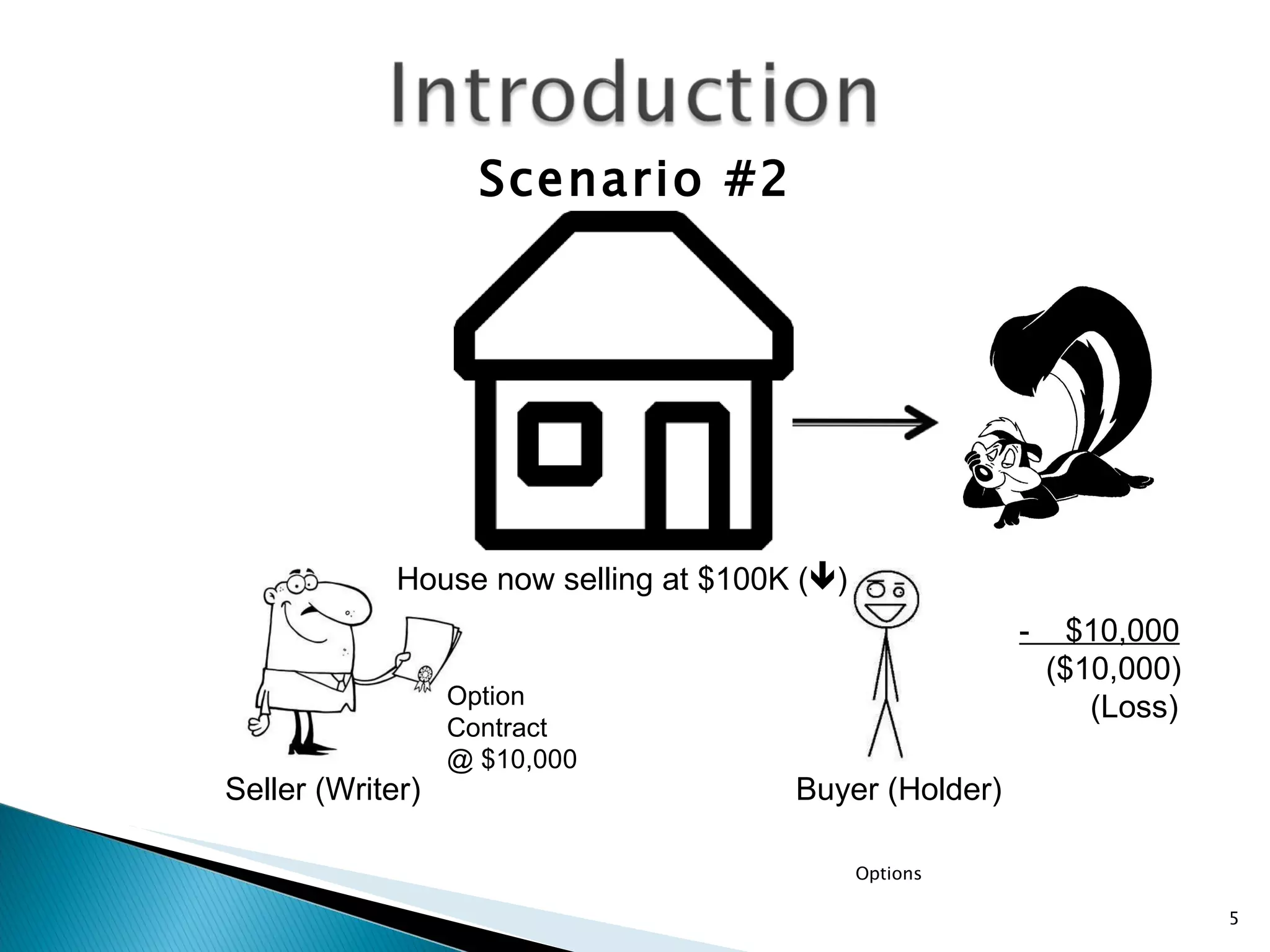
Options House now selling at $100K (  ) Seller (Writer) Buyer (Holder) Scenario #2 Option  Contract @ $10,000 -  $10,000 ($10,000) (Loss)
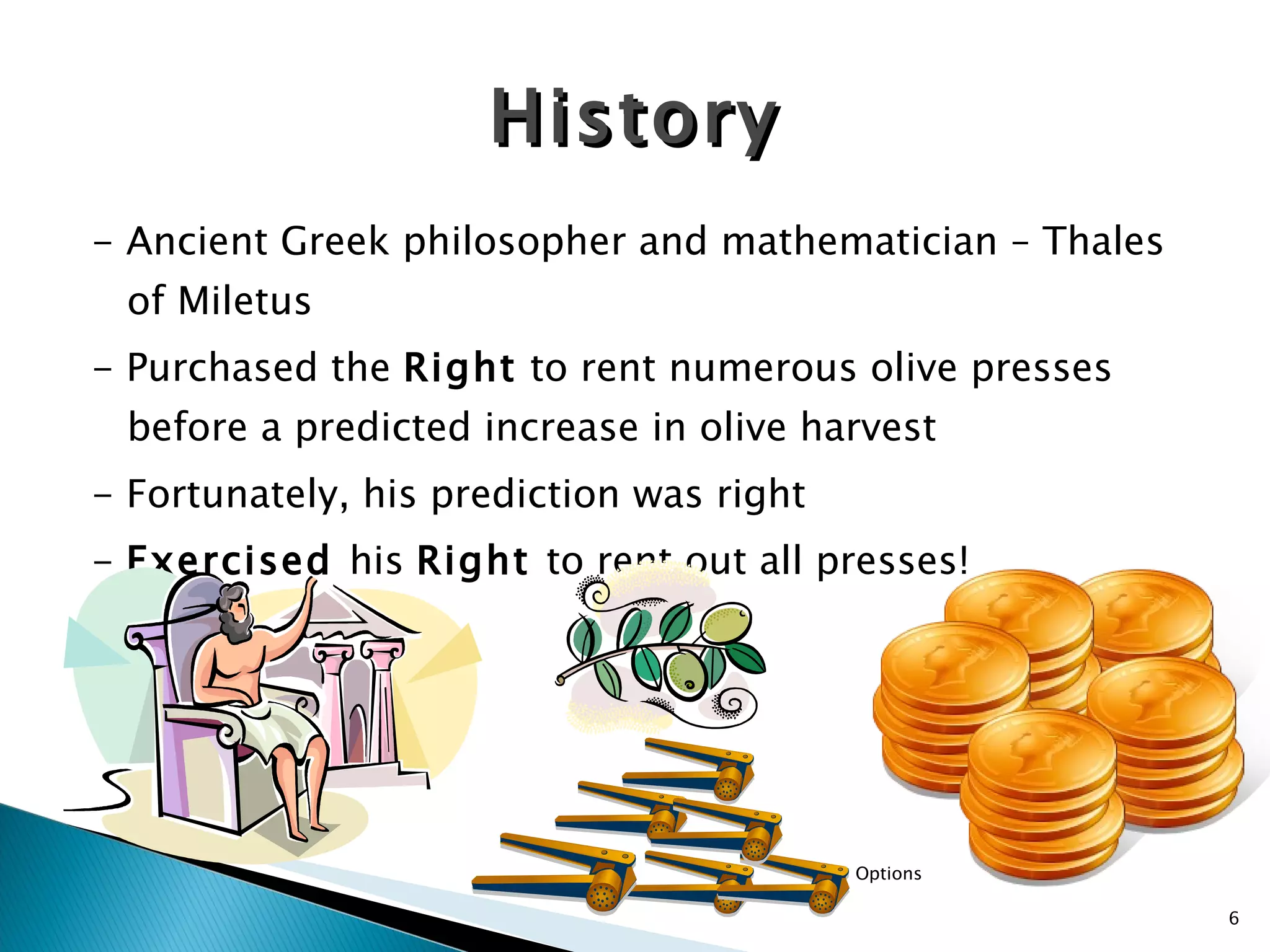
- Ancient Greek philosopher and mathematician – Thales of Miletus - Purchased the  Right  to rent numerous olive presses before a predicted increase in olive harvest - Fortunately, his prediction was right -  Exercised  his  Right  to rent out all presses! History Options
Major markets over the world: Current Markets & Regulator  In Canada, options are traded on the Montreal Exchange  and are cleared through the Canadian Derivatives Clearing Corp(CDCC) The CDCC stands between option buyers and option sellers (writers). Options
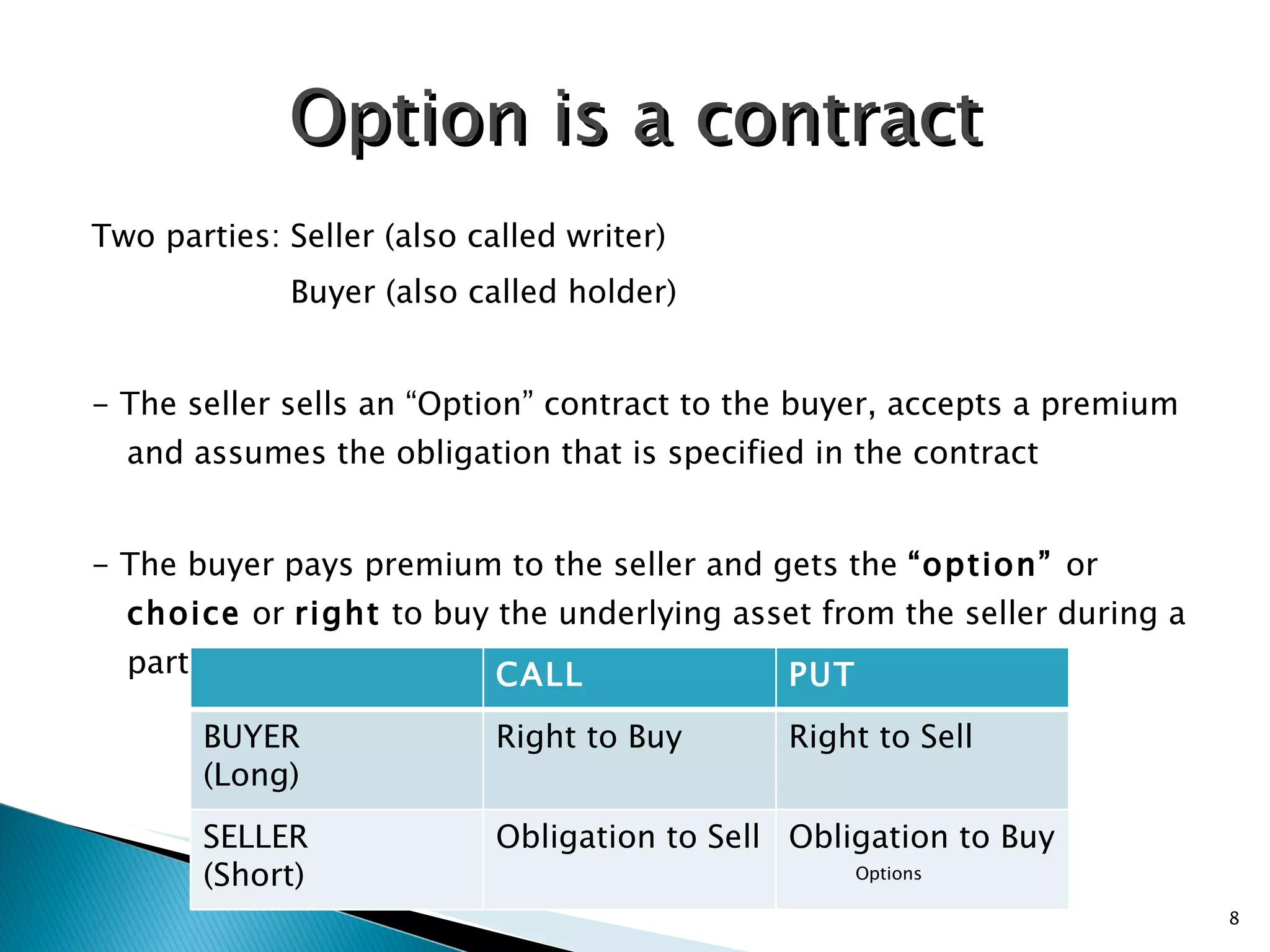
Two parties: Seller (also called writer) Buyer (also called holder) - The seller sells an  “Option” contract to the buyer, accepts a premium and assumes the obligation that is specified in the contract - The buyer pays premium to the seller and gets the  “option”  or  choice  or  right  to buy the underlying asset from the seller during a particular period of time  Option is a contract Options CALL PUT BUYER (Long) Right to Buy Right to Sell SELLER (Short) Obligation to Sell Obligation to Buy
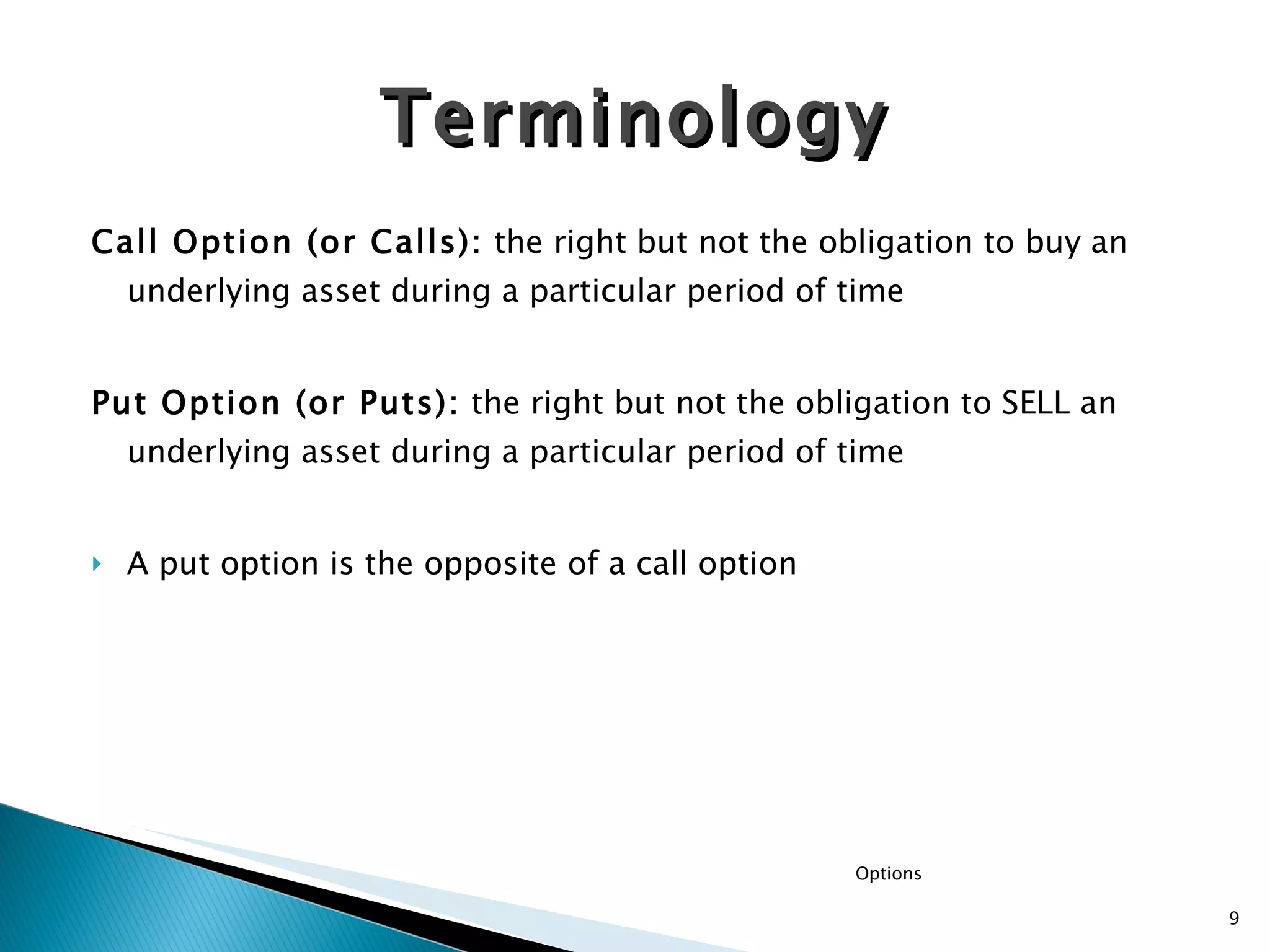
Call Option (or Calls) :  the right but not the obligation to buy an underlying asset during a particular period of time Put Option (or Puts):  the right but not the obligation to SELL an underlying asset during a particular period of time A put option is the opposite of a call option Terminology Options
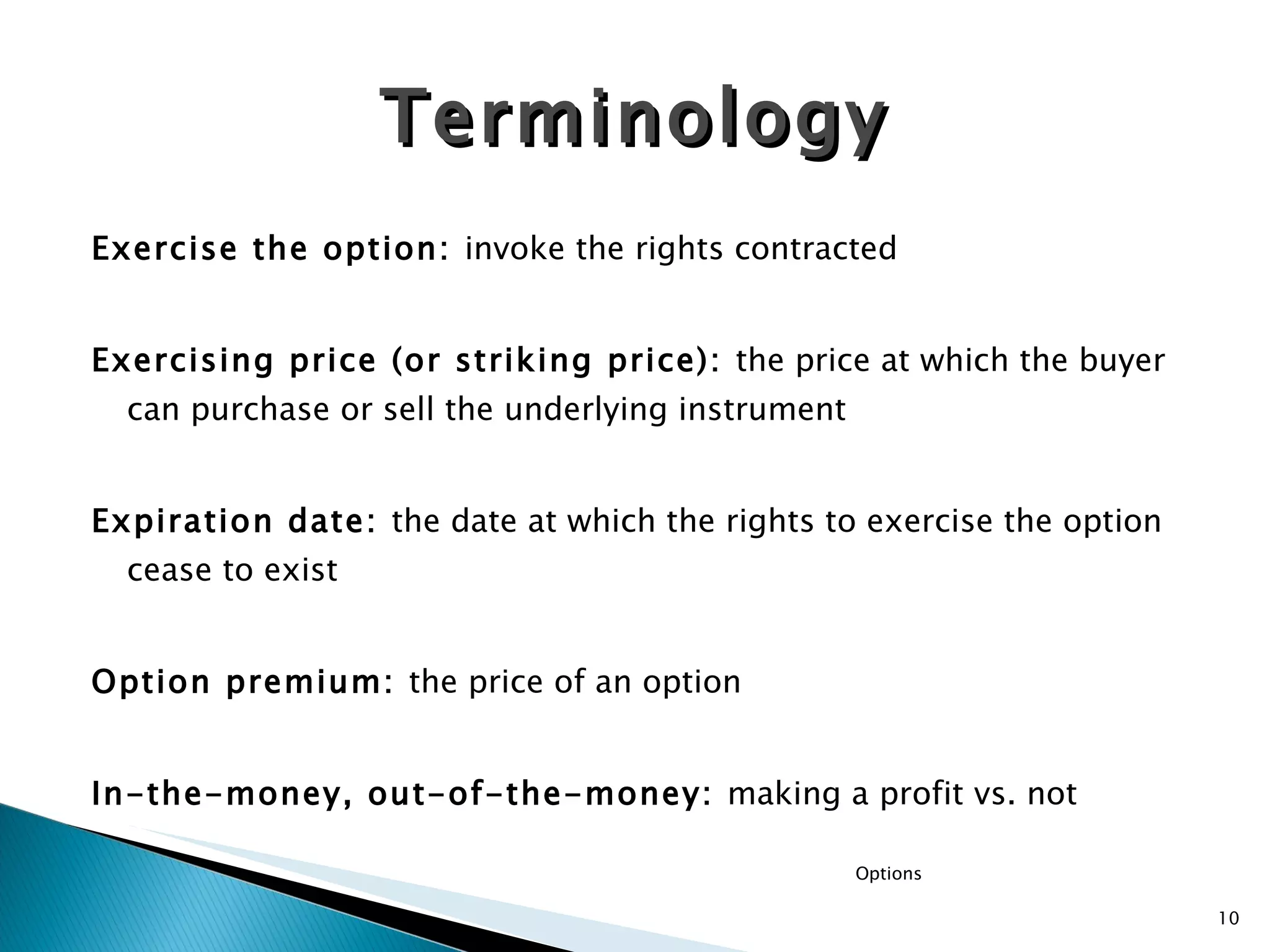
Exercise the option:  invoke the rights contracted Exercising price (or striking price):  the price at which the buyer can purchase or sell the underlying instrument Expiration date:  the date at which the rights to exercise the option cease to exist Option premium:  the price of an option In-the-money, out-of-the-money:  making a profit vs. not Terminology Options
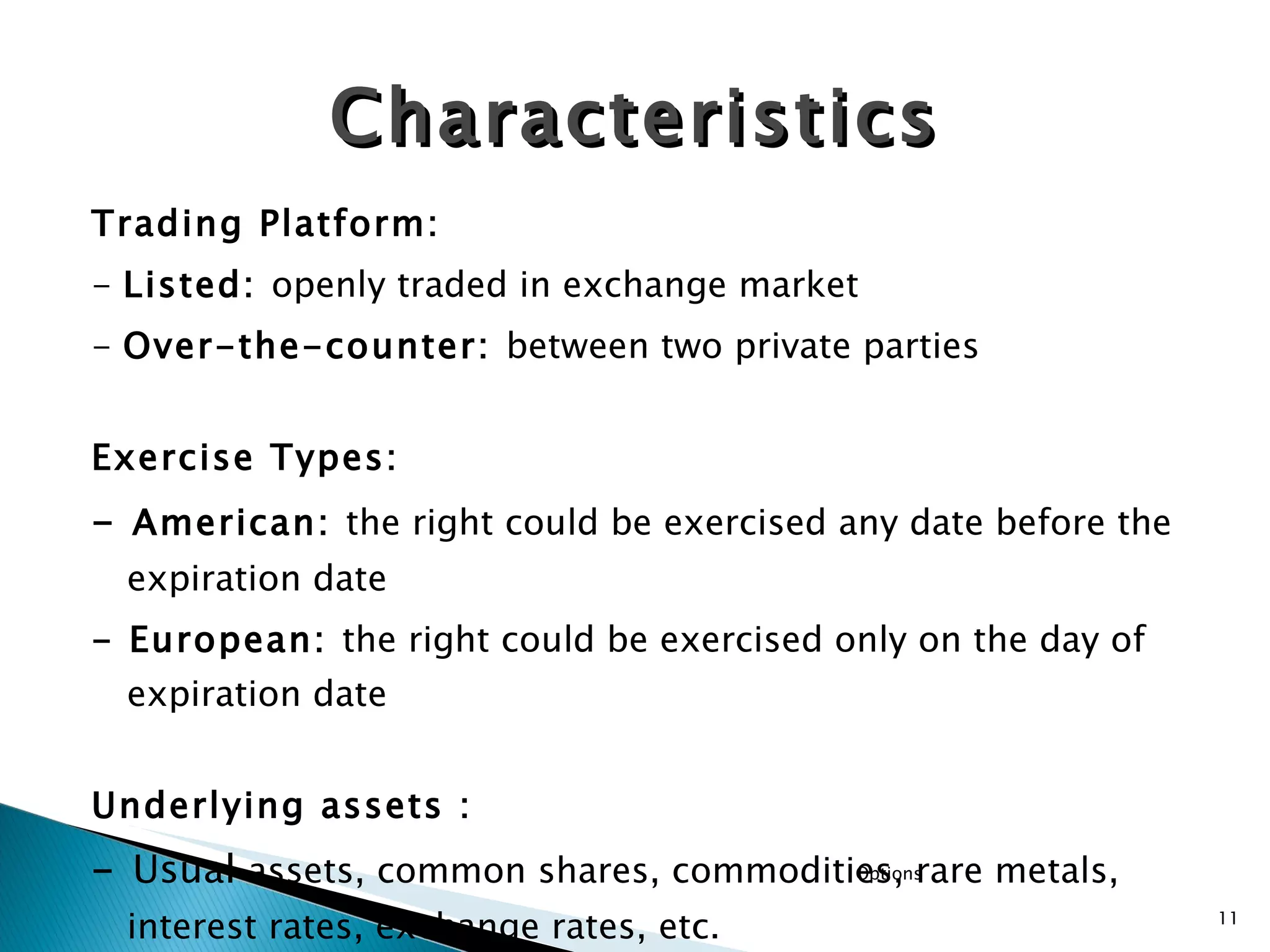
Trading Platform: -  Listed:  openly traded in exchange market -  Over-the-counter:  between two private parties Exercise Types: -  American:  the right could be exercised any date before the expiration date - European:  the right could be exercised only on the day of expiration date Underlying assets : -  Usual  assets, common shares, commodities, rare metals, interest rates, exchange rates, etc. Characteristics Options
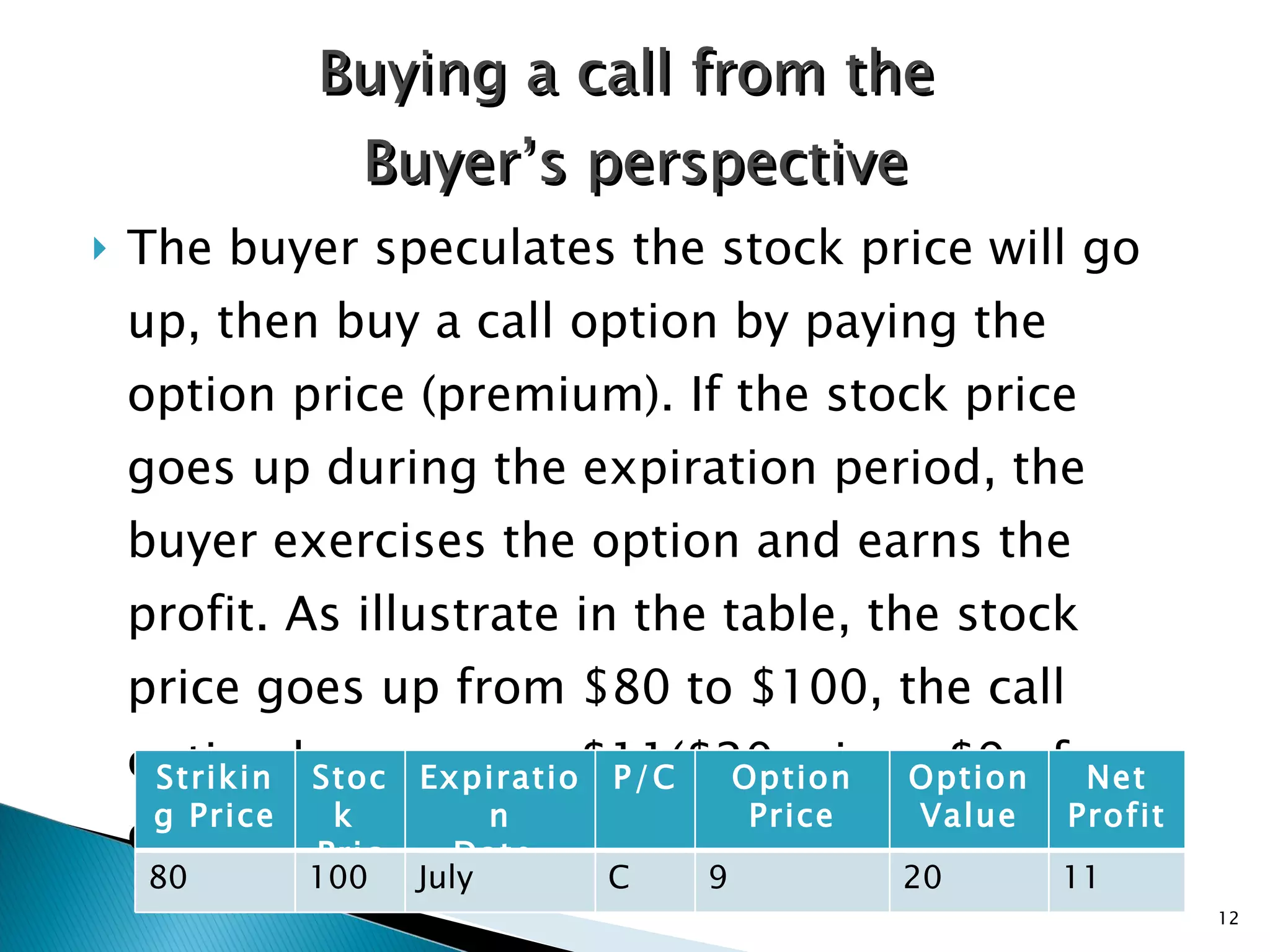
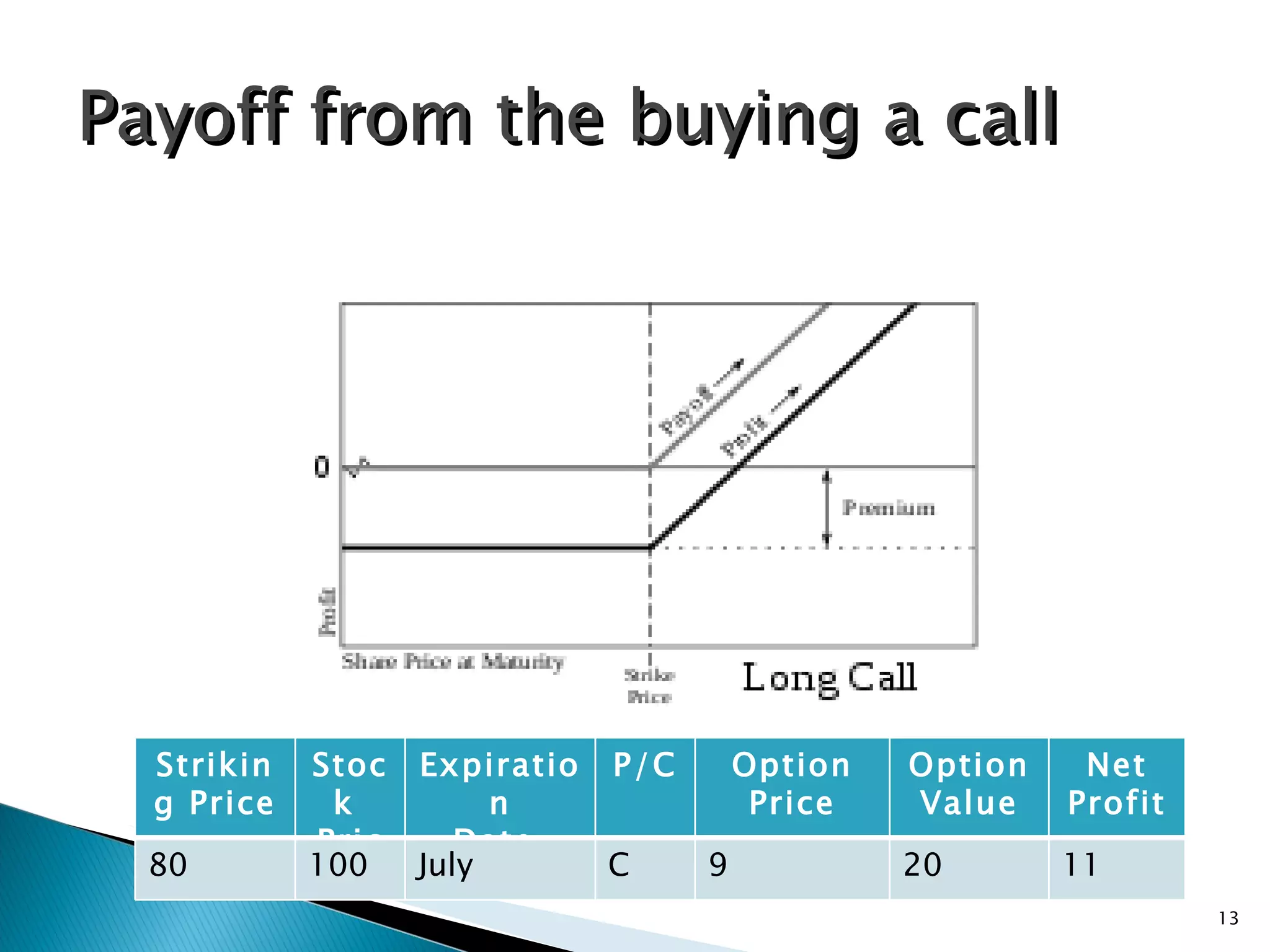
The buyer speculates the stock price will go up, then buy a call option by paying the option price (premium). If the stock price goes up during the expiration period, the buyer exercises the option and earns the profit. As illustrate in the table, the stock price goes up from $80 to $100, the call option buyer earns $11($20 minus $9 of option price ).  Buying a call from the  Buyer’s perspective Options Striking Price Stock  Price Expiration Date  P /C Option Price Option Value Net Profit 80 100 July C 9 20 11
Payoff from the buying a call Options Striking Price Stock  Price Expiration Date  P /C Option Price Option Value Net Profit 80 100 July C 9 20 11
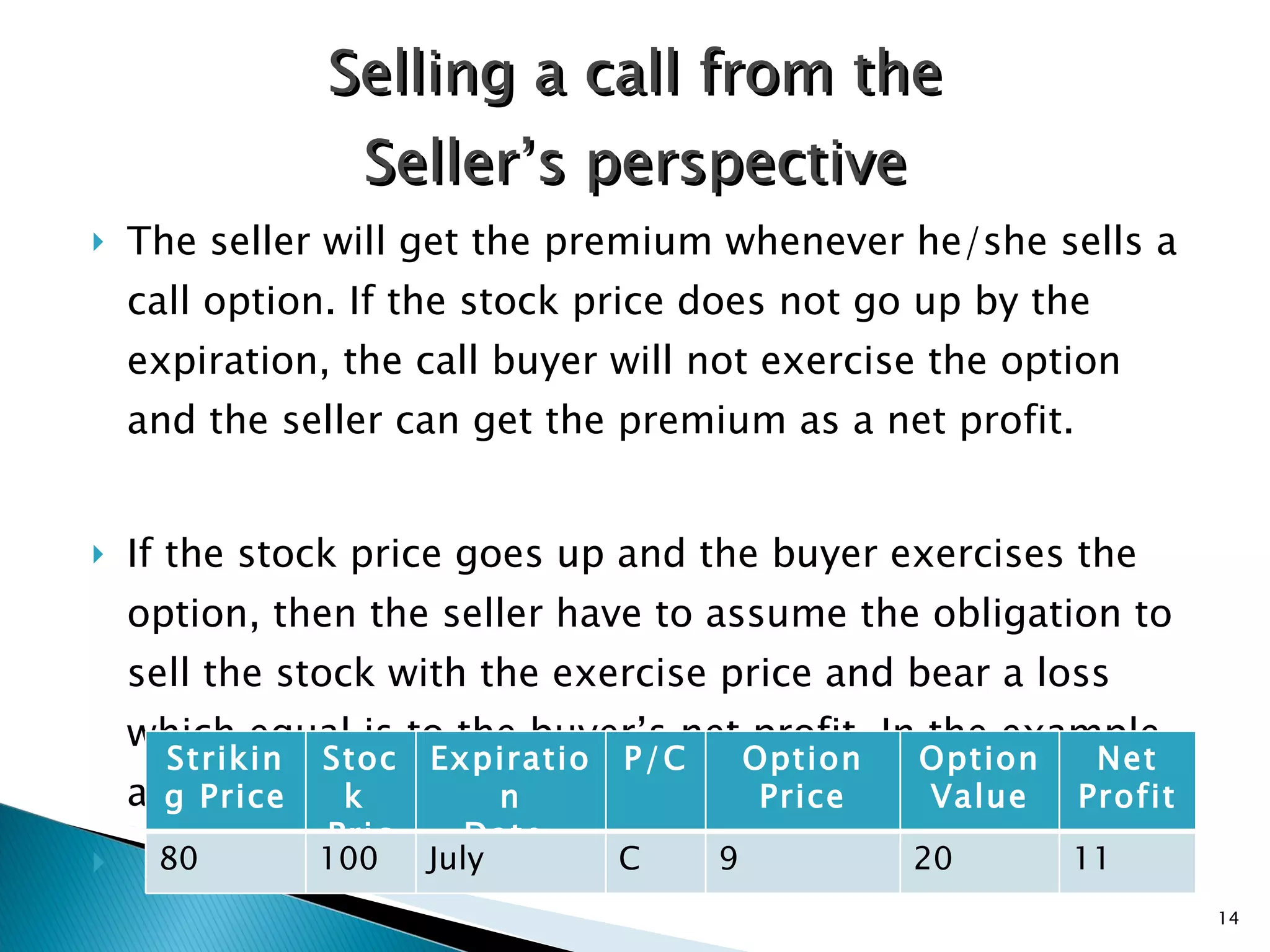
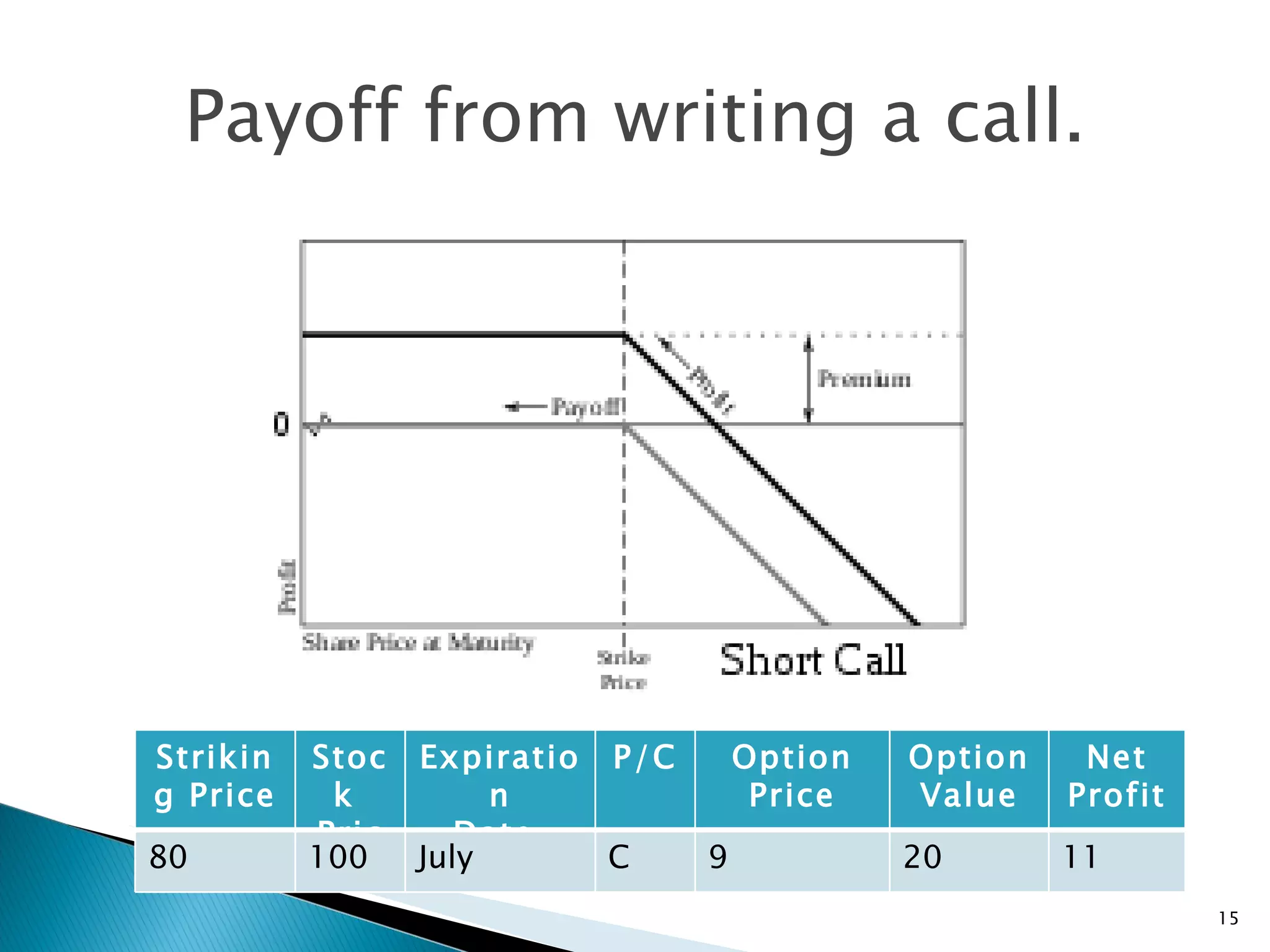
The seller will get the premium whenever he/she sells a call option. If the stock price does not go up by the expiration, the call buyer will not exercise the option and the seller can get the premium as a net profit.  If the stock price goes up and the buyer exercises the option, then the seller have to assume the obligation to sell the stock with the exercise price and bear a loss which equal is to the buyer’s net profit. In the example above, $11 is seller’s net loss and buyer’s net profit  Selling a call from the Seller’s perspective Options Striking Price Stock  Price Expiration Date  P /C Option Price Option Value Net Profit 80 100 July C 9 20 11
Payoff from writing a call. Options Striking Price Stock  Price Expiration Date  P /C Option Price Option Value Net Profit 80 100 July C 9 20 11
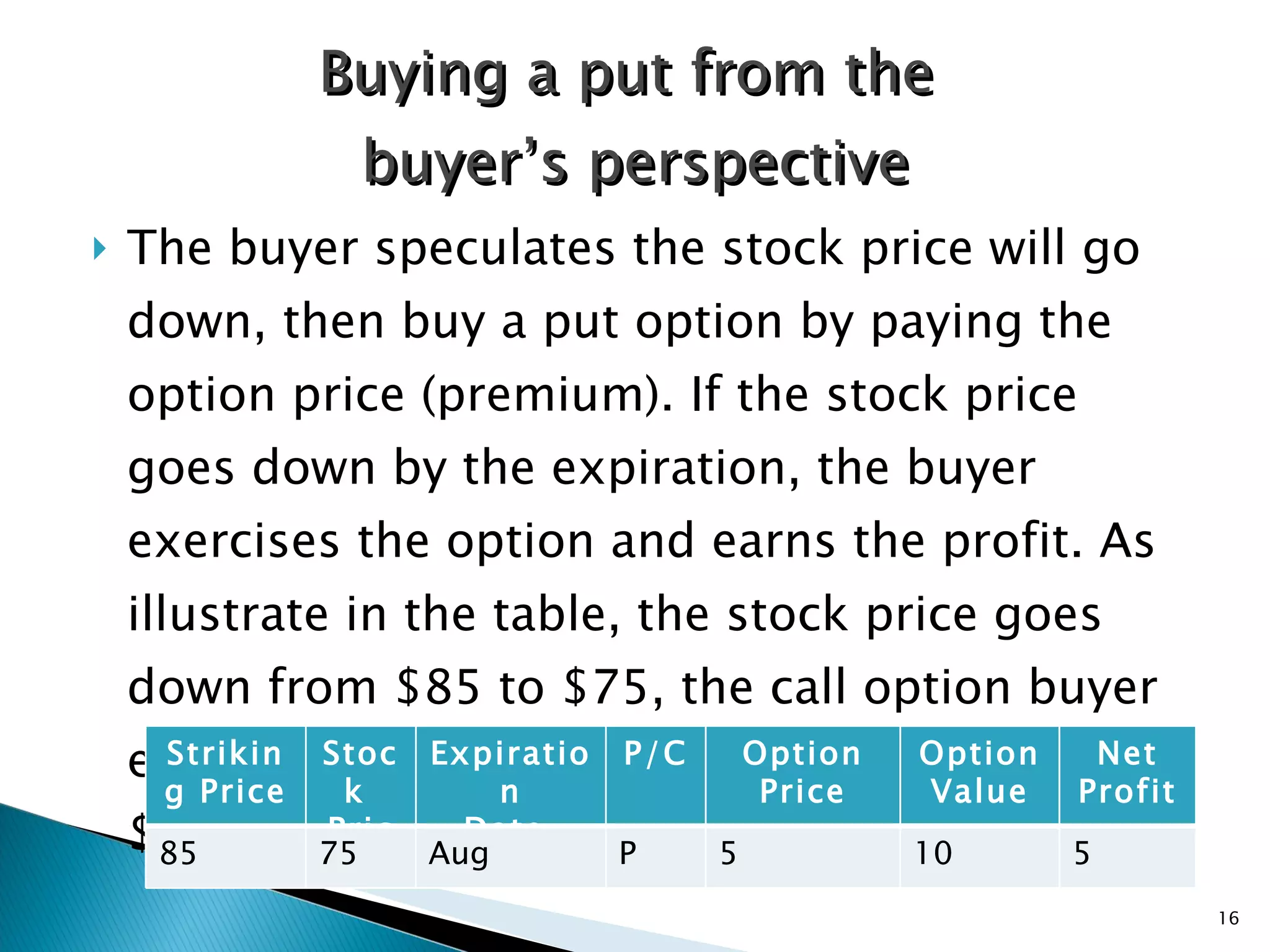
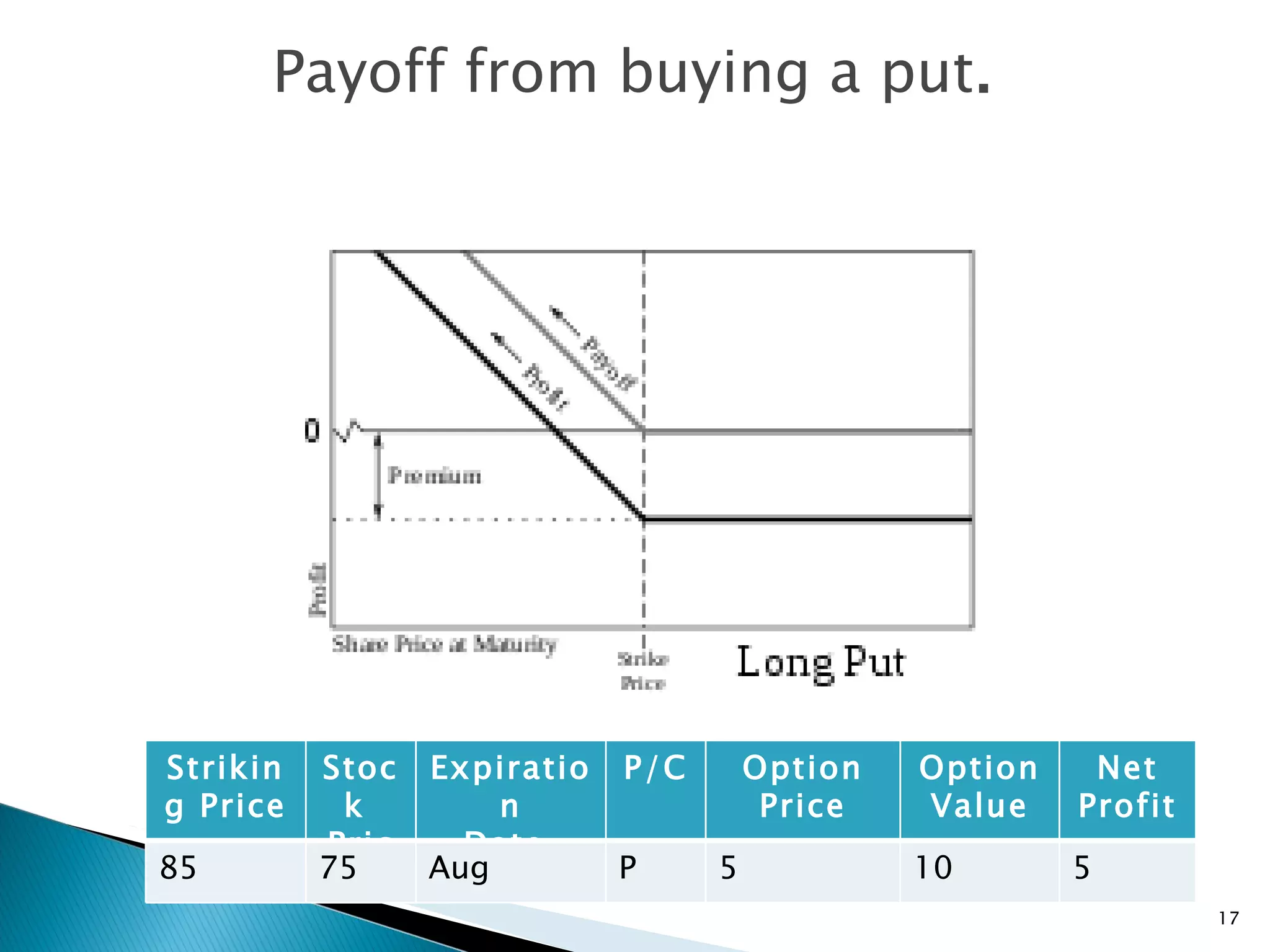
The buyer speculates the stock price will go down, then buy a put option by paying the option price (premium). If the stock price goes down by the expiration, the buyer exercises the option and earns the profit. As illustrate in the table, the stock price goes down from $85 to $75, the call option buyer earns $10 minus $5 of option price and get $5 net profit.  Buying a put from the  buyer’s perspective Options Striking Price Stock  Price Expiration Date  P /C Option Price Option Value Net Profit 85 75 Aug P 5 10 5
Payoff from buying a put . Options Striking Price Stock  Price Expiration Date  P /C Option Price Option Value Net Profit 85 75 Aug P 5 10 5
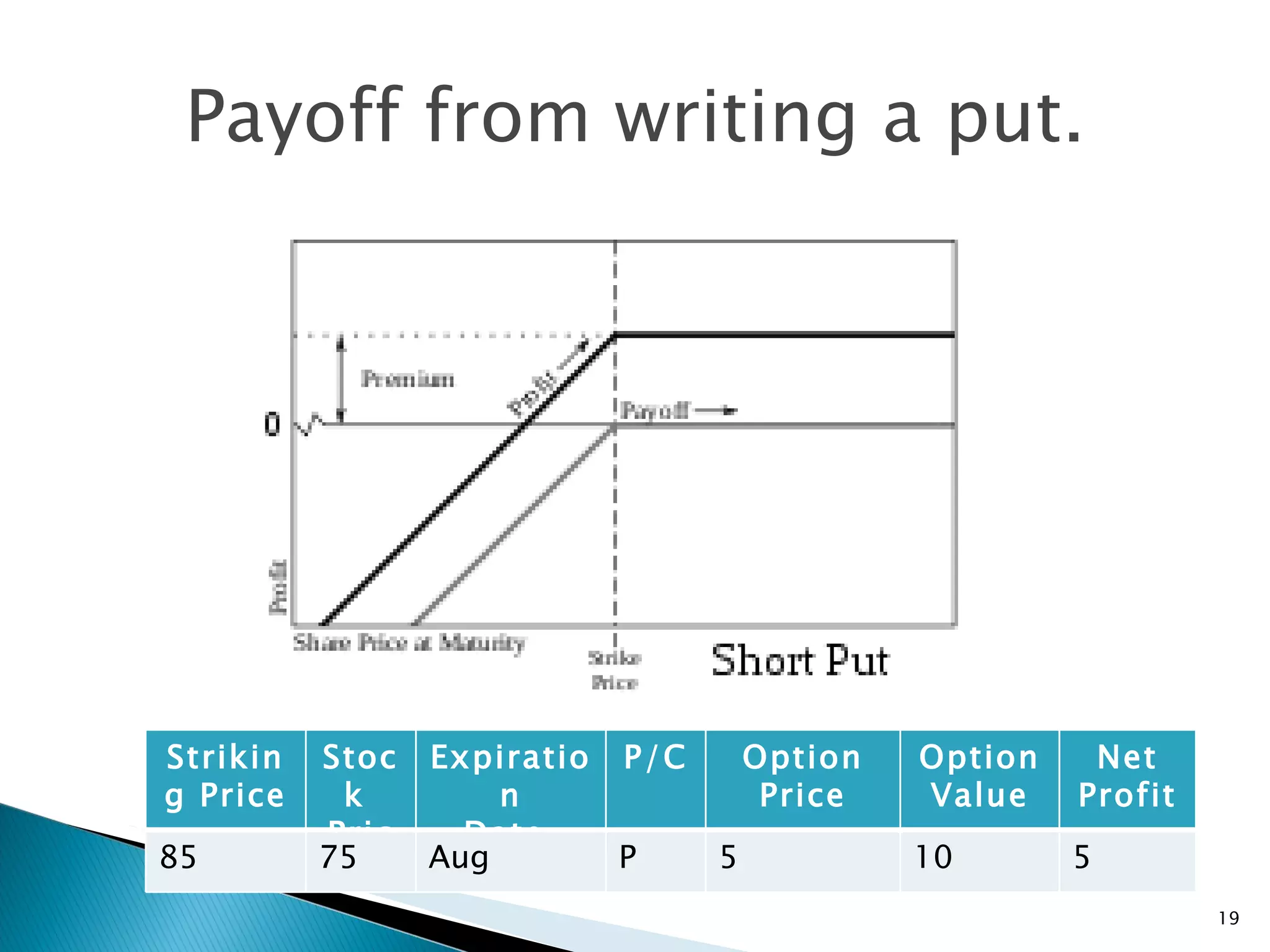
The seller will get the premium whenever he/she sells a put option. If the stock price does not go down by the expiration, the put buyer will not exercise the option and the seller can get the premium as a net profit.  If the stock price goes down and the buyer exercises the option, then the seller have to assume the obligation to sell the stock with the exercise price and bear a loss which equal to the buyer’s net profit. In the example above, $5 is seller’s net loss and buyer’s net profit   Selling a put from the  seller’s perspective Options Striking Price Stock  Price Expiration Date  P /C Option Price Option Value Net Profit 85 75 Aug P 5 10 5
Payoff from writing a put. Options Striking Price Stock  Price Expiration Date  P /C Option Price Option Value Net Profit 85 75 Aug P 5 10 5
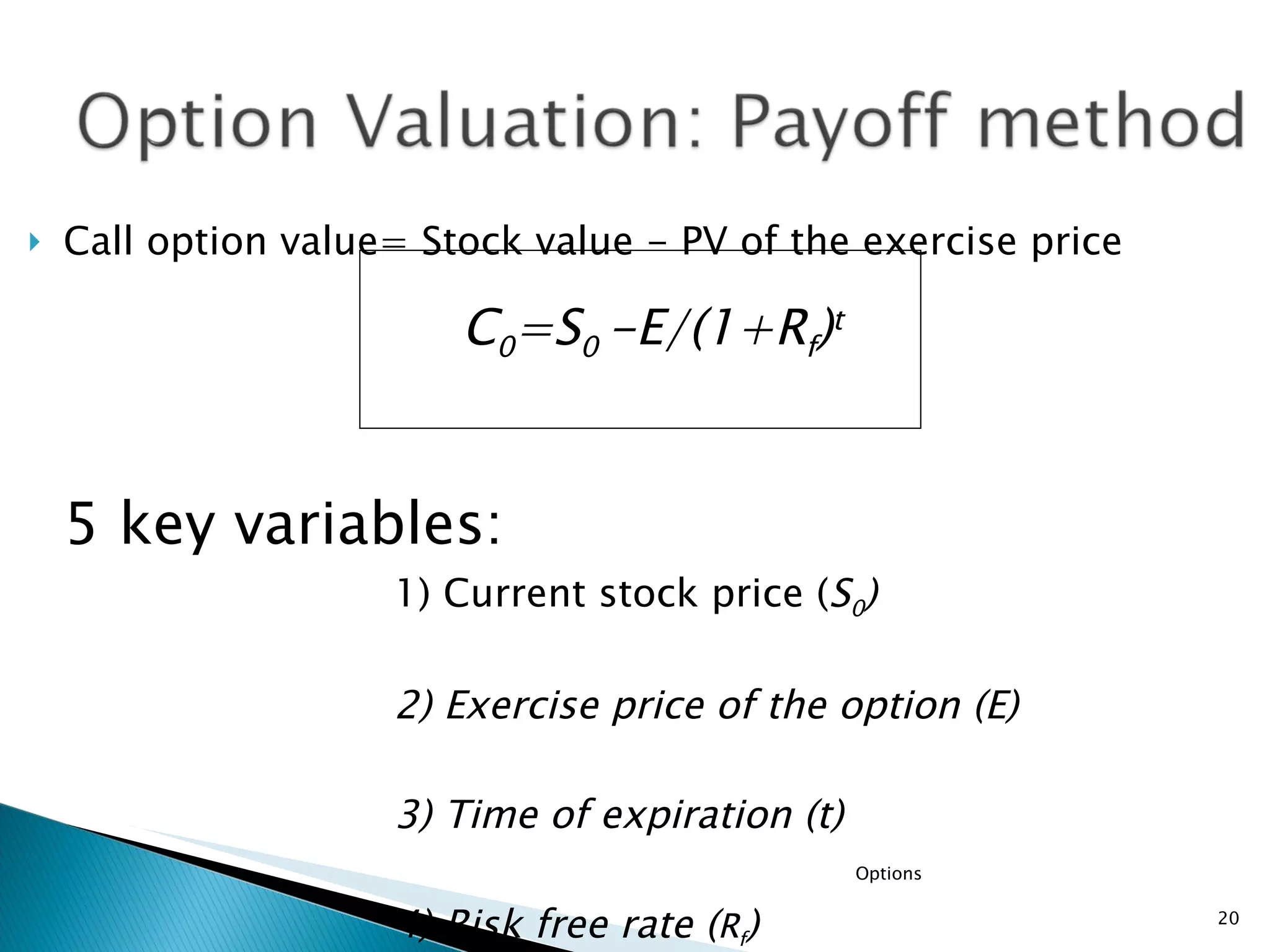
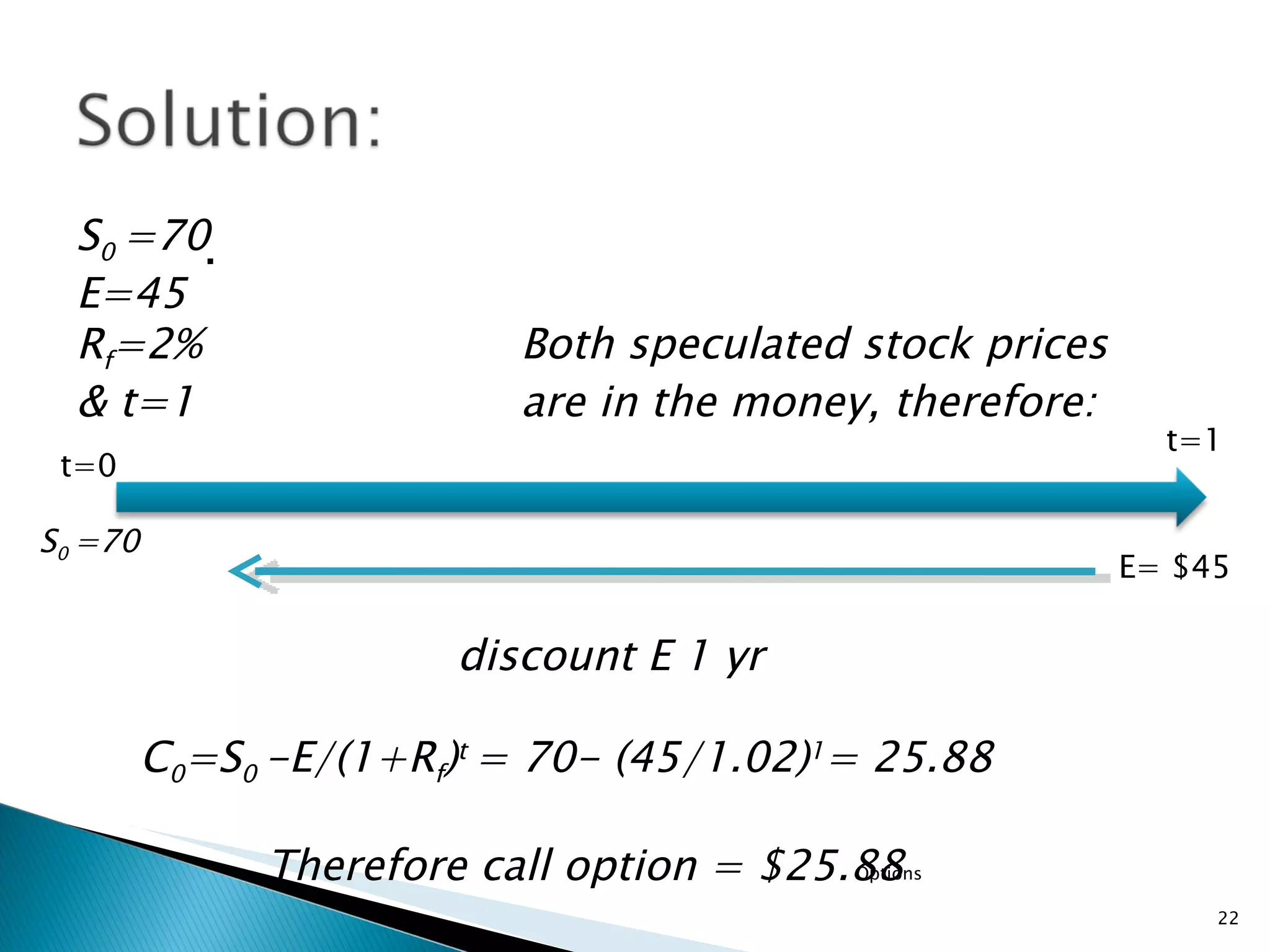
Call option value= Stock value - PV of the exercise price 5 key variables: 1) Current stock price ( S 0 ) 2) Exercise price of the option (E) 3) Time of expiration (t) 4) Risk free rate ( R f ) 5) Variance of return on stock Options C 0 =S 0  -E/(1+R f ) t
You would like to purchase a  1 year  call option for RBC stock- the  exercise price = $45 per share and the  stock price  is currently at $70 and the  risk free rate =2% and you speculate that the stock will be between $60 and $80 in 1 year.  What is the cost of the option? Options
.  Options t=0 t=1 E= $45 S 0  =70 E=45 R f =2%  Both speculated stock prices  & t=1 are in the money, therefore: discount E 1 yr C 0 =S 0  -E/(1+R f ) t  = 70- (45/1.02) 1 = 25.88 Therefore call option = $25.88 S 0  =70
You would like to purchase a  1 year  call option for RBC stock- the  exercise price = $45 per share and the  stock price  is currently at $70 The  risk free rate =2% and you speculate that the stock will be between $40 and $80 in 1 year.  What is the cost of the option? Options
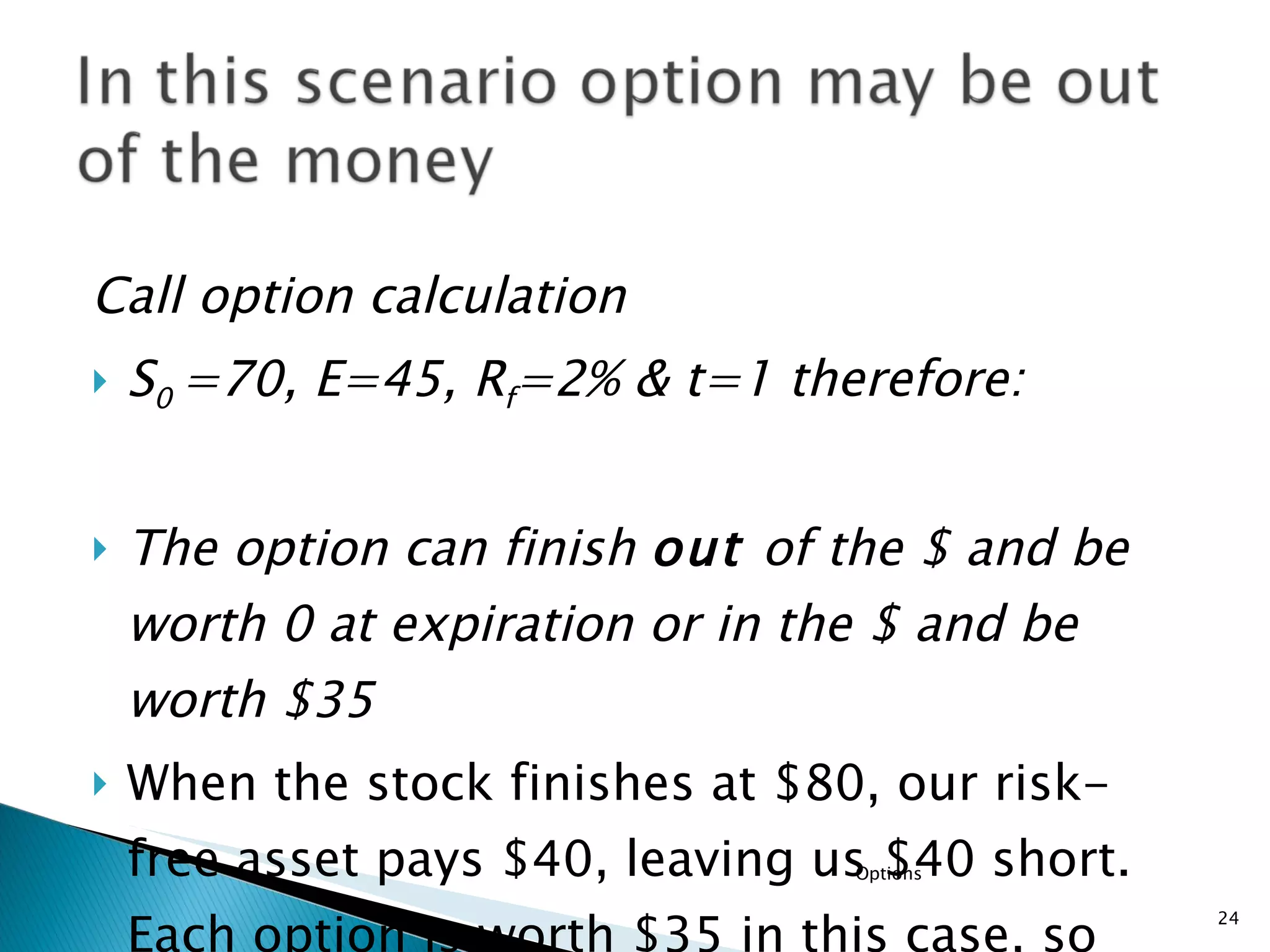
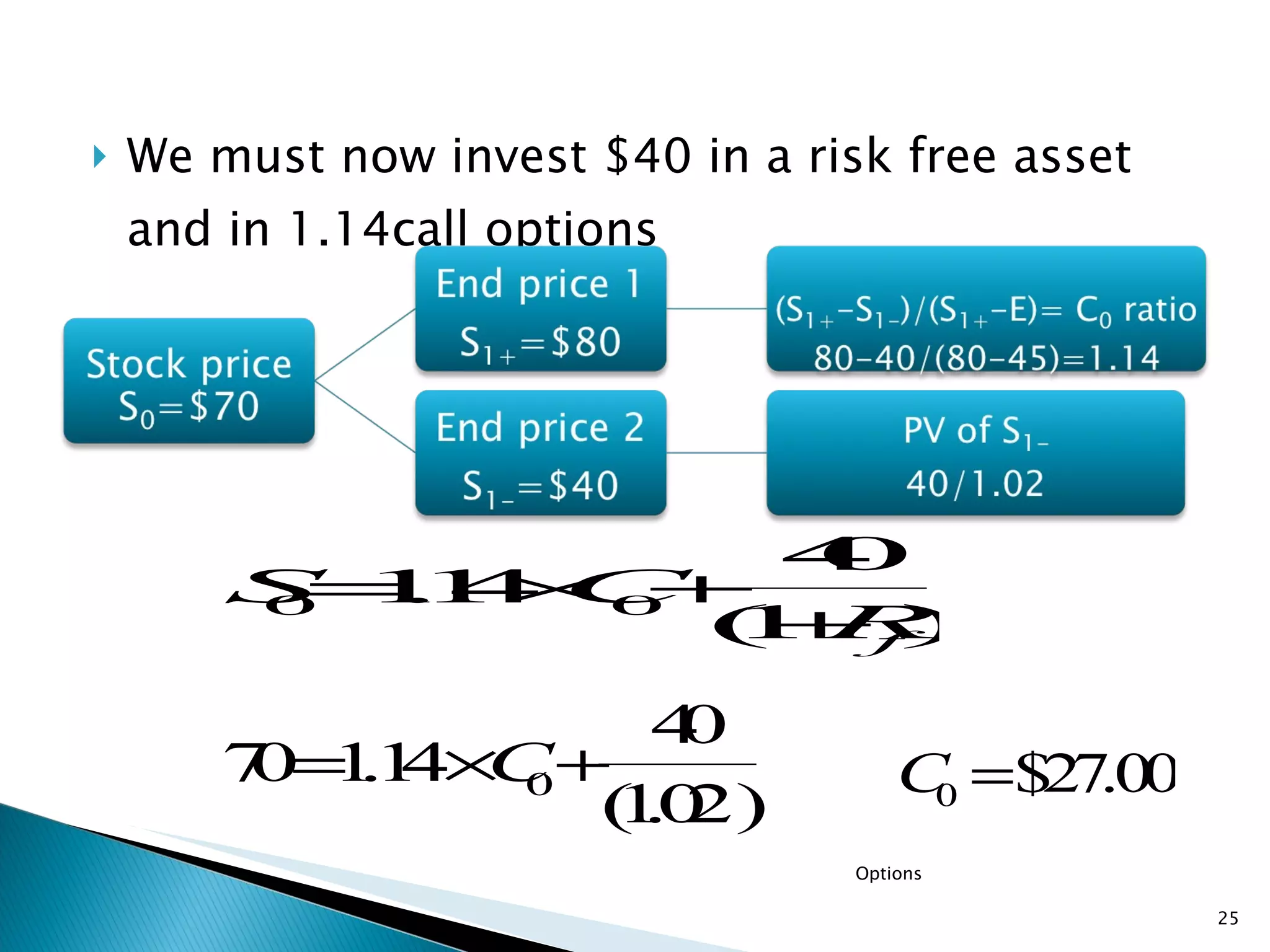
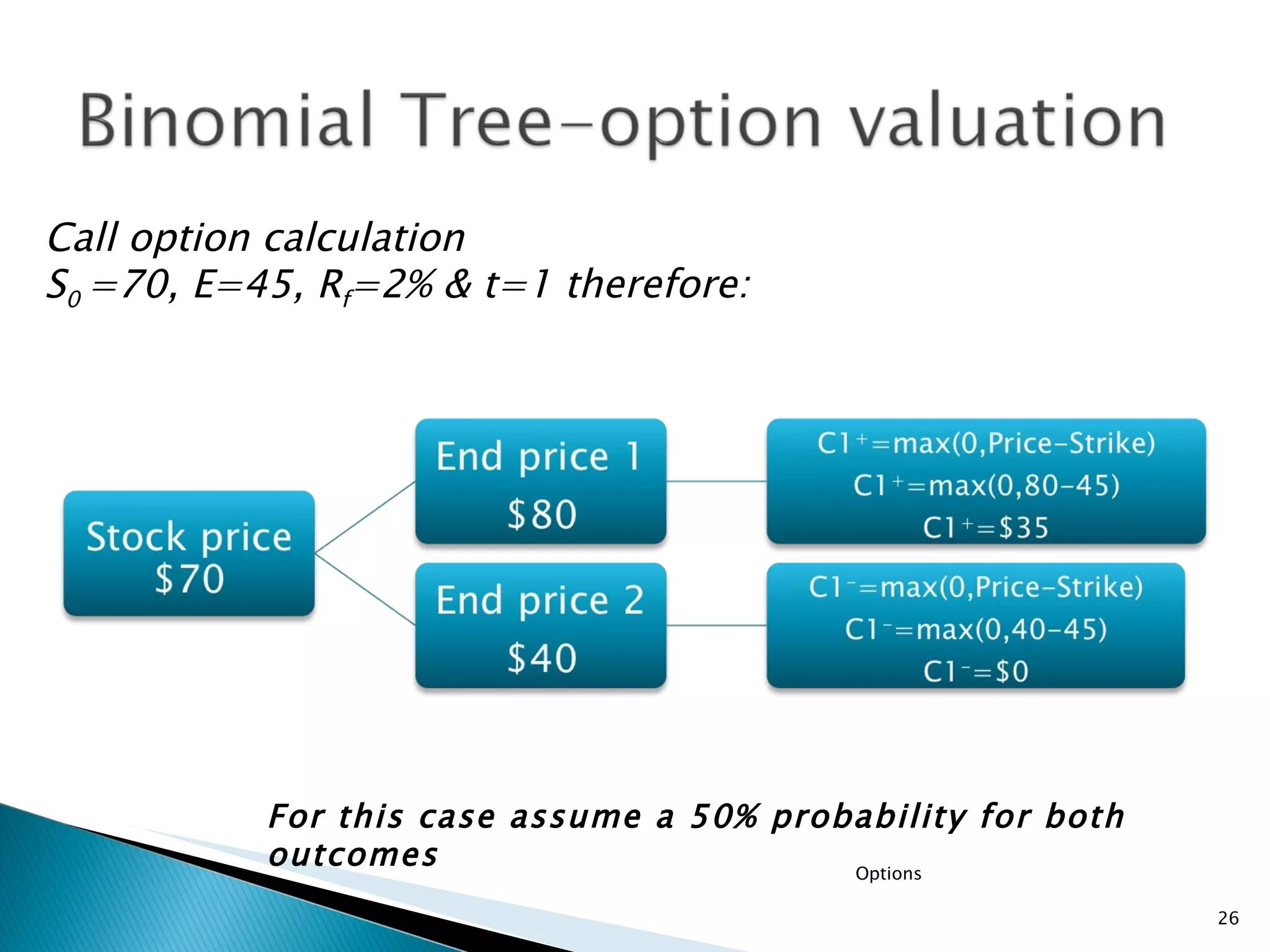
Call option calculation S 0  =70, E=45, R f =2% & t=1 therefore: The option can finish  out  of the $ and be worth 0 at expiration or in the $ and be worth $35  When the stock finishes at $80, our risk-free asset pays $40, leaving us $40 short. Each option is worth $35 in this case, so we need $40/$35 =  1.14options to match  the payoff on the stock.  Options
We must now invest $40 in a risk free asset and in 1.14call options Options
Options For this case assume a 50% probability for both outcomes Call option calculation S 0  =70, E=45, R f =2% & t=1 therefore:
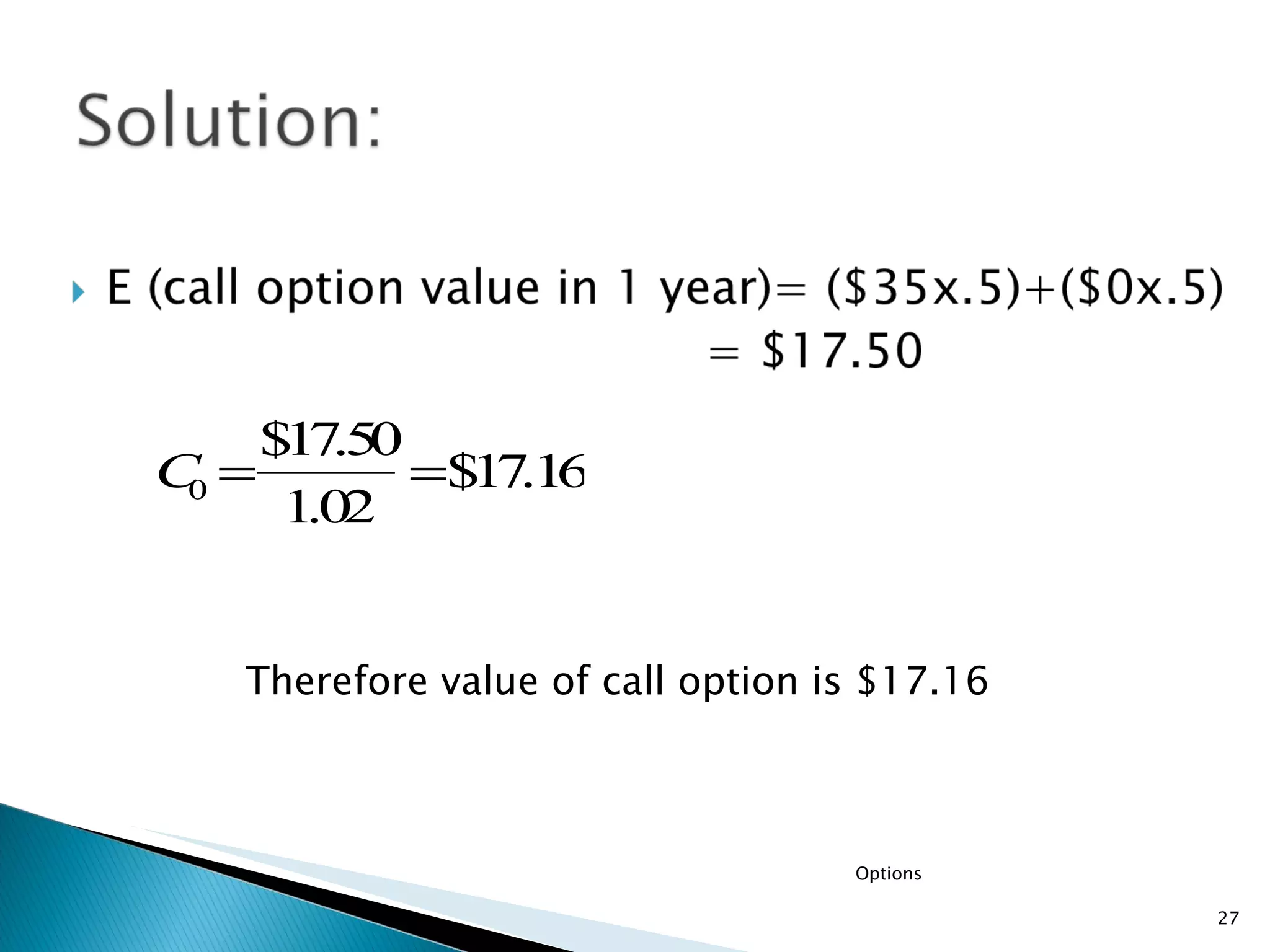
Options Therefore value of call option is $17.16
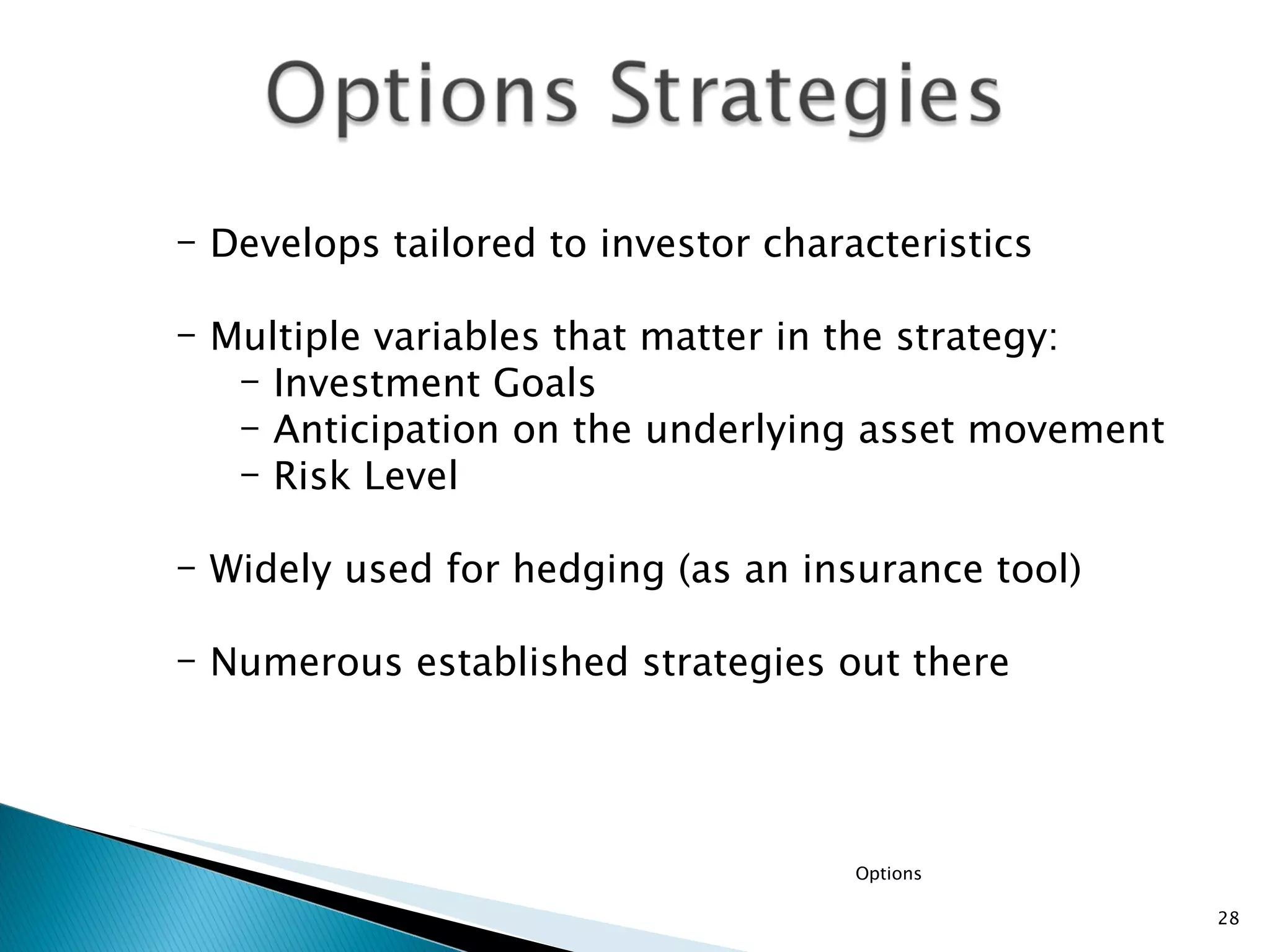
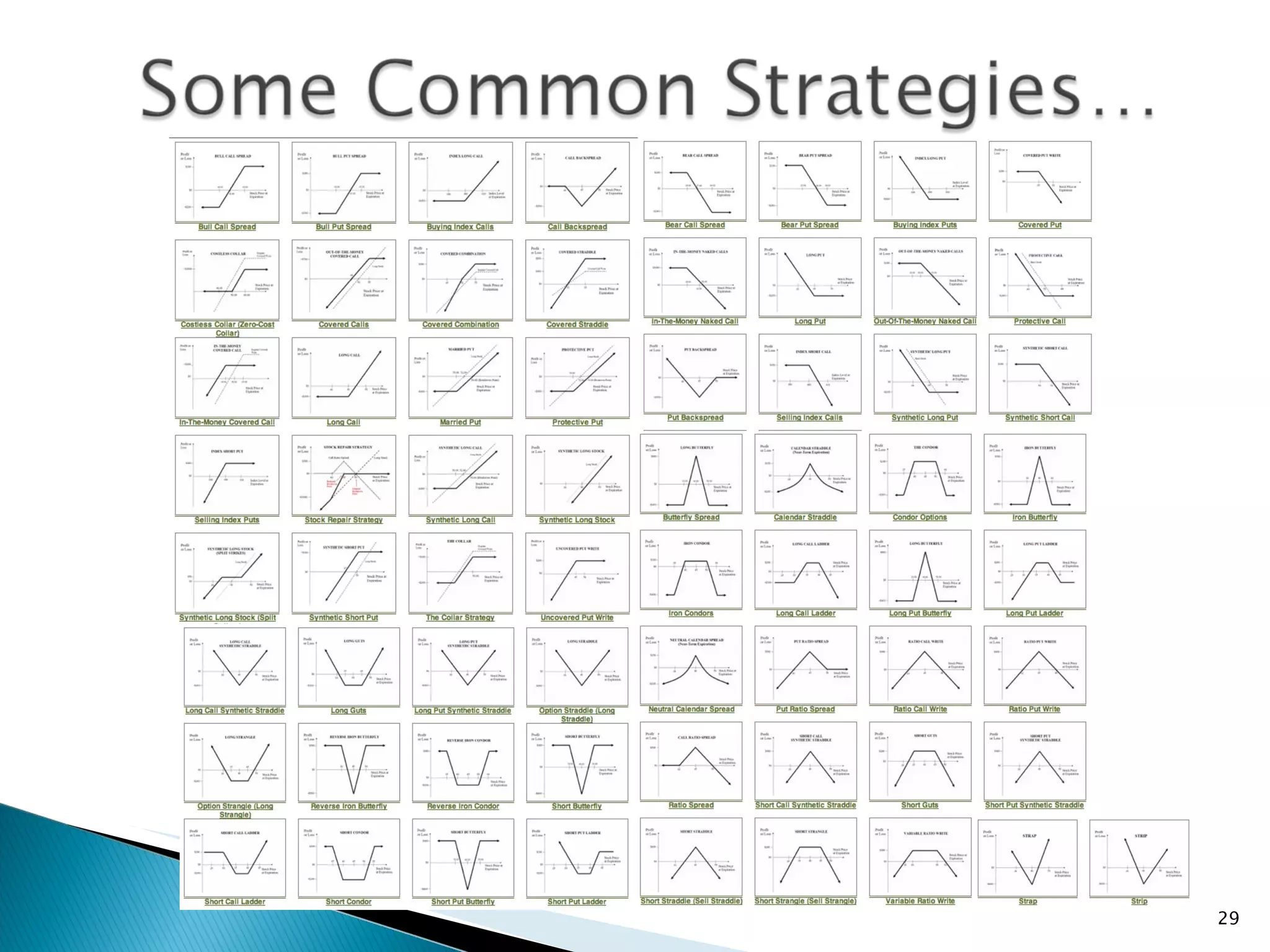
Options Develops tailored to investor characteristics Multiple variables that matter in the strategy: Investment Goals Anticipation on the underlying asset movement Risk Level Widely used for hedging (as an insurance tool) Numerous established strategies out there
Options
Options Types: Bullish Strategies Bearish Strategies Neutral Strategies
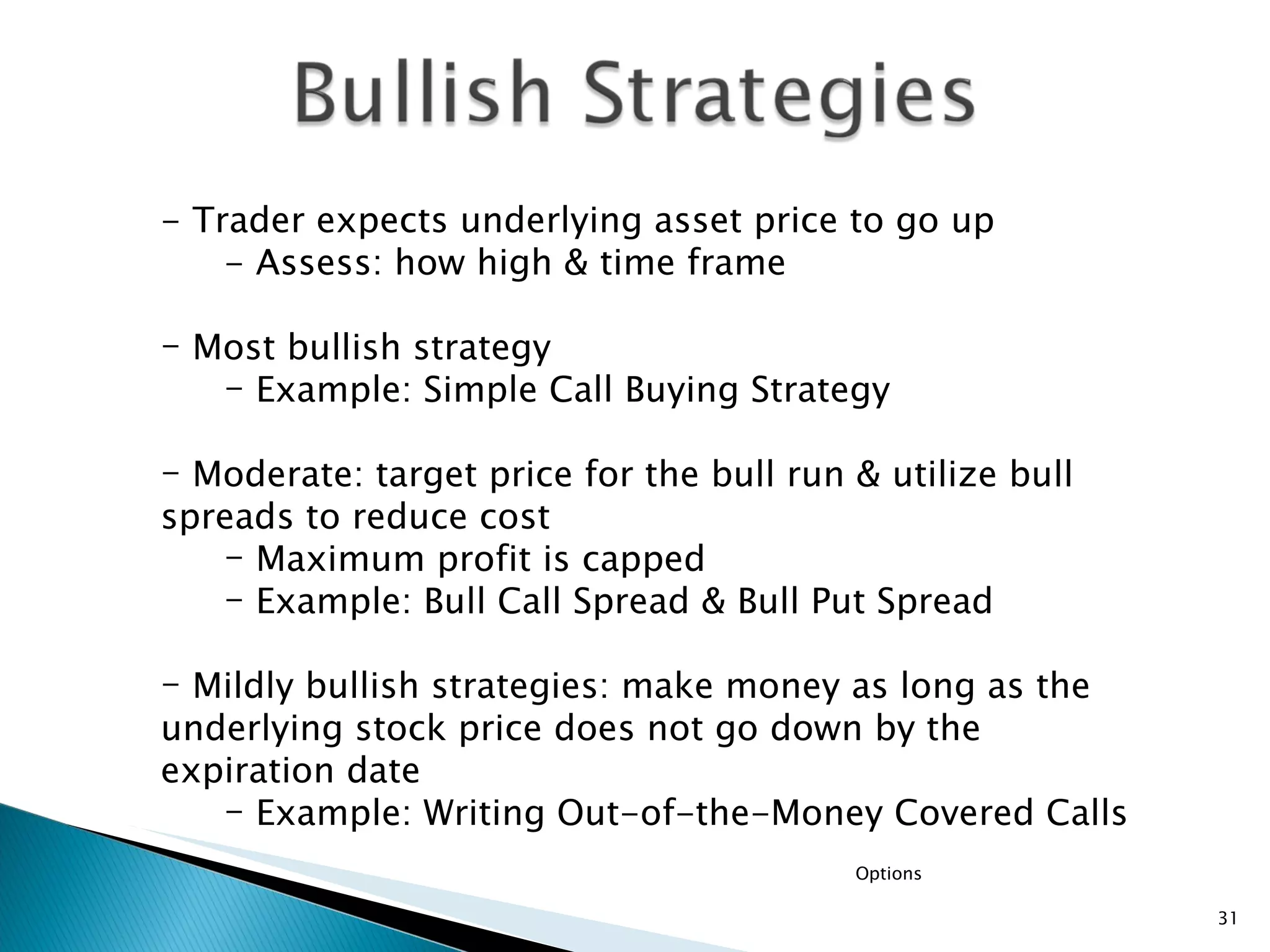
Options - Trader expects underlying asset price to go up  - Assess: how high & time frame Most bullish strategy  Example: Simple Call Buying Strategy Moderate: target price for the bull run & utilize bull spreads to reduce cost Maximum profit is capped Example: Bull Call Spread & Bull Put Spread Mildly bullish strategies: make money as long as the underlying stock price does not go down by the expiration date Example: Writing Out-of-the-Money Covered Calls
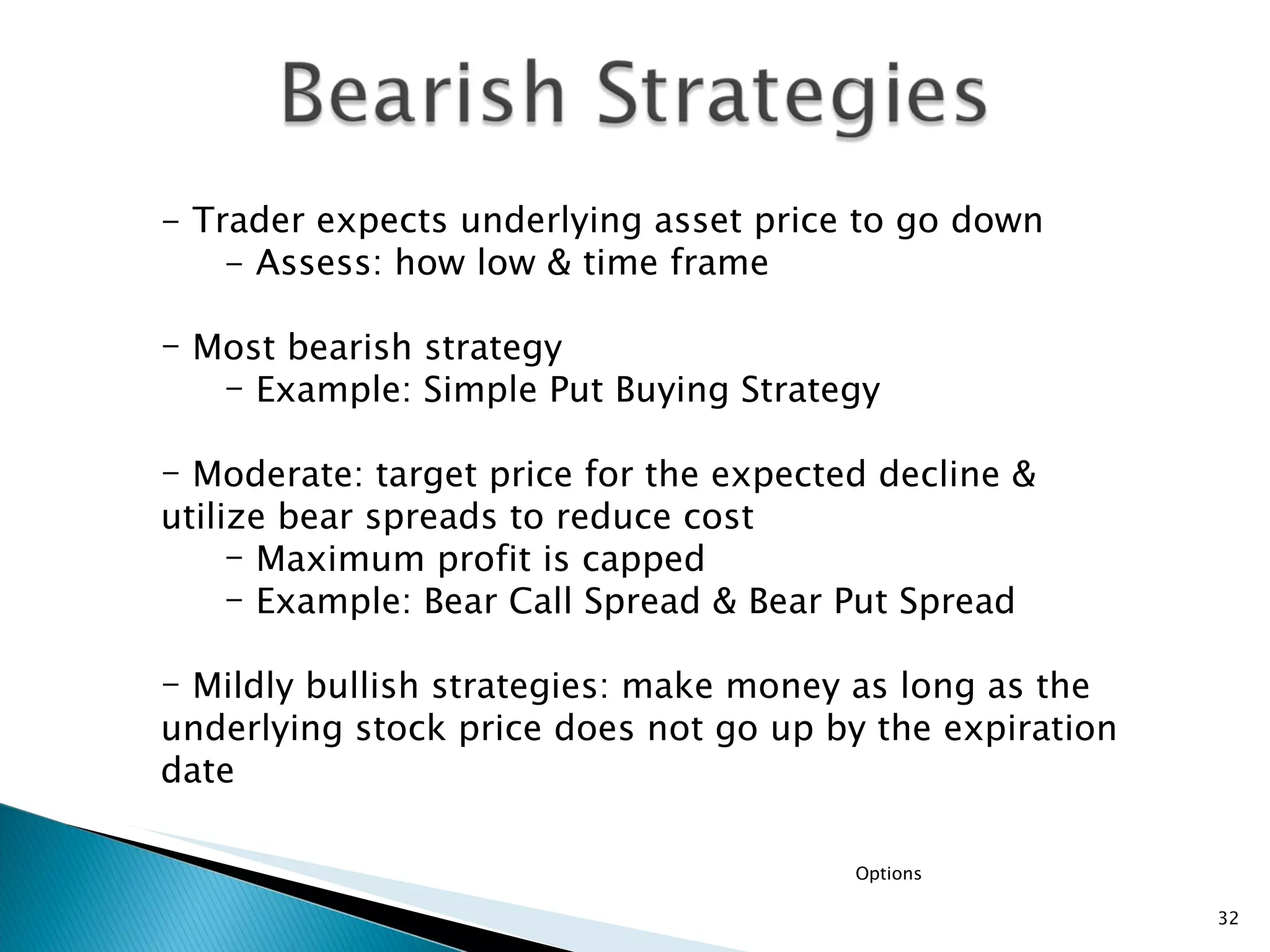
Options - Trader expects underlying asset price to go down  - Assess: how low & time frame Most bearish strategy  Example: Simple Put Buying Strategy Moderate: target price for the expected decline & utilize bear spreads to reduce cost Maximum profit is capped Example: Bear Call Spread & Bear Put Spread Mildly bullish strategies: make money as long as the underlying stock price does not go up by the expiration date
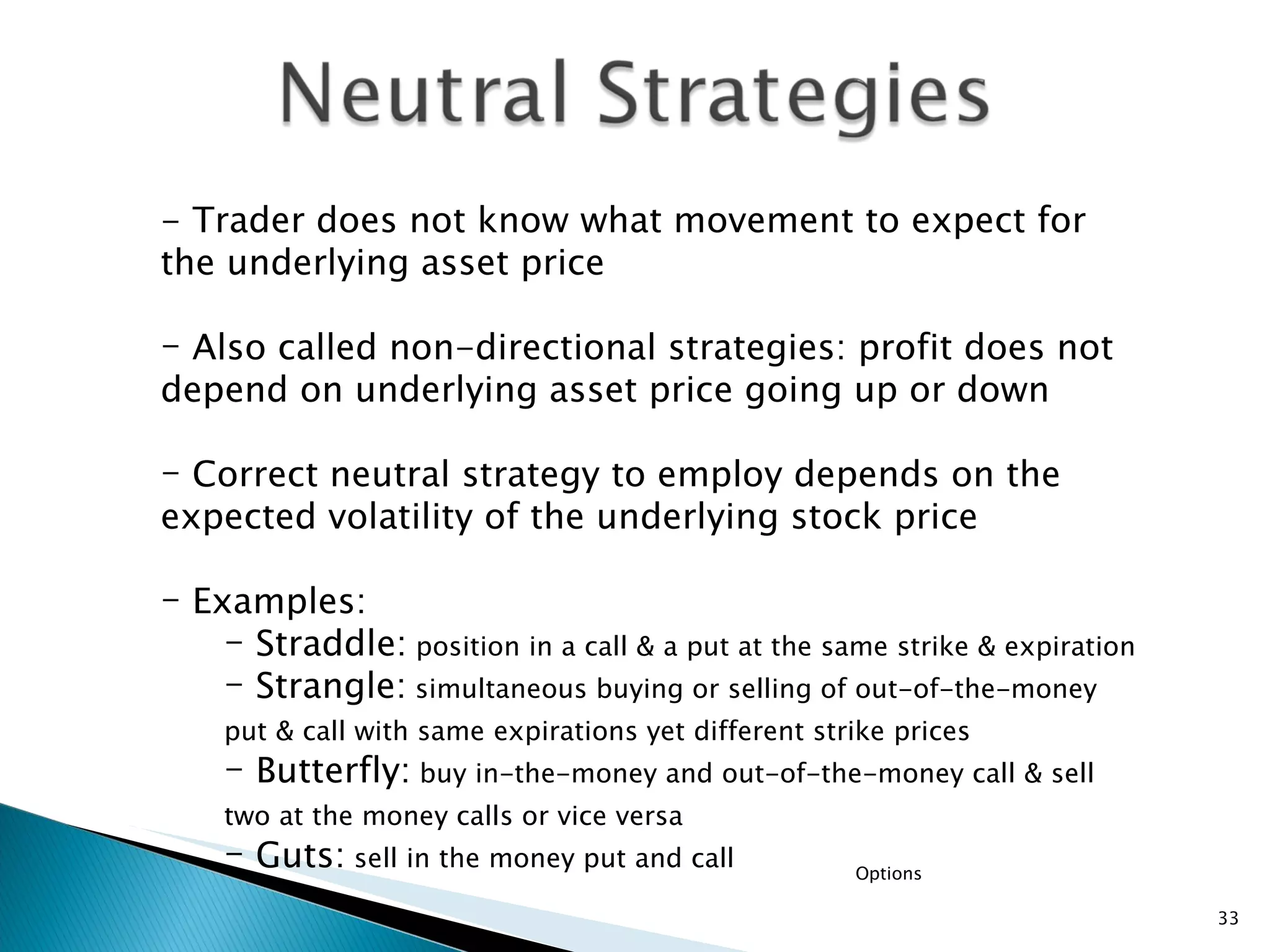
Options - Trader does not know what movement to expect for the underlying asset price Also called non-directional strategies: profit does not depend on underlying asset price going up or down Correct neutral strategy to employ depends on the expected volatility of the underlying stock price Examples: Straddle:  position in a call & a put at the same strike & expiration   Strangle:  simultaneous buying or selling of out-of-the-money put & call with same expirations yet different strike prices   Butterfly:  buy in-the-money and out-of-the-money call & sell two at the money calls or vice versa   Guts:  sell in the money put and call
Q & A Options
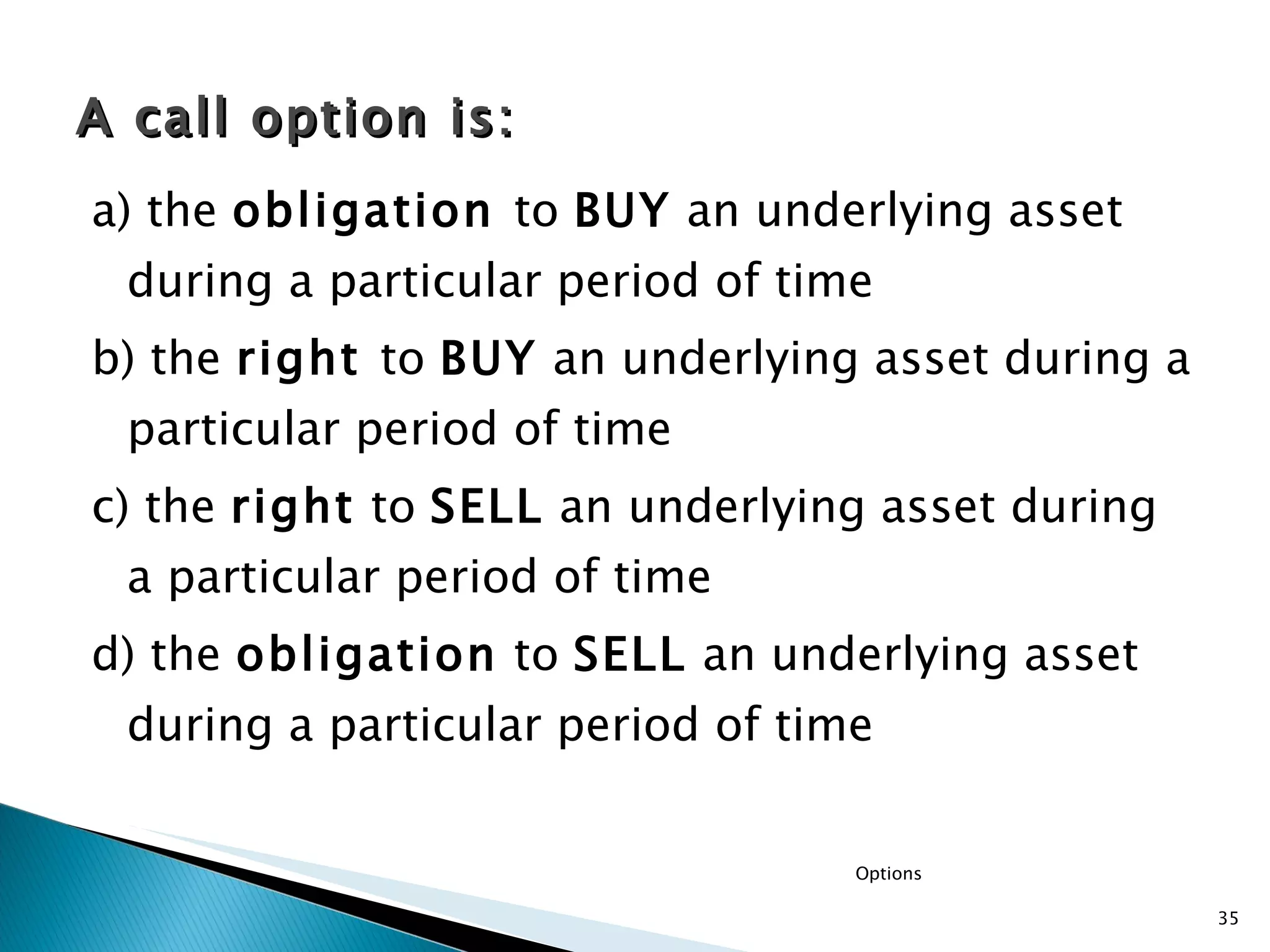
a) the  obligation  to  BUY  an underlying asset during a particular period of time b) the  right  to  BUY  an underlying asset during a particular period of time c)  the  right  to  SELL  an underlying asset during a particular period of time d)  the  obligation  to  SELL  an underlying asset during a particular period of time A call option is: Options
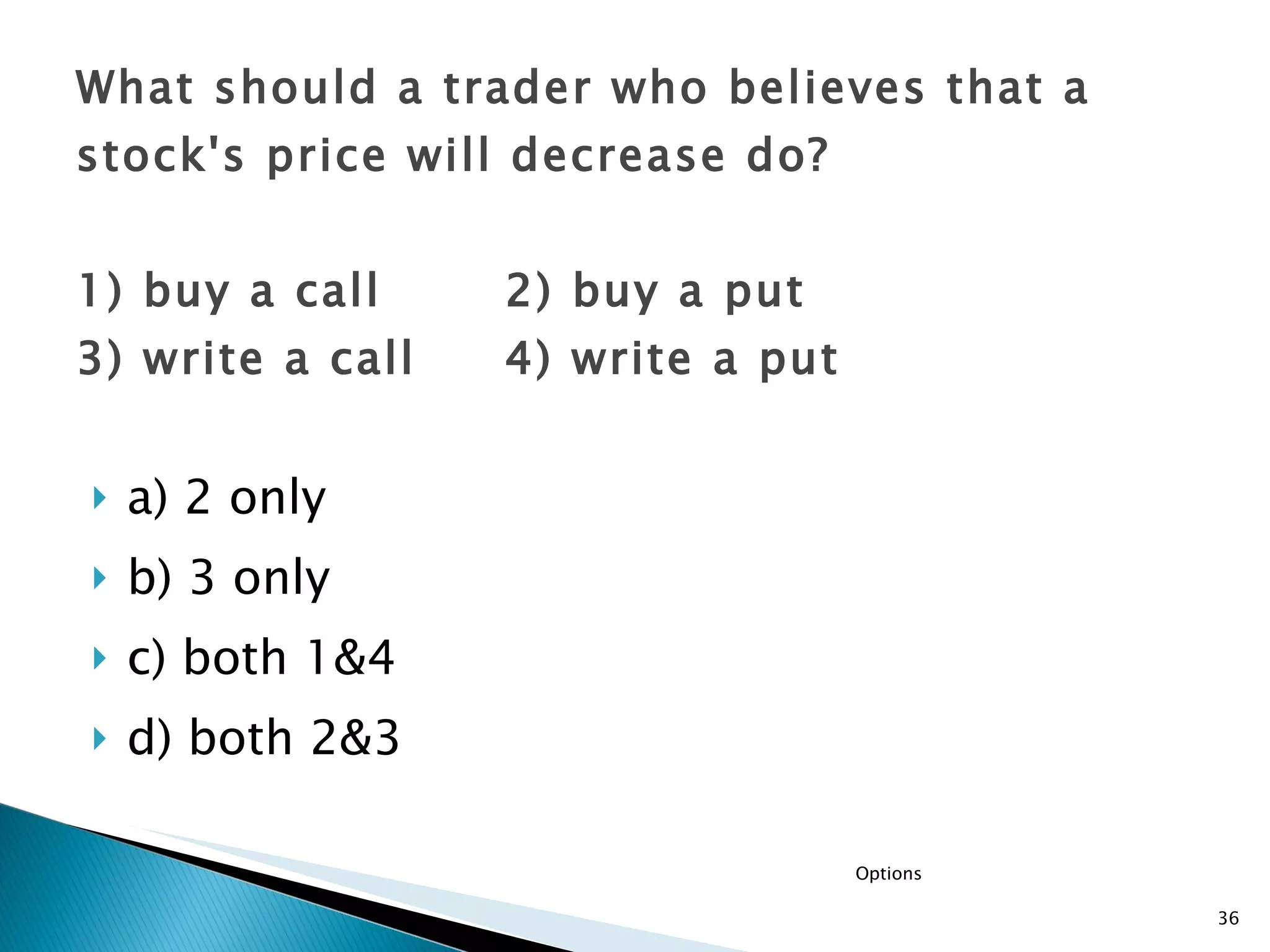
a) 2 only  b) 3 only c) both 1&4  d) both 2&3 What should a trader who believes that a stock's price will decrease do? 1) buy a call  2) buy a put  3) write a call  4) write a put Options
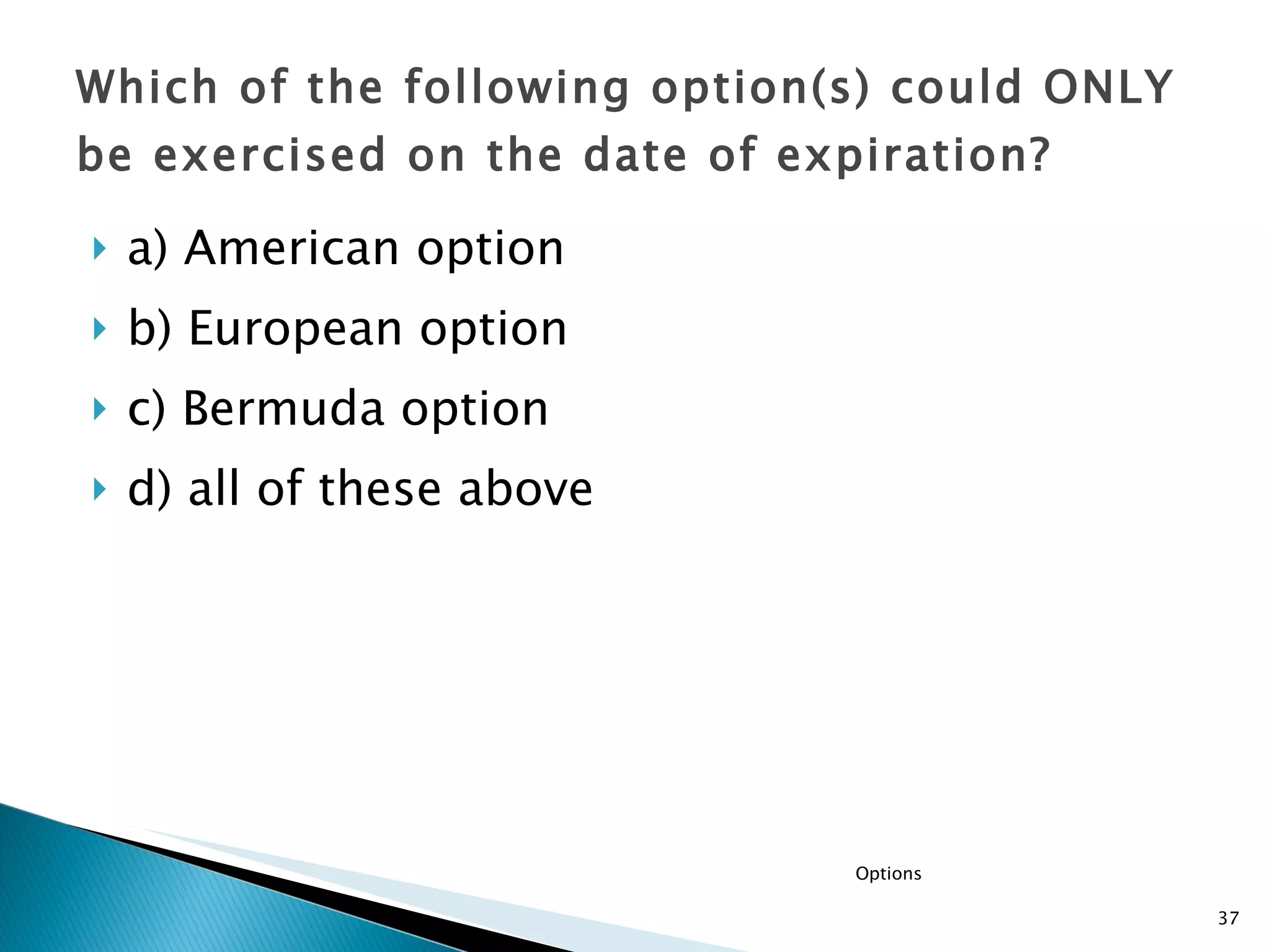
a) American option b) European option c) Bermuda option d) all of these above Which of the following option(s) could ONLY be exercised on the date of expiration? Options
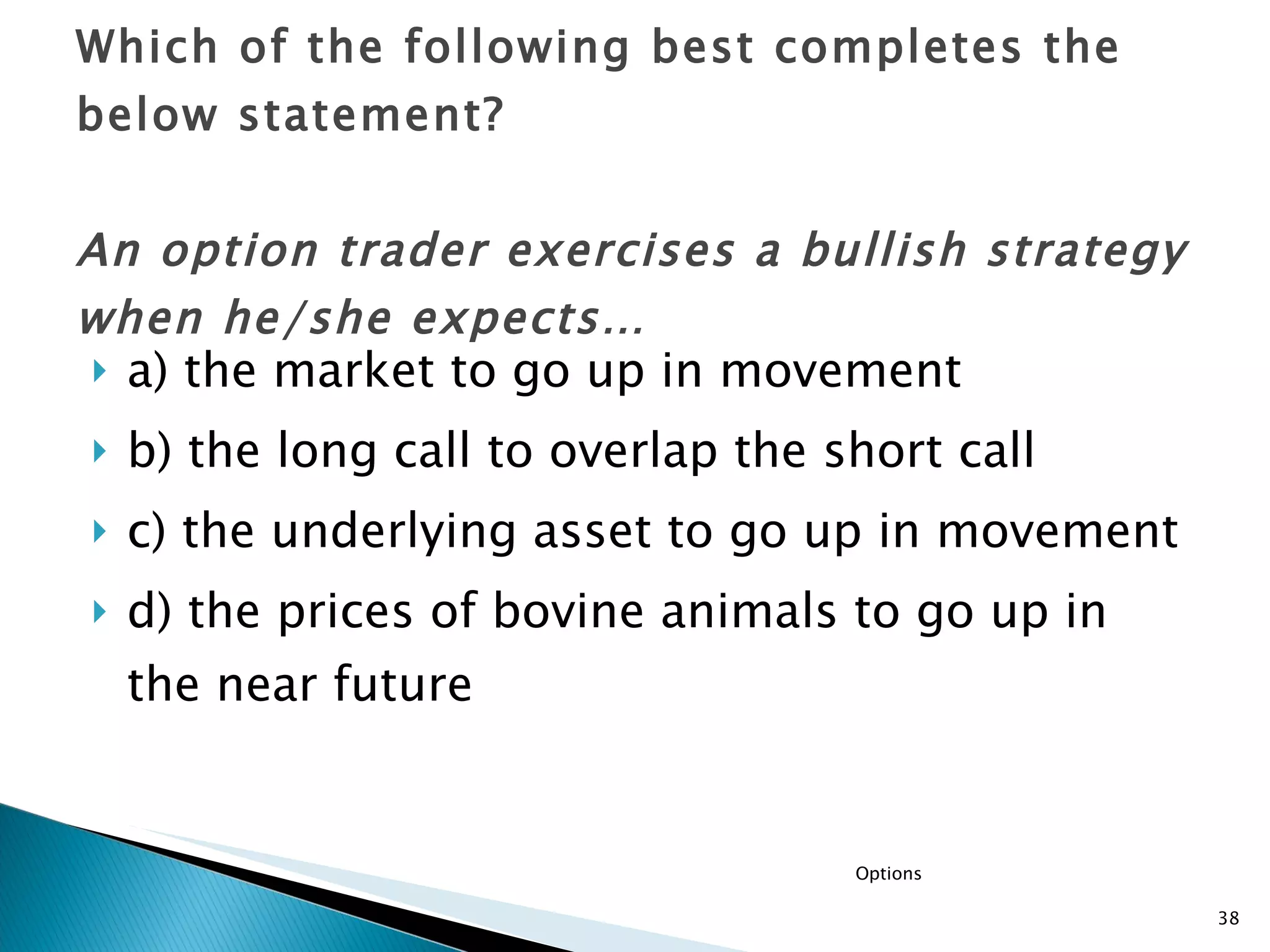
a) the market to go up in movement b) the long call to overlap the short call  c) the underlying asset to go up in movement d) the prices of bovine animals to go up in the near future Which of the following best completes the below statement? An option trader exercises a bullish strategy when he/she expects… Options
Options References: TradeKing.com  Covered Call Options Strategy. <http://www.youtube.com/watch?v=UT6Y4OZ_Ejc> OptionsPhysics.com  Straddles and Strangles. <http://www.youtube.com/watch?v=HPHs7UsjBmY&NR=1> The Options Guide  Options & Futures Trading Explained <http://www.theoptionsguide.com/> About.com  <http://daytrading.about.com/b/2007/11/18/options-trading-basic-options-strategies.htm> OptionsTradingGuide.com  <http://www.option-trading-guide.com/spreads.html> The Options Industry Council  Strategies <http://www.optionseducation.org/strategy/default.jsp> Barrie, Scott (2001).  The Complete Idiot's Guide to Options and Futures. Alpha Books. pp. 120–121. InvestorWords.com Index Options.  <  http://www.investorwords.com/2431/index_option.html  > OIC<  http://www.optionseducation.org/basics/leaps/default.jsp  > Index Options. InvestorWords.com, March 18, 2011  Option (finance), Wikipedia, modified on 15 March 2011 at 23:34,  < http://en.wikipedia.org/wiki/Option_(finance) >  Options Basics: Types of options. Investopedia.com, March 18, 2011 < http://www.investopedia.com/university/options/option3.asp >  Black, F. and Myron, S. The Pricing and Corporate Liabilities. Journal of Political Economy, 81, 637-659 Cox, J. C., Ross, S.A. and Rubinstein, M. (1979). Option Pricing: A Simplified Approach. Journal of Financial Economics, 7, 229-263 Dixit, A. K. and Pindyck, R.S.(1995).  The Options Approach to Capital Investment . Harvard Business Review, 73, 105---115. Dale Jackson, BNN  Producer 3:32 pm, E.T. February 17,2011 Canadian <http://www.bnn.ca/Blogs/2011/02/17/It-may-be-time-for-alternative-thinking.aspx>   Call Options Trading for Beginners - Put and Call Options Explained < http://www.youtube.com/watch?v=q_z1Zx_BALo > Ross S.A., Westerfield R.W., Jordan B.D., Roberts G.S., (2010)  Fundamentals of Corporate Finance,   Seventh Canadian Edition . Canada: McGraw-Hill Ryerson Kaplan Schweser Faculty (2010).  Chartered Financial Analyst Level 2, Book 5,   Derivatives and portfolio management.  La Crosse, WI, United States: Kaplan  Berk J.,DeMarzo P.M.,Stangeland D.,(2010)  Corporate Finance , Canadian Edition, Canada: Pearson Education Canada
Backup Slides Options
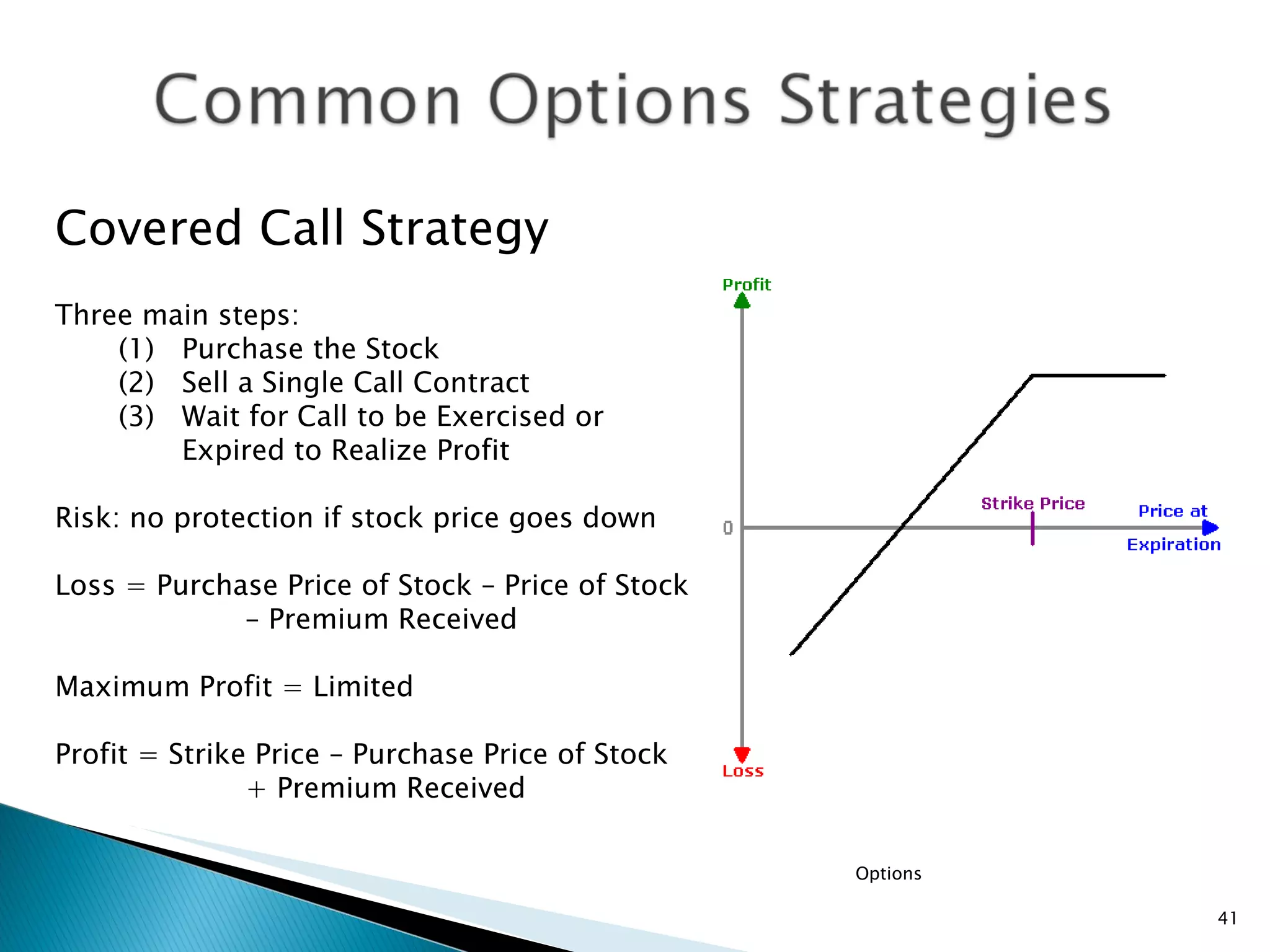
Options Covered Call Strategy Three main steps: Purchase the Stock Sell a Single Call Contract Wait for Call to be Exercised or Expired to Realize Profit Risk: no protection if stock price goes down  Loss = Purchase Price of Stock – Price of Stock  –  Premium Received Maximum Profit = Limited Profit = Strike Price – Purchase Price of Stock  + Premium Received
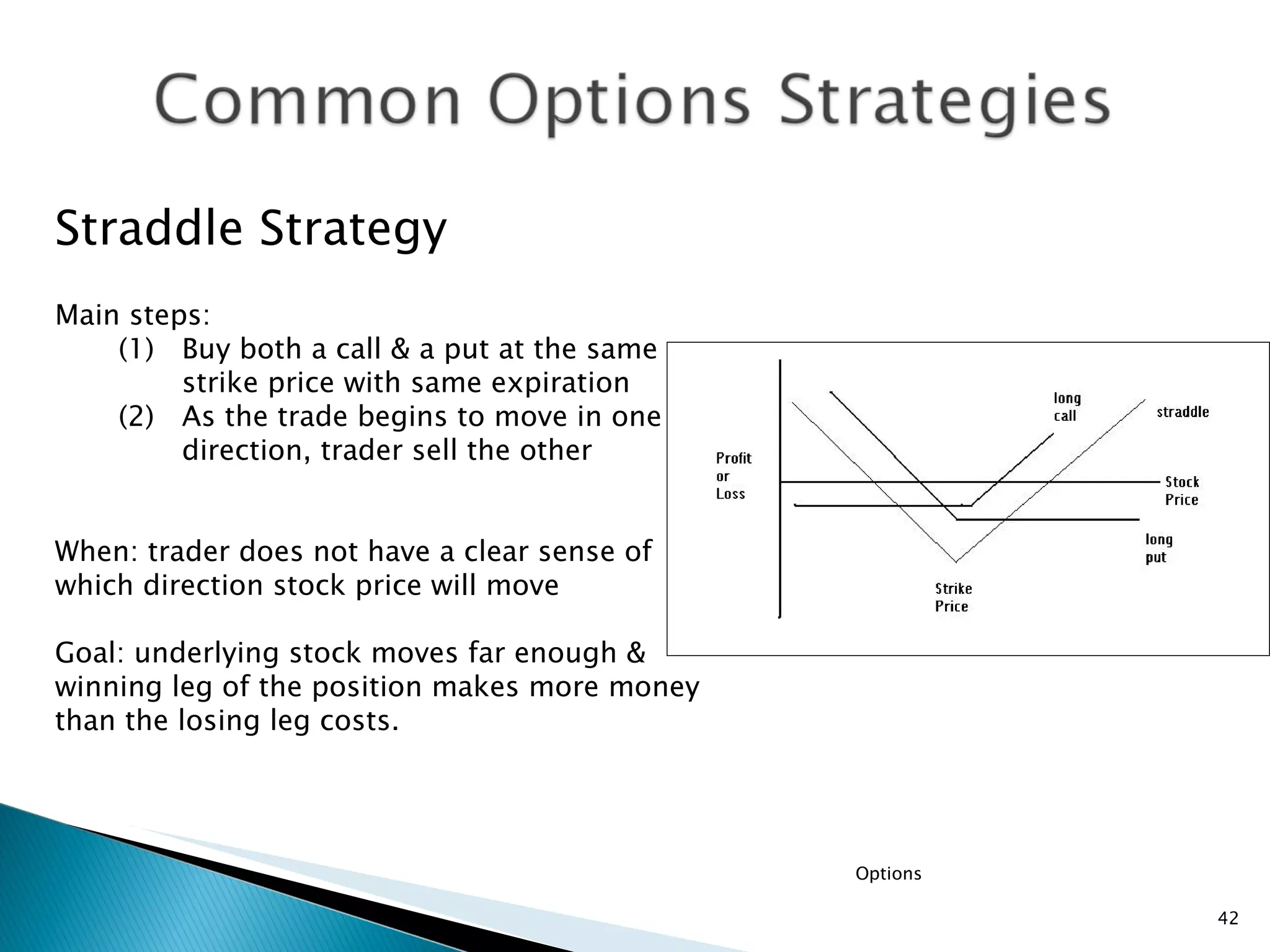
Options Straddle Strategy Main steps: (1) Buy both a call & a put at the same strike price with same expiration (2) As the trade begins to move in one direction, trader sell the other When: trader does not have a clear sense of which direction stock price will move Goal: underlying stock moves far enough & winning leg of the position makes more money than the losing leg costs.
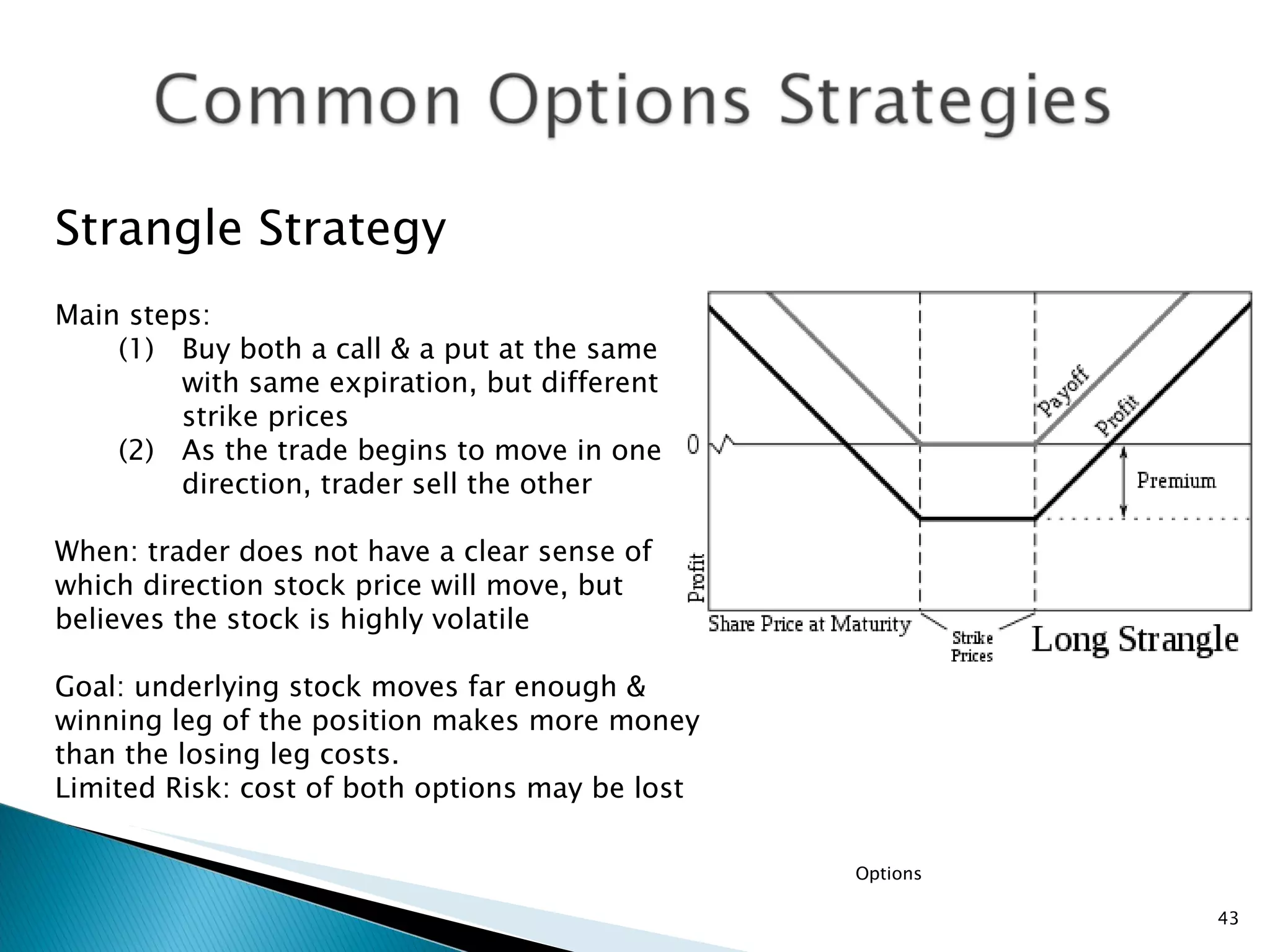
Options Strangle Strategy Main steps: (1) Buy both a call & a put at the same with same expiration, but different strike prices (2) As the trade begins to move in one direction, trader sell the other When: trader does not have a clear sense of which direction stock price will move, but believes the stock is highly volatile Goal: underlying stock moves far enough & winning leg of the position makes more money than the losing leg costs. Limited Risk: cost of both options may be lost
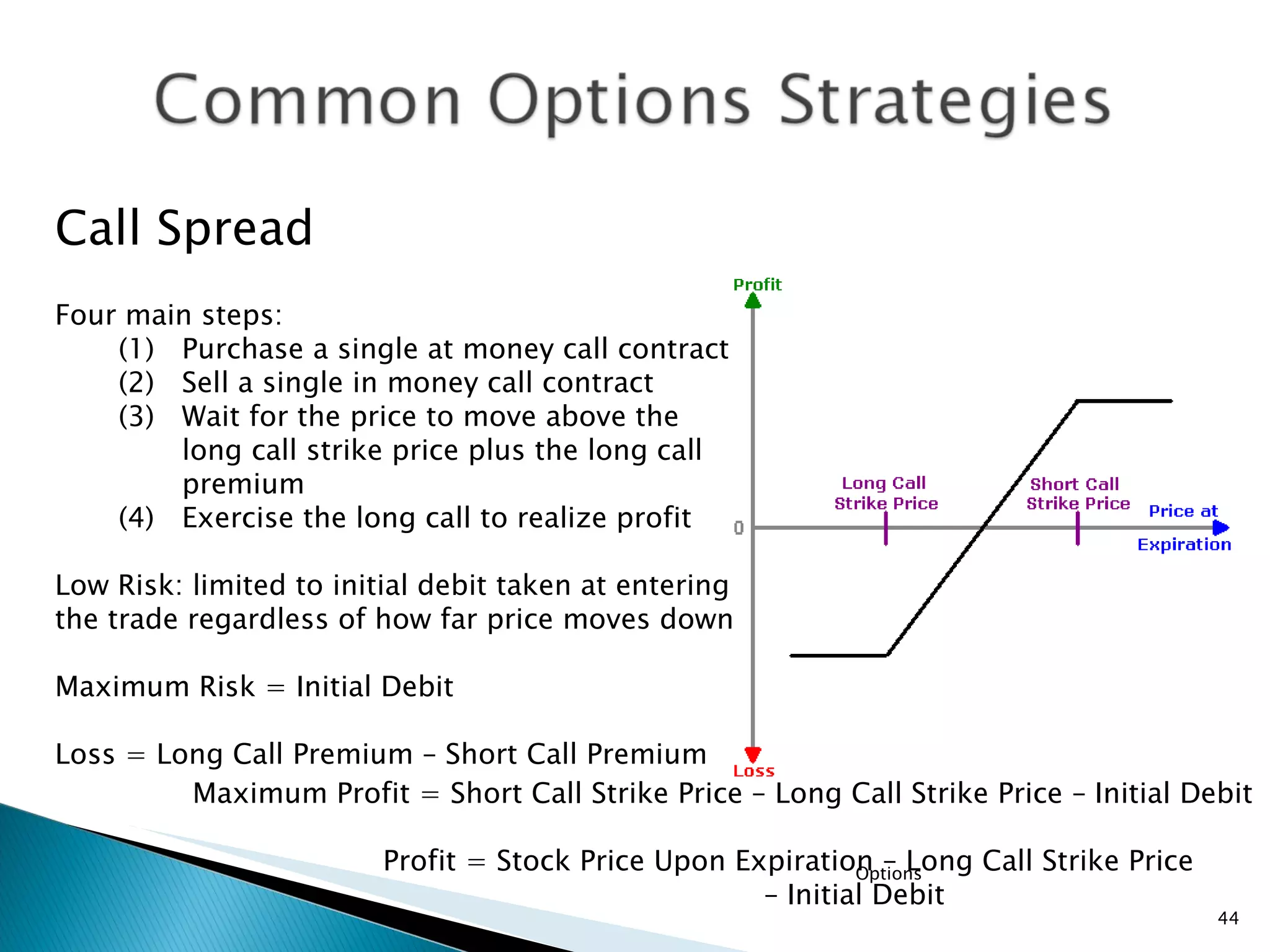
Options Call Spread Four main steps: Purchase a single at money call contract Sell a single in money call contract Wait for the price to move above the  long call strike price plus the long call premium (4) Exercise the long call to realize profit Low Risk: limited to initial debit taken at entering the trade regardless of how far price moves down  Maximum Risk = Initial Debit Loss = Long Call Premium – Short Call Premium  Maximum Profit = Short Call Strike Price – Long Call Strike Price – Initial Debit Profit = Stock Price Upon Expiration – Long Call Strike Price   –  Initial Debit
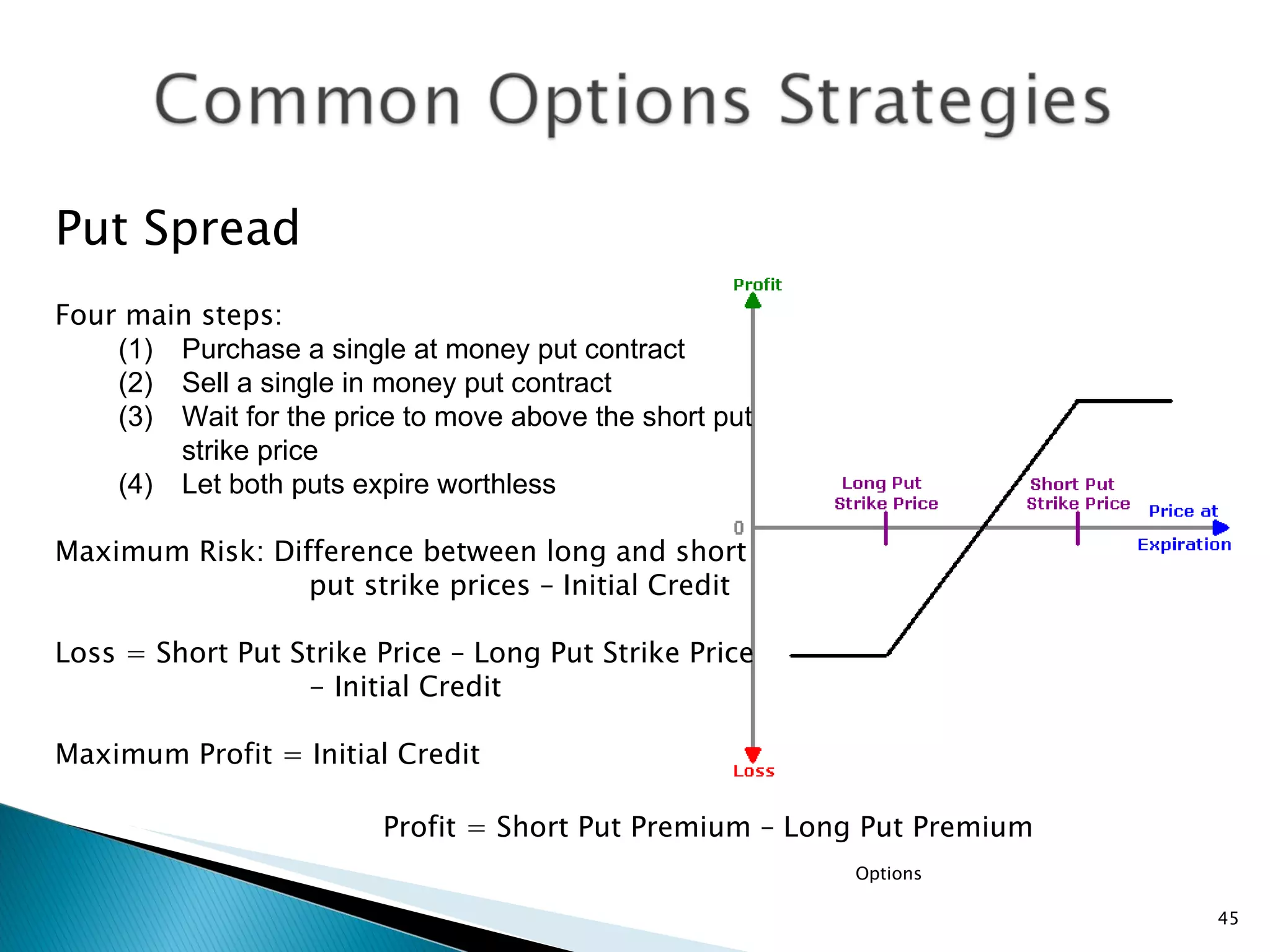
Options Put Spread Four main steps: Purchase a single at money put contract Sell a single in money put contract Wait for the price to move above the short put strike price Let both puts expire worthless Maximum Risk: Difference between long and short  put strike prices – Initial Credit  Loss = Short Put Strike Price – Long Put Strike Price - Initial Credit Maximum Profit = Initial Credit Profit = Short Put Premium – Long Put Premium
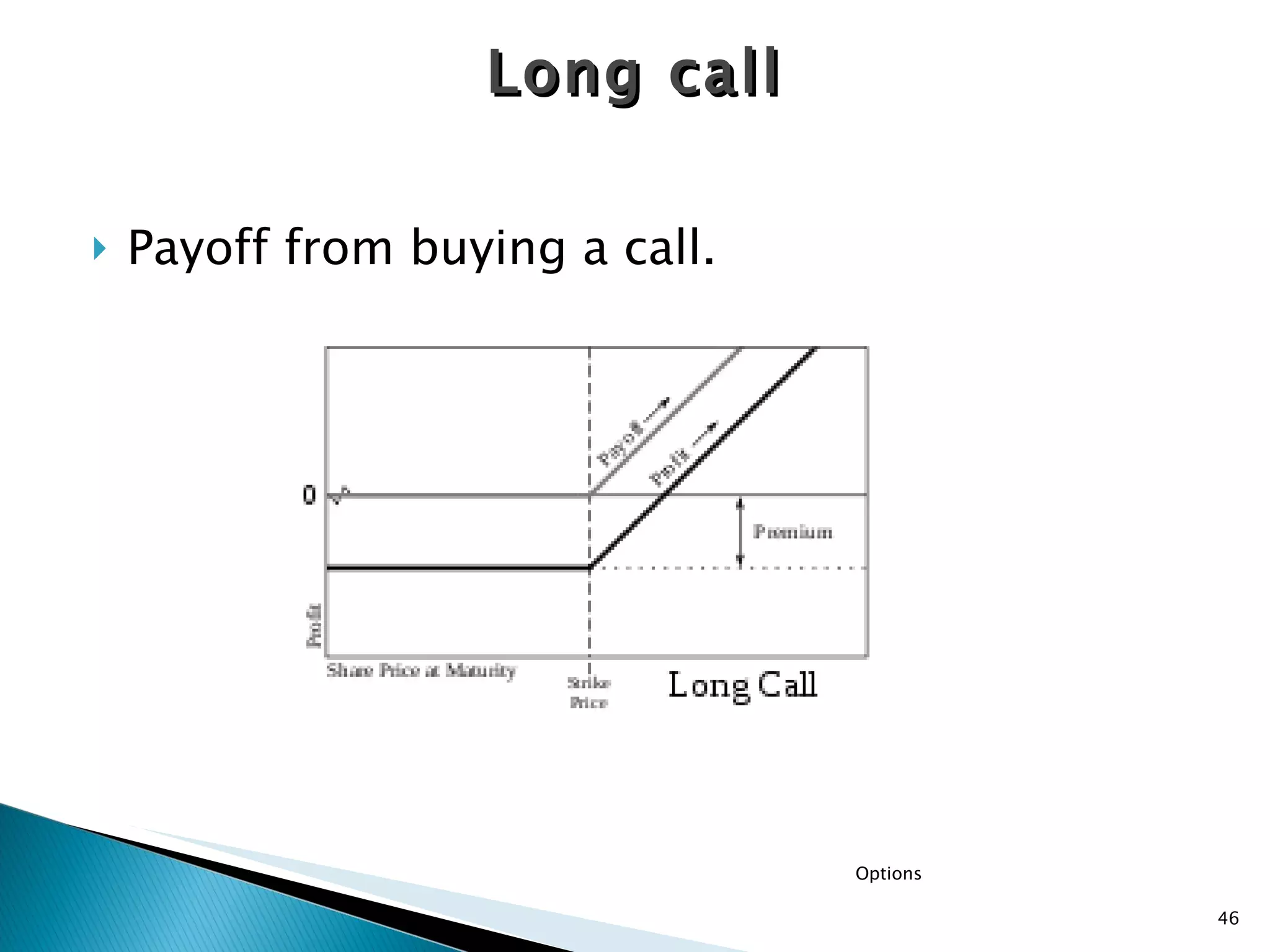
Payoff from buying a call. Long call Options
A trader who believes that a stock's price will  increase  might buy the right to purchase the stock (a  call option ) rather than just purchase the stock itself. He would have no obligation to buy the stock, only the right to do so until the expiration date. If the stock price at expiration is above the exercise price by more than the premium (price) paid, he will profit. If the stock price at expiration is lower than the exercise price, he will let the call contract expire worthless, and only lose the amount of the premium. A trader might buy the option instead of shares, because for the same amount of money, he can control ( leverage ) a much larger number of shares Options
Insurance  Loan guarantees The right to collect from a third party (often a governmental institution) if the borrower defaults  Employee stock options   Incentive form of compensation awarded by the corporation to employees, as the stock price increase, employees realize profit on either selling the stock or purchase the share at a lower prefixed price. Other options Options
Other options Real options An option with payoffs in real goods Index options (stocks market index options) With an index as underlying security, the settlement is made by cash payment if the option is exersiced. LEAPS ® ( Long-Term Equity AnticiPation Securities® ) Options for investors who prepare to carry the position in long term of period. Options
The call provision on the bond Held by the corporation, gives the corporation the right to call back the bond at a fixed price for a fixed time period Put bonds Gives the holder of the bond the right to force the issuer to repurchase the bond at a fixed price for a fixed period of time The overallotment options Gives the underwriters of an IPO the right to purchase additional shares of stock of the firm Other options Options
-  London engaged in  Puts  and  Refusals (Calls)  in 1690:  - investors have the right to convert the bond into a common stock issuers of the bond have the right to buy back the bond at a specified price -  In 19 th  century of North America,  Privileges  were sold, which combine a call and a put on a selected share, expired usually within 3 months  Extra History Options
Options http://www.slideshare.net/muratcoskun/options-presentation-introduction-to-corporate-finance

Options

  • 1.
    Introduction to CorporateFinance Options Prepared by Ying Pan Tong Niu Charlie Giurleo I.Murat Coskun
  • 2.
    Introduction Basic concept- History - Current markets & Regulator - Characteristics & Terminology Types of Options - Call options - Put options Valuation - Payoff method - Binomial tree method Strategies - Bullish strategy - Bearish strategy - Neutral strategy Q&A & REWARDS! Options
  • 3.
    Options House sellingat $1M Option Contract @ $10,000 Seller (Writer) Buyer (Holder)
  • 4.
    Options House nowselling at $2M (  ) Seller (Writer) Buyer (Holder) Scenario #1 Option Contract @ $10,000 $2,000,000 $1,000,000 - $10,000 $990,000 (Profit)
  • 5.
    Options House nowselling at $100K (  ) Seller (Writer) Buyer (Holder) Scenario #2 Option Contract @ $10,000 - $10,000 ($10,000) (Loss)
  • 6.
    - Ancient Greekphilosopher and mathematician – Thales of Miletus - Purchased the Right to rent numerous olive presses before a predicted increase in olive harvest - Fortunately, his prediction was right - Exercised his Right to rent out all presses! History Options
  • 7.
    Major markets overthe world: Current Markets & Regulator In Canada, options are traded on the Montreal Exchange and are cleared through the Canadian Derivatives Clearing Corp(CDCC) The CDCC stands between option buyers and option sellers (writers). Options
  • 8.
    Two parties: Seller(also called writer) Buyer (also called holder) - The seller sells an “Option” contract to the buyer, accepts a premium and assumes the obligation that is specified in the contract - The buyer pays premium to the seller and gets the “option” or choice or right to buy the underlying asset from the seller during a particular period of time Option is a contract Options CALL PUT BUYER (Long) Right to Buy Right to Sell SELLER (Short) Obligation to Sell Obligation to Buy
  • 9.
    Call Option (orCalls) : the right but not the obligation to buy an underlying asset during a particular period of time Put Option (or Puts): the right but not the obligation to SELL an underlying asset during a particular period of time A put option is the opposite of a call option Terminology Options
  • 10.
    Exercise the option: invoke the rights contracted Exercising price (or striking price): the price at which the buyer can purchase or sell the underlying instrument Expiration date: the date at which the rights to exercise the option cease to exist Option premium: the price of an option In-the-money, out-of-the-money: making a profit vs. not Terminology Options
  • 11.
    Trading Platform: - Listed: openly traded in exchange market - Over-the-counter: between two private parties Exercise Types: - American: the right could be exercised any date before the expiration date - European: the right could be exercised only on the day of expiration date Underlying assets : - Usual assets, common shares, commodities, rare metals, interest rates, exchange rates, etc. Characteristics Options
  • 12.
    The buyer speculatesthe stock price will go up, then buy a call option by paying the option price (premium). If the stock price goes up during the expiration period, the buyer exercises the option and earns the profit. As illustrate in the table, the stock price goes up from $80 to $100, the call option buyer earns $11($20 minus $9 of option price ). Buying a call from the Buyer’s perspective Options Striking Price Stock Price Expiration Date P /C Option Price Option Value Net Profit 80 100 July C 9 20 11
  • 13.
    Payoff from thebuying a call Options Striking Price Stock Price Expiration Date P /C Option Price Option Value Net Profit 80 100 July C 9 20 11
  • 14.
    The seller willget the premium whenever he/she sells a call option. If the stock price does not go up by the expiration, the call buyer will not exercise the option and the seller can get the premium as a net profit. If the stock price goes up and the buyer exercises the option, then the seller have to assume the obligation to sell the stock with the exercise price and bear a loss which equal is to the buyer’s net profit. In the example above, $11 is seller’s net loss and buyer’s net profit Selling a call from the Seller’s perspective Options Striking Price Stock Price Expiration Date P /C Option Price Option Value Net Profit 80 100 July C 9 20 11
  • 15.
    Payoff from writinga call. Options Striking Price Stock Price Expiration Date P /C Option Price Option Value Net Profit 80 100 July C 9 20 11
  • 16.
    The buyer speculatesthe stock price will go down, then buy a put option by paying the option price (premium). If the stock price goes down by the expiration, the buyer exercises the option and earns the profit. As illustrate in the table, the stock price goes down from $85 to $75, the call option buyer earns $10 minus $5 of option price and get $5 net profit. Buying a put from the buyer’s perspective Options Striking Price Stock Price Expiration Date P /C Option Price Option Value Net Profit 85 75 Aug P 5 10 5
  • 17.
    Payoff from buyinga put . Options Striking Price Stock Price Expiration Date P /C Option Price Option Value Net Profit 85 75 Aug P 5 10 5
  • 18.
    The seller willget the premium whenever he/she sells a put option. If the stock price does not go down by the expiration, the put buyer will not exercise the option and the seller can get the premium as a net profit. If the stock price goes down and the buyer exercises the option, then the seller have to assume the obligation to sell the stock with the exercise price and bear a loss which equal to the buyer’s net profit. In the example above, $5 is seller’s net loss and buyer’s net profit Selling a put from the seller’s perspective Options Striking Price Stock Price Expiration Date P /C Option Price Option Value Net Profit 85 75 Aug P 5 10 5
  • 19.
    Payoff from writinga put. Options Striking Price Stock Price Expiration Date P /C Option Price Option Value Net Profit 85 75 Aug P 5 10 5
  • 20.
    Call option value=Stock value - PV of the exercise price 5 key variables: 1) Current stock price ( S 0 ) 2) Exercise price of the option (E) 3) Time of expiration (t) 4) Risk free rate ( R f ) 5) Variance of return on stock Options C 0 =S 0 -E/(1+R f ) t
  • 21.
    You would liketo purchase a 1 year call option for RBC stock- the exercise price = $45 per share and the stock price is currently at $70 and the risk free rate =2% and you speculate that the stock will be between $60 and $80 in 1 year. What is the cost of the option? Options
  • 22.
    . Optionst=0 t=1 E= $45 S 0 =70 E=45 R f =2% Both speculated stock prices & t=1 are in the money, therefore: discount E 1 yr C 0 =S 0 -E/(1+R f ) t = 70- (45/1.02) 1 = 25.88 Therefore call option = $25.88 S 0 =70
  • 23.
    You would liketo purchase a 1 year call option for RBC stock- the exercise price = $45 per share and the stock price is currently at $70 The risk free rate =2% and you speculate that the stock will be between $40 and $80 in 1 year. What is the cost of the option? Options
  • 24.
    Call option calculationS 0 =70, E=45, R f =2% & t=1 therefore: The option can finish out of the $ and be worth 0 at expiration or in the $ and be worth $35 When the stock finishes at $80, our risk-free asset pays $40, leaving us $40 short. Each option is worth $35 in this case, so we need $40/$35 = 1.14options to match the payoff on the stock. Options
  • 25.
    We must nowinvest $40 in a risk free asset and in 1.14call options Options
  • 26.
    Options For thiscase assume a 50% probability for both outcomes Call option calculation S 0 =70, E=45, R f =2% & t=1 therefore:
  • 27.
    Options Therefore valueof call option is $17.16
  • 28.
    Options Develops tailoredto investor characteristics Multiple variables that matter in the strategy: Investment Goals Anticipation on the underlying asset movement Risk Level Widely used for hedging (as an insurance tool) Numerous established strategies out there
  • 29.
  • 30.
    Options Types: BullishStrategies Bearish Strategies Neutral Strategies
  • 31.
    Options - Traderexpects underlying asset price to go up - Assess: how high & time frame Most bullish strategy Example: Simple Call Buying Strategy Moderate: target price for the bull run & utilize bull spreads to reduce cost Maximum profit is capped Example: Bull Call Spread & Bull Put Spread Mildly bullish strategies: make money as long as the underlying stock price does not go down by the expiration date Example: Writing Out-of-the-Money Covered Calls
  • 32.
    Options - Traderexpects underlying asset price to go down - Assess: how low & time frame Most bearish strategy Example: Simple Put Buying Strategy Moderate: target price for the expected decline & utilize bear spreads to reduce cost Maximum profit is capped Example: Bear Call Spread & Bear Put Spread Mildly bullish strategies: make money as long as the underlying stock price does not go up by the expiration date
  • 33.
    Options - Traderdoes not know what movement to expect for the underlying asset price Also called non-directional strategies: profit does not depend on underlying asset price going up or down Correct neutral strategy to employ depends on the expected volatility of the underlying stock price Examples: Straddle: position in a call & a put at the same strike & expiration Strangle: simultaneous buying or selling of out-of-the-money put & call with same expirations yet different strike prices Butterfly: buy in-the-money and out-of-the-money call & sell two at the money calls or vice versa Guts: sell in the money put and call
  • 34.
    Q & AOptions
  • 35.
    a) the obligation to BUY an underlying asset during a particular period of time b) the right to BUY an underlying asset during a particular period of time c) the right to SELL an underlying asset during a particular period of time d) the obligation to SELL an underlying asset during a particular period of time A call option is: Options
  • 36.
    a) 2 only b) 3 only c) both 1&4 d) both 2&3 What should a trader who believes that a stock's price will decrease do? 1) buy a call 2) buy a put 3) write a call 4) write a put Options
  • 37.
    a) American optionb) European option c) Bermuda option d) all of these above Which of the following option(s) could ONLY be exercised on the date of expiration? Options
  • 38.
    a) the marketto go up in movement b) the long call to overlap the short call c) the underlying asset to go up in movement d) the prices of bovine animals to go up in the near future Which of the following best completes the below statement? An option trader exercises a bullish strategy when he/she expects… Options
  • 39.
    Options References: TradeKing.com Covered Call Options Strategy. <http://www.youtube.com/watch?v=UT6Y4OZ_Ejc> OptionsPhysics.com Straddles and Strangles. <http://www.youtube.com/watch?v=HPHs7UsjBmY&NR=1> The Options Guide Options & Futures Trading Explained <http://www.theoptionsguide.com/> About.com <http://daytrading.about.com/b/2007/11/18/options-trading-basic-options-strategies.htm> OptionsTradingGuide.com <http://www.option-trading-guide.com/spreads.html> The Options Industry Council Strategies <http://www.optionseducation.org/strategy/default.jsp> Barrie, Scott (2001). The Complete Idiot's Guide to Options and Futures. Alpha Books. pp. 120–121. InvestorWords.com Index Options. < http://www.investorwords.com/2431/index_option.html > OIC< http://www.optionseducation.org/basics/leaps/default.jsp > Index Options. InvestorWords.com, March 18, 2011 Option (finance), Wikipedia, modified on 15 March 2011 at 23:34, < http://en.wikipedia.org/wiki/Option_(finance) > Options Basics: Types of options. Investopedia.com, March 18, 2011 < http://www.investopedia.com/university/options/option3.asp > Black, F. and Myron, S. The Pricing and Corporate Liabilities. Journal of Political Economy, 81, 637-659 Cox, J. C., Ross, S.A. and Rubinstein, M. (1979). Option Pricing: A Simplified Approach. Journal of Financial Economics, 7, 229-263 Dixit, A. K. and Pindyck, R.S.(1995). The Options Approach to Capital Investment . Harvard Business Review, 73, 105---115. Dale Jackson, BNN Producer 3:32 pm, E.T. February 17,2011 Canadian <http://www.bnn.ca/Blogs/2011/02/17/It-may-be-time-for-alternative-thinking.aspx> Call Options Trading for Beginners - Put and Call Options Explained < http://www.youtube.com/watch?v=q_z1Zx_BALo > Ross S.A., Westerfield R.W., Jordan B.D., Roberts G.S., (2010) Fundamentals of Corporate Finance, Seventh Canadian Edition . Canada: McGraw-Hill Ryerson Kaplan Schweser Faculty (2010). Chartered Financial Analyst Level 2, Book 5, Derivatives and portfolio management. La Crosse, WI, United States: Kaplan Berk J.,DeMarzo P.M.,Stangeland D.,(2010) Corporate Finance , Canadian Edition, Canada: Pearson Education Canada
  • 40.
  • 41.
    Options Covered CallStrategy Three main steps: Purchase the Stock Sell a Single Call Contract Wait for Call to be Exercised or Expired to Realize Profit Risk: no protection if stock price goes down Loss = Purchase Price of Stock – Price of Stock – Premium Received Maximum Profit = Limited Profit = Strike Price – Purchase Price of Stock + Premium Received
  • 42.
    Options Straddle StrategyMain steps: (1) Buy both a call & a put at the same strike price with same expiration (2) As the trade begins to move in one direction, trader sell the other When: trader does not have a clear sense of which direction stock price will move Goal: underlying stock moves far enough & winning leg of the position makes more money than the losing leg costs.
  • 43.
    Options Strangle StrategyMain steps: (1) Buy both a call & a put at the same with same expiration, but different strike prices (2) As the trade begins to move in one direction, trader sell the other When: trader does not have a clear sense of which direction stock price will move, but believes the stock is highly volatile Goal: underlying stock moves far enough & winning leg of the position makes more money than the losing leg costs. Limited Risk: cost of both options may be lost
  • 44.
    Options Call SpreadFour main steps: Purchase a single at money call contract Sell a single in money call contract Wait for the price to move above the long call strike price plus the long call premium (4) Exercise the long call to realize profit Low Risk: limited to initial debit taken at entering the trade regardless of how far price moves down Maximum Risk = Initial Debit Loss = Long Call Premium – Short Call Premium Maximum Profit = Short Call Strike Price – Long Call Strike Price – Initial Debit Profit = Stock Price Upon Expiration – Long Call Strike Price – Initial Debit
  • 45.
    Options Put SpreadFour main steps: Purchase a single at money put contract Sell a single in money put contract Wait for the price to move above the short put strike price Let both puts expire worthless Maximum Risk: Difference between long and short put strike prices – Initial Credit Loss = Short Put Strike Price – Long Put Strike Price - Initial Credit Maximum Profit = Initial Credit Profit = Short Put Premium – Long Put Premium
  • 46.
    Payoff from buyinga call. Long call Options
  • 47.
    A trader whobelieves that a stock's price will increase might buy the right to purchase the stock (a call option ) rather than just purchase the stock itself. He would have no obligation to buy the stock, only the right to do so until the expiration date. If the stock price at expiration is above the exercise price by more than the premium (price) paid, he will profit. If the stock price at expiration is lower than the exercise price, he will let the call contract expire worthless, and only lose the amount of the premium. A trader might buy the option instead of shares, because for the same amount of money, he can control ( leverage ) a much larger number of shares Options
  • 48.
    Insurance Loanguarantees The right to collect from a third party (often a governmental institution) if the borrower defaults Employee stock options Incentive form of compensation awarded by the corporation to employees, as the stock price increase, employees realize profit on either selling the stock or purchase the share at a lower prefixed price. Other options Options
  • 49.
    Other options Realoptions An option with payoffs in real goods Index options (stocks market index options) With an index as underlying security, the settlement is made by cash payment if the option is exersiced. LEAPS ® ( Long-Term Equity AnticiPation Securities® ) Options for investors who prepare to carry the position in long term of period. Options
  • 50.
    The call provisionon the bond Held by the corporation, gives the corporation the right to call back the bond at a fixed price for a fixed time period Put bonds Gives the holder of the bond the right to force the issuer to repurchase the bond at a fixed price for a fixed period of time The overallotment options Gives the underwriters of an IPO the right to purchase additional shares of stock of the firm Other options Options
  • 51.
    - Londonengaged in Puts and Refusals (Calls) in 1690: - investors have the right to convert the bond into a common stock issuers of the bond have the right to buy back the bond at a specified price - In 19 th century of North America, Privileges were sold, which combine a call and a put on a selected share, expired usually within 3 months Extra History Options
  • 52.

Editor's Notes

  • #8 London International Financial Futures and Options Exchange Chicago Board Options Exchange Boston Options Exchange NYSE Amex Options Montreal Exchange:
  • #17 Capping the down side and hedge your losses
  • #21 This simple formula is used specifically when the option is certain to finish in the money. When determining option values using this method, there are 4 main factors that need to be identified. The first factor is stock price ( S 0 ). If this increases then so does the value of the call. Next, if the exercise price (E) increases, then the value of the call goes down. If the time to expiration of the call (t) increases then the option will be worth more. Similarly, if the risk-free rate ( R f ) increases then the option value will also rise.
  • #26 . In this case, the greater the variance of the return on the underlying asset, the greater the value of the option. present value of the lower stock price (S 1- ) is invested in a risk free asset and then a ratio is calculated to determine the number of call options necessary for the sum to equate to the current stock price
  • #27 When using the One-period binomial model , we need to know the beginning asset value, the size of the 2 possible changes and the probabilities of each of these changes occurring. In knowing these values, we can calculate the expected value of the option in 1 period by adding the probability-weighted average of the payoffs in each state. This value would then need to be discounted at the risk free rate to determine the option’s value today.
  • #33 Mirror of Bullish Strategies
  • #34 Mirror of Bullish Strategies
  • #36 ANSWER IS B
  • #37 Here The trader can both buy or write calls and puts THE ANSWER IS D
  • #38 ANSWER IS B
  • #39 ANSWER IS C
  • #42 High Risk: no protection if stock moves down
  • #43 Difference in the costs of calls and puts will likely mean that the trader will not have the equal number of calls and puts, but the dollar amount must be virtually identical for the straddle to work as intended. A trader chooses an options straddle when he or she does not have a clear sense of which direction a given stock will move, but has a strong opinion that the stock’s volatility or movement will increase before the options expire.
  • #44 The owner of a long strangle makes a profit if the underlying price moves far enough away from the current price, either above or below. Thus, an investor may take a long strangle position if he thinks the underlying security is higly volatile, buy does not know which direction it will move. This position is a limited risk, since the most a purchaser may lose is the cost of both options. At the same time, there is unlimited profit potential.
  • #45 Mirror of Bullish Strategies
  • #46 Mirror of Bullish Strategies