Derivatives
Derivative is a product which
does not have any value on its
own but it derives its value
from some underlying assets
Types of Derivatives
 Forward
 Futures
 Options
 Swaps

contracts
Forward Contracts
It is one to one bi-partite contract
 To be performed in the future
 At the terms decided today.
 Offer tremendous flexibility to design the
contract in terms of the price, quantity,
quality ( in case of commodities)
 Delivery time
 Place

Forward contracts - continue
For example, if you agree on March 1 buy 15 gms of Gold
on June 1 at a price of Rs.870 per gm from a goldsmith,
you have bought forward gold or you are long forward
gold.
Whereas the goldsmith has sold forward gold or is short
forward gold.
No money or gold changes hand when the deal is signed.
Short position – which commits the seller to deliver an
item at the contracted price on maturity
Long position – which commits the buyer to purchase an
item at the contracted price on maturity.
Futures
Agreement Between two parties
 To Buy or sell an asset
 At a certain time in the future
 At a certain price
 Every futures contract is a forward
contract but it is a standardised
contract.

Futures Vs Forward contracts
The key difference between OPTION CONTRACT and
FORWARD & FUTURES contracts is:
The holder of a option enjoys the right to buy or sell.
A forward or futures contract imposes a firm

obligation

to go through the transaction.
The forward or futures contract is not an
investment because no cash is paid to buy an
asset. It is just commitment to do a transaction
in future.
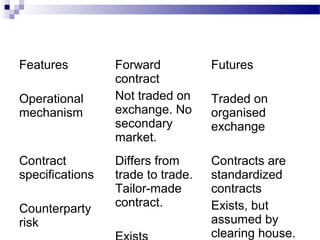
Features
Operational
mechanism

Contract
specifications
Counterparty
risk

Forward
contract
Not traded on
exchange. No
secondary
market.

Futures

Differs from
trade to trade.
Tailor-made
contract.

Contracts are
standardized
contracts
Exists, but
assumed by
clearing house.

Traded on
organised
exchange
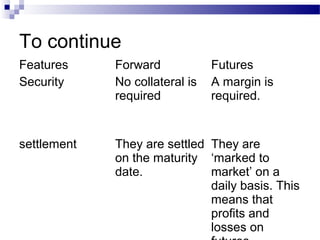
To continue
Features
Security

Forward
No collateral is
required

Futures
A margin is
required.

settlement

They are settled They are
on the maturity ‘marked to
date.
market’ on a
daily basis. This
means that
profits and
losses on
Futures Terminology
Spot Price :- The price at which an
asset trades in Spot Market
 Futures Price :- Price at which the
futures contract trades in the futures
market
 Contract Cycle : - Period over which a
contract trades in the futures market
 Expiry Date :- last day on which the
contract will be traded

Futures Terminology cont.
Contract Size : - Amount of Asset that
has to be delivered under one contract
 Initial Margin :- Deposited at the time a
futures contract is first entered into. It
may about 10% of the value of contract
– it is fixed by the exchange. The
margin has to be posted by both the
parties to the futures contract are
exposed to losses.

Continue
Mark to the Market :- This means that the profits and
losses on futures contracts are settled on a periodic
basis. Ex.
The marking-to-market feature implies that the value
of the futures contract is set to zero at the end of
each trading day.
 Open Interest :- Total number of outstanding
contracts (long/short) at any point of time. It is either
the number of long or short contracts outstanding.
At the beginning of trading cycle open interest is
zero. When maturity date nears open interest
declines sharply.

Settlement of Futures Contracts
The NSCCL ( the National Stock Exchange Clearing Corporation
Limited) clears and settles all the deals executed on the NSE’s
F & O segment. Currently F&O contracts in India are cashsettled.
Daily Mark to Market Settlement



Open Positions are marked to daily settlement price and settled on
T+1 basis
Open positions are reset to the Daily Settlement price

Final Settlement



On the expiry day, open positions are marked to the final settlement
price
Settlement takes place on T+1 basis
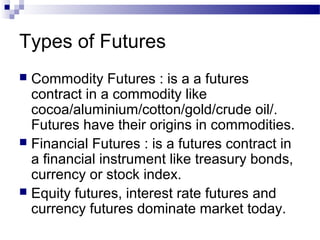
Types of Futures
Commodity Futures : is a a futures
contract in a commodity like
cocoa/aluminium/cotton/gold/crude oil/.
Futures have their origins in commodities.
 Financial Futures : is a futures contract in
a financial instrument like treasury bonds,
currency or stock index.
 Equity futures, interest rate futures and
currency futures dominate market today.

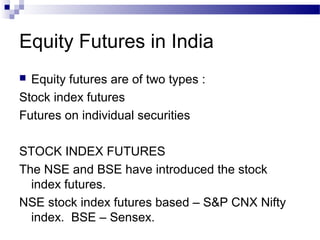
Equity Futures in India
Equity futures are of two types :
Stock index futures
Futures on individual securities


STOCK INDEX FUTURES
The NSE and BSE have introduced the stock
index futures.
NSE stock index futures based – S&P CNX Nifty
index. BSE – Sensex.
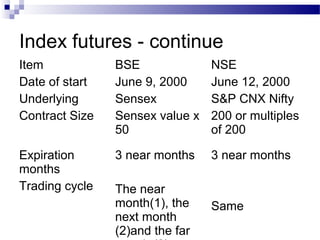
Index futures - continue
Item
Date of start
Underlying
Contract Size

BSE
June 9, 2000
Sensex
Sensex value x
50

NSE
June 12, 2000
S&P CNX Nifty
200 or multiples
of 200

Expiration
months
Trading cycle

3 near months

3 near months

The near
month(1), the
next month
(2)and the far

Same
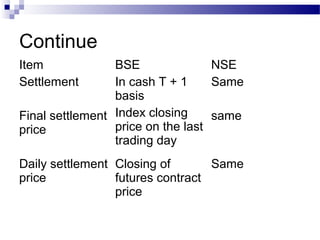
Continue
Item
Settlement

BSE
NSE
In cash T + 1
Same
basis
Final settlement Index closing
same
price on the last
price
trading day
Daily settlement Closing of
Same
price
futures contract
price
Futures on individual securities









Introduced in India in 2001.
Both NSE and BSE have introduced futures on
individual securities.
Three months trading cycle
Currently available for 31 securities.
Daily mark-to-market settlement/final mark-tomarket settlement on expiry of a futures
contract.
T+1 basis
Lot size may be stipulated by the exchange from
time to time.
Pricing of Future contracts
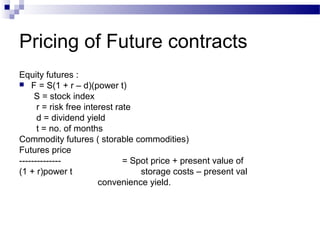
Equity futures :
 F = S(1 + r – d)(power t)
S = stock index
r = risk free interest rate
d = dividend yield
t = no. of months
Commodity futures ( storable commodities)
Futures price
-------------= Spot price + present value of
(1 + r)power t
storage costs – present val
convenience yield.
Use of Futures contracts
Participants in the Futures market are :
Either Hedgers or Speculators.
Hedgers are parties who are exposed to risk because they have a prior
position in the commodity or the financial instrument specified in the
futures contract. They buy or sell futures contract to protect
themselves against the risk of price changes.
Speculators do not have a prior position that they want to hedge
against price fluctuation. Rather they are willing to assume the risk
of price fluctuation in the hope of profiting from them. It attracts them
because
- Leverage
- Ease of transaction
- Lower transaction cost.

Option Contracts
Deferred delivery contracts
 Gives the buyer the right
 not the obligation
 to buy or sell
 a specified underlying
 at a set price
 on or before a specified date

Types of Options
Call Option


Right to BUY ( but not the obligation) a specified
underlying ( commodity or a financial instrument)
at a set price on or before an expiration date.



If a investor feels that the price of gold will
increase in the future, the investor can hedge
the inherent risk by buying a gold call option.
Put Option
Put Option


Right to SELL ( but not the obligation) a
specified underlying ( commodity or a financial
instrument) at a set price on or before an
expiration date.



For example, if an investor expects a decline in
the price of silver in the near future, he can buy
a silver put option.
To continue
A

‘call’ is way to profit if
prices go up.
 A ‘put’ is way to profit if
prices go down.
Options Terminology







Index Options : Index in the underlying security. The
first derivative product to be introduced in the Indian
securities market – ‘index futures’
Stock Options : Options on individual stocks
American Options : Options that can be exercised at
any time
European Option : Option that can be exercised only
on the expiration date
Asian options : option that can be exercised at the
best price prevalent during option duration.
Options Terminology cont.


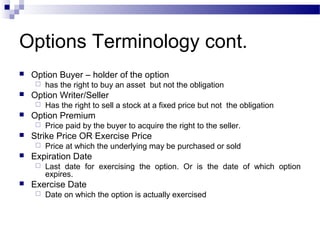
Option Buyer – holder of the option




Option Writer/Seller




Price at which the underlying may be purchased or sold

Expiration Date




Price paid by the buyer to acquire the right to the seller.

Strike Price OR Exercise Price




Has the right to sell a stock at a fixed price but not the obligation

Option Premium




has the right to buy an asset but not the obligation

Last date for exercising the option. Or is the date of which option
expires.

Exercise Date


Date on which the option is actually exercised
Options Terminology cont.


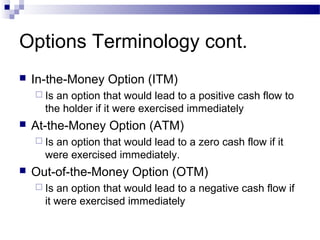
In-the-Money Option (ITM)
 Is

an option that would lead to a positive cash flow to
the holder if it were exercised immediately



At-the-Money Option (ATM)
 Is

an option that would lead to a zero cash flow if it
were exercised immediately.



Out-of-the-Money Option (OTM)
 Is

an option that would lead to a negative cash flow if
it were exercised immediately
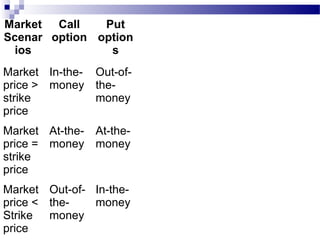
Market Call
Put
Scenar option option
ios
s
Market In-the- Out-ofprice > money thestrike
money
price
Market At-the- At-theprice = money money
strike
price
Market Out-of- In-theprice < themoney
Strike money
price
Settlement of Option Contracts
Daily premium settlement


On T+1 basis
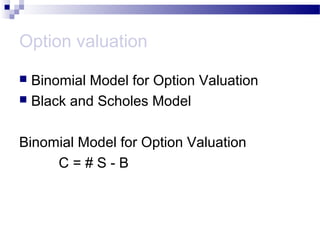
Option valuation
Binomial Model for Option Valuation
 Black and Scholes Model


Binomial Model for Option Valuation
C=#S-B
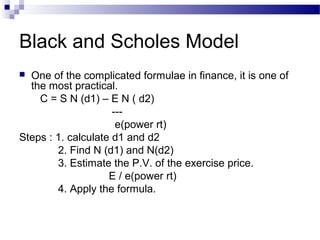
Black and Scholes Model
One of the complicated formulae in finance, it is one of
the most practical.
C = S N (d1) – E N ( d2)
--e(power rt)
Steps : 1. calculate d1 and d2
2. Find N (d1) and N(d2)
3. Estimate the P.V. of the exercise price.
E / e(power rt)
4. Apply the formula.

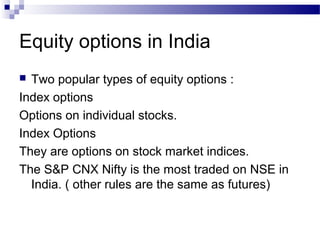
Equity options in India
Two popular types of equity options :
Index options
Options on individual stocks.
Index Options
They are options on stock market indices.
The S&P CNX Nifty is the most traded on NSE in
India. ( other rules are the same as futures)

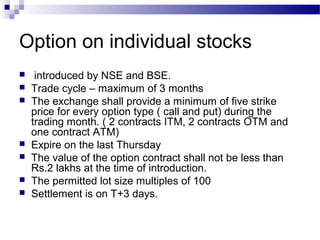
Option on individual stocks









introduced by NSE and BSE.
Trade cycle – maximum of 3 months
The exchange shall provide a minimum of five strike
price for every option type ( call and put) during the
trading month. ( 2 contracts ITM, 2 contracts OTM and
one contract ATM)
Expire on the last Thursday
The value of the option contract shall not be less than
Rs.2 lakhs at the time of introduction.
The permitted lot size multiples of 100
Settlement is on T+3 days.
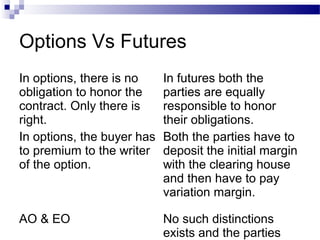
Options Vs Futures
In options, there is no
obligation to honor the
contract. Only there is
right.
In options, the buyer has
to premium to the writer
of the option.

In futures both the
parties are equally
responsible to honor
their obligations.
Both the parties have to
deposit the initial margin
with the clearing house
and then have to pay
variation margin.

AO & EO

No such distinctions
exists and the parties
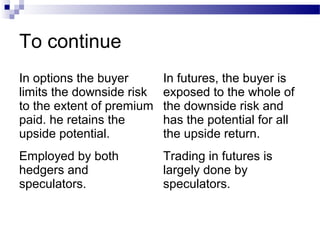
To continue
In options the buyer
limits the downside risk
to the extent of premium
paid. he retains the
upside potential.

In futures, the buyer is
exposed to the whole of
the downside risk and
has the potential for all
the upside return.

Employed by both
hedgers and
speculators.

Trading in futures is
largely done by
speculators.
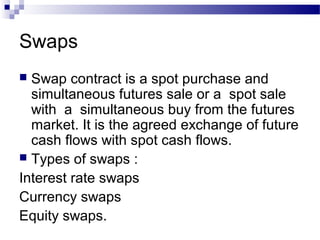
Swaps
Swap contract is a spot purchase and
simultaneous futures sale or a spot sale
with a simultaneous buy from the futures
market. It is the agreed exchange of future
cash flows with spot cash flows.
 Types of swaps :
Interest rate swaps
Currency swaps
Equity swaps.

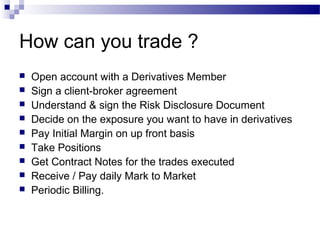
How can you trade ?










Open account with a Derivatives Member
Sign a client-broker agreement
Understand & sign the Risk Disclosure Document
Decide on the exposure you want to have in derivatives
Pay Initial Margin on up front basis
Take Positions
Get Contract Notes for the trades executed
Receive / Pay daily Mark to Market
Periodic Billing.

Derivatives

  • 1.
    Derivatives Derivative is aproduct which does not have any value on its own but it derives its value from some underlying assets
  • 2.
    Types of Derivatives Forward  Futures  Options  Swaps contracts
  • 3.
    Forward Contracts It isone to one bi-partite contract  To be performed in the future  At the terms decided today.  Offer tremendous flexibility to design the contract in terms of the price, quantity, quality ( in case of commodities)  Delivery time  Place 
  • 4.
    Forward contracts -continue For example, if you agree on March 1 buy 15 gms of Gold on June 1 at a price of Rs.870 per gm from a goldsmith, you have bought forward gold or you are long forward gold. Whereas the goldsmith has sold forward gold or is short forward gold. No money or gold changes hand when the deal is signed. Short position – which commits the seller to deliver an item at the contracted price on maturity Long position – which commits the buyer to purchase an item at the contracted price on maturity.
  • 5.
    Futures Agreement Between twoparties  To Buy or sell an asset  At a certain time in the future  At a certain price  Every futures contract is a forward contract but it is a standardised contract. 
  • 6.
    Futures Vs Forwardcontracts The key difference between OPTION CONTRACT and FORWARD & FUTURES contracts is: The holder of a option enjoys the right to buy or sell. A forward or futures contract imposes a firm obligation to go through the transaction. The forward or futures contract is not an investment because no cash is paid to buy an asset. It is just commitment to do a transaction in future.
  • 7.
    Features Operational mechanism Contract specifications Counterparty risk Forward contract Not traded on exchange.No secondary market. Futures Differs from trade to trade. Tailor-made contract. Contracts are standardized contracts Exists, but assumed by clearing house. Traded on organised exchange
  • 8.
    To continue Features Security Forward No collateralis required Futures A margin is required. settlement They are settled They are on the maturity ‘marked to date. market’ on a daily basis. This means that profits and losses on
  • 9.
    Futures Terminology Spot Price:- The price at which an asset trades in Spot Market  Futures Price :- Price at which the futures contract trades in the futures market  Contract Cycle : - Period over which a contract trades in the futures market  Expiry Date :- last day on which the contract will be traded 
  • 10.
    Futures Terminology cont. ContractSize : - Amount of Asset that has to be delivered under one contract  Initial Margin :- Deposited at the time a futures contract is first entered into. It may about 10% of the value of contract – it is fixed by the exchange. The margin has to be posted by both the parties to the futures contract are exposed to losses. 
  • 11.
    Continue Mark to theMarket :- This means that the profits and losses on futures contracts are settled on a periodic basis. Ex. The marking-to-market feature implies that the value of the futures contract is set to zero at the end of each trading day.  Open Interest :- Total number of outstanding contracts (long/short) at any point of time. It is either the number of long or short contracts outstanding. At the beginning of trading cycle open interest is zero. When maturity date nears open interest declines sharply. 
  • 12.
    Settlement of FuturesContracts The NSCCL ( the National Stock Exchange Clearing Corporation Limited) clears and settles all the deals executed on the NSE’s F & O segment. Currently F&O contracts in India are cashsettled. Daily Mark to Market Settlement   Open Positions are marked to daily settlement price and settled on T+1 basis Open positions are reset to the Daily Settlement price Final Settlement   On the expiry day, open positions are marked to the final settlement price Settlement takes place on T+1 basis
  • 13.
    Types of Futures CommodityFutures : is a a futures contract in a commodity like cocoa/aluminium/cotton/gold/crude oil/. Futures have their origins in commodities.  Financial Futures : is a futures contract in a financial instrument like treasury bonds, currency or stock index.  Equity futures, interest rate futures and currency futures dominate market today. 
  • 14.
    Equity Futures inIndia Equity futures are of two types : Stock index futures Futures on individual securities  STOCK INDEX FUTURES The NSE and BSE have introduced the stock index futures. NSE stock index futures based – S&P CNX Nifty index. BSE – Sensex.
  • 15.
    Index futures -continue Item Date of start Underlying Contract Size BSE June 9, 2000 Sensex Sensex value x 50 NSE June 12, 2000 S&P CNX Nifty 200 or multiples of 200 Expiration months Trading cycle 3 near months 3 near months The near month(1), the next month (2)and the far Same
  • 16.
    Continue Item Settlement BSE NSE In cash T+ 1 Same basis Final settlement Index closing same price on the last price trading day Daily settlement Closing of Same price futures contract price
  • 17.
    Futures on individualsecurities        Introduced in India in 2001. Both NSE and BSE have introduced futures on individual securities. Three months trading cycle Currently available for 31 securities. Daily mark-to-market settlement/final mark-tomarket settlement on expiry of a futures contract. T+1 basis Lot size may be stipulated by the exchange from time to time.
  • 18.
    Pricing of Futurecontracts Equity futures :  F = S(1 + r – d)(power t) S = stock index r = risk free interest rate d = dividend yield t = no. of months Commodity futures ( storable commodities) Futures price -------------= Spot price + present value of (1 + r)power t storage costs – present val convenience yield.
  • 19.
    Use of Futurescontracts Participants in the Futures market are : Either Hedgers or Speculators. Hedgers are parties who are exposed to risk because they have a prior position in the commodity or the financial instrument specified in the futures contract. They buy or sell futures contract to protect themselves against the risk of price changes. Speculators do not have a prior position that they want to hedge against price fluctuation. Rather they are willing to assume the risk of price fluctuation in the hope of profiting from them. It attracts them because - Leverage - Ease of transaction - Lower transaction cost. 
  • 20.
    Option Contracts Deferred deliverycontracts  Gives the buyer the right  not the obligation  to buy or sell  a specified underlying  at a set price  on or before a specified date 
  • 21.
    Types of Options CallOption  Right to BUY ( but not the obligation) a specified underlying ( commodity or a financial instrument) at a set price on or before an expiration date.  If a investor feels that the price of gold will increase in the future, the investor can hedge the inherent risk by buying a gold call option.
  • 22.
    Put Option Put Option  Rightto SELL ( but not the obligation) a specified underlying ( commodity or a financial instrument) at a set price on or before an expiration date.  For example, if an investor expects a decline in the price of silver in the near future, he can buy a silver put option.
  • 23.
    To continue A ‘call’ isway to profit if prices go up.  A ‘put’ is way to profit if prices go down.
  • 24.
    Options Terminology      Index Options: Index in the underlying security. The first derivative product to be introduced in the Indian securities market – ‘index futures’ Stock Options : Options on individual stocks American Options : Options that can be exercised at any time European Option : Option that can be exercised only on the expiration date Asian options : option that can be exercised at the best price prevalent during option duration.
  • 25.
    Options Terminology cont.  OptionBuyer – holder of the option   Option Writer/Seller   Price at which the underlying may be purchased or sold Expiration Date   Price paid by the buyer to acquire the right to the seller. Strike Price OR Exercise Price   Has the right to sell a stock at a fixed price but not the obligation Option Premium   has the right to buy an asset but not the obligation Last date for exercising the option. Or is the date of which option expires. Exercise Date  Date on which the option is actually exercised
  • 26.
    Options Terminology cont.  In-the-MoneyOption (ITM)  Is an option that would lead to a positive cash flow to the holder if it were exercised immediately  At-the-Money Option (ATM)  Is an option that would lead to a zero cash flow if it were exercised immediately.  Out-of-the-Money Option (OTM)  Is an option that would lead to a negative cash flow if it were exercised immediately
  • 27.
    Market Call Put Scenar optionoption ios s Market In-the- Out-ofprice > money thestrike money price Market At-the- At-theprice = money money strike price Market Out-of- In-theprice < themoney Strike money price
  • 28.
    Settlement of OptionContracts Daily premium settlement  On T+1 basis
  • 29.
    Option valuation Binomial Modelfor Option Valuation  Black and Scholes Model  Binomial Model for Option Valuation C=#S-B
  • 30.
    Black and ScholesModel One of the complicated formulae in finance, it is one of the most practical. C = S N (d1) – E N ( d2) --e(power rt) Steps : 1. calculate d1 and d2 2. Find N (d1) and N(d2) 3. Estimate the P.V. of the exercise price. E / e(power rt) 4. Apply the formula. 
  • 31.
    Equity options inIndia Two popular types of equity options : Index options Options on individual stocks. Index Options They are options on stock market indices. The S&P CNX Nifty is the most traded on NSE in India. ( other rules are the same as futures) 
  • 32.
    Option on individualstocks        introduced by NSE and BSE. Trade cycle – maximum of 3 months The exchange shall provide a minimum of five strike price for every option type ( call and put) during the trading month. ( 2 contracts ITM, 2 contracts OTM and one contract ATM) Expire on the last Thursday The value of the option contract shall not be less than Rs.2 lakhs at the time of introduction. The permitted lot size multiples of 100 Settlement is on T+3 days.
  • 33.
    Options Vs Futures Inoptions, there is no obligation to honor the contract. Only there is right. In options, the buyer has to premium to the writer of the option. In futures both the parties are equally responsible to honor their obligations. Both the parties have to deposit the initial margin with the clearing house and then have to pay variation margin. AO & EO No such distinctions exists and the parties
  • 34.
    To continue In optionsthe buyer limits the downside risk to the extent of premium paid. he retains the upside potential. In futures, the buyer is exposed to the whole of the downside risk and has the potential for all the upside return. Employed by both hedgers and speculators. Trading in futures is largely done by speculators.
  • 35.
    Swaps Swap contract isa spot purchase and simultaneous futures sale or a spot sale with a simultaneous buy from the futures market. It is the agreed exchange of future cash flows with spot cash flows.  Types of swaps : Interest rate swaps Currency swaps Equity swaps. 
  • 36.
    How can youtrade ?          Open account with a Derivatives Member Sign a client-broker agreement Understand & sign the Risk Disclosure Document Decide on the exposure you want to have in derivatives Pay Initial Margin on up front basis Take Positions Get Contract Notes for the trades executed Receive / Pay daily Mark to Market Periodic Billing.