Dr.Divya M
Assistant Professor in Commerce
MES Keveeyam College, Valanchery
 The amount which is paid by the option buyer to
the option seller
 Premium
 Computed by demand and supply of the
underlying asset.
 Premium is considered as the value of an option.
 Option valuation refers to determining the fair
amount of the premium.
 On comparing such fair premium with the actual
premium, one can make out whether an option is
underpriced, overpriced or fairly priced
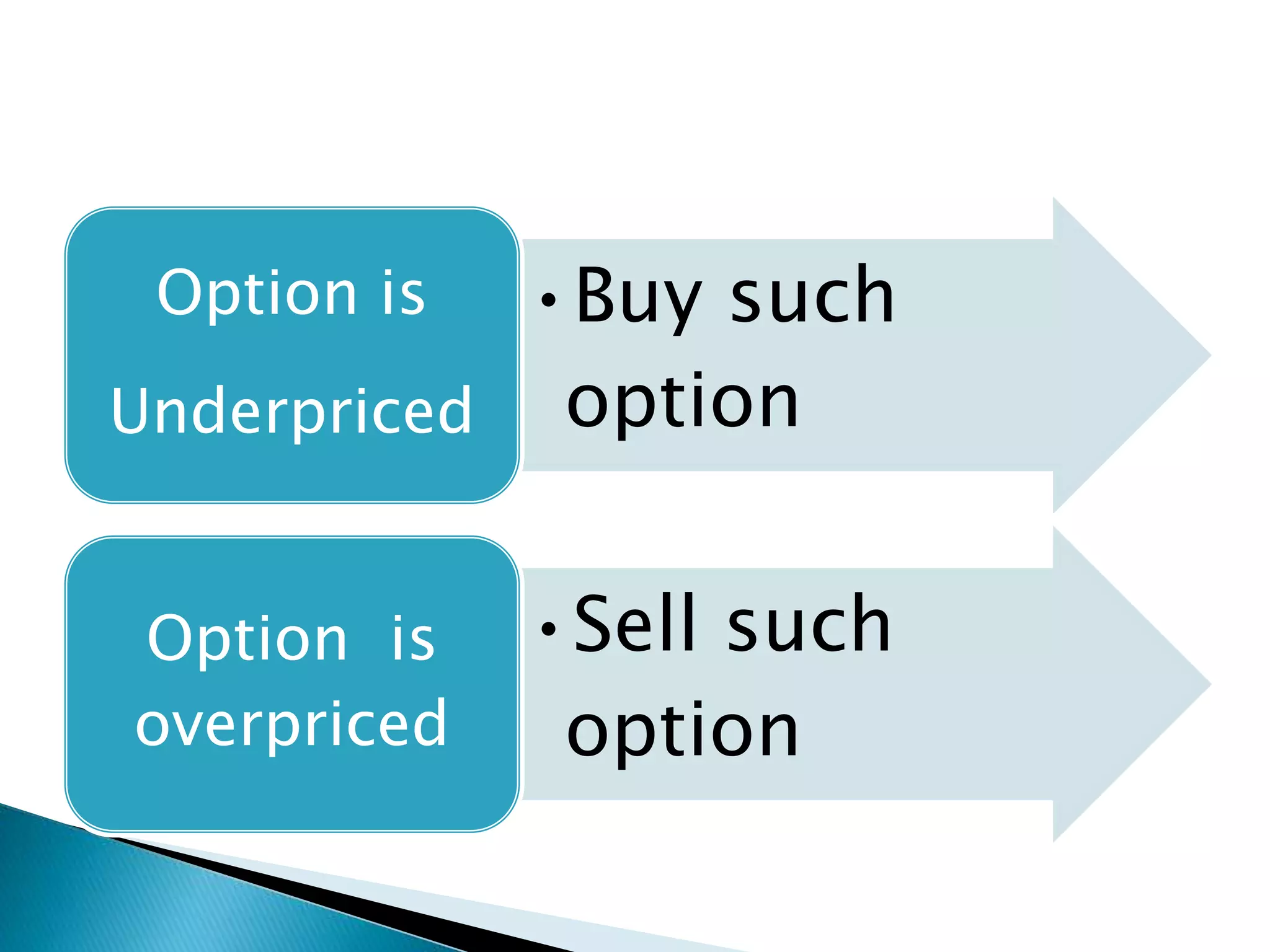
•Buy such
option
Option is
Underpriced
•Sell such
option
Option is
overpriced
 The amount that the option buyer would
receive if the option is exercised
 Value of the option if it is exercised
immediately
 Difference between spot price and strike price
 Intrinsic value of an option can never be
negative
•Intrinsic value=Spot price-strike price
(ITM)
•Intrinsic value=0 (if Strike price>spot
price ) OTM
•Intrinsic value=0 (if spot price=Strike
price ) ATM
Call
option
• Intrinsic value=strike price-Spot price (ITM)
• Intrinsic value=0 (if spot price>Strike price )
OTM
• Intrinsic value=0 (if spot price=Strike price )
ATM
Put
option
 Intrinsic value (mathematically)
 For call option
 For put option
Max(S-E,0)
Max(E-S,0)
 Difference between option premium and
intrinsic value
 Amount by which the market price of an
option exceeds its intrinsic value.
 Extrinsic value
 Premium over parity value
 Speculative value
 Volatile value
 Call /put that is ATM and OTM have time
value, i.e., No intrinsic value
 Time value of an option cannot be negative
 Time value reflects what the traders are
willing to pay for the uncertainty with regard
to the price of the underlying asset
 Time value depends on
◦ Time to expiration of the option
◦ Volatility in the prices of the underlying asset
 Time value of an option depends upon
whether option is in-the-money, at-the-
money or out-of-the money.
 Time value is the maximum for at-the money
options due to the high uncertainty about the
future movement of the price of underlying
asset
 As the option goes deeper in the money or
out of the money, as a result of uncertainty
with regard to price of the underlying asset,
the time value of option diminishes.
 Minimum value of a call
 Maximum value of a call
 Value of the call at expiration
 Value of an option can be zero or positive
 It will never negative (no obligation)
It means
“price of a call option in which stock price (today)is S0, the time to
expiration is T, and the exercise price is E which is greater than or equal
to zero (It cannot have negative value)
For an American option
 Max(S0-E,0) means “ Take the maximum value of
the two arguments zero or (S0-E)
C(So,T,E)>0
C(So,T,E)>Max(S0-E,0)
 Price of the stock
 C(St, E,0)= Max(St-E)
 Minimum value of a put
 Maximum value of a put
 Value of the put at expiration
 Value of an option can be zero or positive
 It will never negative (no obligation)
It means
“price of a put option in which stock price (today)is S0, the time to
expiration is T, and the exercise price is E which is greater than or equal
to zero (It cannot have negative value)
For an American option
 Max(S0-E,0) means “ Take the maximum value of
the two arguments zero or (S0-E)
P(So,T,E)>0
P(So,T,E)>Max(E-S0),0)
 Maximum value is the strike price
 P(St, E,0)= Max(E-St,0)
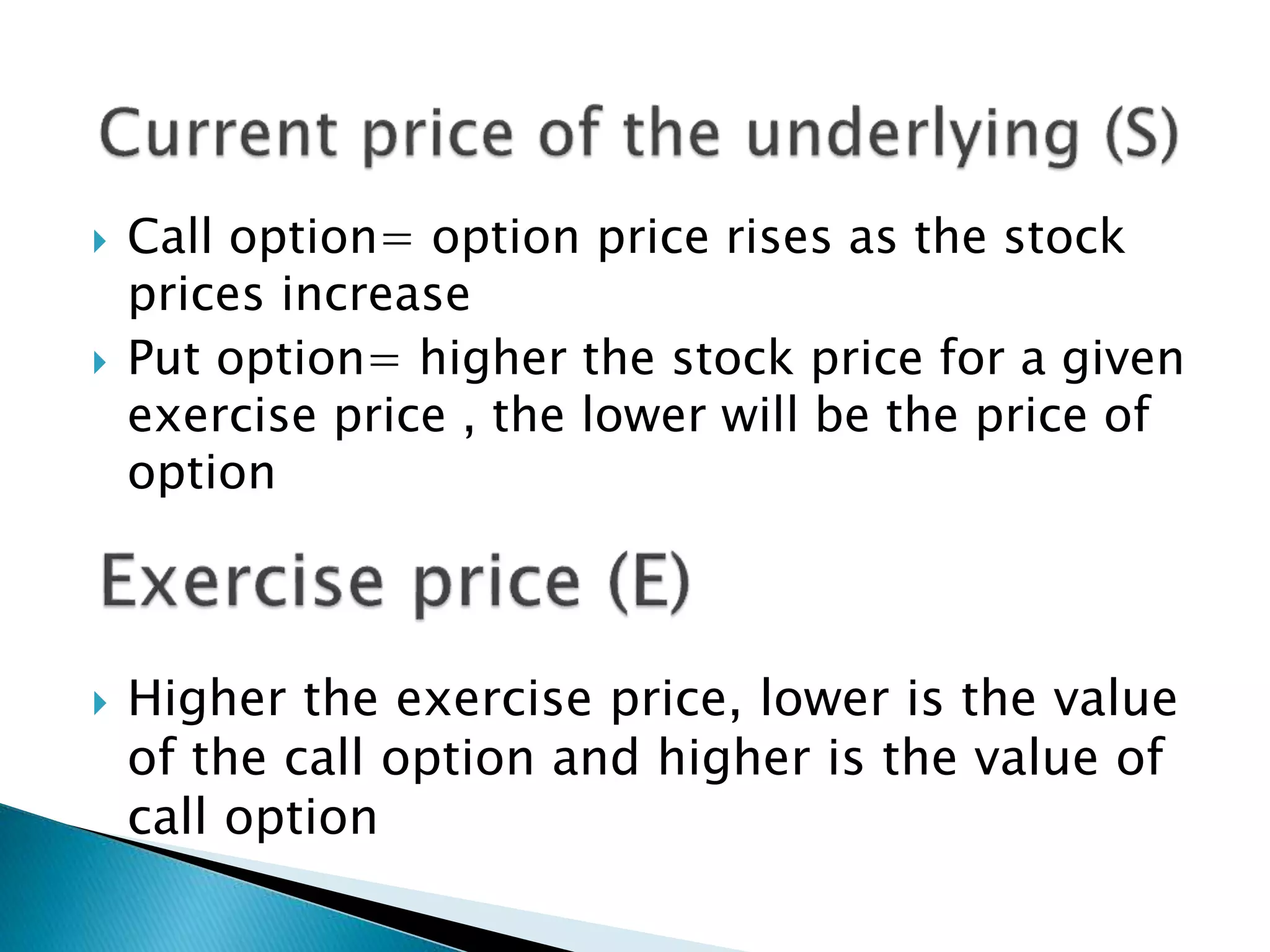
 Current price of the underlying (S)
 Exercise price (E)
 Time to Expiration(T)
 Volatility or variability of the price of the
stock
 Interest rate (r)
 Dividend (D)
 Call option= option price rises as the stock
prices increase
 Put option= higher the stock price for a given
exercise price , the lower will be the price of
option
 Higher the exercise price, lower is the value
of the call option and higher is the value of
call option
 With more time available, there would be
greater chances of achieving the exercise
price
 This is true for both call and put option
 The option with longer life will be valued
more than the option with shorter life
 Volatility refers to the degree to which the
price of a stock or stock index tend to
fluctuate overtime
 Higher volatility makes the call and put
option more expensive
 Higher the interest rate lower the present
value of exercise price. As a result the value
of the call will increase and the value of the
put will decrease.
 Benefit of the ownership accrue only to the
holder of the asset and not to the holder of
the derivative.
 When dividends are paid , it would be more
beneficial to hold the asset than to hold the
call
 The value of the call decreases with increased
dividend.
 The value of put increases with increased
dividend. (retain the ownership of asset till
exercise)
 Parity in the values of European call and
European put
 No arbitrage between the value of a European
call and put options with the same strike
price and expiry date on the same underlying
asset.
 Financial relationship between the price of a
put option and call option on the same
underlying asset with identical strike price
and expiry
 Hans Stoll (1969)
 C+pv(E)=P+S
 C=current market value of the call (eg:3)
 PV(E)=present value of strike price E ,
discounted from expiration
date(110/10%=100)
 P=Current market value of the put(eg:3)
 S=current market value of the underlying
asset
 3+100=3+100
 103=103
 Put call parity principle links the put and call option
prices
 Put call parity relates the prices of call,put,stock and
bornds
 Put call parity demonstrates that given the price of a
call ,one can determine the price of a put
 Put call parity also establishes a link between capital
market,derivatives market and det markets
 Put call parity can be used to check for arbitrage
opportunities resulting from relative mis pricing of
calls and put
 Put call parity may be used to judge relatives
sensitivity to parametre changes
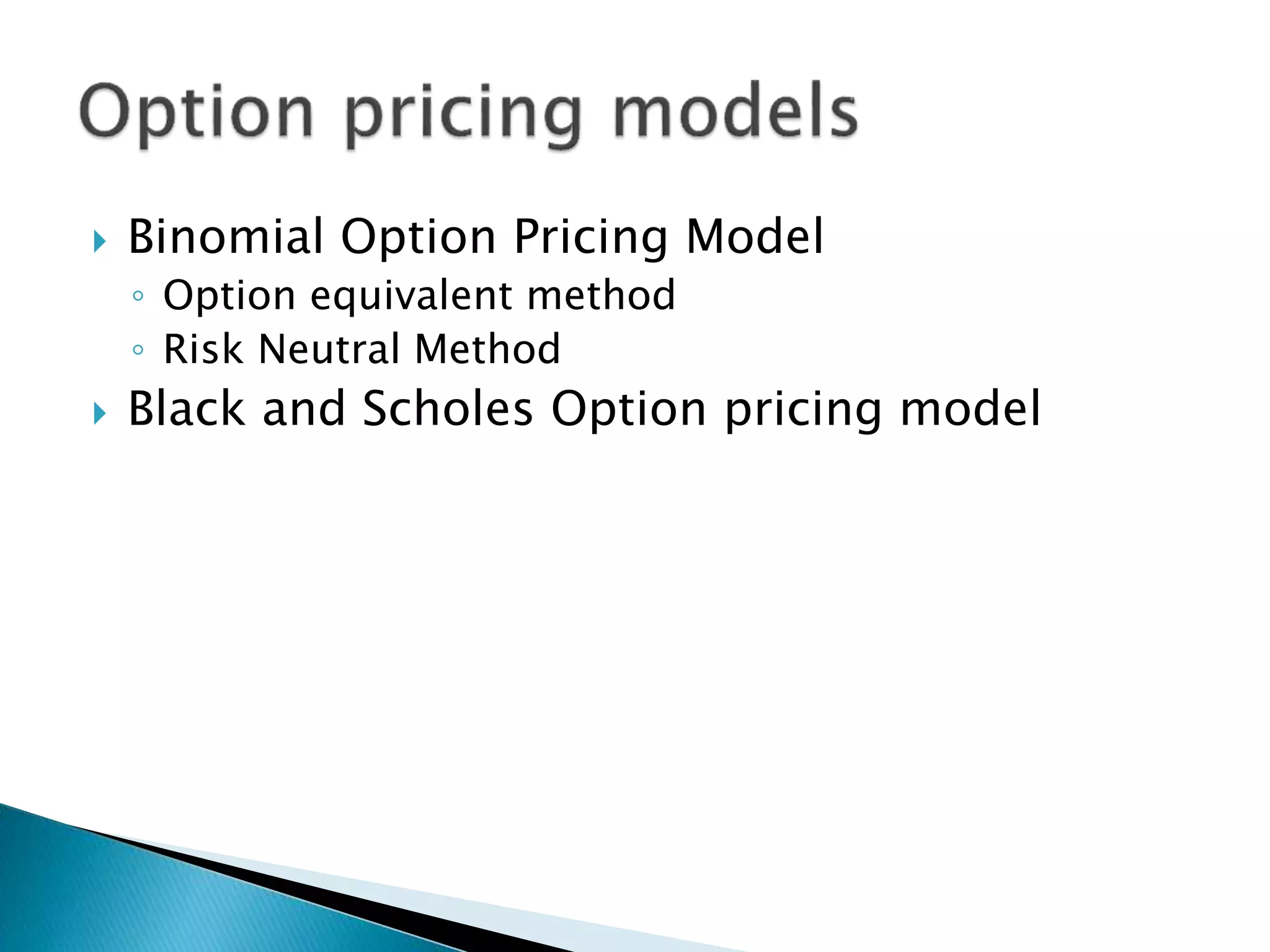
 Binomial Option Pricing Model
◦ Option equivalent method
◦ Risk Neutral Method
 Black and Scholes Option pricing model
 John cox, Stephen Ross and Mark Rubinstein
(1979)
 C-R-R option pricing model
 This model is based on using the
probabilities of stock moving up or down, the
risk free rate and time interval of each step
till expiry
 Using the probabilities a tree would be
constructed and evaluated to finally find the
price of the option. This tree is called
Binomial tree
 Binomial tree states that during a short
interval of time the stock will have only two
possible values- an upside move or downside
move
 Binomial model is a discrete time model
 It is based on binomial probability
distribution
 A binomial probability distribution is a
distribution in which there are two outcomes
 Two state model
 Price of the underlying asset=S0
 Two value
 Su
 Sd
 Each point where two line meet is called a
node
 Node=possible future price of the stock
 the probability that the stock price will move
from one node to another is known as
transition probability
 Discrete time model
 Length of the time interval remains constant
throughout the tree
 Volatility remains constant throughout the
tree
 The probaility of an up movement and down
movement remains same in the entire tree]
 Binomial tree is recombinant
 Option price is calculated by backward
process calculation(from expiration to the
present)
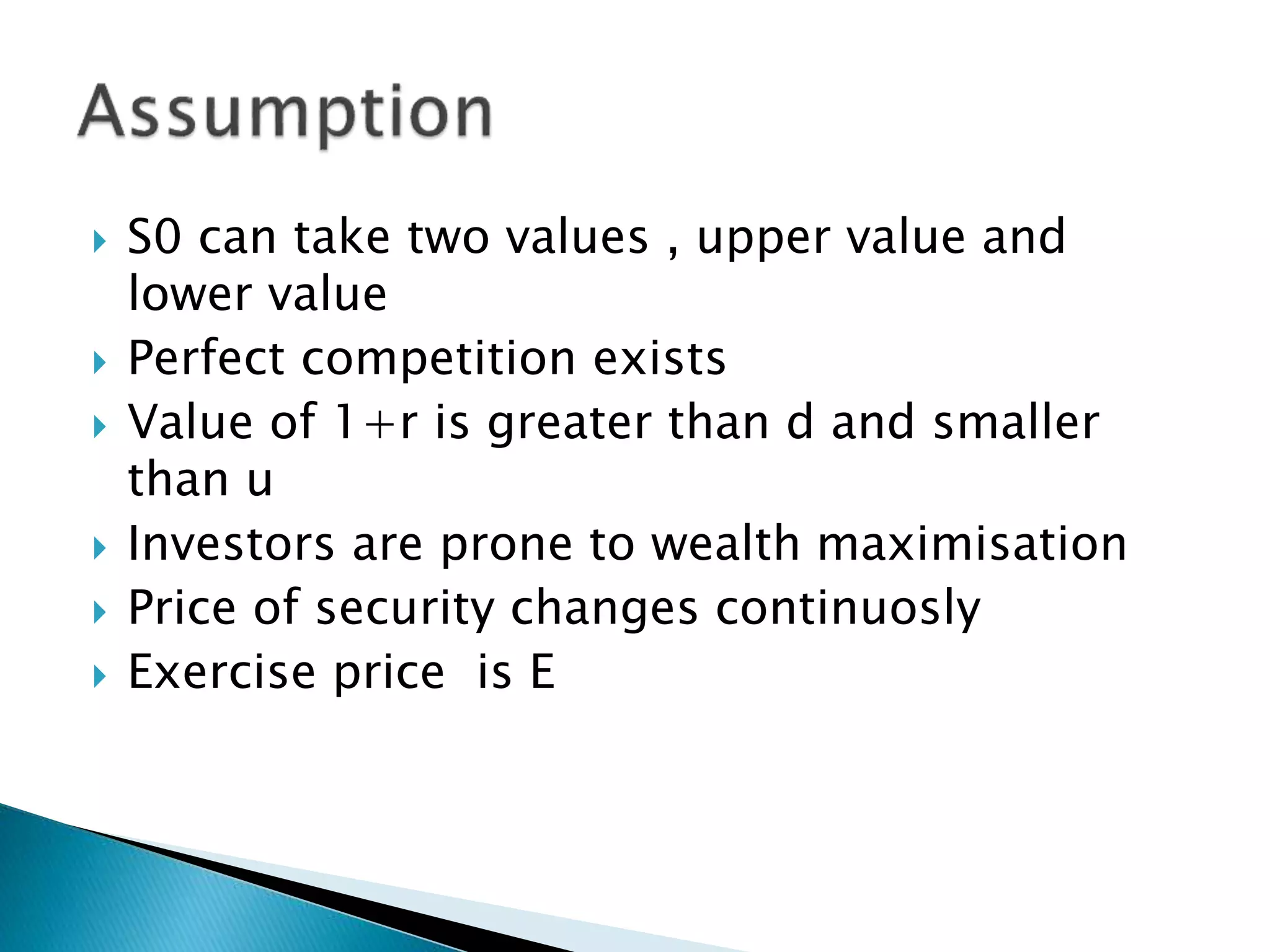
 S0 can take two values , upper value and
lower value
 Perfect competition exists
 Value of 1+r is greater than d and smaller
than u
 Investors are prone to wealth maximisation
 Price of security changes continuosly
 Exercise price is E
 Call option
 Two ways of calculating value of call option
 1. option equivalent method
 2. Risk neutral method
 It assumes that the outcomes for a particular
share on which an option contract has been
written can result into any two values that is a
high value or low value as compared to spot
price for the call option.
 A hedge ratio can help in creating a potfolio
with zero inflow and outflow to maintain
equilibrium price of a call option.
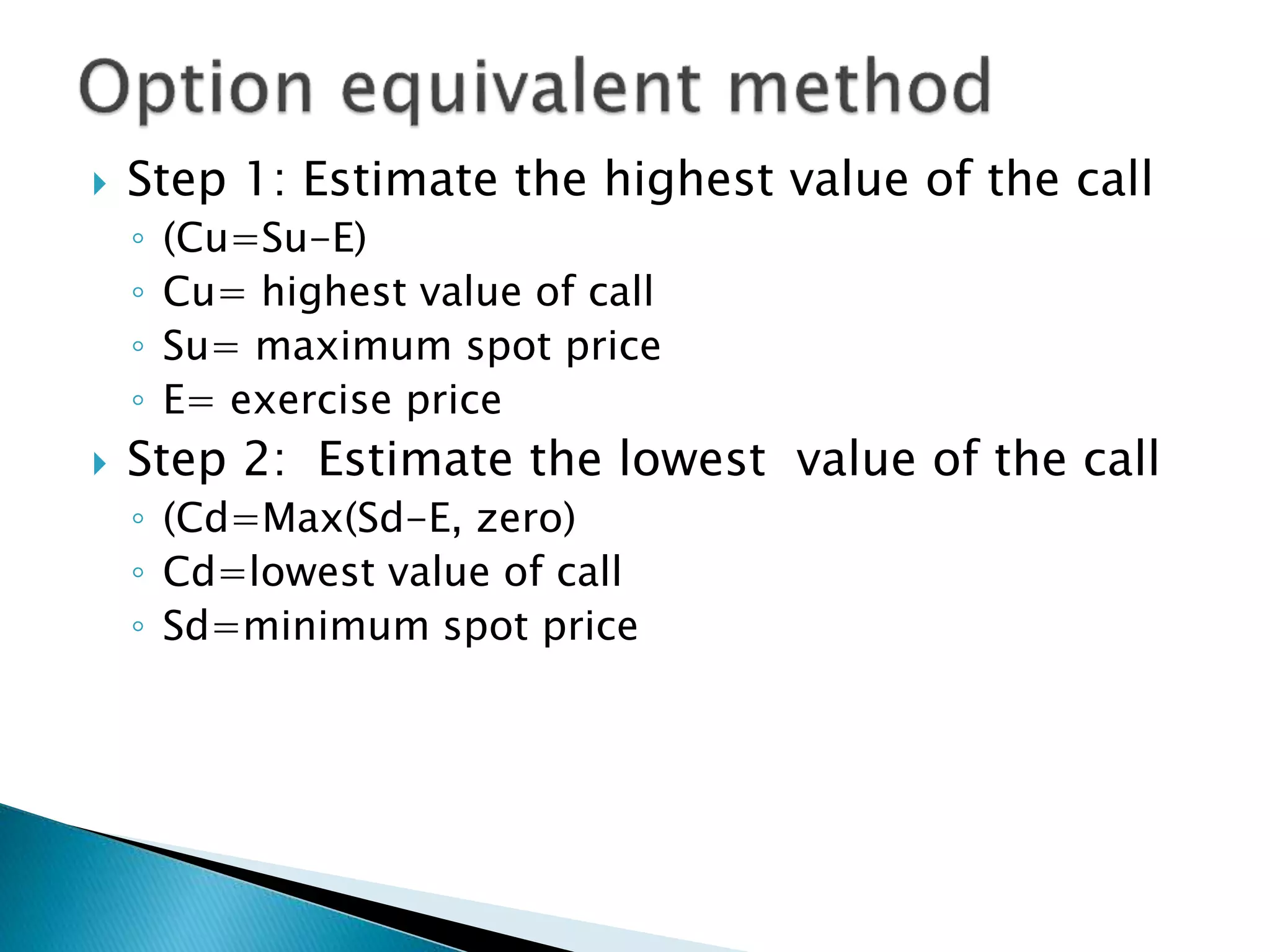
 Step 1: Estimate the highest value of the call
◦ (Cu=Su-E)
◦ Cu= highest value of call
◦ Su= maximum spot price
◦ E= exercise price
 Step 2: Estimate the lowest value of the call
◦ (Cd=Max(Sd-E, zero)
◦ Cd=lowest value of call
◦ Sd=minimum spot price
 Step 3: Calculation of Hedge ratio
H= (Cu-Cd)/ Su-Sd
 Step 4: Estimate the fund to be borrowed
B= (dCu-uCd) / (u-d)*(1+r)
◦ Cu= highest value of call
◦ Cd=lowest value of call
◦ d= lowest multiple of current spot price upto which spot
price of the expiration date might decline
◦ U=hightest multiple of current spot price upto which
spot price of the expiration date might rise
◦ R=risk free rate of return for the effective duration of
call option
 Step 5: Calculate the price of the call by using
t
C=(h*S)-B
h= Hedge Ratio
S= spot price at present
B= Borrowed funds
 Current market price of the shares of A ltd is Rs.100 and an
option with exercise price of Rs.115 for a call option with 12
months to expiration. It is expected that the spot price of
these shares at the end of 3 moths from now might increase
by 60% of the current spot price or it might decline by 20% of
the current spot price. If the risk free rate of return is 10% p.a
find out the price of call option
 As per risk neutral model, the risk free rate of
interest is a weighted average of rate of
return at higher and lower probable price
where the weights used represents the
probabilities of rise and fall in prices
1. Estimate the highest value of the call
Cu=Su-E
2. Estimate the lowest value of the call
Cd=(Maximum(Sd-E),zero)
3. Estimate the probability of increase in the spot
price of the underlying shares on the expiration
date. (It is calculated with the help of expected
return of the investor or the risk free rate of
return)
E(r)=[(p*percentage increase)+(1-p*percentage
decrease)]
4. Calculate the expected future value of the
call option with the help of probability
Cu*p+[cd*(1-p)]
5. Calculate the present value of the call
Future value/(1+r)n
 Current market price of the shares of A ltd is Rs.100 and an
option with exercise price of Rs.115 for a call option with 12
months to expiration. It is expected that the spot price of
these shares at the end of 3 moths from now might increase
by 60% of the current spot price or it might decline by 20% of
the current spot price. If the risk free rate of return is 10% p.a
find out the price of call option
 C+pv(E)=P+S
 Once we calculate the price of call option,
easy to calculate the price of a put option
 P=C-S+Pv(E)
 PV(E) =E /ert
 Fisher Black and Myron Scholes
 Calculate the value of a European call option
 Complex calculus and differential equations
Binomial Model Black Scholes Model
 Computational procedure
(numerical method)
 Flexible model to value
options that are not
regularly traded
 Assumes that % change
in the share price follows
binomial distribution
 American option
 Discrete time model
(specific intervals)
 Analytical approach
 Analytical models that
values options that
regularly traded
 Assumes that % change
in the share price follows
a log normal distribution
 European Option
 Continuous time
basis(infinte number of
intervals)
 Five factors
◦ Asset price
◦ Exercise price
◦ Time remaining foe expiration
◦ Risk free rate of return
◦ Volatility measured by standard deviation
 Variation in the option value with respect to
each determinant of price are denoted by
greek letters
 Delta=change of the value of asset price
 Theta=time left for maturity
 Gamma=change in delta
 Rho=change in risk free rate
 Vega= change in volatility
Valuation of options

Valuation of options

  • 1.
    Dr.Divya M Assistant Professorin Commerce MES Keveeyam College, Valanchery
  • 2.
     The amountwhich is paid by the option buyer to the option seller  Premium  Computed by demand and supply of the underlying asset.  Premium is considered as the value of an option.  Option valuation refers to determining the fair amount of the premium.  On comparing such fair premium with the actual premium, one can make out whether an option is underpriced, overpriced or fairly priced
  • 3.
    •Buy such option Option is Underpriced •Sellsuch option Option is overpriced
  • 4.
     The amountthat the option buyer would receive if the option is exercised  Value of the option if it is exercised immediately  Difference between spot price and strike price  Intrinsic value of an option can never be negative
  • 5.
    •Intrinsic value=Spot price-strikeprice (ITM) •Intrinsic value=0 (if Strike price>spot price ) OTM •Intrinsic value=0 (if spot price=Strike price ) ATM Call option • Intrinsic value=strike price-Spot price (ITM) • Intrinsic value=0 (if spot price>Strike price ) OTM • Intrinsic value=0 (if spot price=Strike price ) ATM Put option
  • 6.
     Intrinsic value(mathematically)  For call option  For put option Max(S-E,0) Max(E-S,0)
  • 7.
     Difference betweenoption premium and intrinsic value  Amount by which the market price of an option exceeds its intrinsic value.  Extrinsic value  Premium over parity value  Speculative value  Volatile value
  • 8.
     Call /putthat is ATM and OTM have time value, i.e., No intrinsic value  Time value of an option cannot be negative  Time value reflects what the traders are willing to pay for the uncertainty with regard to the price of the underlying asset  Time value depends on ◦ Time to expiration of the option ◦ Volatility in the prices of the underlying asset
  • 9.
     Time valueof an option depends upon whether option is in-the-money, at-the- money or out-of-the money.  Time value is the maximum for at-the money options due to the high uncertainty about the future movement of the price of underlying asset  As the option goes deeper in the money or out of the money, as a result of uncertainty with regard to price of the underlying asset, the time value of option diminishes.
  • 10.
     Minimum valueof a call  Maximum value of a call  Value of the call at expiration
  • 11.
     Value ofan option can be zero or positive  It will never negative (no obligation) It means “price of a call option in which stock price (today)is S0, the time to expiration is T, and the exercise price is E which is greater than or equal to zero (It cannot have negative value) For an American option  Max(S0-E,0) means “ Take the maximum value of the two arguments zero or (S0-E) C(So,T,E)>0 C(So,T,E)>Max(S0-E,0)
  • 12.
     Price ofthe stock
  • 13.
     C(St, E,0)=Max(St-E)
  • 14.
     Minimum valueof a put  Maximum value of a put  Value of the put at expiration
  • 15.
     Value ofan option can be zero or positive  It will never negative (no obligation) It means “price of a put option in which stock price (today)is S0, the time to expiration is T, and the exercise price is E which is greater than or equal to zero (It cannot have negative value) For an American option  Max(S0-E,0) means “ Take the maximum value of the two arguments zero or (S0-E) P(So,T,E)>0 P(So,T,E)>Max(E-S0),0)
  • 16.
     Maximum valueis the strike price
  • 17.
     P(St, E,0)=Max(E-St,0)
  • 18.
     Current priceof the underlying (S)  Exercise price (E)  Time to Expiration(T)  Volatility or variability of the price of the stock  Interest rate (r)  Dividend (D)
  • 19.
     Call option=option price rises as the stock prices increase  Put option= higher the stock price for a given exercise price , the lower will be the price of option  Higher the exercise price, lower is the value of the call option and higher is the value of call option
  • 20.
     With moretime available, there would be greater chances of achieving the exercise price  This is true for both call and put option  The option with longer life will be valued more than the option with shorter life
  • 21.
     Volatility refersto the degree to which the price of a stock or stock index tend to fluctuate overtime  Higher volatility makes the call and put option more expensive
  • 22.
     Higher theinterest rate lower the present value of exercise price. As a result the value of the call will increase and the value of the put will decrease.
  • 23.
     Benefit ofthe ownership accrue only to the holder of the asset and not to the holder of the derivative.  When dividends are paid , it would be more beneficial to hold the asset than to hold the call  The value of the call decreases with increased dividend.  The value of put increases with increased dividend. (retain the ownership of asset till exercise)
  • 24.
     Parity inthe values of European call and European put  No arbitrage between the value of a European call and put options with the same strike price and expiry date on the same underlying asset.  Financial relationship between the price of a put option and call option on the same underlying asset with identical strike price and expiry  Hans Stoll (1969)
  • 25.
     C+pv(E)=P+S  C=currentmarket value of the call (eg:3)  PV(E)=present value of strike price E , discounted from expiration date(110/10%=100)  P=Current market value of the put(eg:3)  S=current market value of the underlying asset  3+100=3+100  103=103
  • 28.
     Put callparity principle links the put and call option prices  Put call parity relates the prices of call,put,stock and bornds  Put call parity demonstrates that given the price of a call ,one can determine the price of a put  Put call parity also establishes a link between capital market,derivatives market and det markets  Put call parity can be used to check for arbitrage opportunities resulting from relative mis pricing of calls and put  Put call parity may be used to judge relatives sensitivity to parametre changes
  • 29.
     Binomial OptionPricing Model ◦ Option equivalent method ◦ Risk Neutral Method  Black and Scholes Option pricing model
  • 30.
     John cox,Stephen Ross and Mark Rubinstein (1979)  C-R-R option pricing model  This model is based on using the probabilities of stock moving up or down, the risk free rate and time interval of each step till expiry  Using the probabilities a tree would be constructed and evaluated to finally find the price of the option. This tree is called Binomial tree
  • 31.
     Binomial treestates that during a short interval of time the stock will have only two possible values- an upside move or downside move  Binomial model is a discrete time model  It is based on binomial probability distribution  A binomial probability distribution is a distribution in which there are two outcomes  Two state model
  • 32.
     Price ofthe underlying asset=S0  Two value  Su  Sd
  • 33.
     Each pointwhere two line meet is called a node  Node=possible future price of the stock  the probability that the stock price will move from one node to another is known as transition probability
  • 34.
     Discrete timemodel  Length of the time interval remains constant throughout the tree  Volatility remains constant throughout the tree  The probaility of an up movement and down movement remains same in the entire tree]  Binomial tree is recombinant  Option price is calculated by backward process calculation(from expiration to the present)
  • 35.
     S0 cantake two values , upper value and lower value  Perfect competition exists  Value of 1+r is greater than d and smaller than u  Investors are prone to wealth maximisation  Price of security changes continuosly  Exercise price is E
  • 36.
     Call option Two ways of calculating value of call option  1. option equivalent method  2. Risk neutral method
  • 37.
     It assumesthat the outcomes for a particular share on which an option contract has been written can result into any two values that is a high value or low value as compared to spot price for the call option.  A hedge ratio can help in creating a potfolio with zero inflow and outflow to maintain equilibrium price of a call option.
  • 38.
     Step 1:Estimate the highest value of the call ◦ (Cu=Su-E) ◦ Cu= highest value of call ◦ Su= maximum spot price ◦ E= exercise price  Step 2: Estimate the lowest value of the call ◦ (Cd=Max(Sd-E, zero) ◦ Cd=lowest value of call ◦ Sd=minimum spot price
  • 39.
     Step 3:Calculation of Hedge ratio H= (Cu-Cd)/ Su-Sd  Step 4: Estimate the fund to be borrowed B= (dCu-uCd) / (u-d)*(1+r) ◦ Cu= highest value of call ◦ Cd=lowest value of call ◦ d= lowest multiple of current spot price upto which spot price of the expiration date might decline ◦ U=hightest multiple of current spot price upto which spot price of the expiration date might rise ◦ R=risk free rate of return for the effective duration of call option
  • 40.
     Step 5:Calculate the price of the call by using t C=(h*S)-B h= Hedge Ratio S= spot price at present B= Borrowed funds
  • 41.
     Current marketprice of the shares of A ltd is Rs.100 and an option with exercise price of Rs.115 for a call option with 12 months to expiration. It is expected that the spot price of these shares at the end of 3 moths from now might increase by 60% of the current spot price or it might decline by 20% of the current spot price. If the risk free rate of return is 10% p.a find out the price of call option
  • 42.
     As perrisk neutral model, the risk free rate of interest is a weighted average of rate of return at higher and lower probable price where the weights used represents the probabilities of rise and fall in prices
  • 43.
    1. Estimate thehighest value of the call Cu=Su-E 2. Estimate the lowest value of the call Cd=(Maximum(Sd-E),zero) 3. Estimate the probability of increase in the spot price of the underlying shares on the expiration date. (It is calculated with the help of expected return of the investor or the risk free rate of return) E(r)=[(p*percentage increase)+(1-p*percentage decrease)]
  • 44.
    4. Calculate theexpected future value of the call option with the help of probability Cu*p+[cd*(1-p)] 5. Calculate the present value of the call Future value/(1+r)n
  • 45.
     Current marketprice of the shares of A ltd is Rs.100 and an option with exercise price of Rs.115 for a call option with 12 months to expiration. It is expected that the spot price of these shares at the end of 3 moths from now might increase by 60% of the current spot price or it might decline by 20% of the current spot price. If the risk free rate of return is 10% p.a find out the price of call option
  • 46.
     C+pv(E)=P+S  Oncewe calculate the price of call option, easy to calculate the price of a put option  P=C-S+Pv(E)  PV(E) =E /ert
  • 50.
     Fisher Blackand Myron Scholes  Calculate the value of a European call option  Complex calculus and differential equations
  • 56.
    Binomial Model BlackScholes Model  Computational procedure (numerical method)  Flexible model to value options that are not regularly traded  Assumes that % change in the share price follows binomial distribution  American option  Discrete time model (specific intervals)  Analytical approach  Analytical models that values options that regularly traded  Assumes that % change in the share price follows a log normal distribution  European Option  Continuous time basis(infinte number of intervals)
  • 57.
     Five factors ◦Asset price ◦ Exercise price ◦ Time remaining foe expiration ◦ Risk free rate of return ◦ Volatility measured by standard deviation  Variation in the option value with respect to each determinant of price are denoted by greek letters
  • 58.
     Delta=change ofthe value of asset price  Theta=time left for maturity  Gamma=change in delta  Rho=change in risk free rate  Vega= change in volatility