DERIVATIVES
DR. P. SUGANTHI,
ASSISTANT PROFESSOR,
DEPARTMENT OF MANAGEMENT
STUDIES,
V.V.VANNIAPERUMAL COLLEGE FOR
WOMEN,
VIRUDHUNAGAR
INTRODUCTION
 Derivative is a product whose value is derived
from the value of one or more basic variables,
called bases (underlying asset, index, or
reference rate), in a contractual manner.
 The underlying asset can be equity, forex,
commodity or any other asset.
 In the Indian context the Securities Contracts
(Regulation) Act, 1956, (SC(R)A) defines "derivative"
to include-
A security derived from a debt instrument, share, loan
whether secured or unsecured, risk instrument or
contract for differences or any other form of security. 2.
FACTORS DRIVING THE
GROWTH OF DERIVATIVES
 Increased volatility in asset prices
 Increased integration of national and
international financial markets
 Marked improvement in communication facilities
and sharp decline in their costs
 Development of more sophisticated risk
management tools and hence, a wider choice of
risk management strategies, and
 Innovations in the derivatives markets, leading
to higher returns, reduced risk as well as
transactions costs as compared to individual
FORWARD CONTRACTS
 A forward contract is an agreement to buy or sell
an asset on a specified date for a specified -
One party agrees to buy (long position) and the
other agrees to sell (short position)
 FEATURES:
 bilateral contracts and involves counter-party risk
 custom designed, and hence is unique in terms of
contract size, expiration date and the asset type and
quality.
 contract price is generally not available in public
domain
 the contract has to be settled by delivery of the asset.
LIMITATIONS - FORWARDS
 Lack of centralization of trading,
 Illiquidity, and
 Counterparty risk
FUTURES
 A futures contract is an agreement between two
parties to buy or sell an asset at a certain time in the
future at a certain price. But unlike forward
contracts, the futures contracts are standardized
and exchange traded.
 The standardized items in a futures contract are:
 Quantity of the underlying
 Quality of the underlying
 The date and the month of delivery
 The units of price quotation and minimum price change
 Location of settlement
FUTURES TERMINOLOGY
 Spot price
 Futures price
 Contract cycle
 Expiry date
 Contract size or lot size
 Basis
 Cost of carry
 Initial margin
 Marking-to-market
 Maintenance margin
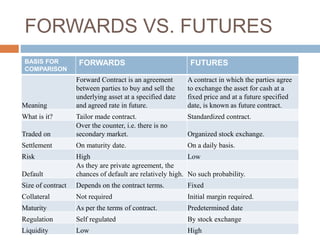
FORWARDS VS. FUTURES
BASIS FOR
COMPARISON
FORWARDS FUTURES
Meaning
Forward Contract is an agreement
between parties to buy and sell the
underlying asset at a specified date
and agreed rate in future.
A contract in which the parties agree
to exchange the asset for cash at a
fixed price and at a future specified
date, is known as future contract.
What is it? Tailor made contract. Standardized contract.
Traded on
Over the counter, i.e. there is no
secondary market. Organized stock exchange.
Settlement On maturity date. On a daily basis.
Risk High Low
Default
As they are private agreement, the
chances of default are relatively high. No such probability.
Size of contract Depends on the contract terms. Fixed
Collateral Not required Initial margin required.
Maturity As per the terms of contract. Predetermined date
Regulation Self regulated By stock exchange
Liquidity Low High
OPTIONS
 An option gives the holder of the option the right
to do something. The holder does not have to
exercise this right. the purchase of an option
requires an up-front payment.
OPTIONS TERMINOLOGY:
 Index and Stock options
 Buyer and Writer
 Call and Put
 Option Price / Premium
 Expiration date
 Strike Price
 American and European
 At-the-money, In-the-money, Out-of-the-money
 Intrinsic Value, Time Value
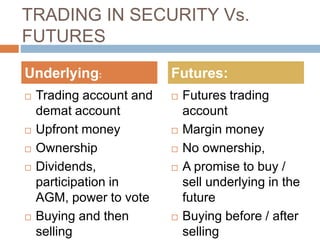
TRADING IN SECURITY Vs.
FUTURES
 Trading account and
demat account
 Upfront money
 Ownership
 Dividends,
participation in
AGM, power to vote
 Buying and then
selling
 Futures trading
account
 Margin money
 No ownership,
 A promise to buy /
sell underlying in the
future
 Buying before / after
selling
Underlying: Futures:
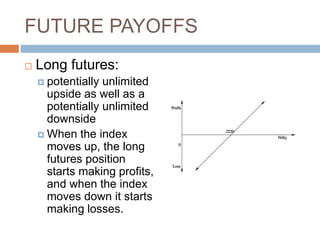
FUTURE PAYOFFS
 Long futures:
 potentially unlimited
upside as well as a
potentially unlimited
downside
 When the index
moves up, the long
futures position
starts making profits,
and when the index
moves down it starts
making losses.
FUTURE PAYOFFS
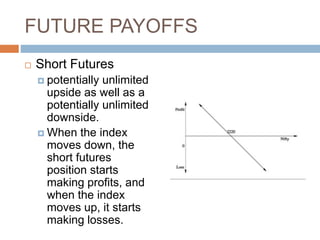
 Short Futures
 potentially unlimited
upside as well as a
potentially unlimited
downside.
 When the index
moves down, the
short futures
position starts
making profits, and
when the index
moves up, it starts
making losses.
APPLICATION OF FUTURES
 Hedging: Long security, sell futures
 value of his security falling from Rs.450 to Rs.390.
enter into an offsetting stock futures position, in this
case, take on a short futures position
 Assume – Spot price – Rs.390, Two-month futures -
Rs.402. Now, the price of his security falls to Rs.350,
will result in a fall in the price of futures
 his short futures position will start making profits. The
loss of Rs.40 incurred on the security he holds, will be
made up by the profits made on his short futures
position
 Hedging is for removal of unwanted exposure, i.e.
unnecessary risk and will make lesser profits. Hope
APPLICATION OF FUTURES
 Speculation: Bullish security, buy futures
 Speculation: Bearish security, sell futures
 Arbitrage: Overpriced futures: buy spot, sell
futures
 Arbitrage: Underpriced futures: buy futures,
sell spot
OPTION PAYOFFS
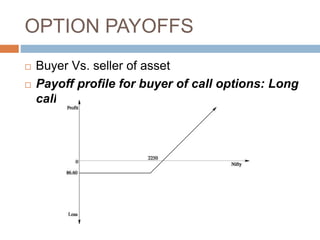
 Buyer Vs. seller of asset
 Payoff profile for buyer of call options: Long
call
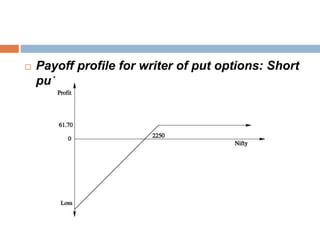
 Payoff profile for writer of put options: Short
put
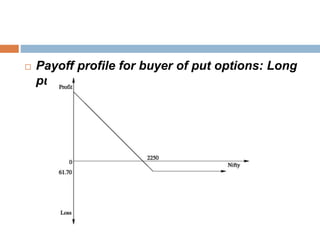
 Payoff profile for buyer of put options: Long
put
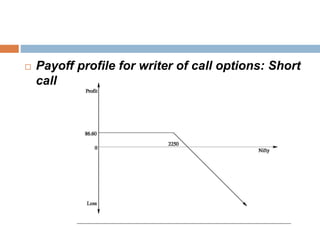
 Payoff profile for writer of call options: Short
call
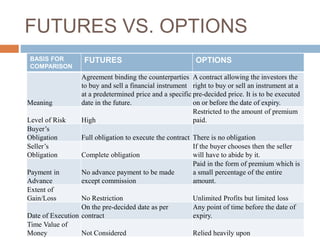
FUTURES VS. OPTIONS
BASIS FOR
COMPARISON
FUTURES OPTIONS
Meaning
Agreement binding the counterparties
to buy and sell a financial instrument
at a predetermined price and a specific
date in the future.
A contract allowing the investors the
right to buy or sell an instrument at a
pre-decided price. It is to be executed
on or before the date of expiry.
Level of Risk High
Restricted to the amount of premium
paid.
Buyer’s
Obligation Full obligation to execute the contract There is no obligation
Seller’s
Obligation Complete obligation
If the buyer chooses then the seller
will have to abide by it.
Payment in
Advance
No advance payment to be made
except commission
Paid in the form of premium which is
a small percentage of the entire
amount.
Extent of
Gain/Loss No Restriction Unlimited Profits but limited loss
Date of Execution
On the pre-decided date as per
contract
Any point of time before the date of
expiry.
Time Value of
Money Not Considered Relied heavily upon
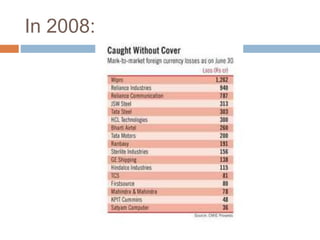
In 2008:
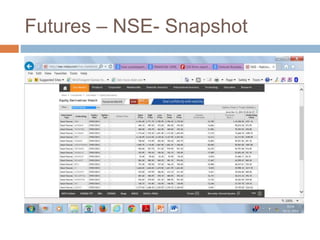
Futures – NSE- Snapshot
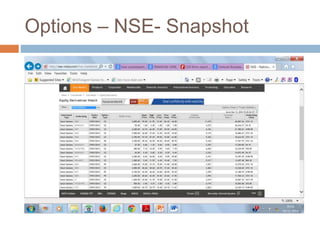
Options – NSE- Snapshot
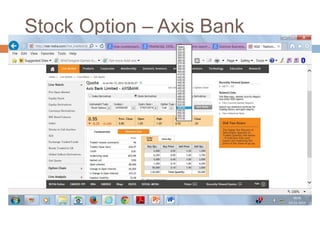
Stock Option – Axis Bank
Derivatives

Derivatives

  • 1.
    DERIVATIVES DR. P. SUGANTHI, ASSISTANTPROFESSOR, DEPARTMENT OF MANAGEMENT STUDIES, V.V.VANNIAPERUMAL COLLEGE FOR WOMEN, VIRUDHUNAGAR
  • 2.
    INTRODUCTION  Derivative isa product whose value is derived from the value of one or more basic variables, called bases (underlying asset, index, or reference rate), in a contractual manner.  The underlying asset can be equity, forex, commodity or any other asset.  In the Indian context the Securities Contracts (Regulation) Act, 1956, (SC(R)A) defines "derivative" to include- A security derived from a debt instrument, share, loan whether secured or unsecured, risk instrument or contract for differences or any other form of security. 2.
  • 3.
    FACTORS DRIVING THE GROWTHOF DERIVATIVES  Increased volatility in asset prices  Increased integration of national and international financial markets  Marked improvement in communication facilities and sharp decline in their costs  Development of more sophisticated risk management tools and hence, a wider choice of risk management strategies, and  Innovations in the derivatives markets, leading to higher returns, reduced risk as well as transactions costs as compared to individual
  • 4.
    FORWARD CONTRACTS  Aforward contract is an agreement to buy or sell an asset on a specified date for a specified - One party agrees to buy (long position) and the other agrees to sell (short position)  FEATURES:  bilateral contracts and involves counter-party risk  custom designed, and hence is unique in terms of contract size, expiration date and the asset type and quality.  contract price is generally not available in public domain  the contract has to be settled by delivery of the asset.
  • 5.
    LIMITATIONS - FORWARDS Lack of centralization of trading,  Illiquidity, and  Counterparty risk
  • 6.
    FUTURES  A futurescontract is an agreement between two parties to buy or sell an asset at a certain time in the future at a certain price. But unlike forward contracts, the futures contracts are standardized and exchange traded.  The standardized items in a futures contract are:  Quantity of the underlying  Quality of the underlying  The date and the month of delivery  The units of price quotation and minimum price change  Location of settlement
  • 7.
    FUTURES TERMINOLOGY  Spotprice  Futures price  Contract cycle  Expiry date  Contract size or lot size  Basis  Cost of carry  Initial margin  Marking-to-market  Maintenance margin
  • 8.
    FORWARDS VS. FUTURES BASISFOR COMPARISON FORWARDS FUTURES Meaning Forward Contract is an agreement between parties to buy and sell the underlying asset at a specified date and agreed rate in future. A contract in which the parties agree to exchange the asset for cash at a fixed price and at a future specified date, is known as future contract. What is it? Tailor made contract. Standardized contract. Traded on Over the counter, i.e. there is no secondary market. Organized stock exchange. Settlement On maturity date. On a daily basis. Risk High Low Default As they are private agreement, the chances of default are relatively high. No such probability. Size of contract Depends on the contract terms. Fixed Collateral Not required Initial margin required. Maturity As per the terms of contract. Predetermined date Regulation Self regulated By stock exchange Liquidity Low High
  • 9.
    OPTIONS  An optiongives the holder of the option the right to do something. The holder does not have to exercise this right. the purchase of an option requires an up-front payment.
  • 10.
    OPTIONS TERMINOLOGY:  Indexand Stock options  Buyer and Writer  Call and Put  Option Price / Premium  Expiration date  Strike Price  American and European  At-the-money, In-the-money, Out-of-the-money  Intrinsic Value, Time Value
  • 11.
    TRADING IN SECURITYVs. FUTURES  Trading account and demat account  Upfront money  Ownership  Dividends, participation in AGM, power to vote  Buying and then selling  Futures trading account  Margin money  No ownership,  A promise to buy / sell underlying in the future  Buying before / after selling Underlying: Futures:
  • 12.
    FUTURE PAYOFFS  Longfutures:  potentially unlimited upside as well as a potentially unlimited downside  When the index moves up, the long futures position starts making profits, and when the index moves down it starts making losses.
  • 13.
    FUTURE PAYOFFS  ShortFutures  potentially unlimited upside as well as a potentially unlimited downside.  When the index moves down, the short futures position starts making profits, and when the index moves up, it starts making losses.
  • 14.
    APPLICATION OF FUTURES Hedging: Long security, sell futures  value of his security falling from Rs.450 to Rs.390. enter into an offsetting stock futures position, in this case, take on a short futures position  Assume – Spot price – Rs.390, Two-month futures - Rs.402. Now, the price of his security falls to Rs.350, will result in a fall in the price of futures  his short futures position will start making profits. The loss of Rs.40 incurred on the security he holds, will be made up by the profits made on his short futures position  Hedging is for removal of unwanted exposure, i.e. unnecessary risk and will make lesser profits. Hope
  • 15.
    APPLICATION OF FUTURES Speculation: Bullish security, buy futures  Speculation: Bearish security, sell futures  Arbitrage: Overpriced futures: buy spot, sell futures  Arbitrage: Underpriced futures: buy futures, sell spot
  • 16.
    OPTION PAYOFFS  BuyerVs. seller of asset  Payoff profile for buyer of call options: Long call
  • 17.
     Payoff profilefor writer of put options: Short put
  • 18.
     Payoff profilefor buyer of put options: Long put
  • 19.
     Payoff profilefor writer of call options: Short call
  • 20.
    FUTURES VS. OPTIONS BASISFOR COMPARISON FUTURES OPTIONS Meaning Agreement binding the counterparties to buy and sell a financial instrument at a predetermined price and a specific date in the future. A contract allowing the investors the right to buy or sell an instrument at a pre-decided price. It is to be executed on or before the date of expiry. Level of Risk High Restricted to the amount of premium paid. Buyer’s Obligation Full obligation to execute the contract There is no obligation Seller’s Obligation Complete obligation If the buyer chooses then the seller will have to abide by it. Payment in Advance No advance payment to be made except commission Paid in the form of premium which is a small percentage of the entire amount. Extent of Gain/Loss No Restriction Unlimited Profits but limited loss Date of Execution On the pre-decided date as per contract Any point of time before the date of expiry. Time Value of Money Not Considered Relied heavily upon
  • 21.
  • 22.
  • 23.
  • 24.