By-Ranpreet Kaur
Derivatives
Derivative
The Securities Contracts (Regulation) Act, 1956 defines
"derivatives" to include:
1. A security derived from a debt instrument, share, loan whether
secured or unsecured, risk instrument, or contract for differences
or any other form of security.
2. A contract which derives its value from the prices, or index of
prices, of underlying securities.
Derivatives
The term “derivatives” is used to refer to financial instruments which
derive their value from some underlying assets. The underlying assets
could be equities (shares), debt (bonds, T-bills, and notes), currencies,
and even indices of these various assets, such as the Nifty 50 Index.
Derivatives derive their names from their respective underlying asset.
 Derivatives can be traded either on a regulated exchange, such as the
NSE or off the exchanges, i.e., directly between the different parties,
which is called “over-the-counter” (OTC) trading. (In India only
exchange traded equity derivatives are permitted under the law.)
Parties deal in Derivatives
 Hedgers
 Arbitrageurs
 Speculators
 Traders
 Exporter/Importer
 Financial Institutions
 Organizations
 Banks
forward contract
A forward is thus an agreement between two parties in which one
party, the buyer, enters into an agreement with the other party,
the seller, that he would buy from the seller an underlying asset on
the expiry date at the forward price. Therefore, it is a commitment
by both the parties to engage in a transaction at a later date with
the price set in advance.
A forward contract or simply a forward is a contract
between two parties to buy or sell an asset at a certain
future date for a certain price that is pre-decided on the date of
the contract.
forward contract
 A forward contract or simply a forward is a contract between
two parties to buy or sell an asset at a certain future date for a
certain price that is pre-decided on the date of the contract.
 The future date is referred to as expiry date and the pre-decided price
is referred to as Forward Price.
 It may be noted that Forwards are private contracts and their terms
are determined by the parties involved.
 This is different from a spot market contract, which involves
immediate payment and immediate transfer of asset.
 Forward contracts are traded only in Over the Counter (OTC)
market and not in stock exchanges. OTC market is a private market
where individuals/institutions can trade through negotiations on a one
to one basis
Conti..
 The long position holder is the buyer of the contract and the
short position holder is the seller of the contract.
 The long position will take the delivery of the asset and pay
the seller of the asset the contract value.
 When it comes to default, both parties are at risk because
typically no cash is exchanged at the beginning of the
transaction.
 However, some transactions do require that one or both sides
put up some form of collateral to protect them from the
defaulted party.
Settling a Forward Contract at
Expiration
 Physical Delivery
 Cash Settlement
Future contract
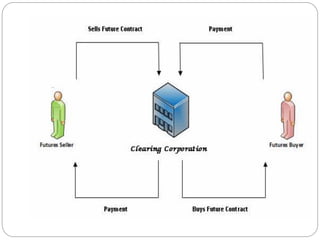
Like a forward contract, a futures contract is an agreement between
two parties in which the buyer agrees to buy an underlying asset
from the seller, at a future date at a price that is agreed upon today.
However, unlike a forward contract, a futures contract is not a
private transaction but gets traded on a recognized
stock exchange. In addition, a futures contract is standardized
by the exchange.
 Although futures contracts require no initial investment, futures
exchanges require both the buyer and seller to post a security
deposit known as margin.
option
 An option is a derivative contract between a buyer and a
seller, where one party (say First Party) gives to the other (say
Second Party) the right, but not the obligation, to buy from (or
sell to) the First Party the underlying asset on or before a specific
day at an agreed-upon price.
 In return for granting the option, the party granting the option
collects a payment from the other party. This payment collected is
called the “premium” or price of the option.
conti
 The right to buy or sell is held by the “option buyer” (also
called the option holder); the party granting the right is the
“option seller” or “option writer”. Unlike forwards and futures
contracts, options require a cash payment (called the premium)
upfront from the option buyer to the option seller. This payment is
called option premium or option price.
 Options can be traded either on the stock exchange or in over the
counter (OTC) markets. Options traded on the exchanges are
backed by the Clearing Corporation thereby minimizing the risk
arising due to default by the counter parties involved. Options
traded in the OTC market however are not backed by the Clearing
Corporation.
Types of options
There are two types of options—call options and put option
A call option is an option granting the right to the buyer of the option to buy the
underlying asset on a specific day at an agreed upon price, but not the obligation to
do so. It is the seller who grants this right to the buyer of the option. It may be
noted that the person who has the right to buy the underlying asset is
known as the “buyer of the call option”.
Since the buyer of the call option has the right (but no obligation) to buy the
underlying asset, he will exercise his right to buy the underlying asset if
and only if the price of the underlying asset in the market is more
than the strike price on or before the expiry date of the contract.
The buyer of the call option does not have an obligation to buy if he
does not want
to.
Put option
 A put option is a contract granting the right to the buyer of the option to sell
the underlying asset on or before a specific day at an agreed upon price,
but not the obligation to do so. It is the seller who grants this right to the
buyer of the option.
 The person who has the right to sell the underlying asset is known as
the “buyer of the put option”. The price at which the buyer has the right
to sell the asset is agreed upon at the time of entering the
contract.
 Since the buyer of the put option has the right (but not the obligation) to
sell the underlying asset, he will exercise his right to sell the
underlying asset if and only if the price of the underlying
asset in the market is less than the strike price on or before
the expiry date of the contract. The buyer of the put option
does not have the obligation to sell if he does not want to.
Differences between futures and
options
 futures ----Both the buyer and the seller are under an obligation to
fulfill the contract.
 options ---The buyer of the option has the right and not an obligation
whereas the seller is under obligation to fulfill the contract if and when
the buyer exercises his right.
 futures ---- The buyer and the seller are subject to unlimited risk of
loss.
 options --- The seller is subjected to unlimited risk of losing whereas
the buyer has limited potential to lose (which is the option premium).
 futures ---- The buyer and the seller have potential to make unlimited
gain or loss.
 options --- The buyer has potential to make unlimited gain while the
seller has a potential to make unlimited gain. On the other hand the
buyer has a limited loss potential and the seller has an unlimited loss
potential.
Types of options
Options can be divided into two different categories depending
upon the primary exercise styles associated with options.
These categories are:
 European Options:European options are options that
can be exercised only on the expiration date.
 American options:American options are options that can
be exercised on any day on or before the expiry date.They
can be exercised by the buyer on any day on or before the
final settlement date or the expiry date.
SWAP
A swap is defined as the derivative contract in which two
parties may swap their financial instruments. These
instruments defined as the underlying asset in which
swap can be occurred with reference to exchange of cash
flows based on a notional principal amount. The parties
to the contract consent to generally change the cash flow
but they do not prefer to exchange the principal.
Conti..
 Like in Interest rate Swap, parties to the contact can swap
their interest payment obligations.Assume one party is
having obligation to pay fixed rate of interest and other party
need to pay flexible rate of interest so they can do swap of
their obligation of payment by keeping principal amount
common.
 In Currency Swap also parties to the contact have option to
swap their currencies as suppose one party has rupee as
currency and he need to make payment in dollar and other
party has dollar but need to pay in rupee so they can swap
their obligations of payment in different currencies.
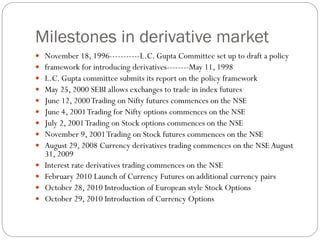
Milestones in derivative market
 November 18, 1996-----------L.C. Gupta Committee set up to draft a policy
 framework for introducing derivatives--------May 11, 1998
 L.C. Gupta committee submits its report on the policy framework
 May 25, 2000 SEBI allows exchanges to trade in index futures
 June 12, 2000Trading on Nifty futures commences on the NSE
 June 4, 2001Trading for Nifty options commences on the NSE
 July 2, 2001Trading on Stock options commences on the NSE
 November 9, 2001Trading on Stock futures commences on the NSE
 August 29, 2008 Currency derivatives trading commences on the NSE August
31, 2009
 Interest rate derivatives trading commences on the NSE
 February 2010 Launch of Currency Futures on additional currency pairs
 October 28, 2010 Introduction of European style Stock Options
 October 29, 2010 Introduction of Currency Options
Importance of Derivatives
 Price Discovery
 Risk Management/Minimization(hedge against risk)
 Liquidity
 Return/profit
 Uncertainty(Future Fluctuations)

Unit-2_Derivatives_Dr._Ranpreet_Kaur.pdf

  • 1.
  • 2.
    Derivative The Securities Contracts(Regulation) Act, 1956 defines "derivatives" to include: 1. A security derived from a debt instrument, share, loan whether secured or unsecured, risk instrument, or contract for differences or any other form of security. 2. A contract which derives its value from the prices, or index of prices, of underlying securities.
  • 3.
    Derivatives The term “derivatives”is used to refer to financial instruments which derive their value from some underlying assets. The underlying assets could be equities (shares), debt (bonds, T-bills, and notes), currencies, and even indices of these various assets, such as the Nifty 50 Index. Derivatives derive their names from their respective underlying asset.  Derivatives can be traded either on a regulated exchange, such as the NSE or off the exchanges, i.e., directly between the different parties, which is called “over-the-counter” (OTC) trading. (In India only exchange traded equity derivatives are permitted under the law.)
  • 4.
    Parties deal inDerivatives  Hedgers  Arbitrageurs  Speculators  Traders  Exporter/Importer  Financial Institutions  Organizations  Banks
  • 5.
    forward contract A forwardis thus an agreement between two parties in which one party, the buyer, enters into an agreement with the other party, the seller, that he would buy from the seller an underlying asset on the expiry date at the forward price. Therefore, it is a commitment by both the parties to engage in a transaction at a later date with the price set in advance. A forward contract or simply a forward is a contract between two parties to buy or sell an asset at a certain future date for a certain price that is pre-decided on the date of the contract.
  • 6.
    forward contract  Aforward contract or simply a forward is a contract between two parties to buy or sell an asset at a certain future date for a certain price that is pre-decided on the date of the contract.  The future date is referred to as expiry date and the pre-decided price is referred to as Forward Price.  It may be noted that Forwards are private contracts and their terms are determined by the parties involved.  This is different from a spot market contract, which involves immediate payment and immediate transfer of asset.  Forward contracts are traded only in Over the Counter (OTC) market and not in stock exchanges. OTC market is a private market where individuals/institutions can trade through negotiations on a one to one basis
  • 7.
    Conti..  The longposition holder is the buyer of the contract and the short position holder is the seller of the contract.  The long position will take the delivery of the asset and pay the seller of the asset the contract value.  When it comes to default, both parties are at risk because typically no cash is exchanged at the beginning of the transaction.  However, some transactions do require that one or both sides put up some form of collateral to protect them from the defaulted party.
  • 8.
    Settling a ForwardContract at Expiration  Physical Delivery  Cash Settlement
  • 9.
    Future contract Like aforward contract, a futures contract is an agreement between two parties in which the buyer agrees to buy an underlying asset from the seller, at a future date at a price that is agreed upon today. However, unlike a forward contract, a futures contract is not a private transaction but gets traded on a recognized stock exchange. In addition, a futures contract is standardized by the exchange.  Although futures contracts require no initial investment, futures exchanges require both the buyer and seller to post a security deposit known as margin.
  • 11.
    option  An optionis a derivative contract between a buyer and a seller, where one party (say First Party) gives to the other (say Second Party) the right, but not the obligation, to buy from (or sell to) the First Party the underlying asset on or before a specific day at an agreed-upon price.  In return for granting the option, the party granting the option collects a payment from the other party. This payment collected is called the “premium” or price of the option.
  • 12.
    conti  The rightto buy or sell is held by the “option buyer” (also called the option holder); the party granting the right is the “option seller” or “option writer”. Unlike forwards and futures contracts, options require a cash payment (called the premium) upfront from the option buyer to the option seller. This payment is called option premium or option price.  Options can be traded either on the stock exchange or in over the counter (OTC) markets. Options traded on the exchanges are backed by the Clearing Corporation thereby minimizing the risk arising due to default by the counter parties involved. Options traded in the OTC market however are not backed by the Clearing Corporation.
  • 13.
    Types of options Thereare two types of options—call options and put option A call option is an option granting the right to the buyer of the option to buy the underlying asset on a specific day at an agreed upon price, but not the obligation to do so. It is the seller who grants this right to the buyer of the option. It may be noted that the person who has the right to buy the underlying asset is known as the “buyer of the call option”. Since the buyer of the call option has the right (but no obligation) to buy the underlying asset, he will exercise his right to buy the underlying asset if and only if the price of the underlying asset in the market is more than the strike price on or before the expiry date of the contract. The buyer of the call option does not have an obligation to buy if he does not want to.
  • 14.
    Put option  Aput option is a contract granting the right to the buyer of the option to sell the underlying asset on or before a specific day at an agreed upon price, but not the obligation to do so. It is the seller who grants this right to the buyer of the option.  The person who has the right to sell the underlying asset is known as the “buyer of the put option”. The price at which the buyer has the right to sell the asset is agreed upon at the time of entering the contract.  Since the buyer of the put option has the right (but not the obligation) to sell the underlying asset, he will exercise his right to sell the underlying asset if and only if the price of the underlying asset in the market is less than the strike price on or before the expiry date of the contract. The buyer of the put option does not have the obligation to sell if he does not want to.
  • 15.
    Differences between futuresand options  futures ----Both the buyer and the seller are under an obligation to fulfill the contract.  options ---The buyer of the option has the right and not an obligation whereas the seller is under obligation to fulfill the contract if and when the buyer exercises his right.  futures ---- The buyer and the seller are subject to unlimited risk of loss.  options --- The seller is subjected to unlimited risk of losing whereas the buyer has limited potential to lose (which is the option premium).  futures ---- The buyer and the seller have potential to make unlimited gain or loss.  options --- The buyer has potential to make unlimited gain while the seller has a potential to make unlimited gain. On the other hand the buyer has a limited loss potential and the seller has an unlimited loss potential.
  • 16.
    Types of options Optionscan be divided into two different categories depending upon the primary exercise styles associated with options. These categories are:  European Options:European options are options that can be exercised only on the expiration date.  American options:American options are options that can be exercised on any day on or before the expiry date.They can be exercised by the buyer on any day on or before the final settlement date or the expiry date.
  • 17.
    SWAP A swap isdefined as the derivative contract in which two parties may swap their financial instruments. These instruments defined as the underlying asset in which swap can be occurred with reference to exchange of cash flows based on a notional principal amount. The parties to the contract consent to generally change the cash flow but they do not prefer to exchange the principal.
  • 18.
    Conti..  Like inInterest rate Swap, parties to the contact can swap their interest payment obligations.Assume one party is having obligation to pay fixed rate of interest and other party need to pay flexible rate of interest so they can do swap of their obligation of payment by keeping principal amount common.  In Currency Swap also parties to the contact have option to swap their currencies as suppose one party has rupee as currency and he need to make payment in dollar and other party has dollar but need to pay in rupee so they can swap their obligations of payment in different currencies.
  • 19.
    Milestones in derivativemarket  November 18, 1996-----------L.C. Gupta Committee set up to draft a policy  framework for introducing derivatives--------May 11, 1998  L.C. Gupta committee submits its report on the policy framework  May 25, 2000 SEBI allows exchanges to trade in index futures  June 12, 2000Trading on Nifty futures commences on the NSE  June 4, 2001Trading for Nifty options commences on the NSE  July 2, 2001Trading on Stock options commences on the NSE  November 9, 2001Trading on Stock futures commences on the NSE  August 29, 2008 Currency derivatives trading commences on the NSE August 31, 2009  Interest rate derivatives trading commences on the NSE  February 2010 Launch of Currency Futures on additional currency pairs  October 28, 2010 Introduction of European style Stock Options  October 29, 2010 Introduction of Currency Options
  • 20.
    Importance of Derivatives Price Discovery  Risk Management/Minimization(hedge against risk)  Liquidity  Return/profit  Uncertainty(Future Fluctuations)