By: Amit Mittal Nitin Mittal
Introduction to Derivatives Derivatives are the financial instruments which derive their value from the value of the underlying asset. The underlying asset can be equity, fixed income instruments, interest rates, foreign exchange or commodities. The price movements of derivative products are related to that of the underlying securities.
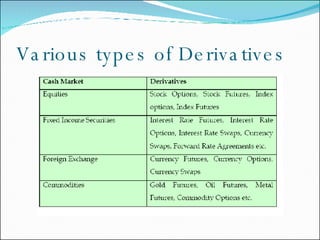
Various types of Derivatives
History of Derivatives Chicago Board of Trade (CBOT) for derivatives trading, became functional in 1848 and by 1865 futures contract in commodities started trading. In 1972 currency futures were introduced, followed by equity options in 1973. Year 1975 saw introduction to Interest Rate futures. Currency Swaps were introduced in 1981 and in 1982 Index futures, Interest Rate swaps and Currency Options were started.  In 1983, Index Options and Options on futures were started.
 
Advantages of using Derivatives Leveraged Positions Lesser transaction costs  Ease of creating positions Derivatives as Risk Management Products Derivatives as Trading Products
Structured or Over The Counter  versus  Exchange traded Derivatives Exchange traded derivatives are standardized contracts which can only be traded on a recognized exchange.  The clearing house of the exchange provides the counterparty guarantee OTC derivatives on the other hand are customized contracts and the terms of the contract are flexible. There is no counterparty guarantee. The liquidity of an OTC derivative can be limited as it is a customized contract.
Derivatives to be discussed Futures Forwards Options
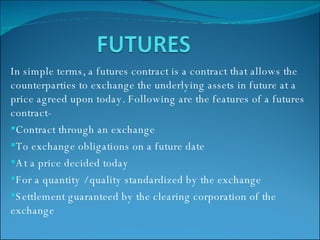
In simple terms, a futures contract is a contract that allows the counterparties to exchange the underlying assets in future at a price agreed upon today. Following are the features of a futures contract- Contract through an exchange To exchange obligations on a future date At a price decided today For a quantity / quality standardized by the exchange Settlement guaranteed by the clearing corporation of the exchange
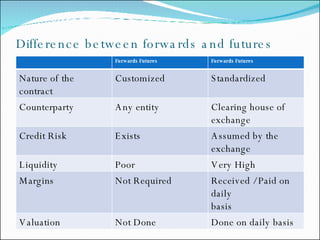
Difference between forwards and futures Forwards Futures Forwards Futures Nature of the contract Customized Standardized Counterparty Any entity  Clearing house of exchange Credit Risk Exists Assumed by the exchange Liquidity Poor Very High Margins Not Required Received / Paid on daily basis Valuation Not Done Done on daily basis
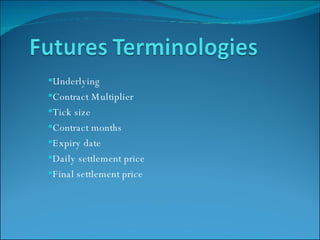
Underlying  Contract Multiplier  Tick size  Contract months Expiry date Daily settlement price Final settlement price
Pricing of Futures Trading of futures Margins required for futures contracts Settlement of futures
 
Forward Contracts Forward Contract is an OTC derivative product. It is a contract between two parties, which enables the buyer to lock a desired value of the underlying that will become applicable at some future date, now. There is no counterparty guarantee provided by any third party. Forward contracts unlike futures, are deliverable contracts (Though there are non-deliverable forward contracts also).
Different Types of Forward Contracts Depending on the underlying asset, the most common types of forward contracts are: Currency Forwards Interest Rate Forwards, and Commodity Forwards
Participants in Forward Contracts Hedgers  – They participate in the forward market with a view to protect or cover an existing exposure in the spot market. Speculators  – These dealers based on their opinion about the market movements take an exposure in the forward market with a view to make profits from the expected movement in the underlying element. Arbitrageurs  – These players neither hedge nor speculate. They try to take advantage of the price differences in the spot and forward markets.
Options Options or option contracts are instruments Right, but not the obligation, is given To buy or sell a specific asset At a specific price On or before a specified date Options can be exchange traded derivatives or even over the counter derivatives.
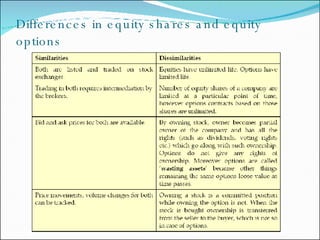
Differences in equity shares and equity options
Option Terminologies Strike Price or Exercise Price Expiration Date Exercise Date Option Buyer Option Seller American option European option Option Premium
Option Classifications Call Option : an option which gives a right to buy the underlying asset at a strike price. Put Option : an option which gives a right to sell the underlying asset at strike price.
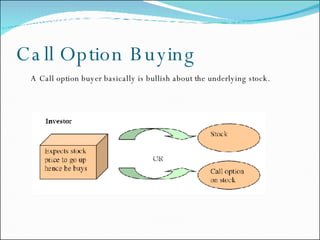
Call Option Buying A Call option buyer basically is bullish about the underlying stock.
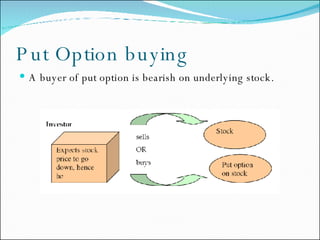
Put Option buying A buyer of put option is bearish on underlying stock.
Both the Call and Put option buyers are buying the rights, that is they are transferring their risks to the sellers of the option.  For this transfer of risk to the sellers, buyers have to compensate by paying  Option Premium .  Option premium is also known as Price of the option, Cost or Value of the option.
Option Selling: Motives for selling options The seller is ready to assume the risk in option exercise. The incentives for the seller to assume that risk are two : Option Premium  – This is the actual amount received by him for selling an option to the buyer. The possibility of non-exercise of option  – In seller’s view the possibility of option being exercised by the buyer may be low.
Factors influencing Option Pricing Time to expiration – greater the time to expiration, higher the value of the options.  Volatility –higher the volatility, higher the value of the options. Risk free Rate of Interest – If interest rate goes up, calls gain in value while puts lose value.
ITM, ATM, OTM Options In the money At the money  Out of money
Intrinsic and Time value of the option Intrinsic value is equal to the amount by which option is in the money. Time value is the difference between market price of the option and intrinsic value.
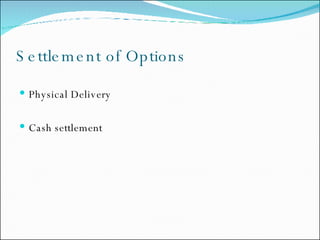
Settlement of Options Physical Delivery Cash settlement
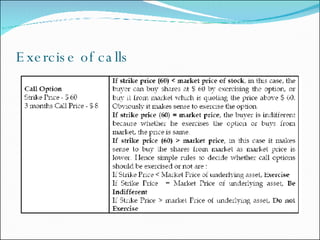
Exercise of calls
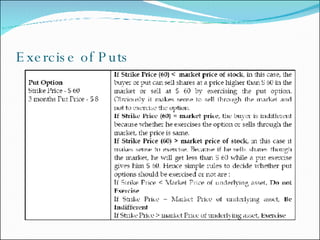
Exercise of Puts
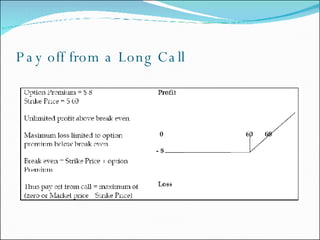
Pay off from a Long Call
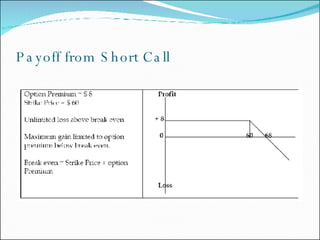
Payoff from Short Call
 
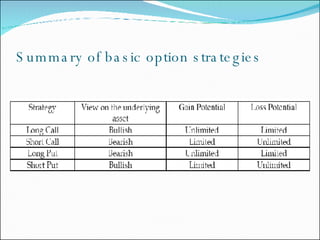
Summary of basic option strategies
Thank You!

Derivatives

  • 1.
    By: Amit MittalNitin Mittal
  • 2.
    Introduction to DerivativesDerivatives are the financial instruments which derive their value from the value of the underlying asset. The underlying asset can be equity, fixed income instruments, interest rates, foreign exchange or commodities. The price movements of derivative products are related to that of the underlying securities.
  • 3.
    Various types ofDerivatives
  • 4.
    History of DerivativesChicago Board of Trade (CBOT) for derivatives trading, became functional in 1848 and by 1865 futures contract in commodities started trading. In 1972 currency futures were introduced, followed by equity options in 1973. Year 1975 saw introduction to Interest Rate futures. Currency Swaps were introduced in 1981 and in 1982 Index futures, Interest Rate swaps and Currency Options were started. In 1983, Index Options and Options on futures were started.
  • 5.
  • 6.
    Advantages of usingDerivatives Leveraged Positions Lesser transaction costs Ease of creating positions Derivatives as Risk Management Products Derivatives as Trading Products
  • 7.
    Structured or OverThe Counter versus Exchange traded Derivatives Exchange traded derivatives are standardized contracts which can only be traded on a recognized exchange. The clearing house of the exchange provides the counterparty guarantee OTC derivatives on the other hand are customized contracts and the terms of the contract are flexible. There is no counterparty guarantee. The liquidity of an OTC derivative can be limited as it is a customized contract.
  • 8.
    Derivatives to bediscussed Futures Forwards Options
  • 9.
    In simple terms,a futures contract is a contract that allows the counterparties to exchange the underlying assets in future at a price agreed upon today. Following are the features of a futures contract- Contract through an exchange To exchange obligations on a future date At a price decided today For a quantity / quality standardized by the exchange Settlement guaranteed by the clearing corporation of the exchange
  • 10.
    Difference between forwardsand futures Forwards Futures Forwards Futures Nature of the contract Customized Standardized Counterparty Any entity Clearing house of exchange Credit Risk Exists Assumed by the exchange Liquidity Poor Very High Margins Not Required Received / Paid on daily basis Valuation Not Done Done on daily basis
  • 11.
    Underlying ContractMultiplier Tick size Contract months Expiry date Daily settlement price Final settlement price
  • 12.
    Pricing of FuturesTrading of futures Margins required for futures contracts Settlement of futures
  • 13.
  • 14.
    Forward Contracts ForwardContract is an OTC derivative product. It is a contract between two parties, which enables the buyer to lock a desired value of the underlying that will become applicable at some future date, now. There is no counterparty guarantee provided by any third party. Forward contracts unlike futures, are deliverable contracts (Though there are non-deliverable forward contracts also).
  • 15.
    Different Types ofForward Contracts Depending on the underlying asset, the most common types of forward contracts are: Currency Forwards Interest Rate Forwards, and Commodity Forwards
  • 16.
    Participants in ForwardContracts Hedgers – They participate in the forward market with a view to protect or cover an existing exposure in the spot market. Speculators – These dealers based on their opinion about the market movements take an exposure in the forward market with a view to make profits from the expected movement in the underlying element. Arbitrageurs – These players neither hedge nor speculate. They try to take advantage of the price differences in the spot and forward markets.
  • 17.
    Options Options oroption contracts are instruments Right, but not the obligation, is given To buy or sell a specific asset At a specific price On or before a specified date Options can be exchange traded derivatives or even over the counter derivatives.
  • 18.
    Differences in equityshares and equity options
  • 19.
    Option Terminologies StrikePrice or Exercise Price Expiration Date Exercise Date Option Buyer Option Seller American option European option Option Premium
  • 20.
    Option Classifications CallOption : an option which gives a right to buy the underlying asset at a strike price. Put Option : an option which gives a right to sell the underlying asset at strike price.
  • 21.
    Call Option BuyingA Call option buyer basically is bullish about the underlying stock.
  • 22.
    Put Option buyingA buyer of put option is bearish on underlying stock.
  • 23.
    Both the Calland Put option buyers are buying the rights, that is they are transferring their risks to the sellers of the option. For this transfer of risk to the sellers, buyers have to compensate by paying Option Premium . Option premium is also known as Price of the option, Cost or Value of the option.
  • 24.
    Option Selling: Motivesfor selling options The seller is ready to assume the risk in option exercise. The incentives for the seller to assume that risk are two : Option Premium – This is the actual amount received by him for selling an option to the buyer. The possibility of non-exercise of option – In seller’s view the possibility of option being exercised by the buyer may be low.
  • 25.
    Factors influencing OptionPricing Time to expiration – greater the time to expiration, higher the value of the options. Volatility –higher the volatility, higher the value of the options. Risk free Rate of Interest – If interest rate goes up, calls gain in value while puts lose value.
  • 26.
    ITM, ATM, OTMOptions In the money At the money Out of money
  • 27.
    Intrinsic and Timevalue of the option Intrinsic value is equal to the amount by which option is in the money. Time value is the difference between market price of the option and intrinsic value.
  • 28.
    Settlement of OptionsPhysical Delivery Cash settlement
  • 29.
  • 30.
  • 31.
    Pay off froma Long Call
  • 32.
  • 33.
  • 34.
    Summary of basicoption strategies
  • 35.