Plastic Forming
What is Plastics?
 Derived from GREEK word “PLASTIKOS” = able to
be shaped or molded.
 Any synthetic organic material that can be
molded under heat and pressure into a shape
that is retained after the heat and pressures are
removed is called plastic.
PLASTICS
Advantages
 Durable
 cheap
 Corrosions resistance
 Light weight
 Reusable and recyclable
 Good insulators
 Resistant to chemicals and
water
 Can be formed into
complex shapes
Disadvantages
 Not friendly to the
environment
 Can be a fire hazard
 Brittle at low
temperature
 Produce toxic fumes
when its burnt
 Low heat resistance
 Softer and less elastic
than metal
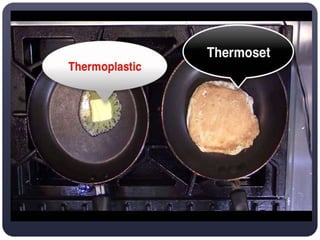
Thermoplastic
 Can be softened and reshaped by heating again
and again
 Many types – soften at different temperatures
 They can be retransformed into thermoplastics by
reheating.
 No chemical changes (curing) takes place during
the molding operations
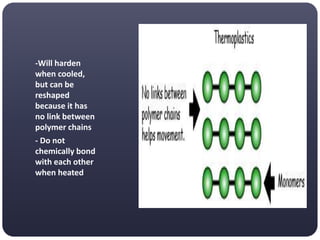
-Will harden
when cooled,
but can be
reshaped
because it has
no link between
polymer chains
- Do not
chemically bond
with each other
when heated
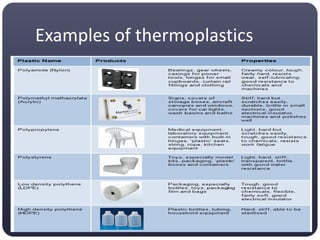
Examples of thermoplastics
Thermosetting plastic (thermoset)
 It can be heated and set, once only
 Cannot be re-softened
 But once hardened they can not be transformed
back to thermosets by application of heat.
 Used where an item needs to withstand heat
 The thermosets are those that undergo a curing
process during heating and shaping, which causes
a permanent chemical change in their molecular
structure.
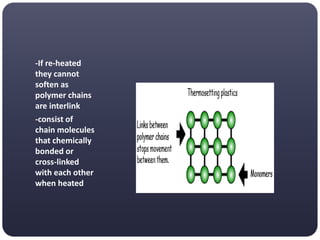
-If re-heated
they cannot
soften as
polymer chains
are interlink
-consist of
chain molecules
that chemically
bonded or
cross-linked
with each other
when heated
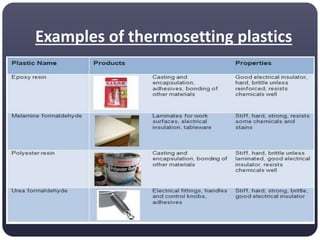
Examples of thermosetting plastics
Plastic Forming Machine
 It is the process of shaping plastic using a rigid frame
or mould.
 It began somewhere between 1940 and 1950 in the
USA
 By the late 1950s, when the rotational moulding
process was better understood, applications for other
industries were developed including road cones,
marine buoys, and car armrests. A process was
developed in Europe in the early 1960s that enabled
large hollow containers to be created in Low
Density Polyethylene(LDPE)
Working Mechanism
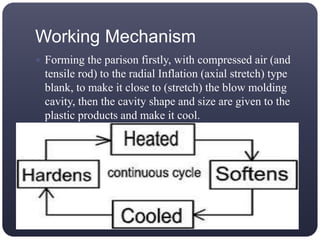
 Forming the parison firstly, with compressed air (and
tensile rod) to the radial Inflation (axial stretch) type
blank, to make it close to (stretch) the blow molding
cavity, then the cavity shape and size are given to the
plastic products and make it cool.
Types of Processes
 Injection molding
 Extrusion molding
 Blow molding
 Vacuum forming
 Compression molding
 Rotational molding

Intro to plastic

  • 1.
  • 2.
    What is Plastics? Derived from GREEK word “PLASTIKOS” = able to be shaped or molded.  Any synthetic organic material that can be molded under heat and pressure into a shape that is retained after the heat and pressures are removed is called plastic.
  • 3.
    PLASTICS Advantages  Durable  cheap Corrosions resistance  Light weight  Reusable and recyclable  Good insulators  Resistant to chemicals and water  Can be formed into complex shapes Disadvantages  Not friendly to the environment  Can be a fire hazard  Brittle at low temperature  Produce toxic fumes when its burnt  Low heat resistance  Softer and less elastic than metal
  • 4.
    Thermoplastic  Can besoftened and reshaped by heating again and again  Many types – soften at different temperatures  They can be retransformed into thermoplastics by reheating.  No chemical changes (curing) takes place during the molding operations
  • 5.
    -Will harden when cooled, butcan be reshaped because it has no link between polymer chains - Do not chemically bond with each other when heated
  • 6.
  • 7.
    Thermosetting plastic (thermoset) It can be heated and set, once only  Cannot be re-softened  But once hardened they can not be transformed back to thermosets by application of heat.  Used where an item needs to withstand heat  The thermosets are those that undergo a curing process during heating and shaping, which causes a permanent chemical change in their molecular structure.
  • 8.
    -If re-heated they cannot softenas polymer chains are interlink -consist of chain molecules that chemically bonded or cross-linked with each other when heated
  • 9.
  • 11.
    Plastic Forming Machine It is the process of shaping plastic using a rigid frame or mould.  It began somewhere between 1940 and 1950 in the USA  By the late 1950s, when the rotational moulding process was better understood, applications for other industries were developed including road cones, marine buoys, and car armrests. A process was developed in Europe in the early 1960s that enabled large hollow containers to be created in Low Density Polyethylene(LDPE)
  • 12.
    Working Mechanism  Formingthe parison firstly, with compressed air (and tensile rod) to the radial Inflation (axial stretch) type blank, to make it close to (stretch) the blow molding cavity, then the cavity shape and size are given to the plastic products and make it cool.
  • 13.
    Types of Processes Injection molding  Extrusion molding  Blow molding  Vacuum forming  Compression molding  Rotational molding