



THERMOPLASTIC
B U I L D I N G C O N S T R U C T I O N & M AT E R I A L S
TOPICS TO COVER UP
• Introduction to plastic.
• Introduction to thermoplastic.
• Properties .
• Types of thermoplastics.
• Application.
• Market Survey
PLASTIC
WHAT IS PLASTIC?
• Material of “New age”.
• Alexander Parkes in England created “Parkesine”, the first man-made plastic.
• Its basic constituent is prepared synthetically or semi- synthetically from monomer.
• Easily machined , cast and joined.
• Ease of manufacturing and versatility ,hardness, elasticity, breaking strength,
temperature resistance, thermal dimensional stability, chemical resistance
• Plastic is a composition of :
Organic polymer+ Carbon+ Oxygen+ Nitrogen+ Sulphur
chalk , starch, ivory dust, zinc oxide (according to the requirement).
• Plastic can be classified as: ELASTOMERS, THERMOSETS & THERMOPLASTICS.
Introduction to Plastic | Introduction to Thermoplastic | Properties | Types of Thermoplastics | Manufacturing Process | Application
WHAT IS PLASTIC?
• ADVANTAGES:
– Light in weight.
– Comes in various shapes and sizes and colors.
– Strong, water resistant, cheap, corrosion and chemical resistant.
– Are used in construction industry for both interior and exterior works.
– Can be remolded and reused.
• DISADVANTAGES :
– Non biodegradable.
– They produce poisonous gaseous production when decomposed or burnt that causes
cancer.
Introduction to Plastic | Introduction to Thermoplastic | Properties | Types of Thermoplastics | Manufacturing Process | Application
THERMOPLASTIC
Introduction to Plastic | Introduction to Thermoplastic | Properties | Types of Thermoplastics | Manufacturing Process | Application
• DEFINITION : These are the plastic that soften on heating without undergoing any chemical change.
They are bonded by covalent bonds and weak van der walls forces hence can be easily
moulded to any shape and can also be reused.
Made from polymer resins.
• Celluloid, which is considered the first thermoplastic, it made its appearance in the mid-
1800s and reigned in the industry for approximately 100 years.
• ADVANTAGES :
– Can be mass produced in low cost.
– Can replace metals.
– Comes in variable thickness and properties according to use.
• DISADVANTAGES :
– They melt at high temperatures.
– They undergo chemical leaching over a period of time and hence affects our health.
Introduction to Plastic | Introduction to Thermoplastic | Properties | Types of Thermoplastics | Application
PROPERTIES
• Can be remoulded and recycled
• Can be degraded to some level.
• Melts before passing to a gaseous state.
• They are brittle and glossy.
• Soluble in certain solvents.
• Swell in the presence of certain solvent.
• Good resistance to creep.
• Also provide sound and heat insulation.
• Ex - pipes, bottles , buckets, glazing etc.
Introduction to Plastic | Introduction to Thermoplastic | Properties | Types of Thermoplastics | Manufacturing Process | Application
TYPES OF THERMOPLASTICS
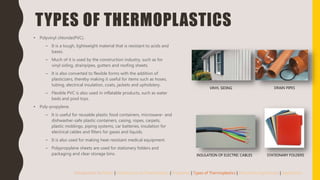
• Polyvinyl chloride(PVC).
– It is a tough, lightweight material that is resistant to acids and
bases.
– Much of it is used by the construction industry, such as for
vinyl siding, drainpipes, gutters and roofing sheets.
– It is also converted to flexible forms with the addition of
plasticizers, thereby making it useful for items such as hoses,
tubing, electrical insulation, coats, jackets and upholstery.
– Flexible PVC is also used in inflatable products, such as water
beds and pool toys.
• Poly-propylene.
– It is useful for reusable plastic food containers, microwave- and
dishwasher-safe plastic containers, casing, ropes, carpets,
plastic moldings, piping systems, car batteries, insulation for
electrical cables and filters for gases and liquids.
– It is also used for making heat-resistant medical equipment.
– Polypropylene sheets are used for stationery folders and
packaging and clear storage bins.
Introduction to Plastic | Introduction to Thermoplastic | Properties | Types of Thermoplastics | Manufacturing Process | Application
VINYL SIDING DRAIN PIPES
INSULATION OF ELECTRIC CABLES STATIONARY FOLDERS
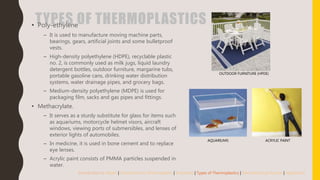
TYPES OF THERMOPLASTICS• Poly-ethylene
– It is used to manufacture moving machine parts,
bearings, gears, artificial joints and some bulletproof
vests.
– High-density polyethylene (HDPE), recyclable plastic
no. 2, is commonly used as milk jugs, liquid laundry
detergent bottles, outdoor furniture, margarine tubs,
portable gasoline cans, drinking water distribution
systems, water drainage pipes, and grocery bags.
– Medium-density polyethylene (MDPE) is used for
packaging film, sacks and gas pipes and fittings.
• Methacrylate.
– It serves as a sturdy substitute for glass for items such
as aquariums, motorcycle helmet visors, aircraft
windows, viewing ports of submersibles, and lenses of
exterior lights of automobiles.
– In medicine, it is used in bone cement and to replace
eye lenses.
– Acrylic paint consists of PMMA particles suspended in
water.
Introduction to Plastic | Introduction to Thermoplastic | Properties | Types of Thermoplastics | Manufacturing Process | Application
OUTDOOR FURNITURE (HPDE)
ACRYLIC PAINTAQUARIUMS
APPLICATION
• AS A BUILDING MATERIAL
Construction professionals select plastic materials based on the following criteria:
 Durability:
Plastic hardware is corrosion resistant and hence can survive harsh weather conditions.
 Cost Effectiveness
 Recyclable:
To reduce harmful waste accumulation on the site.
 Energy Saving:
Plastic consumes less heat than metal, hence the insulating effects of some plastics can decrease
sound pollution level.
 Ease of installation
 Maintenance required- less.
Introduction to Plastic | Introduction to Thermoplastic | Properties | Types of Thermoplastics | Manufacturing Process | Application
APPLICATION
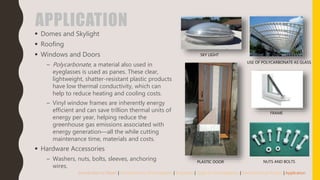
 Domes and Skylight
 Roofing
 Windows and Doors
– Polycarbonate, a material also used in
eyeglasses is used as panes. These clear,
lightweight, shatter-resistant plastic products
have low thermal conductivity, which can
help to reduce heating and cooling costs.
– Vinyl window frames are inherently energy
efficient and can save trillion thermal units of
energy per year, helping reduce the
greenhouse gas emissions associated with
energy generation—all the while cutting
maintenance time, materials and costs.
 Hardware Accessories
– Washers, nuts, bolts, sleeves, anchoring
wires.
Introduction to Plastic | Introduction to Thermoplastic | Properties | Types of Thermoplastics | Manufacturing Process | Application
SKY LIGHT
USE OF POLYCARBONATE AS GLASS
FRAME
NUTS AND BOLTSPLASTIC DOOR
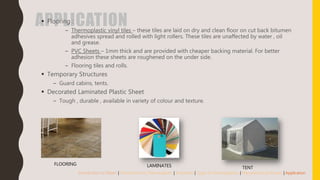
APPLICATION Flooring :
– Thermoplastic vinyl tiles – these tiles are laid on dry and clean floor on cut back bitumen
adhesives spread and rolled with light rollers. These tiles are unaffected by water , oil
and grease.
– PVC Sheets – 1mm thick and are provided with cheaper backing material. For better
adhesion these sheets are roughened on the under side.
– Flooring tiles and rolls.
 Temporary Structures
– Guard cabins, tents.
 Decorated Laminated Plastic Sheet
– Tough , durable , available in variety of colour and texture.
LAMINATESFLOORING
TENT
Introduction to Plastic | Introduction to Thermoplastic | Properties | Types of Thermoplastics | Manufacturing Process | Application
MARKET SURVEY
MARKET RATES
COMPANY LOW MEDIUM HIGH
Sintex 3000 3500 5500
Maruti 3200 4000 4500
Duron 2800 3200 4000
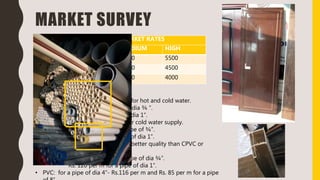
• Max. thickness of panel – 1.5 inch.
• CPVC-yellow in color and is used for hot and cold water.
• Rate: 63.33 per m for pipe of dia ¾ “.
96.66 per m for pipe of dia 1”.
• UPVC: whit in color and is used for cold water supply.
• Rates: rs 53.33 per m for a pipe of ¾”.
Rs 70 per m for a pipe of dia 1”.
• PPR: It is green in color and is of better quality than CPVC or
UPVC.
• Rate: Rs. 63.33 per m for a pipe of dia ¾”.
Rs. 120 per m for a pipe of dia 1”.
• PVC: for a pipe of dia 4”- Rs.116 per m and Rs. 85 per m for a pipe
THANK YOU
P R E S E N T E D B Y :
• SHADAB SAIFI
• JUHI CHAUHAN
• MONICA SAXENA
• KRITIKA JUYAL
• MEGHA SHARMA
• PIYUSH PATHAK

Thermoplastic and its Application

  • 1.
    THERMOPLASTIC B U IL D I N G C O N S T R U C T I O N & M AT E R I A L S
  • 2.
    TOPICS TO COVERUP • Introduction to plastic. • Introduction to thermoplastic. • Properties . • Types of thermoplastics. • Application. • Market Survey
  • 3.
  • 4.
    WHAT IS PLASTIC? •Material of “New age”. • Alexander Parkes in England created “Parkesine”, the first man-made plastic. • Its basic constituent is prepared synthetically or semi- synthetically from monomer. • Easily machined , cast and joined. • Ease of manufacturing and versatility ,hardness, elasticity, breaking strength, temperature resistance, thermal dimensional stability, chemical resistance • Plastic is a composition of : Organic polymer+ Carbon+ Oxygen+ Nitrogen+ Sulphur chalk , starch, ivory dust, zinc oxide (according to the requirement). • Plastic can be classified as: ELASTOMERS, THERMOSETS & THERMOPLASTICS. Introduction to Plastic | Introduction to Thermoplastic | Properties | Types of Thermoplastics | Manufacturing Process | Application
  • 5.
    WHAT IS PLASTIC? •ADVANTAGES: – Light in weight. – Comes in various shapes and sizes and colors. – Strong, water resistant, cheap, corrosion and chemical resistant. – Are used in construction industry for both interior and exterior works. – Can be remolded and reused. • DISADVANTAGES : – Non biodegradable. – They produce poisonous gaseous production when decomposed or burnt that causes cancer. Introduction to Plastic | Introduction to Thermoplastic | Properties | Types of Thermoplastics | Manufacturing Process | Application
  • 6.
    THERMOPLASTIC Introduction to Plastic| Introduction to Thermoplastic | Properties | Types of Thermoplastics | Manufacturing Process | Application
  • 7.
    • DEFINITION :These are the plastic that soften on heating without undergoing any chemical change. They are bonded by covalent bonds and weak van der walls forces hence can be easily moulded to any shape and can also be reused. Made from polymer resins. • Celluloid, which is considered the first thermoplastic, it made its appearance in the mid- 1800s and reigned in the industry for approximately 100 years. • ADVANTAGES : – Can be mass produced in low cost. – Can replace metals. – Comes in variable thickness and properties according to use. • DISADVANTAGES : – They melt at high temperatures. – They undergo chemical leaching over a period of time and hence affects our health. Introduction to Plastic | Introduction to Thermoplastic | Properties | Types of Thermoplastics | Application
  • 8.
    PROPERTIES • Can beremoulded and recycled • Can be degraded to some level. • Melts before passing to a gaseous state. • They are brittle and glossy. • Soluble in certain solvents. • Swell in the presence of certain solvent. • Good resistance to creep. • Also provide sound and heat insulation. • Ex - pipes, bottles , buckets, glazing etc. Introduction to Plastic | Introduction to Thermoplastic | Properties | Types of Thermoplastics | Manufacturing Process | Application
  • 9.
    TYPES OF THERMOPLASTICS •Polyvinyl chloride(PVC). – It is a tough, lightweight material that is resistant to acids and bases. – Much of it is used by the construction industry, such as for vinyl siding, drainpipes, gutters and roofing sheets. – It is also converted to flexible forms with the addition of plasticizers, thereby making it useful for items such as hoses, tubing, electrical insulation, coats, jackets and upholstery. – Flexible PVC is also used in inflatable products, such as water beds and pool toys. • Poly-propylene. – It is useful for reusable plastic food containers, microwave- and dishwasher-safe plastic containers, casing, ropes, carpets, plastic moldings, piping systems, car batteries, insulation for electrical cables and filters for gases and liquids. – It is also used for making heat-resistant medical equipment. – Polypropylene sheets are used for stationery folders and packaging and clear storage bins. Introduction to Plastic | Introduction to Thermoplastic | Properties | Types of Thermoplastics | Manufacturing Process | Application VINYL SIDING DRAIN PIPES INSULATION OF ELECTRIC CABLES STATIONARY FOLDERS
  • 10.
    TYPES OF THERMOPLASTICS•Poly-ethylene – It is used to manufacture moving machine parts, bearings, gears, artificial joints and some bulletproof vests. – High-density polyethylene (HDPE), recyclable plastic no. 2, is commonly used as milk jugs, liquid laundry detergent bottles, outdoor furniture, margarine tubs, portable gasoline cans, drinking water distribution systems, water drainage pipes, and grocery bags. – Medium-density polyethylene (MDPE) is used for packaging film, sacks and gas pipes and fittings. • Methacrylate. – It serves as a sturdy substitute for glass for items such as aquariums, motorcycle helmet visors, aircraft windows, viewing ports of submersibles, and lenses of exterior lights of automobiles. – In medicine, it is used in bone cement and to replace eye lenses. – Acrylic paint consists of PMMA particles suspended in water. Introduction to Plastic | Introduction to Thermoplastic | Properties | Types of Thermoplastics | Manufacturing Process | Application OUTDOOR FURNITURE (HPDE) ACRYLIC PAINTAQUARIUMS
  • 11.
    APPLICATION • AS ABUILDING MATERIAL Construction professionals select plastic materials based on the following criteria:  Durability: Plastic hardware is corrosion resistant and hence can survive harsh weather conditions.  Cost Effectiveness  Recyclable: To reduce harmful waste accumulation on the site.  Energy Saving: Plastic consumes less heat than metal, hence the insulating effects of some plastics can decrease sound pollution level.  Ease of installation  Maintenance required- less. Introduction to Plastic | Introduction to Thermoplastic | Properties | Types of Thermoplastics | Manufacturing Process | Application
  • 12.
    APPLICATION  Domes andSkylight  Roofing  Windows and Doors – Polycarbonate, a material also used in eyeglasses is used as panes. These clear, lightweight, shatter-resistant plastic products have low thermal conductivity, which can help to reduce heating and cooling costs. – Vinyl window frames are inherently energy efficient and can save trillion thermal units of energy per year, helping reduce the greenhouse gas emissions associated with energy generation—all the while cutting maintenance time, materials and costs.  Hardware Accessories – Washers, nuts, bolts, sleeves, anchoring wires. Introduction to Plastic | Introduction to Thermoplastic | Properties | Types of Thermoplastics | Manufacturing Process | Application SKY LIGHT USE OF POLYCARBONATE AS GLASS FRAME NUTS AND BOLTSPLASTIC DOOR
  • 13.
    APPLICATION Flooring : –Thermoplastic vinyl tiles – these tiles are laid on dry and clean floor on cut back bitumen adhesives spread and rolled with light rollers. These tiles are unaffected by water , oil and grease. – PVC Sheets – 1mm thick and are provided with cheaper backing material. For better adhesion these sheets are roughened on the under side. – Flooring tiles and rolls.  Temporary Structures – Guard cabins, tents.  Decorated Laminated Plastic Sheet – Tough , durable , available in variety of colour and texture. LAMINATESFLOORING TENT Introduction to Plastic | Introduction to Thermoplastic | Properties | Types of Thermoplastics | Manufacturing Process | Application
  • 14.
    MARKET SURVEY MARKET RATES COMPANYLOW MEDIUM HIGH Sintex 3000 3500 5500 Maruti 3200 4000 4500 Duron 2800 3200 4000 • Max. thickness of panel – 1.5 inch. • CPVC-yellow in color and is used for hot and cold water. • Rate: 63.33 per m for pipe of dia ¾ “. 96.66 per m for pipe of dia 1”. • UPVC: whit in color and is used for cold water supply. • Rates: rs 53.33 per m for a pipe of ¾”. Rs 70 per m for a pipe of dia 1”. • PPR: It is green in color and is of better quality than CPVC or UPVC. • Rate: Rs. 63.33 per m for a pipe of dia ¾”. Rs. 120 per m for a pipe of dia 1”. • PVC: for a pipe of dia 4”- Rs.116 per m and Rs. 85 per m for a pipe
  • 16.
    THANK YOU P RE S E N T E D B Y : • SHADAB SAIFI • JUHI CHAUHAN • MONICA SAXENA • KRITIKA JUYAL • MEGHA SHARMA • PIYUSH PATHAK