ADDITIVES
1
INTRODUCTION
Additives:
Any Substance that is added generally in small concentration to resins in
order to :
• Alter their properties
• Facilitate processing
• Change the physical, chemical or electrical properties of end products.
• Reduce the cost
2
WHY TO USE ADDITIVES IN PLASTICS ?
• Improve processing conditions
• Increase resin’s stability to oxidation
• Obtain better impact resistance
• Increase or decrease hardness
• Control surface tension
• Facilitate extrusion moulding
• Control blocking
• Reduce cost
• Increase flame resistance.
3
TYPES OF ADDITIVES
4
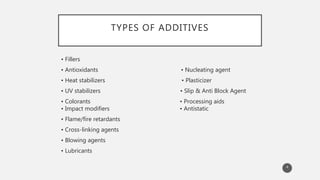
• Fillers
• Antioxidants • Nucleating agent
• Heat stabilizers • Plasticizer
• UV stabilizers • Slip & Anti Block Agent
• Colorants • Processing aids
• Impact modifiers • Antistatic
• Flame/fire retardants
• Cross-linking agents
• Blowing agents
• Lubricants
FILLER
5
• It is used to modify mechanical properties & to reduce the cost.
 EFFECT OF FILLER
• The use of inert fillers can influence the polymer properties in the following ways
:
• Increase in density.
• Increase in modulus of elasticity.
• Lower shrinkage.
• Increase in hardness.
• Increase in HDT.
• Reduction of raw material cost.
• For e.g. Calcium Carbonate
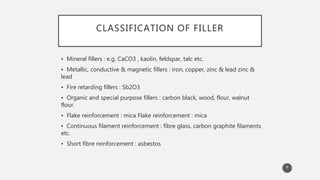
CLASSIFICATION OF FILLER
• Mineral fillers : e.g. CaCO3 , kaolin, feldspar, talc etc.
• Metallic, conductive & magnetic fillers : iron, copper, zinc & lead zinc &
lead
• Fire retarding fillers : Sb2O3
• Organic and special purpose fillers : carbon black, wood, flour, walnut
flour.
• Flake reinforcement : mica Flake reinforcement : mica
• Continuous filament reinforcement : fibre glass, carbon graphite filaments
etc.
• Short fibre reinforcement : asbestos
6
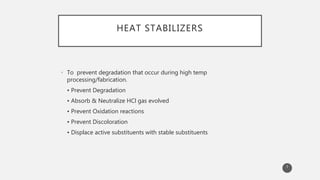
HEAT STABILIZERS
• To prevent degradation that occur during high temp
processing/fabrication.
• Prevent Degradation
• Absorb & Neutralize HCl gas evolved
• Prevent Oxidation reactions
• Prevent Discoloration
• Displace active substituents with stable substituents
7
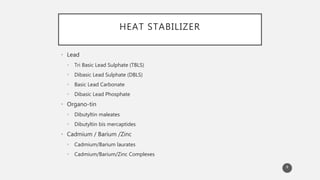
HEAT STABILIZER
• Lead
• Tri Basic Lead Sulphate (TBLS)
• Dibasic Lead Sulphate (DBLS)
• Basic Lead Carbonate
• Dibasic Lead Phosphate
• Organo-tin
• Dibutyltin maleates
• Dibutyltin bis mercaptides
• Cadmium / Barium /Zinc
• Cadmium/Barium laurates
• Cadmium/Barium/Zinc Complexes
8
UV STABILIZERS
• UV stabilizers in plastics usually act by absorbing the UV radiation
preferentially, and dissipating the energy as low-level heat.
• Eg,
Benzophenones – for PE, Polyesters
Benzotriazoles – for PS, Polyesters
Carbon black
9
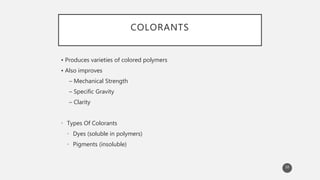
COLORANTS
• Produces varieties of colored polymers
• Also improves
– Mechanical Strength
– Specific Gravity
– Clarity
• Types Of Colorants
• Dyes (soluble in polymers)
• Pigments (insoluble)
10
COLORANTS
• Dyes :
• Impart brilliant transparent color to clear plastics
• Inorganic & Organic
• AZOS for brightness and clarity
• Anthraquinone (AQ) –Good heat transparent weathearibility (Auto
tube light)
• Pigments :
• Diarylide pigment
• Lead chromate
11
ANTISTATIC AGENT
• Prevent electrostatic charges – mostly seen in PE, PP, PS, Nylons,
Polyesters,
Urathenes, Cellulosics, Acrylics & Acrylonitriles
• Because of insulation properties electrical charge may get deposited on
the
surface of the plastics produced during processing.
• This may cause severe damage to the products & equipments.
• It may cause accumulation of dust.
• The accumulation of static charge can be minimized by the use of
antistatic
agents.
• Chemicals added to plastics to reduce built up of electrostatic charges on
the
surface of materials
12
ANTISTATIC AGENT
• Eg,
• Amines
• Quaternary ammonium compounds,
• Phosphates
• Polyethylene glycol esters
13
FIRE RETARDANTS
• Polymers being organic compounds burn or decompose on exposure to
fire,
generates toxic fumes, smoke.
• Eg,
• Inorganic : Zinc borate
• Halogenated : Chlorinate paraffins
• Applicable to polymers to be used in mines, automobiles, air vehicles,
railways,
etc.
14
CROSS LINKING AGENT
• Thermosets cure either on application of heat or cross linking/curing/
hardening
agents.
• In some cases agent triggers off the reaction & therefore linking the resin
molecules or It enters into the parts between molecules and completes
the chain.
• Classification :
• free radical initiator : Isobutyl nitrile, Alkyl peroxide .
• non free radical agents : Isocyanate with polyol
• Used : Manufacture of Thermosets like polyurethane, Urea
Formaldehyde, etc.
15
BLOWING AGENT
• Polymeric foams preparation
• Mechanical
• Chemically
• Substances called blowing agents, which on heating decompose giving N
& CO2.
• Applications: mattresses, pillows, insulation, foam pipes for non-p
conditions.
e.g. Para toluene sulphonyl hydrazide.
16
LUBRICANTS
• Hot processing of polymers need lubricants either internally or externally.
• Internal lubricants decreasing normal cohesive forces between
polymer
molecules good flow conditions by lowering viscosity.
• They function by reducing intra-molecular friction before and during the
melt
formation of the polymer by promoting flow and reducing melt viscosity of
the
polymeric mass.
• They also enhance polymer properties like heat stability, impact strength,
colour
& clarity.
• Eg, Amine Waxes ,Ester Derivatives .
17
LUBRICANTS
• External lubricant don’t let melt to stick to hot surface of processing. By
forming a thin layer at melt-solid interface.
• Prevent friction between polymer melt & metal surface
• Prevent sticking to the metal parts
• They are usually high molecular compounds and have non-polar groups.
• Eg, Metal Stearates, Zinc Stearates, Calcium Stearates, Magnesium
Stearates,
Hydrocarbon waxes
18
IMPACT MODIFIERS
• To enhance the impact properties of certain brittle polymers so as to use
in the field.
• E.g.
• Chlorinated polyethylene EVA are used for PVC.
• SBR is used for polystyrene material.
• EPDM is used for PP ( Bumpers)
• Acrylic rubbers for Poyamides
19
ANTIOXIDANTS
• They inhibit or retard the oxidative degradation of materials at normal or
elevated temperature during processing, storage or service due to
• Heat
• Light
• Chemical Induction
• How it works? – It interrupt the chain reaction by combining with the
free
radicals forming a non reactive products
• E.g, Hindered Phenols or Aromatic Amines
20
PLASTICIZERS
• Improve process ability by reducing Tg
• These are high boiling non-volatile solvents.
• Polar with a high Mol. Wt. ester type organic compounds.
• Reduce internal friction between polymer chain.
• Effect of plasticizer
• Easy melt
• Improve flexibility
• Increase Softness and Flexibility.
• Improve Process ability.
21
PLASTICIZERS
• Primary Plasticizers – These are highly compatible with PVC and can be
used alone.
• Eg, Phthalates, Di-Octyl Phthalate (DOP), Di Iso Octyl Phthalate (DIOP)
Phosphates, Tricresyl Phosphate (TCP).
• Secondary Plasticizers – These are less compatible with resin & and are
usually
employed together with primary plasticizers.
• Eg, Di Octyl Sebacate (DOS), Adipic Acid Polyesters, Epoxidised oil.
22
SLIP & ANTI BLOCK AGENT
• Slip : Reduces coefficient of friction- They are high molecular weight
fatty alcohols.
• Amount (0.05 – 0.2% ) e.g. For film of 25 micron 0.01% of Oleamide.
• Anti block Agents : Prevent adhesion between the film surface
Amount (0.05 -0.2%).
• E.g. – Calcium Carbonate in PVC film – Metal Salts – Fatty Acids – Natural &
Synthetic Waxy Materials.
23
NUCLEATING AGENT
• Aiding transmission of white light in Plastics
• Forms large nos. of nuclei & reduces the size of spherulites.
• Eg. – Sodium, Potassium, Lithium benzoates. – Inorganic Powders – Clays,
Silica Flour.
24
THANK YOU
25

Additives of Polymer, Additives of plastic, Improve properties of Plastic, Types of Additives

  • 1.
  • 2.
    INTRODUCTION Additives: Any Substance thatis added generally in small concentration to resins in order to : • Alter their properties • Facilitate processing • Change the physical, chemical or electrical properties of end products. • Reduce the cost 2
  • 3.
    WHY TO USEADDITIVES IN PLASTICS ? • Improve processing conditions • Increase resin’s stability to oxidation • Obtain better impact resistance • Increase or decrease hardness • Control surface tension • Facilitate extrusion moulding • Control blocking • Reduce cost • Increase flame resistance. 3
  • 4.
    TYPES OF ADDITIVES 4 •Fillers • Antioxidants • Nucleating agent • Heat stabilizers • Plasticizer • UV stabilizers • Slip & Anti Block Agent • Colorants • Processing aids • Impact modifiers • Antistatic • Flame/fire retardants • Cross-linking agents • Blowing agents • Lubricants
  • 5.
    FILLER 5 • It isused to modify mechanical properties & to reduce the cost.  EFFECT OF FILLER • The use of inert fillers can influence the polymer properties in the following ways : • Increase in density. • Increase in modulus of elasticity. • Lower shrinkage. • Increase in hardness. • Increase in HDT. • Reduction of raw material cost. • For e.g. Calcium Carbonate
  • 6.
    CLASSIFICATION OF FILLER •Mineral fillers : e.g. CaCO3 , kaolin, feldspar, talc etc. • Metallic, conductive & magnetic fillers : iron, copper, zinc & lead zinc & lead • Fire retarding fillers : Sb2O3 • Organic and special purpose fillers : carbon black, wood, flour, walnut flour. • Flake reinforcement : mica Flake reinforcement : mica • Continuous filament reinforcement : fibre glass, carbon graphite filaments etc. • Short fibre reinforcement : asbestos 6
  • 7.
    HEAT STABILIZERS • Toprevent degradation that occur during high temp processing/fabrication. • Prevent Degradation • Absorb & Neutralize HCl gas evolved • Prevent Oxidation reactions • Prevent Discoloration • Displace active substituents with stable substituents 7
  • 8.
    HEAT STABILIZER • Lead •Tri Basic Lead Sulphate (TBLS) • Dibasic Lead Sulphate (DBLS) • Basic Lead Carbonate • Dibasic Lead Phosphate • Organo-tin • Dibutyltin maleates • Dibutyltin bis mercaptides • Cadmium / Barium /Zinc • Cadmium/Barium laurates • Cadmium/Barium/Zinc Complexes 8
  • 9.
    UV STABILIZERS • UVstabilizers in plastics usually act by absorbing the UV radiation preferentially, and dissipating the energy as low-level heat. • Eg, Benzophenones – for PE, Polyesters Benzotriazoles – for PS, Polyesters Carbon black 9
  • 10.
    COLORANTS • Produces varietiesof colored polymers • Also improves – Mechanical Strength – Specific Gravity – Clarity • Types Of Colorants • Dyes (soluble in polymers) • Pigments (insoluble) 10
  • 11.
    COLORANTS • Dyes : •Impart brilliant transparent color to clear plastics • Inorganic & Organic • AZOS for brightness and clarity • Anthraquinone (AQ) –Good heat transparent weathearibility (Auto tube light) • Pigments : • Diarylide pigment • Lead chromate 11
  • 12.
    ANTISTATIC AGENT • Preventelectrostatic charges – mostly seen in PE, PP, PS, Nylons, Polyesters, Urathenes, Cellulosics, Acrylics & Acrylonitriles • Because of insulation properties electrical charge may get deposited on the surface of the plastics produced during processing. • This may cause severe damage to the products & equipments. • It may cause accumulation of dust. • The accumulation of static charge can be minimized by the use of antistatic agents. • Chemicals added to plastics to reduce built up of electrostatic charges on the surface of materials 12
  • 13.
    ANTISTATIC AGENT • Eg, •Amines • Quaternary ammonium compounds, • Phosphates • Polyethylene glycol esters 13
  • 14.
    FIRE RETARDANTS • Polymersbeing organic compounds burn or decompose on exposure to fire, generates toxic fumes, smoke. • Eg, • Inorganic : Zinc borate • Halogenated : Chlorinate paraffins • Applicable to polymers to be used in mines, automobiles, air vehicles, railways, etc. 14
  • 15.
    CROSS LINKING AGENT •Thermosets cure either on application of heat or cross linking/curing/ hardening agents. • In some cases agent triggers off the reaction & therefore linking the resin molecules or It enters into the parts between molecules and completes the chain. • Classification : • free radical initiator : Isobutyl nitrile, Alkyl peroxide . • non free radical agents : Isocyanate with polyol • Used : Manufacture of Thermosets like polyurethane, Urea Formaldehyde, etc. 15
  • 16.
    BLOWING AGENT • Polymericfoams preparation • Mechanical • Chemically • Substances called blowing agents, which on heating decompose giving N & CO2. • Applications: mattresses, pillows, insulation, foam pipes for non-p conditions. e.g. Para toluene sulphonyl hydrazide. 16
  • 17.
    LUBRICANTS • Hot processingof polymers need lubricants either internally or externally. • Internal lubricants decreasing normal cohesive forces between polymer molecules good flow conditions by lowering viscosity. • They function by reducing intra-molecular friction before and during the melt formation of the polymer by promoting flow and reducing melt viscosity of the polymeric mass. • They also enhance polymer properties like heat stability, impact strength, colour & clarity. • Eg, Amine Waxes ,Ester Derivatives . 17
  • 18.
    LUBRICANTS • External lubricantdon’t let melt to stick to hot surface of processing. By forming a thin layer at melt-solid interface. • Prevent friction between polymer melt & metal surface • Prevent sticking to the metal parts • They are usually high molecular compounds and have non-polar groups. • Eg, Metal Stearates, Zinc Stearates, Calcium Stearates, Magnesium Stearates, Hydrocarbon waxes 18
  • 19.
    IMPACT MODIFIERS • Toenhance the impact properties of certain brittle polymers so as to use in the field. • E.g. • Chlorinated polyethylene EVA are used for PVC. • SBR is used for polystyrene material. • EPDM is used for PP ( Bumpers) • Acrylic rubbers for Poyamides 19
  • 20.
    ANTIOXIDANTS • They inhibitor retard the oxidative degradation of materials at normal or elevated temperature during processing, storage or service due to • Heat • Light • Chemical Induction • How it works? – It interrupt the chain reaction by combining with the free radicals forming a non reactive products • E.g, Hindered Phenols or Aromatic Amines 20
  • 21.
    PLASTICIZERS • Improve processability by reducing Tg • These are high boiling non-volatile solvents. • Polar with a high Mol. Wt. ester type organic compounds. • Reduce internal friction between polymer chain. • Effect of plasticizer • Easy melt • Improve flexibility • Increase Softness and Flexibility. • Improve Process ability. 21
  • 22.
    PLASTICIZERS • Primary Plasticizers– These are highly compatible with PVC and can be used alone. • Eg, Phthalates, Di-Octyl Phthalate (DOP), Di Iso Octyl Phthalate (DIOP) Phosphates, Tricresyl Phosphate (TCP). • Secondary Plasticizers – These are less compatible with resin & and are usually employed together with primary plasticizers. • Eg, Di Octyl Sebacate (DOS), Adipic Acid Polyesters, Epoxidised oil. 22
  • 23.
    SLIP & ANTIBLOCK AGENT • Slip : Reduces coefficient of friction- They are high molecular weight fatty alcohols. • Amount (0.05 – 0.2% ) e.g. For film of 25 micron 0.01% of Oleamide. • Anti block Agents : Prevent adhesion between the film surface Amount (0.05 -0.2%). • E.g. – Calcium Carbonate in PVC film – Metal Salts – Fatty Acids – Natural & Synthetic Waxy Materials. 23
  • 24.
    NUCLEATING AGENT • Aidingtransmission of white light in Plastics • Forms large nos. of nuclei & reduces the size of spherulites. • Eg. – Sodium, Potassium, Lithium benzoates. – Inorganic Powders – Clays, Silica Flour. 24
  • 25.