Group No 07
HISTORY
 World War II
Development of Thermoplastics, windshields
 1950’s
High volume production and products of
thermoplastics.
Development of blister packaging
Food packaging divisions
 1980’s
Flexibility in size of containers use by the machine
 Today
In addition to packaging, used for refrigerator liners,
shower stalls, bath tubs, automotive trunk liners and
more
What is Thermoforming?
Thermoforming is the process
involving heating a plastic sheet and
forming it into a cavity or over a tool
using vacuum, air pressure, and
mechanical means.
The Mold
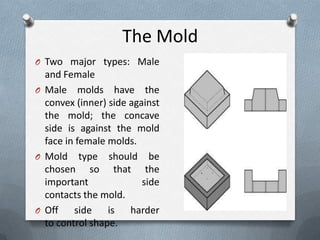
O Two major types: Male
and Female
O Male molds have the
convex (inner) side against
the mold; the concave
side is against the mold
face in female molds.
O Mold type should be
chosen so that the
important side
contacts the mold.
O Off side is harder
to control shape.
TYPES OF THERMOFORMING
O Vacuum Thermoforming
O Pressure Thermoforming
O Mechanical Thermoforming
Vacuum Thermoforming
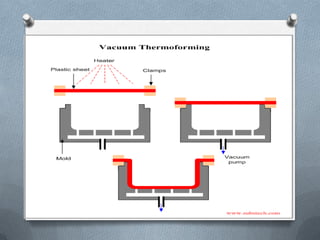
O The process involves shaping a preheated
thermoplastic sheet by means of vacuum
produced in the mold cavity space.
O The atmospheric pressure forces the soft
sheet to deform in conformity with the
cavity shape.
O When the plastic comes into the contact
with the mold surface it cools down and
hardens.
Pressure Thermoforming:-
O The process involves shaping a preheated
thermoplastic sheet by means of air
pressure.
O The air pressure forces the soft sheet to
deform in conformity with the cavity
shape.
O When the plastic comes into the contact
with the mold surface it cools down and
hardens.
Mechanical Thermoforming:-
O The process involves shaping a preheated
thermoplastic sheet by means of a direct
mechanical force.
O A core plug (positive mold) forces the soft
sheet to fill the space between the plug
and the negative mold.
O The process provides precise dimensional
tolerance and surface detailing.
Thermoplastics which may be
processed by the thermoforming
method are:O Polypropylene (PP)
O Polystyrene (PS)
O Polyvinyl Chloride (PVC)
O Low Density Polyethylene (LDPE)
O High Density Polyethylene (HDPE)
O Cellulose Acetate
O Polymethylmethacrylate (PMMA)
O Acrylonitrile-Butadiene-Styrene (ABS)
Advantages
 They are light in weight and durable.
 They reduce per unit packaging cost of the product.
 Thermoforming can be recycled thus technology is
environment friendly
 The plastic used for packaging is stiffer than the average
plastic. This gives the products a high quality packaging.
 The transportation costs are reduced as the packaging
does not add to the total weight of the product.
 Low Temperature required
 Low pressure required
 Fast mold cycle
Disadvantages
 Limited shape complexity.
 Trimming is required .
 Parts with sharp bends and corners are difficult
to be produced.
 Generates greater amount of scrap.
 Internal stresses are produced.
COMPARISION
PRESSURE FORMING VACUUM FORMING
O Mold cycle is fast.
O Sheet can be formed at
lower temperature
because the forcing
pressure is high.
O Greater dimensional
control.
O Mold cycle is slow.
O Sheet can be
formed at
comparatively high
temperature.
O Dimensional
control is less.
WHAT IS EXTRUSION…???
Extrusion is a process used to create
objects of a fixed cross-sectional profile.
A material is pushed or drawn through a
die of the desired cross-section.
HISTORY
O In 1797, Joseph Bramah introduce the first
extrusion process for making lead pipe. It
involved preheating the metal and then
forcing it through a die via a hand driven
plunger. The process wasn't developed
until 1820 when Thomas Burr constructed
the first hydraulic powered press. At this
time the process was called squirting. In
1894, Alexander Dick expanded the
extrusion process to copper and brass
alloys.
PROCESS:
The process begins by heating the stock
material. It is then loaded into the
container in the press. A dummy block is
placed behind it where the ram then
presses on the material to push it out of
the die. If better properties are required
then it may be heat treated or cold
worked.
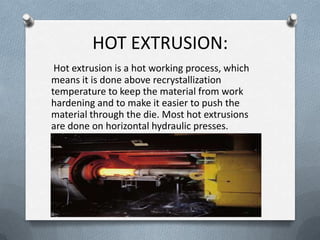
HOT EXTRUSION:
Hot extrusion is a hot working process, which
means it is done above recrystallization
temperature to keep the material from work
hardening and to make it easier to push the
material through the die. Most hot extrusions
are done on horizontal hydraulic presses.
COLD EXTRUSION:
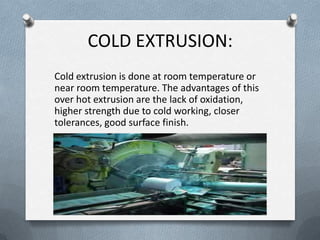
Cold extrusion is done at room temperature or
near room temperature. The advantages of this
over hot extrusion are the lack of oxidation,
higher strength due to cold working, closer
tolerances, good surface finish.
WARM EXTRUSION:
Warm extrusion is done above room
temperature, but below the
recrystallization temperature of the
material. It is usually used to achieve the
proper balance of required forces,
ductility and final extrusion properties.
DIRECT & INDIRECT EXTRUSION:
O DIRECT EXTRUSION:
Direct extrusion also termed as
forward extrusion. If the die is held stationary and
the ram moves towards it then its called “direct
extrusion”.
O INDIRECT EXTRUSION:
Indirect Extrusion is also
termed as backward extrusion. Here the die is not
stationary and moves with respect to the ram.
HYDROSTATIC EXTRUSION:
In the hydrostatic extrusion process the
billet is completely surrounded by a
pressurized liquid, except where the
billet contacts the die. This process can
be done hot, warm, or cold, however the
temperature is limited by the stability of
the fluid used. The process must be
carried out in a sealed cylinder to contain
the hydrostatic medium.
EXTRUSION ADVANTAGES AND
DISADVANTAGES:
ADVANTAGES: DISADVANTA-GES:
O Continuous.
O High production
volumes.
O Low cost.
O Many types of raw
material.
O Surface cracking.
O Internal cracking.
O Uniform cross-
sectional shape
only.
PREFERENCES:
O Low labour cost.
O High production rates.
O Cost efficient.
O No need of surface finish after
extrusion process.
O Minimum scrap losses.
INJECTION MOLDING
HISTORY
O The first man-made plastic was invented in Britain in 1851
by Alexander Parkes. He publicly demonstrated it at the 1862
International Exhibition in London, calling the material he produced
“Parkesine”.
O In 1868, American inventor John Wesley Hyatt developed a plastic
material he named Celluloid, improving on Parkes' invention so that
it could be processed into finished form. Together with his brother
Isaiah, Hyatt patented the first injection molding machine in 1872.
O The industry expanded rapidly in the 1940s because World War
II created a huge demand for inexpensive, mass-produced products.
In 1946, American inventor James Watson Hendry built the first
screw injection machine, which allowed much more precise control
over the speed of injection and the quality of articles produced.
O The plastic injection molding industry has evolved over the years
from producing combs and buttons to producing a vast array of
products for many industries
including automotive, medical, aerospace, consumer products,
toys, plumbing, packaging, and construction.
INJECTION MOLDING
Injection molding is
a manufacturing process for producing
parts from
both thermoplastic and thermosetting plasti
c materials. In injection molding material is
fed into a heated barrel, mixed, and forced
into a mold cavity where it cools and
hardens to the configuration of the mold
cavity.
THERMO PLASTIC:
O A thermoplastic, also known as a
thermo softening plastic, is a
polymer that turns to a liquid
when heated and freezes to a very
glassy state when cooled
sufficiently. Nylon, polyethylene,
and polystyrene are examples
of thermoplastic.
THERMOSETTING PLASTIC:
A thermosetting plastic, also known as a
thermoset, is polymer material that
irreversibly cures. The cure may be done
through heat (generally above 200 C
(392 F)), through a chemical reaction
(two-part epoxy, for example), or
irradiation such as electron beam
processing. epoxy and phenolic are
examples of thermosetting plastics
APPLICATIONS:
Injection molding is used to create many
things such as wire spools, packaging,
bottle caps, automotive dashboards,
pocket combs, and most other plastic
products available today. Injection
molding is the most common method of
part manufacturing. It is ideal for
producing high volumes of the same
object.
COMPARISON B/W INJECTON
MOLDING AND OTHER PROCESS
INJECTION: BLOW:
O Mold remain sealed through
out the process
O In injection molding we keep
air pressure very low because
more air pressure can
diminish the product.
O The injection molding
process ends inside the mold
means the process ends after
the ejection of the mold.
O it employs a narrow nozzle
to coupled with the mold.
O In this process mold remain
split a part.
O In blow molding we force
more and more air into the
mold to expand the plastic to
the limits of the mold cavity.
In this process mold remain
spilt apart
O In blow molding process does
not end inside after the
ejection of the product some
more processes like air
blowing and trimming are
performed.
O It employs die head extrudes
a tube of molten plastic.
APPLICATION IN PAKISTAN
INDUSTRIES
O Siddiqi sons industries.
(Fan parts, Citrus press juicers,
Television parts)
O Arfeen international (pvt) ltd.
O Qismat plastic industry(spare parts of
washing machine, spare pats of fans).
O Universal Engg works(specialize in
plastic and metal products).
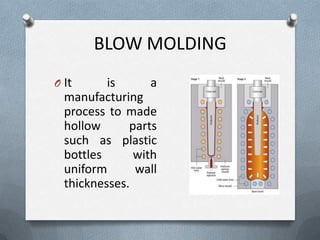
BLOW MOLDING
O It is a
manufacturing
process to made
hollow parts
such as plastic
bottles with
uniform wall
thicknesses.
HISTORY
O Enoch Ferngren and William Kopitke
were the first verified people who used
the Blow Molding Process. The process
principle comes from the idea of
blowing glass. Ferngren and Kopitke
produced a blow molding machine and
sold it to Hartford Empire Company in
1937. This was the beginning of the
commercial blow molding process.
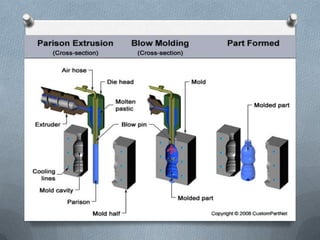
PROCESS:
The blow molding process begins with
melting down the plastic and forming it
into a parison or preform. The parison is
a tube-like piece of plastic with a hole in
one end in which compressed air can
pass through. The parison is then
clamped into a mold and air is pumped
into it. The air pressure then pushes the
plastic out to match the mold. Once the
plastic has cooled and hardened the
mold opens up and the part is ejected.
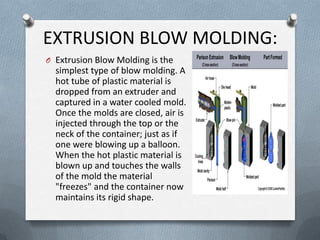
EXTRUSION BLOW MOLDING:
O Extrusion Blow Molding is the
simplest type of blow molding. A
hot tube of plastic material is
dropped from an extruder and
captured in a water cooled mold.
Once the molds are closed, air is
injected through the top or the
neck of the container; just as if
one were blowing up a balloon.
When the hot plastic material is
blown up and touches the walls
of the mold the material
"freezes" and the container now
maintains its rigid shape.
INJECTION BLOW MOLDING:
O Injection blow molding is a
process used to make hollow
products, such as drinks bottles, in
large quantities.
O The process is divided in to three
stages,
O injection, blowing and ejection.
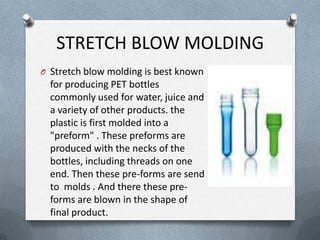
STRETCH BLOW MOLDING
O Stretch blow molding is best known
for producing PET bottles
commonly used for water, juice and
a variety of other products. the
plastic is first molded into a
"preform" . These preforms are
produced with the necks of the
bottles, including threads on one
end. Then these pre-forms are send
to molds . And there these pre-
forms are blown in the shape of
final product.
APPLICATION IN PAKISTAN
INDUSTRIES
O Tabraiz mold engineering Lahore
Pakistan. ( products: pet blow mold,
machine parts, labeling parts)
O Thermosole industries (pvt) ltd.
Kotlakhpat. (covering 90% of blow
molding automotive market in
Pakistan)
O Kalson engineering in Lahore.
(services in mold making)

Thermoforming and types

  • 1.
    Group No 07 HISTORY World War II Development of Thermoplastics, windshields  1950’s High volume production and products of thermoplastics. Development of blister packaging Food packaging divisions  1980’s Flexibility in size of containers use by the machine  Today In addition to packaging, used for refrigerator liners, shower stalls, bath tubs, automotive trunk liners and more
  • 2.
    What is Thermoforming? Thermoformingis the process involving heating a plastic sheet and forming it into a cavity or over a tool using vacuum, air pressure, and mechanical means.
  • 3.
    The Mold O Twomajor types: Male and Female O Male molds have the convex (inner) side against the mold; the concave side is against the mold face in female molds. O Mold type should be chosen so that the important side contacts the mold. O Off side is harder to control shape.
  • 4.
    TYPES OF THERMOFORMING OVacuum Thermoforming O Pressure Thermoforming O Mechanical Thermoforming
  • 5.
    Vacuum Thermoforming O Theprocess involves shaping a preheated thermoplastic sheet by means of vacuum produced in the mold cavity space. O The atmospheric pressure forces the soft sheet to deform in conformity with the cavity shape. O When the plastic comes into the contact with the mold surface it cools down and hardens.
  • 7.
    Pressure Thermoforming:- O Theprocess involves shaping a preheated thermoplastic sheet by means of air pressure. O The air pressure forces the soft sheet to deform in conformity with the cavity shape. O When the plastic comes into the contact with the mold surface it cools down and hardens.
  • 8.
    Mechanical Thermoforming:- O Theprocess involves shaping a preheated thermoplastic sheet by means of a direct mechanical force. O A core plug (positive mold) forces the soft sheet to fill the space between the plug and the negative mold. O The process provides precise dimensional tolerance and surface detailing.
  • 9.
    Thermoplastics which maybe processed by the thermoforming method are:O Polypropylene (PP) O Polystyrene (PS) O Polyvinyl Chloride (PVC) O Low Density Polyethylene (LDPE) O High Density Polyethylene (HDPE) O Cellulose Acetate O Polymethylmethacrylate (PMMA) O Acrylonitrile-Butadiene-Styrene (ABS)
  • 10.
    Advantages  They arelight in weight and durable.  They reduce per unit packaging cost of the product.  Thermoforming can be recycled thus technology is environment friendly  The plastic used for packaging is stiffer than the average plastic. This gives the products a high quality packaging.  The transportation costs are reduced as the packaging does not add to the total weight of the product.  Low Temperature required  Low pressure required  Fast mold cycle
  • 11.
    Disadvantages  Limited shapecomplexity.  Trimming is required .  Parts with sharp bends and corners are difficult to be produced.  Generates greater amount of scrap.  Internal stresses are produced.
  • 12.
    COMPARISION PRESSURE FORMING VACUUMFORMING O Mold cycle is fast. O Sheet can be formed at lower temperature because the forcing pressure is high. O Greater dimensional control. O Mold cycle is slow. O Sheet can be formed at comparatively high temperature. O Dimensional control is less.
  • 13.
    WHAT IS EXTRUSION…??? Extrusionis a process used to create objects of a fixed cross-sectional profile. A material is pushed or drawn through a die of the desired cross-section.
  • 14.
    HISTORY O In 1797,Joseph Bramah introduce the first extrusion process for making lead pipe. It involved preheating the metal and then forcing it through a die via a hand driven plunger. The process wasn't developed until 1820 when Thomas Burr constructed the first hydraulic powered press. At this time the process was called squirting. In 1894, Alexander Dick expanded the extrusion process to copper and brass alloys.
  • 15.
    PROCESS: The process beginsby heating the stock material. It is then loaded into the container in the press. A dummy block is placed behind it where the ram then presses on the material to push it out of the die. If better properties are required then it may be heat treated or cold worked.
  • 16.
    HOT EXTRUSION: Hot extrusionis a hot working process, which means it is done above recrystallization temperature to keep the material from work hardening and to make it easier to push the material through the die. Most hot extrusions are done on horizontal hydraulic presses.
  • 17.
    COLD EXTRUSION: Cold extrusionis done at room temperature or near room temperature. The advantages of this over hot extrusion are the lack of oxidation, higher strength due to cold working, closer tolerances, good surface finish.
  • 18.
    WARM EXTRUSION: Warm extrusionis done above room temperature, but below the recrystallization temperature of the material. It is usually used to achieve the proper balance of required forces, ductility and final extrusion properties.
  • 19.
    DIRECT & INDIRECTEXTRUSION: O DIRECT EXTRUSION: Direct extrusion also termed as forward extrusion. If the die is held stationary and the ram moves towards it then its called “direct extrusion”. O INDIRECT EXTRUSION: Indirect Extrusion is also termed as backward extrusion. Here the die is not stationary and moves with respect to the ram.
  • 20.
    HYDROSTATIC EXTRUSION: In thehydrostatic extrusion process the billet is completely surrounded by a pressurized liquid, except where the billet contacts the die. This process can be done hot, warm, or cold, however the temperature is limited by the stability of the fluid used. The process must be carried out in a sealed cylinder to contain the hydrostatic medium.
  • 21.
    EXTRUSION ADVANTAGES AND DISADVANTAGES: ADVANTAGES:DISADVANTA-GES: O Continuous. O High production volumes. O Low cost. O Many types of raw material. O Surface cracking. O Internal cracking. O Uniform cross- sectional shape only.
  • 23.
    PREFERENCES: O Low labourcost. O High production rates. O Cost efficient. O No need of surface finish after extrusion process. O Minimum scrap losses.
  • 25.
  • 26.
    HISTORY O The firstman-made plastic was invented in Britain in 1851 by Alexander Parkes. He publicly demonstrated it at the 1862 International Exhibition in London, calling the material he produced “Parkesine”. O In 1868, American inventor John Wesley Hyatt developed a plastic material he named Celluloid, improving on Parkes' invention so that it could be processed into finished form. Together with his brother Isaiah, Hyatt patented the first injection molding machine in 1872. O The industry expanded rapidly in the 1940s because World War II created a huge demand for inexpensive, mass-produced products. In 1946, American inventor James Watson Hendry built the first screw injection machine, which allowed much more precise control over the speed of injection and the quality of articles produced. O The plastic injection molding industry has evolved over the years from producing combs and buttons to producing a vast array of products for many industries including automotive, medical, aerospace, consumer products, toys, plumbing, packaging, and construction.
  • 27.
    INJECTION MOLDING Injection moldingis a manufacturing process for producing parts from both thermoplastic and thermosetting plasti c materials. In injection molding material is fed into a heated barrel, mixed, and forced into a mold cavity where it cools and hardens to the configuration of the mold cavity.
  • 30.
    THERMO PLASTIC: O Athermoplastic, also known as a thermo softening plastic, is a polymer that turns to a liquid when heated and freezes to a very glassy state when cooled sufficiently. Nylon, polyethylene, and polystyrene are examples of thermoplastic.
  • 31.
    THERMOSETTING PLASTIC: A thermosettingplastic, also known as a thermoset, is polymer material that irreversibly cures. The cure may be done through heat (generally above 200 C (392 F)), through a chemical reaction (two-part epoxy, for example), or irradiation such as electron beam processing. epoxy and phenolic are examples of thermosetting plastics
  • 32.
    APPLICATIONS: Injection molding isused to create many things such as wire spools, packaging, bottle caps, automotive dashboards, pocket combs, and most other plastic products available today. Injection molding is the most common method of part manufacturing. It is ideal for producing high volumes of the same object.
  • 33.
    COMPARISON B/W INJECTON MOLDINGAND OTHER PROCESS INJECTION: BLOW: O Mold remain sealed through out the process O In injection molding we keep air pressure very low because more air pressure can diminish the product. O The injection molding process ends inside the mold means the process ends after the ejection of the mold. O it employs a narrow nozzle to coupled with the mold. O In this process mold remain split a part. O In blow molding we force more and more air into the mold to expand the plastic to the limits of the mold cavity. In this process mold remain spilt apart O In blow molding process does not end inside after the ejection of the product some more processes like air blowing and trimming are performed. O It employs die head extrudes a tube of molten plastic.
  • 36.
    APPLICATION IN PAKISTAN INDUSTRIES OSiddiqi sons industries. (Fan parts, Citrus press juicers, Television parts) O Arfeen international (pvt) ltd. O Qismat plastic industry(spare parts of washing machine, spare pats of fans). O Universal Engg works(specialize in plastic and metal products).
  • 37.
    BLOW MOLDING O Itis a manufacturing process to made hollow parts such as plastic bottles with uniform wall thicknesses.
  • 38.
    HISTORY O Enoch Ferngrenand William Kopitke were the first verified people who used the Blow Molding Process. The process principle comes from the idea of blowing glass. Ferngren and Kopitke produced a blow molding machine and sold it to Hartford Empire Company in 1937. This was the beginning of the commercial blow molding process.
  • 39.
    PROCESS: The blow moldingprocess begins with melting down the plastic and forming it into a parison or preform. The parison is a tube-like piece of plastic with a hole in one end in which compressed air can pass through. The parison is then clamped into a mold and air is pumped into it. The air pressure then pushes the plastic out to match the mold. Once the plastic has cooled and hardened the mold opens up and the part is ejected.
  • 42.
    EXTRUSION BLOW MOLDING: OExtrusion Blow Molding is the simplest type of blow molding. A hot tube of plastic material is dropped from an extruder and captured in a water cooled mold. Once the molds are closed, air is injected through the top or the neck of the container; just as if one were blowing up a balloon. When the hot plastic material is blown up and touches the walls of the mold the material "freezes" and the container now maintains its rigid shape.
  • 43.
    INJECTION BLOW MOLDING: OInjection blow molding is a process used to make hollow products, such as drinks bottles, in large quantities. O The process is divided in to three stages, O injection, blowing and ejection.
  • 46.
    STRETCH BLOW MOLDING OStretch blow molding is best known for producing PET bottles commonly used for water, juice and a variety of other products. the plastic is first molded into a "preform" . These preforms are produced with the necks of the bottles, including threads on one end. Then these pre-forms are send to molds . And there these pre- forms are blown in the shape of final product.
  • 49.
    APPLICATION IN PAKISTAN INDUSTRIES OTabraiz mold engineering Lahore Pakistan. ( products: pet blow mold, machine parts, labeling parts) O Thermosole industries (pvt) ltd. Kotlakhpat. (covering 90% of blow molding automotive market in Pakistan) O Kalson engineering in Lahore. (services in mold making)