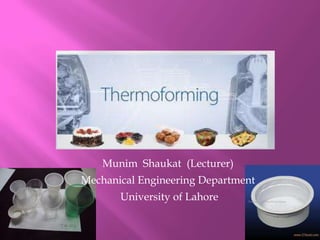
Munim Shaukat (Lecturer)
Mechanical Engineering Department
       University of Lahore
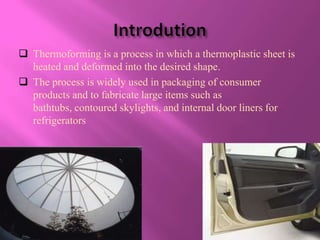
 Thermoforming is a process in which a thermoplastic sheet is
  heated and deformed into the desired shape.
 The process is widely used in packaging of consumer
  products and to fabricate large items such as
  bathtubs, contoured skylights, and internal door liners for
  refrigerators
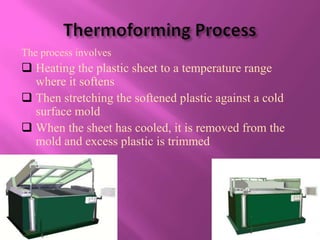
The process involves
 Heating the plastic sheet to a temperature range
  where it softens
 Then stretching the softened plastic against a cold
  surface mold
 When the sheet has cooled, it is removed from the
  mold and excess plastic is trimmed
Thermoforming Process consists of two main steps:
 Heating
 Forming
 Heating is usually accomplished by radiant electric
   heaters, located on one or both sides of the starting plastic
   sheet at a distance of roughly 125 mm (5in).
 The methods by which the forming step is accomplished can
   be classified into three basic categories:
1. vacuum thermoforming
2. pressure thermoforming,
3. mechanical thermoforming
 Heating the sheet
 Clamping the
  sheet
 Moving the sheet
  and mold into
  proper
  relationship for
  forming, a
  vacuum or
  pressure system
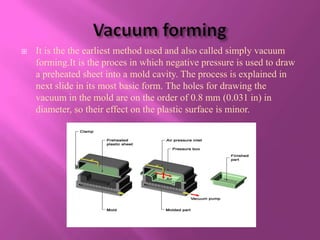
   It is the the earliest method used and also called simply vacuum
    forming.It is the proces in which negative pressure is used to draw
    a preheated sheet into a mold cavity. The process is explained in
    next slide in its most basic form. The holes for drawing the
    vacuum in the mold are on the order of 0.8 mm (0.031 in) in
    diameter, so their effect on the plastic surface is minor.
• Vacuum thermoforming: (1) a flat plastic sheet is softened by
   heating; (2) the softened sheet is placed over a concave mold cavity; (3)
   a vacuum draws the sheet into the cavity; and (4) the plastic hardens
   on contact with the cold mold surface, and the part is removed and
   subsequently trimmed from the web.
 Uneven wall thicknesses are observed in this technique
 As the sheet touch the mold, the thickness at the location
  become fixed, further stretching occur in the area that have
  not yet touched the mold, typically at the corner.
 Therefore the thinnest area occur at the corner, near the
  clamp

                Plastics sheet


                                                   Thin corner
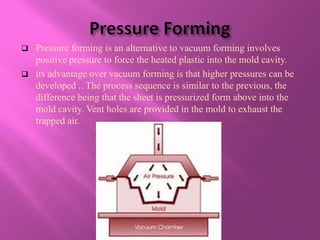
 Pressure forming is an alternative to vacuum forming involves
  positive pressure to force the heated plastic into the mold cavity.
 its advantage over vacuum forming is that higher pressures can be
  developed .. The process sequence is similar to the previous, the
  difference being that the sheet is pressurized form above into the
  mold cavity. Vent holes are provided in the mold to exhaust the
  trapped air.
   Positive air
    pressure
    from the
    top of the
    plastic used
    to force the
    materials
    against the
    mold
 The third method, called mechanical thermoforming, uses matching
  positive and negative molds that are brought against the heated
  plastic sheet, forcing it to assume their shape. In the pure mechanical
  forming method, air pressure (positive or negative) is not used at all.
 Its advantages are better dimensional control and the opportunity for
  surface detailing on both sides of the part.
 The disadvantage is that two mold halves are required; the molds for
  the other two methods are therefore less costly.
 Heating the sheet
 Clamping the
  sheet
 Moving the sheet
  and mold into
  proper
  relationship for
  forming, a
  vacuum or
  pressure system
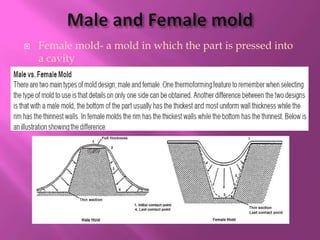
 this point it is useful to distinguish between negative
  and positive molds. Both types are used in
  thermoforming
 A positive mold has a convex shape In the case of the
  positive mold, the heated sheet is draped over the
  convex form and negative or positive pressure is used
  to force the plastic against the mold surface. The
  positive mold is shown in the case of vacuum forming.
 Negative molds have concave cavities
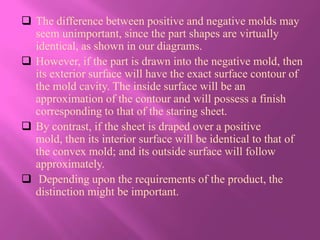
 The difference between positive and negative molds may
  seem unimportant, since the part shapes are virtually
  identical, as shown in our diagrams.
 However, if the part is drawn into the negative mold, then
  its exterior surface will have the exact surface contour of
  the mold cavity. The inside surface will be an
  approximation of the contour and will possess a finish
  corresponding to that of the staring sheet.
 By contrast, if the sheet is draped over a positive
  mold, then its interior surface will be identical to that of
  the convex mold; and its outside surface will follow
  approximately.
 Depending upon the requirements of the product, the
  distinction might be important.
   Female mold- a mold in which the part is pressed into
    a cavity
Plastic types: Thermosets
 General properties: more durable, harder, tough, light.

 Typical uses: automobile parts, construction materials.

Examples:

Unsaturated Polyesters: varnishes, boat hulls, furniture


Epoxies and Resins:…        glues, coating of electrical circuits,
             composites: fiberglass in helicopter blades, boats,
Plastic types: Elastomers
General properties: these are thermosets, and have rubber-like properties.

Typical uses: medical masks, gloves, rubber-substitutes


 Examples:

 Polyurethanes: mattress, cushion, insulation, toys

 Silicones: surgical gloves, oxygen masks in medical applications
         joint seals
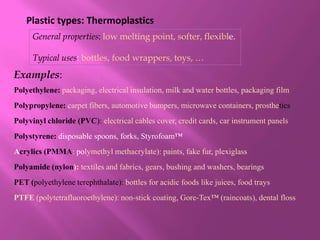
Plastic types: Thermoplastics
     General properties: low melting point, softer, flexible.

     Typical uses: bottles, food wrappers, toys, …
Examples:
Polyethylene: packaging, electrical insulation, milk and water bottles, packaging film
Polypropylene: carpet fibers, automotive bumpers, microwave containers, prosthetics
Polyvinyl chloride (PVC): electrical cables cover, credit cards, car instrument panels
Polystyrene: disposable spoons, forks, Styrofoam™
Acrylics (PMMA: polymethyl methacrylate): paints, fake fur, plexiglass
Polyamide (nylon): textiles and fabrics, gears, bushing and washers, bearings
PET (polyethylene terephthalate): bottles for acidic foods like juices, food trays
PTFE (polytetrafluoroethylene): non-stick coating, Gore-Tex™ (raincoats), dental floss
Thermoforming uses plastic sheet, which is
   heated, stretched, cooled and mechanically cut
    The plastic sheet is manipulated as a rubbery solid or
     elastic liquid
    The solid or elastic liquid properties are more important
     than the viscous properties when thermoforming
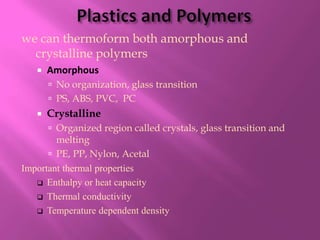
we can thermoform both amorphous and
  crystalline polymers
      Amorphous
        No organization, glass transition
        PS, ABS, PVC, PC
      Crystalline
        Organized region called crystals, glass transition and
        melting
       PE, PP, Nylon, Acetal
Important thermal properties
    Enthalpy or heat capacity

    Thermal conductivity

    Temperature dependent density
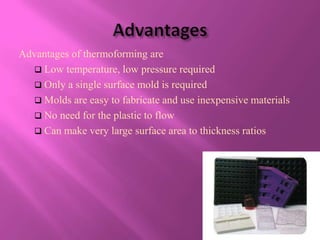
Advantages of thermoforming are
   Low temperature, low pressure required
   Only a single surface mold is required
   Molds are easy to fabricate and use inexpensive materials
   No need for the plastic to flow
   Can make very large surface area to thickness ratios
Disadvantages of thermoforming
    Plastic material is more expensive because the pellets have
     to be made into sheets
    Generally more waste to reprocess
    Can get a great deal of wall thickness variation
 Is used to estimate the amount of wall thickness
  variation that might occur
 High draw ratio result in excessive thinning and
  wall nonuniformities
 Draw ratio = depth of part / width of part
It gives us some approximation of the amount of thinning that
    will be experienced by the plastic sheet when it is
    transformed

 Area ratio = area of the sheet before forming
  area of the part after forming
 If the sheet is 200 cm2, and will be thermoformed into a part
  that has total area of 400cm2, the area ratio is 1:2
 Area ratio x desired thickness of finished part = minimum
  original thickness (thickness of the blank)
 The overall average thickness of the part will therefore be
  one-half of original thickness
 The area ratio is often used to calculate the size of the
  unformed sheet that must be used to make a particular part
 Mass production thermoforming operations are performed in the
  packaging industry
 Thin film packaging items that are mass produced by thermoforming
  include blister packs and skin packs.
 Thermoforming applications include large parts that can be produced
  from thicker sheet stock. Examples include covers for business
  machines, boat hulls, shower stalls, diffusers for lights, advertising
  displays and sins, bathtubs, and certain toys.
 We had previously mentioned contoured skylights and
  internal door liners for refrigerators.
 These would be made, respectively, out of acrylic (because of
  its transparency) and ABS (because of its ease in forming and
  resistance to oil and fats found in refrigerators).
 Mass production thermoforming operations are performed in the
  packaging industry
 Thin film packaging items that are mass produced by thermoforming
  include blister packs and skin packs.
 Thermoforming applications include large parts that can be produced
  from thicker sheet stock. Examples include covers for business
  machines, boat hulls, shower stalls, diffusers for lights, advertising
  displays and sins, bathtubs, and certain toys.
 We had previously mentioned contoured skylights and
  internal door liners for refrigerators.
 These would be made, respectively, out of acrylic (because of
  its transparency) and ABS (because of its ease in forming and
  resistance to oil and fats found in refrigerators).
Blister Packs


                             Formed blister pack material


Skin Packs
Lec 4

Lec 4

  • 1.
    Munim Shaukat (Lecturer) MechanicalEngineering Department University of Lahore
  • 2.
     Thermoforming isa process in which a thermoplastic sheet is heated and deformed into the desired shape.  The process is widely used in packaging of consumer products and to fabricate large items such as bathtubs, contoured skylights, and internal door liners for refrigerators
  • 3.
    The process involves Heating the plastic sheet to a temperature range where it softens  Then stretching the softened plastic against a cold surface mold  When the sheet has cooled, it is removed from the mold and excess plastic is trimmed
  • 4.
    Thermoforming Process consistsof two main steps:  Heating  Forming  Heating is usually accomplished by radiant electric heaters, located on one or both sides of the starting plastic sheet at a distance of roughly 125 mm (5in).  The methods by which the forming step is accomplished can be classified into three basic categories: 1. vacuum thermoforming 2. pressure thermoforming, 3. mechanical thermoforming
  • 5.
     Heating thesheet  Clamping the sheet  Moving the sheet and mold into proper relationship for forming, a vacuum or pressure system
  • 6.
    It is the the earliest method used and also called simply vacuum forming.It is the proces in which negative pressure is used to draw a preheated sheet into a mold cavity. The process is explained in next slide in its most basic form. The holes for drawing the vacuum in the mold are on the order of 0.8 mm (0.031 in) in diameter, so their effect on the plastic surface is minor.
  • 7.
    • Vacuum thermoforming:(1) a flat plastic sheet is softened by heating; (2) the softened sheet is placed over a concave mold cavity; (3) a vacuum draws the sheet into the cavity; and (4) the plastic hardens on contact with the cold mold surface, and the part is removed and subsequently trimmed from the web.
  • 8.
     Uneven wallthicknesses are observed in this technique  As the sheet touch the mold, the thickness at the location become fixed, further stretching occur in the area that have not yet touched the mold, typically at the corner.  Therefore the thinnest area occur at the corner, near the clamp Plastics sheet Thin corner
  • 9.
     Pressure formingis an alternative to vacuum forming involves positive pressure to force the heated plastic into the mold cavity.  its advantage over vacuum forming is that higher pressures can be developed .. The process sequence is similar to the previous, the difference being that the sheet is pressurized form above into the mold cavity. Vent holes are provided in the mold to exhaust the trapped air.
  • 10.
    Positive air pressure from the top of the plastic used to force the materials against the mold
  • 11.
     The thirdmethod, called mechanical thermoforming, uses matching positive and negative molds that are brought against the heated plastic sheet, forcing it to assume their shape. In the pure mechanical forming method, air pressure (positive or negative) is not used at all.  Its advantages are better dimensional control and the opportunity for surface detailing on both sides of the part.  The disadvantage is that two mold halves are required; the molds for the other two methods are therefore less costly.
  • 13.
     Heating thesheet  Clamping the sheet  Moving the sheet and mold into proper relationship for forming, a vacuum or pressure system
  • 14.
     this pointit is useful to distinguish between negative and positive molds. Both types are used in thermoforming  A positive mold has a convex shape In the case of the positive mold, the heated sheet is draped over the convex form and negative or positive pressure is used to force the plastic against the mold surface. The positive mold is shown in the case of vacuum forming.  Negative molds have concave cavities
  • 15.
     The differencebetween positive and negative molds may seem unimportant, since the part shapes are virtually identical, as shown in our diagrams.  However, if the part is drawn into the negative mold, then its exterior surface will have the exact surface contour of the mold cavity. The inside surface will be an approximation of the contour and will possess a finish corresponding to that of the staring sheet.  By contrast, if the sheet is draped over a positive mold, then its interior surface will be identical to that of the convex mold; and its outside surface will follow approximately.  Depending upon the requirements of the product, the distinction might be important.
  • 16.
    Female mold- a mold in which the part is pressed into a cavity
  • 18.
    Plastic types: Thermosets General properties: more durable, harder, tough, light. Typical uses: automobile parts, construction materials. Examples: Unsaturated Polyesters: varnishes, boat hulls, furniture Epoxies and Resins:… glues, coating of electrical circuits, composites: fiberglass in helicopter blades, boats,
  • 19.
    Plastic types: Elastomers Generalproperties: these are thermosets, and have rubber-like properties. Typical uses: medical masks, gloves, rubber-substitutes Examples: Polyurethanes: mattress, cushion, insulation, toys Silicones: surgical gloves, oxygen masks in medical applications joint seals
  • 20.
    Plastic types: Thermoplastics General properties: low melting point, softer, flexible. Typical uses: bottles, food wrappers, toys, … Examples: Polyethylene: packaging, electrical insulation, milk and water bottles, packaging film Polypropylene: carpet fibers, automotive bumpers, microwave containers, prosthetics Polyvinyl chloride (PVC): electrical cables cover, credit cards, car instrument panels Polystyrene: disposable spoons, forks, Styrofoam™ Acrylics (PMMA: polymethyl methacrylate): paints, fake fur, plexiglass Polyamide (nylon): textiles and fabrics, gears, bushing and washers, bearings PET (polyethylene terephthalate): bottles for acidic foods like juices, food trays PTFE (polytetrafluoroethylene): non-stick coating, Gore-Tex™ (raincoats), dental floss
  • 21.
    Thermoforming uses plasticsheet, which is heated, stretched, cooled and mechanically cut  The plastic sheet is manipulated as a rubbery solid or elastic liquid  The solid or elastic liquid properties are more important than the viscous properties when thermoforming
  • 22.
    we can thermoformboth amorphous and crystalline polymers  Amorphous  No organization, glass transition  PS, ABS, PVC, PC  Crystalline  Organized region called crystals, glass transition and melting  PE, PP, Nylon, Acetal Important thermal properties  Enthalpy or heat capacity  Thermal conductivity  Temperature dependent density
  • 25.
    Advantages of thermoformingare  Low temperature, low pressure required  Only a single surface mold is required  Molds are easy to fabricate and use inexpensive materials  No need for the plastic to flow  Can make very large surface area to thickness ratios
  • 26.
    Disadvantages of thermoforming  Plastic material is more expensive because the pellets have to be made into sheets  Generally more waste to reprocess  Can get a great deal of wall thickness variation
  • 27.
     Is usedto estimate the amount of wall thickness variation that might occur  High draw ratio result in excessive thinning and wall nonuniformities  Draw ratio = depth of part / width of part
  • 28.
    It gives ussome approximation of the amount of thinning that will be experienced by the plastic sheet when it is transformed  Area ratio = area of the sheet before forming area of the part after forming  If the sheet is 200 cm2, and will be thermoformed into a part that has total area of 400cm2, the area ratio is 1:2  Area ratio x desired thickness of finished part = minimum original thickness (thickness of the blank)  The overall average thickness of the part will therefore be one-half of original thickness  The area ratio is often used to calculate the size of the unformed sheet that must be used to make a particular part
  • 29.
     Mass productionthermoforming operations are performed in the packaging industry  Thin film packaging items that are mass produced by thermoforming include blister packs and skin packs.  Thermoforming applications include large parts that can be produced from thicker sheet stock. Examples include covers for business machines, boat hulls, shower stalls, diffusers for lights, advertising displays and sins, bathtubs, and certain toys.  We had previously mentioned contoured skylights and internal door liners for refrigerators.  These would be made, respectively, out of acrylic (because of its transparency) and ABS (because of its ease in forming and resistance to oil and fats found in refrigerators).
  • 31.
     Mass productionthermoforming operations are performed in the packaging industry  Thin film packaging items that are mass produced by thermoforming include blister packs and skin packs.  Thermoforming applications include large parts that can be produced from thicker sheet stock. Examples include covers for business machines, boat hulls, shower stalls, diffusers for lights, advertising displays and sins, bathtubs, and certain toys.  We had previously mentioned contoured skylights and internal door liners for refrigerators.  These would be made, respectively, out of acrylic (because of its transparency) and ABS (because of its ease in forming and resistance to oil and fats found in refrigerators).
  • 32.
    Blister Packs Formed blister pack material Skin Packs