FRP PROCESSING
METHODS
GEETHU C.THOMAS
JEFF JOSE
KESIYA GEORGE
KRISHNAPRIYA M.P
Group 3
IMPORTANT METHODS
Hand Lay-up
Spray up method
Filament winding
Match die molding
Pultrusion
Resin transfer molding
Reaction injection molding
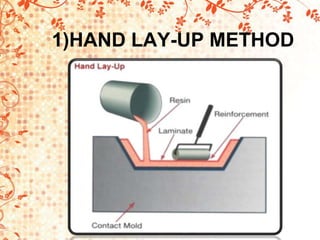
1)HAND LAY-UP METHOD
• Hand Lay-Up is well suited for low volume
production of product.
• This method can be used for both corrosion
barrier and the structural portion.
• A mold must be used for hand lay-up parts
unless the composite is to be joined directly to
another structure.
• The mold can be as simple as a flat sheet or
have infinite curves and edges.
• For some shapes, molds must be joined in
sections so they can be taken apart for part
removal after curing.
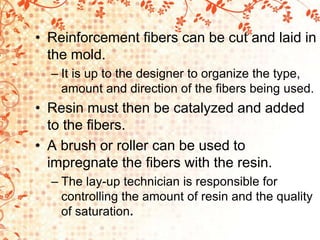
• Reinforcement fibers can be cut and laid in
the mold.
– It is up to the designer to organize the type,
amount and direction of the fibers being used.
• Resin must then be catalyzed and added
to the fibers.
• A brush or roller can be used to
impregnate the fibers with the resin.
– The lay-up technician is responsible for
controlling the amount of resin and the quality
of saturation.
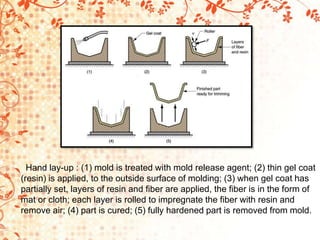
Hand lay-up : (1) mold is treated with mold release agent; (2) thin gel coat
(resin) is applied, to the outside surface of molding; (3) when gel coat has
partially set, layers of resin and fiber are applied, the fiber is in the form of
mat or cloth; each layer is rolled to impregnate the fiber with resin and
remove air; (4) part is cured; (5) fully hardened part is removed from mold.
Materials used for hand layup
• Resins:
– Any, e.g. epoxy, polyester, vinyl ester,
phenolic.
• Fibres:
– Any, although heavy aramid fabrics can be
hard to wet-out by hand.
Advantages:
• i) Widely used for many years.
• ii) Simple principles to teach.
• iii) Low cost tooling, if room-temperature
cure resins are used.
• iv) Wide choice of suppliers and material
types.
• v) Higher fibre contents, and longer fibers
than with spray lay-up.
Disadvantages
• Resin mixing, laminate resin contents, and laminate
quality are very Dependent On The Skills of laminators.
Low resin content laminates cannot usually be achieved
without the incorporation of excessive quantities of voids.
• ii) Health and safety considerations of resins. The lower
molecular weights of hand lay-up resins generally means
that they have the potential to be more harmful than
higher molecular weight products. The lower viscosity of
the resins also means that they have an increased
tendency to penetrate clothing etc.
• iii) Resins need to be low in viscosity to be
workable by hand. This generally
compromises their mechanical/thermal
properties due to the need for high
diluents levels.
• Generally large in size but low in production quantity - not
economical for high production
• Applications:
– Boat hulls
– Swimming pools
– Large container tanks
– Movie and stage props
– Other formed sheets
• The largest molding ever made was ship hulls for the British Royal
Navy: 85 m (280 ft) long
2)Spray up method
• Fibre is chopped in a hand-held gun and
fed into a spray of catalysed resin directed
at the mould. The deposited materials are
left to cure under standard atmospheric
conditions.
• Materials Options:
Resins: Primarily polyester.
Fibres: Glass roving only.
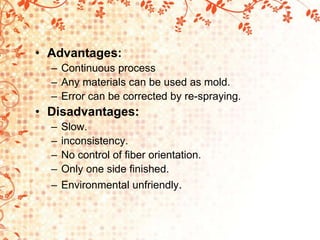
• Advantages:
– Continuous process
– Any materials can be used as mold.
– Error can be corrected by re-spraying.
• Disadvantages:
– Slow.
– inconsistency.
– No control of fiber orientation.
– Only one side finished.
– Environmental unfriendly.
3) PULTRUSION
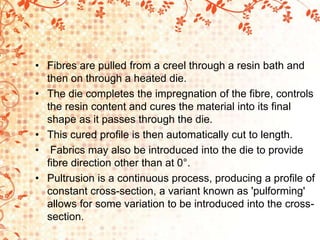
• Fibres are pulled from a creel through a resin bath and
then on through a heated die.
• The die completes the impregnation of the fibre, controls
the resin content and cures the material into its final
shape as it passes through the die.
• This cured profile is then automatically cut to length.
• Fabrics may also be introduced into the die to provide
fibre direction other than at 0°.
• Pultrusion is a continuous process, producing a profile of
constant cross-section, a variant known as 'pulforming'
allows for some variation to be introduced into the cross-
section.
Main Advantages:
• i) This can be a very fast, and therefore
economic, way of impregnating and curing
materials.
ii) Resin content can be accurately controlled.
iii) Fibre cost is minimised since the majority is
taken from a creel.
iv) Structural properties of laminates can be very
good since the profiles have very straight fibres
and high fibre volume fractions can be obtained.
v) Resin impregnation area can be enclosed
thus limiting volatile emissions.
Main Disadvantages:
• i) Limited to constant or near constant
cross-section components
ii) Heated die costs can be high.
• Typical Applications:
Beams and girders used in roof structures,
bridges, ladders, frameworks.
4) FILAMENT WINDING
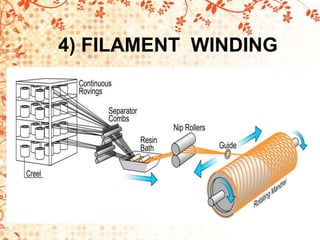
• This process is primarily used for hollow,
generally circular or oval sectioned
components, such as pipes and tanks.
• Fibre tows are passed through a resin
bath before being wound onto a mandrel
in a variety of orientations, controlled by
the fibre feeding mechanism, and rate of
rotation of the mandrel.
Main Advantages
• i) This can be a very fast and therefore
economic method of laying material down.
ii) Resin content can be controlled by metering
the resin onto each fibre tow through nips or
dies.
iii) Fibre cost is minimised since there is no
secondary process to convert fibre into fabric
prior to use.
iv) Structural properties of laminates can be very
good since straight fibres can be laid in a
complex pattern to match the applied loads.
Main Disadvantages
• i) The process is limited to convex shaped
components.
ii) Fibre cannot easily be laid exactly along the
length of a component.
iii) Mandrel costs for large components can be
high.
iv) The external surface of the component is
unmolded, and therefore cosmetically
unattractive.
v) Low viscosity resins usually need to be used
with their attendant lower mechanical and health
and safety properties.
5) Resin transfer moulding
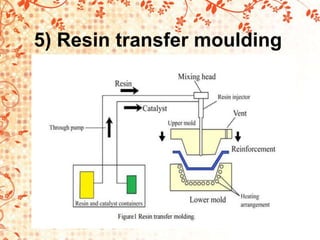
• Resin transfer molding is a closed molding
process
• In this technique, as the name indicates,
resin is transferred over the already placed
reinforcement
• Reinforcement in terms of either woven
mat or strand mat form is placed on the
surface of lower half mold.
• A release gel is applied on the mold surface for
easy removal of the composite.
• The mold is properly closed and clamped. The
clamping can be done either perimeter clamping
or press clamping mechanism
• The resin is pumped into the mold through ports
and air is displaced through other vents
• After curing, the mold is opened and composite
product is taken out
Raw materials
Advantage
• Composite part produced with this method has good
surface finish on both side surface of the product.
• Any combination of reinforced materials (including 3D) in
any orientation can be achieved.
• Fast cycle time can be achieved through temperature
control tooling device.
• Process can be manual control, semi-automated or
highly automated.
• Composite part thickness is uniform which is determined
by the mold cavity.
• The process does not require high injection pressure
Disadvantages
• Mould cavity limits the size of the
composite.
• High tooling cost.
• There is limitation on reinforcing materials
due to the flow and resin saturation of
fibres.
6) Reaction injection moulding
• Reaction injection molding (RIM) is
similar to injection
molding except thermosetting polymers ar
e used, which requires a curing reaction to
occur within the mold.
• First, the two parts of the polymer are mixed
together.
• The mixture is then injected into the mould
under high pressure using an impinging mixer.
• The mixture is allowed to sit in the mole long
enough for it to expand and cure.
• If reinforcing agents are added to the mixture
then the process is known as reinforced
reaction injection moulding (RRIM).
• Common reinforcing agents
include glass fibers and mica. This process is
usually used to produce rigid foam automotive
panels
Advantages and disadvantages
• Reaction injection molding can produce strong, flexible,
lightweight parts which can easily be painted
• It also has the advantage of quick cycle times compared to
typical vacuum cast materials.
• The bi-component mixture injected into the mold has a much
lower viscosity than molten thermoplastic polymers, therefore
large, light-weight, and thin-walled items can be successfully
RIM processed.
• This thinner mixture also requires less clamping forces, which
leads to smaller equipment and ultimately lower capital
expenditures.
• Another advantage of RIM processed foam is that a high-
density skin is formed with a low-density core.
• The disadvantages are slow cycle times, compared to injection
moulding, and expensive raw materials.
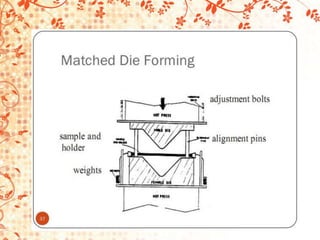
7) Matched die forming
a) Matched-die molding (Acuan
Terpadan)
-The composite material is pressed
between heated matched dies
-Pressure required depends on the flow
characteristics of the feed materials
- The feed materials flows into the
contours of the mould and cures at
high temp.
• There are three types of matched die
forming
• Perform moulding
• Sheet molding compound
• Dough/bulk molding compound (DMC)
• These three molding technique utilize
same type of high pressure molding
equipment but differ in the form of the
material that is placed inside the mold
to form the part
a) Sheet molding compound (SMC)
Sheet of resin-fiber blend which contains
additives (curing agent, release agent &
pigments). Clean to be used & give good
consistency in properties
b) Dough molding compound (DMC)
Blends (in dough forms) of all the necessary
constituents (but only short fibers are used)
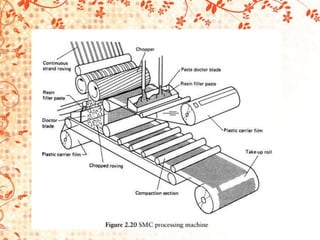
Sheet molding compound
(SMC)
• SMC moulding is a sheet material that is
made by chopped glass fibres on to a
sheet of plastic film on which a resin-
initator-filler mixture has been doctored
• Another film which also has the resin
mixture applied onto it, is placed on the
top and then the sandwich of resin mixture
and the chopped glass is passed between
the compaction rolls to wet the fibres and
mix the constituents
• The material is then cured and rolled up
for shipment
• A typical SMC incorporates about 30-
50%fibres ,25%resin,25-45%filler
Bulk moulding compound
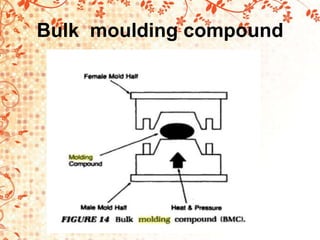
• BMC is a dough like mixture of chopped
fibreglass resin initiator and fillers that has a
composition similar to that of SMC
• The resulting material is called a premix
• The fibreglass mixture is about 5-10% lower
than SMC
• BMC is moulded by placing a weighed amount
of material onto the lower mould
• The mod are then closed under pressure
,temperature
Advantages
• Both interior and exterior surfaces are
finished
• Production rate can be high
• Labour cost are low
• Minimum trimming of parts are moulded
• Product has good mechanical properties
and closed part tolerance
Disadvantages
• More equipment is needed than layup
• Mould and tooling are costly than layup
moulds
• Transparent parts are not possible with
SMC and BMC
• Moulding problems may cause surface
imperfections
• SMC and BMC have limited shelf life
REFERENCE
• Handbook of Composite
Reinforcements -By Stuart M. Lee
• http://www.frprawmaterial.com/frp-
process.html
• Handbook of Composite Fabrication- by
G Akovali
• Introduction to Composite Materials and
Structures Nachiketa Tiwari Indian
Institute of Technology Kanpur
Fibre Reinforced Plastic manufacturing methods

Fibre Reinforced Plastic manufacturing methods

  • 1.
    FRP PROCESSING METHODS GEETHU C.THOMAS JEFFJOSE KESIYA GEORGE KRISHNAPRIYA M.P Group 3
  • 2.
    IMPORTANT METHODS Hand Lay-up Sprayup method Filament winding Match die molding Pultrusion Resin transfer molding Reaction injection molding
  • 3.
  • 4.
    • Hand Lay-Upis well suited for low volume production of product. • This method can be used for both corrosion barrier and the structural portion. • A mold must be used for hand lay-up parts unless the composite is to be joined directly to another structure. • The mold can be as simple as a flat sheet or have infinite curves and edges. • For some shapes, molds must be joined in sections so they can be taken apart for part removal after curing.
  • 5.
    • Reinforcement fiberscan be cut and laid in the mold. – It is up to the designer to organize the type, amount and direction of the fibers being used. • Resin must then be catalyzed and added to the fibers. • A brush or roller can be used to impregnate the fibers with the resin. – The lay-up technician is responsible for controlling the amount of resin and the quality of saturation.
  • 6.
    Hand lay-up :(1) mold is treated with mold release agent; (2) thin gel coat (resin) is applied, to the outside surface of molding; (3) when gel coat has partially set, layers of resin and fiber are applied, the fiber is in the form of mat or cloth; each layer is rolled to impregnate the fiber with resin and remove air; (4) part is cured; (5) fully hardened part is removed from mold.
  • 7.
    Materials used forhand layup • Resins: – Any, e.g. epoxy, polyester, vinyl ester, phenolic. • Fibres: – Any, although heavy aramid fabrics can be hard to wet-out by hand.
  • 8.
    Advantages: • i) Widelyused for many years. • ii) Simple principles to teach. • iii) Low cost tooling, if room-temperature cure resins are used. • iv) Wide choice of suppliers and material types. • v) Higher fibre contents, and longer fibers than with spray lay-up.
  • 9.
    Disadvantages • Resin mixing,laminate resin contents, and laminate quality are very Dependent On The Skills of laminators. Low resin content laminates cannot usually be achieved without the incorporation of excessive quantities of voids. • ii) Health and safety considerations of resins. The lower molecular weights of hand lay-up resins generally means that they have the potential to be more harmful than higher molecular weight products. The lower viscosity of the resins also means that they have an increased tendency to penetrate clothing etc.
  • 10.
    • iii) Resinsneed to be low in viscosity to be workable by hand. This generally compromises their mechanical/thermal properties due to the need for high diluents levels.
  • 11.
    • Generally largein size but low in production quantity - not economical for high production • Applications: – Boat hulls – Swimming pools – Large container tanks – Movie and stage props – Other formed sheets • The largest molding ever made was ship hulls for the British Royal Navy: 85 m (280 ft) long
  • 12.
  • 13.
    • Fibre ischopped in a hand-held gun and fed into a spray of catalysed resin directed at the mould. The deposited materials are left to cure under standard atmospheric conditions. • Materials Options: Resins: Primarily polyester. Fibres: Glass roving only.
  • 15.
    • Advantages: – Continuousprocess – Any materials can be used as mold. – Error can be corrected by re-spraying. • Disadvantages: – Slow. – inconsistency. – No control of fiber orientation. – Only one side finished. – Environmental unfriendly.
  • 16.
  • 17.
    • Fibres arepulled from a creel through a resin bath and then on through a heated die. • The die completes the impregnation of the fibre, controls the resin content and cures the material into its final shape as it passes through the die. • This cured profile is then automatically cut to length. • Fabrics may also be introduced into the die to provide fibre direction other than at 0°. • Pultrusion is a continuous process, producing a profile of constant cross-section, a variant known as 'pulforming' allows for some variation to be introduced into the cross- section.
  • 19.
    Main Advantages: • i)This can be a very fast, and therefore economic, way of impregnating and curing materials. ii) Resin content can be accurately controlled. iii) Fibre cost is minimised since the majority is taken from a creel. iv) Structural properties of laminates can be very good since the profiles have very straight fibres and high fibre volume fractions can be obtained. v) Resin impregnation area can be enclosed thus limiting volatile emissions.
  • 20.
    Main Disadvantages: • i)Limited to constant or near constant cross-section components ii) Heated die costs can be high. • Typical Applications: Beams and girders used in roof structures, bridges, ladders, frameworks.
  • 21.
  • 22.
    • This processis primarily used for hollow, generally circular or oval sectioned components, such as pipes and tanks. • Fibre tows are passed through a resin bath before being wound onto a mandrel in a variety of orientations, controlled by the fibre feeding mechanism, and rate of rotation of the mandrel.
  • 24.
    Main Advantages • i)This can be a very fast and therefore economic method of laying material down. ii) Resin content can be controlled by metering the resin onto each fibre tow through nips or dies. iii) Fibre cost is minimised since there is no secondary process to convert fibre into fabric prior to use. iv) Structural properties of laminates can be very good since straight fibres can be laid in a complex pattern to match the applied loads.
  • 25.
    Main Disadvantages • i)The process is limited to convex shaped components. ii) Fibre cannot easily be laid exactly along the length of a component. iii) Mandrel costs for large components can be high. iv) The external surface of the component is unmolded, and therefore cosmetically unattractive. v) Low viscosity resins usually need to be used with their attendant lower mechanical and health and safety properties.
  • 26.
  • 27.
    • Resin transfermolding is a closed molding process • In this technique, as the name indicates, resin is transferred over the already placed reinforcement • Reinforcement in terms of either woven mat or strand mat form is placed on the surface of lower half mold.
  • 28.
    • A releasegel is applied on the mold surface for easy removal of the composite. • The mold is properly closed and clamped. The clamping can be done either perimeter clamping or press clamping mechanism • The resin is pumped into the mold through ports and air is displaced through other vents • After curing, the mold is opened and composite product is taken out
  • 29.
  • 30.
    Advantage • Composite partproduced with this method has good surface finish on both side surface of the product. • Any combination of reinforced materials (including 3D) in any orientation can be achieved. • Fast cycle time can be achieved through temperature control tooling device. • Process can be manual control, semi-automated or highly automated. • Composite part thickness is uniform which is determined by the mold cavity. • The process does not require high injection pressure
  • 31.
    Disadvantages • Mould cavitylimits the size of the composite. • High tooling cost. • There is limitation on reinforcing materials due to the flow and resin saturation of fibres.
  • 32.
    6) Reaction injectionmoulding • Reaction injection molding (RIM) is similar to injection molding except thermosetting polymers ar e used, which requires a curing reaction to occur within the mold.
  • 33.
    • First, thetwo parts of the polymer are mixed together. • The mixture is then injected into the mould under high pressure using an impinging mixer. • The mixture is allowed to sit in the mole long enough for it to expand and cure. • If reinforcing agents are added to the mixture then the process is known as reinforced reaction injection moulding (RRIM). • Common reinforcing agents include glass fibers and mica. This process is usually used to produce rigid foam automotive panels
  • 34.
    Advantages and disadvantages •Reaction injection molding can produce strong, flexible, lightweight parts which can easily be painted • It also has the advantage of quick cycle times compared to typical vacuum cast materials. • The bi-component mixture injected into the mold has a much lower viscosity than molten thermoplastic polymers, therefore large, light-weight, and thin-walled items can be successfully RIM processed. • This thinner mixture also requires less clamping forces, which leads to smaller equipment and ultimately lower capital expenditures. • Another advantage of RIM processed foam is that a high- density skin is formed with a low-density core. • The disadvantages are slow cycle times, compared to injection moulding, and expensive raw materials.
  • 35.
    7) Matched dieforming a) Matched-die molding (Acuan Terpadan) -The composite material is pressed between heated matched dies -Pressure required depends on the flow characteristics of the feed materials - The feed materials flows into the contours of the mould and cures at high temp.
  • 37.
    • There arethree types of matched die forming • Perform moulding • Sheet molding compound • Dough/bulk molding compound (DMC) • These three molding technique utilize same type of high pressure molding equipment but differ in the form of the material that is placed inside the mold to form the part
  • 38.
    a) Sheet moldingcompound (SMC) Sheet of resin-fiber blend which contains additives (curing agent, release agent & pigments). Clean to be used & give good consistency in properties b) Dough molding compound (DMC) Blends (in dough forms) of all the necessary constituents (but only short fibers are used)
  • 39.
    Sheet molding compound (SMC) •SMC moulding is a sheet material that is made by chopped glass fibres on to a sheet of plastic film on which a resin- initator-filler mixture has been doctored • Another film which also has the resin mixture applied onto it, is placed on the top and then the sandwich of resin mixture and the chopped glass is passed between the compaction rolls to wet the fibres and mix the constituents
  • 41.
    • The materialis then cured and rolled up for shipment • A typical SMC incorporates about 30- 50%fibres ,25%resin,25-45%filler
  • 42.
  • 43.
    • BMC isa dough like mixture of chopped fibreglass resin initiator and fillers that has a composition similar to that of SMC • The resulting material is called a premix • The fibreglass mixture is about 5-10% lower than SMC • BMC is moulded by placing a weighed amount of material onto the lower mould • The mod are then closed under pressure ,temperature
  • 44.
    Advantages • Both interiorand exterior surfaces are finished • Production rate can be high • Labour cost are low • Minimum trimming of parts are moulded • Product has good mechanical properties and closed part tolerance
  • 45.
    Disadvantages • More equipmentis needed than layup • Mould and tooling are costly than layup moulds • Transparent parts are not possible with SMC and BMC • Moulding problems may cause surface imperfections • SMC and BMC have limited shelf life
  • 46.
    REFERENCE • Handbook ofComposite Reinforcements -By Stuart M. Lee • http://www.frprawmaterial.com/frp- process.html • Handbook of Composite Fabrication- by G Akovali • Introduction to Composite Materials and Structures Nachiketa Tiwari Indian Institute of Technology Kanpur