An Introduction to Information Systems in Organizations
Principles and Learning Objectives The value of information is directly linked to how it helps decision makers achieve the organization’s goals Distinguish data from information and describe the characteristics used to evaluate the value of data
Principles and Learning Objectives (continued) Knowing the potential impact of information systems and having the ability to put this knowledge to work can result in a successful personal career and organizations that reach their goals Identify the basic types of business information systems and discuss who uses them, how they are used, and what kinds of benefits they deliver
Principles and Learning Objectives (continued) System users, business managers, and information systems professionals must work together to build a successful information system Identify the major steps of the systems development process and state the goal of each
Principles and Learning Objectives (continued) The use of information systems to add value to the organization can also give an organization a competitive advantage Identify the value-added processes in the supply chain and describe the role of information systems within them Identify some of the strategies employed to lower costs or improve service Define the term  competitive advantage  and discuss how organizations are using information systems to gain such an advantage
Principles and Learning Objectives (continued) Cooperation between business managers and IS personnel is the key to unlocking the potential of any new or modified system Define the types of roles, functions, and careers available in information systems
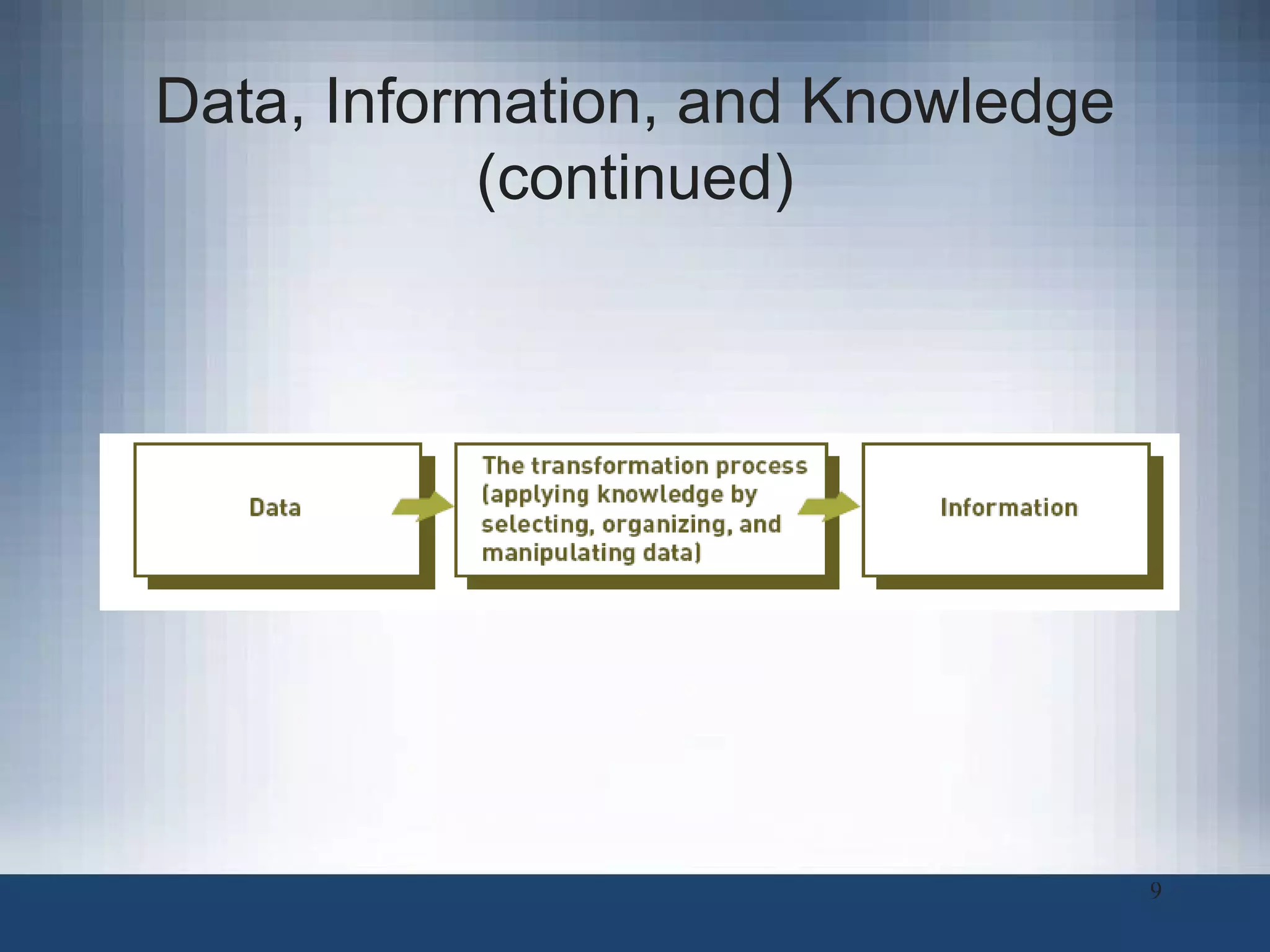
Information Concepts Data, information, and knowledge Data : Raw facts Information :   Collection of facts organized in such a way that they have additional value beyond the value of the facts themselves Process :   Set of logically related tasks performed to achieve a defined outcome Knowledge :   Awareness and understanding of a set of information
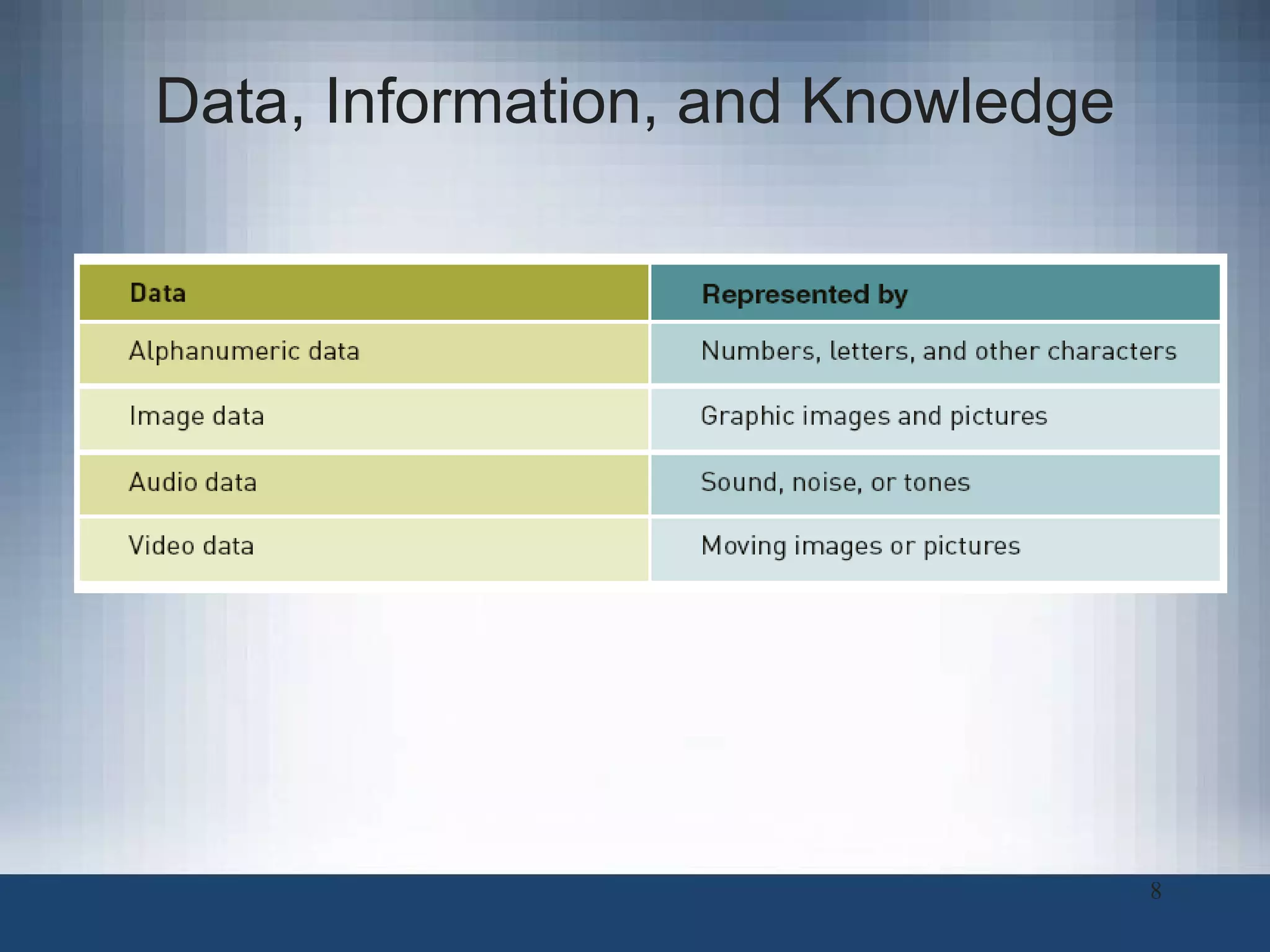
Data, Information, and Knowledge
Data, Information, and Knowledge (continued)
The Characteristics of Valuable Information If information is not accurate or complete People can make poor decisions, costing thousands, or even millions, of dollars Information can be of little value to the organization  If information is not relevant, not delivered to decision makers in a timely fashion, or too complex to understand
The Value of Information Valuable information  Can help people and their organizations perform tasks more efficiently and effectively Can help managers decide whether to invest in additional information systems and technology
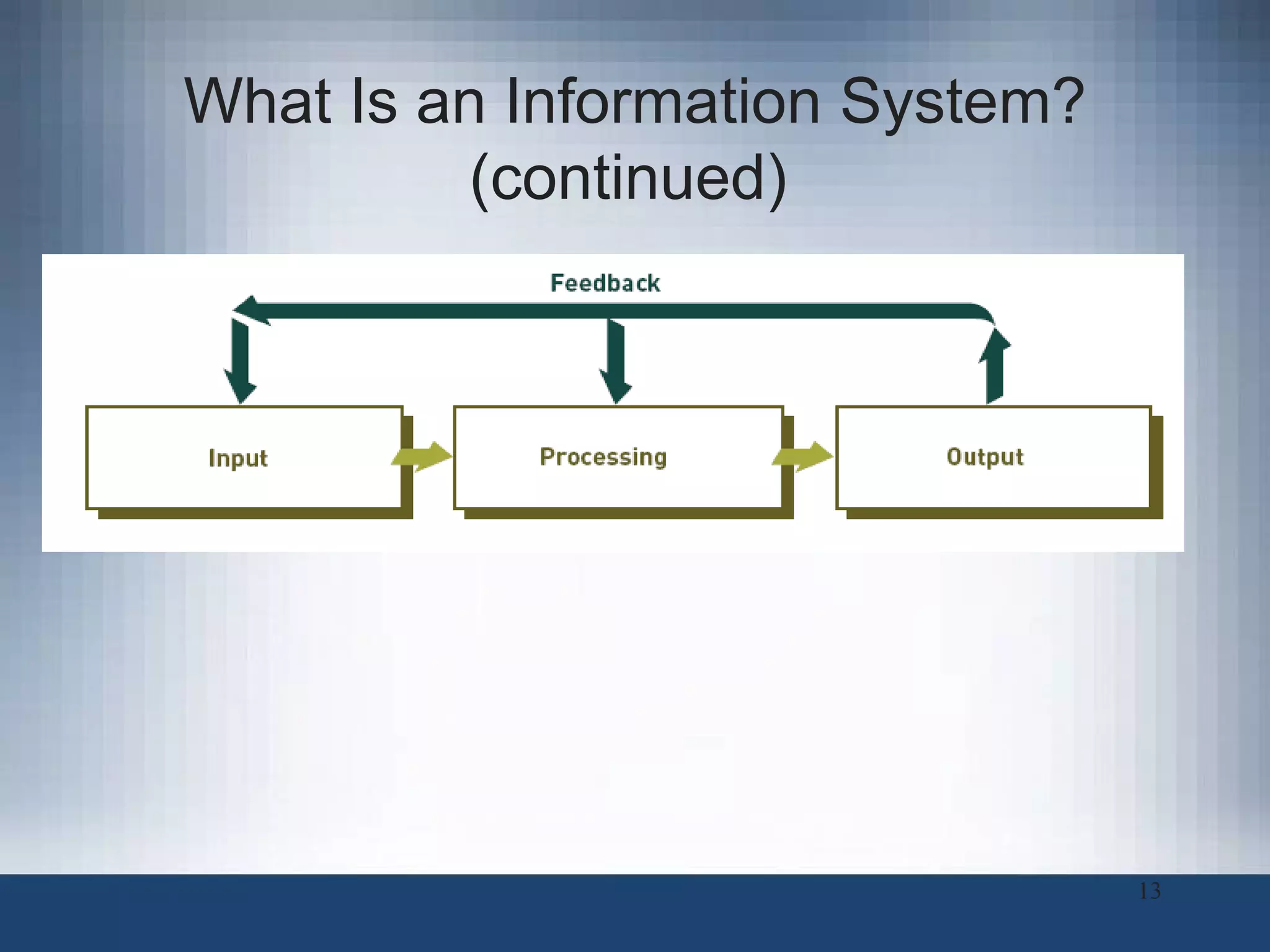
What Is an Information System?   Feedback mechanism The component that helps organizations achieve their goals, such as increasing profits or improving customer service
What Is an Information System? (continued)
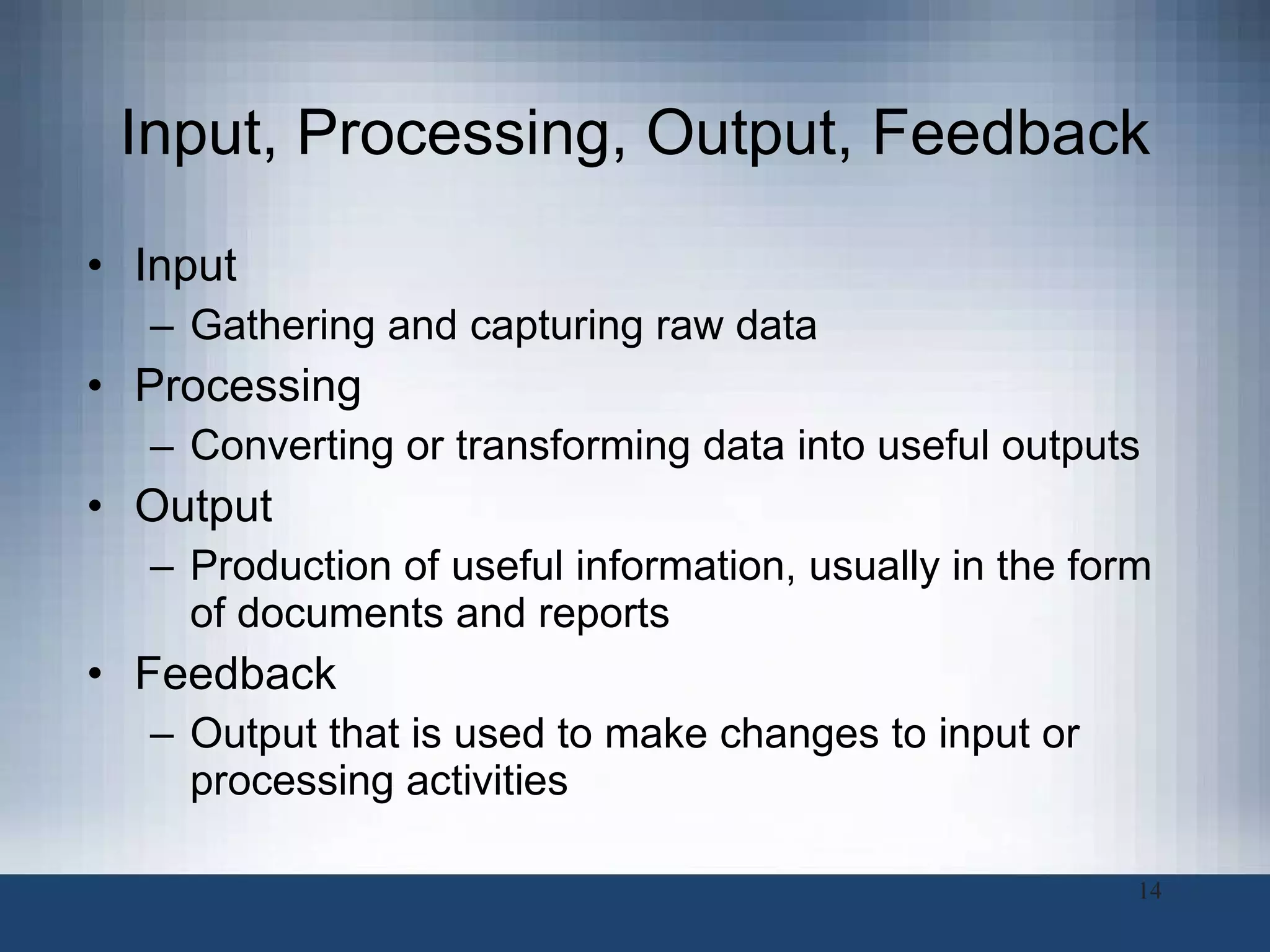
Input, Processing, Output, Feedback Input Gathering and capturing raw data Processing Converting or transforming data into useful outputs Output Production of useful information, usually in the form of documents and reports Feedback Output that is used to make changes to input or processing activities
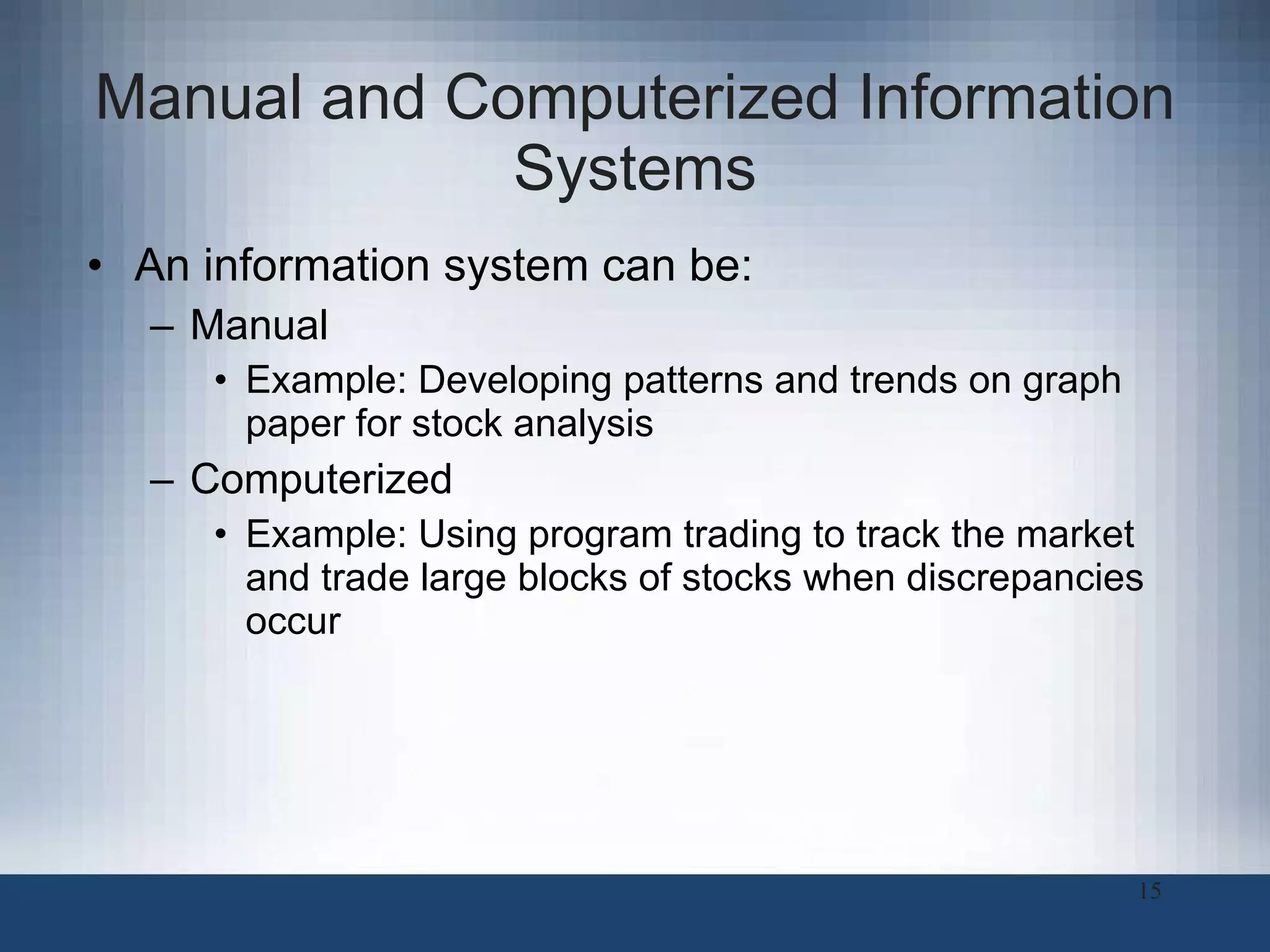
Manual and Computerized Information Systems An information system can be: Manual Example: Developing patterns and trends on graph paper for stock analysis Computerized Example: Using program trading to track the market and trade large blocks of stocks when discrepancies occur
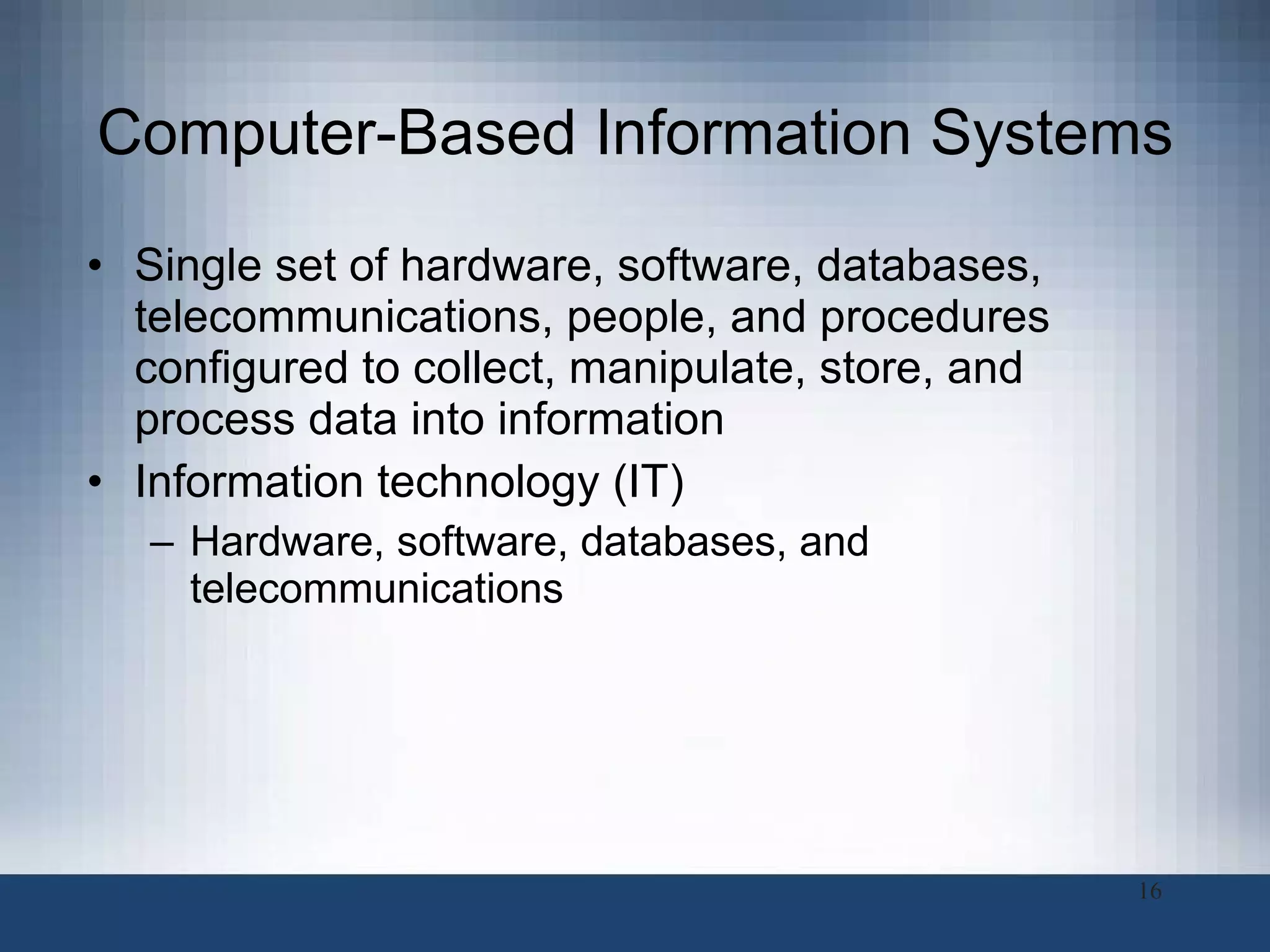
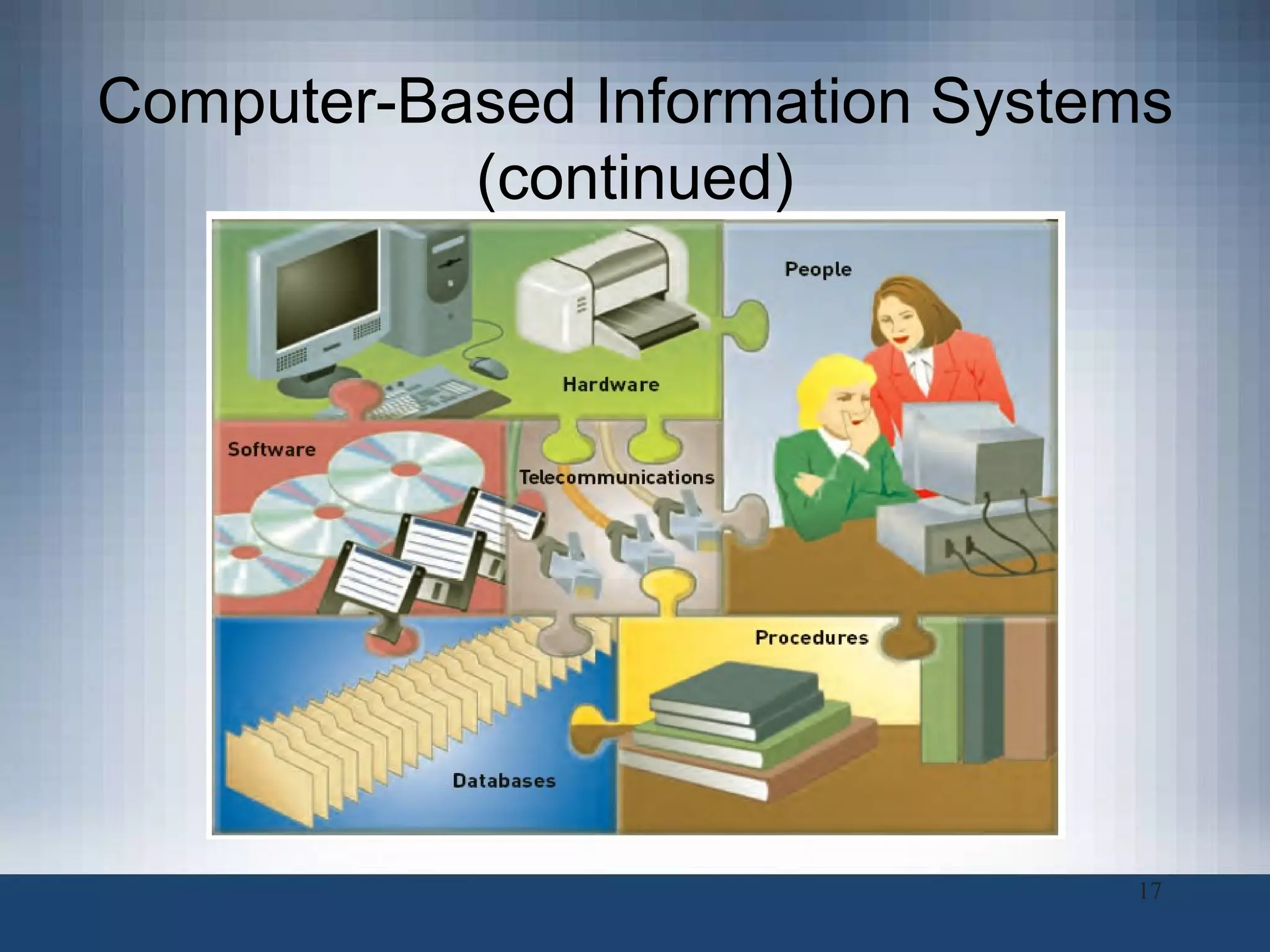
Computer-Based Information Systems Single set of hardware, software, databases, telecommunications, people, and procedures configured to collect, manipulate, store, and process data into information Information technology (IT)  Hardware, software, databases, and telecommunications
Computer-Based Information Systems (continued)
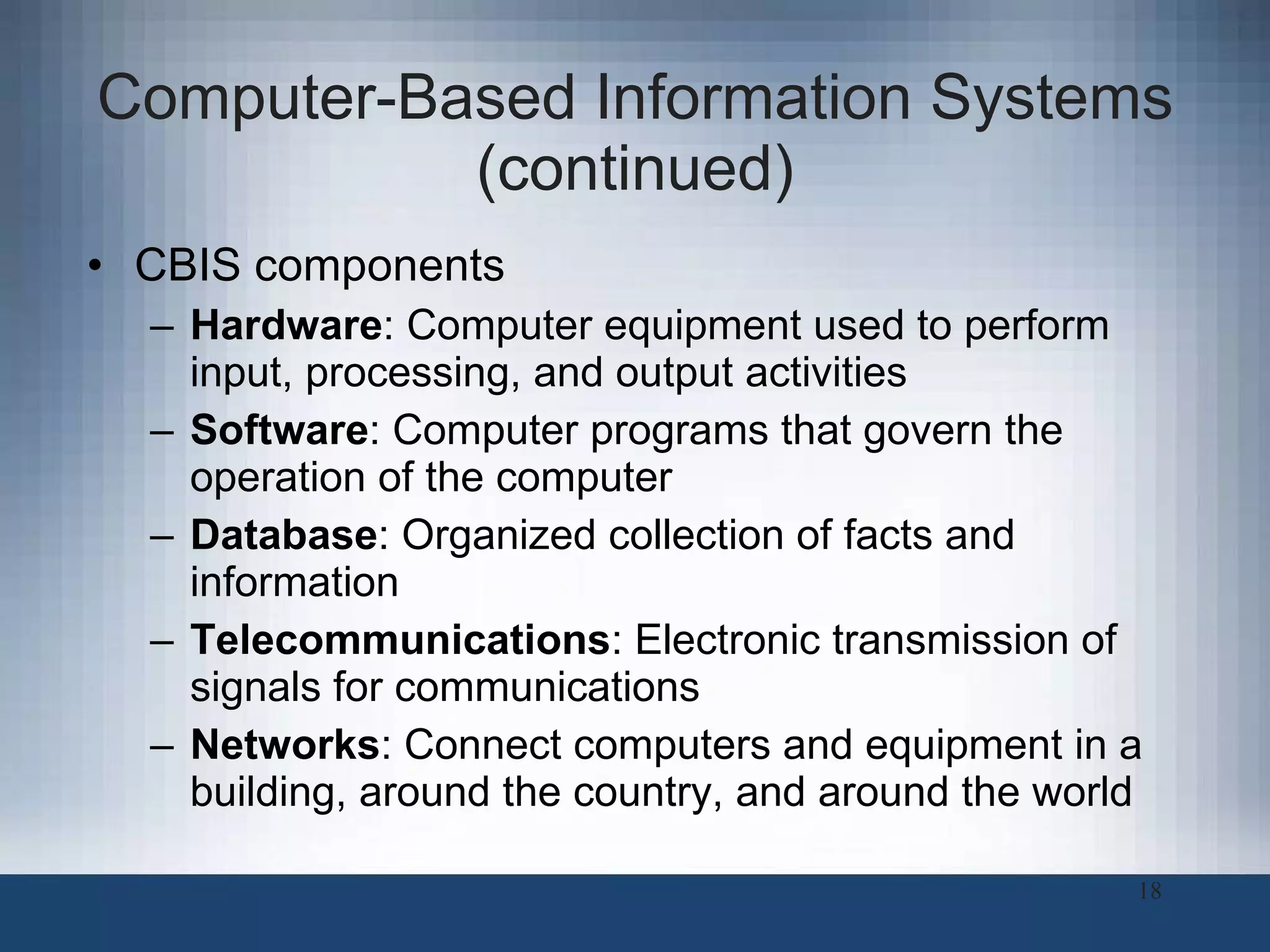
Computer-Based Information Systems (continued) CBIS components Hardware : Computer equipment used to perform input, processing, and output activities Software : Computer programs that govern the operation of the computer Database : Organized collection of facts and information Telecommunications : Electronic transmission of signals for communications Networks : Connect computers and equipment in a building, around the country, and around the world
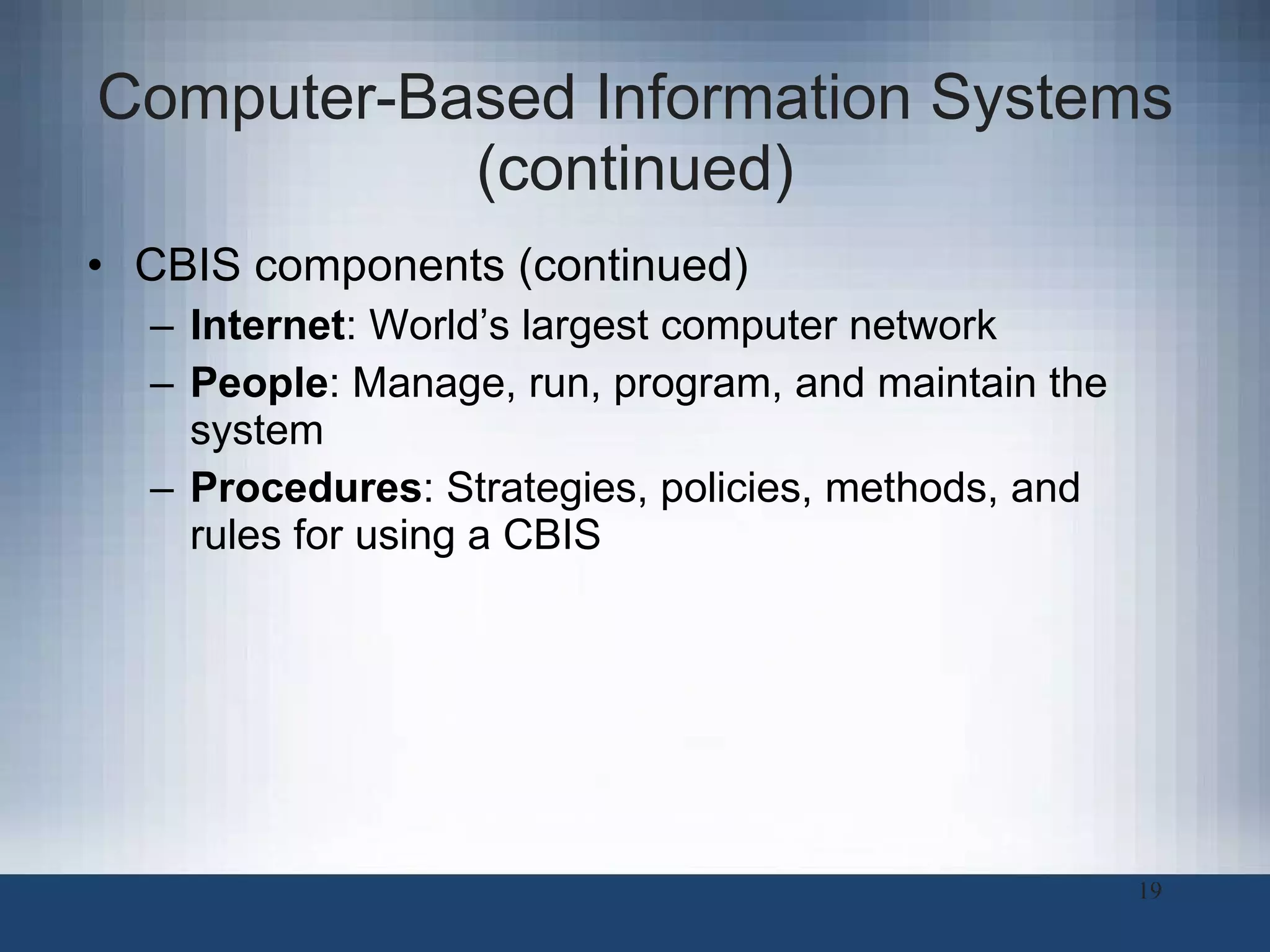
Computer-Based Information Systems (continued) CBIS components (continued) Internet : World’s largest computer network People : Manage, run, program, and maintain the system Procedures : Strategies, policies, methods, and rules for using a CBIS
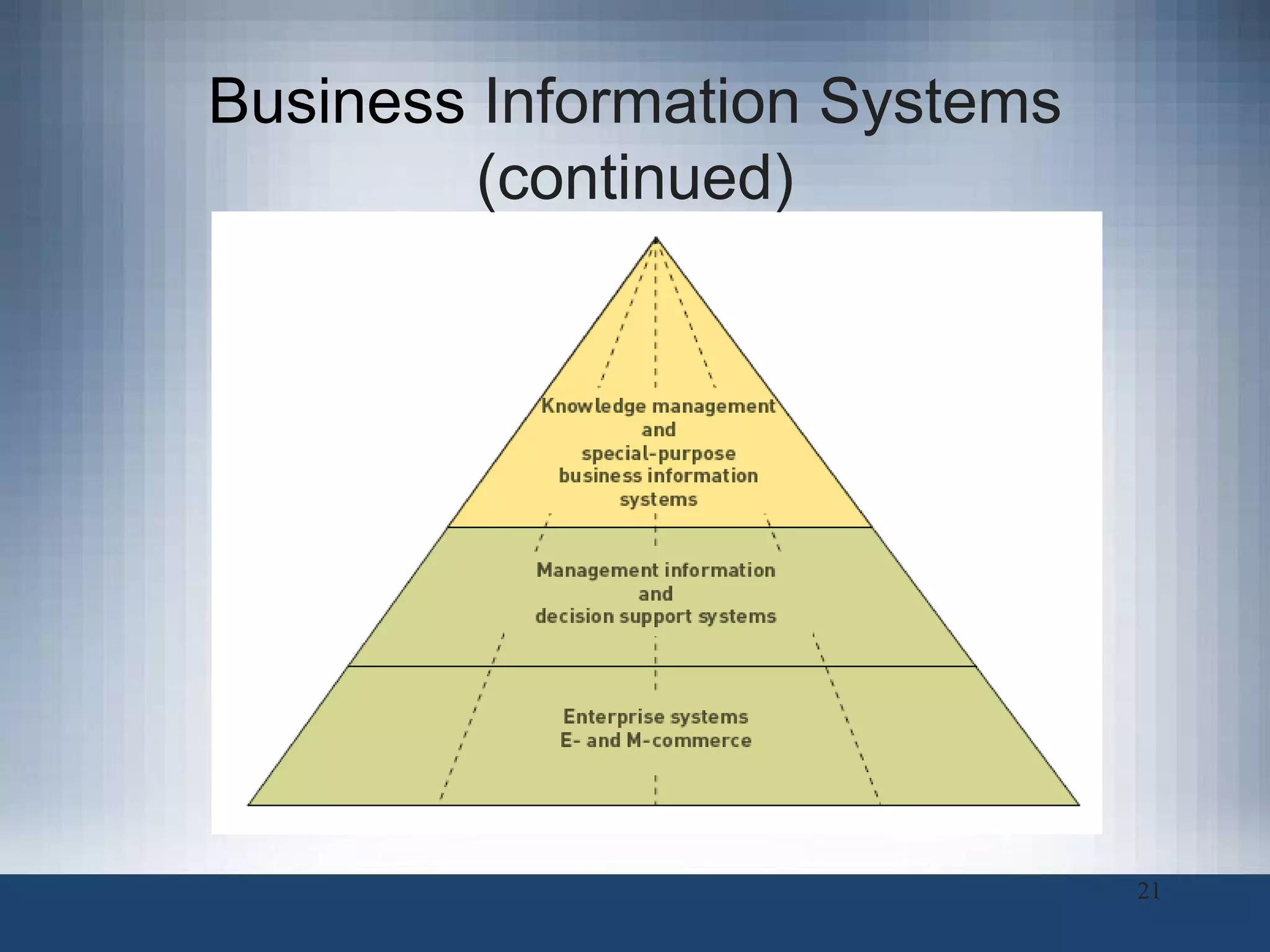
Business   Information Systems Most common types of information systems used  are those designed for: Electronic and mobile commerce Transaction processing Management information Decision support
Business   Information Systems (continued)
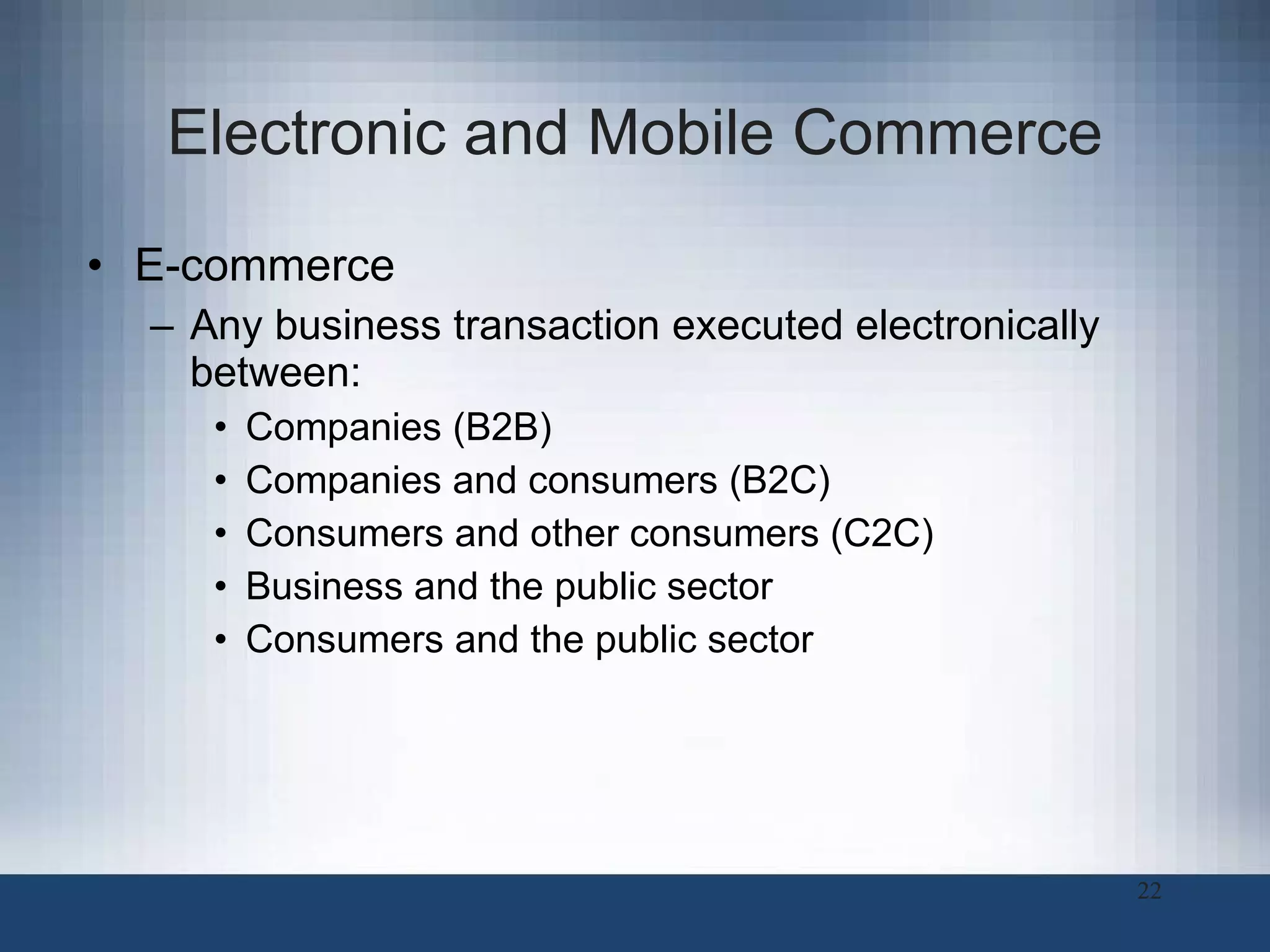
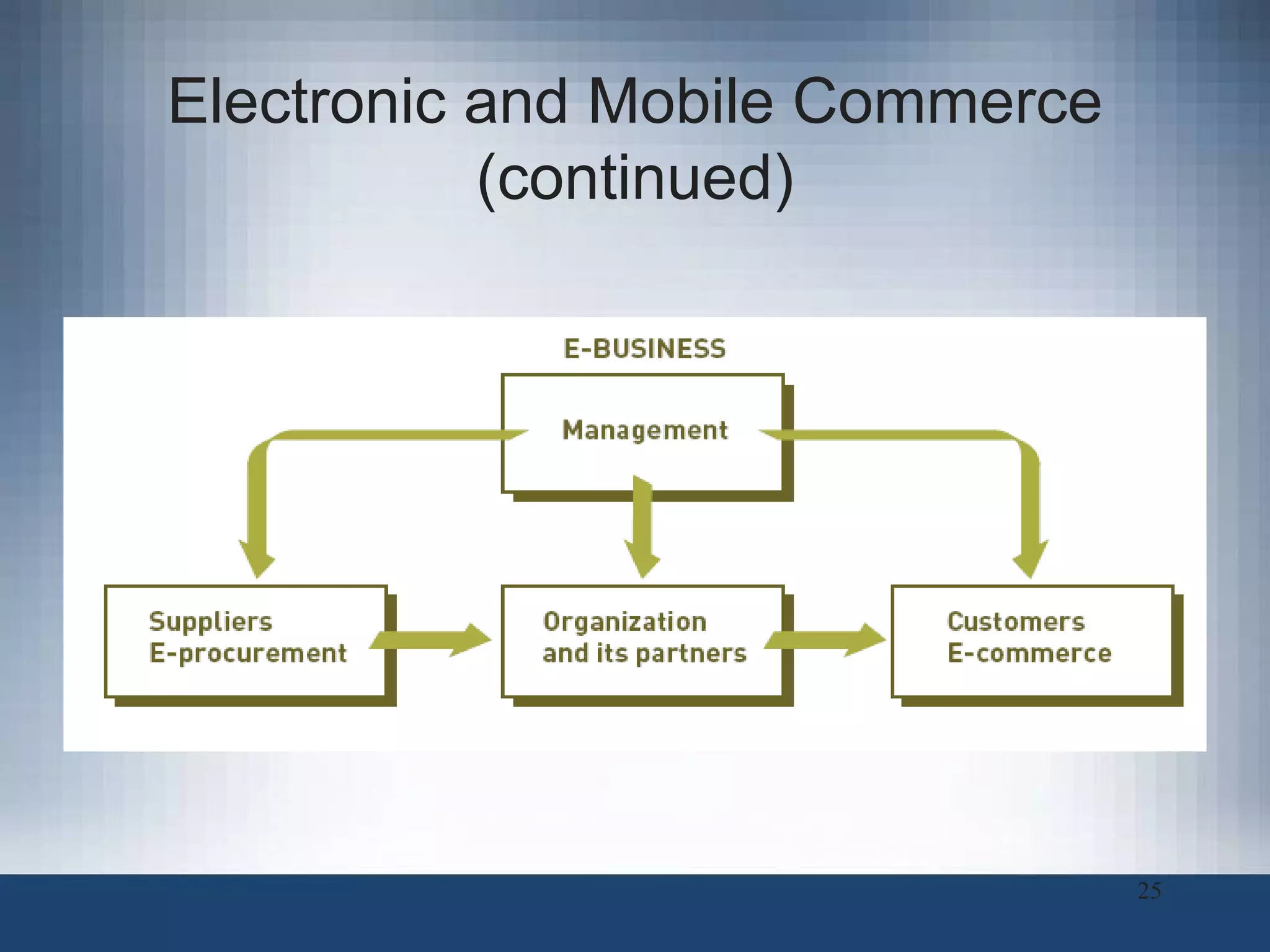
Electronic and Mobile Commerce E-commerce  Any business transaction executed electronically between:  Companies (B2B) Companies and consumers (B2C) Consumers and other consumers (C2C) Business and the public sector Consumers and the public sector
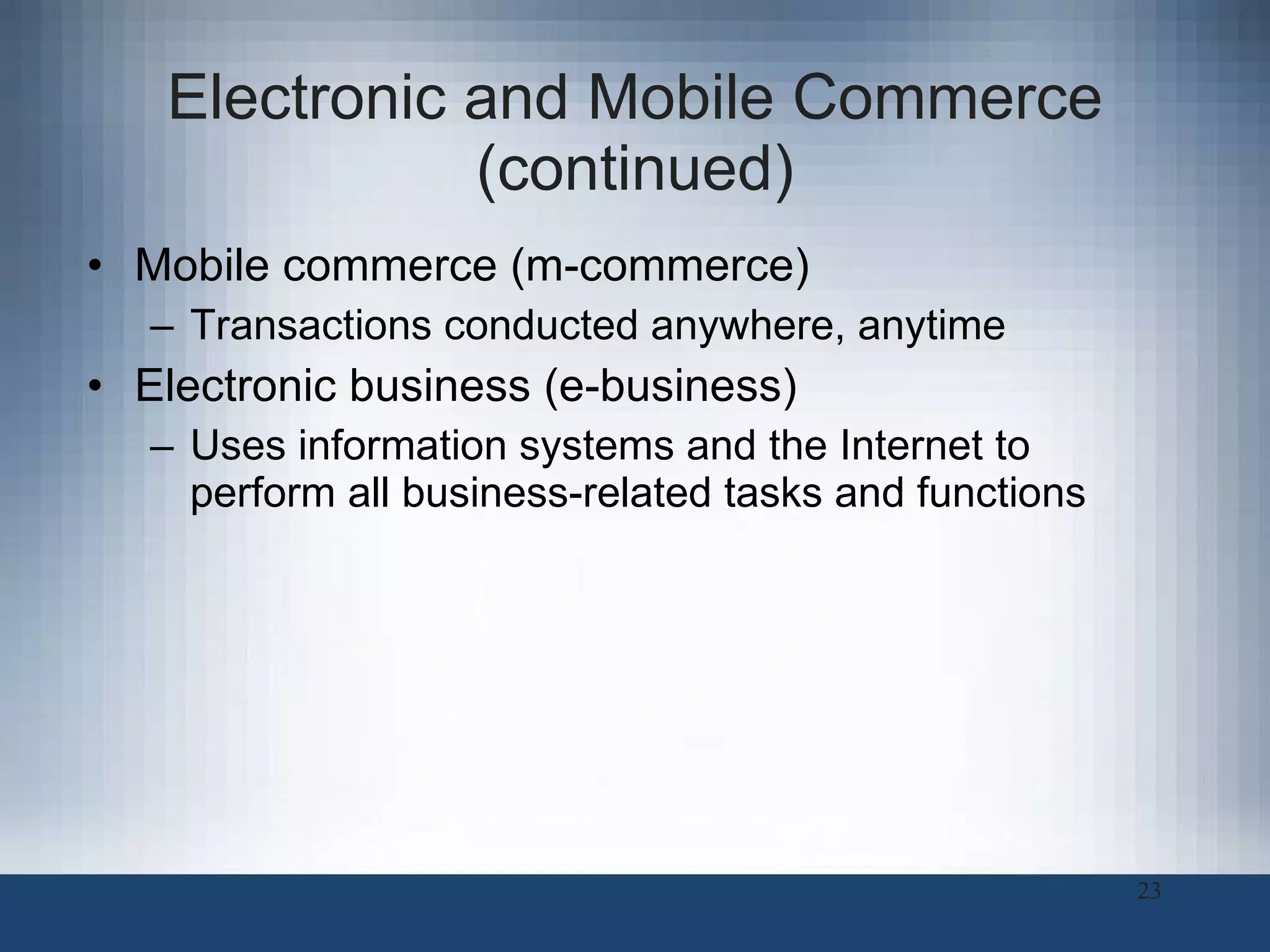
Electronic and Mobile Commerce (continued) Mobile commerce (m-commerce)  Transactions conducted anywhere, anytime Electronic business (e-business) Uses information systems and the Internet to perform all business-related tasks and functions
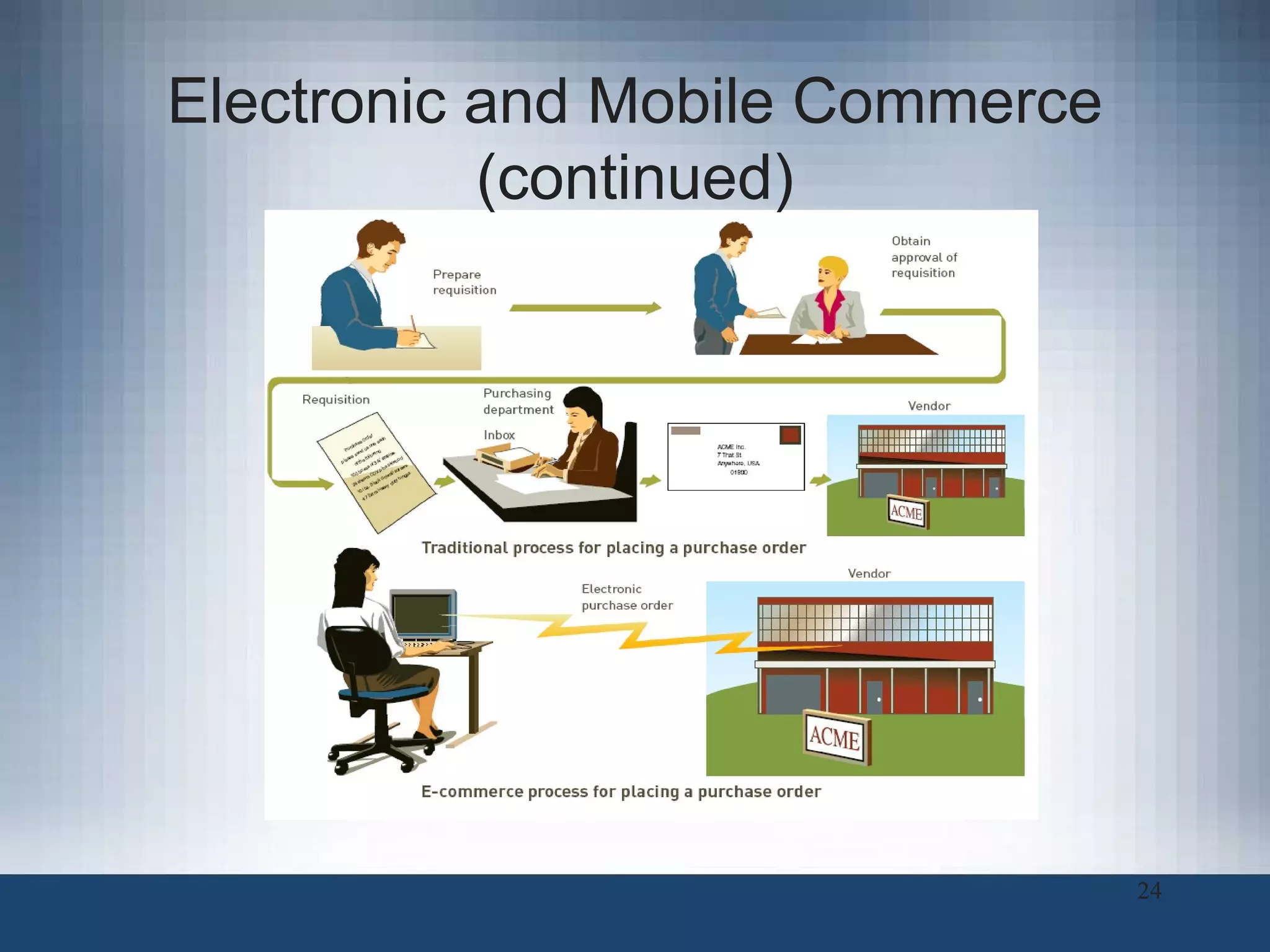
Electronic and Mobile Commerce (continued)
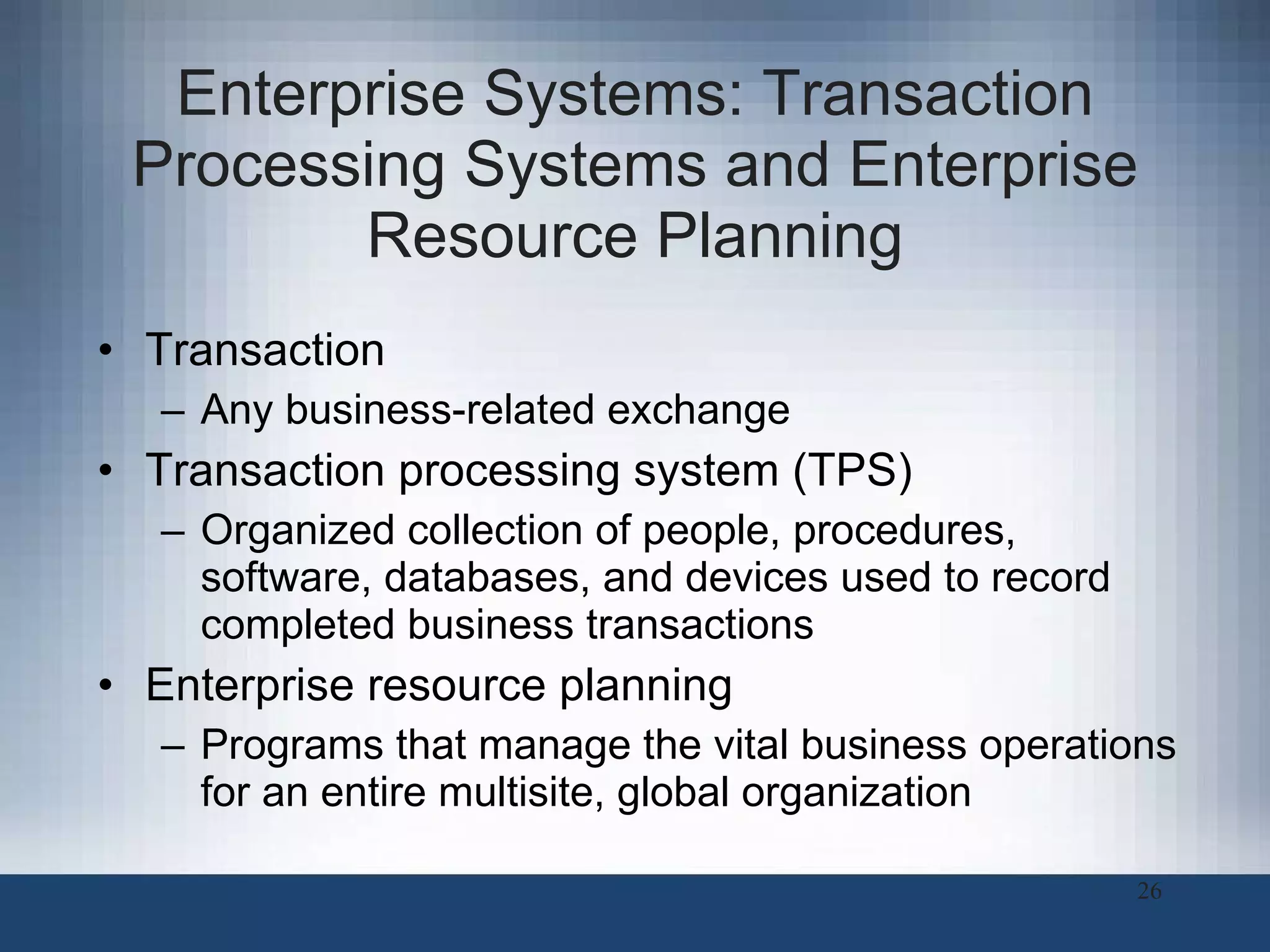
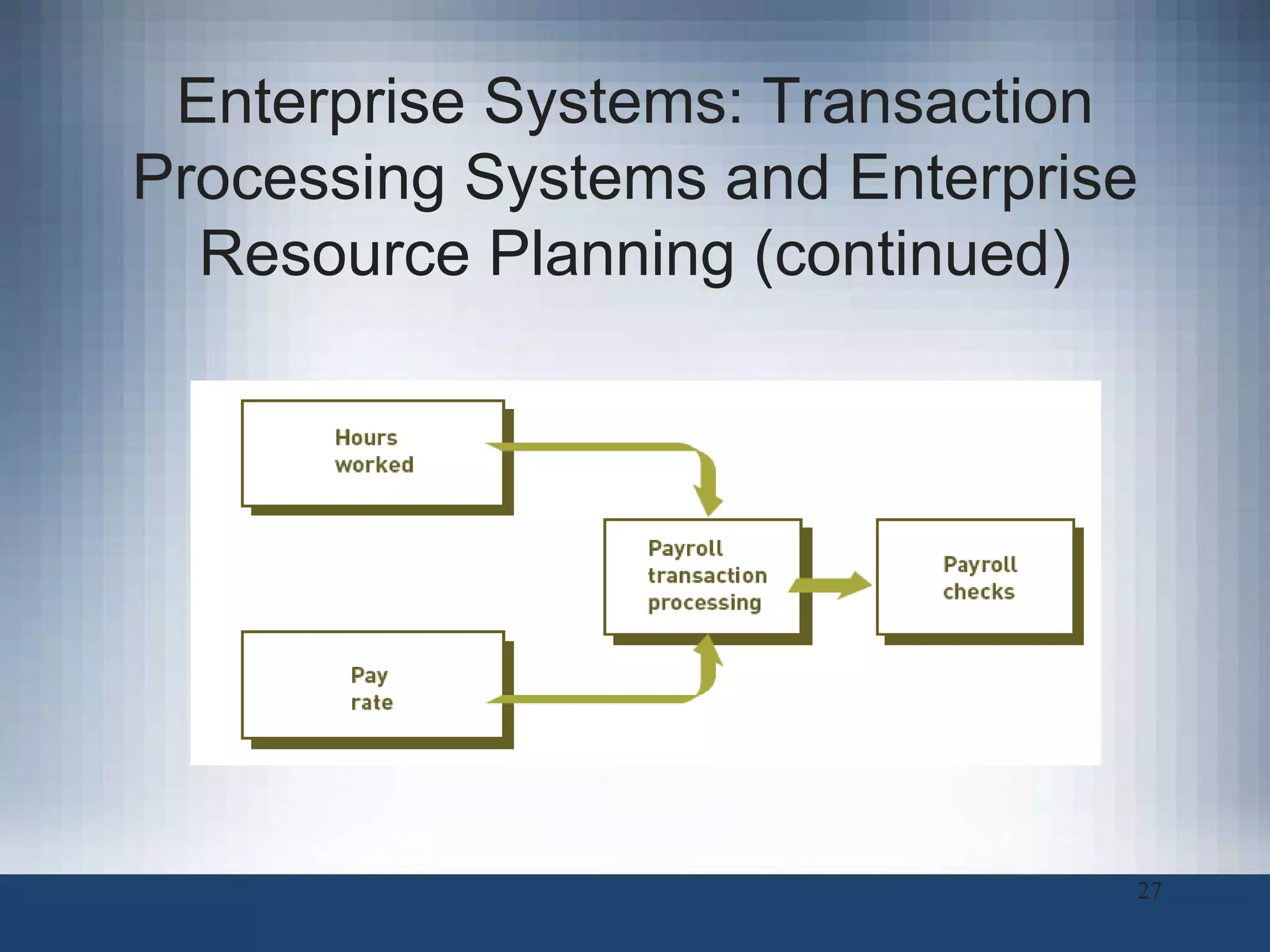
Enterprise Systems: Transaction Processing Systems and Enterprise Resource Planning Transaction  Any business-related exchange Transaction processing system (TPS) Organized collection of people, procedures, software, databases, and devices used to record completed business transactions Enterprise resource planning Programs that manage the vital business operations for an entire multisite, global organization
Enterprise Systems: Transaction Processing Systems and Enterprise Resource Planning (continued)
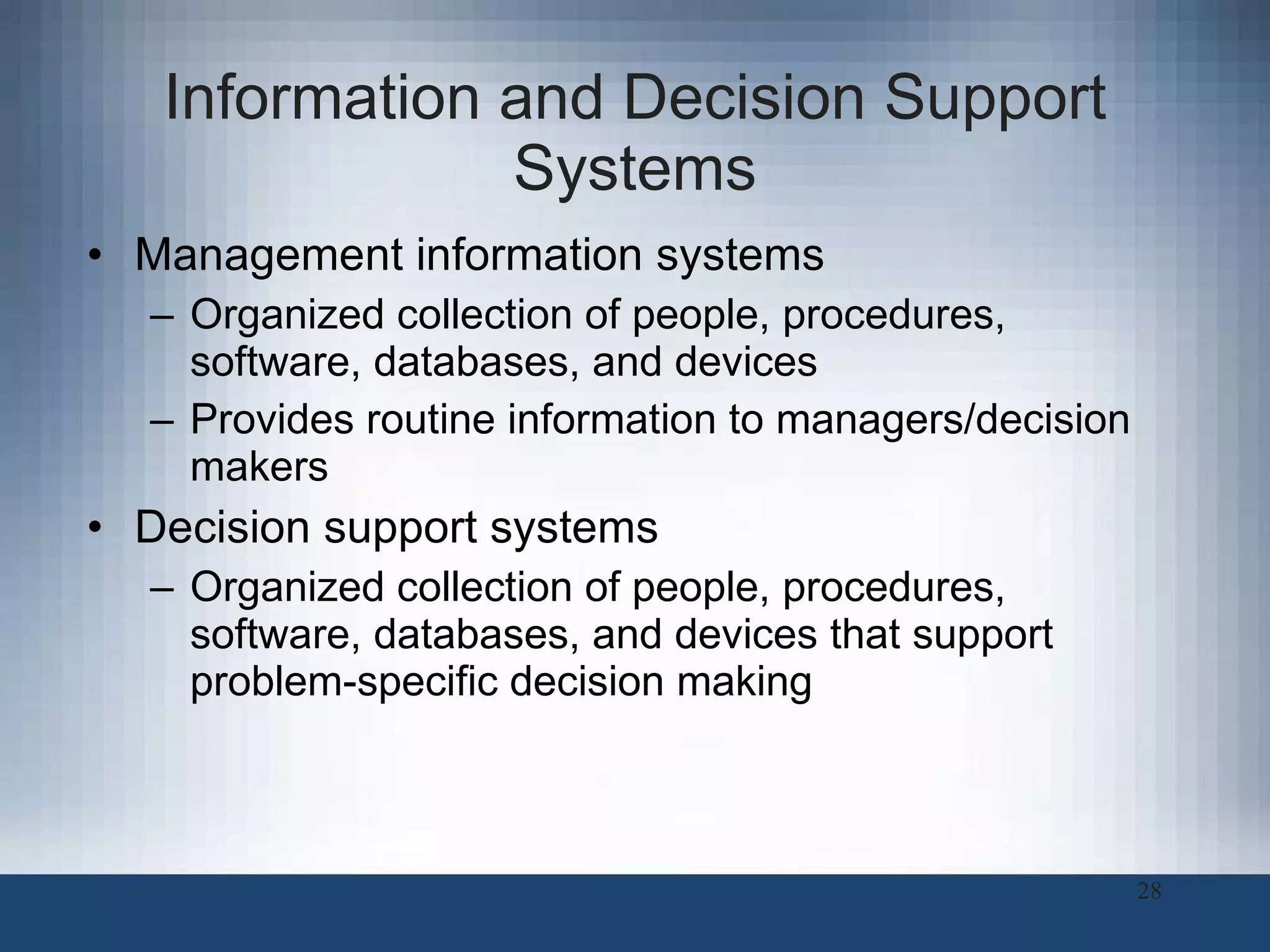
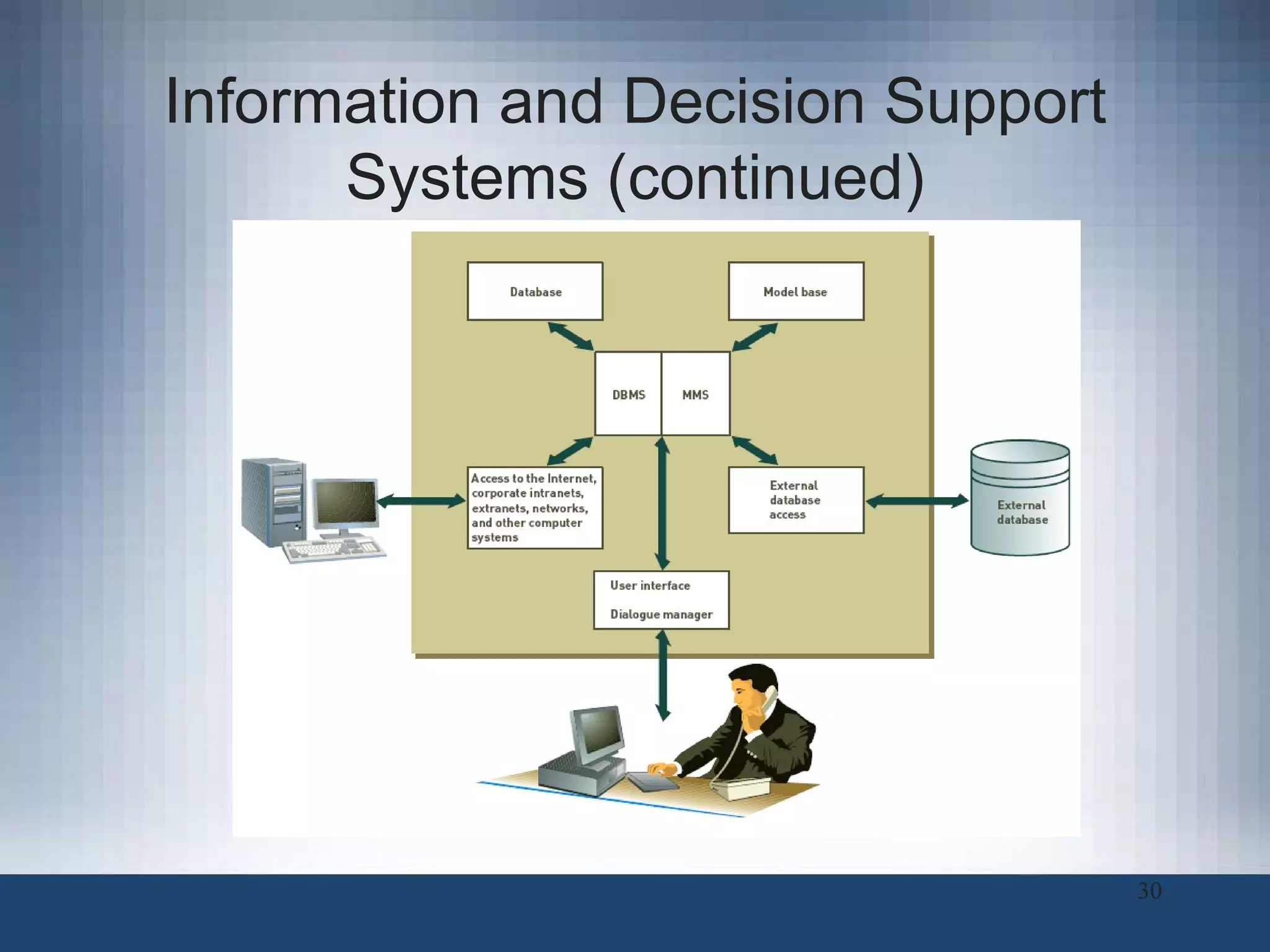
Information and Decision Support Systems Management information systems Organized collection of people, procedures, software, databases, and devices  Provides routine information to managers/decision makers Decision support systems Organized collection of people, procedures, software, databases, and devices that support problem-specific decision making
Information and Decision Support Systems (continued)
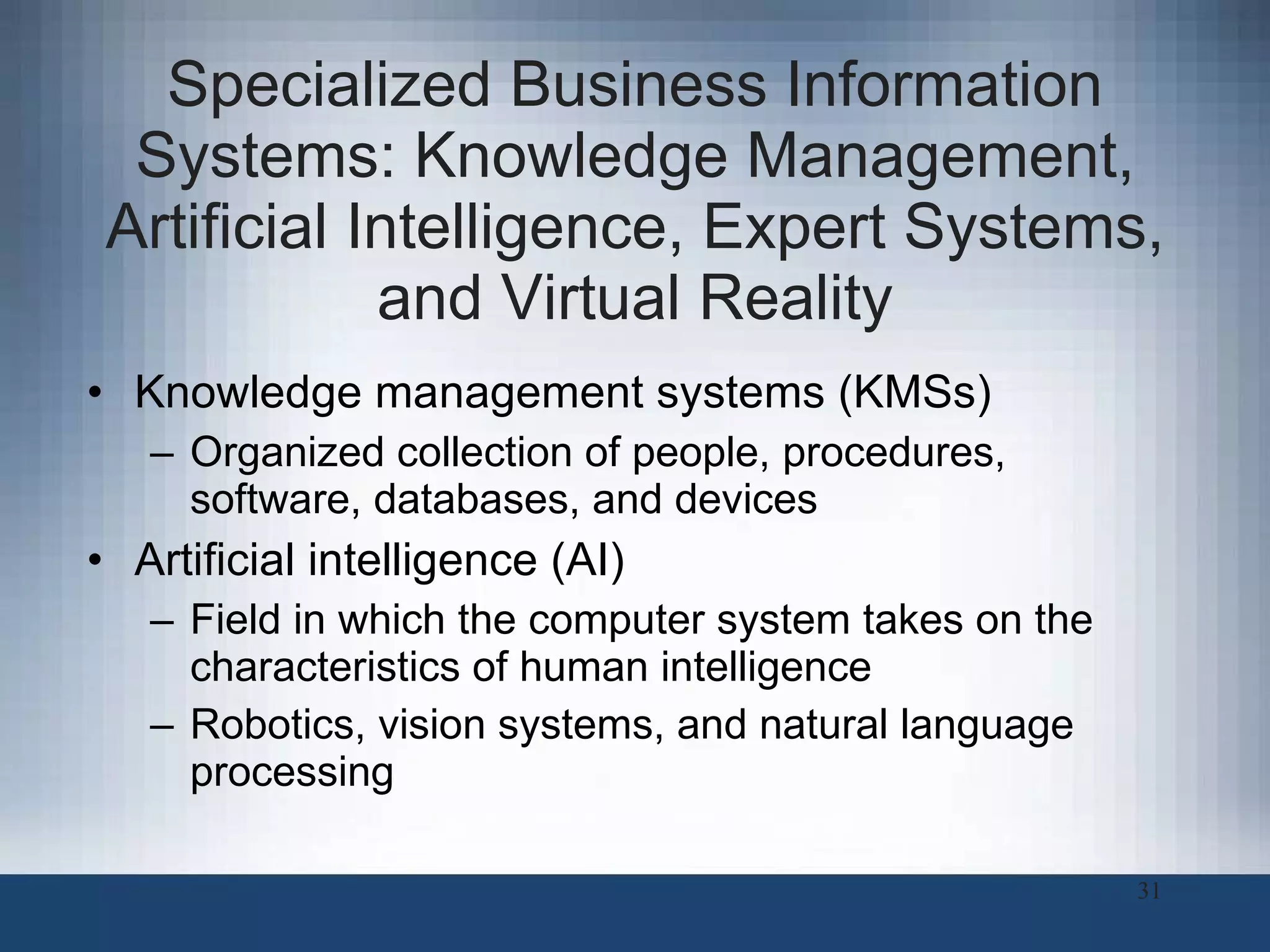
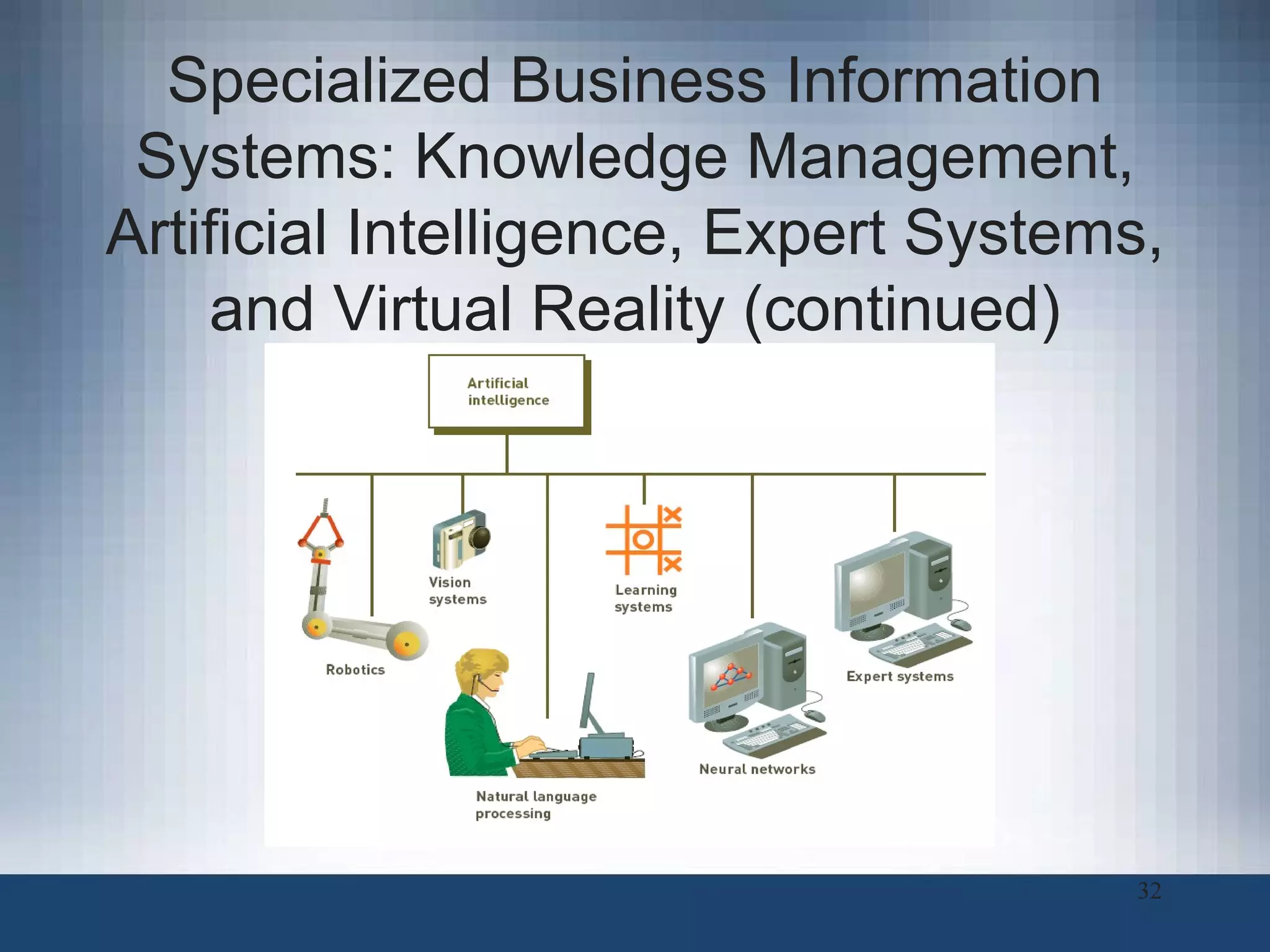
Specialized Business Information Systems: Knowledge Management, Artificial Intelligence, Expert Systems, and Virtual Reality Knowledge management systems (KMSs) Organized collection of people, procedures, software, databases, and devices  Artificial intelligence (AI) Field in which the computer system takes on the characteristics of human intelligence Robotics, vision systems, and natural language processing
Specialized Business Information Systems: Knowledge Management, Artificial Intelligence, Expert Systems, and Virtual Reality (continued)
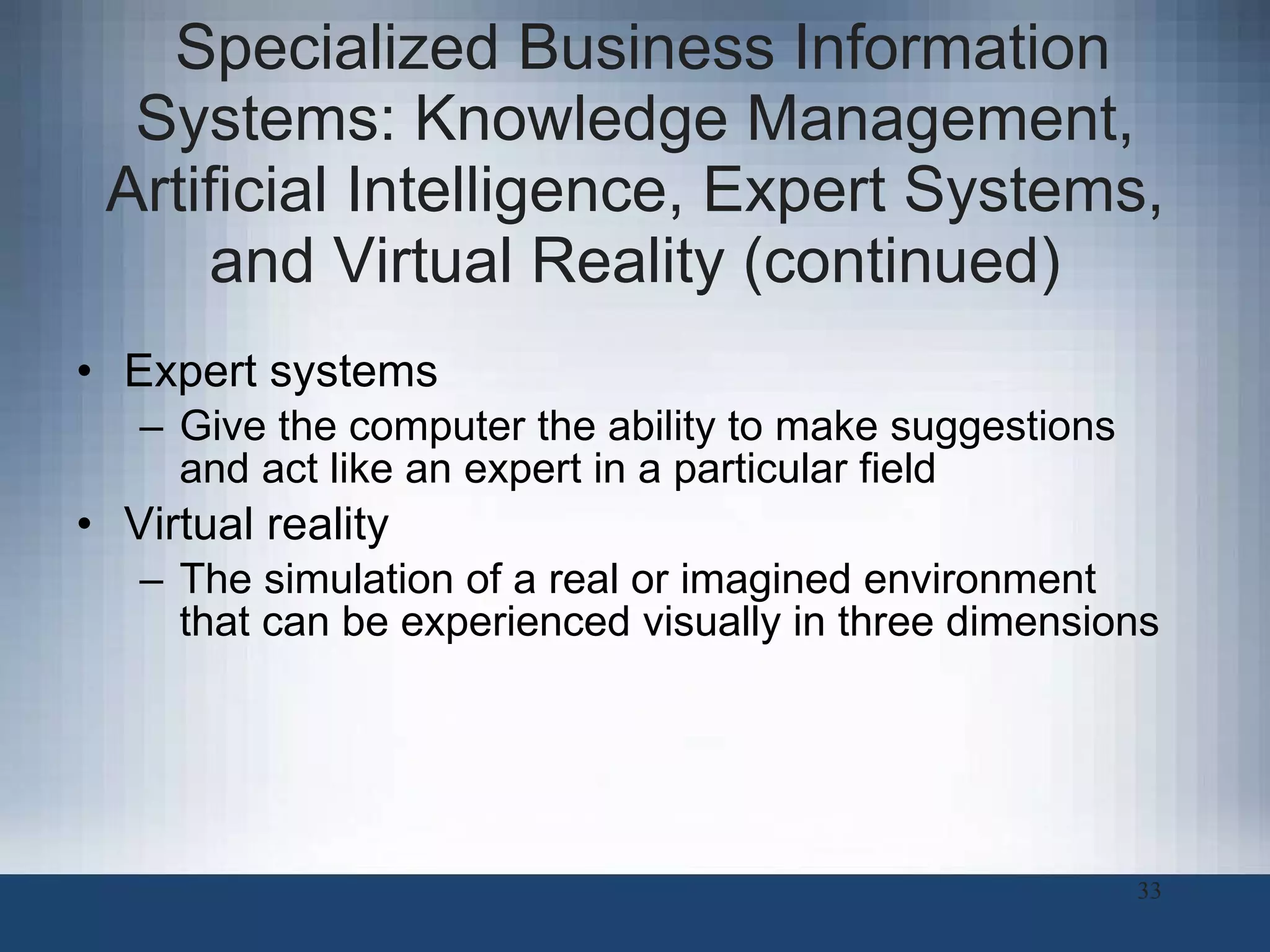
Specialized Business Information Systems: Knowledge Management, Artificial Intelligence, Expert Systems, and Virtual Reality (continued) Expert systems Give the computer the ability to make suggestions and act like an expert in a particular field Virtual reality The simulation of a real or imagined environment that can be experienced visually in three dimensions
Systems Development Creating or modifying existing business systems Systems development failures can be a result of:  Poor planning and scheduling Insufficient management of risk Poor requirements determination Lack of user involvement Outsourcing Allows a company to focus on what it does best and delegate other functions
Systems Development (continued)
Systems Investigation and Analysis Systems investigation Goal is to gain understanding of the problem to be solved or opportunity to be addressed Systems analysis Defines problems and opportunities of the existing system
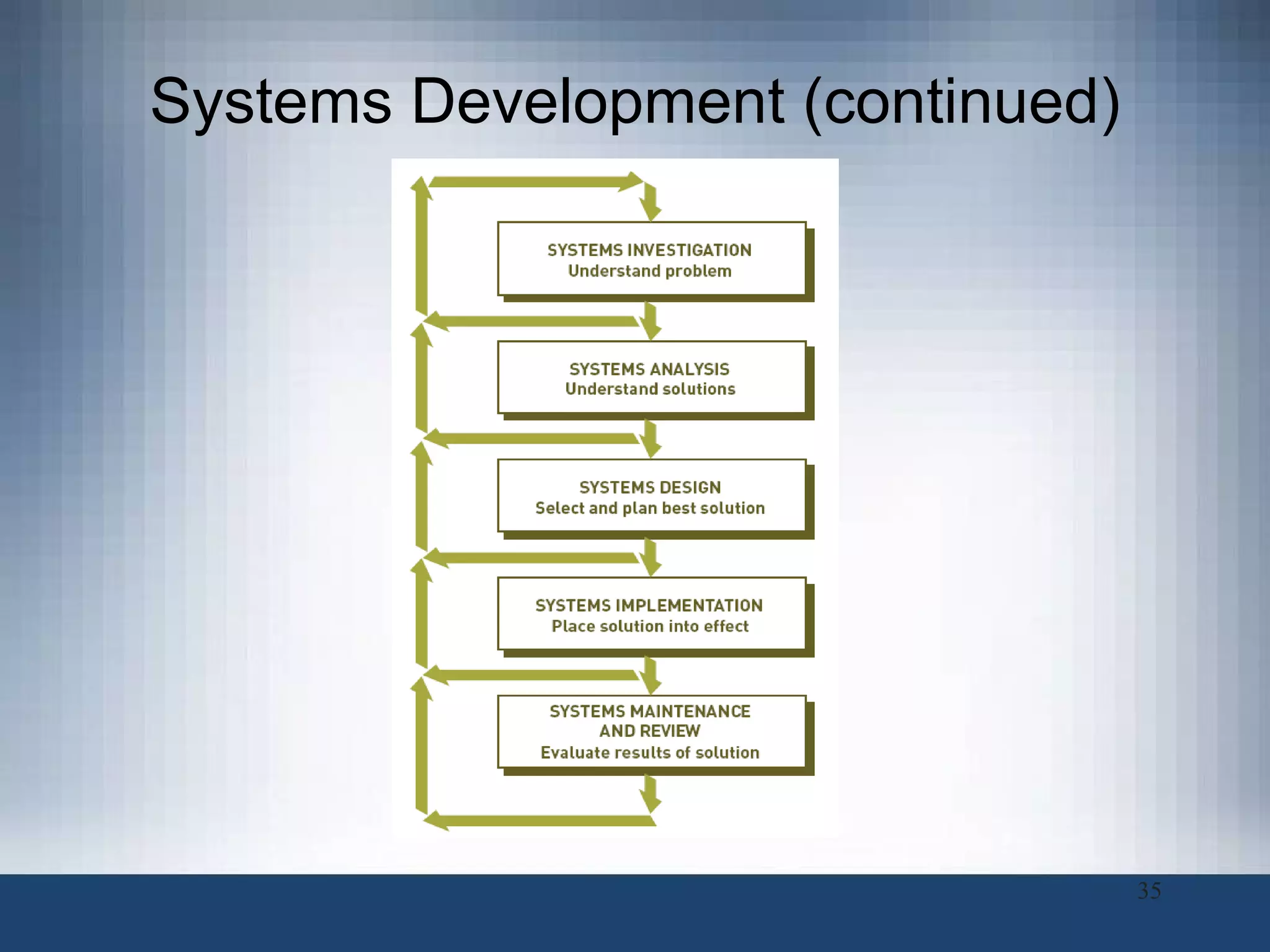
Systems Design, Implementation, and Maintenance and Review Systems design Determines how the new system will work to meet the business needs defined during systems analysis Systems implementation Creating or acquiring the system components defined in the design step, assembling them, and putting the new system into operation Systems maintenance and review Checking and modifying the system so that it continues to meet changing business needs
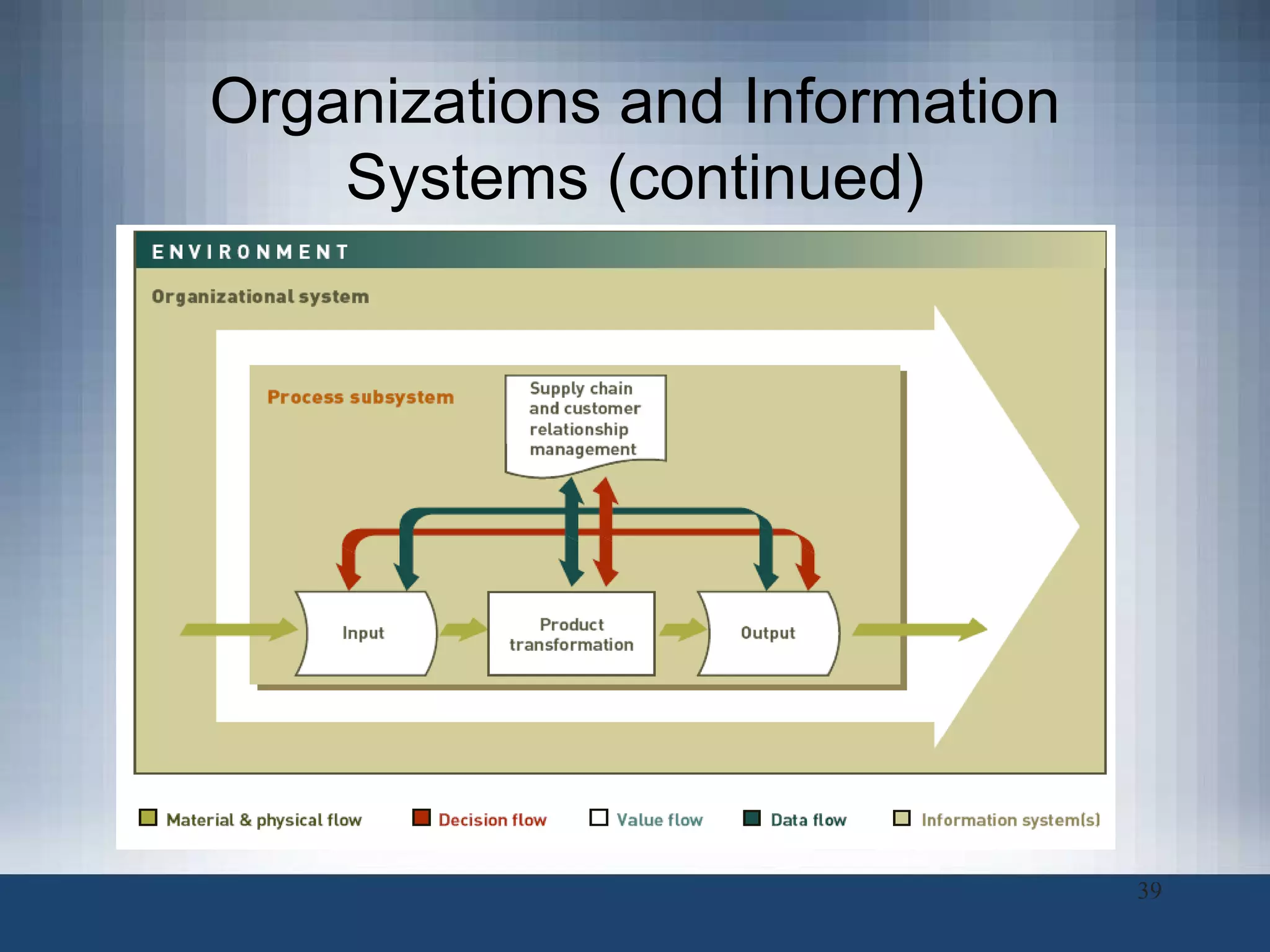
Organizations and Information Systems Organization Collection of people and other resources established to accomplish a set of goals Has inputs, processing mechanisms, outputs, and feedback
Organizations and Information Systems (continued)
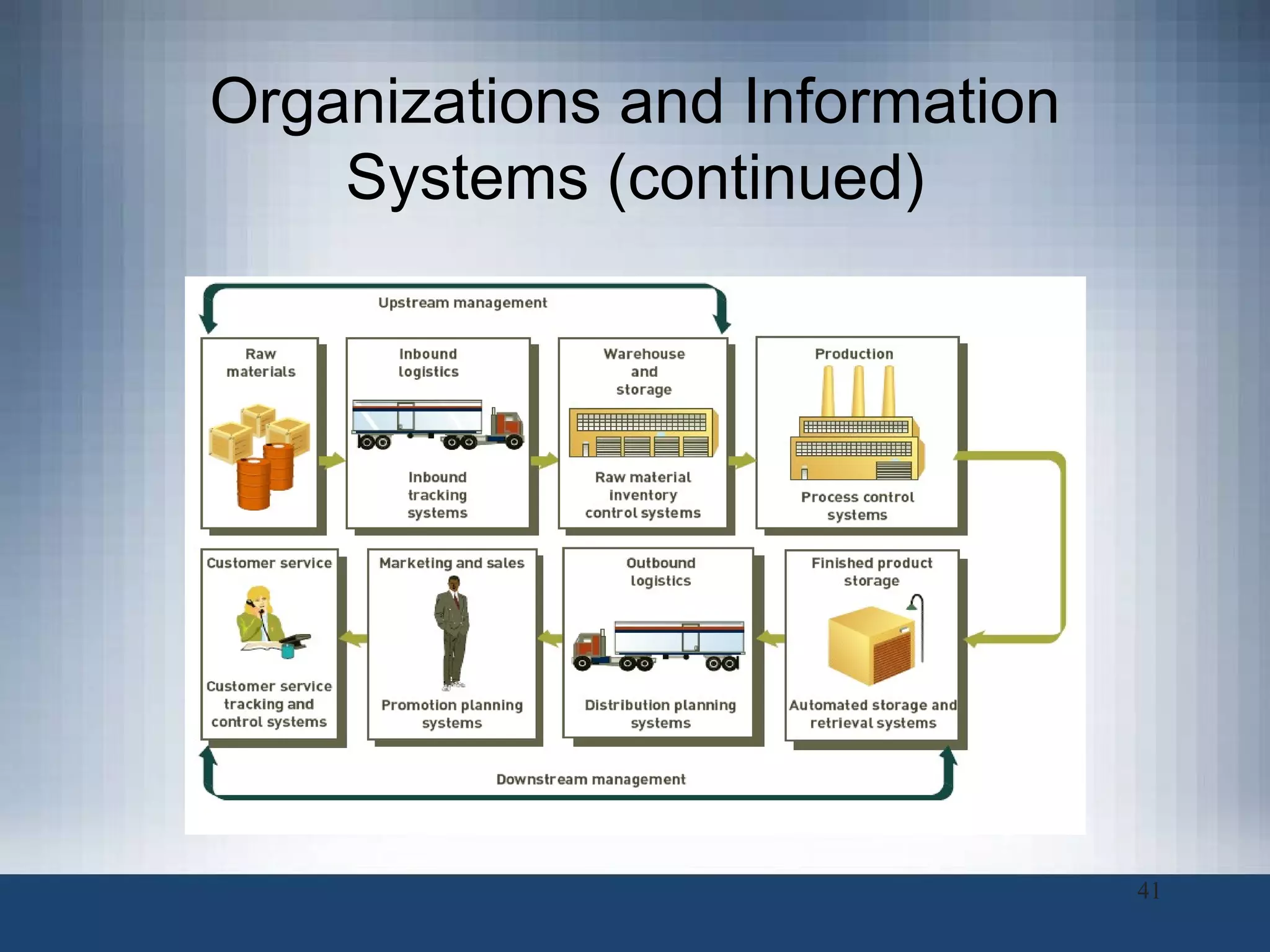
Organizations and Information Systems (continued) Value chain Series of activities that includes inbound logistics, warehouse and storage, and production  Supply chain management (SCM) Helps determine what supplies are required for the value chain and what quantities are needed to meet customer demand Customer relationship management (CRM)   Helps companies manage all aspects of customer encounters, including marketing and advertising
Organizations and Information Systems (continued)
Organizational Culture and Change Organizational culture Major understandings and assumptions The understandings are often not stated or documented as goals or formal policies Organizational change How organizations plan for, implement, and handle change Can be sustaining or disruptive
User Satisfaction and Technology Acceptance Technology acceptance model (TAM) Specifies factors that can lead to higher acceptance and usage of technology Technology diffusion Measure of widespread use of technology Technology infusion Extent to which technology permeates a department
Competitive Advantage Significant, long-term benefit to a company over its competition An organization often uses its information system to help achieve a competitive advantage
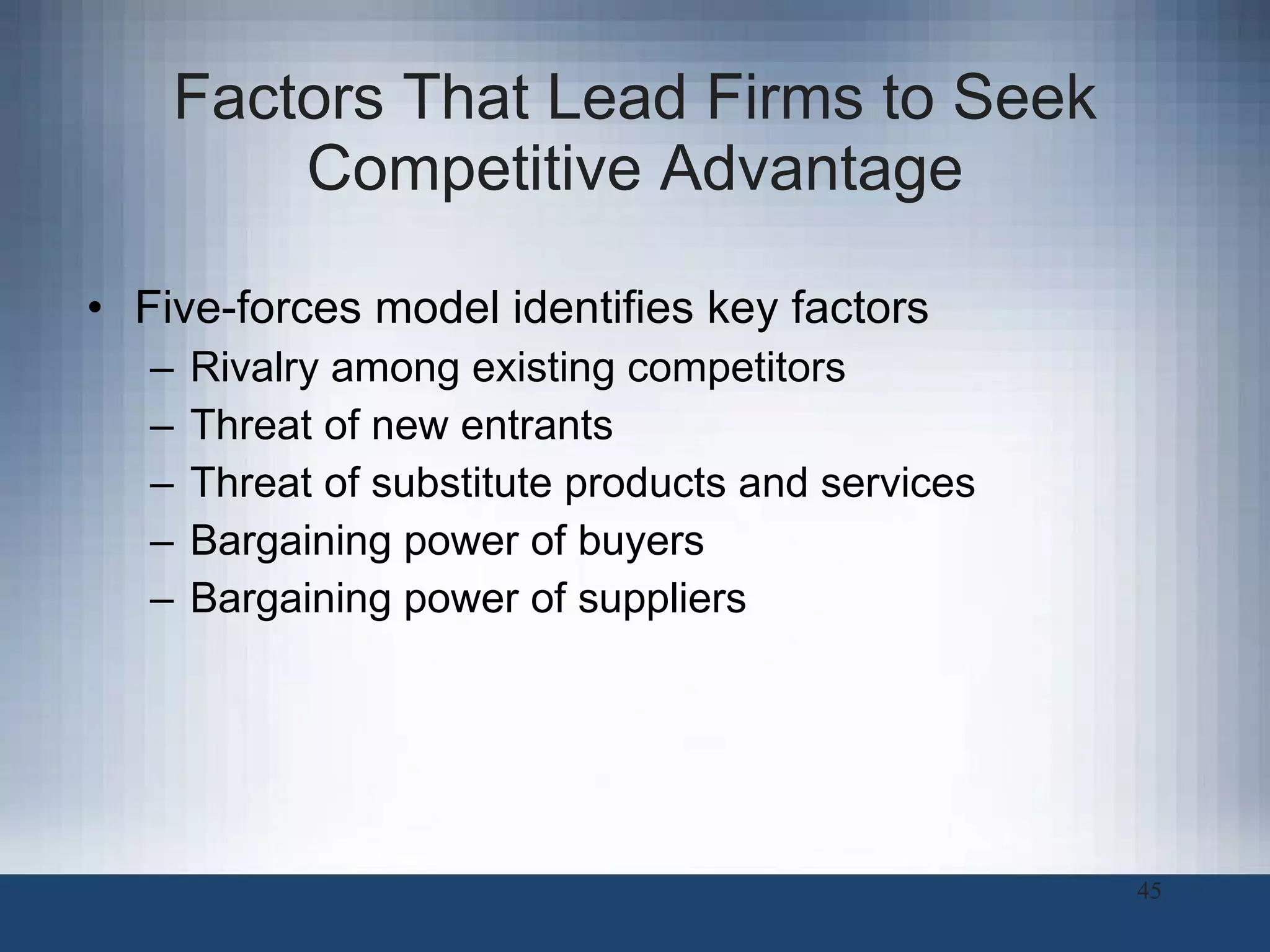
Factors That Lead Firms to Seek Competitive Advantage Five-forces model identifies key factors Rivalry among existing competitors Threat of new entrants Threat of substitute products and services Bargaining power of buyers Bargaining power of suppliers
Strategic Planning for Competitive Advantage Cost leadership Deliver the lowest possible products and services Differentiation Deliver different products and services Niche strategy Deliver to a small, niche market Altering the industry structure Change the industry to become more favorable to organization
Strategic Planning for Competitive Advantage (continued) Creating new products and services Introduce periodically or frequently Improving existing product lines and service Make real or perceived improvements Other strategies Growth in sales First to market Customizing products and services Hiring the best people
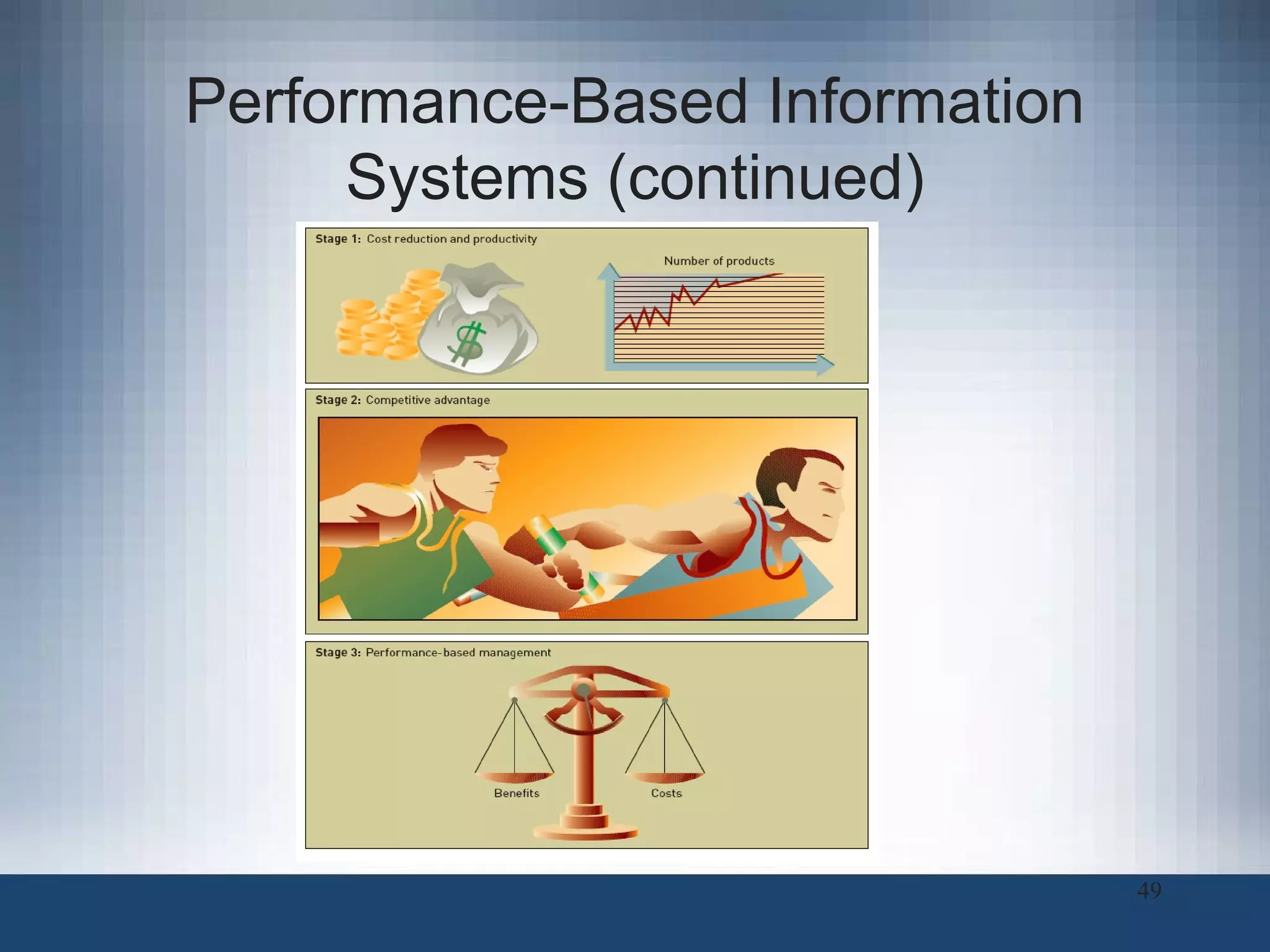
Performance-Based Information Systems Three major stages Organizations focused on using information systems to reduce costs and improve productivity Companies generally ignored revenue potential, not looking for opportunities to use information systems to increase sales Companies carefully consider both strategic advantage and costs
Performance-Based Information Systems (continued)
Productivity Output achieved divided by input required Higher level of output for a given level of input means greater productivity Lower level of output for a given level of input means lower productivity
Return on Investment and the Value of Information Systems Earnings growth Increase in profits Market share Percentage of sales in relation to total market Customer awareness and satisfaction Based on feedback from internal and external users Total cost of ownership Sum of all costs over the life of the information system
Risk Managers must consider the risks of:  Designing, developing, and implementing new or modified information systems Information systems can be costly failures Costs of development and implementation can be greater than the returns from the new system
Company Networks Intranet Internal corporate network built using Internet and World Wide Web standards and products Extranet Network that links selected resources of the intranet with customers, suppliers, or other business partners Virtual private network (VPN)  Secure connection between two points on the Internet
Careers In Information Systems Knowledge workers (KWs)  People who create, use, and disseminate knowledge Students are increasingly completing business degrees with a global or international orientation
Roles, Functions, and Careers in IS  Primary responsibilities in information systems Operations : Focuses on the efficiency of IS functions Systems development : Focuses on development projects and ongoing maintenance and review Support : Provides user assistance, data administration, user training, and Web administration Information service units : Miniature IS department attached and directly reporting to a functional area in a large organization
Typical IS Titles and Functions Chief Information Officer (CIO) Employs IS department’s equipment and personnel to help the organization attain its goals LAN administrators Set up and manage the network hardware, software, and security processes  Internet careers Opportunities are found in both traditional companies and those that specialize in the Internet
Global Challenges in Information Systems Cultural challenges Language challenges Time and distance challenges Infrastructure challenges Currency challenges
Global Challenges in Information Systems (continued) Product and service challenges Technology transfer issues State, regional, and national laws Trade agreements
Summary Data consists of raw facts Information Data transformed into a meaningful form Types of systems include:  E-commerce and m-commerce TPS and ERP MIS and DSS Specialized business information systems
Summary (continued) Systems development  Creating or modifying existing business systems  Organization  Formal collection of people and various other resources established to accomplish a set of goals Supply chain management (SCM) helps determine:  What supplies are required What quantities are needed to meet customer demand How the supplies are to be processed
Summary (continued) Five-forces model covers:  Rivalry among existing competitors Threat of new market entrants Threat of substitute products and services Bargaining power of buyers and suppliers Information systems personnel typically work in an IS department that employs: A chief information officer Systems analysts  Computer programmers and operators

Intro to Information Systems

  • 1.
    An Introduction toInformation Systems in Organizations
  • 2.
    Principles and LearningObjectives The value of information is directly linked to how it helps decision makers achieve the organization’s goals Distinguish data from information and describe the characteristics used to evaluate the value of data
  • 3.
    Principles and LearningObjectives (continued) Knowing the potential impact of information systems and having the ability to put this knowledge to work can result in a successful personal career and organizations that reach their goals Identify the basic types of business information systems and discuss who uses them, how they are used, and what kinds of benefits they deliver
  • 4.
    Principles and LearningObjectives (continued) System users, business managers, and information systems professionals must work together to build a successful information system Identify the major steps of the systems development process and state the goal of each
  • 5.
    Principles and LearningObjectives (continued) The use of information systems to add value to the organization can also give an organization a competitive advantage Identify the value-added processes in the supply chain and describe the role of information systems within them Identify some of the strategies employed to lower costs or improve service Define the term competitive advantage and discuss how organizations are using information systems to gain such an advantage
  • 6.
    Principles and LearningObjectives (continued) Cooperation between business managers and IS personnel is the key to unlocking the potential of any new or modified system Define the types of roles, functions, and careers available in information systems
  • 7.
    Information Concepts Data,information, and knowledge Data : Raw facts Information : Collection of facts organized in such a way that they have additional value beyond the value of the facts themselves Process : Set of logically related tasks performed to achieve a defined outcome Knowledge : Awareness and understanding of a set of information
  • 8.
  • 9.
    Data, Information, andKnowledge (continued)
  • 10.
    The Characteristics ofValuable Information If information is not accurate or complete People can make poor decisions, costing thousands, or even millions, of dollars Information can be of little value to the organization If information is not relevant, not delivered to decision makers in a timely fashion, or too complex to understand
  • 11.
    The Value ofInformation Valuable information Can help people and their organizations perform tasks more efficiently and effectively Can help managers decide whether to invest in additional information systems and technology
  • 12.
    What Is anInformation System? Feedback mechanism The component that helps organizations achieve their goals, such as increasing profits or improving customer service
  • 13.
    What Is anInformation System? (continued)
  • 14.
    Input, Processing, Output,Feedback Input Gathering and capturing raw data Processing Converting or transforming data into useful outputs Output Production of useful information, usually in the form of documents and reports Feedback Output that is used to make changes to input or processing activities
  • 15.
    Manual and ComputerizedInformation Systems An information system can be: Manual Example: Developing patterns and trends on graph paper for stock analysis Computerized Example: Using program trading to track the market and trade large blocks of stocks when discrepancies occur
  • 16.
    Computer-Based Information SystemsSingle set of hardware, software, databases, telecommunications, people, and procedures configured to collect, manipulate, store, and process data into information Information technology (IT) Hardware, software, databases, and telecommunications
  • 17.
  • 18.
    Computer-Based Information Systems(continued) CBIS components Hardware : Computer equipment used to perform input, processing, and output activities Software : Computer programs that govern the operation of the computer Database : Organized collection of facts and information Telecommunications : Electronic transmission of signals for communications Networks : Connect computers and equipment in a building, around the country, and around the world
  • 19.
    Computer-Based Information Systems(continued) CBIS components (continued) Internet : World’s largest computer network People : Manage, run, program, and maintain the system Procedures : Strategies, policies, methods, and rules for using a CBIS
  • 20.
    Business Information Systems Most common types of information systems used are those designed for: Electronic and mobile commerce Transaction processing Management information Decision support
  • 21.
    Business Information Systems (continued)
  • 22.
    Electronic and MobileCommerce E-commerce Any business transaction executed electronically between: Companies (B2B) Companies and consumers (B2C) Consumers and other consumers (C2C) Business and the public sector Consumers and the public sector
  • 23.
    Electronic and MobileCommerce (continued) Mobile commerce (m-commerce) Transactions conducted anywhere, anytime Electronic business (e-business) Uses information systems and the Internet to perform all business-related tasks and functions
  • 24.
    Electronic and MobileCommerce (continued)
  • 25.
    Electronic and MobileCommerce (continued)
  • 26.
    Enterprise Systems: TransactionProcessing Systems and Enterprise Resource Planning Transaction Any business-related exchange Transaction processing system (TPS) Organized collection of people, procedures, software, databases, and devices used to record completed business transactions Enterprise resource planning Programs that manage the vital business operations for an entire multisite, global organization
  • 27.
    Enterprise Systems: TransactionProcessing Systems and Enterprise Resource Planning (continued)
  • 28.
    Information and DecisionSupport Systems Management information systems Organized collection of people, procedures, software, databases, and devices Provides routine information to managers/decision makers Decision support systems Organized collection of people, procedures, software, databases, and devices that support problem-specific decision making
  • 29.
    Information and DecisionSupport Systems (continued)
  • 30.
    Information and DecisionSupport Systems (continued)
  • 31.
    Specialized Business InformationSystems: Knowledge Management, Artificial Intelligence, Expert Systems, and Virtual Reality Knowledge management systems (KMSs) Organized collection of people, procedures, software, databases, and devices Artificial intelligence (AI) Field in which the computer system takes on the characteristics of human intelligence Robotics, vision systems, and natural language processing
  • 32.
    Specialized Business InformationSystems: Knowledge Management, Artificial Intelligence, Expert Systems, and Virtual Reality (continued)
  • 33.
    Specialized Business InformationSystems: Knowledge Management, Artificial Intelligence, Expert Systems, and Virtual Reality (continued) Expert systems Give the computer the ability to make suggestions and act like an expert in a particular field Virtual reality The simulation of a real or imagined environment that can be experienced visually in three dimensions
  • 34.
    Systems Development Creatingor modifying existing business systems Systems development failures can be a result of: Poor planning and scheduling Insufficient management of risk Poor requirements determination Lack of user involvement Outsourcing Allows a company to focus on what it does best and delegate other functions
  • 35.
  • 36.
    Systems Investigation andAnalysis Systems investigation Goal is to gain understanding of the problem to be solved or opportunity to be addressed Systems analysis Defines problems and opportunities of the existing system
  • 37.
    Systems Design, Implementation,and Maintenance and Review Systems design Determines how the new system will work to meet the business needs defined during systems analysis Systems implementation Creating or acquiring the system components defined in the design step, assembling them, and putting the new system into operation Systems maintenance and review Checking and modifying the system so that it continues to meet changing business needs
  • 38.
    Organizations and InformationSystems Organization Collection of people and other resources established to accomplish a set of goals Has inputs, processing mechanisms, outputs, and feedback
  • 39.
    Organizations and InformationSystems (continued)
  • 40.
    Organizations and InformationSystems (continued) Value chain Series of activities that includes inbound logistics, warehouse and storage, and production Supply chain management (SCM) Helps determine what supplies are required for the value chain and what quantities are needed to meet customer demand Customer relationship management (CRM) Helps companies manage all aspects of customer encounters, including marketing and advertising
  • 41.
    Organizations and InformationSystems (continued)
  • 42.
    Organizational Culture andChange Organizational culture Major understandings and assumptions The understandings are often not stated or documented as goals or formal policies Organizational change How organizations plan for, implement, and handle change Can be sustaining or disruptive
  • 43.
    User Satisfaction andTechnology Acceptance Technology acceptance model (TAM) Specifies factors that can lead to higher acceptance and usage of technology Technology diffusion Measure of widespread use of technology Technology infusion Extent to which technology permeates a department
  • 44.
    Competitive Advantage Significant,long-term benefit to a company over its competition An organization often uses its information system to help achieve a competitive advantage
  • 45.
    Factors That LeadFirms to Seek Competitive Advantage Five-forces model identifies key factors Rivalry among existing competitors Threat of new entrants Threat of substitute products and services Bargaining power of buyers Bargaining power of suppliers
  • 46.
    Strategic Planning forCompetitive Advantage Cost leadership Deliver the lowest possible products and services Differentiation Deliver different products and services Niche strategy Deliver to a small, niche market Altering the industry structure Change the industry to become more favorable to organization
  • 47.
    Strategic Planning forCompetitive Advantage (continued) Creating new products and services Introduce periodically or frequently Improving existing product lines and service Make real or perceived improvements Other strategies Growth in sales First to market Customizing products and services Hiring the best people
  • 48.
    Performance-Based Information SystemsThree major stages Organizations focused on using information systems to reduce costs and improve productivity Companies generally ignored revenue potential, not looking for opportunities to use information systems to increase sales Companies carefully consider both strategic advantage and costs
  • 49.
  • 50.
    Productivity Output achieveddivided by input required Higher level of output for a given level of input means greater productivity Lower level of output for a given level of input means lower productivity
  • 51.
    Return on Investmentand the Value of Information Systems Earnings growth Increase in profits Market share Percentage of sales in relation to total market Customer awareness and satisfaction Based on feedback from internal and external users Total cost of ownership Sum of all costs over the life of the information system
  • 52.
    Risk Managers mustconsider the risks of: Designing, developing, and implementing new or modified information systems Information systems can be costly failures Costs of development and implementation can be greater than the returns from the new system
  • 53.
    Company Networks IntranetInternal corporate network built using Internet and World Wide Web standards and products Extranet Network that links selected resources of the intranet with customers, suppliers, or other business partners Virtual private network (VPN) Secure connection between two points on the Internet
  • 54.
    Careers In InformationSystems Knowledge workers (KWs) People who create, use, and disseminate knowledge Students are increasingly completing business degrees with a global or international orientation
  • 55.
    Roles, Functions, andCareers in IS Primary responsibilities in information systems Operations : Focuses on the efficiency of IS functions Systems development : Focuses on development projects and ongoing maintenance and review Support : Provides user assistance, data administration, user training, and Web administration Information service units : Miniature IS department attached and directly reporting to a functional area in a large organization
  • 56.
    Typical IS Titlesand Functions Chief Information Officer (CIO) Employs IS department’s equipment and personnel to help the organization attain its goals LAN administrators Set up and manage the network hardware, software, and security processes Internet careers Opportunities are found in both traditional companies and those that specialize in the Internet
  • 57.
    Global Challenges inInformation Systems Cultural challenges Language challenges Time and distance challenges Infrastructure challenges Currency challenges
  • 58.
    Global Challenges inInformation Systems (continued) Product and service challenges Technology transfer issues State, regional, and national laws Trade agreements
  • 59.
    Summary Data consistsof raw facts Information Data transformed into a meaningful form Types of systems include: E-commerce and m-commerce TPS and ERP MIS and DSS Specialized business information systems
  • 60.
    Summary (continued) Systemsdevelopment Creating or modifying existing business systems Organization Formal collection of people and various other resources established to accomplish a set of goals Supply chain management (SCM) helps determine: What supplies are required What quantities are needed to meet customer demand How the supplies are to be processed
  • 61.
    Summary (continued) Five-forcesmodel covers: Rivalry among existing competitors Threat of new market entrants Threat of substitute products and services Bargaining power of buyers and suppliers Information systems personnel typically work in an IS department that employs: A chief information officer Systems analysts Computer programmers and operators