Management Information Systems
Management Information Systems Terminology Confusion MIS = the study of information technology in business settings But, MIS is also term to refer to class of systems used to support operational and tactical decision making
A Model for Problem Solving Decision Making Phase Intelligence gathering Design Choice Implementation Monitoring
Decision Making A step in problem solving Intelligence gathering Definition of problem Data gathered on scope Constraints identified Design phase Alternatives identified and assessed Choice Selection of an alternative
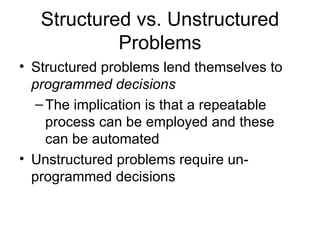
Structured vs. Unstructured Problems Structured problems lend themselves to  programmed decisions The implication is that a repeatable process can be employed and these can be automated Unstructured problems require un-programmed decisions
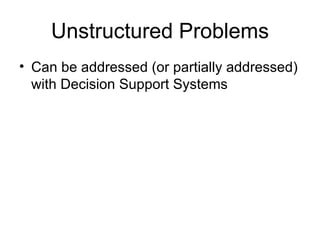
Unstructured Problems Can be addressed (or partially addressed) with Decision Support Systems
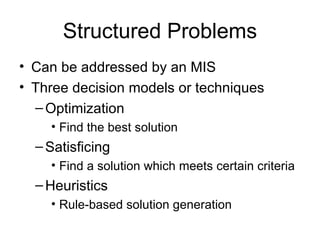
Structured Problems Can be addressed by an MIS Three decision models or techniques Optimization Find the best solution Satisficing Find a solution which meets certain criteria Heuristics Rule-based solution generation
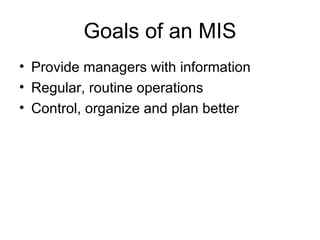
Goals of an MIS Provide managers with information Regular, routine operations Control, organize and plan better
Typical Inputs and Outputs Inputs:  Information from the Sources Outputs: hard and softcopy reports Scheduled reports On-demand reports Key-indicator (business fundamentals) Exception reports
Functional Perspectives of MIS Financial MIS Will integrate information from multiple sources Functions Costing P&L reporting Auditing Funds management
Functional Perspectives of MIS Manufacturing Design and Engineering Master Production Scheduling Inventory Control Materials Planning Manufacturing and Process Control Quality Control
Functional Perspectives of MIS Marketing Market research Web-based market research Pricing
Functional Perspectives of MIS Transportation and Logistics Route and schedule optimization Human Resources Accounting
Decision Support Systems (DSS) Used for unstructured problems Characteristics Data from multiple sources internal and external to organization Presentation flexibility Simulation and what-if capability Support for multiple decision approaches Statistical analysis
Components of a DSS Model management software Provides a variety of solution models Financial, statistical, graphical, project management Dialogue Manager Allows user interaction with DSS
Group Decision Making Systems Very interesting field How can information technology improve how decisions are made by groups?
Group Decision Making Systems Applications Where time is critical Where participants are geographically dispersed Where authority obstructs communication Military Business Government
Group Decision Making Systems Common characteristics Meeting moderation/facilitation Signed and anonymous comments Structured deliberations Presentation period Comment period Automated collation of comments “Voting” Face-to-face and remote
Executive Information Systems What information does a chief executive of board member require?
Executive Information Systems High level with drill down Key business and industry data Structured and unstructured information Structured:  orders Unstructured: Industry news feed Graphical

Chapter 2 Management Information System (Basics)

  • 1.
  • 2.
    Management Information SystemsTerminology Confusion MIS = the study of information technology in business settings But, MIS is also term to refer to class of systems used to support operational and tactical decision making
  • 3.
    A Model forProblem Solving Decision Making Phase Intelligence gathering Design Choice Implementation Monitoring
  • 4.
    Decision Making Astep in problem solving Intelligence gathering Definition of problem Data gathered on scope Constraints identified Design phase Alternatives identified and assessed Choice Selection of an alternative
  • 5.
    Structured vs. UnstructuredProblems Structured problems lend themselves to programmed decisions The implication is that a repeatable process can be employed and these can be automated Unstructured problems require un-programmed decisions
  • 6.
    Unstructured Problems Canbe addressed (or partially addressed) with Decision Support Systems
  • 7.
    Structured Problems Canbe addressed by an MIS Three decision models or techniques Optimization Find the best solution Satisficing Find a solution which meets certain criteria Heuristics Rule-based solution generation
  • 8.
    Goals of anMIS Provide managers with information Regular, routine operations Control, organize and plan better
  • 9.
    Typical Inputs andOutputs Inputs: Information from the Sources Outputs: hard and softcopy reports Scheduled reports On-demand reports Key-indicator (business fundamentals) Exception reports
  • 10.
    Functional Perspectives ofMIS Financial MIS Will integrate information from multiple sources Functions Costing P&L reporting Auditing Funds management
  • 11.
    Functional Perspectives ofMIS Manufacturing Design and Engineering Master Production Scheduling Inventory Control Materials Planning Manufacturing and Process Control Quality Control
  • 12.
    Functional Perspectives ofMIS Marketing Market research Web-based market research Pricing
  • 13.
    Functional Perspectives ofMIS Transportation and Logistics Route and schedule optimization Human Resources Accounting
  • 14.
    Decision Support Systems(DSS) Used for unstructured problems Characteristics Data from multiple sources internal and external to organization Presentation flexibility Simulation and what-if capability Support for multiple decision approaches Statistical analysis
  • 15.
    Components of aDSS Model management software Provides a variety of solution models Financial, statistical, graphical, project management Dialogue Manager Allows user interaction with DSS
  • 16.
    Group Decision MakingSystems Very interesting field How can information technology improve how decisions are made by groups?
  • 17.
    Group Decision MakingSystems Applications Where time is critical Where participants are geographically dispersed Where authority obstructs communication Military Business Government
  • 18.
    Group Decision MakingSystems Common characteristics Meeting moderation/facilitation Signed and anonymous comments Structured deliberations Presentation period Comment period Automated collation of comments “Voting” Face-to-face and remote
  • 19.
    Executive Information SystemsWhat information does a chief executive of board member require?
  • 20.
    Executive Information SystemsHigh level with drill down Key business and industry data Structured and unstructured information Structured: orders Unstructured: Industry news feed Graphical