MANAGEMENT INFORMATION SYSTEMS:
CHAPTER-I
INFORMATION SYSTEM CONCEPTS
PRESENTED BY
Dr.R. VENKATESHWAR RAO
Professor- Department of Management
• Fundamental concepts of Information System(IS)
• Information technologies, including Internet-based information
systems, are playing vital and expanding roles in business. Information
technology can help all kinds of businesses improve the efficiency and
effectiveness of their business processes, managerial decision
making, and workgroup collaboration, which strengthens their
competitive positions in rapidly changing marketplaces.
• What Is an Information System?
• An information system (IS) can be any organized combination of
people, hardware, software, communications networks, data
resources, and policies and procedures that stores, retrieves,
transforms, and disseminates information in an organization.
• Even today we make regular use of information systems that
have nothing to do with a computer. Consider some of the
following examples of information systems:
• • Smoke signals for communication
• • Card catalogs in a library
• Your book bag, day planner, notebooks, and file folders
• • The cash register at your favorite fast-food restaurant
• • A paper-based accounting ledger
Basic Systems Concepts
• System Concepts:
System concepts underlie all business processes, as well as our
understanding of information systems and technologies.
• Technology. Computer networks are systems of
information processing components that use a variety of
hardware, software, data management, and
telecommunications network technologies.
• • Applications. E-business and e-commerce applications
involve interconnected business information systems.
• Development. Developing ways to use information
technology in business includes designing the basic
components of information systems.
• Management. Managing information technology
emphasizes the quality, strategic business value, and
security of an organization’s information systems.
What Is a System?
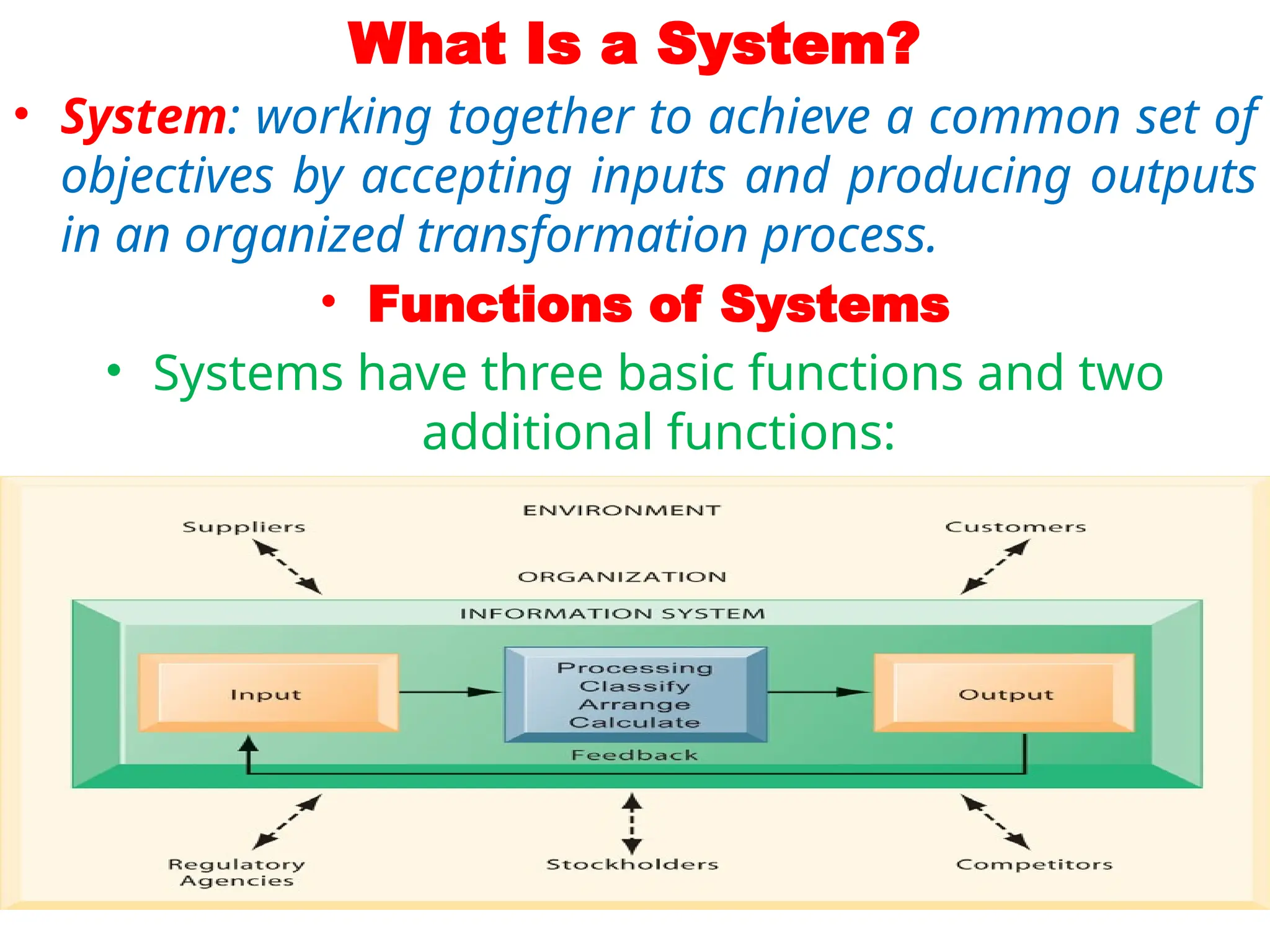
• System: working together to achieve a common set of
objectives by accepting inputs and producing outputs
in an organized transformation process.
• Functions of Systems
• Systems have three basic functions and two
additional functions:
Functions of Systems
1. Input involves capturing and assembling elements that
enter the system to be processed. For example, raw
materials, energy, data, and human effort must be secured
and organized for processing.
2. Processing involves transformation processes that convert
input into output. Examples are manufacturing processes,
the human breathing process, or mathematical
calculations.
3. Output involves transferring elements that have been
produced by a transformation process to their ultimate
destination.
4. Feedback is data about the performance of a system. For
example, data about sales performance are feedback to a
sales manager.
5. Control involves monitoring and evaluating feedback to
determine whether a system is moving toward the achievement of
its goal. The control function then makes the necessary
adjustments to a system’s input and processing components to
ensure that it produces proper output.
System Characteristics:
• Organizations themselves consist of many subsystems, such as
departments, divisions, process teams, and other workgroups.
Organizations are examples of open systems because they interface
and interact with other systems in their environment.
1. People, hardware, software, peripherals, and networks. They have
clearly defined boundaries:
2. Functions, modules, type of application, department, or end-user
group. All the interrelated components work together to achieve a
common goal by accepting inputs and producing outputs in an
organized transformation process.
3. Using raw materials, hiring new people, manufacturing products for
sale, and disseminating information to others. Information systems
make extensive use of feedback and control to improve their
effectiveness:
4. Error messages, dialog boxes, passwords, and user rights
management. Many information systems are designed to change in
relation to their environments and are adaptive:
5. Intelligent software agents, expert systems, and highly specialized
decision support
Components of Information Systems:
• An information system depends on the resources of people (end users
and IS specialists), hardware (machines and media), software (programs
and procedures), data (data and knowledge bases), and networks
(communications media and network support) to perform input,
processing, output, storage, and control activities that transform data
resources into information products.
Organization as Open Systems
I. Any organization can be described as a “system.”
II. A system is a group of components (or parts) that
interact with each other and are dependent on each
other to serve a common goal.
III. Organizations and other social systems can be
“closed” or “open” systems.
IV. Closed systems have boundaries that cannot be
penetrated by new information or ideas.
V. Open systems have permeable boundaries (or
boundaries which allow things to pass through
them)
VI. Open systems interact with their environments and
constantly let in new information and ideas so that
they can continue to grow. Modern organizations are
highly interactive with surrounding environment by
exchanging information as Open Systems
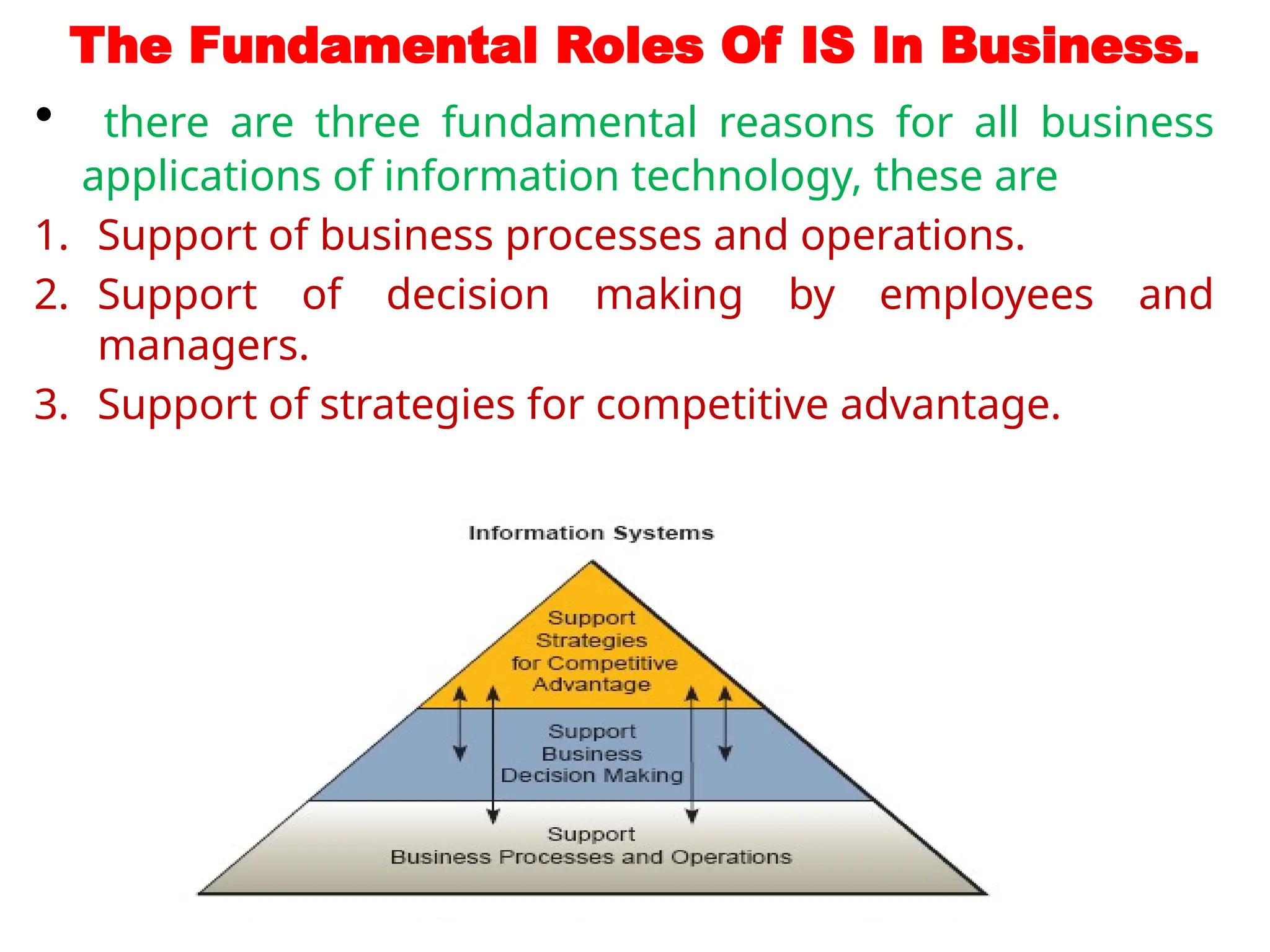
The Fundamental Roles Of IS In Business.
• there are three fundamental reasons for all business
applications of information technology, these are
1. Support of business processes and operations.
2. Support of decision making by employees and
managers.
3. Support of strategies for competitive advantage.
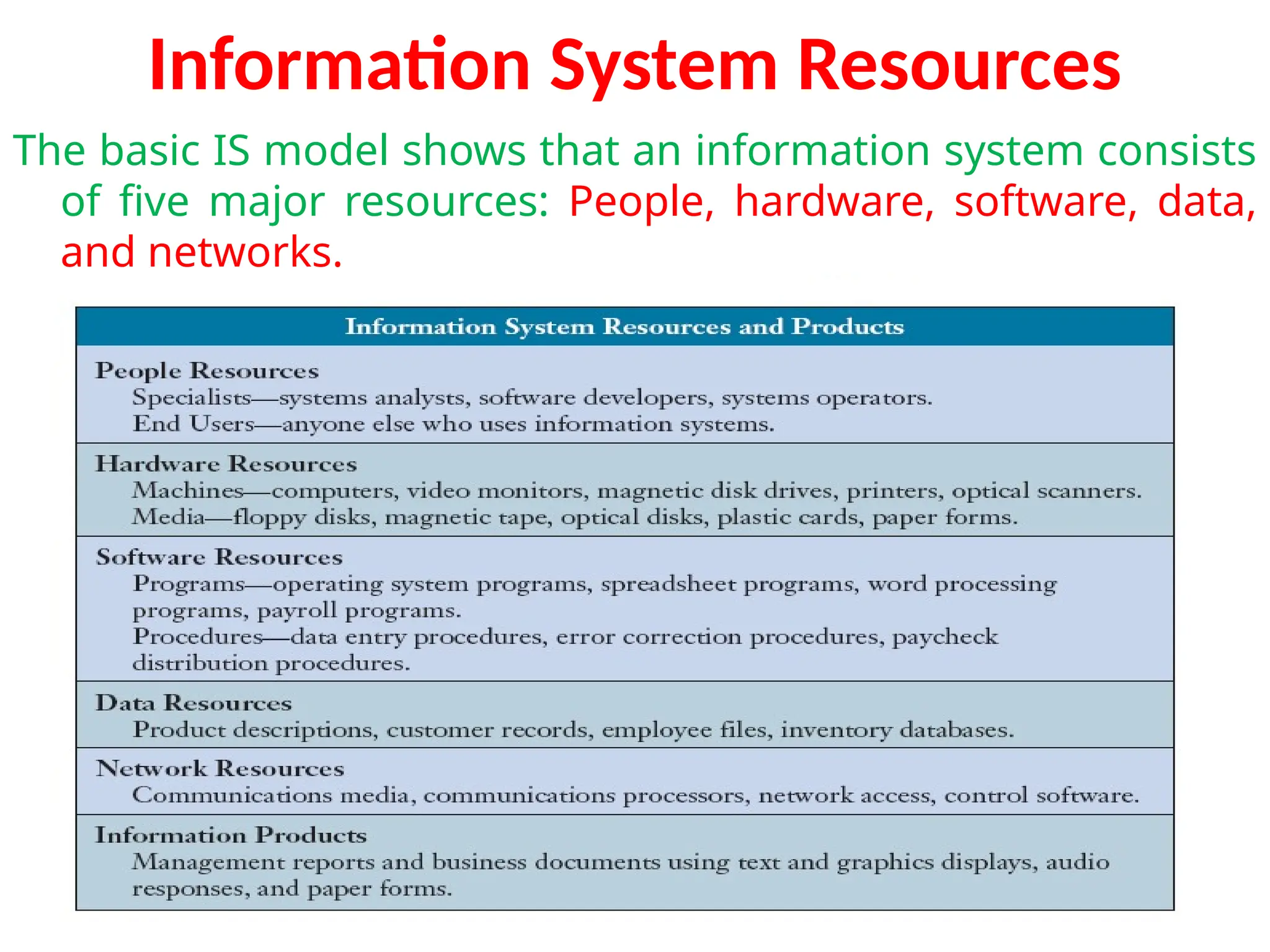
Information System Resources
The basic IS model shows that an information system consists
of five major resources: People, hardware, software, data,
and networks.
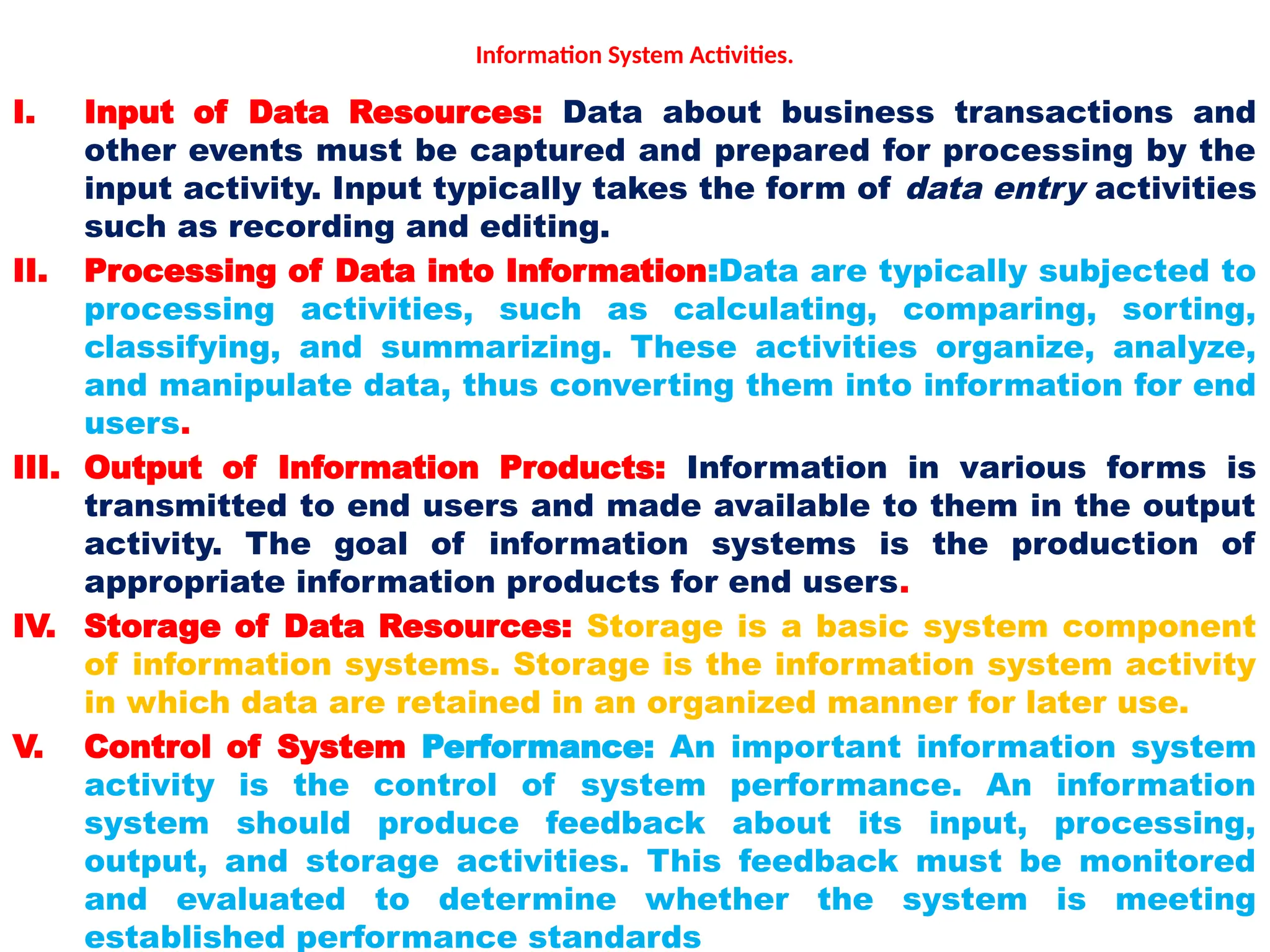
Information System Activities.
I. Input of Data Resources: Data about business transactions and
other events must be captured and prepared for processing by the
input activity. Input typically takes the form of data entry activities
such as recording and editing.
II. Processing of Data into Information:Data are typically subjected to
processing activities, such as calculating, comparing, sorting,
classifying, and summarizing. These activities organize, analyze,
and manipulate data, thus converting them into information for end
users.
III. Output of Information Products: Information in various forms is
transmitted to end users and made available to them in the output
activity. The goal of information systems is the production of
appropriate information products for end users.
IV. Storage of Data Resources: Storage is a basic system component
of information systems. Storage is the information system activity
in which data are retained in an organized manner for later use.
V. Control of System Performance: An important information system
activity is the control of system performance. An information
system should produce feedback about its input, processing,
output, and storage activities. This feedback must be monitored
and evaluated to determine whether the system is meeting
established performance standards
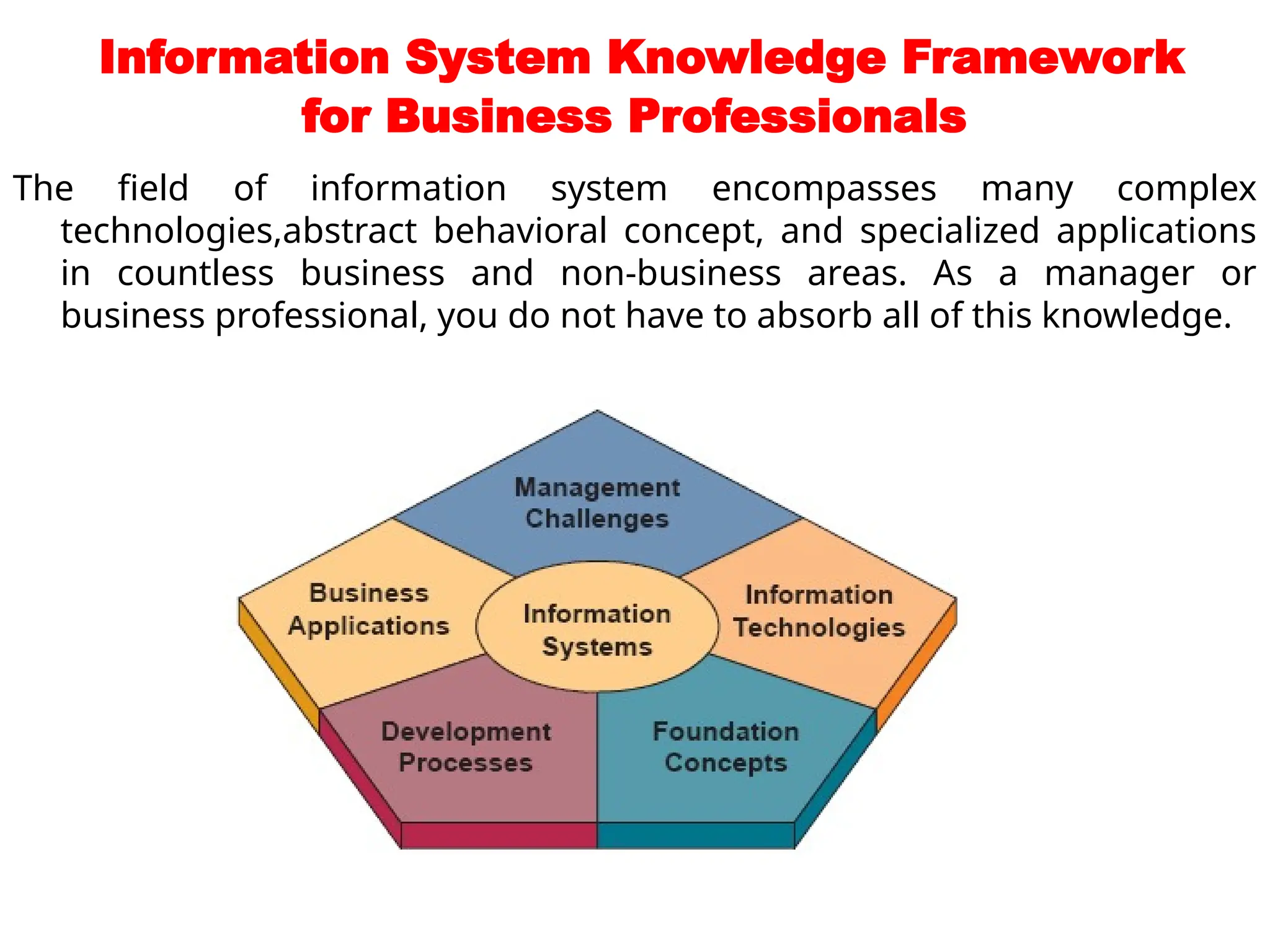
Information System Knowledge Framework
for Business Professionals
The field of information system encompasses many complex
technologies,abstract behavioral concept, and specialized applications
in countless business and non-business areas. As a manager or
business professional, you do not have to absorb all of this knowledge.
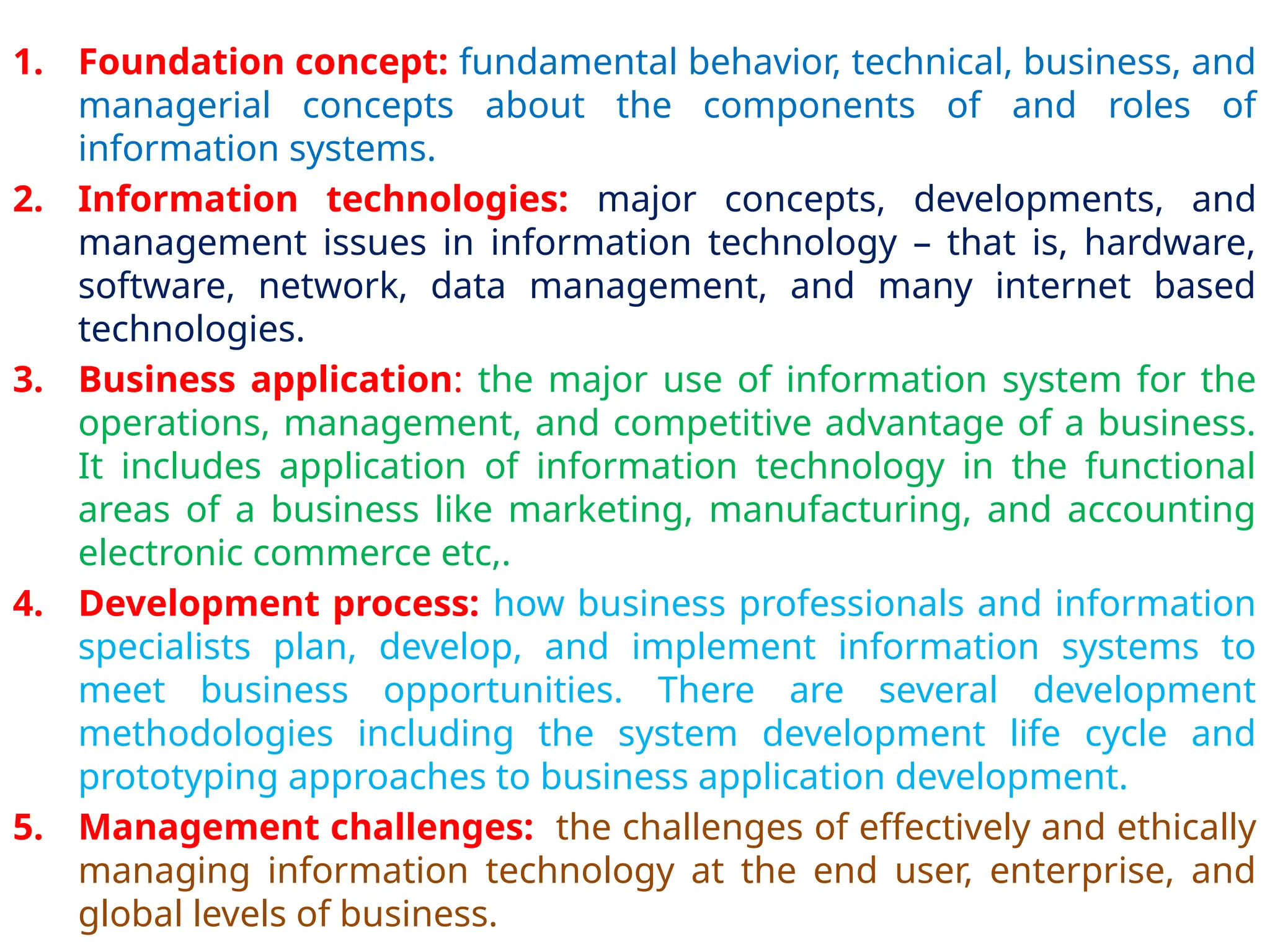
1. Foundation concept: fundamental behavior, technical, business, and
managerial concepts about the components of and roles of
information systems.
2. Information technologies: major concepts, developments, and
management issues in information technology – that is, hardware,
software, network, data management, and many internet based
technologies.
3. Business application: the major use of information system for the
operations, management, and competitive advantage of a business.
It includes application of information technology in the functional
areas of a business like marketing, manufacturing, and accounting
electronic commerce etc,.
4. Development process: how business professionals and information
specialists plan, develop, and implement information systems to
meet business opportunities. There are several development
methodologies including the system development life cycle and
prototyping approaches to business application development.
5. Management challenges: the challenges of effectively and ethically
managing information technology at the end user, enterprise, and
global levels of business.
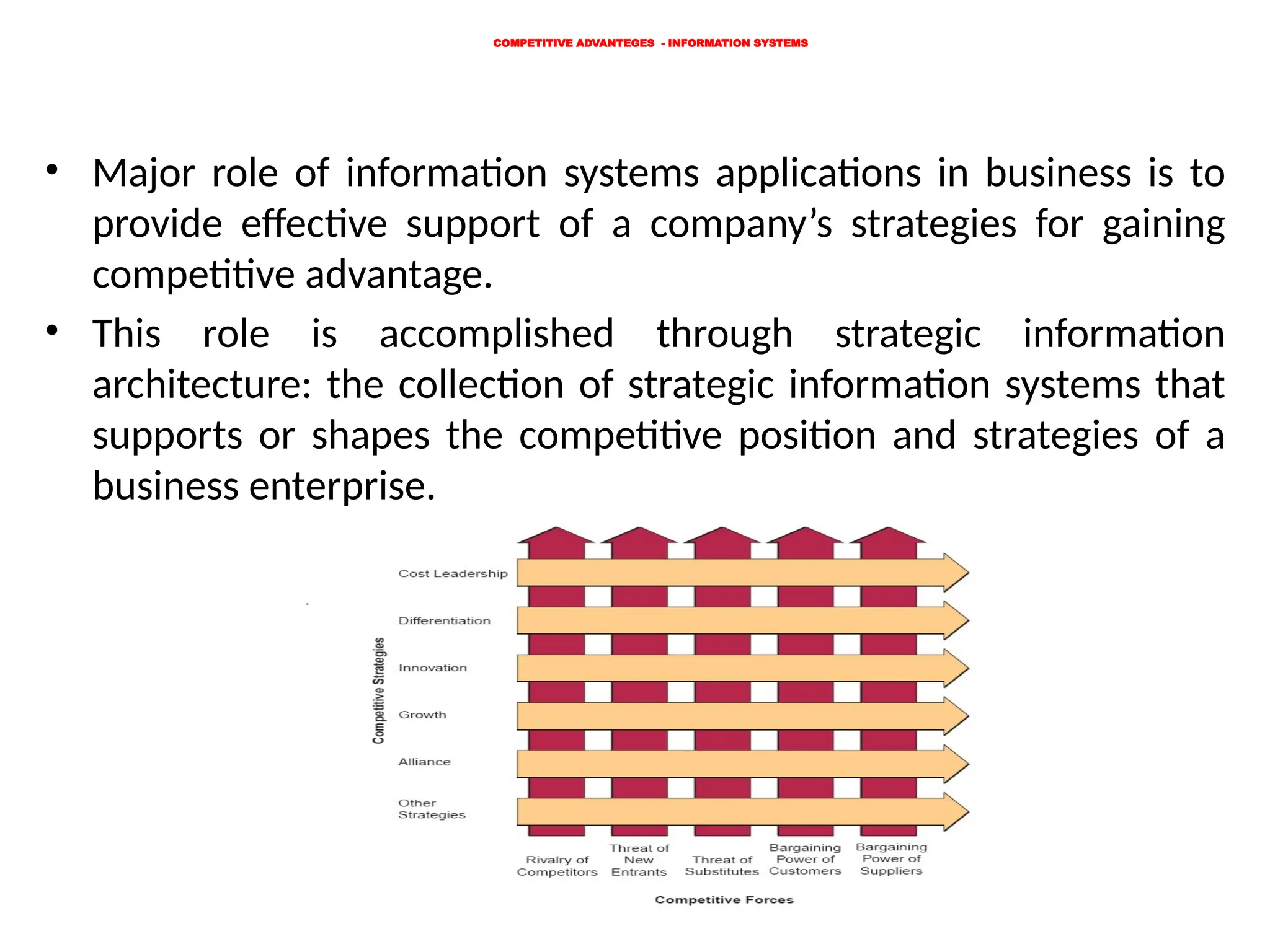
COMPETITIVE ADVANTEGES - INFORMATION SYSTEMS
• Major role of information systems applications in business is to
provide effective support of a company’s strategies for gaining
competitive advantage.
• This role is accomplished through strategic information
architecture: the collection of strategic information systems that
supports or shapes the competitive position and strategies of a
business enterprise.
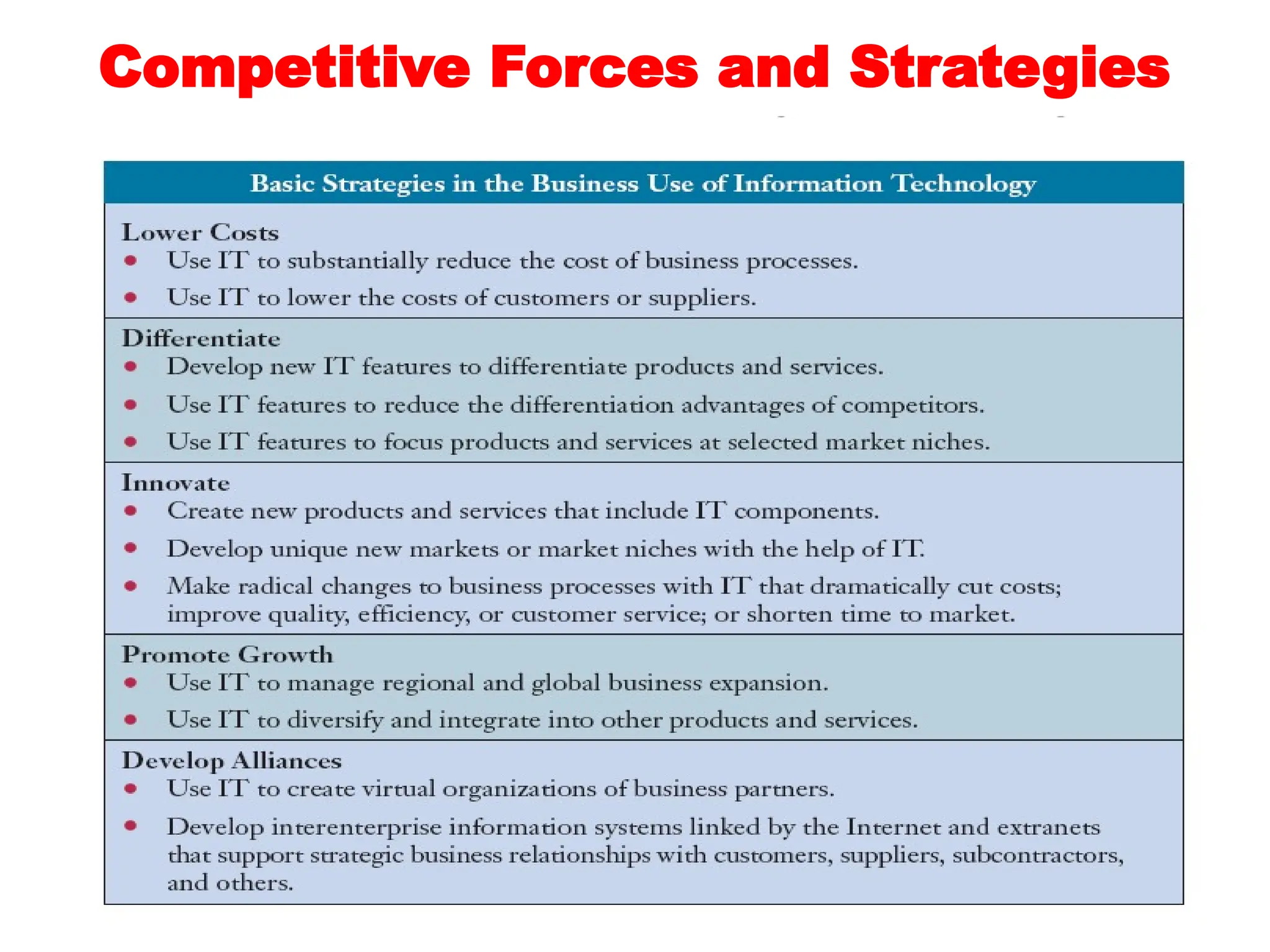
Competitive Forces and Strategies
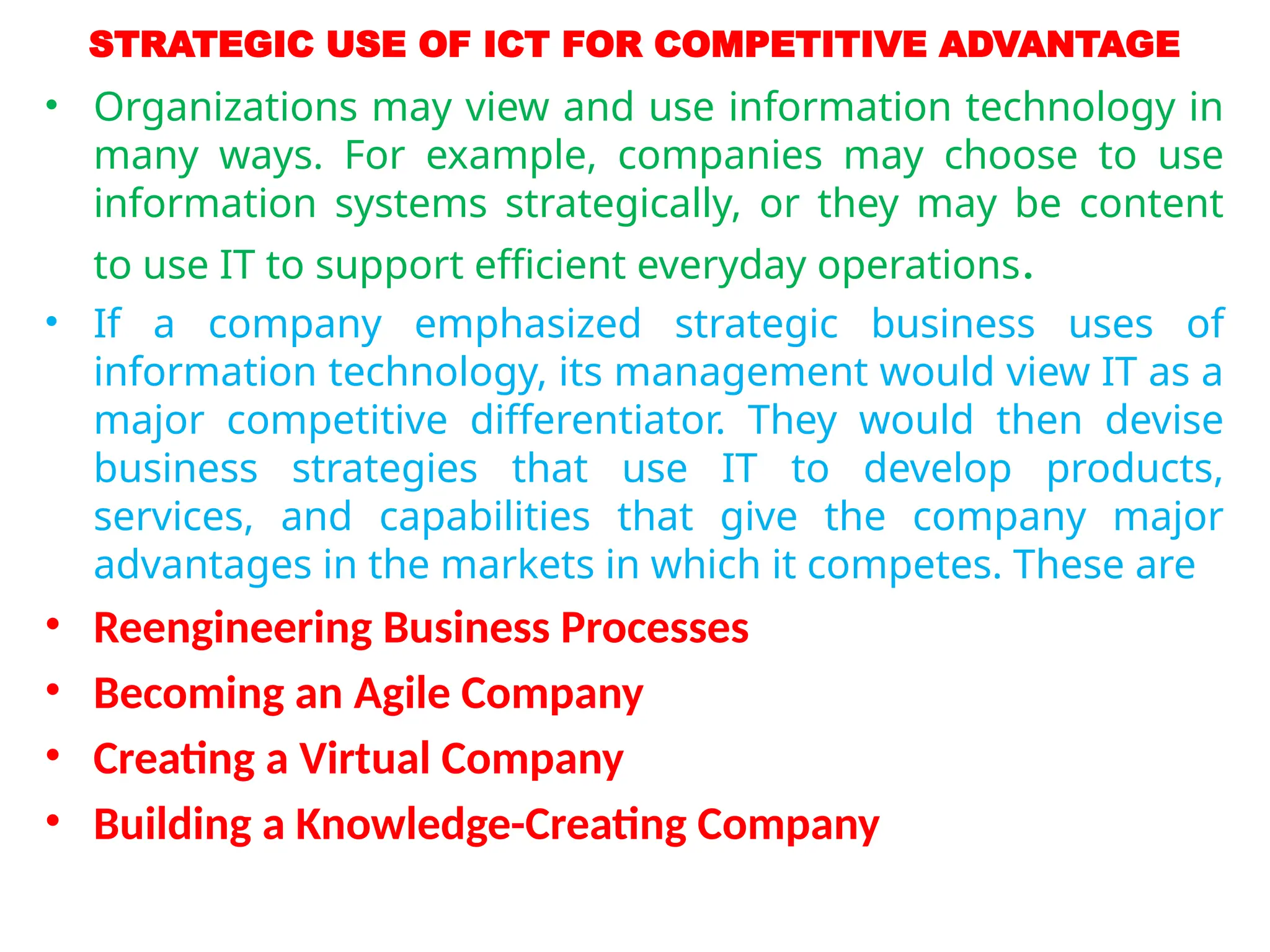
STRATEGIC USE OF ICT FOR COMPETITIVE ADVANTAGE
• Organizations may view and use information technology in
many ways. For example, companies may choose to use
information systems strategically, or they may be content
to use IT to support efficient everyday operations.
• If a company emphasized strategic business uses of
information technology, its management would view IT as a
major competitive differentiator. They would then devise
business strategies that use IT to develop products,
services, and capabilities that give the company major
advantages in the markets in which it competes. These are
• Reengineering Business Processes
• Becoming an Agile Company
• Creating a Virtual Company
• Building a Knowledge-Creating Company
Reengineering Business Processes
• One of the most important implementations of competitive
strategies is Business Process Reengineering (BPR), often simply
called reengineering. Reengineering is a fundamental rethinking
and radical redesign of business processes to achieve dramatic
improvements in cost, quality, speed, and service.
• BPR combines a strategy of promoting business innovation with a
strategy of making major improvements to business processes so
that a company can become a much stronger and more successful
competitor in the marketplace.
• Many companies have found that organizational redesign approaches
are an important enabler of reengineering, along with the use of
information technology. For example, one common approach is the use
of self-directed cross-functional or multidisciplinary process teams.
• Information technology plays a major role in reengineering most
business processes. The speed, information-processing capabilities, and
connectivity of computers and Internet technologies can substantially
increase the efficiency of business processes, as well as
communications and collaboration among the people responsible for
their operation and management.
Becoming an Agile Company
• Companies are changing from a competitive environment in which
mass-market products and services were standardized, long-lived,
information-poor, and exchanged in one-time transactions, to an
environment in which companies compete globally with niche
market products and services that are individualized, short-lived,
information-rich, and exchanged on an ongoing basis with
customers
• To be an agile company, a business must use four basic strategies.
• First, the business must ensure that customers perceive the products or
services of an agile company as solutions to their individual problems.
• Second, an agile company cooperates with customers, suppliers, other
companies, and even with its competitors.
• Third, an agile company organizes so that it thrives on change and
uncertainty. It uses flexible organizational structures keyed to the
requirements of different and constantly changing customer
opportunities.
• Fourth, an agile company leverages the impact of its people and the
knowledge they possess.
THE END
THANK YOU

management information systems- information system concepts.pptx

  • 1.
    MANAGEMENT INFORMATION SYSTEMS: CHAPTER-I INFORMATIONSYSTEM CONCEPTS PRESENTED BY Dr.R. VENKATESHWAR RAO Professor- Department of Management
  • 2.
    • Fundamental conceptsof Information System(IS) • Information technologies, including Internet-based information systems, are playing vital and expanding roles in business. Information technology can help all kinds of businesses improve the efficiency and effectiveness of their business processes, managerial decision making, and workgroup collaboration, which strengthens their competitive positions in rapidly changing marketplaces. • What Is an Information System? • An information system (IS) can be any organized combination of people, hardware, software, communications networks, data resources, and policies and procedures that stores, retrieves, transforms, and disseminates information in an organization. • Even today we make regular use of information systems that have nothing to do with a computer. Consider some of the following examples of information systems: • • Smoke signals for communication • • Card catalogs in a library • Your book bag, day planner, notebooks, and file folders • • The cash register at your favorite fast-food restaurant • • A paper-based accounting ledger
  • 3.
    Basic Systems Concepts •System Concepts: System concepts underlie all business processes, as well as our understanding of information systems and technologies. • Technology. Computer networks are systems of information processing components that use a variety of hardware, software, data management, and telecommunications network technologies. • • Applications. E-business and e-commerce applications involve interconnected business information systems. • Development. Developing ways to use information technology in business includes designing the basic components of information systems. • Management. Managing information technology emphasizes the quality, strategic business value, and security of an organization’s information systems.
  • 4.
    What Is aSystem? • System: working together to achieve a common set of objectives by accepting inputs and producing outputs in an organized transformation process. • Functions of Systems • Systems have three basic functions and two additional functions:
  • 5.
    Functions of Systems 1.Input involves capturing and assembling elements that enter the system to be processed. For example, raw materials, energy, data, and human effort must be secured and organized for processing. 2. Processing involves transformation processes that convert input into output. Examples are manufacturing processes, the human breathing process, or mathematical calculations. 3. Output involves transferring elements that have been produced by a transformation process to their ultimate destination. 4. Feedback is data about the performance of a system. For example, data about sales performance are feedback to a sales manager. 5. Control involves monitoring and evaluating feedback to determine whether a system is moving toward the achievement of its goal. The control function then makes the necessary adjustments to a system’s input and processing components to ensure that it produces proper output.
  • 6.
    System Characteristics: • Organizationsthemselves consist of many subsystems, such as departments, divisions, process teams, and other workgroups. Organizations are examples of open systems because they interface and interact with other systems in their environment. 1. People, hardware, software, peripherals, and networks. They have clearly defined boundaries: 2. Functions, modules, type of application, department, or end-user group. All the interrelated components work together to achieve a common goal by accepting inputs and producing outputs in an organized transformation process. 3. Using raw materials, hiring new people, manufacturing products for sale, and disseminating information to others. Information systems make extensive use of feedback and control to improve their effectiveness: 4. Error messages, dialog boxes, passwords, and user rights management. Many information systems are designed to change in relation to their environments and are adaptive: 5. Intelligent software agents, expert systems, and highly specialized decision support
  • 7.
    Components of InformationSystems: • An information system depends on the resources of people (end users and IS specialists), hardware (machines and media), software (programs and procedures), data (data and knowledge bases), and networks (communications media and network support) to perform input, processing, output, storage, and control activities that transform data resources into information products.
  • 8.
    Organization as OpenSystems I. Any organization can be described as a “system.” II. A system is a group of components (or parts) that interact with each other and are dependent on each other to serve a common goal. III. Organizations and other social systems can be “closed” or “open” systems. IV. Closed systems have boundaries that cannot be penetrated by new information or ideas. V. Open systems have permeable boundaries (or boundaries which allow things to pass through them) VI. Open systems interact with their environments and constantly let in new information and ideas so that they can continue to grow. Modern organizations are highly interactive with surrounding environment by exchanging information as Open Systems
  • 9.
    The Fundamental RolesOf IS In Business. • there are three fundamental reasons for all business applications of information technology, these are 1. Support of business processes and operations. 2. Support of decision making by employees and managers. 3. Support of strategies for competitive advantage.
  • 10.
    Information System Resources Thebasic IS model shows that an information system consists of five major resources: People, hardware, software, data, and networks.
  • 11.
    Information System Activities. I.Input of Data Resources: Data about business transactions and other events must be captured and prepared for processing by the input activity. Input typically takes the form of data entry activities such as recording and editing. II. Processing of Data into Information:Data are typically subjected to processing activities, such as calculating, comparing, sorting, classifying, and summarizing. These activities organize, analyze, and manipulate data, thus converting them into information for end users. III. Output of Information Products: Information in various forms is transmitted to end users and made available to them in the output activity. The goal of information systems is the production of appropriate information products for end users. IV. Storage of Data Resources: Storage is a basic system component of information systems. Storage is the information system activity in which data are retained in an organized manner for later use. V. Control of System Performance: An important information system activity is the control of system performance. An information system should produce feedback about its input, processing, output, and storage activities. This feedback must be monitored and evaluated to determine whether the system is meeting established performance standards
  • 12.
    Information System KnowledgeFramework for Business Professionals The field of information system encompasses many complex technologies,abstract behavioral concept, and specialized applications in countless business and non-business areas. As a manager or business professional, you do not have to absorb all of this knowledge.
  • 13.
    1. Foundation concept:fundamental behavior, technical, business, and managerial concepts about the components of and roles of information systems. 2. Information technologies: major concepts, developments, and management issues in information technology – that is, hardware, software, network, data management, and many internet based technologies. 3. Business application: the major use of information system for the operations, management, and competitive advantage of a business. It includes application of information technology in the functional areas of a business like marketing, manufacturing, and accounting electronic commerce etc,. 4. Development process: how business professionals and information specialists plan, develop, and implement information systems to meet business opportunities. There are several development methodologies including the system development life cycle and prototyping approaches to business application development. 5. Management challenges: the challenges of effectively and ethically managing information technology at the end user, enterprise, and global levels of business.
  • 14.
    COMPETITIVE ADVANTEGES -INFORMATION SYSTEMS • Major role of information systems applications in business is to provide effective support of a company’s strategies for gaining competitive advantage. • This role is accomplished through strategic information architecture: the collection of strategic information systems that supports or shapes the competitive position and strategies of a business enterprise.
  • 15.
  • 16.
    STRATEGIC USE OFICT FOR COMPETITIVE ADVANTAGE • Organizations may view and use information technology in many ways. For example, companies may choose to use information systems strategically, or they may be content to use IT to support efficient everyday operations. • If a company emphasized strategic business uses of information technology, its management would view IT as a major competitive differentiator. They would then devise business strategies that use IT to develop products, services, and capabilities that give the company major advantages in the markets in which it competes. These are • Reengineering Business Processes • Becoming an Agile Company • Creating a Virtual Company • Building a Knowledge-Creating Company
  • 17.
    Reengineering Business Processes •One of the most important implementations of competitive strategies is Business Process Reengineering (BPR), often simply called reengineering. Reengineering is a fundamental rethinking and radical redesign of business processes to achieve dramatic improvements in cost, quality, speed, and service. • BPR combines a strategy of promoting business innovation with a strategy of making major improvements to business processes so that a company can become a much stronger and more successful competitor in the marketplace. • Many companies have found that organizational redesign approaches are an important enabler of reengineering, along with the use of information technology. For example, one common approach is the use of self-directed cross-functional or multidisciplinary process teams. • Information technology plays a major role in reengineering most business processes. The speed, information-processing capabilities, and connectivity of computers and Internet technologies can substantially increase the efficiency of business processes, as well as communications and collaboration among the people responsible for their operation and management.
  • 18.
    Becoming an AgileCompany • Companies are changing from a competitive environment in which mass-market products and services were standardized, long-lived, information-poor, and exchanged in one-time transactions, to an environment in which companies compete globally with niche market products and services that are individualized, short-lived, information-rich, and exchanged on an ongoing basis with customers • To be an agile company, a business must use four basic strategies. • First, the business must ensure that customers perceive the products or services of an agile company as solutions to their individual problems. • Second, an agile company cooperates with customers, suppliers, other companies, and even with its competitors. • Third, an agile company organizes so that it thrives on change and uncertainty. It uses flexible organizational structures keyed to the requirements of different and constantly changing customer opportunities. • Fourth, an agile company leverages the impact of its people and the knowledge they possess.
  • 19.