Intervertebral disc herniation
 The cervical spine is subjected to stresses that result from disk
degeneration (from aging, occupational stresses) and spondylosis
(degenerative changes occurring in disk and adjacent vertebral bodies).
 Cervical disk degeneration may lead to lesions that can cause damage
to the spinal cord and its roots.
 A cervical disk herniation usually occurs at the C5-6 and C6-7
interspaces.
 Pain and stiffness may occur in the neck, the top of the shoulders, and
the region of the scapulae.
 Sometimes patients interpret these signs as symptoms of heart trouble
or bursitis.
 Pain may also occur in the upper extremities and head, accompanied
by paresthesia (tingling or a “pins and needles” sensation) and
numbness of the upper extremities.
 Cervical MRI usually confirms the diagnosis.
Medical Management
 Bed rest (usually 1 to 2 days) is important because it eliminates the
stress of gravity and relieves the cervical spine from the need to
support the head.
 It also reduces inflammation and edema in soft tissues around the
disk, relieving pressure on the nerve roots.
 Proper positioning on a firm mattress may bring dramatic relief from
pain.
 The cervical spine may be rested and immobilized by a cervical collar,
cervical traction, or a brace.
 A collar allows maximal opening of the intervertebral foramina and
holds the head in a neutral or slightly flexed position.
 The patient may have to wear the collar 24 hours a day during the
acute phase.
 The skin under the collar is inspected for irritation.
 Cervical traction is accomplished by means of a head halter attached to
a pulley and weight.
 It increases vertebral separation and thus relieves pressure on the
nerve roots.
 The head of the bed is elevated to provide counter traction.
PHARMACOLOGIC THERAPY
 Analgesic agents (NSAIDs, propoxyphene [Darvon], oxycodone
[Tylox], or hydrocodone [Vicodin]) are prescribed during the acute
phase to relieve pain, and sedatives may be administered to control the
anxiety often associated with cervical disk disease.
 Muscle relaxants (cyclobenzaprine [Flexeril], methocarbamol
[Robaxin], metaxalone [Skelaxin]) are administered to interrupt the
cycle of muscle spasm and to promote comfort.
 NSAIDs (aspirin, ibuprofen [Motrin, Advil], naproxen [Naprosyn,
Anaprox]) or corticosteroids are prescribed to treat the inflammatory
response that usually occurs in the supporting tissues and affected
nerve roots.
 Occasionally, an injection of a corticosteroid into the epidural space
may be administered for relief of radicular (spinal nerve root) pain.
 NSAIDs are given with food and antacids to prevent gastrointestinal
irritation.
 Hot, moist compresses (for 10 to 20 minutes) applied to the back of the
neck several times daily increase blood flow to the muscles and help
relax the spastic muscles and the patient.
SURGICAL MANAGEMENT
 Surgical excision of the herniated disk may be necessary when there is
a significant neurologic deficit, progression of the deficit, evidence of
cord compression, or pain that either worsens or fails to improve.
 A cervical discectomy, with or without fusion, may be performed to
alleviate symptoms.
 An anterior surgical approach may be used through a transverse
incision to remove disk material that has herniated into the spinal
canal and foramina, or a posterior approach may be used at the
appropriate level of the cervical spine.
 Microsurgery, such as endoscopic microdiscectomy, may be performed
in selected patients through a small incision and using magnification
techniques.
 Nursing Interventions
 RELIEVING PAIN
 IMPROVING MOBILITY
 MONITORING AND MANAGING POTENTIAL COMPLICATIONS
HERNIATION OF A LUMBAR DISK
 A herniated lumbar disk produces low back pain accompanied by
varying degrees of sensory and motor impairment.
Clinical Manifestations
 The patient complains of low back pain with muscle spasms, followed
by radiation of the pain into one hip and down into the leg (sciatica).
 Pain is aggravated by actions that increase intra spinal fluid pressure
(bending, lifting, straining, as in sneezing and coughing) and usually is
relieved by bed rest.
 Usually there is some type of postural deformity, because pain causes
an alteration of the normal spinal mechanics.
 If the patient lies on the back and attempts to raise a leg in a straight
position, pain radiates into the leg because this maneuver, called the
straight leg-raising test, stretches the sciatic nerve.
 Additional signs include muscle weakness, alterations in tendon
reflexes, and sensory loss.
Assessment and Diagnostic Findings
 The diagnosis of lumbar disk disease is based on the history and
physical findings and the use of imaging techniques such as MRI, CT,
and myelography.
Medical Management
 Bed rest for 1 to 2 days on a firm mattress (to limit spinal flexion) is
encouraged to reduce the weight load and gravitational forces, thereby
freeing the disk from stress.
 The patient is allowed to assume a comfortable position; usually, a
semi- Fowler’s position with moderate hip and knee flexion relaxes the
back muscles.
 When the patient is in a side-lying position, a pillow is placed between
the legs.
 To get out of bed, the patient lies on one side while pushing up to a
sitting position.
 Because muscle spasm is prominent during the acute phase, muscle
relaxants are used.
 NSAIDs and systemic corticosteroids may be administered to counter
the inflammation that usually occurs in the supporting tissues and the
affected nerve roots.
 Moist heat and massage help to relax spastic muscles and have a
sedative effect.
 Antidepressant agents appear to help in low back pain that is
neuropathic in origin
SURGICAL MANAGEMENT
 In the lumbar region, surgical treatment includes lumbar disk excision
through a postero lateral laminotomy and the newer techniques of
micro-discectomy and percutaneous discectomy.
 In microdiscectomy, an operating microscope is used to visualize the
offending disk and compressed nerve roots; it permits a small
incision(2.5 cm [1 inch]) and minimal blood loss and takes about 30
minutes of operating time.
 Generally, it involves a short hospital stay, and the patient makes a
rapid recovery.
 Percutaneous discectomy is an alternative treatment for herniated
intervertebral disks of the lumbar spine at the L4-5 level.
 One approach in current use is through a 2.5-cm (1-inch) incision just
above the iliac crest.
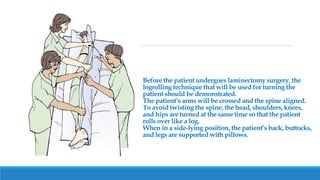
Before the patient undergoes laminectomy surgery, the
logrolling technique that will be used for turning the
patient should be demonstrated.
The patient’s arms will be crossed and the spine aligned.
To avoid twisting the spine, the head, shoulders, knees,
and hips are turned at the same time so that the patient
rolls over like a log.
When in a side-lying position, the patient’s back, buttocks,
and legs are supported with pillows.
Nursing Management
 PROVIDING PREOPERATIVE CARE
 ASSESSING THE PATIENT AFTER SURGERY
 POSITIONING THE PATIENT
 Thanking you.

Intervertebral disc herniation.pptx

  • 2.
    Intervertebral disc herniation The cervical spine is subjected to stresses that result from disk degeneration (from aging, occupational stresses) and spondylosis (degenerative changes occurring in disk and adjacent vertebral bodies).  Cervical disk degeneration may lead to lesions that can cause damage to the spinal cord and its roots.
  • 3.
     A cervicaldisk herniation usually occurs at the C5-6 and C6-7 interspaces.  Pain and stiffness may occur in the neck, the top of the shoulders, and the region of the scapulae.  Sometimes patients interpret these signs as symptoms of heart trouble or bursitis.  Pain may also occur in the upper extremities and head, accompanied by paresthesia (tingling or a “pins and needles” sensation) and numbness of the upper extremities.  Cervical MRI usually confirms the diagnosis.
  • 4.
    Medical Management  Bedrest (usually 1 to 2 days) is important because it eliminates the stress of gravity and relieves the cervical spine from the need to support the head.  It also reduces inflammation and edema in soft tissues around the disk, relieving pressure on the nerve roots.  Proper positioning on a firm mattress may bring dramatic relief from pain.
  • 5.
     The cervicalspine may be rested and immobilized by a cervical collar, cervical traction, or a brace.  A collar allows maximal opening of the intervertebral foramina and holds the head in a neutral or slightly flexed position.  The patient may have to wear the collar 24 hours a day during the acute phase.  The skin under the collar is inspected for irritation.
  • 6.
     Cervical tractionis accomplished by means of a head halter attached to a pulley and weight.  It increases vertebral separation and thus relieves pressure on the nerve roots.  The head of the bed is elevated to provide counter traction.
  • 7.
    PHARMACOLOGIC THERAPY  Analgesicagents (NSAIDs, propoxyphene [Darvon], oxycodone [Tylox], or hydrocodone [Vicodin]) are prescribed during the acute phase to relieve pain, and sedatives may be administered to control the anxiety often associated with cervical disk disease.  Muscle relaxants (cyclobenzaprine [Flexeril], methocarbamol [Robaxin], metaxalone [Skelaxin]) are administered to interrupt the cycle of muscle spasm and to promote comfort.  NSAIDs (aspirin, ibuprofen [Motrin, Advil], naproxen [Naprosyn, Anaprox]) or corticosteroids are prescribed to treat the inflammatory response that usually occurs in the supporting tissues and affected nerve roots.
  • 8.
     Occasionally, aninjection of a corticosteroid into the epidural space may be administered for relief of radicular (spinal nerve root) pain.  NSAIDs are given with food and antacids to prevent gastrointestinal irritation.  Hot, moist compresses (for 10 to 20 minutes) applied to the back of the neck several times daily increase blood flow to the muscles and help relax the spastic muscles and the patient.
  • 9.
    SURGICAL MANAGEMENT  Surgicalexcision of the herniated disk may be necessary when there is a significant neurologic deficit, progression of the deficit, evidence of cord compression, or pain that either worsens or fails to improve.  A cervical discectomy, with or without fusion, may be performed to alleviate symptoms.  An anterior surgical approach may be used through a transverse incision to remove disk material that has herniated into the spinal canal and foramina, or a posterior approach may be used at the appropriate level of the cervical spine.
  • 10.
     Microsurgery, suchas endoscopic microdiscectomy, may be performed in selected patients through a small incision and using magnification techniques.  Nursing Interventions  RELIEVING PAIN  IMPROVING MOBILITY  MONITORING AND MANAGING POTENTIAL COMPLICATIONS
  • 11.
    HERNIATION OF ALUMBAR DISK  A herniated lumbar disk produces low back pain accompanied by varying degrees of sensory and motor impairment.
  • 12.
    Clinical Manifestations  Thepatient complains of low back pain with muscle spasms, followed by radiation of the pain into one hip and down into the leg (sciatica).  Pain is aggravated by actions that increase intra spinal fluid pressure (bending, lifting, straining, as in sneezing and coughing) and usually is relieved by bed rest.  Usually there is some type of postural deformity, because pain causes an alteration of the normal spinal mechanics.
  • 13.
     If thepatient lies on the back and attempts to raise a leg in a straight position, pain radiates into the leg because this maneuver, called the straight leg-raising test, stretches the sciatic nerve.  Additional signs include muscle weakness, alterations in tendon reflexes, and sensory loss.
  • 14.
    Assessment and DiagnosticFindings  The diagnosis of lumbar disk disease is based on the history and physical findings and the use of imaging techniques such as MRI, CT, and myelography.
  • 15.
    Medical Management  Bedrest for 1 to 2 days on a firm mattress (to limit spinal flexion) is encouraged to reduce the weight load and gravitational forces, thereby freeing the disk from stress.  The patient is allowed to assume a comfortable position; usually, a semi- Fowler’s position with moderate hip and knee flexion relaxes the back muscles.  When the patient is in a side-lying position, a pillow is placed between the legs.  To get out of bed, the patient lies on one side while pushing up to a sitting position.
  • 16.
     Because musclespasm is prominent during the acute phase, muscle relaxants are used.  NSAIDs and systemic corticosteroids may be administered to counter the inflammation that usually occurs in the supporting tissues and the affected nerve roots.  Moist heat and massage help to relax spastic muscles and have a sedative effect.  Antidepressant agents appear to help in low back pain that is neuropathic in origin
  • 17.
    SURGICAL MANAGEMENT  Inthe lumbar region, surgical treatment includes lumbar disk excision through a postero lateral laminotomy and the newer techniques of micro-discectomy and percutaneous discectomy.  In microdiscectomy, an operating microscope is used to visualize the offending disk and compressed nerve roots; it permits a small incision(2.5 cm [1 inch]) and minimal blood loss and takes about 30 minutes of operating time.  Generally, it involves a short hospital stay, and the patient makes a rapid recovery.
  • 18.
     Percutaneous discectomyis an alternative treatment for herniated intervertebral disks of the lumbar spine at the L4-5 level.  One approach in current use is through a 2.5-cm (1-inch) incision just above the iliac crest.
  • 19.
    Before the patientundergoes laminectomy surgery, the logrolling technique that will be used for turning the patient should be demonstrated. The patient’s arms will be crossed and the spine aligned. To avoid twisting the spine, the head, shoulders, knees, and hips are turned at the same time so that the patient rolls over like a log. When in a side-lying position, the patient’s back, buttocks, and legs are supported with pillows.
  • 20.
    Nursing Management  PROVIDINGPREOPERATIVE CARE  ASSESSING THE PATIENT AFTER SURGERY  POSITIONING THE PATIENT  Thanking you.