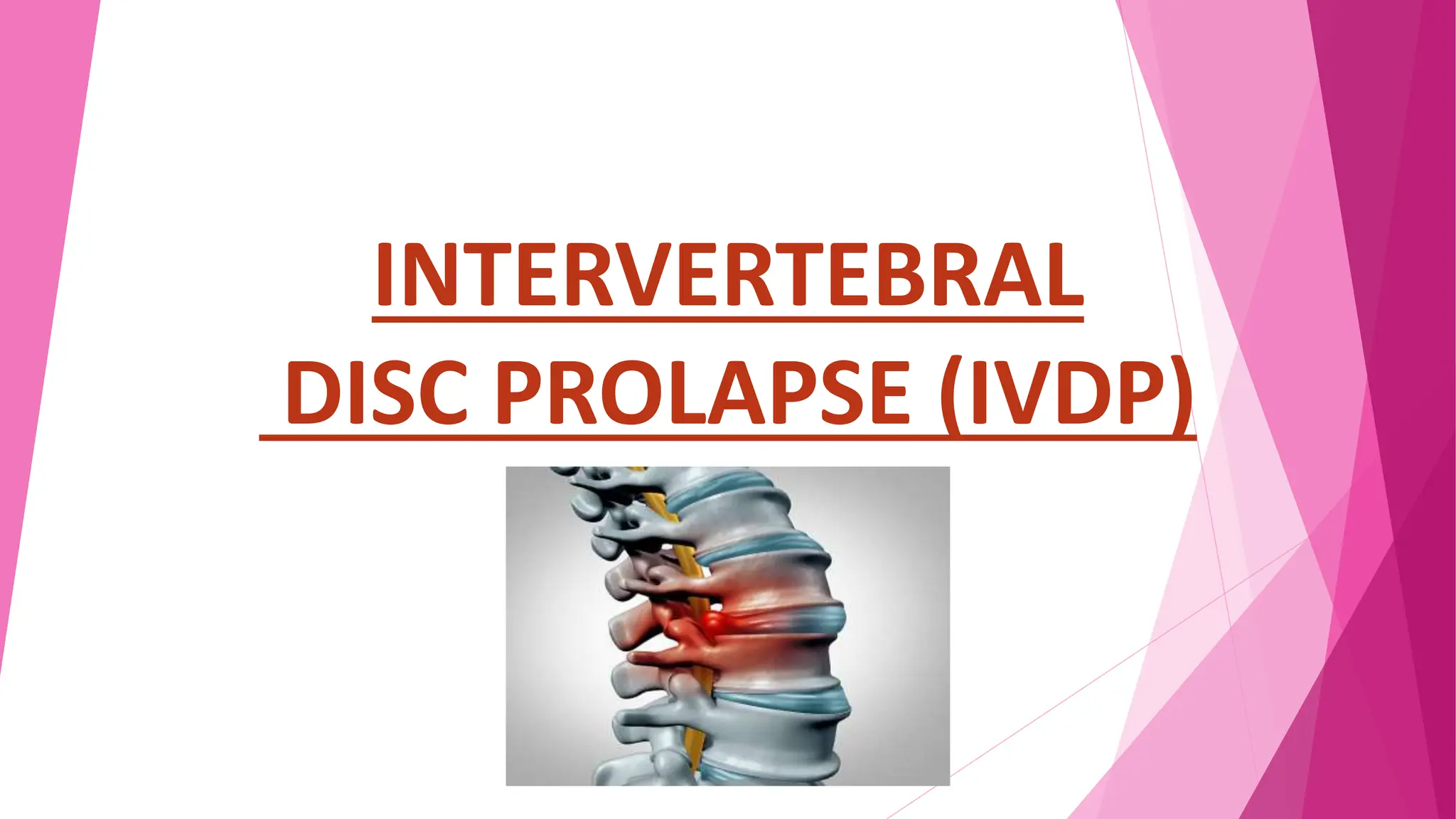
INTERVERTEBRAL
DISC PROLAPSE (IVDP)
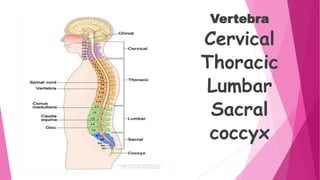
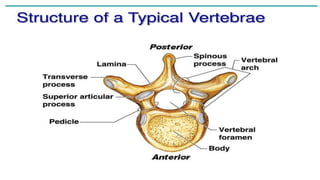
Vertebra
Cervical
Thoracic
Lumbar
Sacral
coccyx
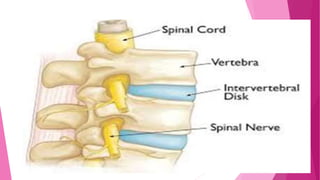
Intervertebral disc
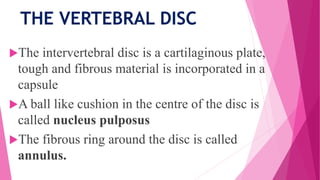
THE VERTEBRAL DISC
The intervertebral disc is a cartilaginous plate,
tough and fibrous material is incorporated in a
capsule
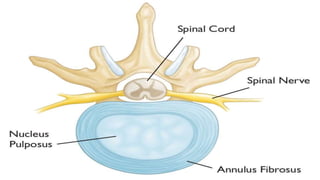
A ball like cushion in the centre of the disc is
called nucleus pulposus
The fibrous ring around the disc is called
annulus.
INTERVERTEBRAL DISC
DISEASE
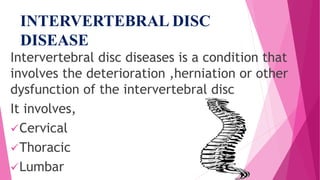
Intervertebral disc diseases is a condition that
involves the deterioration ,herniation or other
dysfunction of the intervertebral disc
It involves,
Cervical
Thoracic
Lumbar
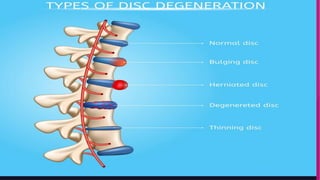
TYPES OF DISC
DEGENERATION
 BULGING DISC
 HERNIATED DISC
 DEGENERATED DISC
 THINNING DISC
DEFINITION
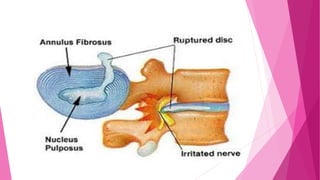
IVDP is a condition in which a tear in the outer,
fibrous ring (annulus fibrosus) of the intervertebral
disc allows the soft central portion(nucleus pulposus)
to bulge out.
Common sites :L4-L5, C6-C7, L5-S1, C5-C6
ETIOLOGY
Structural degeneration
of the disc by
degenerative disease
Ageing
Occupational
Repeated stress and trauma to spine
Repetitive mechanical activities (frequent
bending, twisting, lifting)
Traumatic injury
Spinal stenosis(narrowing of the spinal canal
forces the disc to prolapse)
Obesity
Practicing poor posture(improper spinal alignment
strains the back and neck)
Tobacco use weakens the disc
Spondylosis- wear and tear of spinal disc
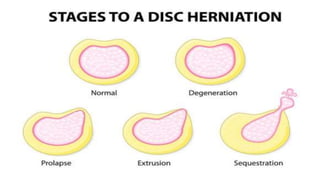
STAGES OF DISC HERNIATION
Degeneration : there is no bulge
Prolapse: just a bulge, contained herniation-
nucleus is with in annulus
Extrusion: non contained herniation
Sequestration: it act as a free fragment - no
continuity with the parent disc
PATHOPHYSIOLOGY
In the herniation of intervertebral disc the
nucleus of the disc protrudes into the annulus
with subsequent nerve compression
IN NUCLEUS
Degenerative changes
Loss of protein polysaccharides in the disc
decreases the water content of the nucleus
and it starts to dry out and shrink
Loss of elasticity, flexibility and shock
absorbing capabilities
IN ANNULUS
Development of radiating cracks
weakens the resistance to nucleus
herniation
These changes limit the ability of the disc to
distribute pressure between vertebra
 The loads are transferred to annulus fibrosus
With the structural damage nucleus pulposus
may sweeps through a torn or stretched annulus
Produces radiculopathy
Continued pressure causes changes in
sensation and deep tendon reflexes
CLINICAL MANIFESTATION
It depends on the location, the rate of
development(acute or chronic) and the effect
on the surrounding structures
Cervical spine
 Radiculopathy: radiating pain, numbness, tingling and
diminished strength or range of motion
 Pain and stiffness in the neck, in the top of the shoulders,
region of scapulae
Pain the upper extremities and head
Paraesthesia (tingling or pin and needle sensation)
Numbness of the extremities
Weak handgrip
Lumbar spine
 Lower back ache with muscle spasm followed by,
 Radicular pain that radiates down the buttocks and below the
knee along sciatic nerve
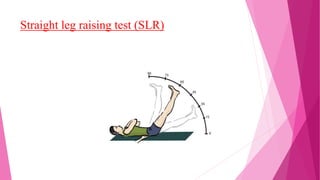
 Straight leg raising test (SLR) positive due to nerve root irritation.
Straight leg raising test (SLR)
Reflexes depressed or absent
Paraesthesia or muscle weakness in legs ,feet and
toes
Pain aggravates on bending ,lifting or straining,
sneezing or coughing due to increased intra spinal
fluid pressure
Sensory loss
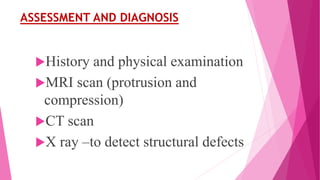
ASSESSMENT AND DIAGNOSIS
History and physical examination
MRI scan (protrusion and
compression)
CT scan
X ray –to detect structural defects
MANAGEMENT
Medical /conservative management
Goals
To provide rest and immobilise the cervical
spine
To give soft tissue time to heal
To reduce inflammation
Bed rest (usually 1-2 days)-eliminates stress and
gravity.
Proper positioning on a firm mattress.
Cervical collar, cervical traction or a brace
Collar-holds the head in a neutral or slightly
flexed position
Cervical isometric exercises (strengthen neck
muscles)
General management
Restricted activity for several days
Local ice or heat for 10-20 min (increase blood
flow)
Weight reduction and physical therapy
Biofeedback
Exercises to strengthen muscles and
decrease pain
Limit extreme spinal movements
Traction
Tens(trans cutaneous electrical nerve
stimulation)
Good body mechanics
Discourage extremes of flexion and torsion
Pharmacological management
Analgesic
Opioids ( eg:tramadol)
NSAIDS (eg:aspirin, ibuprofen)
Sedatives (to control anxiety)
Muscle relaxants(reduce muscle spasm eg:
cyclobenzaprine,metaxalone)
Corticosteroids (to reduce inflammation)
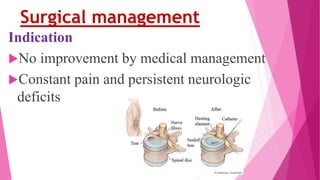
Surgical management
Indication
No improvement by medical management
Constant pain and persistent neurologic
deficits
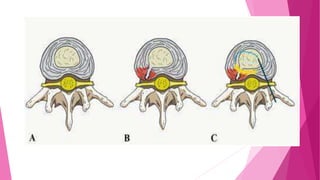
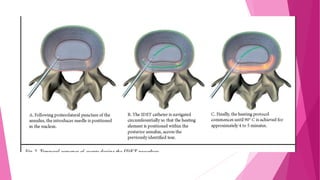
Intra discal electro thermoplasty (IDET)
Minimally invasive – OP procedure
Inserting needle to the affected disc
with the help of X ray
The wire is threaded down through
the needle in to the disc
The wire is heated and it denervates the small
nerve fibres
The heat melts the annulus fibrosus which
trigger the body to generate new reinforcing
proteins in the fibres of annulus
Radio frequency discal nucleoplasty
Probe geSame as IDET, instead of heat,
radio frequency fibre is used
nerate energy which breaks the molecular
bonds of the gel in the nucleus pulposus.
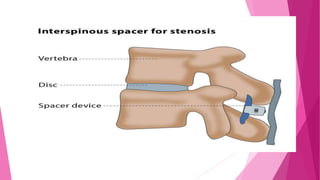
Interspinous process decompression system
A device made of titanium is fits on to a mount that is
placed on vertebra in the lower back
 It is used in patients with pain due to lumbar spinal
stenosis
Discectomy
 It is a surgical procedure to decompress the nerve
root
Microsurgical discectomy: using microscope the
surgeon visualise the disc and increase safety,
make effective and reduce rehabilitation time.
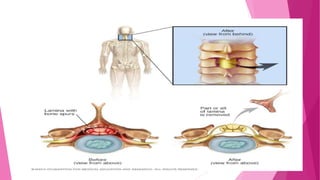
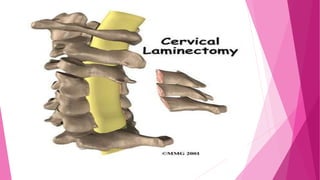
Laminectomy
Common and traditional surgical procedure for
lumbar disc disease
It involves the surgical excision of the
vertebra(lamina) to gain access to the spinal
cord or to relieve pressure on nerves.
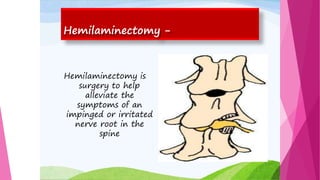
Hemilaminectomy -
Hemilaminectomy is
surgery to help
alleviate the
symptoms of an
impinged or irritated
nerve root in the
spine
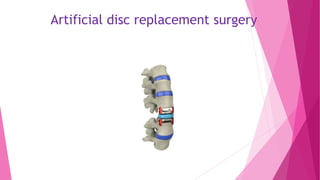
DISC ARTHROPLASTY
The damaged disc is removed and new one
is implanted
Artificial disc replacement surgery
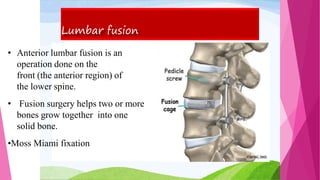
Lumbar fusion
• Anterior lumbar fusion is an
operation done on the
front (the anterior region) of
the lower spine.
• Fusion surgery helps two or more
bones grow together into one
solid bone.
•Moss Miami fixation
Complications of disc surgery
Archnoiditis- inflammation of arachinoid
membrane
Adhesions and scarring around the spinal nerves
chronic neuritis and neurofibrosis.
Disc surgery may relieve pressure ,but not reverse
the effects of neural injury, scarring and pain.
 Failed disc syndrome
Remaining of the disability
Hematoma at surgical site leads to cord
compression
Nursing management
 Assessment (pre op)
 Ask about past injuries
 Determine onset, location and radiation of pain
 Assess paraesthesia, limited movement and diminished
function of neck ,shoulders and upper extremities
 Whether the symptoms are bilateral with large herniation's
(cord compression)
 Palpate the area around the cervical spine to assess muscle
tone and tenderness
 Range of motion in neck and shoulders
Nursing management
 Ask about health issues that may affect post op function
Assess mood and stress levels
Assess bowel and bladder function
Teach legrolling ,deep breathing coughing
exercise and muscle setting exercise
 Assessment (post op)
After lumbar disc excision
Vital signs (BP, pulse for CVS function assessment,
respiratory difficulty)
Wound (haemorrhage, vascular injury)
Post op neurologic deficit
Sensation and motor strength of extremities
Colour temperature and sensation of toes
Urinary retention (sign of neurologic deficit)
Nursing diagnosis
 Acute pain related to surgical procedure
 Impaired physical mobility related to post op surgical
regimen
 Deficient knowledge about the post op course
 Anxiety related to surgery
Constipation related decreased mobility
Self care deficit
Urinary retention
Disturbed sleep pattern
Nursing interventions
Relieving pain and medications
 The patient may be kept flat in the bed for 12 to 24 hrs.
 Monitor site for hematoma
 Administer prescribed medications
 Post op- requires opioids such as IV morphine 24 to 48 hrs
 Patient controlled analgesics for continued pain
 Once fluid diet takes then oral medications
 Muscle relaxant
Positioning the patient
Maintain proper alignment of
spine
Ambulation depends on surgery
Potential for CSF leakage
Inspect dressing for serosanguinous drainage (dural
leak)
Report and care for headache
Note colour, amount and characteristics
Monitor neurologic signs frequently
Sensation, numbness, paraesthesia, tingling
Temperature, capillary refill and pulses
Swallowing deficits ,upper and lower extremity
weakness
Assess sudden radicular or spinal root pain-spinal
instability
Paralytic ileus
 May occur and affect bowel fuction
 Manifest as –nausea, abdominal distention, constipation
 Assess passage of flatus, bowel sounds in all quadrants
 Flat soft abdomen
 Provide stool softners ( eg: docusate)
Bladder emptying
 Due to activity restriction, opioids and anaesthesia it may
affect
 Use commode
 Ambulate the patient
 Ensure privacy
 Intermittent catheterisation/indwelling catheter
 Monitor incontinence/distention and report
Improving activities/mobility
-Limit activities and use rigid orthosis (thoraco-lambar-sacral orthosis)
-Chair back, brace, cervical collar(neck brace)
-Turn body instead of neck to look side to side
-Neck: position in neutral position
-Assist during position changes
-Alert for spinal cord edema: manifest as respiratory distress and
worsening neurologic status of upper limb.
Spinal fusion
Proper body mechanics
Avoid sitting or standing for prolonged periods
Encourage activities if that include walking ,lying
down and shifting weight from one foot to the other
when standing
Restrict lifting
Teach to mentally think before activities
Any twisting movement of the spine is
contraindicated
Use thighs and knees than back to absorb shock of
movement
A firm mattress or bed board is essential
Monitor and manage potential complications
PPT ON INTERVERTEBRAL DISC PROLAPSE CLASS

PPT ON INTERVERTEBRAL DISC PROLAPSE CLASS

  • 1.
  • 2.
  • 3.
  • 5.
    THE VERTEBRAL DISC Theintervertebral disc is a cartilaginous plate, tough and fibrous material is incorporated in a capsule A ball like cushion in the centre of the disc is called nucleus pulposus The fibrous ring around the disc is called annulus.
  • 8.
    INTERVERTEBRAL DISC DISEASE Intervertebral discdiseases is a condition that involves the deterioration ,herniation or other dysfunction of the intervertebral disc It involves, Cervical Thoracic Lumbar
  • 9.
    TYPES OF DISC DEGENERATION BULGING DISC  HERNIATED DISC  DEGENERATED DISC  THINNING DISC
  • 11.
    DEFINITION IVDP is acondition in which a tear in the outer, fibrous ring (annulus fibrosus) of the intervertebral disc allows the soft central portion(nucleus pulposus) to bulge out. Common sites :L4-L5, C6-C7, L5-S1, C5-C6
  • 12.
    ETIOLOGY Structural degeneration of thedisc by degenerative disease Ageing Occupational
  • 13.
    Repeated stress andtrauma to spine Repetitive mechanical activities (frequent bending, twisting, lifting) Traumatic injury Spinal stenosis(narrowing of the spinal canal forces the disc to prolapse) Obesity
  • 14.
    Practicing poor posture(improperspinal alignment strains the back and neck) Tobacco use weakens the disc Spondylosis- wear and tear of spinal disc
  • 15.
    STAGES OF DISCHERNIATION Degeneration : there is no bulge Prolapse: just a bulge, contained herniation- nucleus is with in annulus Extrusion: non contained herniation Sequestration: it act as a free fragment - no continuity with the parent disc
  • 17.
    PATHOPHYSIOLOGY In the herniationof intervertebral disc the nucleus of the disc protrudes into the annulus with subsequent nerve compression
  • 18.
    IN NUCLEUS Degenerative changes Lossof protein polysaccharides in the disc decreases the water content of the nucleus and it starts to dry out and shrink Loss of elasticity, flexibility and shock absorbing capabilities
  • 19.
    IN ANNULUS Development ofradiating cracks weakens the resistance to nucleus herniation
  • 20.
    These changes limitthe ability of the disc to distribute pressure between vertebra  The loads are transferred to annulus fibrosus With the structural damage nucleus pulposus may sweeps through a torn or stretched annulus
  • 21.
    Produces radiculopathy Continued pressurecauses changes in sensation and deep tendon reflexes
  • 22.
    CLINICAL MANIFESTATION It dependson the location, the rate of development(acute or chronic) and the effect on the surrounding structures
  • 23.
    Cervical spine  Radiculopathy:radiating pain, numbness, tingling and diminished strength or range of motion  Pain and stiffness in the neck, in the top of the shoulders, region of scapulae
  • 24.
    Pain the upperextremities and head Paraesthesia (tingling or pin and needle sensation) Numbness of the extremities Weak handgrip
  • 25.
    Lumbar spine  Lowerback ache with muscle spasm followed by,  Radicular pain that radiates down the buttocks and below the knee along sciatic nerve  Straight leg raising test (SLR) positive due to nerve root irritation.
  • 26.
  • 27.
    Reflexes depressed orabsent Paraesthesia or muscle weakness in legs ,feet and toes Pain aggravates on bending ,lifting or straining, sneezing or coughing due to increased intra spinal fluid pressure Sensory loss
  • 28.
    ASSESSMENT AND DIAGNOSIS Historyand physical examination MRI scan (protrusion and compression) CT scan X ray –to detect structural defects
  • 30.
    MANAGEMENT Medical /conservative management Goals Toprovide rest and immobilise the cervical spine To give soft tissue time to heal To reduce inflammation
  • 31.
    Bed rest (usually1-2 days)-eliminates stress and gravity. Proper positioning on a firm mattress. Cervical collar, cervical traction or a brace Collar-holds the head in a neutral or slightly flexed position Cervical isometric exercises (strengthen neck muscles)
  • 32.
    General management Restricted activityfor several days Local ice or heat for 10-20 min (increase blood flow)
  • 33.
    Weight reduction andphysical therapy Biofeedback Exercises to strengthen muscles and decrease pain
  • 34.
    Limit extreme spinalmovements Traction Tens(trans cutaneous electrical nerve stimulation) Good body mechanics Discourage extremes of flexion and torsion
  • 35.
    Pharmacological management Analgesic Opioids (eg:tramadol) NSAIDS (eg:aspirin, ibuprofen) Sedatives (to control anxiety) Muscle relaxants(reduce muscle spasm eg: cyclobenzaprine,metaxalone) Corticosteroids (to reduce inflammation)
  • 36.
    Surgical management Indication No improvementby medical management Constant pain and persistent neurologic deficits
  • 37.
    Intra discal electrothermoplasty (IDET) Minimally invasive – OP procedure Inserting needle to the affected disc with the help of X ray The wire is threaded down through the needle in to the disc
  • 40.
    The wire isheated and it denervates the small nerve fibres The heat melts the annulus fibrosus which trigger the body to generate new reinforcing proteins in the fibres of annulus
  • 41.
    Radio frequency discalnucleoplasty Probe geSame as IDET, instead of heat, radio frequency fibre is used nerate energy which breaks the molecular bonds of the gel in the nucleus pulposus.
  • 42.
    Interspinous process decompressionsystem A device made of titanium is fits on to a mount that is placed on vertebra in the lower back  It is used in patients with pain due to lumbar spinal stenosis
  • 44.
    Discectomy  It isa surgical procedure to decompress the nerve root Microsurgical discectomy: using microscope the surgeon visualise the disc and increase safety, make effective and reduce rehabilitation time.
  • 45.
    Laminectomy Common and traditionalsurgical procedure for lumbar disc disease It involves the surgical excision of the vertebra(lamina) to gain access to the spinal cord or to relieve pressure on nerves.
  • 48.
    Hemilaminectomy - Hemilaminectomy is surgeryto help alleviate the symptoms of an impinged or irritated nerve root in the spine
  • 50.
    DISC ARTHROPLASTY The damageddisc is removed and new one is implanted
  • 51.
  • 52.
    Lumbar fusion • Anteriorlumbar fusion is an operation done on the front (the anterior region) of the lower spine. • Fusion surgery helps two or more bones grow together into one solid bone. •Moss Miami fixation
  • 53.
    Complications of discsurgery Archnoiditis- inflammation of arachinoid membrane Adhesions and scarring around the spinal nerves chronic neuritis and neurofibrosis. Disc surgery may relieve pressure ,but not reverse the effects of neural injury, scarring and pain.
  • 54.
     Failed discsyndrome Remaining of the disability Hematoma at surgical site leads to cord compression
  • 55.
    Nursing management  Assessment(pre op)  Ask about past injuries  Determine onset, location and radiation of pain  Assess paraesthesia, limited movement and diminished function of neck ,shoulders and upper extremities
  • 56.
     Whether thesymptoms are bilateral with large herniation's (cord compression)  Palpate the area around the cervical spine to assess muscle tone and tenderness  Range of motion in neck and shoulders
  • 57.
    Nursing management  Askabout health issues that may affect post op function Assess mood and stress levels Assess bowel and bladder function Teach legrolling ,deep breathing coughing exercise and muscle setting exercise
  • 58.
     Assessment (postop) After lumbar disc excision Vital signs (BP, pulse for CVS function assessment, respiratory difficulty) Wound (haemorrhage, vascular injury) Post op neurologic deficit Sensation and motor strength of extremities Colour temperature and sensation of toes Urinary retention (sign of neurologic deficit)
  • 59.
    Nursing diagnosis  Acutepain related to surgical procedure  Impaired physical mobility related to post op surgical regimen  Deficient knowledge about the post op course  Anxiety related to surgery
  • 60.
    Constipation related decreasedmobility Self care deficit Urinary retention Disturbed sleep pattern
  • 61.
    Nursing interventions Relieving painand medications  The patient may be kept flat in the bed for 12 to 24 hrs.  Monitor site for hematoma  Administer prescribed medications  Post op- requires opioids such as IV morphine 24 to 48 hrs  Patient controlled analgesics for continued pain  Once fluid diet takes then oral medications  Muscle relaxant
  • 62.
    Positioning the patient Maintainproper alignment of spine Ambulation depends on surgery
  • 63.
    Potential for CSFleakage Inspect dressing for serosanguinous drainage (dural leak) Report and care for headache Note colour, amount and characteristics
  • 64.
    Monitor neurologic signsfrequently Sensation, numbness, paraesthesia, tingling Temperature, capillary refill and pulses Swallowing deficits ,upper and lower extremity weakness Assess sudden radicular or spinal root pain-spinal instability
  • 65.
    Paralytic ileus  Mayoccur and affect bowel fuction  Manifest as –nausea, abdominal distention, constipation  Assess passage of flatus, bowel sounds in all quadrants  Flat soft abdomen  Provide stool softners ( eg: docusate)
  • 66.
    Bladder emptying  Dueto activity restriction, opioids and anaesthesia it may affect  Use commode  Ambulate the patient  Ensure privacy  Intermittent catheterisation/indwelling catheter  Monitor incontinence/distention and report
  • 67.
    Improving activities/mobility -Limit activitiesand use rigid orthosis (thoraco-lambar-sacral orthosis) -Chair back, brace, cervical collar(neck brace) -Turn body instead of neck to look side to side -Neck: position in neutral position -Assist during position changes -Alert for spinal cord edema: manifest as respiratory distress and worsening neurologic status of upper limb.
  • 68.
    Spinal fusion Proper bodymechanics Avoid sitting or standing for prolonged periods Encourage activities if that include walking ,lying down and shifting weight from one foot to the other when standing Restrict lifting
  • 69.
    Teach to mentallythink before activities Any twisting movement of the spine is contraindicated Use thighs and knees than back to absorb shock of movement A firm mattress or bed board is essential Monitor and manage potential complications