INTERVERTEBRAL DISC
PROLAPSE
( IVDP)
Evaluator: Mr L Anand Presenter: Shruti Shirke
[Asso professor, CON AIIMS BBSR] M.Sc Neuroscience Nursing
INTERVERTEBRAL DISC
• Is a hydrostatic, load bearing structure between
the vertebral bodies.
• Nucleus pulposus + annulus fibrosus
• Is relatively avascular.
• L4-5, largest avascular structure in the body.
• Is relatively avascular structure and the
Essential minerals and fluids required for
regeneration enter the disks passively during
the night.
Functions of IVD
• It supports the axial load on the column that is delivered by the
body mass.
• Assist a limited range of motion at the spine.
• Shock absorbing system.
• Serve ligament functions between vertebral bodies.
• Assist to keep the normal shape & curvature of each spinal region
(cervical, thoracic, ..etc)
Definition
Spinal disc herniation, also known as a slipped disc, is a
medical condition affecting the spine in which a tear in the
outer, fibrous ring of an intervertebral disc allows the soft,
central portion to bulge out beyond the damaged outer rings.
Location
• The majority of spinal disc herniation cases occur in lumbar
region (95% in L4-L5 or L5-S1).
• The second most common site is the cervical region (C5-
C6, C6- C7).
• The thoracic region accounts for only 0.15% to 4.0% of
cases.
Types of IVDP
• Posterolateral disc herniation – protrusion is usually posterolateral into
vertebral canal, compress the roots of a spinal nerve.
• protruded disc usually compresses next lower nerve as that nerve crosses
level of disc in its path to its foramen. (eg.protrusion of fifth lumbar disc
usually affects S1 instead.
• Central (posterior) herniation: less frequently, a protruded disc above
second lumbar vertebra may compress spinal cord itself or or may result
in cauda equina syndrome.
• Lateral disc herniation: may compress the nerve root above the level of
the herniation
• L4 nerve root is most often involved & patient typically have intense
radicular pain.
Stages of IVDP
• Degeneration :Loss of fluid in nucleus
pulposus
• Protrusion :Bulge in the disc but not a
complete rupture
• Prolapse :Nucleus forced into outermost
layer of annulus fibrosus- not a complete
rupture
• Extrusion: A small hole in annulus
fibrosus and fluid moves into epidural
space
• Sequestration :Disc fragments start to
form outside of the disc area.
CAUSES
Repetitive mechanical activities –
• Frequent bending, twisting, lifting, and other similar activities without breaks and
proper stretching can leave the discs damaged.
Living a sedentary lifestyle –
• Individuals who rarely if ever engage in physical activity are more prone to
herniated discs because the muscles that support the back and neck weaken, which
increases strain on the spine.
Traumatic injury to lumbar discs -
• commonly occurs when lifting while bent at the waist, rather than lifting with the
legs while the back is straight.
Obesity –
• Spinal degeneration can be quickened as a result of the burden of
supporting excess body fat.
Practicing poor posture –
• Improper spinal alignment while sitting, standing, or lying down
strains the back and neck.
Tobacco abuse –
• The chemicals commonly found in cigarettes can interfere with the
disc’s ability to absorb nutrients, which results in the weakening of
the disc.
Conditions related to spinal pain
• Scoliosis: Abnormal sagittal, coronal and axial curvature of the
spine.
• Neoplasm
• Infection
• Spondylosis: (is a form of arthritis—spinal osteoarthritis)
Degeneration of the IVD leads to disc prolapse
• Spondylolisthesis: Slipping of one vertebra on the adjacent
vertebra
• Rheumatoid arthritis
• Ankylosing spondylitis (hunched forward posture)
• Whiplash injury and other trauma
Clinical manifestations
• The main symptoms of a prolapsed disc include:
• In severe cases, loss of control of bladder and/or bowels, numbness in the genital area, and
impotence (in men)
• Numbness, pins and needles, or tingling in one or both arms or legs
• Pain behind the shoulder blade(s) or in the buttock(s) ,Pain running down one or both arms or
legs
• The location of these symptoms depends upon which nerve(s) has been affected. In other
words, the precise location of the symptoms helps determine your diagnosis.
• Weakness involving one or both arms or legs
Sign and Symptoms by location
• Lumbar area
• Pain: Sciatica(L4 L5 S1 S2 S3 give rise to sciatica nerve):
Syndrome of lumbar back pain that radiates down to one leg
to the ankle aggravates by coughing, sneezing, straining.
• Patient prefers lateral recumbent position
Sign and Symptoms by location
• Postural deformity
• Motor deficit: (L5 Extensor halluces longus) EHL weakness, foot
drop, weakness, atrophy, saddle anesthesia, urinary incontinence
or retension.
• Sensory deficit: Decreased sensation in foot, paresthesia, saddle
anesthesia, tenderness in nerve innervations.
• Alteration in reflexes
Sign and Symptoms by location
• Cervical area
• Pain in shoulder, neck and arms and affected nerve innervations
• Motor deficit
• Myelopathy: Decreased fine motor dexterity, gait disturbnces,
cramping of the extremities, hyperreflexia, positive hoffman sign,
ankle clonus, poor tandem gait.
• Spurling sign: Pain aggravates
• Lhermitte sign: barber chair phenomena, electric shock like sensation
Nerve innervations: Cervical area
• C1, C2 and C3 provide motor function to the head and neck, as well as sensation from the top
of your scalp to the sides of your face
• C4 enables you to shrug your shoulders and automatically causes the diaphragm to contract
when you are breathing. The 4th cervical spinal nerve also provides sensation to your neck,
shoulders and parts of your upper arms
• C5 enables various upper body movements like lifting your shoulders and flexing your biceps,
and enables feeling toward the tip of the shoulder
• C6 allows you to move your wrists and flex your biceps and also provides sensation to the
inner (thumb) side of your forearms and hand
• C7 powers the triceps muscle on the back of your upper arms and transmits sensation along
the back of the arms, and down to the middle finger
• C8 allows you to open and close your hands (hand grip) and gives you the ability to feel the
outer (pinky) side of your hands and forearms
Clinical difference between myelopathy and
radiculopathy
Diagnosis
• Diagnosis is based on the history, symptoms, and physical
examination.
• X-Ray : lumbo-sacral spine; Narrowed disc spaces. Loss of
lumber lordosis. Compensatory scoliosis.
• CT scan lumber spine: It can show the shape and size of the
spinal canal, its contents, and the structures around it, including
soft tissues.
Diagnosis
• MRI lumber spine: Intervertebral disc protrusion.
Compression of nerve root.
• Myelogram: pressure on the spinal cord or nerves, such as
herniated discs, tumors, or bone spurs.
Physical examination
• Straight Leg Raising Test
• EHL test
• Hoffman’s test
• Gait assessment
• Motor functions (MRC)
• Sensation
• Reflex
Management
• Bed rest.
• Non-steroidal anti-inflammatory drugs (NSAIDs).
• Patient education on proper body mechanics.
• Physical therapy, to address mechanical factors, and may
include modalities to temporarily relieve pain (i.e. traction,
electrical stimulation massage).
Management
• Oral steroids (e.g. prednisone or methylprednisolone).
• Epidural cortisone injection.
• Intravenous sedation, analgesia-assisted traction therapy (IVSAAT).
• Weight control.
• Tobacco cessation.
• Lumbosacral back support.
Discectomy / Microdiscectomy
• This procedure is used to
remove part of an
intervertebral disc that is
compressing the spinal cord
or a nerve root.
The Tessys method
• The Tessys method (transformational endoscopic surgical
system) is a minimally invasive surgical procedure to remove
herniated discs.
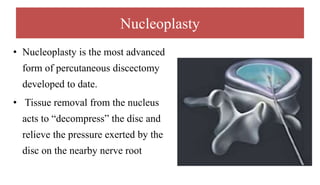
Nucleoplasty
• Nucleoplasty is the most advanced
form of percutaneous discectomy
developed to date.
• Tissue removal from the nucleus
acts to “decompress” the disc and
relieve the pressure exerted by the
disc on the nearby nerve root
Laminectomy
• To relieve spinal stenosis
or nerve compression.
Lumbar fusion
• Anterior lumbar fusion is an
operation done on the front
(the anterior region) of the
lower spine.
• Fusion surgery helps two or
more bones grow together into
one solid bone.
Total Disc Replacement
• Artificial Disc Replacement (ADR), or Total
Disc Replacement (TDR), is a type of
arthroplasty.
• It is a surgical procedure in which
degenerated intervertebral discs in the spinal
column are replaced with artificial devices in
the lumbar (lower) or cervical (upper) spine.
Nursing diagnosis
• Acute and chronic pain r/t inflammation or rupture of an IVD
• Risk for trauma r/t improper body mechanics
• Risk for constipation r/t decreased activity
• Impaired physical mobility r/t pain, muscle weakness
• Risk for disuse syndrome r/t bed rest and immobility
Nursing management
• Assess the general condition of the patient
• Check the vital signs
• Assess the level and characteristics of pain
• Provide proper back care and skin care to the patient
• Advice patient to do proper exercise
• Provide adequate nutrition
• Change the position frequently
• Advice to avoid heavy exercise like heavy weight lifting
• Put traction for the prescribed period of time.
• Continue the medications till the doctor advised
Assessing the patient after surgery
• Vital signs are checked frequently and the wound is inspected for hemorrhage
• IV morphine
• Sensation and motor strength of the lower extremities are evaluated at specified
intervals, along with the color and temperature of the legs and sensation of the toes.
• Assess for CSF leakage
• Assess for paralytic ileus
• Assess for urinary retention/incontinence
Complication
Adhesion
segmental
disease
Prevention of adhesion segmental disease and
PIVD
• Rest
• Diet
• Spinal belt
• Body mechanics
• Lumbar stretching and strengthening exercises
• Cervical stretching and strengthening exercise
Lumbar stretching
and strengthening
exercises
Cervical
stretching and
strengthening
exercise
Health Education
• Always wear a seatbelt
• Protect your head and upper neck by wearing a helmet when biking
• Adjust your computer monitor or screen to eye level; avoid slumping
• Don’t tuck your phone between your ear and shoulder
• Sleep using a pillow that supports your neck
• Periodic neck stretching movements and exercises can help release
tension and avoid stiff neck
• Talk with your doctor about bone health; calcium and/or vitamin D
supplements
• Quit smoking and/or vaping
Conclusion
• PIVD is the most common health disorder among general
public
• Successful PIVD management is only followed vis proper
body mechanics, diet, posture, protection from injury.
Inter vertebral disc prolapse

Inter vertebral disc prolapse

  • 1.
    INTERVERTEBRAL DISC PROLAPSE ( IVDP) Evaluator:Mr L Anand Presenter: Shruti Shirke [Asso professor, CON AIIMS BBSR] M.Sc Neuroscience Nursing
  • 2.
    INTERVERTEBRAL DISC • Isa hydrostatic, load bearing structure between the vertebral bodies. • Nucleus pulposus + annulus fibrosus • Is relatively avascular. • L4-5, largest avascular structure in the body. • Is relatively avascular structure and the Essential minerals and fluids required for regeneration enter the disks passively during the night.
  • 3.
    Functions of IVD •It supports the axial load on the column that is delivered by the body mass. • Assist a limited range of motion at the spine. • Shock absorbing system. • Serve ligament functions between vertebral bodies. • Assist to keep the normal shape & curvature of each spinal region (cervical, thoracic, ..etc)
  • 4.
    Definition Spinal disc herniation,also known as a slipped disc, is a medical condition affecting the spine in which a tear in the outer, fibrous ring of an intervertebral disc allows the soft, central portion to bulge out beyond the damaged outer rings.
  • 5.
    Location • The majorityof spinal disc herniation cases occur in lumbar region (95% in L4-L5 or L5-S1). • The second most common site is the cervical region (C5- C6, C6- C7). • The thoracic region accounts for only 0.15% to 4.0% of cases.
  • 7.
    Types of IVDP •Posterolateral disc herniation – protrusion is usually posterolateral into vertebral canal, compress the roots of a spinal nerve. • protruded disc usually compresses next lower nerve as that nerve crosses level of disc in its path to its foramen. (eg.protrusion of fifth lumbar disc usually affects S1 instead. • Central (posterior) herniation: less frequently, a protruded disc above second lumbar vertebra may compress spinal cord itself or or may result in cauda equina syndrome. • Lateral disc herniation: may compress the nerve root above the level of the herniation • L4 nerve root is most often involved & patient typically have intense radicular pain.
  • 8.
    Stages of IVDP •Degeneration :Loss of fluid in nucleus pulposus • Protrusion :Bulge in the disc but not a complete rupture • Prolapse :Nucleus forced into outermost layer of annulus fibrosus- not a complete rupture • Extrusion: A small hole in annulus fibrosus and fluid moves into epidural space • Sequestration :Disc fragments start to form outside of the disc area.
  • 10.
    CAUSES Repetitive mechanical activities– • Frequent bending, twisting, lifting, and other similar activities without breaks and proper stretching can leave the discs damaged. Living a sedentary lifestyle – • Individuals who rarely if ever engage in physical activity are more prone to herniated discs because the muscles that support the back and neck weaken, which increases strain on the spine. Traumatic injury to lumbar discs - • commonly occurs when lifting while bent at the waist, rather than lifting with the legs while the back is straight.
  • 11.
    Obesity – • Spinaldegeneration can be quickened as a result of the burden of supporting excess body fat. Practicing poor posture – • Improper spinal alignment while sitting, standing, or lying down strains the back and neck. Tobacco abuse – • The chemicals commonly found in cigarettes can interfere with the disc’s ability to absorb nutrients, which results in the weakening of the disc.
  • 12.
    Conditions related tospinal pain • Scoliosis: Abnormal sagittal, coronal and axial curvature of the spine. • Neoplasm • Infection • Spondylosis: (is a form of arthritis—spinal osteoarthritis) Degeneration of the IVD leads to disc prolapse • Spondylolisthesis: Slipping of one vertebra on the adjacent vertebra • Rheumatoid arthritis • Ankylosing spondylitis (hunched forward posture) • Whiplash injury and other trauma
  • 14.
    Clinical manifestations • Themain symptoms of a prolapsed disc include: • In severe cases, loss of control of bladder and/or bowels, numbness in the genital area, and impotence (in men) • Numbness, pins and needles, or tingling in one or both arms or legs • Pain behind the shoulder blade(s) or in the buttock(s) ,Pain running down one or both arms or legs • The location of these symptoms depends upon which nerve(s) has been affected. In other words, the precise location of the symptoms helps determine your diagnosis. • Weakness involving one or both arms or legs
  • 16.
    Sign and Symptomsby location • Lumbar area • Pain: Sciatica(L4 L5 S1 S2 S3 give rise to sciatica nerve): Syndrome of lumbar back pain that radiates down to one leg to the ankle aggravates by coughing, sneezing, straining. • Patient prefers lateral recumbent position
  • 17.
    Sign and Symptomsby location • Postural deformity • Motor deficit: (L5 Extensor halluces longus) EHL weakness, foot drop, weakness, atrophy, saddle anesthesia, urinary incontinence or retension. • Sensory deficit: Decreased sensation in foot, paresthesia, saddle anesthesia, tenderness in nerve innervations. • Alteration in reflexes
  • 20.
    Sign and Symptomsby location • Cervical area • Pain in shoulder, neck and arms and affected nerve innervations • Motor deficit • Myelopathy: Decreased fine motor dexterity, gait disturbnces, cramping of the extremities, hyperreflexia, positive hoffman sign, ankle clonus, poor tandem gait. • Spurling sign: Pain aggravates • Lhermitte sign: barber chair phenomena, electric shock like sensation
  • 21.
  • 23.
    • C1, C2and C3 provide motor function to the head and neck, as well as sensation from the top of your scalp to the sides of your face • C4 enables you to shrug your shoulders and automatically causes the diaphragm to contract when you are breathing. The 4th cervical spinal nerve also provides sensation to your neck, shoulders and parts of your upper arms • C5 enables various upper body movements like lifting your shoulders and flexing your biceps, and enables feeling toward the tip of the shoulder • C6 allows you to move your wrists and flex your biceps and also provides sensation to the inner (thumb) side of your forearms and hand • C7 powers the triceps muscle on the back of your upper arms and transmits sensation along the back of the arms, and down to the middle finger • C8 allows you to open and close your hands (hand grip) and gives you the ability to feel the outer (pinky) side of your hands and forearms
  • 24.
    Clinical difference betweenmyelopathy and radiculopathy
  • 25.
    Diagnosis • Diagnosis isbased on the history, symptoms, and physical examination. • X-Ray : lumbo-sacral spine; Narrowed disc spaces. Loss of lumber lordosis. Compensatory scoliosis. • CT scan lumber spine: It can show the shape and size of the spinal canal, its contents, and the structures around it, including soft tissues.
  • 26.
    Diagnosis • MRI lumberspine: Intervertebral disc protrusion. Compression of nerve root. • Myelogram: pressure on the spinal cord or nerves, such as herniated discs, tumors, or bone spurs.
  • 30.
    Physical examination • StraightLeg Raising Test • EHL test • Hoffman’s test • Gait assessment • Motor functions (MRC) • Sensation • Reflex
  • 32.
    Management • Bed rest. •Non-steroidal anti-inflammatory drugs (NSAIDs). • Patient education on proper body mechanics. • Physical therapy, to address mechanical factors, and may include modalities to temporarily relieve pain (i.e. traction, electrical stimulation massage).
  • 33.
    Management • Oral steroids(e.g. prednisone or methylprednisolone). • Epidural cortisone injection. • Intravenous sedation, analgesia-assisted traction therapy (IVSAAT). • Weight control. • Tobacco cessation. • Lumbosacral back support.
  • 35.
    Discectomy / Microdiscectomy •This procedure is used to remove part of an intervertebral disc that is compressing the spinal cord or a nerve root.
  • 36.
    The Tessys method •The Tessys method (transformational endoscopic surgical system) is a minimally invasive surgical procedure to remove herniated discs.
  • 37.
    Nucleoplasty • Nucleoplasty isthe most advanced form of percutaneous discectomy developed to date. • Tissue removal from the nucleus acts to “decompress” the disc and relieve the pressure exerted by the disc on the nearby nerve root
  • 38.
    Laminectomy • To relievespinal stenosis or nerve compression.
  • 39.
    Lumbar fusion • Anteriorlumbar fusion is an operation done on the front (the anterior region) of the lower spine. • Fusion surgery helps two or more bones grow together into one solid bone.
  • 40.
    Total Disc Replacement •Artificial Disc Replacement (ADR), or Total Disc Replacement (TDR), is a type of arthroplasty. • It is a surgical procedure in which degenerated intervertebral discs in the spinal column are replaced with artificial devices in the lumbar (lower) or cervical (upper) spine.
  • 41.
    Nursing diagnosis • Acuteand chronic pain r/t inflammation or rupture of an IVD • Risk for trauma r/t improper body mechanics • Risk for constipation r/t decreased activity • Impaired physical mobility r/t pain, muscle weakness • Risk for disuse syndrome r/t bed rest and immobility
  • 42.
    Nursing management • Assessthe general condition of the patient • Check the vital signs • Assess the level and characteristics of pain • Provide proper back care and skin care to the patient • Advice patient to do proper exercise • Provide adequate nutrition • Change the position frequently • Advice to avoid heavy exercise like heavy weight lifting • Put traction for the prescribed period of time. • Continue the medications till the doctor advised
  • 43.
    Assessing the patientafter surgery • Vital signs are checked frequently and the wound is inspected for hemorrhage • IV morphine • Sensation and motor strength of the lower extremities are evaluated at specified intervals, along with the color and temperature of the legs and sensation of the toes. • Assess for CSF leakage • Assess for paralytic ileus • Assess for urinary retention/incontinence
  • 44.
  • 45.
    Prevention of adhesionsegmental disease and PIVD • Rest • Diet • Spinal belt • Body mechanics • Lumbar stretching and strengthening exercises • Cervical stretching and strengthening exercise
  • 46.
  • 47.
  • 48.
    Health Education • Alwayswear a seatbelt • Protect your head and upper neck by wearing a helmet when biking • Adjust your computer monitor or screen to eye level; avoid slumping • Don’t tuck your phone between your ear and shoulder • Sleep using a pillow that supports your neck • Periodic neck stretching movements and exercises can help release tension and avoid stiff neck • Talk with your doctor about bone health; calcium and/or vitamin D supplements • Quit smoking and/or vaping
  • 49.
    Conclusion • PIVD isthe most common health disorder among general public • Successful PIVD management is only followed vis proper body mechanics, diet, posture, protection from injury.