TUBERCULOSIS OF SPINE
(POTT’S DISEASE)
INTRODUCTION
The spine is the commonest
site of bone & joint tuberculosis.
The children & young adults
most commonly affected.
The most commonly affected
region is the dorso-lumber area.
It can involve more than one
region of spine.
The vaccinated &
nonvaccinated both groups can
have spinal tuberculosis.
TYPES OF VERTEBRAL
TUBERCULOSIS
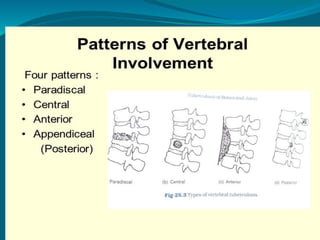
1) Paradiscal – commonest type
2) Central – Body of a single
vertebra is affected.
3) Anterior – Infection is
localised to the anterior part of
vertebral body.
4) Posterior (appendicial) –
Posterior complex of vertebra
i.e. pedicle, lamina, spinous
process are affected.
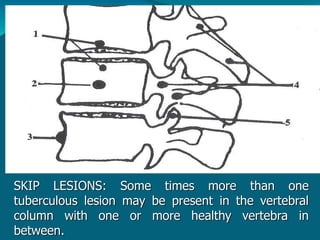
SKIP LESIONS: Some times more than one
tuberculous lesion may be present in the vertebral
column with one or more healthy vertebra in
between.
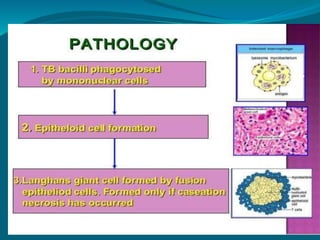
PATHOLOGY
T.B. of spine is always secondary.
The bacteria reaches the spine by
heamatogenous route from the
lungs, lymph nodes or intestine.
It spreads via the paravertebral
venous plexus (Batson’s plexus).
PATHOLOGY CONTD.
The granulomatous inflammation
spreads up and down stripping the
anterior or posterior longitudinal
ligaments and the periosteum from
the front and sides of vertebral
bodies. This results in loss of
periosteal blood supply and
destruction of many contiguous
vertebral bodies.
COLD ABSCESS
This is a collection of pus and
tubercular debris with bacilli from a
diseased vertebra. The abscess is
called cold because it is not
associated with signs of
inflammation.
The cold abscess penetrates the bone
and ligaments and can track along the
plane of least resistance --
COLD ABSCESS CONTD.
1) Anteriorly- prevertebral abscess,
Retropharyngeal abscess
2) Posteriorly- along the posterior
divisions of spinal nerves,
paravertebral abscess
3) Along 12th thoracic / Ilioinguinal
nerve –Renal abcess.
COLD ABSCESS CONTD.
4) Through upper opening of
psoas sheath- Psoas abscess.
5) Passing behind median
arcuate ligament –
Intraabdominal abscess.
CLINICAL FEATURES
1) Constitutionalsymptoms-
Fever, weight loss etc.
2)Pain presenting symptom, it
aggravates at night (night cry)
3) Stiffness- a very early symptom
of T.B. spine.
CLINICAL FEATURES CONTD.
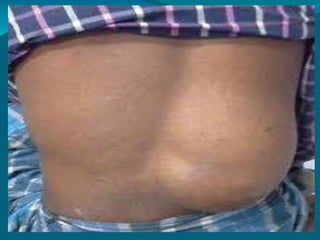
4) Paravertebral swelling – a superficial
cold abscess may appear as paravertebral
swelling. It may burst through the skin
forming a discharging sinus.
5) Deformity:
Knuckle- prominence of a single spinous
process.
Gibbus – 2-3 spinous process prominence.
Kyphus ->3 spinous process prominence.
CLINICAL FEATURES CONTD.
6)Tuberculous paraplegia
(Pott’s paraplegia)-Early
onset and late onset
paraplegia.
7)Rarely as spinal tumour
syndrome.
INVESTIGATION
1) Routine blood examination –
raised ESR, Anaemia,
lymphocytosis.
2) X-ray (To find primary focus) Chest
X-ray & X-ray KUB
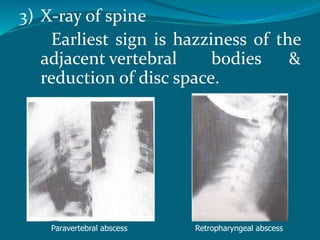
3) X-ray of spine
Earliest sign is hazziness of the
adjacent vertebral bodies &
reduction of disc space.
Paravertebral abscess Retropharyngeal abscess
Destruction of the vertebral
bodies.
Evidence of cold abscess-
paravertebral bird nest type
shadow.
Widened mediastinum.
Aneurysmal sign –in anterior type.
4) CT scan- Indicates precisely the
extent of destruction of vertebra.
5) MRI – It is the investigation of
choice to evaluate type and extent
of compression of the cord in case
of Pott’s paraplegia.
6) Myelography – indicated in case
presenting with spinal tumour
syndrome.
7) Biopsy – A CT guided biopsy may
be needed in doubtful cases.
DIFFERENTIAL DIAGNOSIS
1) Spinal pyogenic osteomyelitis.
2)Typhoid spine
3) Brucella spondylitis
4)Mycotic spondylitis
5) Syphyllitic infection of spine.
DIFFERENTIAL DIAGNOSIS CONTD.
6) Tumerous condition like
haemangioma, GCT,
aneurysmal bone cyst.
7) Primary spinal tumour
8) Secondary neoplastic deposits
9) Multiple myeloma
10) Spinal osteochondrosis.
TREATMENT
Conservative treatment
(Middle path regime)
 Rest in hard bed
 Antituberculous drugs
TREATMENT CONTD.
 Gradual mobilisation- after 3-
9 weeks of starting treatment
with suitable spinal braces.
 Drainage of cold abscess when
present inspite of conservative
treatment.
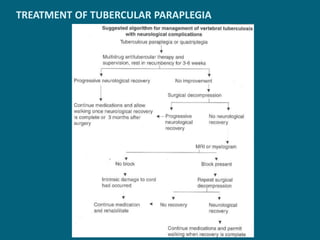
TREATMENT OF TUBERCULAR PARAPLEGIA
INDICATIONS OF OPERATIVE TREATMENT
1) Paraplegia appearing during usual
conservative treatment.
2) Paraplegia getting worse or
remaining stationary despite
adequate conservative treatment.
3) Rapid onset progressive paraplegia.
OPERATIVE PROCEDURES
1) Costo-transversectomy.
2) Anterolateral decompression
3) Radical debridement and
arthrodesis (Hongkong
operation)
4) Surgery for deformity
correction.
THANK YOU

Tuberculosis spine

  • 1.
  • 2.
    INTRODUCTION The spine isthe commonest site of bone & joint tuberculosis. The children & young adults most commonly affected.
  • 3.
    The most commonlyaffected region is the dorso-lumber area. It can involve more than one region of spine. The vaccinated & nonvaccinated both groups can have spinal tuberculosis.
  • 4.
    TYPES OF VERTEBRAL TUBERCULOSIS 1)Paradiscal – commonest type 2) Central – Body of a single vertebra is affected. 3) Anterior – Infection is localised to the anterior part of vertebral body.
  • 5.
    4) Posterior (appendicial)– Posterior complex of vertebra i.e. pedicle, lamina, spinous process are affected.
  • 7.
    SKIP LESIONS: Sometimes more than one tuberculous lesion may be present in the vertebral column with one or more healthy vertebra in between.
  • 8.
    PATHOLOGY T.B. of spineis always secondary. The bacteria reaches the spine by heamatogenous route from the lungs, lymph nodes or intestine. It spreads via the paravertebral venous plexus (Batson’s plexus).
  • 9.
    PATHOLOGY CONTD. The granulomatousinflammation spreads up and down stripping the anterior or posterior longitudinal ligaments and the periosteum from the front and sides of vertebral bodies. This results in loss of periosteal blood supply and destruction of many contiguous vertebral bodies.
  • 11.
    COLD ABSCESS This isa collection of pus and tubercular debris with bacilli from a diseased vertebra. The abscess is called cold because it is not associated with signs of inflammation. The cold abscess penetrates the bone and ligaments and can track along the plane of least resistance --
  • 12.
    COLD ABSCESS CONTD. 1)Anteriorly- prevertebral abscess, Retropharyngeal abscess 2) Posteriorly- along the posterior divisions of spinal nerves, paravertebral abscess 3) Along 12th thoracic / Ilioinguinal nerve –Renal abcess.
  • 13.
    COLD ABSCESS CONTD. 4)Through upper opening of psoas sheath- Psoas abscess. 5) Passing behind median arcuate ligament – Intraabdominal abscess.
  • 15.
    CLINICAL FEATURES 1) Constitutionalsymptoms- Fever,weight loss etc. 2)Pain presenting symptom, it aggravates at night (night cry) 3) Stiffness- a very early symptom of T.B. spine.
  • 16.
    CLINICAL FEATURES CONTD. 4)Paravertebral swelling – a superficial cold abscess may appear as paravertebral swelling. It may burst through the skin forming a discharging sinus. 5) Deformity: Knuckle- prominence of a single spinous process. Gibbus – 2-3 spinous process prominence. Kyphus ->3 spinous process prominence.
  • 17.
    CLINICAL FEATURES CONTD. 6)Tuberculousparaplegia (Pott’s paraplegia)-Early onset and late onset paraplegia. 7)Rarely as spinal tumour syndrome.
  • 18.
    INVESTIGATION 1) Routine bloodexamination – raised ESR, Anaemia, lymphocytosis. 2) X-ray (To find primary focus) Chest X-ray & X-ray KUB
  • 19.
    3) X-ray ofspine Earliest sign is hazziness of the adjacent vertebral bodies & reduction of disc space. Paravertebral abscess Retropharyngeal abscess
  • 20.
    Destruction of thevertebral bodies. Evidence of cold abscess- paravertebral bird nest type shadow. Widened mediastinum. Aneurysmal sign –in anterior type. 4) CT scan- Indicates precisely the extent of destruction of vertebra.
  • 21.
    5) MRI –It is the investigation of choice to evaluate type and extent of compression of the cord in case of Pott’s paraplegia. 6) Myelography – indicated in case presenting with spinal tumour syndrome. 7) Biopsy – A CT guided biopsy may be needed in doubtful cases.
  • 22.
    DIFFERENTIAL DIAGNOSIS 1) Spinalpyogenic osteomyelitis. 2)Typhoid spine 3) Brucella spondylitis 4)Mycotic spondylitis 5) Syphyllitic infection of spine.
  • 23.
    DIFFERENTIAL DIAGNOSIS CONTD. 6)Tumerous condition like haemangioma, GCT, aneurysmal bone cyst. 7) Primary spinal tumour 8) Secondary neoplastic deposits 9) Multiple myeloma 10) Spinal osteochondrosis.
  • 24.
    TREATMENT Conservative treatment (Middle pathregime)  Rest in hard bed  Antituberculous drugs
  • 25.
    TREATMENT CONTD.  Gradualmobilisation- after 3- 9 weeks of starting treatment with suitable spinal braces.  Drainage of cold abscess when present inspite of conservative treatment.
  • 26.
  • 27.
    INDICATIONS OF OPERATIVETREATMENT 1) Paraplegia appearing during usual conservative treatment. 2) Paraplegia getting worse or remaining stationary despite adequate conservative treatment. 3) Rapid onset progressive paraplegia.
  • 28.
    OPERATIVE PROCEDURES 1) Costo-transversectomy. 2)Anterolateral decompression 3) Radical debridement and arthrodesis (Hongkong operation) 4) Surgery for deformity correction.
  • 29.