A
               PRESENTATION
                    ON
“INTERMEDIATE BAND QUANTUM DOT SOLAR CELL”
   Photovoltaic
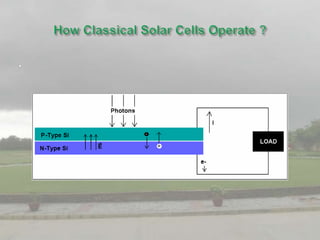
   Conventional solar cell
     Introduction
     Working
     Limitations
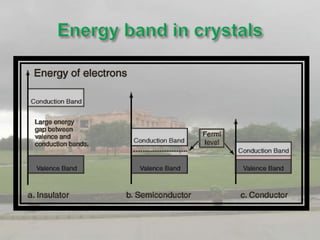
   Energy bands in solids
   Intermediate band solar cell
   Quantum dot
   Intermediate band quantum dot solar cell
     Introduction
     Construction
     Working
     Advantages
     Applications
     Limitations
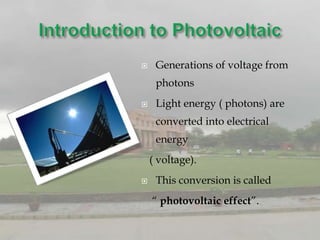
    Generations of voltage from
     photons
    Light energy ( photons) are
     converted into electrical
     energy
    ( voltage).
    This conversion is called
    “ photovoltaic effect”.
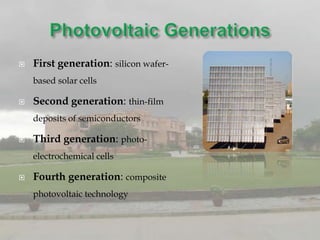
   First generation: silicon wafer-
    based solar cells

   Second generation: thin-film
    deposits of semiconductors

   Third generation: photo-
    electrochemical cells

   Fourth generation: composite
    photovoltaic technology
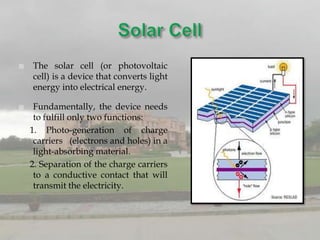
   The solar cell (or photovoltaic
    cell) is a device that converts light
    energy into electrical energy.

    Fundamentally, the device needs
     to fulfill only two functions:
    1. Photo-generation of charge
     carriers (electrons and holes) in a
     light-absorbing material.
    2. Separation of the charge carriers
     to a conductive contact that will
     transmit the electricity.
.
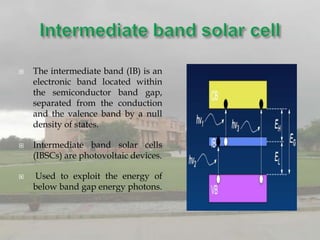
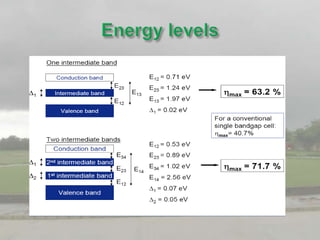
   The intermediate band (IB) is an
    electronic band located within
    the semiconductor band gap,
    separated from the conduction
    and the valence band by a null
    density of states.

   Intermediate band solar cells
    (IBSCs) are photovoltaic devices.

   Used to exploit the energy of
    below band gap energy photons.
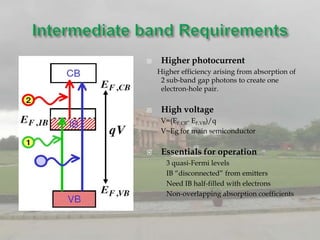
    Higher photocurrent
    Higher efficiency arising from absorption of
     2 sub-band gap photons to create one
     electron-hole pair.

    High voltage
     V=(EF,CB- EF,VB)/q
     V~Eg for main semiconductor


    Essentials for operation
      3 quasi-Fermi levels
      IB “disconnected” from emitters
      Need IB half-filled with electrons
      Non-overlapping absorption coefficients
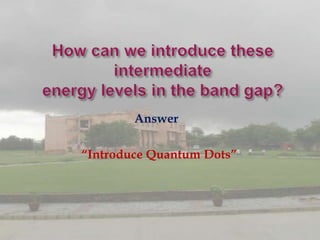
Answer

“Introduce Quantum Dots”
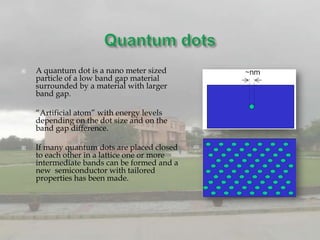
   A quantum dot is a nano meter sized
    particle of a low band gap material
    surrounded by a material with larger
    band gap.

   “Artificial atom” with energy levels
    depending on the dot size and on the
    band gap difference.

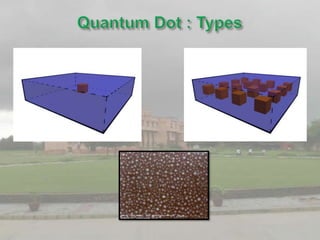
   If many quantum dots are placed closed
    to each other in a lattice one or more
    intermediate bands can be formed and a
    new semiconductor with tailored
    properties has been made.
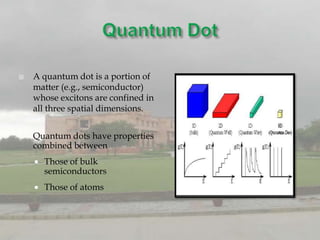
   A quantum dot is a portion of
    matter (e.g., semiconductor)
    whose excitons are confined in
    all three spatial dimensions.


   Quantum dots have properties
    combined between
       Those of bulk
        semiconductors
       Those of atoms
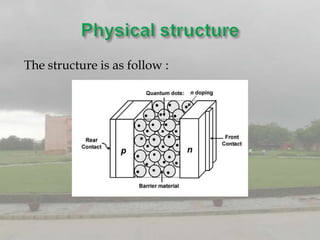
The structure is as follow :
   Dot sized shape, composition

   Dot spacing

   Dot regularity

   Materials

   Doping
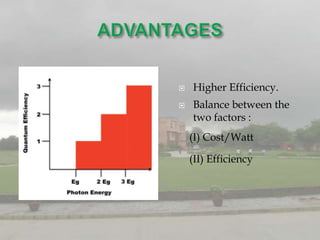
   Higher Efficiency.
   Balance between the
    two factors :
    (I) Cost/Watt

    (II) Efficiency
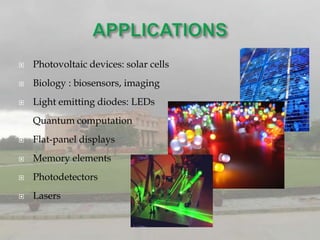
   Photovoltaic devices: solar cells
   Biology : biosensors, imaging
   Light emitting diodes: LEDs
   Quantum computation
   Flat-panel displays
   Memory elements
   Photodetectors
   Lasers
   Weak absorption of sub-band gap photons

   Low open-circuit voltage

   Low currents

   Cost
   QD SL cells show photo responses extended to
    longer wavelengths than GaAs control cells,
    demonstrating current generation from the
    absorption of sub-bandgap photons.

   IBSC theoretically offers a way to significantly
    increase cell efficiency compared to that of a
    single-junction solar cell.
   Much more work needs to be done before IBSC
    can
    make a major contribution to the PV market.

            “ Miles To Go Before I sleep”
Intermediate band quantum dot solar cell

Intermediate band quantum dot solar cell

  • 1.
    A PRESENTATION ON “INTERMEDIATE BAND QUANTUM DOT SOLAR CELL”
  • 2.
    Photovoltaic  Conventional solar cell  Introduction  Working  Limitations  Energy bands in solids  Intermediate band solar cell  Quantum dot  Intermediate band quantum dot solar cell  Introduction  Construction  Working  Advantages  Applications  Limitations
  • 3.
    Generations of voltage from photons  Light energy ( photons) are converted into electrical energy ( voltage).  This conversion is called “ photovoltaic effect”.
  • 4.
    First generation: silicon wafer- based solar cells  Second generation: thin-film deposits of semiconductors  Third generation: photo- electrochemical cells  Fourth generation: composite photovoltaic technology
  • 5.
    The solar cell (or photovoltaic cell) is a device that converts light energy into electrical energy.  Fundamentally, the device needs to fulfill only two functions: 1. Photo-generation of charge carriers (electrons and holes) in a light-absorbing material. 2. Separation of the charge carriers to a conductive contact that will transmit the electricity.
  • 6.
  • 8.
    The intermediate band (IB) is an electronic band located within the semiconductor band gap, separated from the conduction and the valence band by a null density of states.  Intermediate band solar cells (IBSCs) are photovoltaic devices.  Used to exploit the energy of below band gap energy photons.
  • 9.
    Higher photocurrent Higher efficiency arising from absorption of 2 sub-band gap photons to create one electron-hole pair.  High voltage V=(EF,CB- EF,VB)/q V~Eg for main semiconductor  Essentials for operation 3 quasi-Fermi levels IB “disconnected” from emitters Need IB half-filled with electrons Non-overlapping absorption coefficients
  • 11.
  • 12.
    A quantum dot is a nano meter sized particle of a low band gap material surrounded by a material with larger band gap.  “Artificial atom” with energy levels depending on the dot size and on the band gap difference.  If many quantum dots are placed closed to each other in a lattice one or more intermediate bands can be formed and a new semiconductor with tailored properties has been made.
  • 13.
    A quantum dot is a portion of matter (e.g., semiconductor) whose excitons are confined in all three spatial dimensions.  Quantum dots have properties combined between  Those of bulk semiconductors  Those of atoms
  • 14.
    The structure isas follow :
  • 16.
    Dot sized shape, composition  Dot spacing  Dot regularity  Materials  Doping
  • 17.
    Higher Efficiency.  Balance between the two factors : (I) Cost/Watt (II) Efficiency
  • 18.
    Photovoltaic devices: solar cells  Biology : biosensors, imaging  Light emitting diodes: LEDs  Quantum computation  Flat-panel displays  Memory elements  Photodetectors  Lasers
  • 19.
    Weak absorption of sub-band gap photons  Low open-circuit voltage  Low currents  Cost
  • 20.
    QD SL cells show photo responses extended to longer wavelengths than GaAs control cells, demonstrating current generation from the absorption of sub-bandgap photons.  IBSC theoretically offers a way to significantly increase cell efficiency compared to that of a single-junction solar cell.
  • 21.
    Much more work needs to be done before IBSC can make a major contribution to the PV market. “ Miles To Go Before I sleep”