11
Vineeth VSVineeth VS
S7 ECES7 ECE
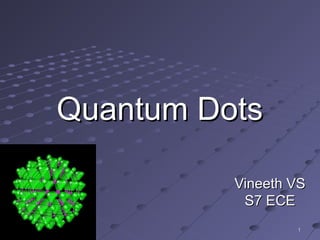
Quantum DotsQuantum Dots
22
IntroductionIntroduction
Quantum dots are semiconductors whose excitons areQuantum dots are semiconductors whose excitons are
confined in all three dimensions of space.confined in all three dimensions of space.
Quantum dots have properties combined betweenQuantum dots have properties combined between

Those of bulk semiconductorsThose of bulk semiconductors

Those of atomsThose of atoms
Different methods to create quantum dots.Different methods to create quantum dots.
Multiple applications.Multiple applications.
33
OutlineOutline
1.1. Quantum Confinement and Quantum DotsQuantum Confinement and Quantum Dots
2.2. Fabrication of Quantum DotsFabrication of Quantum Dots
3.3. Quantum Dot ApplicationsQuantum Dot Applications
44
Bulk SemiconductorsBulk Semiconductors
Electrons in conduction band (and holes in the valenceElectrons in conduction band (and holes in the valence
band) are free to move in all three dimensions of space.band) are free to move in all three dimensions of space.
B.E.A. Saleh,
M.C. Teich.
Fundamentals
of Photonics.
fig. 16.1-10
and 16.1-29.
55
Thin Film SemiconductorsThin Film Semiconductors
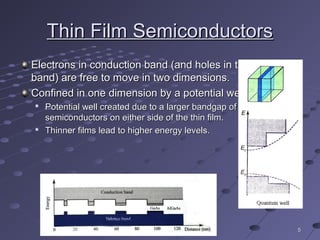
Electrons in conduction band (and holes in the valenceElectrons in conduction band (and holes in the valence
band) are free to move in two dimensions.band) are free to move in two dimensions.
Confined in one dimension by a potential well.Confined in one dimension by a potential well.

Potential well created due to a larger bandgap of thePotential well created due to a larger bandgap of the
semiconductors on either side of the thin film.semiconductors on either side of the thin film.

Thinner films lead to higher energy levels.Thinner films lead to higher energy levels.
66
Quantum WireQuantum Wire
Thin semiconductor wire surrounded by a material with aThin semiconductor wire surrounded by a material with a
larger bandgap.larger bandgap.

Surrounding material confines electrons and holes in twoSurrounding material confines electrons and holes in two
dimensions (carriers can only move in one dimension) due to itsdimensions (carriers can only move in one dimension) due to its
larger bandgap.larger bandgap.
Quantum wire acts as a potential well.Quantum wire acts as a potential well.
77
Quantum DotQuantum Dot
Electrons and holes are confined in all three dimensionsElectrons and holes are confined in all three dimensions
of space by a surrounding material with a largerof space by a surrounding material with a larger
bandgap.bandgap.
Discrete energy levels (artificial atom).Discrete energy levels (artificial atom).
A quantum dot has a larger bandgap.A quantum dot has a larger bandgap.
Like bulk semiconductor, electrons tend to makeLike bulk semiconductor, electrons tend to make
transitions near the edges of the bandgap in quantumtransitions near the edges of the bandgap in quantum
dots.dots.
88
Very small semiconductor particles with a sizeVery small semiconductor particles with a size
comparable to the Bohr radius of the excitonscomparable to the Bohr radius of the excitons
(separation of electron and hole).(separation of electron and hole).

Typical dimensions: 1 – 10 nmTypical dimensions: 1 – 10 nm

Can be as large as severalCan be as large as several μμm.m.

Different shapes (cubes, spheres, pyramids, etc.)Different shapes (cubes, spheres, pyramids, etc.)
Quantum DotQuantum Dot
99
Discrete Energy LevelsDiscrete Energy Levels
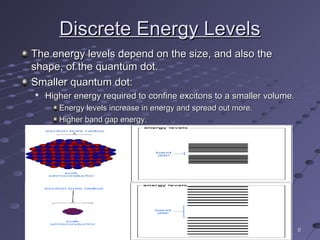
The energy levels depend on the size, and also theThe energy levels depend on the size, and also the
shape, of the quantum dot.shape, of the quantum dot.
Smaller quantum dot:Smaller quantum dot:

Higher energy required to confine excitons to a smaller volume.Higher energy required to confine excitons to a smaller volume.
Energy levels increase in energy and spread out more.Energy levels increase in energy and spread out more.
Higher band gap energy.Higher band gap energy.
.
1010
CdSe Quantum DotCdSe Quantum Dot
5 nm dots: red5 nm dots: red
1.5 nm dots: violet1.5 nm dots: violet
1111
How to Make Quantum DotsHow to Make Quantum Dots
There are three main ways to confine excitons inThere are three main ways to confine excitons in
semiconductors:semiconductors:

LithographyLithography

Colloidal synthesisColloidal synthesis

Epitaxy:Epitaxy:
Patterned GrowthPatterned Growth
Self-Organized GrowthSelf-Organized Growth
1212
LithographyLithography
Quantum wells are covered with a polymer mask andQuantum wells are covered with a polymer mask and
exposed to an electron or ion beam.exposed to an electron or ion beam.
The surface is covered with a thin layer of metal, thenThe surface is covered with a thin layer of metal, then
cleaned and only the exposed areas keep the metal layer.cleaned and only the exposed areas keep the metal layer.
Pillars are etched into the entire surface.Pillars are etched into the entire surface.
Multiple layers are applied thisMultiple layers are applied this
way to build up the propertiesway to build up the properties
and size wanted.and size wanted.
Disadvantages: slow,Disadvantages: slow,
contamination, low density,contamination, low density,
defect formation.defect formation.
1313
Colloidal SynthesisColloidal Synthesis
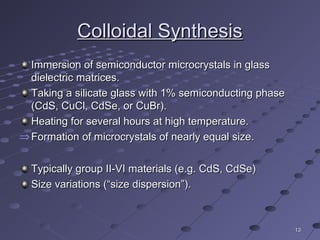
Immersion of semiconductor microcrystals in glassImmersion of semiconductor microcrystals in glass
dielectric matrices.dielectric matrices.
Taking a silicate glass with 1% semiconducting phaseTaking a silicate glass with 1% semiconducting phase
(CdS, CuCl, CdSe, or CuBr).(CdS, CuCl, CdSe, or CuBr).
Heating for several hours at high temperature.Heating for several hours at high temperature.
⇒ Formation of microcrystals of nearly equal size.Formation of microcrystals of nearly equal size.
Typically group II-VI materials (e.g. CdS, CdSe)Typically group II-VI materials (e.g. CdS, CdSe)
Size variations (“size dispersion”).Size variations (“size dispersion”).
1414
Epitaxy: Patterned GrowthEpitaxy: Patterned Growth
Semiconducting compounds with a smaller bandgapSemiconducting compounds with a smaller bandgap
(GaAs) are grown on the surface of a compoundwith a(GaAs) are grown on the surface of a compoundwith a
larger bandgap (AlGaAs).larger bandgap (AlGaAs).
Growth is restricted by coating it with a maskingGrowth is restricted by coating it with a masking
compound (SiOcompound (SiO22) and etching that mask with the shape) and etching that mask with the shape
of the required crystal cell wall shape.of the required crystal cell wall shape.
Disadvantage: density ofDisadvantage: density of
quantum dots limited byquantum dots limited by
mask pattern.mask pattern.
1515
Epitaxy: Self-Organized GrowthEpitaxy: Self-Organized Growth
Uses a large difference in the lattice constants of theUses a large difference in the lattice constants of the
substrate and the crystallizing material.substrate and the crystallizing material.
When the crystallized layer is thicker than the criticalWhen the crystallized layer is thicker than the critical
thickness, there is a strong strain on the layers.thickness, there is a strong strain on the layers.
The breakdown results in randomly distributed islets ofThe breakdown results in randomly distributed islets of
regular shape and size.regular shape and size.
Disadvantages: size andDisadvantages: size and
shape fluctuations, ordering.shape fluctuations, ordering.
Cadmium-free quantum dotsCadmium-free quantum dots
“CFQD”“CFQD”
In many regions of the world there is now, or soon to be,In many regions of the world there is now, or soon to be,
legislation to restrict and in some cases ban heavylegislation to restrict and in some cases ban heavy
metals in many household appliances such as IT &metals in many household appliances such as IT &
telecommunication equipment, Lighting equipment ,telecommunication equipment, Lighting equipment ,
Electrical & electronic tools, Toys, leisure & sportsElectrical & electronic tools, Toys, leisure & sports
equipment.equipment.
For QDs to be commercially viable in many applicationsFor QDs to be commercially viable in many applications
they MUST NOT CONTAIN cadmium or other restrictedthey MUST NOT CONTAIN cadmium or other restricted
elements LIKE mercury, lead, chromium.elements LIKE mercury, lead, chromium.
So research has been able to create non-toxic quantumSo research has been able to create non-toxic quantum
dots usingdots using siliconsilicon..
1616
What is it good for???What is it good for???
Very narrow spectral line width,Very narrow spectral line width,
depending on the quantum dot’s size.depending on the quantum dot’s size.
Multiplexed detectionMultiplexed detection
Large absorption coefficients across aLarge absorption coefficients across a
wide spectral range.wide spectral range.
Small size / high surface-to-volume ratio.Small size / high surface-to-volume ratio.
Very high levels of brightness.Very high levels of brightness.
Blinking.Blinking.
1717
18181818
ApplicationsApplications
Photovoltaic devices: solar cells
Biology : biosensors, imaging
Light emitting diodes: LEDs
Quantum computation
Flat-panel displays
Memory elements
Photodetectors
Lasers
19191919
Solar CellsSolar Cells
Photovoltaic effect:

p-n junction.

Sunlight excites electrons
and creates electron-hole
pairs.

Electrons concentrate on
one side of the cell and
holes on the other side.

Connecting the 2 sides
creates electricity.
20202020
Different Generations of Solar CellsDifferent Generations of Solar Cells
First generation:

Single crystal silicon wafer.

Advantages: high carrier mobility.

Disadvantages: most of photon
energy is wasted as heat,
expensive.
Second generation:

Thin-film technology.

Advantages: less expensive.

Disadvantages: efficiency lower
compared with silicon solar cells.
Third generation:

Nanocrystal solar cells.

Enhance electrical performances of
the second generation while
maintaining low production costs.
21212121
Solar Cells EfficiencySolar Cells Efficiency
What limits the efficiency:

Photons with lower energy than the band gap are not absorbed.

Photons with greater energy than the band gap are absorbed but
the excess energy is lost as heat.
22222222
The quantum dot band gap is tunable and can be used
to create intermediate bandgaps. The maximum
theoretical efficiency of the solar cell is as high as 63.2%
with this method.
How Can Quantum Dots ImproveHow Can Quantum Dots Improve
the Efficiency?the Efficiency?
BIOLOGY: LOCATINGBIOLOGY: LOCATING
CANCER CELLCANCER CELL
This picture showsThis picture shows
silicon quantum dotssilicon quantum dots
fluorescing insidefluorescing inside
cancer cells.cancer cells.
2323
..
These quantum dots can be putThese quantum dots can be put
into single cells, or lots of cells, ininto single cells, or lots of cells, in
the tissue of living organisms. Inthe tissue of living organisms. In
future, it is planned to attachfuture, it is planned to attach
specific antibodies to the quantumspecific antibodies to the quantum
dots – when injected into a body,dots – when injected into a body,
the quantum dots will find andthe quantum dots will find and
bind to cancer cells, andbind to cancer cells, and
illuminate them when theyilluminate them when they
fluoresce.fluoresce.
2424
TARGETED DRUG DELIVERYTARGETED DRUG DELIVERY
In this we attachIn this we attach drugdrug molecules to themolecules to the
quantum dots, which will then be able toquantum dots, which will then be able to
deliver the drug just to the cancer cellsdeliver the drug just to the cancer cells
where it is needed.where it is needed.
Current anti-cancer drugs tend to have aCurrent anti-cancer drugs tend to have a
range of unpleasant side-effects, becauserange of unpleasant side-effects, because
they affect the whole body, not just thethey affect the whole body, not just the
cancer.cancer.
2525
Light emitting diodes: LEDs
2626
Anti-counterfeitingAnti-counterfeiting
From consumer goods like music andFrom consumer goods like music and
software, to critical products like drugsoftware, to critical products like drug
shipments, and even currency itself,shipments, and even currency itself,
quantum dots provide a method ofquantum dots provide a method of
creating unique, optical barcodes: thecreating unique, optical barcodes: the
precise combinations of wavelengths ofprecise combinations of wavelengths of
light emitted by complex combinations oflight emitted by complex combinations of
different quantum dot. Embedded in inks,different quantum dot. Embedded in inks,
plastic, glass, and polymers, quantumplastic, glass, and polymers, quantum
dots are invisible to the naked eye anddots are invisible to the naked eye and
impossible to counterfeit.impossible to counterfeit.
2727
SENSORSSENSORS
The properties of quantum dots are suchThe properties of quantum dots are such
that they can be functionalized to emit lightthat they can be functionalized to emit light
on binding to a “target” molecule”, whichon binding to a “target” molecule”, which
enables them to be used, for example, toenables them to be used, for example, to
detect specific airborne pollutants.detect specific airborne pollutants.
2828
2929
ConclusionConclusion
Quantum dot:

Semiconductor particle with a size in the order of the Bohr radius
of the excitons.

Energy levels depend on the size of the dot.
Different methods for fabricating quantum dots.

LithographyLithography

Colloidal synthesisColloidal synthesis

EpitaxyEpitaxy
Multiple applications.
THANK YOUTHANK YOU
3030

Quantum dots

  • 1.
    11 Vineeth VSVineeth VS S7ECES7 ECE Quantum DotsQuantum Dots
  • 2.
    22 IntroductionIntroduction Quantum dots aresemiconductors whose excitons areQuantum dots are semiconductors whose excitons are confined in all three dimensions of space.confined in all three dimensions of space. Quantum dots have properties combined betweenQuantum dots have properties combined between  Those of bulk semiconductorsThose of bulk semiconductors  Those of atomsThose of atoms Different methods to create quantum dots.Different methods to create quantum dots. Multiple applications.Multiple applications.
  • 3.
    33 OutlineOutline 1.1. Quantum Confinementand Quantum DotsQuantum Confinement and Quantum Dots 2.2. Fabrication of Quantum DotsFabrication of Quantum Dots 3.3. Quantum Dot ApplicationsQuantum Dot Applications
  • 4.
    44 Bulk SemiconductorsBulk Semiconductors Electronsin conduction band (and holes in the valenceElectrons in conduction band (and holes in the valence band) are free to move in all three dimensions of space.band) are free to move in all three dimensions of space. B.E.A. Saleh, M.C. Teich. Fundamentals of Photonics. fig. 16.1-10 and 16.1-29.
  • 5.
    55 Thin Film SemiconductorsThinFilm Semiconductors Electrons in conduction band (and holes in the valenceElectrons in conduction band (and holes in the valence band) are free to move in two dimensions.band) are free to move in two dimensions. Confined in one dimension by a potential well.Confined in one dimension by a potential well.  Potential well created due to a larger bandgap of thePotential well created due to a larger bandgap of the semiconductors on either side of the thin film.semiconductors on either side of the thin film.  Thinner films lead to higher energy levels.Thinner films lead to higher energy levels.
  • 6.
    66 Quantum WireQuantum Wire Thinsemiconductor wire surrounded by a material with aThin semiconductor wire surrounded by a material with a larger bandgap.larger bandgap.  Surrounding material confines electrons and holes in twoSurrounding material confines electrons and holes in two dimensions (carriers can only move in one dimension) due to itsdimensions (carriers can only move in one dimension) due to its larger bandgap.larger bandgap. Quantum wire acts as a potential well.Quantum wire acts as a potential well.
  • 7.
    77 Quantum DotQuantum Dot Electronsand holes are confined in all three dimensionsElectrons and holes are confined in all three dimensions of space by a surrounding material with a largerof space by a surrounding material with a larger bandgap.bandgap. Discrete energy levels (artificial atom).Discrete energy levels (artificial atom). A quantum dot has a larger bandgap.A quantum dot has a larger bandgap. Like bulk semiconductor, electrons tend to makeLike bulk semiconductor, electrons tend to make transitions near the edges of the bandgap in quantumtransitions near the edges of the bandgap in quantum dots.dots.
  • 8.
    88 Very small semiconductorparticles with a sizeVery small semiconductor particles with a size comparable to the Bohr radius of the excitonscomparable to the Bohr radius of the excitons (separation of electron and hole).(separation of electron and hole).  Typical dimensions: 1 – 10 nmTypical dimensions: 1 – 10 nm  Can be as large as severalCan be as large as several μμm.m.  Different shapes (cubes, spheres, pyramids, etc.)Different shapes (cubes, spheres, pyramids, etc.) Quantum DotQuantum Dot
  • 9.
    99 Discrete Energy LevelsDiscreteEnergy Levels The energy levels depend on the size, and also theThe energy levels depend on the size, and also the shape, of the quantum dot.shape, of the quantum dot. Smaller quantum dot:Smaller quantum dot:  Higher energy required to confine excitons to a smaller volume.Higher energy required to confine excitons to a smaller volume. Energy levels increase in energy and spread out more.Energy levels increase in energy and spread out more. Higher band gap energy.Higher band gap energy. .
  • 10.
    1010 CdSe Quantum DotCdSeQuantum Dot 5 nm dots: red5 nm dots: red 1.5 nm dots: violet1.5 nm dots: violet
  • 11.
    1111 How to MakeQuantum DotsHow to Make Quantum Dots There are three main ways to confine excitons inThere are three main ways to confine excitons in semiconductors:semiconductors:  LithographyLithography  Colloidal synthesisColloidal synthesis  Epitaxy:Epitaxy: Patterned GrowthPatterned Growth Self-Organized GrowthSelf-Organized Growth
  • 12.
    1212 LithographyLithography Quantum wells arecovered with a polymer mask andQuantum wells are covered with a polymer mask and exposed to an electron or ion beam.exposed to an electron or ion beam. The surface is covered with a thin layer of metal, thenThe surface is covered with a thin layer of metal, then cleaned and only the exposed areas keep the metal layer.cleaned and only the exposed areas keep the metal layer. Pillars are etched into the entire surface.Pillars are etched into the entire surface. Multiple layers are applied thisMultiple layers are applied this way to build up the propertiesway to build up the properties and size wanted.and size wanted. Disadvantages: slow,Disadvantages: slow, contamination, low density,contamination, low density, defect formation.defect formation.
  • 13.
    1313 Colloidal SynthesisColloidal Synthesis Immersionof semiconductor microcrystals in glassImmersion of semiconductor microcrystals in glass dielectric matrices.dielectric matrices. Taking a silicate glass with 1% semiconducting phaseTaking a silicate glass with 1% semiconducting phase (CdS, CuCl, CdSe, or CuBr).(CdS, CuCl, CdSe, or CuBr). Heating for several hours at high temperature.Heating for several hours at high temperature. ⇒ Formation of microcrystals of nearly equal size.Formation of microcrystals of nearly equal size. Typically group II-VI materials (e.g. CdS, CdSe)Typically group II-VI materials (e.g. CdS, CdSe) Size variations (“size dispersion”).Size variations (“size dispersion”).
  • 14.
    1414 Epitaxy: Patterned GrowthEpitaxy:Patterned Growth Semiconducting compounds with a smaller bandgapSemiconducting compounds with a smaller bandgap (GaAs) are grown on the surface of a compoundwith a(GaAs) are grown on the surface of a compoundwith a larger bandgap (AlGaAs).larger bandgap (AlGaAs). Growth is restricted by coating it with a maskingGrowth is restricted by coating it with a masking compound (SiOcompound (SiO22) and etching that mask with the shape) and etching that mask with the shape of the required crystal cell wall shape.of the required crystal cell wall shape. Disadvantage: density ofDisadvantage: density of quantum dots limited byquantum dots limited by mask pattern.mask pattern.
  • 15.
    1515 Epitaxy: Self-Organized GrowthEpitaxy:Self-Organized Growth Uses a large difference in the lattice constants of theUses a large difference in the lattice constants of the substrate and the crystallizing material.substrate and the crystallizing material. When the crystallized layer is thicker than the criticalWhen the crystallized layer is thicker than the critical thickness, there is a strong strain on the layers.thickness, there is a strong strain on the layers. The breakdown results in randomly distributed islets ofThe breakdown results in randomly distributed islets of regular shape and size.regular shape and size. Disadvantages: size andDisadvantages: size and shape fluctuations, ordering.shape fluctuations, ordering.
  • 16.
    Cadmium-free quantum dotsCadmium-freequantum dots “CFQD”“CFQD” In many regions of the world there is now, or soon to be,In many regions of the world there is now, or soon to be, legislation to restrict and in some cases ban heavylegislation to restrict and in some cases ban heavy metals in many household appliances such as IT &metals in many household appliances such as IT & telecommunication equipment, Lighting equipment ,telecommunication equipment, Lighting equipment , Electrical & electronic tools, Toys, leisure & sportsElectrical & electronic tools, Toys, leisure & sports equipment.equipment. For QDs to be commercially viable in many applicationsFor QDs to be commercially viable in many applications they MUST NOT CONTAIN cadmium or other restrictedthey MUST NOT CONTAIN cadmium or other restricted elements LIKE mercury, lead, chromium.elements LIKE mercury, lead, chromium. So research has been able to create non-toxic quantumSo research has been able to create non-toxic quantum dots usingdots using siliconsilicon.. 1616
  • 17.
    What is itgood for???What is it good for??? Very narrow spectral line width,Very narrow spectral line width, depending on the quantum dot’s size.depending on the quantum dot’s size. Multiplexed detectionMultiplexed detection Large absorption coefficients across aLarge absorption coefficients across a wide spectral range.wide spectral range. Small size / high surface-to-volume ratio.Small size / high surface-to-volume ratio. Very high levels of brightness.Very high levels of brightness. Blinking.Blinking. 1717
  • 18.
    18181818 ApplicationsApplications Photovoltaic devices: solarcells Biology : biosensors, imaging Light emitting diodes: LEDs Quantum computation Flat-panel displays Memory elements Photodetectors Lasers
  • 19.
    19191919 Solar CellsSolar Cells Photovoltaiceffect:  p-n junction.  Sunlight excites electrons and creates electron-hole pairs.  Electrons concentrate on one side of the cell and holes on the other side.  Connecting the 2 sides creates electricity.
  • 20.
    20202020 Different Generations ofSolar CellsDifferent Generations of Solar Cells First generation:  Single crystal silicon wafer.  Advantages: high carrier mobility.  Disadvantages: most of photon energy is wasted as heat, expensive. Second generation:  Thin-film technology.  Advantages: less expensive.  Disadvantages: efficiency lower compared with silicon solar cells. Third generation:  Nanocrystal solar cells.  Enhance electrical performances of the second generation while maintaining low production costs.
  • 21.
    21212121 Solar Cells EfficiencySolarCells Efficiency What limits the efficiency:  Photons with lower energy than the band gap are not absorbed.  Photons with greater energy than the band gap are absorbed but the excess energy is lost as heat.
  • 22.
    22222222 The quantum dotband gap is tunable and can be used to create intermediate bandgaps. The maximum theoretical efficiency of the solar cell is as high as 63.2% with this method. How Can Quantum Dots ImproveHow Can Quantum Dots Improve the Efficiency?the Efficiency?
  • 23.
    BIOLOGY: LOCATINGBIOLOGY: LOCATING CANCERCELLCANCER CELL This picture showsThis picture shows silicon quantum dotssilicon quantum dots fluorescing insidefluorescing inside cancer cells.cancer cells. 2323
  • 24.
    .. These quantum dotscan be putThese quantum dots can be put into single cells, or lots of cells, ininto single cells, or lots of cells, in the tissue of living organisms. Inthe tissue of living organisms. In future, it is planned to attachfuture, it is planned to attach specific antibodies to the quantumspecific antibodies to the quantum dots – when injected into a body,dots – when injected into a body, the quantum dots will find andthe quantum dots will find and bind to cancer cells, andbind to cancer cells, and illuminate them when theyilluminate them when they fluoresce.fluoresce. 2424
  • 25.
    TARGETED DRUG DELIVERYTARGETEDDRUG DELIVERY In this we attachIn this we attach drugdrug molecules to themolecules to the quantum dots, which will then be able toquantum dots, which will then be able to deliver the drug just to the cancer cellsdeliver the drug just to the cancer cells where it is needed.where it is needed. Current anti-cancer drugs tend to have aCurrent anti-cancer drugs tend to have a range of unpleasant side-effects, becauserange of unpleasant side-effects, because they affect the whole body, not just thethey affect the whole body, not just the cancer.cancer. 2525
  • 26.
  • 27.
    Anti-counterfeitingAnti-counterfeiting From consumer goodslike music andFrom consumer goods like music and software, to critical products like drugsoftware, to critical products like drug shipments, and even currency itself,shipments, and even currency itself, quantum dots provide a method ofquantum dots provide a method of creating unique, optical barcodes: thecreating unique, optical barcodes: the precise combinations of wavelengths ofprecise combinations of wavelengths of light emitted by complex combinations oflight emitted by complex combinations of different quantum dot. Embedded in inks,different quantum dot. Embedded in inks, plastic, glass, and polymers, quantumplastic, glass, and polymers, quantum dots are invisible to the naked eye anddots are invisible to the naked eye and impossible to counterfeit.impossible to counterfeit. 2727
  • 28.
    SENSORSSENSORS The properties ofquantum dots are suchThe properties of quantum dots are such that they can be functionalized to emit lightthat they can be functionalized to emit light on binding to a “target” molecule”, whichon binding to a “target” molecule”, which enables them to be used, for example, toenables them to be used, for example, to detect specific airborne pollutants.detect specific airborne pollutants. 2828
  • 29.
    2929 ConclusionConclusion Quantum dot:  Semiconductor particlewith a size in the order of the Bohr radius of the excitons.  Energy levels depend on the size of the dot. Different methods for fabricating quantum dots.  LithographyLithography  Colloidal synthesisColloidal synthesis  EpitaxyEpitaxy Multiple applications.
  • 30.

Editor's Notes

  • #15 Quantum dots created on the surface of GaAs in selective MOCVD growth (metallorganic vapor phase epitaxy) ; width of the electron localization area at the top of the pyramid is about 100 nm.