By
Anish Das
Roll no. -14MS60R16
MATERIALS SCIENCE CENTRE
Indian Institute of Technology
KHARAGPUR, 721302 - INDIA
MARCH, 2015
3/22/2015 1
 What is homo junction and hetero junction?
 Some idea about hetero junction.
 Advantages of tandem solar cell.
 General structure of tandem solar cell.
 Drawback and recent advancements.
3/22/2015 2
Basically we all now that solar cell is
nothing but a p-n / p-p / n-n / n-p /n-i-p/p-i-n junction
kind of structures.
Now if the whole junction is made of the a
single material the junction is called homo junction.
But if the junction is made of different kind
of materials then the junction is known as hetero junction.
3/22/2015 3
As I have told before hetero junction is made
of different kind of materials.
But to make a proper workable hetero
junction we have to considers some points i.e.
1. Availability of substrate.
2. Proper lattice matching.
3/22/2015 4
Availability of substrates is still a big issue
now a days. One can’t use any substrate to grow thin film
or make junction on its. Some important issues are.
1. Cost issue.
2. Stability issue; though you r
able to make but not stable.
Most available substrates are GaAs, InP, GaSb.
They provides relatively low cost and good
lattice matching.
3/22/2015 5
You can’t grow any thin film on any
available substrate. Cause in between substrate and film
there should be lattice matching. If not then the interface
will not be smooth and will act as recombination center.
 You can grow any composition of
composition of Al(x)Ga(1-x)As on GaAs
substarte cause lattice parameter of
AlAs(5.6611) and GaAs(5.6532) almost
matches.
 You can only grow 𝐺𝑎0.47 𝐼𝑛0.53 𝐴𝑠 on
InP substrate. Cause only for that
composition lattice parameters matches
with InP
3/22/2015 6
Lattice misfit factor is defined as the
f =
𝑎𝑠−𝑎𝑓
𝑎𝑓
f < 0: compressive strain
f > 0: tensile strain
A misfit |f| < 5 ×10⁻⁴
is generally
considered very good, and for practical purposes is
assumed lattice-matched
3/22/2015 7
As we now know that the grown film is
always strained due the very little lattice match. And these
kind of films are produced by CVD method by surface
reaction process. So chemical energy is also involved here
Certainly there will be a competition between chem. Eng
and strained eng.
If stained energy dominates we will get
pseudomorphic film.---------requied for our case due to
smooth interface
If chem. Eng. Dominates then at the
interface there will be defects -----we don’t want this.
3/22/2015 8
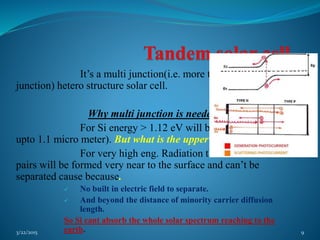
It’s a multi junction(i.e. more than one p-n
junction) hetero structure solar cell.
Why multi junction is needed?
For Si energy > 1.12 eV will be absorbed(i.e
upto 1.1 micro meter). But what is the upper limit?
For very high eng. Radiation the electron-hole
pairs will be formed very near to the surface and can’t be
separated cause because.
 No built in electric field to separate.
 And beyond the distance of minority carrier diffusion
length.
So Si cant absorb the whole solar spectrum reaching to the
earth.3/22/2015 9
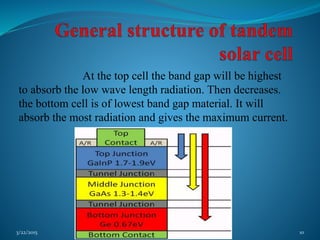
At the top cell the band gap will be highest
to absorb the low wave length radiation. Then decreases.
the bottom cell is of lowest band gap material. It will
absorb the most radiation and gives the maximum current.
3/22/2015 10
Let consider the above figure as the
equivalent solar cell. The different resistance here signifies
the different materials / junctions which will be
illuminated by solar radiation. So the different cell will
give different current. But we have to collect the voltage
from the end and that depends on the maximum resistance
or minimum current.
As our bottom cell is of lowest band gap and
gives maximum current but that current may not be
utilized if the others cell gives less current.
3/22/2015 11
So the cell are connected by tunnel diodes so
that the junction resistance does not affects.
Tunnel Diode
It’s a junction (may be hetero also) between two
heavily doped materials(𝑛++ − 𝑝++). It allows current to flow
with out almost no drop. i.e. with in a small voltage it gives
large current.
3/22/2015 12
Bottom cell may give largest current but it
can’t be utilized if any one cell gives the less current.
Because will get the voltage corresponding to the lowest
current.
So peoples are changing the middle cell by
Q-well or Q-dot.
3/22/2015 13
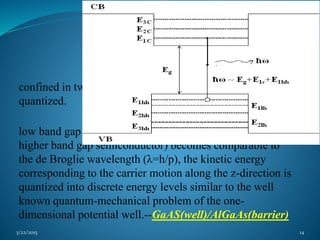
It’s a 2D structure. Electrons’ motion are
confined in two directions. So the energy levels are
quantized.
When the thickness of the active region (any
low band gap semiconductor layer confined between
higher band gap semiconductor) becomes comparable to
the de Broglie wavelength (λ=h/p), the kinetic energy
corresponding to the carrier motion along the z-direction is
quantized into discrete energy levels similar to the well
known quantum-mechanical problem of the one-
dimensional potential well.--GaAS(well)/AlGaAs(barrier)
3/22/2015 14
Ready to illuminate your purpose.
3/22/2015 15
3/22/2015 16
3/22/2015 17

Hetero junction and tandem solar cell.

  • 1.
    By Anish Das Roll no.-14MS60R16 MATERIALS SCIENCE CENTRE Indian Institute of Technology KHARAGPUR, 721302 - INDIA MARCH, 2015 3/22/2015 1
  • 2.
     What ishomo junction and hetero junction?  Some idea about hetero junction.  Advantages of tandem solar cell.  General structure of tandem solar cell.  Drawback and recent advancements. 3/22/2015 2
  • 3.
    Basically we allnow that solar cell is nothing but a p-n / p-p / n-n / n-p /n-i-p/p-i-n junction kind of structures. Now if the whole junction is made of the a single material the junction is called homo junction. But if the junction is made of different kind of materials then the junction is known as hetero junction. 3/22/2015 3
  • 4.
    As I havetold before hetero junction is made of different kind of materials. But to make a proper workable hetero junction we have to considers some points i.e. 1. Availability of substrate. 2. Proper lattice matching. 3/22/2015 4
  • 5.
    Availability of substratesis still a big issue now a days. One can’t use any substrate to grow thin film or make junction on its. Some important issues are. 1. Cost issue. 2. Stability issue; though you r able to make but not stable. Most available substrates are GaAs, InP, GaSb. They provides relatively low cost and good lattice matching. 3/22/2015 5
  • 6.
    You can’t growany thin film on any available substrate. Cause in between substrate and film there should be lattice matching. If not then the interface will not be smooth and will act as recombination center.  You can grow any composition of composition of Al(x)Ga(1-x)As on GaAs substarte cause lattice parameter of AlAs(5.6611) and GaAs(5.6532) almost matches.  You can only grow 𝐺𝑎0.47 𝐼𝑛0.53 𝐴𝑠 on InP substrate. Cause only for that composition lattice parameters matches with InP 3/22/2015 6
  • 7.
    Lattice misfit factoris defined as the f = 𝑎𝑠−𝑎𝑓 𝑎𝑓 f < 0: compressive strain f > 0: tensile strain A misfit |f| < 5 ×10⁻⁴ is generally considered very good, and for practical purposes is assumed lattice-matched 3/22/2015 7
  • 8.
    As we nowknow that the grown film is always strained due the very little lattice match. And these kind of films are produced by CVD method by surface reaction process. So chemical energy is also involved here Certainly there will be a competition between chem. Eng and strained eng. If stained energy dominates we will get pseudomorphic film.---------requied for our case due to smooth interface If chem. Eng. Dominates then at the interface there will be defects -----we don’t want this. 3/22/2015 8
  • 9.
    It’s a multijunction(i.e. more than one p-n junction) hetero structure solar cell. Why multi junction is needed? For Si energy > 1.12 eV will be absorbed(i.e upto 1.1 micro meter). But what is the upper limit? For very high eng. Radiation the electron-hole pairs will be formed very near to the surface and can’t be separated cause because.  No built in electric field to separate.  And beyond the distance of minority carrier diffusion length. So Si cant absorb the whole solar spectrum reaching to the earth.3/22/2015 9
  • 10.
    At the topcell the band gap will be highest to absorb the low wave length radiation. Then decreases. the bottom cell is of lowest band gap material. It will absorb the most radiation and gives the maximum current. 3/22/2015 10
  • 11.
    Let consider theabove figure as the equivalent solar cell. The different resistance here signifies the different materials / junctions which will be illuminated by solar radiation. So the different cell will give different current. But we have to collect the voltage from the end and that depends on the maximum resistance or minimum current. As our bottom cell is of lowest band gap and gives maximum current but that current may not be utilized if the others cell gives less current. 3/22/2015 11
  • 12.
    So the cellare connected by tunnel diodes so that the junction resistance does not affects. Tunnel Diode It’s a junction (may be hetero also) between two heavily doped materials(𝑛++ − 𝑝++). It allows current to flow with out almost no drop. i.e. with in a small voltage it gives large current. 3/22/2015 12
  • 13.
    Bottom cell maygive largest current but it can’t be utilized if any one cell gives the less current. Because will get the voltage corresponding to the lowest current. So peoples are changing the middle cell by Q-well or Q-dot. 3/22/2015 13
  • 14.
    It’s a 2Dstructure. Electrons’ motion are confined in two directions. So the energy levels are quantized. When the thickness of the active region (any low band gap semiconductor layer confined between higher band gap semiconductor) becomes comparable to the de Broglie wavelength (λ=h/p), the kinetic energy corresponding to the carrier motion along the z-direction is quantized into discrete energy levels similar to the well known quantum-mechanical problem of the one- dimensional potential well.--GaAS(well)/AlGaAs(barrier) 3/22/2015 14
  • 15.
    Ready to illuminateyour purpose. 3/22/2015 15
  • 16.
  • 17.