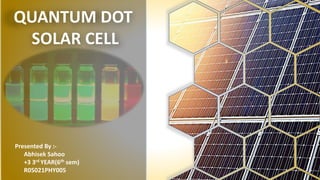
QUANTUM DOT
SOLAR CELL
Presented By :-
Abhisek Sahoo
+3 3rd YEAR(6th sem)
R05021PHY005
INDEX
 Introduction
 History
 Quantum dots
 Solar Cells
 Need for Quantum dots in Solar Cells
 Quantum dots in Solar Cells
 References
Introduction
o A Quantum Dot Solar Cell(QDSC) is a solar cell design that uses quantum dots as the light
absorbing photovoltaic material.
o It replace bulk materials such as silicon, copper indium gallium selenide(CIGS).
o Quantum dots are special class of semiconductors and are nano crystals.
o The energy band increases with decrease in size of quantum dots.
o The adjustable band gap of quantum dots allows the construction of nano structure solar cell,
that is able to absorbs maximum amount of solar spectrum.
HISTORY
o The idea was noted by Burnham and Duggan in 1990.
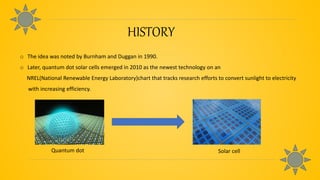
o Later, quantum dot solar cells emerged in 2010 as the newest technology on an
NREL(National Renewable Energy Laboratory)chart that tracks research efforts to convert sunlight to electricity
with increasing efficiency.
Quantum dot Solar cell
QUANTUM DOT
o Quantum dots are special type of semiconductor and very small in size.
o Size from (2-10) nanometers in diameters.
o Zero(0) Degree of Freedom
o They can emit light or absorb it, depending on their size and composition.
o The energy band gap increases with decrease in size of quantum dots.
o The adjustable band gap of quantum dots allows the construction of nano structure solar cell ,
that is able to absorb maximum amount of solar spectrum.
o Quantum dots are some time called “artificial atoms”.
SOLAR CELL
o A Solar cell is like a tiny power generator that
takes sunlight and turns it into electricity.
o It’s made of special materials that create an
electric current when light shines on them.
o These cells are often grouped together to form
solar panels , which can be used to power
things like home, calculators , or even
spacecraft .
o It’s a clean and renewable way to generate power without polluting the environment.
Need for Quantum dots
in Solar Cells
o Reduction in cost :-
- of each kilowatt of electricity produced
- of raw materials
- of processes used to convert the raw materials into functional cells
o Inefficiencies in conventional single junction solar cells
- inability to absorb all of the solar energy
- inability to convert all of the photon energy that is absorbed to free electrons and holes
o Traditional semiconductor materials are crystalline or rigid
QUANTUM DOT IN SOLAR CELL
o Quantum dot solar cells are a type of solar cell that use tiny particles called
quantum dots to absorb sunlight and convert it into electricity.
o It is more efficient than traditional solar cell and it’s utilization efficiency of
sunlight about 66%.
o They still being developed , but they could be a big deal in the future of
solar energy.
Properties
o High efficiency: QDSCs can achieve high conversation efficiencies due to their ability to
absorb a broad range of the solar spectrum compared to conventional solar cells.
o Size tunability: The optical and electronic properties of QDs can be tuned by adjusting their
size , making them highly versatile for use in various applications.
o Low cost: QDSCs are relatively low-cost to produce compared to other types of solar cells.
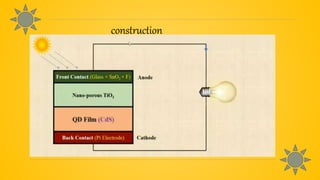
construction
WORKING
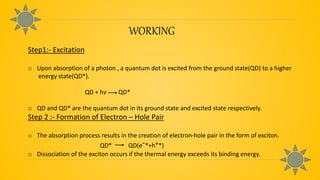
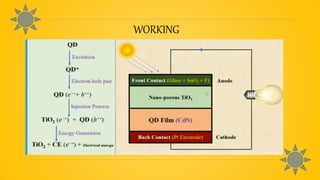
Step1:- Excitation
o Upon absorption of a photon , a quantum dot is excited from the ground state(QD) to a higher
energy state(QD*).
QD + hv QD*
o QD and QD* are the quantum dot in its ground state and excited state respectively.
Step 2 :- Formation of Electron – Hole Pair
o The absorption process results in the creation of electron-hole pair in the form of exciton.
QD* QD(e-*+h+*)
o Dissociation of the exciton occurs if the thermal energy exceeds its binding energy.
WORKING
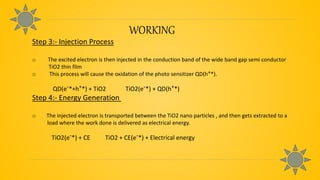
Step 3:- Injection Process
o The excited electron is then injected in the conduction band of the wide band gap semi conductor
TiO2 thin film
o This process will cause the oxidation of the photo sensitizer QD(h+*).
QD(e-*+h+*) + TiO2 TiO2(e-*) + QD(h+*)
Step 4:- Energy Generation
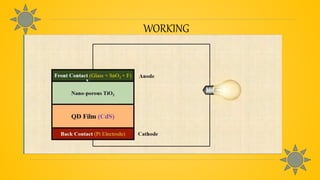
o The injected electron is transported between the TiO2 nano particles , and then gets extracted to a
load where the work done is delivered as electrical energy.
TiO2(e-*) + CE TiO2 + CE(e-*) + Electrical energy
WORKING
WORKING
APPLICATIONS
o Used in power portable electronic devices
o Used in building-integrated photovoltaic cells
o Used in space applications
REFERENCES
• http://www.evidenttech.com/
• http://en.Wikipedia.org/wiki/Solar_cell
• http://en.Wikipedia.org/wiki/Quantum_dot
• http://softpedia.com/
• http://www.sciencedaily.com/articles/
• http://www.i-sis.org.uk/index.php/
White Paper:-
• Brad Gussin , John Romankiewicz
• Peter Green
• L.H. Slooff ,R. Kinderman, A. R. Burgers , J.A.M. van Roosmalen
• UC-Davis Physics , CM Journal Club

Presentation about 'Quantum Dot solar cell.pptx

  • 1.
    QUANTUM DOT SOLAR CELL PresentedBy :- Abhisek Sahoo +3 3rd YEAR(6th sem) R05021PHY005
  • 2.
    INDEX  Introduction  History Quantum dots  Solar Cells  Need for Quantum dots in Solar Cells  Quantum dots in Solar Cells  References
  • 3.
    Introduction o A QuantumDot Solar Cell(QDSC) is a solar cell design that uses quantum dots as the light absorbing photovoltaic material. o It replace bulk materials such as silicon, copper indium gallium selenide(CIGS). o Quantum dots are special class of semiconductors and are nano crystals. o The energy band increases with decrease in size of quantum dots. o The adjustable band gap of quantum dots allows the construction of nano structure solar cell, that is able to absorbs maximum amount of solar spectrum.
  • 4.
    HISTORY o The ideawas noted by Burnham and Duggan in 1990. o Later, quantum dot solar cells emerged in 2010 as the newest technology on an NREL(National Renewable Energy Laboratory)chart that tracks research efforts to convert sunlight to electricity with increasing efficiency. Quantum dot Solar cell
  • 5.
    QUANTUM DOT o Quantumdots are special type of semiconductor and very small in size. o Size from (2-10) nanometers in diameters. o Zero(0) Degree of Freedom o They can emit light or absorb it, depending on their size and composition. o The energy band gap increases with decrease in size of quantum dots. o The adjustable band gap of quantum dots allows the construction of nano structure solar cell , that is able to absorb maximum amount of solar spectrum. o Quantum dots are some time called “artificial atoms”.
  • 6.
    SOLAR CELL o ASolar cell is like a tiny power generator that takes sunlight and turns it into electricity. o It’s made of special materials that create an electric current when light shines on them. o These cells are often grouped together to form solar panels , which can be used to power things like home, calculators , or even spacecraft . o It’s a clean and renewable way to generate power without polluting the environment.
  • 7.
    Need for Quantumdots in Solar Cells o Reduction in cost :- - of each kilowatt of electricity produced - of raw materials - of processes used to convert the raw materials into functional cells o Inefficiencies in conventional single junction solar cells - inability to absorb all of the solar energy - inability to convert all of the photon energy that is absorbed to free electrons and holes o Traditional semiconductor materials are crystalline or rigid
  • 8.
    QUANTUM DOT INSOLAR CELL o Quantum dot solar cells are a type of solar cell that use tiny particles called quantum dots to absorb sunlight and convert it into electricity. o It is more efficient than traditional solar cell and it’s utilization efficiency of sunlight about 66%. o They still being developed , but they could be a big deal in the future of solar energy.
  • 9.
    Properties o High efficiency:QDSCs can achieve high conversation efficiencies due to their ability to absorb a broad range of the solar spectrum compared to conventional solar cells. o Size tunability: The optical and electronic properties of QDs can be tuned by adjusting their size , making them highly versatile for use in various applications. o Low cost: QDSCs are relatively low-cost to produce compared to other types of solar cells.
  • 10.
  • 11.
    WORKING Step1:- Excitation o Uponabsorption of a photon , a quantum dot is excited from the ground state(QD) to a higher energy state(QD*). QD + hv QD* o QD and QD* are the quantum dot in its ground state and excited state respectively. Step 2 :- Formation of Electron – Hole Pair o The absorption process results in the creation of electron-hole pair in the form of exciton. QD* QD(e-*+h+*) o Dissociation of the exciton occurs if the thermal energy exceeds its binding energy.
  • 12.
    WORKING Step 3:- InjectionProcess o The excited electron is then injected in the conduction band of the wide band gap semi conductor TiO2 thin film o This process will cause the oxidation of the photo sensitizer QD(h+*). QD(e-*+h+*) + TiO2 TiO2(e-*) + QD(h+*) Step 4:- Energy Generation o The injected electron is transported between the TiO2 nano particles , and then gets extracted to a load where the work done is delivered as electrical energy. TiO2(e-*) + CE TiO2 + CE(e-*) + Electrical energy
  • 13.
  • 14.
  • 15.
    APPLICATIONS o Used inpower portable electronic devices o Used in building-integrated photovoltaic cells o Used in space applications
  • 16.
    REFERENCES • http://www.evidenttech.com/ • http://en.Wikipedia.org/wiki/Solar_cell •http://en.Wikipedia.org/wiki/Quantum_dot • http://softpedia.com/ • http://www.sciencedaily.com/articles/ • http://www.i-sis.org.uk/index.php/ White Paper:- • Brad Gussin , John Romankiewicz • Peter Green • L.H. Slooff ,R. Kinderman, A. R. Burgers , J.A.M. van Roosmalen • UC-Davis Physics , CM Journal Club