Virendra Thakur
Roll no-A005
SOLAR CELL
Definition
Solar cell is the device that converts energy
of light directly into electrical energy
(electricity) by photovoltaic effect
In general, a solar cell that includes both
solar and nonsolar sources of light
(such as photons from incandescent bulbs)
is termed a photovoltaic cell.
Solar cell is also know as photovoltaic cell
SOLAR CELL
• Most familiar solar cells are based on the effect
of photovoltaic
• In this effect,light falling on semiconductor device of the
two layer produces a potential difference or photo voltage
between the layers
• The voltage thus produced can drive a current through an
external circuit producing useful work
Principle of solar cell
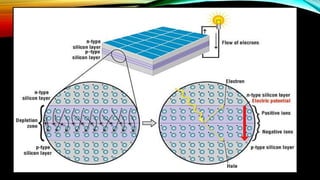
• A solar cell is a very large diode
• When Si that is doped p-type is next to region of Si
doped n-type,the holes from the p-type side diffuse to
the n-type side,the electron diffuse to the p-type side
• This create an Electric Field
• This electric field makes it easy for current to flow in one
direction but hard to flow in other
• This electric field also separate electron and hole that
haves been create by the absorption of sun light
when the electron and hole are separated electric power
can be extracted from the circuit
TYPES OF SOLAR CELL(PANEL)
Based on the crystal used,solar cell can be classified as
1. Monocrystalline silicon cell
2. Polycrystalline silicon cell
3. Amorphous silicon cell (Thin Film)
1. Monocrystalline Solar Panels (Mono-Si)
This type of solar panels(made of monocrystalline
silicon) is the purest one
You can easily recognise them from the
uniform dark look and the rounded edges.
The silicon’s high purity causes this type of
solar panel has one of the highest efficiency
rates, with the newest ones reaching above
20%.
Monocrystalline panels have a high power
output, occupy less space, and last the
longest. Of course, that also means they are
the most expensive of the bunch. Another
advantage to consider is that they tend to
be slightly less affected by high
temperatures compared to polycrystalline
panels.
2. Polycrystalline Solar Panels (Poly-
SI)
You can quickly distinguish these panels
because this type of solar panels has squares,
its angles are not cut, and it has a blue,
speckled look. They are made by melting raw
silicon, which is a faster and cheaper process
than that used for monocrystalline panels.
This leads to a lower final price but also lower
efficiency (around 15%), lower space efficiency,
and a shorter lifespan since they are affected by
hot temperatures to a greater degree.
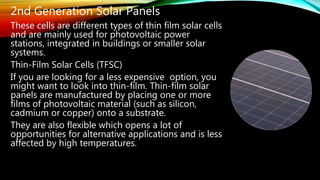
2nd Generation Solar Panels
These cells are different types of thin film solar cells
and are mainly used for photovoltaic power
stations, integrated in buildings or smaller solar
systems.
Thin-Film Solar Cells (TFSC)
If you are looking for a less expensive option, you
might want to look into thin-film. Thin-film solar
panels are manufactured by placing one or more
films of photovoltaic material (such as silicon,
cadmium or copper) onto a substrate.
They are also flexible which opens a lot of
opportunities for alternative applications and is less
affected by high temperatures.
Amorphous Silicon Solar Cell (A-Si)
Have you ever used a solar powered pocket calculator? Yes? Then
you have definitely seen these types of solar panels before. The
amorphous silicon solar cell is among the different types of solar
panels, the one that is used mainly in such pocket calculators.
3rd Generation Solar Panels
3rd generation solar panels include a variety of thin film
technologies but most of them are still in the research or
development
• Cadmium Telluride Solar Cell (CdTe)
• Biohybrid Solar Cell
• Concentrated PV Cell (CVP and HCVP)
CURRENT GENERATION
When light is incident on p-n junction
photon absorbed if hv>Eg. No big
change in majority carries in conduction
band but a significant change in minority
carries in valance band A current is
identified due to a drift of minority
carries across a junction as a generation
current Generation rate g(op) participate
in total current so the total current is
depend on current due to usual diode
and current due to optically generation
I=Ith(e^qV/KT²-1)–Iop
This figure gives many
parameter of solarcell.
Forward bias characteristics
of solar cell
ISC=The Short circuitcurrent
VOC=The Open Circuit
Voltage
VMP=The Voltage at the
maximum power point
IMP= The Current at the
maximum power point
SOLAR CELL PARAMETER
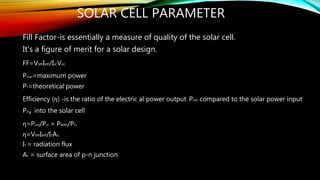
Fill Factor-is essentially a measure of quality of the solar cell.
It’s a figure of merit for a solar design.
FF=VMPIMP/IsCVoC
Pmax=maximum power
PT=theoretical power
Efficiency (η) -is the ratio of the electric al power output Pout compared to the solar power input
Pin, into the solar cell
η=Pout/Pin = PMAX/Pin
η=VMPIMP/ITAS
IT = radiation flux
As = surface area of p-n junction
Advantage
• It’s clean and non polluting
• It’s renewable energy
• Solar cell do not produce noise and they are totally silent
• They require very little maintenance
• They are long lasting source of energy which can be used almost anywhere
Disadvantage
• Solar power can’t be obtained in night time
• They need large area of lands to produce more efficient power supply
• Energy hasn’t be stored in batteries
REFERENCE
“Solar cell” Wikipedia,the free encyclopedia
“Solid State electronic devices” Ben G.Streetman and
Sanjay Kumar Banerjee
“Semiconductor devices physics and technology” S.M.Sze

Solar cell

  • 1.
  • 2.
    Definition Solar cell isthe device that converts energy of light directly into electrical energy (electricity) by photovoltaic effect In general, a solar cell that includes both solar and nonsolar sources of light (such as photons from incandescent bulbs) is termed a photovoltaic cell. Solar cell is also know as photovoltaic cell SOLAR CELL
  • 3.
    • Most familiarsolar cells are based on the effect of photovoltaic • In this effect,light falling on semiconductor device of the two layer produces a potential difference or photo voltage between the layers • The voltage thus produced can drive a current through an external circuit producing useful work Principle of solar cell
  • 5.
    • A solarcell is a very large diode • When Si that is doped p-type is next to region of Si doped n-type,the holes from the p-type side diffuse to the n-type side,the electron diffuse to the p-type side • This create an Electric Field • This electric field makes it easy for current to flow in one direction but hard to flow in other • This electric field also separate electron and hole that haves been create by the absorption of sun light when the electron and hole are separated electric power can be extracted from the circuit
  • 6.
    TYPES OF SOLARCELL(PANEL) Based on the crystal used,solar cell can be classified as 1. Monocrystalline silicon cell 2. Polycrystalline silicon cell 3. Amorphous silicon cell (Thin Film) 1. Monocrystalline Solar Panels (Mono-Si) This type of solar panels(made of monocrystalline silicon) is the purest one
  • 7.
    You can easilyrecognise them from the uniform dark look and the rounded edges. The silicon’s high purity causes this type of solar panel has one of the highest efficiency rates, with the newest ones reaching above 20%. Monocrystalline panels have a high power output, occupy less space, and last the longest. Of course, that also means they are the most expensive of the bunch. Another advantage to consider is that they tend to be slightly less affected by high temperatures compared to polycrystalline panels.
  • 8.
    2. Polycrystalline SolarPanels (Poly- SI) You can quickly distinguish these panels because this type of solar panels has squares, its angles are not cut, and it has a blue, speckled look. They are made by melting raw silicon, which is a faster and cheaper process than that used for monocrystalline panels. This leads to a lower final price but also lower efficiency (around 15%), lower space efficiency, and a shorter lifespan since they are affected by hot temperatures to a greater degree.
  • 9.
    2nd Generation SolarPanels These cells are different types of thin film solar cells and are mainly used for photovoltaic power stations, integrated in buildings or smaller solar systems. Thin-Film Solar Cells (TFSC) If you are looking for a less expensive option, you might want to look into thin-film. Thin-film solar panels are manufactured by placing one or more films of photovoltaic material (such as silicon, cadmium or copper) onto a substrate. They are also flexible which opens a lot of opportunities for alternative applications and is less affected by high temperatures.
  • 10.
    Amorphous Silicon SolarCell (A-Si) Have you ever used a solar powered pocket calculator? Yes? Then you have definitely seen these types of solar panels before. The amorphous silicon solar cell is among the different types of solar panels, the one that is used mainly in such pocket calculators. 3rd Generation Solar Panels 3rd generation solar panels include a variety of thin film technologies but most of them are still in the research or development • Cadmium Telluride Solar Cell (CdTe) • Biohybrid Solar Cell • Concentrated PV Cell (CVP and HCVP)
  • 11.
    CURRENT GENERATION When lightis incident on p-n junction photon absorbed if hv>Eg. No big change in majority carries in conduction band but a significant change in minority carries in valance band A current is identified due to a drift of minority carries across a junction as a generation current Generation rate g(op) participate in total current so the total current is depend on current due to usual diode and current due to optically generation
  • 12.
    I=Ith(e^qV/KT²-1)–Iop This figure givesmany parameter of solarcell. Forward bias characteristics of solar cell ISC=The Short circuitcurrent VOC=The Open Circuit Voltage VMP=The Voltage at the maximum power point IMP= The Current at the maximum power point
  • 13.
    SOLAR CELL PARAMETER FillFactor-is essentially a measure of quality of the solar cell. It’s a figure of merit for a solar design. FF=VMPIMP/IsCVoC Pmax=maximum power PT=theoretical power Efficiency (η) -is the ratio of the electric al power output Pout compared to the solar power input Pin, into the solar cell η=Pout/Pin = PMAX/Pin η=VMPIMP/ITAS IT = radiation flux As = surface area of p-n junction
  • 14.
    Advantage • It’s cleanand non polluting • It’s renewable energy • Solar cell do not produce noise and they are totally silent • They require very little maintenance • They are long lasting source of energy which can be used almost anywhere Disadvantage • Solar power can’t be obtained in night time • They need large area of lands to produce more efficient power supply • Energy hasn’t be stored in batteries
  • 15.
    REFERENCE “Solar cell” Wikipedia,thefree encyclopedia “Solid State electronic devices” Ben G.Streetman and Sanjay Kumar Banerjee “Semiconductor devices physics and technology” S.M.Sze