The document analyzes the interlanguage of Spanish learners in their use of English. It finds that:
1) The learners did not have problems with plural "s" but did make errors with the copula "be" through intralingual and interlingual transfer from Spanish.
2) Possible causes of errors included false hypotheses, slips of the tongue, and incomplete application of rules.
3) While Spanish and English have similarities in copula "be" and plural "s", differences could lead to mistakes, though many errors resulted from general second language acquisition processes rather than differences between the languages.
The Interlanguage Analysis
ofSpanish learners’ interview in English
Agung Diah Wulandari (2014001023)
Ardiansyah (2014001024)
Eka Uliyanti (2014001029)
2.
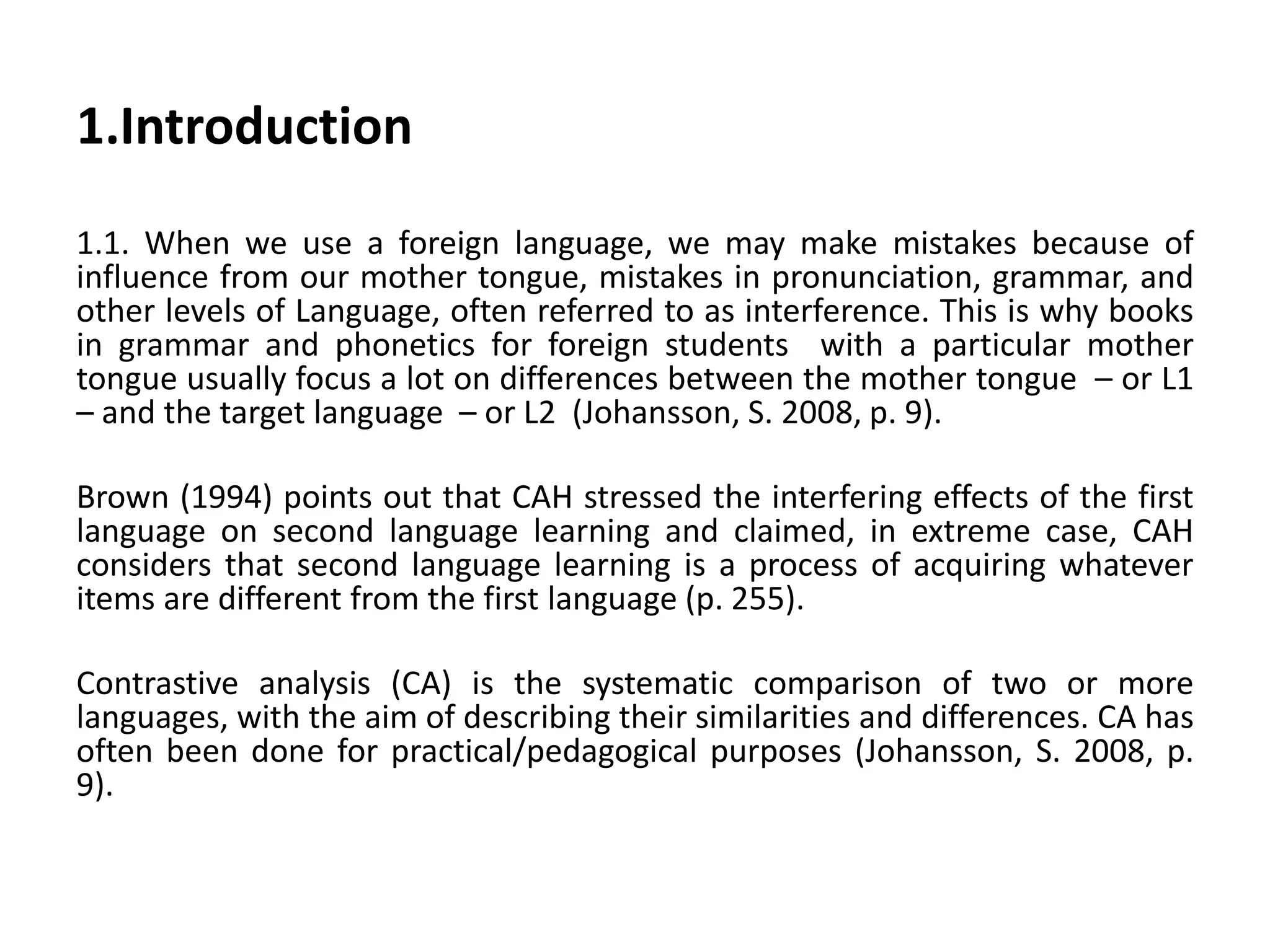
1.Introduction
1.1. When weuse a foreign language, we may make mistakes because of
influence from our mother tongue, mistakes in pronunciation, grammar, and
other levels of Language, often referred to as interference. This is why books
in grammar and phonetics for foreign students with a particular mother
tongue usually focus a lot on differences between the mother tongue – or L1
– and the target language – or L2 (Johansson, S. 2008, p. 9).
Brown (1994) points out that CAH stressed the interfering effects of the first
language on second language learning and claimed, in extreme case, CAH
considers that second language learning is a process of acquiring whatever
items are different from the first language (p. 255).
Contrastive analysis (CA) is the systematic comparison of two or more
languages, with the aim of describing their similarities and differences. CA has
often been done for practical/pedagogical purposes (Johansson, S. 2008, p.
9).
3.
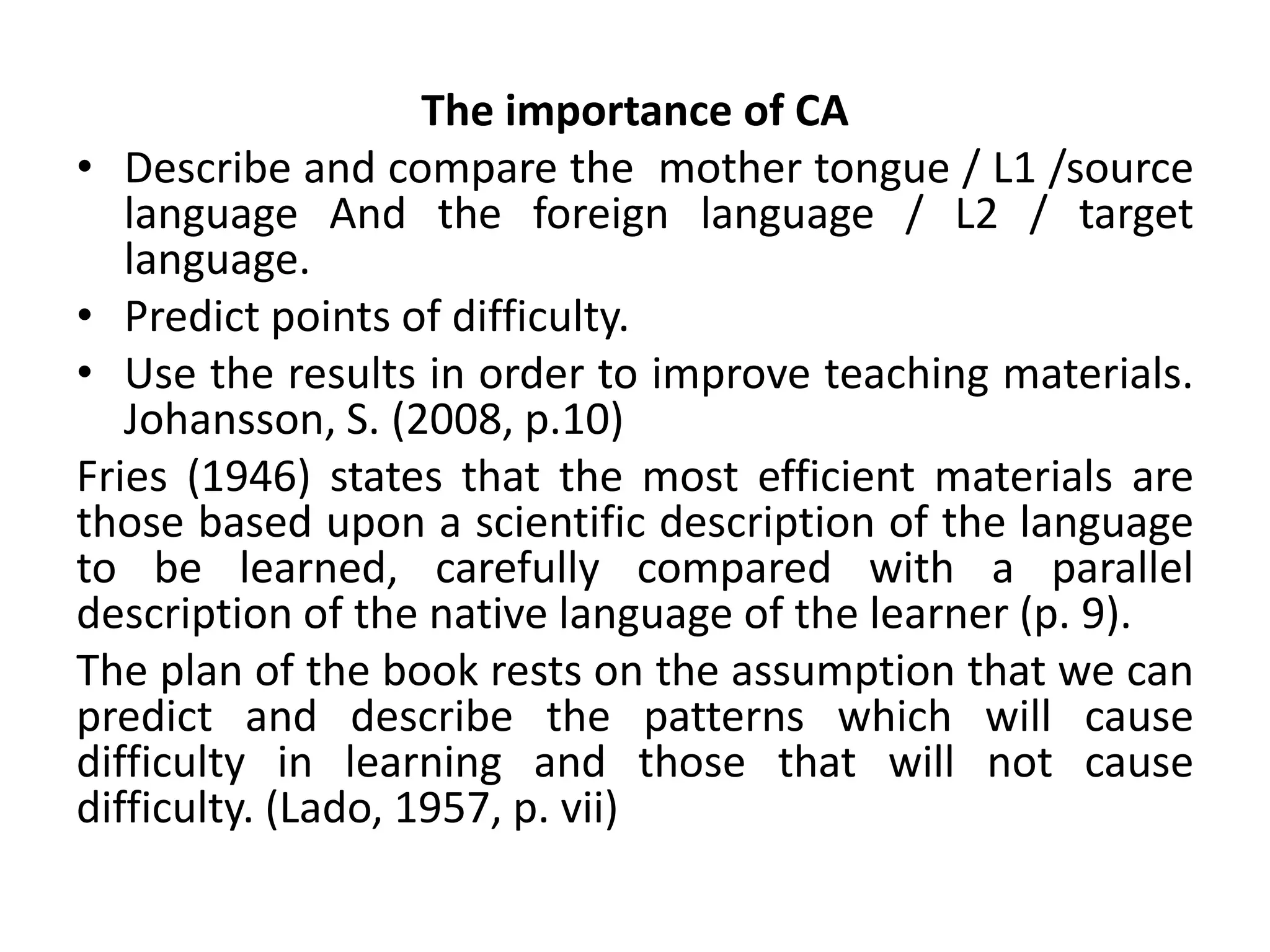
The importance ofCA
• Describe and compare the mother tongue / L1 /source
language And the foreign language / L2 / target
language.
• Predict points of difficulty.
• Use the results in order to improve teaching materials.
Johansson, S. (2008, p.10)
Fries (1946) states that the most efficient materials are
those based upon a scientific description of the language
to be learned, carefully compared with a parallel
description of the native language of the learner (p. 9).
The plan of the book rests on the assumption that we can
predict and describe the patterns which will cause
difficulty in learning and those that will not cause
difficulty. (Lado, 1957, p. vii)
4.
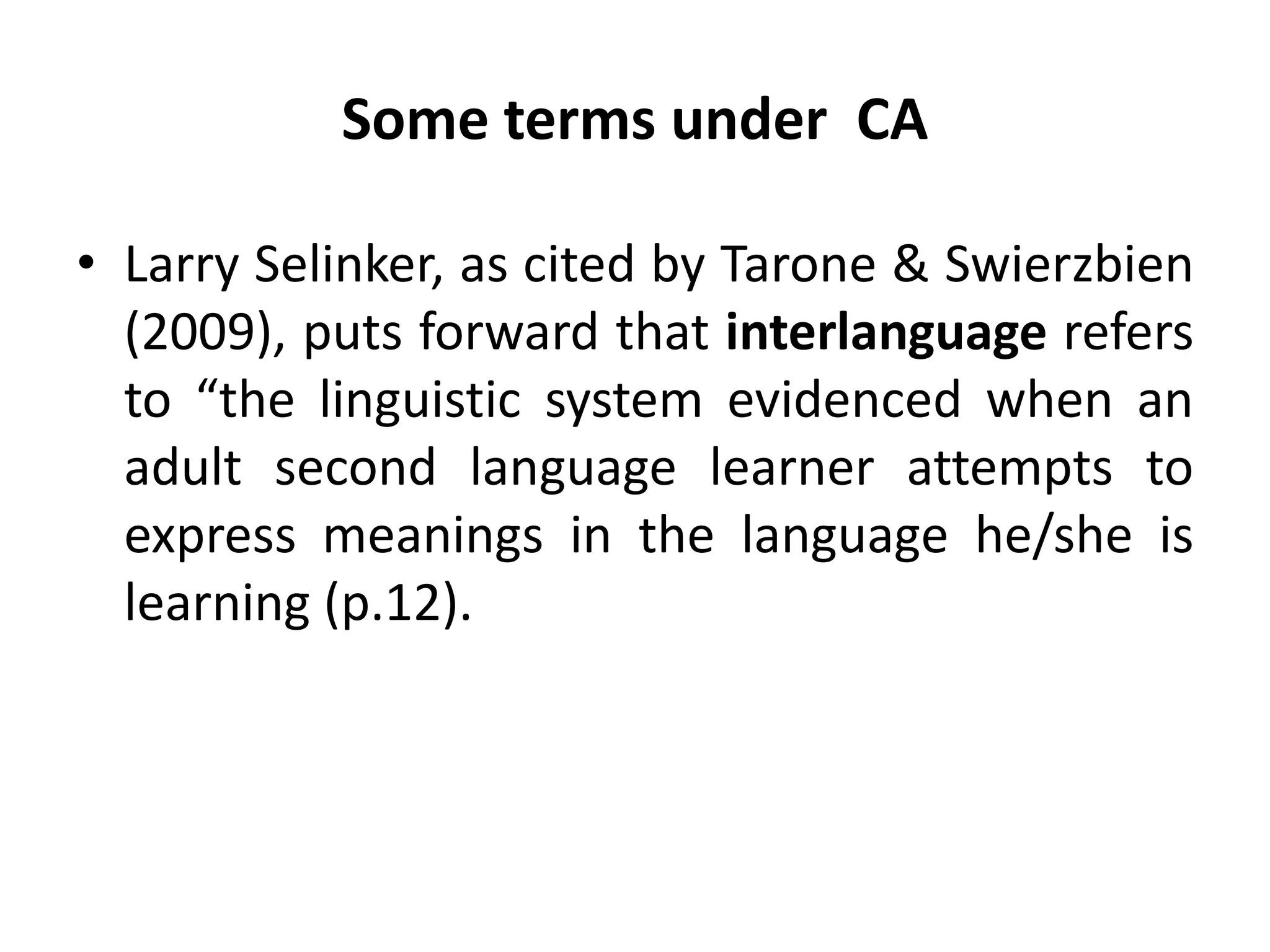
Some terms underCA
• Larry Selinker, as cited by Tarone & Swierzbien
(2009), puts forward that interlanguage refers
to “the linguistic system evidenced when an
adult second language learner attempts to
express meanings in the language he/she is
learning (p.12).
5.
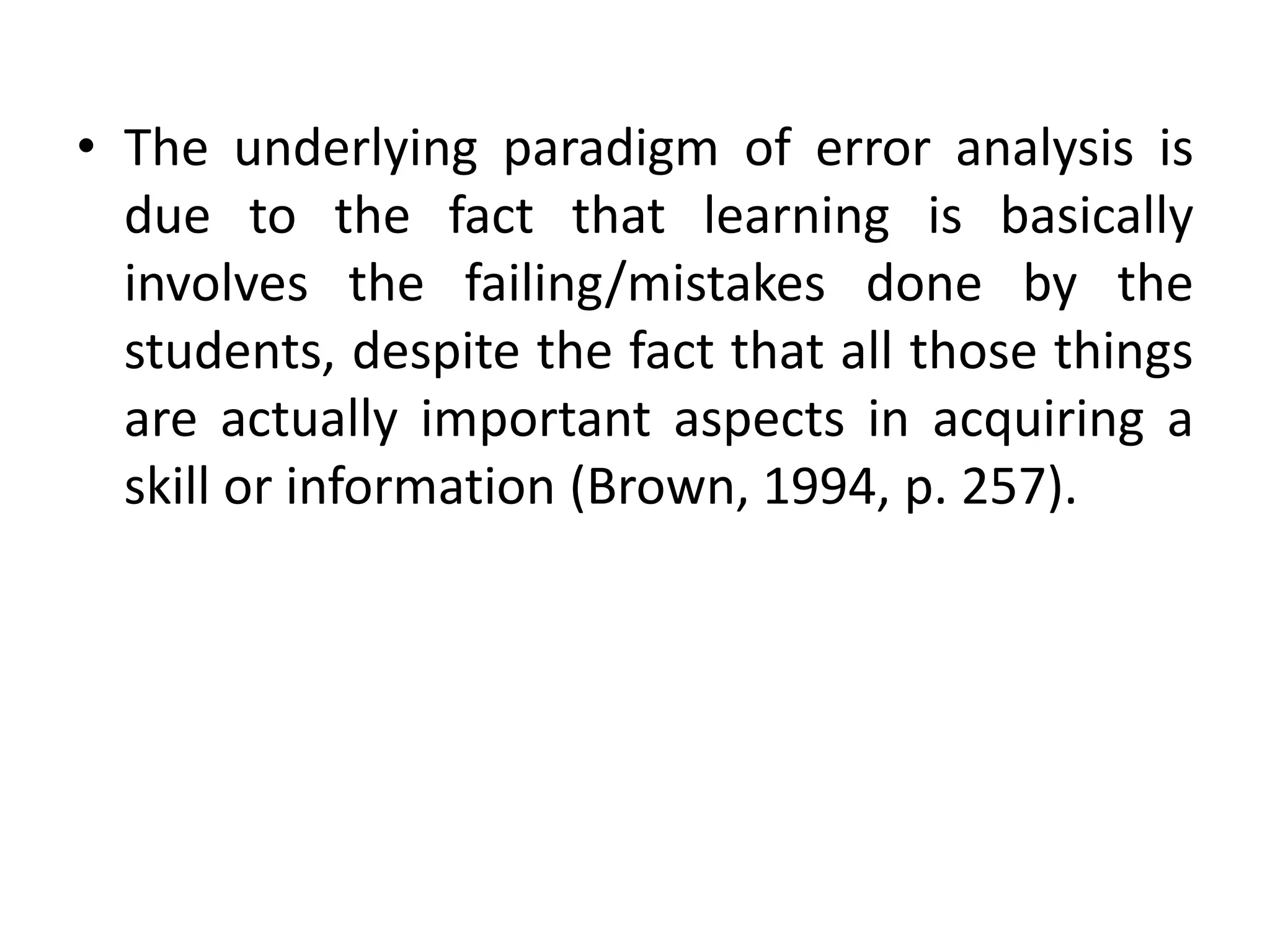
• The underlyingparadigm of error analysis is
due to the fact that learning is basically
involves the failing/mistakes done by the
students, despite the fact that all those things
are actually important aspects in acquiring a
skill or information (Brown, 1994, p. 257).
6.
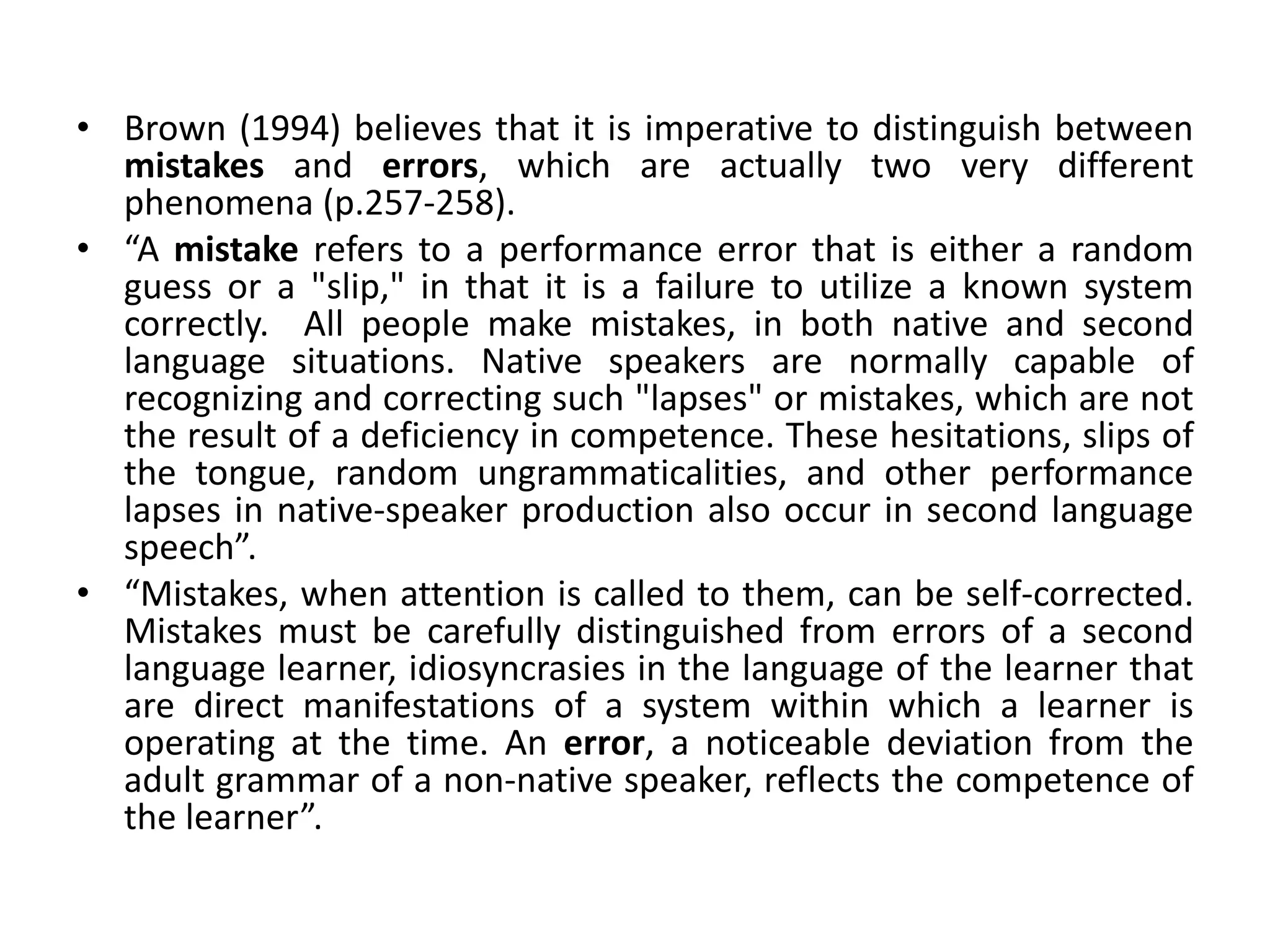
• Brown (1994)believes that it is imperative to distinguish between
mistakes and errors, which are actually two very different
phenomena (p.257-258).
• “A mistake refers to a performance error that is either a random
guess or a "slip," in that it is a failure to utilize a known system
correctly. All people make mistakes, in both native and second
language situations. Native speakers are normally capable of
recognizing and correcting such "lapses" or mistakes, which are not
the result of a deficiency in competence. These hesitations, slips of
the tongue, random ungrammaticalities, and other performance
lapses in native-speaker production also occur in second language
speech”.
• “Mistakes, when attention is called to them, can be self-corrected.
Mistakes must be carefully distinguished from errors of a second
language learner, idiosyncrasies in the language of the learner that
are direct manifestations of a system within which a learner is
operating at the time. An error, a noticeable deviation from the
adult grammar of a non-native speaker, reflects the competence of
the learner”.
7.
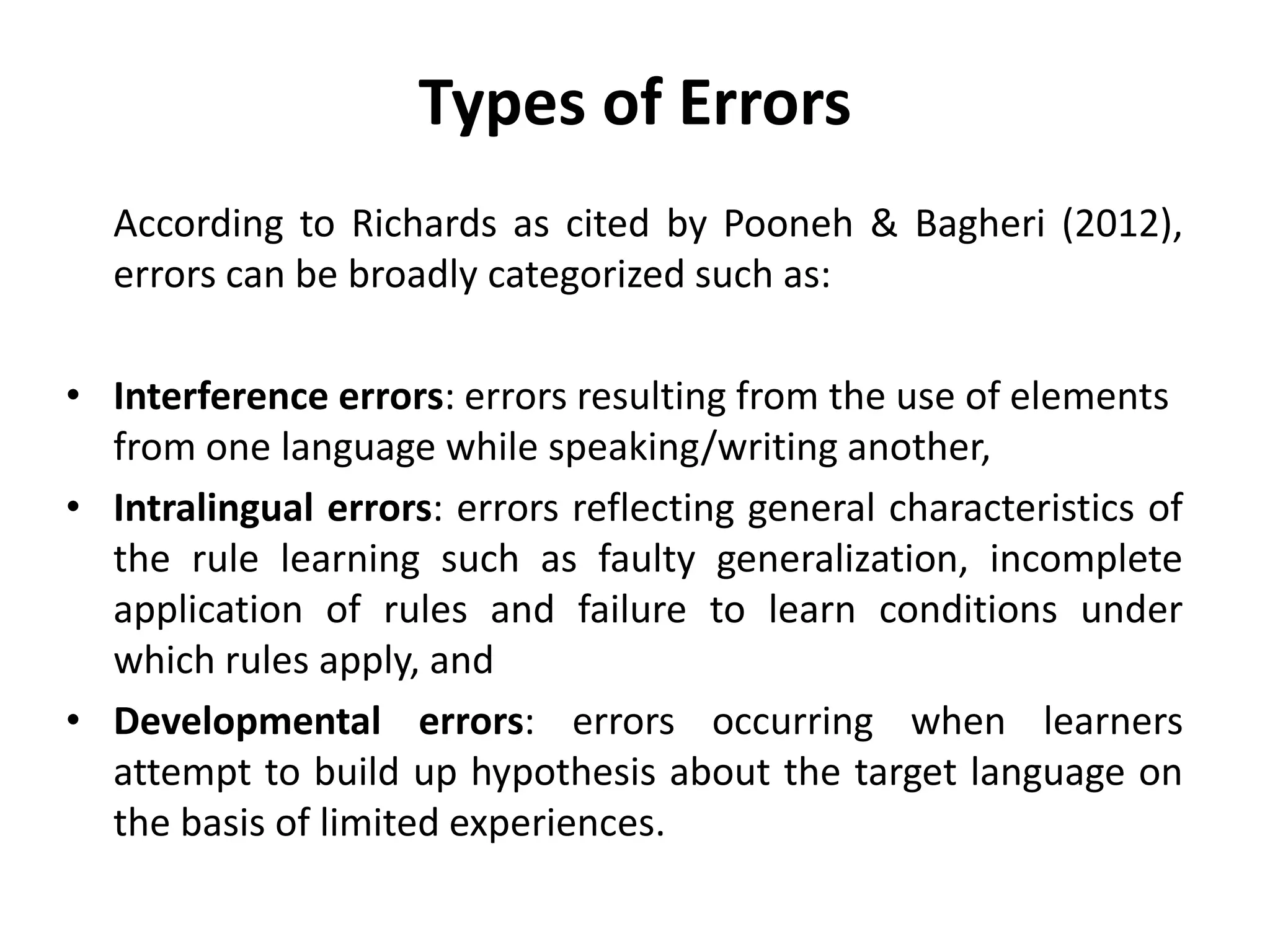
Types of Errors
Accordingto Richards as cited by Pooneh & Bagheri (2012),
errors can be broadly categorized such as:
• Interference errors: errors resulting from the use of elements
from one language while speaking/writing another,
• Intralingual errors: errors reflecting general characteristics of
the rule learning such as faulty generalization, incomplete
application of rules and failure to learn conditions under
which rules apply, and
• Developmental errors: errors occurring when learners
attempt to build up hypothesis about the target language on
the basis of limited experiences.
8.
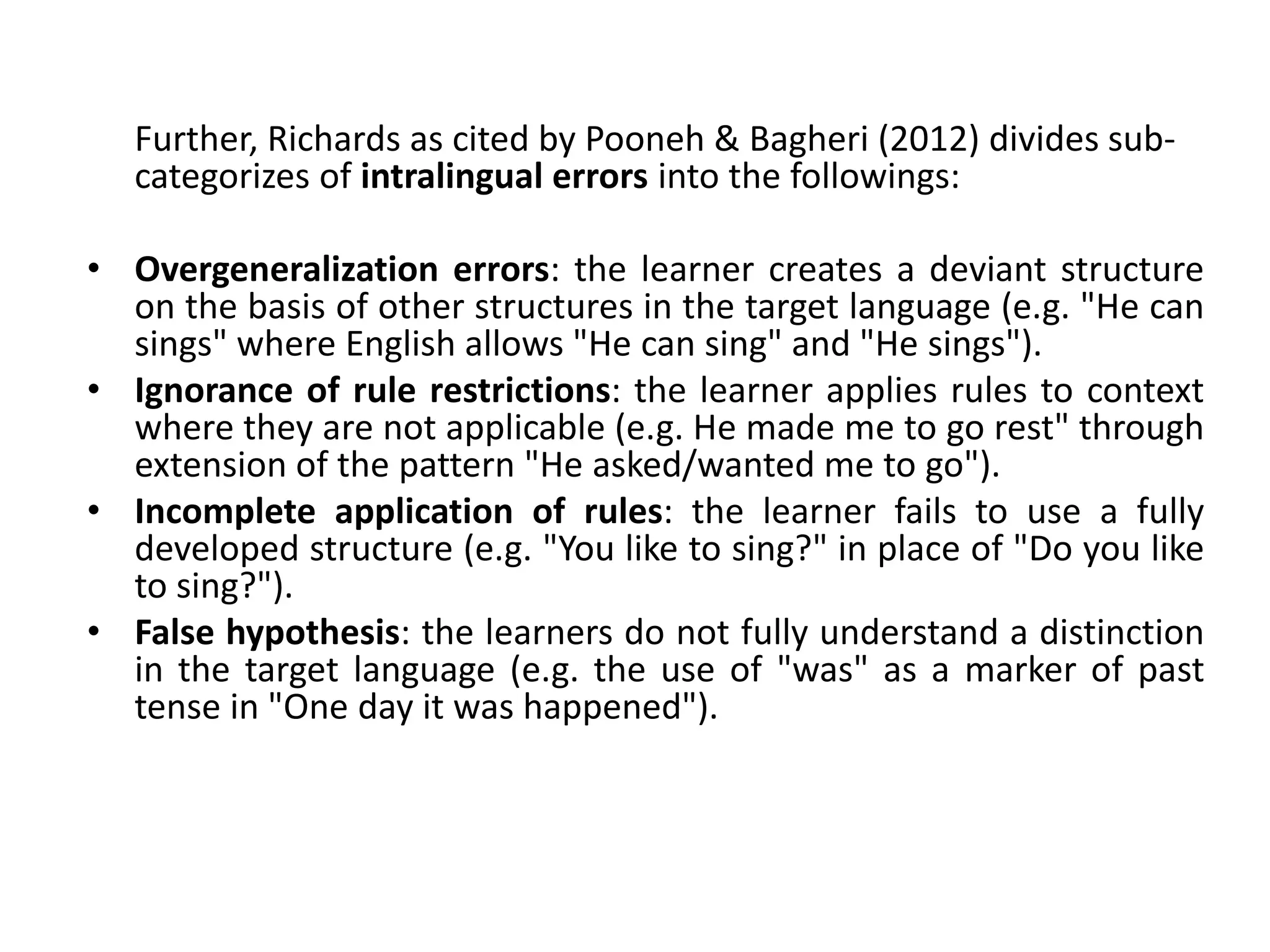
Further, Richards ascited by Pooneh & Bagheri (2012) divides sub-
categorizes of intralingual errors into the followings:
• Overgeneralization errors: the learner creates a deviant structure
on the basis of other structures in the target language (e.g. "He can
sings" where English allows "He can sing" and "He sings").
• Ignorance of rule restrictions: the learner applies rules to context
where they are not applicable (e.g. He made me to go rest" through
extension of the pattern "He asked/wanted me to go").
• Incomplete application of rules: the learner fails to use a fully
developed structure (e.g. "You like to sing?" in place of "Do you like
to sing?").
• False hypothesis: the learners do not fully understand a distinction
in the target language (e.g. the use of "was" as a marker of past
tense in "One day it was happened").
9.
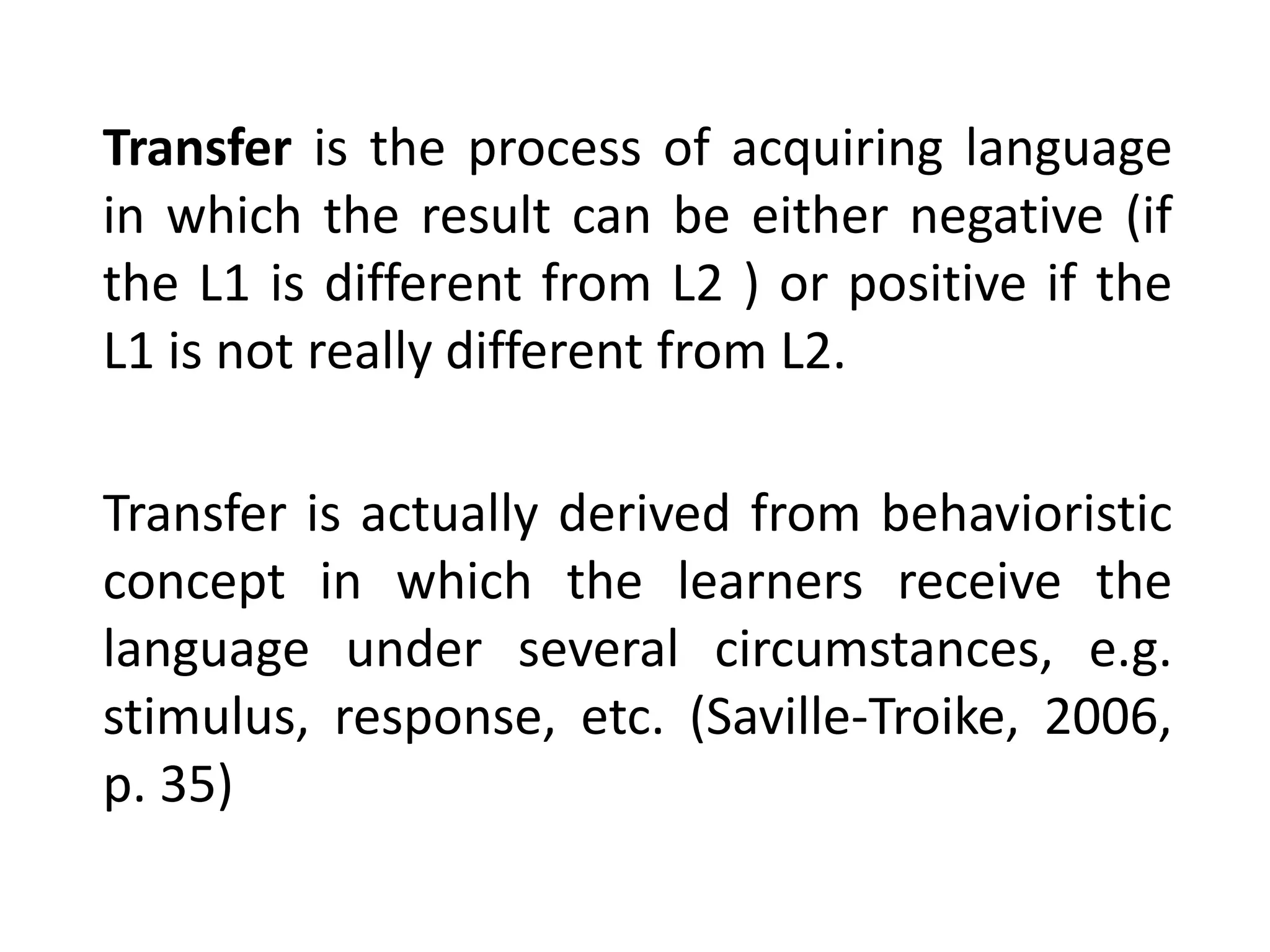
Transfer is theprocess of acquiring language
in which the result can be either negative (if
the L1 is different from L2 ) or positive if the
L1 is not really different from L2.
Transfer is actually derived from behavioristic
concept in which the learners receive the
language under several circumstances, e.g.
stimulus, response, etc. (Saville-Troike, 2006,
p. 35)
10.
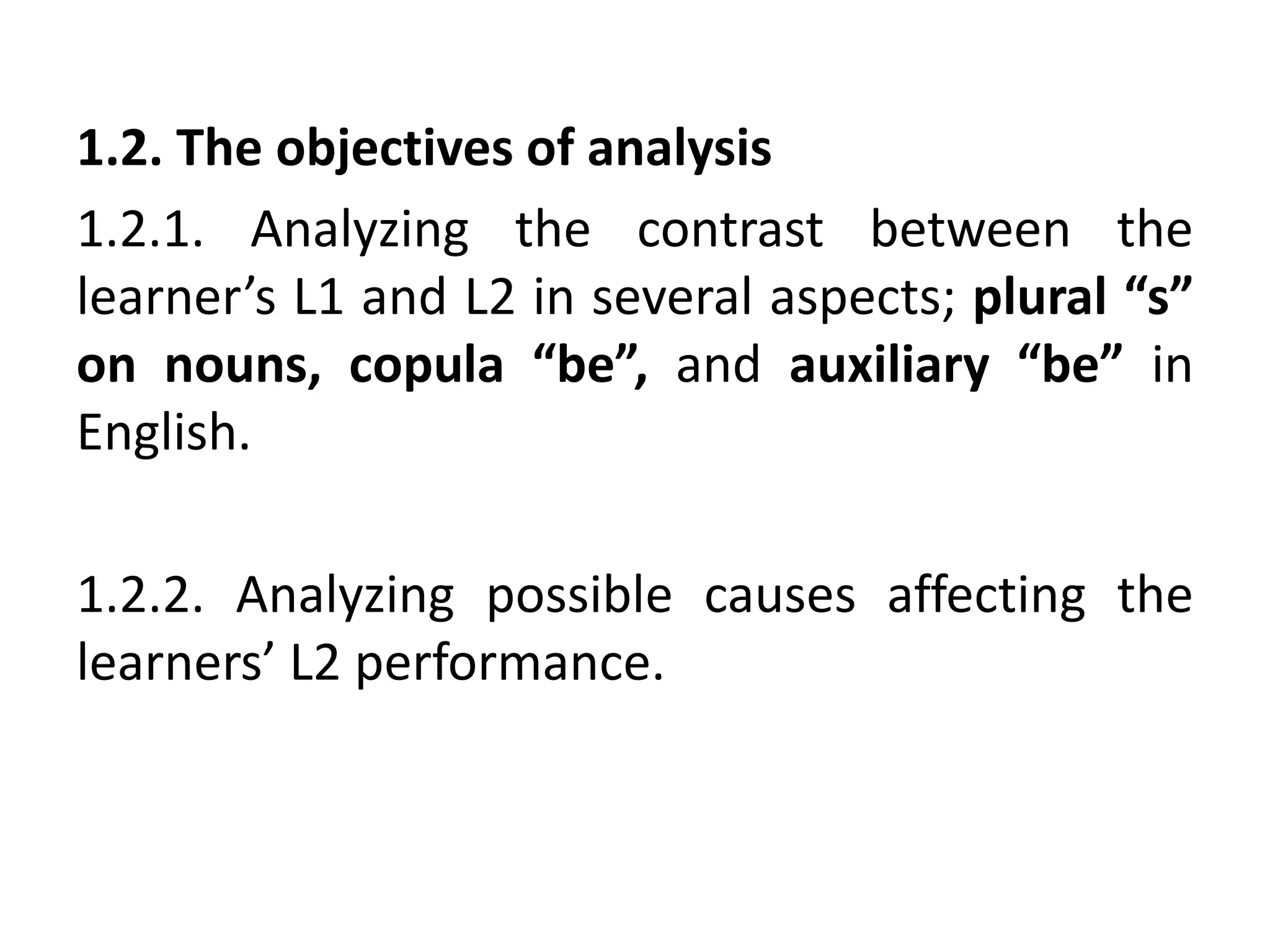
1.2. The objectivesof analysis
1.2.1. Analyzing the contrast between the
learner’s L1 and L2 in several aspects; plural “s”
on nouns, copula “be”, and auxiliary “be” in
English.
1.2.2. Analyzing possible causes affecting the
learners’ L2 performance.
11.
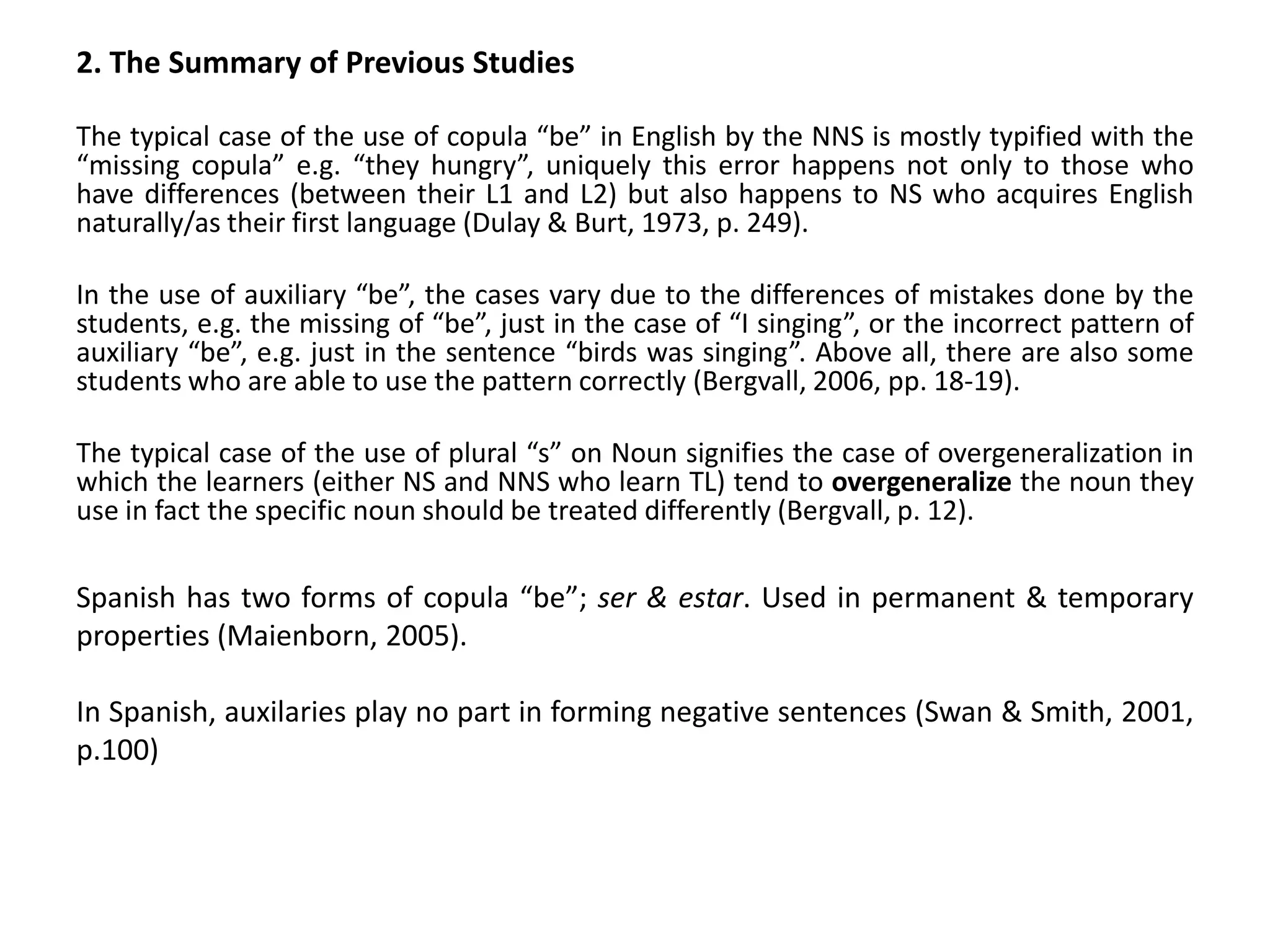
2. The Summaryof Previous Studies
The typical case of the use of copula “be” in English by the NNS is mostly typified with the
“missing copula” e.g. “they hungry”, uniquely this error happens not only to those who
have differences (between their L1 and L2) but also happens to NS who acquires English
naturally/as their first language (Dulay & Burt, 1973, p. 249).
In the use of auxiliary “be”, the cases vary due to the differences of mistakes done by the
students, e.g. the missing of “be”, just in the case of “I singing”, or the incorrect pattern of
auxiliary “be”, e.g. just in the sentence “birds was singing”. Above all, there are also some
students who are able to use the pattern correctly (Bergvall, 2006, pp. 18-19).
The typical case of the use of plural “s” on Noun signifies the case of overgeneralization in
which the learners (either NS and NNS who learn TL) tend to overgeneralize the noun they
use in fact the specific noun should be treated differently (Bergvall, p. 12).
Spanish has two forms of copula “be”; ser & estar. Used in permanent & temporary
properties (Maienborn, 2005).
In Spanish, auxilaries play no part in forming negative sentences (Swan & Smith, 2001,
p.100)
12.
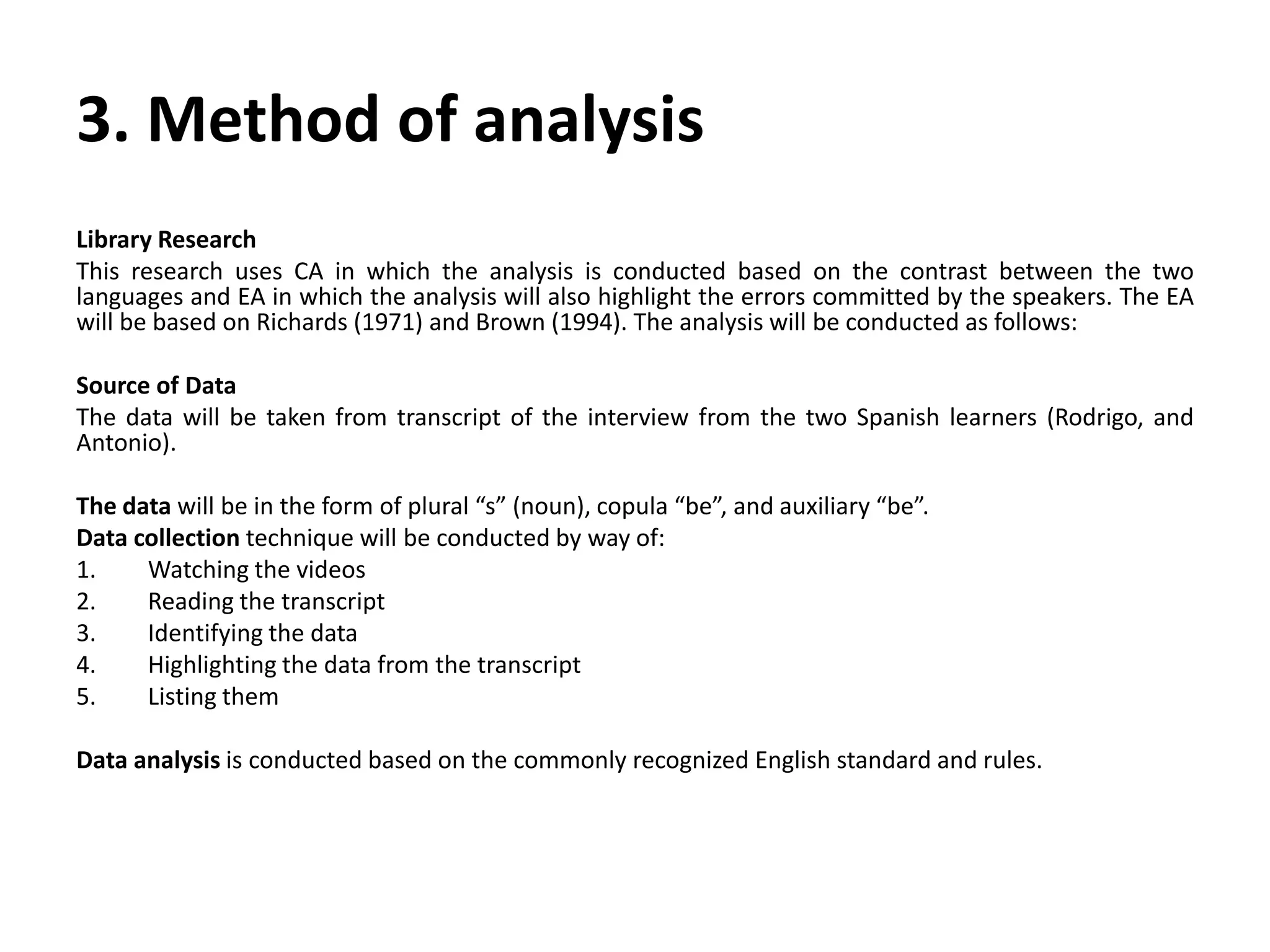
3. Method ofanalysis
Library Research
This research uses CA in which the analysis is conducted based on the contrast between the two
languages and EA in which the analysis will also highlight the errors committed by the speakers. The EA
will be based on Richards (1971) and Brown (1994). The analysis will be conducted as follows:
Source of Data
The data will be taken from transcript of the interview from the two Spanish learners (Rodrigo, and
Antonio).
The data will be in the form of plural “s” (noun), copula “be”, and auxiliary “be”.
Data collection technique will be conducted by way of:
1. Watching the videos
2. Reading the transcript
3. Identifying the data
4. Highlighting the data from the transcript
5. Listing them
Data analysis is conducted based on the commonly recognized English standard and rules.
13.
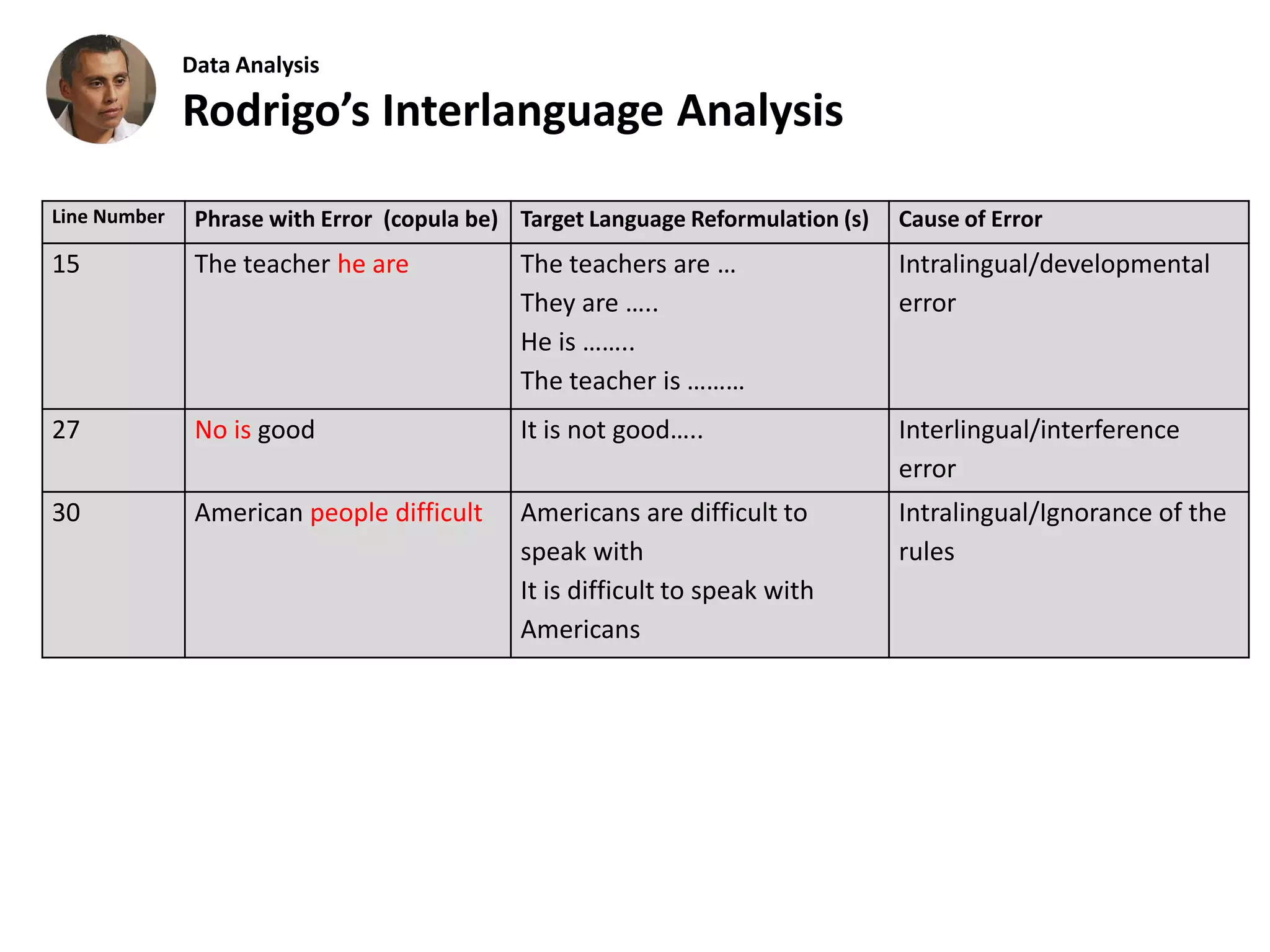
Line Number Phrasewith Error (copula be) Target Language Reformulation (s) Cause of Error
15 The teacher he are The teachers are …
They are …..
He is ……..
The teacher is ………
Intralingual/developmental
error
27 No is good It is not good….. Interlingual/interference
error
30 American people difficult Americans are difficult to
speak with
It is difficult to speak with
Americans
Intralingual/Ignorance of the
rules
Data Analysis
Rodrigo’s Interlanguage Analysis
14.
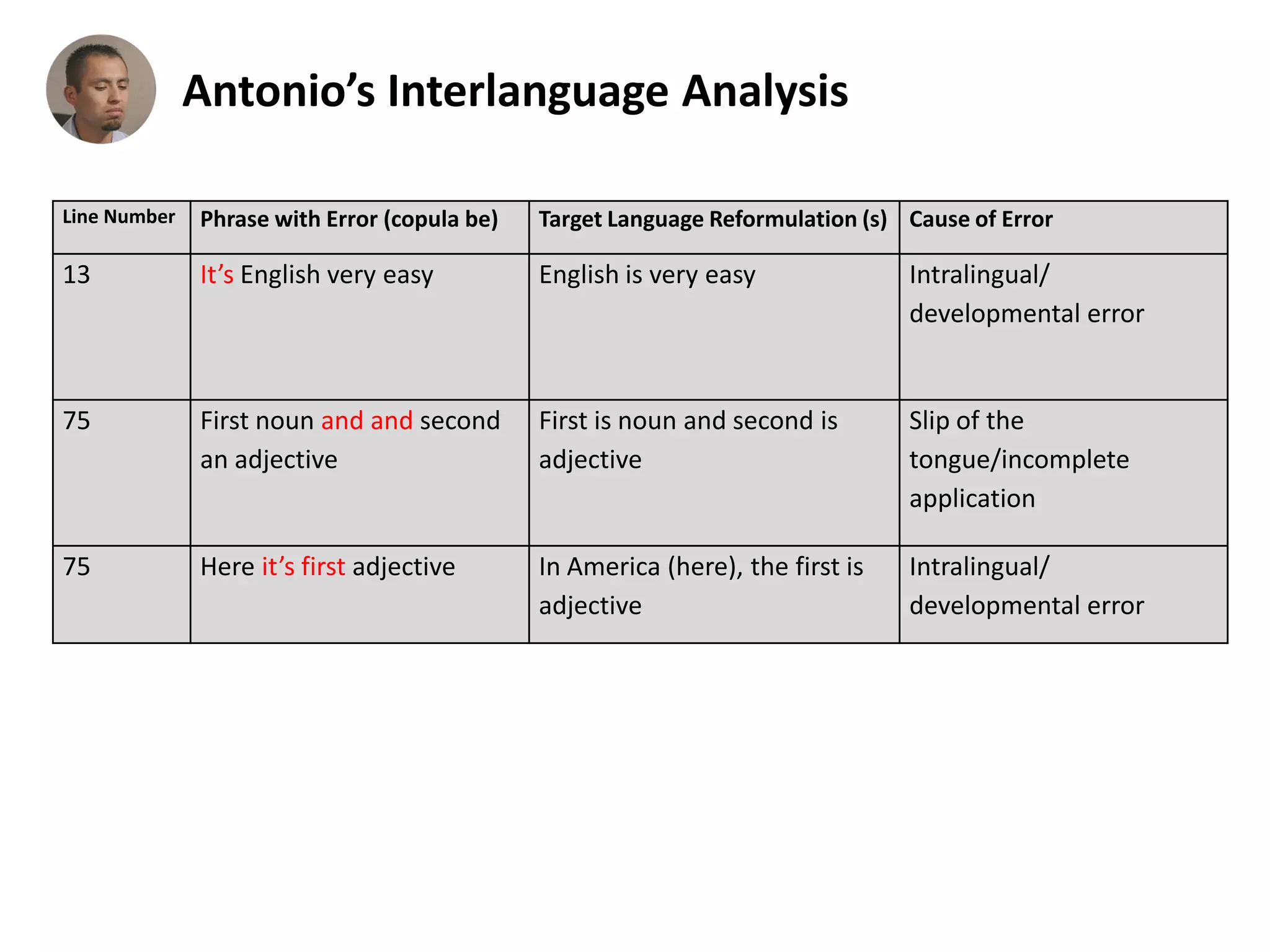
Line Number Phrasewith Error (copula be) Target Language Reformulation (s) Cause of Error
13 It’s English very easy English is very easy Intralingual/
developmental error
75 First noun and and second
an adjective
First is noun and second is
adjective
Slip of the
tongue/incomplete
application
75 Here it’s first adjective In America (here), the first is
adjective
Intralingual/
developmental error
Antonio’s Interlanguage Analysis
15.
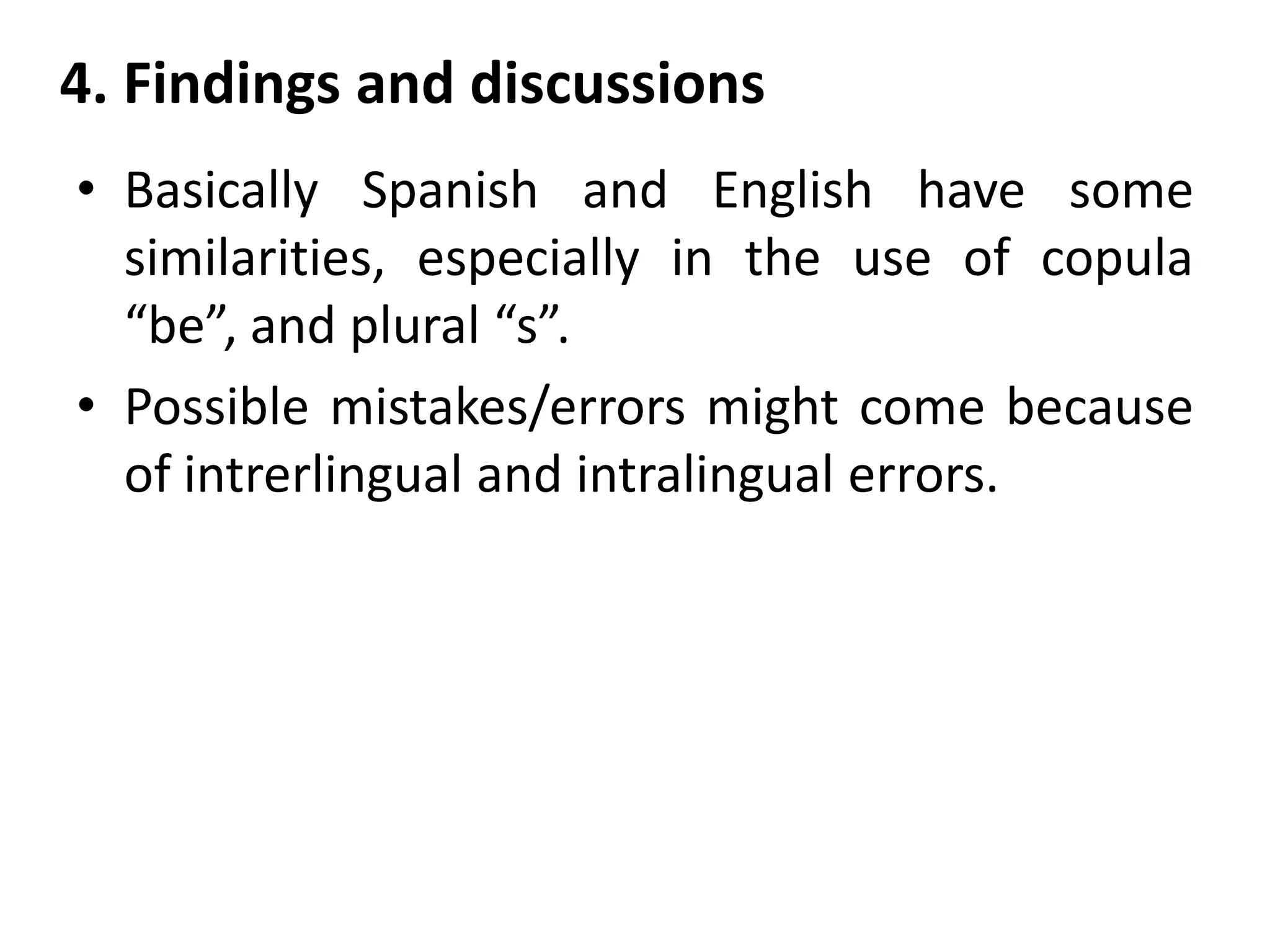
4. Findings anddiscussions
• Basically Spanish and English have some
similarities, especially in the use of copula
“be”, and plural “s”.
• Possible mistakes/errors might come because
of intrerlingual and intralingual errors.
16.
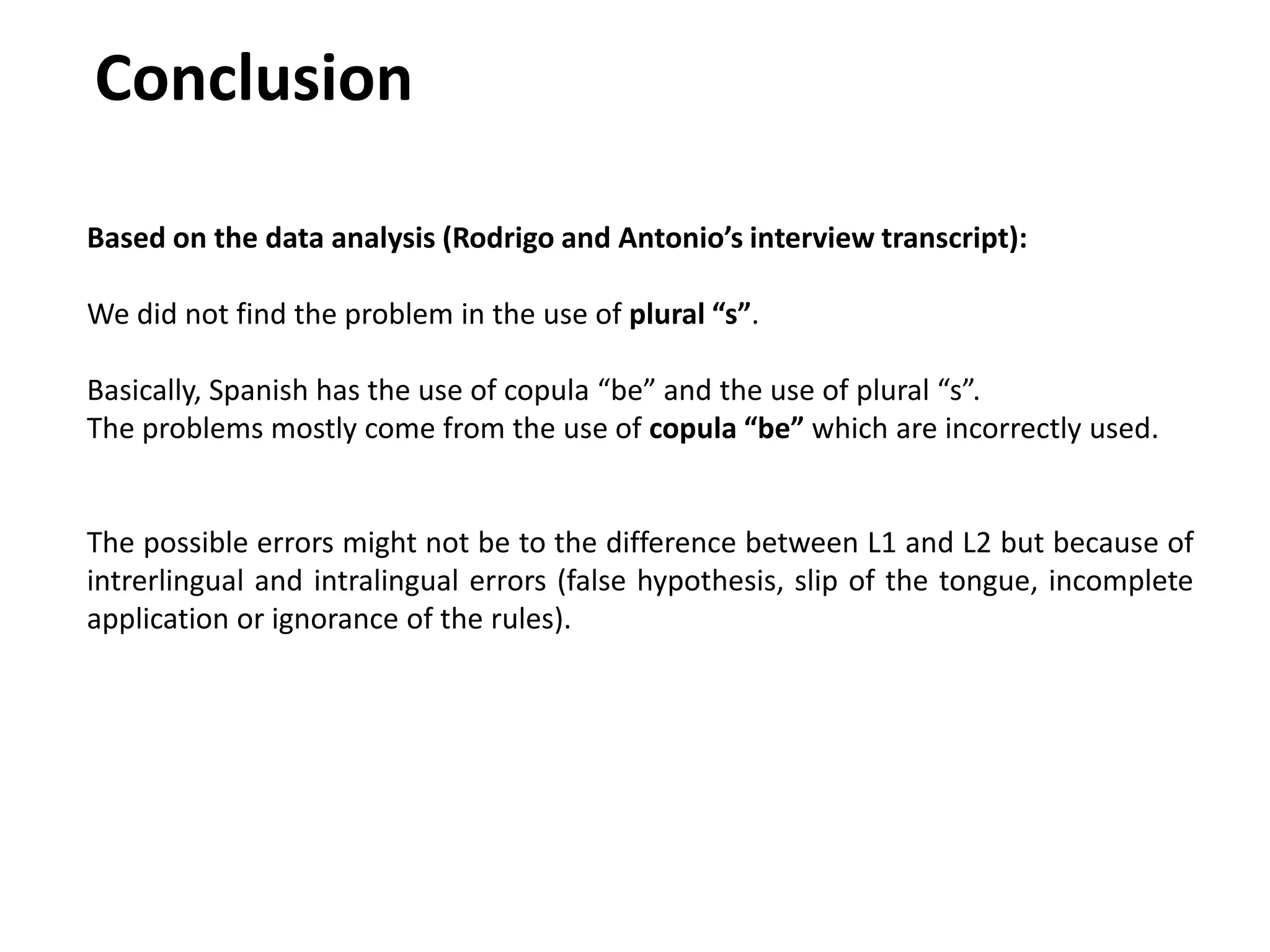
Conclusion
Based on thedata analysis (Rodrigo and Antonio’s interview transcript):
We did not find the problem in the use of plural “s”.
Basically, Spanish has the use of copula “be” and the use of plural “s”.
The problems mostly come from the use of copula “be” which are incorrectly used.
The possible errors might not be to the difference between L1 and L2 but because of
intrerlingual and intralingual errors (false hypothesis, slip of the tongue, incomplete
application or ignorance of the rules).
17.
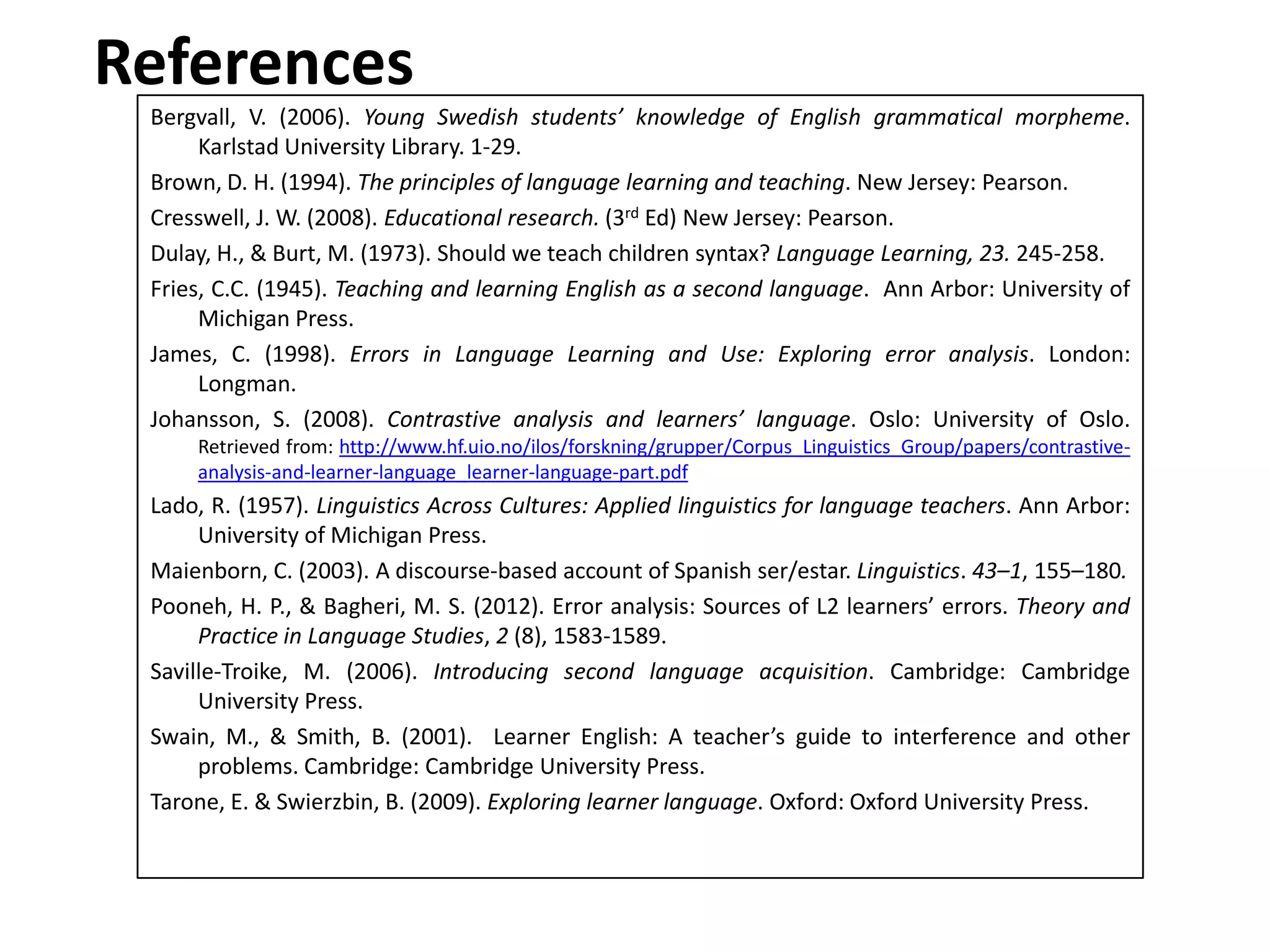
References
Bergvall, V. (2006).Young Swedish students’ knowledge of English grammatical morpheme.
Karlstad University Library. 1-29.
Brown, D. H. (1994). The principles of language learning and teaching. New Jersey: Pearson.
Cresswell, J. W. (2008). Educational research. (3rd Ed) New Jersey: Pearson.
Dulay, H., & Burt, M. (1973). Should we teach children syntax? Language Learning, 23. 245-258.
Fries, C.C. (1945). Teaching and learning English as a second language. Ann Arbor: University of
Michigan Press.
James, C. (1998). Errors in Language Learning and Use: Exploring error analysis. London:
Longman.
Johansson, S. (2008). Contrastive analysis and learners’ language. Oslo: University of Oslo.
Retrieved from: http://www.hf.uio.no/ilos/forskning/grupper/Corpus_Linguistics_Group/papers/contrastive-
analysis-and-learner-language_learner-language-part.pdf
Lado, R. (1957). Linguistics Across Cultures: Applied linguistics for language teachers. Ann Arbor:
University of Michigan Press.
Maienborn, C. (2003). A discourse-based account of Spanish ser/estar. Linguistics. 43–1, 155–180.
Pooneh, H. P., & Bagheri, M. S. (2012). Error analysis: Sources of L2 learners’ errors. Theory and
Practice in Language Studies, 2 (8), 1583-1589.
Saville-Troike, M. (2006). Introducing second language acquisition. Cambridge: Cambridge
University Press.
Swain, M., & Smith, B. (2001). Learner English: A teacher’s guide to interference and other
problems. Cambridge: Cambridge University Press.
Tarone, E. & Swierzbin, B. (2009). Exploring learner language. Oxford: Oxford University Press.