Cohesion In English By: Waseem Azhar Gilany
Cohesion   in   English The various kinds of cohesion had been out lined by MAK Halliday in his writings on stylistics and the concept was developed by Ruqaiya Hasan in her University of Edinburgh doctoral thesis.  Cohesive relations are relations between two or more elements in a text that are independent of the structure: for example between a personal pronoun and an antecedent proper name, such as John ….he. A semantic relation of this kind may be set up either within a sentence with the consequence that when it crosses a sentence boundary it has the effect of making the two sentences cohere with one another.  The major function of cohesion is text formation. As defined: text is a unified whole of linguistic items, this unity of text as a semantic whole is source for the concept of cohesion. .
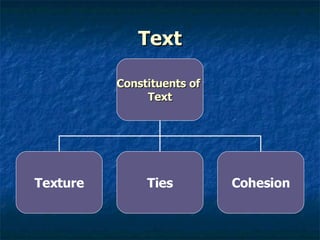
Text Constituents of  Text Texture Ties Cohesion
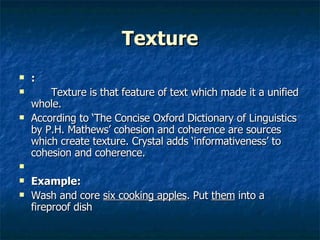
Texture : Texture is that feature of text which made it a unified whole.  According to ‘The Concise Oxford Dictionary of Linguistics by P.H. Mathews’ cohesion and coherence are sources which create texture. Crystal adds ‘informativeness’ to cohesion and coherence. Example: Wash and core  six cooking apples . Put  them  into a fireproof dish
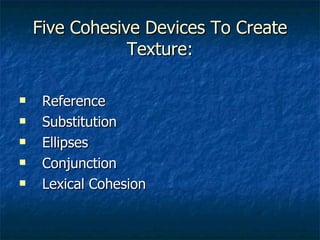
Five Cohesive Devices To Create Texture: Reference  Substitution Ellipses Conjunction  Lexical Cohesion
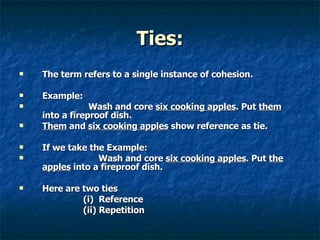
Ties: The term refers to a single instance of cohesion. Example: Wash and core  six cooking apples . Put  them  into a fireproof dish. Them  and  six cooking apples  show reference as tie. If we take the Example:   Wash and core  six cooking apples . Put  the apples  into a fireproof dish. Here are two ties  (i)  Reference   (ii) Repetition
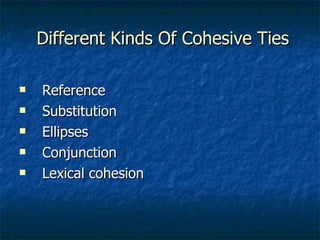
Different Kinds Of Cohesive Ties Reference Substitution Ellipses Conjunction Lexical cohesion
Cohesion ‘ The Concise Oxford Dictionary of Linguistics by P.H. Mathews (1997)’ defines cohesion in term of syntactic unit (sentence). ‘  A Dictionary Of Linguistics And Phonetics by David Crystal (1997)’ defines cohesion in terms of a grammatical unit (words)  MAKH and RH (1976) argued that the concept of cohesion is semantic one. For them it refers to relation of meaning that: exists with in text  gives the text texture  defines the text  as text This relation of meaning between the elements gives the reader presupposition. This is another way of approaching the notion of cohesion that presupposing and the presupposed give us a presupposition at semantic level as a relation of meaning: The one element presupposes the other i.e. the one element cannot be decoded without the presupposed.
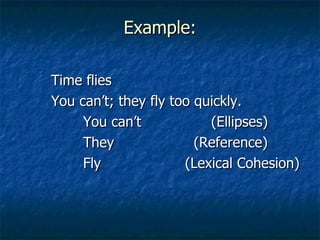
Example: Time flies You can’t; they fly too quickly.  You can’t  (Ellipses) They  (Reference) Fly  (Lexical Cohesion)
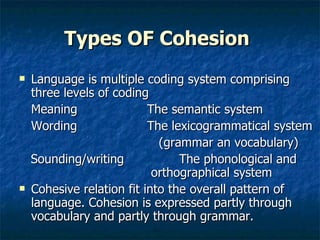
Types OF Cohesion   Language is multiple coding system comprising three levels of coding  Meaning The semantic system Wording The lexicogrammatical system    (grammar an vocabulary)  Sounding/writing The phonological and   orthographical system  Cohesive relation fit into the overall pattern of language. Cohesion is expressed partly through vocabulary and partly through grammar.
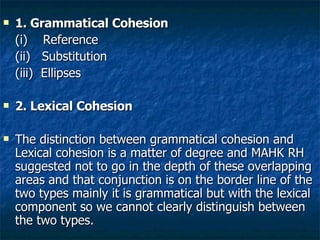
1. Grammatical Cohesion (i)  Reference (ii)  Substitution (iii)  Ellipses 2. Lexical Cohesion The distinction between grammatical cohesion and Lexical cohesion is a matter of degree and MAHK RH suggested not to go in the depth of these overlapping areas and that conjunction is on the border line of the two types mainly it is grammatical but with the lexical component so we cannot clearly distinguish between the two types.
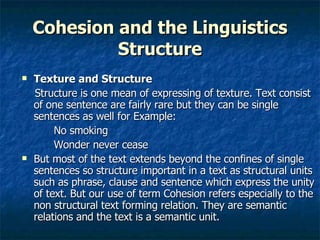
Cohesion and the Linguistics Structure Texture and Structure  Structure is one mean of expressing of texture. Text consist of one sentence are fairly rare but they can be single sentences as well for Example: No smoking Wonder never cease But most of the text extends beyond the confines of single sentences so structure important in a text as structural units such as phrase, clause and sentence which express the unity of text. But our use of term Cohesion refers especially to the non structural text forming relation. They are semantic relations and the text is a semantic unit.
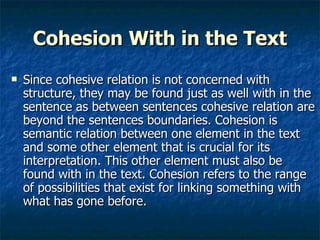
Cohesion With in the Text Since cohesive relation is not concerned with structure, they may be found just as well with in the sentence as between sentences cohesive relation are beyond the sentences boundaries. Cohesion is semantic relation between one element in the text and some other element that is crucial for its interpretation. This other element must also be found with in the text. Cohesion refers to the range of possibilities that exist for linking something with what has gone before.
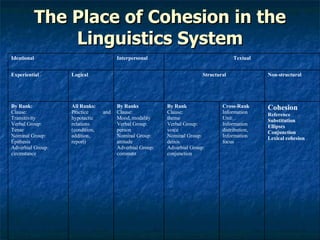
The Place of Cohesion in the Linguistics System Cohesion Reference Substitution Ellipses Conjunction Lexical cohesion Cross-Rank Information Unit: Information distribution, Information  focus By Rank Clause: theme Verbal Group: voice Nominal Group: deixis Adverbial Group: conjunction By Ranks Clause: Mood, modality  Verbal Group: person Nominal Group: attitude Adverbial Group: comment All Ranks: Practice and hypotactic relations (condition, addition,  report) By Rank: Clause: Transitivity Verbal Group: Tense Nominal Group: Epithesis Adverbial Group: circmstance Non-structural  Structural Logical  Experiential  Textual Interpersonal Ideational
Conclusion: Cohesion is a part of text forming component in the linguistics system. It links together the elements that are structurally unrelated through the dependence of one on the other for its interpretation. Without cohesion the semantic system cannot be effectively activated at all.
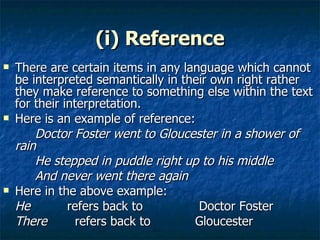
(i) Reference There are certain items in any language which cannot be interpreted semantically in their own right rather they make reference to something else within the text for their interpretation. Here is an example of reference: Doctor Foster went to Gloucester in a shower of rain  He stepped in puddle right up to his middle  And never went there again Here in the above example: He   refers back to  Doctor Foster  There     refers back to  Gloucester
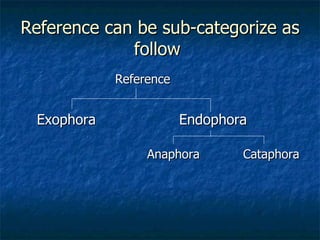
Reference can be sub-categorize as follow  Reference Exophora  Endophora Anaphora  Cataphora
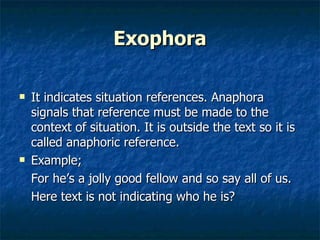
Exophora It indicates situation references. Anaphora signals that reference must be made to the context of situation. It is outside the text so it is called anaphoric reference. Example;  For he’s a jolly good fellow and so say all of us. Here text is not indicating who he is?
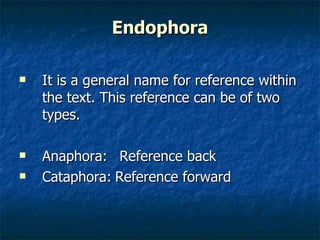
Endophora It is a general name for reference within the text. This reference can be of two types. Anaphora:  Reference back  Cataphora: Reference forward
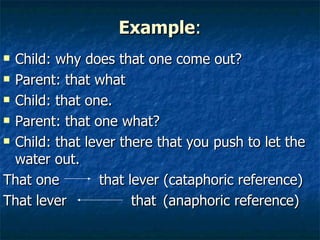
Example : Child: why does that one come out? Parent: that what  Child: that one. Parent: that one what? Child: that lever there that you push to let the water out. That one that lever (cataphoric reference) That lever  that  (anaphoric reference)
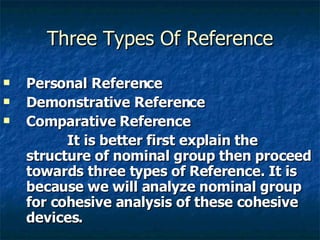
Three Types Of Reference Personal Reference  Demonstrative Reference  Comparative Reference It is better first explain the structure of nominal group then proceed towards three types of Reference. It is because we will analyze nominal group for cohesive analysis of these cohesive devices.
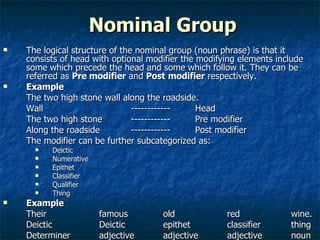
Nominal Group The logical structure of the nominal group (noun phrase) is that it consists of head with optional modifier the modifying elements include some which precede the head and some which follow it. They can be referred as  Pre modifier  and  Post   modifier  respectively.  Example  The two high stone wall along the roadside.  Wall  ------------ Head The two high stone ------------ Pre modifier  Along the roadside  ------------ Post modifier The modifier can be further subcategorized as: Deictic  Numerative  Epithet  Classifier  Qualifier  Thing Example  Their  famous old  red  wine.  Deictic Deictic epithet  classifier thing Determiner  adjective  adjective adjective noun
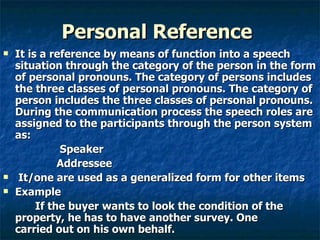
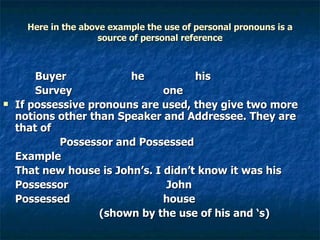
Personal Reference   It is a reference by means of function into a speech situation through the category of the person in the form of personal pronouns. The category of persons includes the three classes of personal pronouns. The category of person includes the three classes of personal pronouns. During the communication process the speech roles are assigned to the participants through the person system as: Speaker Addressee It/one are used as a generalized form for other items Example If the buyer wants to look the condition of the  property, he has to have another survey. One  carried out on his own behalf.
Here in the above example the use of personal pronouns is a source of personal reference Buyer he his Survey one If possessive pronouns are used, they give two more notions other than Speaker and Addressee. They are that of  Possessor and Possessed Example That new house is John’s. I didn’t know it was his Possessor   John Possessed house  (shown by the use of his and ‘s)
Table: Personal Reference  Semantic category Grammatical function Class  Person: speaker (only) addressee (s), with/without other person(s) speaker and other person other person, male other person, female  other persons, objects  object; passage of text generalized person my  yours  our his  her  their  its  one’s  mine  yours ours  his  hers  theirs  [its] I me you we us  he him  she her  they them  it  one  Determiner Noun (pronoun) Modifier Head Possessive Existential
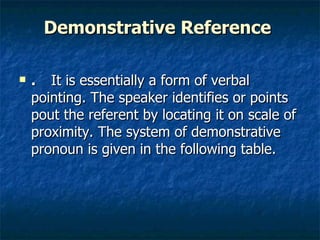
Demonstrative Reference  .  It is essentially a form of verbal pointing. The speaker identifies or points pout the referent by locating it on scale of proximity. The system of demonstrative pronoun is given in the following table.
Table: Demonstrative Reference Semantic category Grammatical category Class  Proximity: near  far  neutral the  here [now]  there then  this these  that those  determiner  adverb  determiner Modifier  Adjunct  Modifier  Non-selective Selective
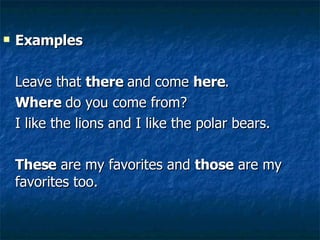
Examples Leave that  there  and come  here . Where  do you come from? I like the lions and I like the polar bears.  These  are my favorites and  those  are my favorites too.
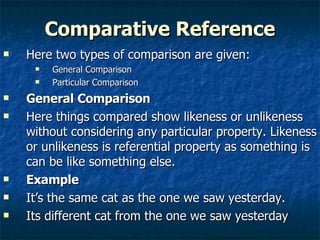
Comparative Reference Here two types of comparison are given: General Comparison  Particular Comparison General Comparison  Here things compared show likeness or unlikeness without considering any particular property. Likeness or unlikeness is referential property as something is can be like something else. Example   It’s the same cat as the one we saw yesterday. Its different cat from the one we saw yesterday
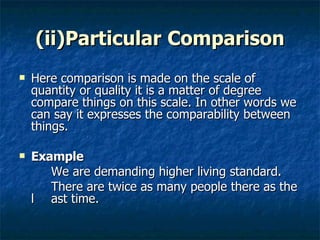
(ii)Particular   Comparison Here comparison is made on the scale of quantity or quality it is a matter of degree compare things on this scale. In other words we can say it expresses the comparability between things. Example We are demanding higher living standard.  There are twice as many people there as the l ast time.
Table: Comparative reference Grammatical function Class General comparison: Identity general similarity difference (ie non-identity or similarity) Particular comparison: so more less equally better, more etc  [comparative adjectives and quantifiers] identically similarly likewise so such differently otherwise same identical equal similar additional  other different else Adverb  Adjectives  Submodifier /adjuncts Modifier Deictic /epithet  (see below)
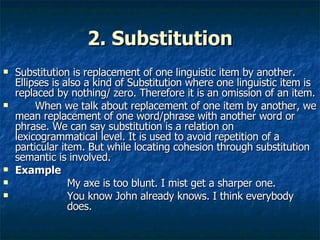
2. Substitution Substitution is replacement of one linguistic item by another. Ellipses is also a kind of Substitution where one linguistic item is replaced by nothing/ zero. Therefore it is an omission of an item. When we talk about replacement of one item by another, we mean replacement of one word/phrase with another word or phrase. We can say substitution is a relation on lexicogrammatical level. It is used to avoid repetition of a particular item. But while locating cohesion through substitution semantic is involved. Example My   axe is too blunt. I mist get a sharper one. You know John already knows. I think everybody  does.
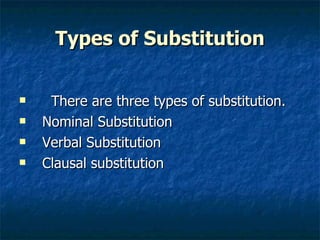
Types of Substitution There are three types of substitution. Nominal Substitution Verbal Substitution Clausal substitution
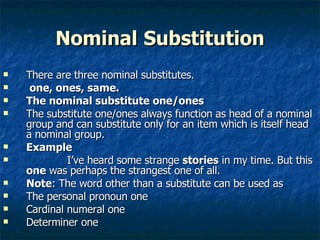
Nominal   Substitution There are three nominal substitutes. one, ones, same. The nominal substitute one/ones The   substitute one/ones always function as head of a nominal group and can substitute only for an item which is itself head a nominal group. Example I’ve heard some strange  stories  in my time. But this  one  was perhaps the strangest one of all.  Note : The word other than a substitute can be used as  The personal pronoun one Cardinal numeral one Determiner one
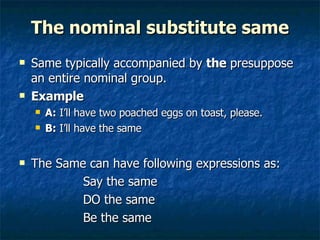
The nominal substitute same Same typically accompanied by  the  presuppose an entire nominal group. Example A:  I’ll have two poached eggs on toast, please. B:  I’ll have   the same The Same can have following expressions as: Say the same DO the same  Be the same
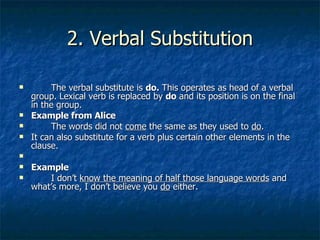
2. Verbal Substitution The verbal substitute is  do.  This operates as head of a verbal group. Lexical verb is replaced by  do  and its position is on the final in the group.  Example from Alice The words did not  come  the same as they used to  do . It can also substitute for a verb plus certain other elements in the clause. Example I don’t  know the meaning of half those language words  and what’s more, I don’t believe you  do  either.
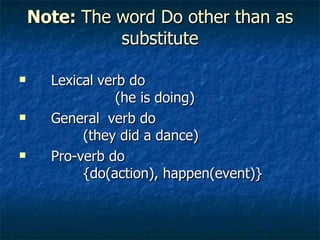
Note:  The word Do other than as substitute Lexical   verb do  (he is doing) General   verb do (they did a dance) Pro-verb do {do(action), happen(event)}
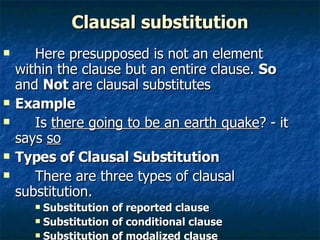
Clausal substitution Here presupposed is not an element within the clause but an entire clause.  So  and  Not  are   clausal   substitutes  Example Is  there going to be an earth quake ? - it says  so Types of Clausal Substitution There are three types of clausal substitution. Substitution of reported clause Substitution of conditional clause Substitution of modalized clause
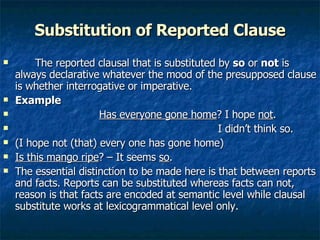
Substitution of Reported Clause The reported clausal that is substituted by  so  or  not  is always declarative whatever the mood of the presupposed clause is whether interrogative or imperative. Example Has everyone gone home ? I hope  not .   I didn’t think so. (I hope not (that) every one has gone home)  Is this mango ripe ? – It seems  so .  The essential distinction to be made here is that between reports and facts. Reports can be substituted whereas facts can not, reason is that facts are encoded at semantic level while clausal substitute works at lexicogrammatical level only.
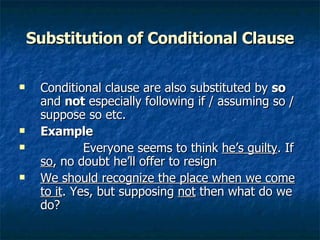
Substitution of Conditional Clause Conditional clause are also substituted by  so  and  not  especially following if / assuming so / suppose so etc. Example Everyone seems to think  he’s guilty . If  so , no doubt he’ll offer to resign  We should recognize the place when we come to it . Yes, but supposing  not  then what do we do?
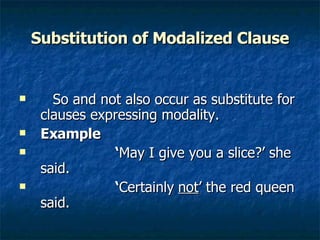
Substitution of Modalized Clause So and not also occur as substitute for clauses expressing modality. Example   ‘ May I give you a slice?’ she said. ‘ Certainly   not ’ the red queen said.
The End Allah Hafiz

Cohesion Types

  • 1.
    Cohesion In EnglishBy: Waseem Azhar Gilany
  • 2.
    Cohesion in English The various kinds of cohesion had been out lined by MAK Halliday in his writings on stylistics and the concept was developed by Ruqaiya Hasan in her University of Edinburgh doctoral thesis. Cohesive relations are relations between two or more elements in a text that are independent of the structure: for example between a personal pronoun and an antecedent proper name, such as John ….he. A semantic relation of this kind may be set up either within a sentence with the consequence that when it crosses a sentence boundary it has the effect of making the two sentences cohere with one another. The major function of cohesion is text formation. As defined: text is a unified whole of linguistic items, this unity of text as a semantic whole is source for the concept of cohesion. .
  • 3.
    Text Constituents of Text Texture Ties Cohesion
  • 4.
    Texture : Textureis that feature of text which made it a unified whole. According to ‘The Concise Oxford Dictionary of Linguistics by P.H. Mathews’ cohesion and coherence are sources which create texture. Crystal adds ‘informativeness’ to cohesion and coherence. Example: Wash and core six cooking apples . Put them into a fireproof dish
  • 5.
    Five Cohesive DevicesTo Create Texture: Reference Substitution Ellipses Conjunction Lexical Cohesion
  • 6.
    Ties: The termrefers to a single instance of cohesion. Example: Wash and core six cooking apples . Put them into a fireproof dish. Them and six cooking apples show reference as tie. If we take the Example: Wash and core six cooking apples . Put the apples into a fireproof dish. Here are two ties (i) Reference (ii) Repetition
  • 7.
    Different Kinds OfCohesive Ties Reference Substitution Ellipses Conjunction Lexical cohesion
  • 8.
    Cohesion ‘ TheConcise Oxford Dictionary of Linguistics by P.H. Mathews (1997)’ defines cohesion in term of syntactic unit (sentence). ‘ A Dictionary Of Linguistics And Phonetics by David Crystal (1997)’ defines cohesion in terms of a grammatical unit (words) MAKH and RH (1976) argued that the concept of cohesion is semantic one. For them it refers to relation of meaning that: exists with in text gives the text texture defines the text as text This relation of meaning between the elements gives the reader presupposition. This is another way of approaching the notion of cohesion that presupposing and the presupposed give us a presupposition at semantic level as a relation of meaning: The one element presupposes the other i.e. the one element cannot be decoded without the presupposed.
  • 9.
    Example: Time fliesYou can’t; they fly too quickly. You can’t (Ellipses) They (Reference) Fly (Lexical Cohesion)
  • 10.
    Types OF Cohesion Language is multiple coding system comprising three levels of coding Meaning The semantic system Wording The lexicogrammatical system (grammar an vocabulary) Sounding/writing The phonological and orthographical system Cohesive relation fit into the overall pattern of language. Cohesion is expressed partly through vocabulary and partly through grammar.
  • 11.
    1. Grammatical Cohesion(i) Reference (ii) Substitution (iii) Ellipses 2. Lexical Cohesion The distinction between grammatical cohesion and Lexical cohesion is a matter of degree and MAHK RH suggested not to go in the depth of these overlapping areas and that conjunction is on the border line of the two types mainly it is grammatical but with the lexical component so we cannot clearly distinguish between the two types.
  • 12.
    Cohesion and theLinguistics Structure Texture and Structure Structure is one mean of expressing of texture. Text consist of one sentence are fairly rare but they can be single sentences as well for Example: No smoking Wonder never cease But most of the text extends beyond the confines of single sentences so structure important in a text as structural units such as phrase, clause and sentence which express the unity of text. But our use of term Cohesion refers especially to the non structural text forming relation. They are semantic relations and the text is a semantic unit.
  • 13.
    Cohesion With inthe Text Since cohesive relation is not concerned with structure, they may be found just as well with in the sentence as between sentences cohesive relation are beyond the sentences boundaries. Cohesion is semantic relation between one element in the text and some other element that is crucial for its interpretation. This other element must also be found with in the text. Cohesion refers to the range of possibilities that exist for linking something with what has gone before.
  • 14.
    The Place ofCohesion in the Linguistics System Cohesion Reference Substitution Ellipses Conjunction Lexical cohesion Cross-Rank Information Unit: Information distribution, Information focus By Rank Clause: theme Verbal Group: voice Nominal Group: deixis Adverbial Group: conjunction By Ranks Clause: Mood, modality Verbal Group: person Nominal Group: attitude Adverbial Group: comment All Ranks: Practice and hypotactic relations (condition, addition, report) By Rank: Clause: Transitivity Verbal Group: Tense Nominal Group: Epithesis Adverbial Group: circmstance Non-structural Structural Logical Experiential Textual Interpersonal Ideational
  • 15.
    Conclusion: Cohesion isa part of text forming component in the linguistics system. It links together the elements that are structurally unrelated through the dependence of one on the other for its interpretation. Without cohesion the semantic system cannot be effectively activated at all.
  • 16.
    (i) Reference Thereare certain items in any language which cannot be interpreted semantically in their own right rather they make reference to something else within the text for their interpretation. Here is an example of reference: Doctor Foster went to Gloucester in a shower of rain He stepped in puddle right up to his middle And never went there again Here in the above example: He refers back to Doctor Foster There refers back to Gloucester
  • 17.
    Reference can besub-categorize as follow Reference Exophora Endophora Anaphora Cataphora
  • 18.
    Exophora It indicatessituation references. Anaphora signals that reference must be made to the context of situation. It is outside the text so it is called anaphoric reference. Example; For he’s a jolly good fellow and so say all of us. Here text is not indicating who he is?
  • 19.
    Endophora It isa general name for reference within the text. This reference can be of two types. Anaphora: Reference back Cataphora: Reference forward
  • 20.
    Example : Child:why does that one come out? Parent: that what Child: that one. Parent: that one what? Child: that lever there that you push to let the water out. That one that lever (cataphoric reference) That lever that (anaphoric reference)
  • 21.
    Three Types OfReference Personal Reference Demonstrative Reference Comparative Reference It is better first explain the structure of nominal group then proceed towards three types of Reference. It is because we will analyze nominal group for cohesive analysis of these cohesive devices.
  • 22.
    Nominal Group Thelogical structure of the nominal group (noun phrase) is that it consists of head with optional modifier the modifying elements include some which precede the head and some which follow it. They can be referred as Pre modifier and Post modifier respectively. Example The two high stone wall along the roadside. Wall ------------ Head The two high stone ------------ Pre modifier Along the roadside ------------ Post modifier The modifier can be further subcategorized as: Deictic Numerative Epithet Classifier Qualifier Thing Example Their famous old red wine. Deictic Deictic epithet classifier thing Determiner adjective adjective adjective noun
  • 23.
    Personal Reference It is a reference by means of function into a speech situation through the category of the person in the form of personal pronouns. The category of persons includes the three classes of personal pronouns. The category of person includes the three classes of personal pronouns. During the communication process the speech roles are assigned to the participants through the person system as: Speaker Addressee It/one are used as a generalized form for other items Example If the buyer wants to look the condition of the property, he has to have another survey. One carried out on his own behalf.
  • 24.
    Here in theabove example the use of personal pronouns is a source of personal reference Buyer he his Survey one If possessive pronouns are used, they give two more notions other than Speaker and Addressee. They are that of Possessor and Possessed Example That new house is John’s. I didn’t know it was his Possessor John Possessed house (shown by the use of his and ‘s)
  • 25.
    Table: Personal Reference Semantic category Grammatical function Class Person: speaker (only) addressee (s), with/without other person(s) speaker and other person other person, male other person, female other persons, objects object; passage of text generalized person my yours our his her their its one’s mine yours ours his hers theirs [its] I me you we us he him she her they them it one Determiner Noun (pronoun) Modifier Head Possessive Existential
  • 26.
    Demonstrative Reference . It is essentially a form of verbal pointing. The speaker identifies or points pout the referent by locating it on scale of proximity. The system of demonstrative pronoun is given in the following table.
  • 27.
    Table: Demonstrative ReferenceSemantic category Grammatical category Class Proximity: near far neutral the here [now] there then this these that those determiner adverb determiner Modifier Adjunct Modifier Non-selective Selective
  • 28.
    Examples Leave that there and come here . Where do you come from? I like the lions and I like the polar bears. These are my favorites and those are my favorites too.
  • 29.
    Comparative Reference Heretwo types of comparison are given: General Comparison Particular Comparison General Comparison Here things compared show likeness or unlikeness without considering any particular property. Likeness or unlikeness is referential property as something is can be like something else. Example It’s the same cat as the one we saw yesterday. Its different cat from the one we saw yesterday
  • 30.
    (ii)Particular Comparison Here comparison is made on the scale of quantity or quality it is a matter of degree compare things on this scale. In other words we can say it expresses the comparability between things. Example We are demanding higher living standard. There are twice as many people there as the l ast time.
  • 31.
    Table: Comparative referenceGrammatical function Class General comparison: Identity general similarity difference (ie non-identity or similarity) Particular comparison: so more less equally better, more etc [comparative adjectives and quantifiers] identically similarly likewise so such differently otherwise same identical equal similar additional other different else Adverb Adjectives Submodifier /adjuncts Modifier Deictic /epithet (see below)
  • 32.
    2. Substitution Substitutionis replacement of one linguistic item by another. Ellipses is also a kind of Substitution where one linguistic item is replaced by nothing/ zero. Therefore it is an omission of an item. When we talk about replacement of one item by another, we mean replacement of one word/phrase with another word or phrase. We can say substitution is a relation on lexicogrammatical level. It is used to avoid repetition of a particular item. But while locating cohesion through substitution semantic is involved. Example My axe is too blunt. I mist get a sharper one. You know John already knows. I think everybody does.
  • 33.
    Types of SubstitutionThere are three types of substitution. Nominal Substitution Verbal Substitution Clausal substitution
  • 34.
    Nominal Substitution There are three nominal substitutes. one, ones, same. The nominal substitute one/ones The substitute one/ones always function as head of a nominal group and can substitute only for an item which is itself head a nominal group. Example I’ve heard some strange stories in my time. But this one was perhaps the strangest one of all. Note : The word other than a substitute can be used as The personal pronoun one Cardinal numeral one Determiner one
  • 35.
    The nominal substitutesame Same typically accompanied by the presuppose an entire nominal group. Example A: I’ll have two poached eggs on toast, please. B: I’ll have the same The Same can have following expressions as: Say the same DO the same Be the same
  • 36.
    2. Verbal SubstitutionThe verbal substitute is do. This operates as head of a verbal group. Lexical verb is replaced by do and its position is on the final in the group. Example from Alice The words did not come the same as they used to do . It can also substitute for a verb plus certain other elements in the clause. Example I don’t know the meaning of half those language words and what’s more, I don’t believe you do either.
  • 37.
    Note: Theword Do other than as substitute Lexical verb do (he is doing) General verb do (they did a dance) Pro-verb do {do(action), happen(event)}
  • 38.
    Clausal substitution Herepresupposed is not an element within the clause but an entire clause. So and Not are clausal substitutes Example Is there going to be an earth quake ? - it says so Types of Clausal Substitution There are three types of clausal substitution. Substitution of reported clause Substitution of conditional clause Substitution of modalized clause
  • 39.
    Substitution of ReportedClause The reported clausal that is substituted by so or not is always declarative whatever the mood of the presupposed clause is whether interrogative or imperative. Example Has everyone gone home ? I hope not . I didn’t think so. (I hope not (that) every one has gone home) Is this mango ripe ? – It seems so . The essential distinction to be made here is that between reports and facts. Reports can be substituted whereas facts can not, reason is that facts are encoded at semantic level while clausal substitute works at lexicogrammatical level only.
  • 40.
    Substitution of ConditionalClause Conditional clause are also substituted by so and not especially following if / assuming so / suppose so etc. Example Everyone seems to think he’s guilty . If so , no doubt he’ll offer to resign We should recognize the place when we come to it . Yes, but supposing not then what do we do?
  • 41.
    Substitution of ModalizedClause So and not also occur as substitute for clauses expressing modality. Example ‘ May I give you a slice?’ she said. ‘ Certainly not ’ the red queen said.
  • 42.