Presented by: Younes TAIAPresented by: Younes TAIA
younes.taia@gmail.comyounes.taia@gmail.com
TEFL&ICT Master programTEFL&ICT Master program
The Natural Approach
University of Ibn-Zohr Methods and Techniques
FLSH Prof. Naima TRIMASSE
MA TEFL&ICT
Semester 2
References :
Jack C.Richards and Theodore S.Rodgers. Approaches and Methods in
Language Teaching: A description and analysis. Cambridge University
Press.

Outline
The theoretical background
Definition
Principles and foundations
TPR VS NA
Procedures and techniques
Learning process.
How does NA syllabus look like?
Strengths
Weaknesses

The Natural Approach is based on the
following assumptions.
► The Naturalistic view of Child Language Acquisition.
► James Asher’s TPR
► Stephen Krashen and Tracy Terrell ’s works on Second
Language Acquisition (SLA).

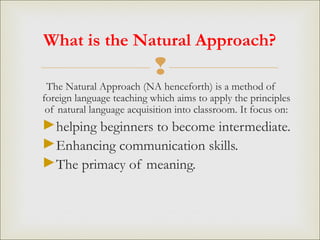
What is the Natural Approach?
The Natural Approach (NA henceforth) is a method of
foreign language teaching which aims to apply the principles
of natural language acquisition into classroom. It focus on:
►helping beginners to become intermediate.
►Enhancing communication skills.
►The primacy of meaning.

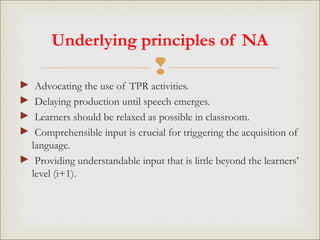
Underlying principles of NA
► Advocating the use of TPR activities.
► Delaying production until speech emerges.
► Learners should be relaxed as possible in classroom.
► Comprehensible input is crucial for triggering the acquisition of
language.
► Providing understandable input that is little beyond the learners’
level (i+1).
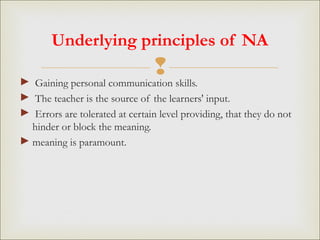
► Gaining personal communication skills.
► The teacher is the source of the learners' input.
► Errors are tolerated at certain level providing, that they do not
hinder or block the meaning.
► meaning is paramount.
Underlying principles of NA

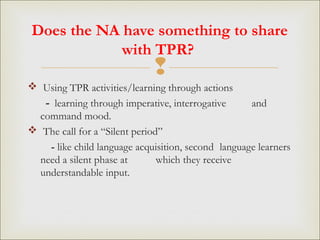
Does the NA have something to share
with TPR?
 Using TPR activities/learning through actions
- learning through imperative, interrogative and
command mood.
 The call for a “Silent period”
- like child language acquisition, second language learners
need a silent phase at which they receive
understandable input.

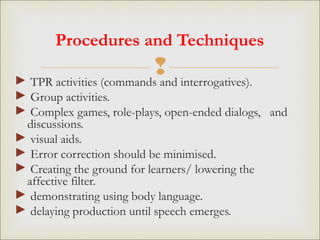
Procedures and Techniques
► TPR activities (commands and interrogatives).
► Group activities.
► Complex games, role-plays, open-ended dialogs, and
discussions.
► visual aids.
► Error correction should be minimised.
► Creating the ground for learners/ lowering the
affective filter.
► demonstrating using body language.
► delaying production until speech emerges.
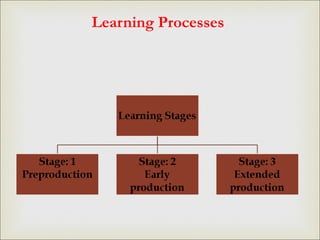
Learning Processes

How does NA syllabus
look like?
► Communicative syllabus; mainly focusing on enhacing
skills both oral and written.

Strengths
► following a logical/ rationale order.
► attempting to reduce the learners’ inhibition.
► a heavy stress is on meaning and vocabulary.
► the use of target language.

Weaknesses
► The notion of “Silent Period”
► How does a teacher manage such silent class
effectively?
► Error treatment
► Learners are passive at certain level
► Little emphasis was given to grammar analysis.
► what type of input to provide.

The natural approach

  • 1.
    Presented by: YounesTAIAPresented by: Younes TAIA younes.taia@gmail.comyounes.taia@gmail.com TEFL&ICT Master programTEFL&ICT Master program The Natural Approach University of Ibn-Zohr Methods and Techniques FLSH Prof. Naima TRIMASSE MA TEFL&ICT Semester 2 References : Jack C.Richards and Theodore S.Rodgers. Approaches and Methods in Language Teaching: A description and analysis. Cambridge University Press.
  • 2.
     Outline The theoretical background Definition Principlesand foundations TPR VS NA Procedures and techniques Learning process. How does NA syllabus look like? Strengths Weaknesses
  • 3.
     The Natural Approachis based on the following assumptions. ► The Naturalistic view of Child Language Acquisition. ► James Asher’s TPR ► Stephen Krashen and Tracy Terrell ’s works on Second Language Acquisition (SLA).
  • 4.
     What is theNatural Approach? The Natural Approach (NA henceforth) is a method of foreign language teaching which aims to apply the principles of natural language acquisition into classroom. It focus on: ►helping beginners to become intermediate. ►Enhancing communication skills. ►The primacy of meaning.
  • 5.
     Underlying principles ofNA ► Advocating the use of TPR activities. ► Delaying production until speech emerges. ► Learners should be relaxed as possible in classroom. ► Comprehensible input is crucial for triggering the acquisition of language. ► Providing understandable input that is little beyond the learners’ level (i+1).
  • 6.
    ► Gaining personalcommunication skills. ► The teacher is the source of the learners' input. ► Errors are tolerated at certain level providing, that they do not hinder or block the meaning. ► meaning is paramount. Underlying principles of NA
  • 7.
     Does the NAhave something to share with TPR?  Using TPR activities/learning through actions - learning through imperative, interrogative and command mood.  The call for a “Silent period” - like child language acquisition, second language learners need a silent phase at which they receive understandable input.
  • 8.
     Procedures and Techniques ►TPR activities (commands and interrogatives). ► Group activities. ► Complex games, role-plays, open-ended dialogs, and discussions. ► visual aids. ► Error correction should be minimised. ► Creating the ground for learners/ lowering the affective filter. ► demonstrating using body language. ► delaying production until speech emerges.
  • 9.
  • 10.
     How does NAsyllabus look like? ► Communicative syllabus; mainly focusing on enhacing skills both oral and written.
  • 11.
     Strengths ► following alogical/ rationale order. ► attempting to reduce the learners’ inhibition. ► a heavy stress is on meaning and vocabulary. ► the use of target language.
  • 12.
     Weaknesses ► The notionof “Silent Period” ► How does a teacher manage such silent class effectively? ► Error treatment ► Learners are passive at certain level ► Little emphasis was given to grammar analysis. ► what type of input to provide.