Analyzing language complexity
of Chinese and African Learners
Presenters:
Agung Diah Wulandari // Ardiansyah // Eka Uliyanti // Paula Kristanti
• Most communicative tasks generally refer to what Cummins (1981, 2000) has called social language and
academic language, the first referring to basic interpersonal communication. This kind of language
generally typifies a relatively concrete and, observable utterance, e.g. the speech about things, people,
and actions, and is generally supported by a considerable amount of contextual information (e.g., visual
information about people and places). In this language, a lot of information can also be conveyed
nonverbally to support and clarify our verbal communication (CARLA, 2015, para. 1).
• The latter, is typically a more complex called as
Academic language, due to its differences and the possibility to develop its meaning independently
(without being contextualized). Academic language proficiency is the ability to use cognitively demanding
language (e.g. abstract nouns and complex syntax) as a tool for critical thinking, and it typically is used in
situations where there may be comparatively little contextual support to aid in the sending and receiving
of information (CARLA, 2015, para. 1)
Introduction
• language complexity refers to how the students organizes and
elaborates their speech. Language complexity generally varies
based on the topic of discussion (CAL, 2015, para. 1-2).
• For example: the use of one word or phrase in a certain situation
(e.g., What languages do you speak?), or the use of strings of
sentences which are typically complex in different situation (e.g.,
Do you think it’s important to keep up with the news? Why/Why
not?). (CAL, 2015, para. 1-2)
What is language complexity?
• Language Complexity / Cognitive complexity is related to complexity in
language, both sentence structure and lexicon (CARLA, 2015, para. 1-2 ).
• In functional linguistics perspective (Schleppegrell, 2004) certain
utterance can be identified in terms of language forms that function to
express a wide range of logical relationships in academic discourse. One
such logical relationship occurs when one states an inference and the
facts that support that inference (CARLA, 2015, para. 1-2 ).
Typically the inference is framed using an
abstract noun, such as ‘wealth’, while the
facts may be realized as concrete nouns,
such as car, nice house, or satellite dish.
Linguistic forms are also needed to link
inferences to supporting facts
(Lackstrom, 1981, cited in CARLA, 2015,
para. 1).
• Tarone & Swierzbin (2009, p. 87) propose that native speakers of
English could possibly show the above concept by way of producing
evidence in support of their inferences using phrases like ‘just based
on’, ‘from looking at these’, ‘because’.
• In short, Biber (2006) states that academic language typically includes
an increased variety in the lexicon, such as the use of rare and/or
abstract nouns; very complex noun phrases with multiple levels of
embedding; and an increased occurrence of relative, adverbial and
complement clauses (in Tarone & Swierzbin (2009, p. 87).
The syntactic and lexical variety that is characteristic of
academic language is more cognitively demanding. In addition,
the lack of contextual support puts pressure on the speaker to be
more precise, to make sure the listener understands. Only at
higher levels of proficiency do language learners appear to
master the more complex registers and uses of the language
(CARLA, 2015, para. 1-2).
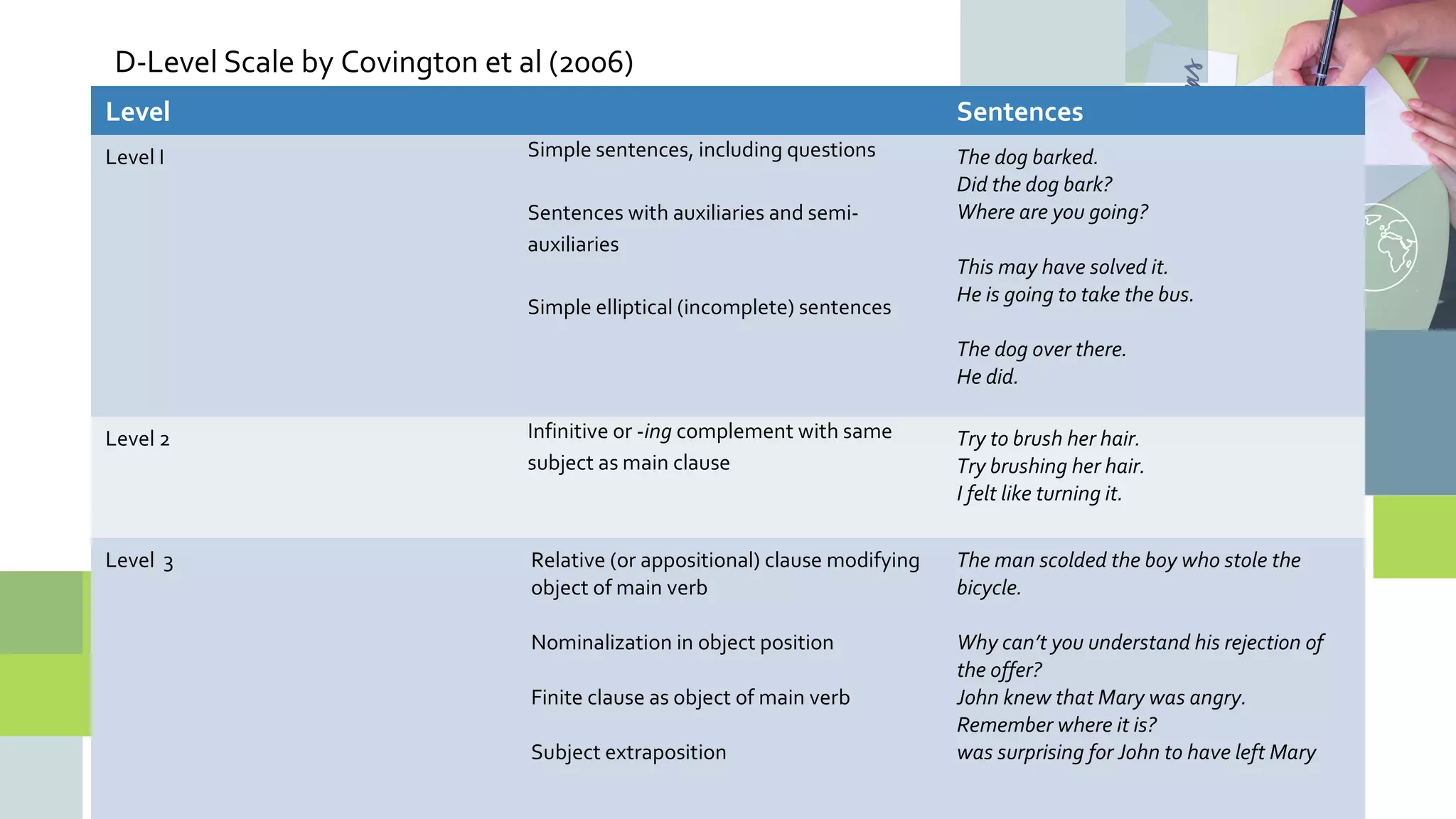
Level Sentences
Level I Simple sentences, including questions
Sentences with auxiliaries and semi-
auxiliaries
Simple elliptical (incomplete) sentences
The dog barked.
Did the dog bark?
Where are you going?
This may have solved it.
He is going to take the bus.
The dog over there.
He did.
Level 2 Infinitive or -ing complement with same
subject as main clause
Try to brush her hair.
Try brushing her hair.
I felt like turning it.
Level 3 Relative (or appositional) clause modifying
object of main verb
Nominalization in object position
Finite clause as object of main verb
Subject extraposition
The man scolded the boy who stole the
bicycle.
Why can’t you understand his rejection of
the offer?
John knew that Mary was angry.
Remember where it is?
was surprising for John to have left Mary
D-Level Scale by Covington et al (2006)
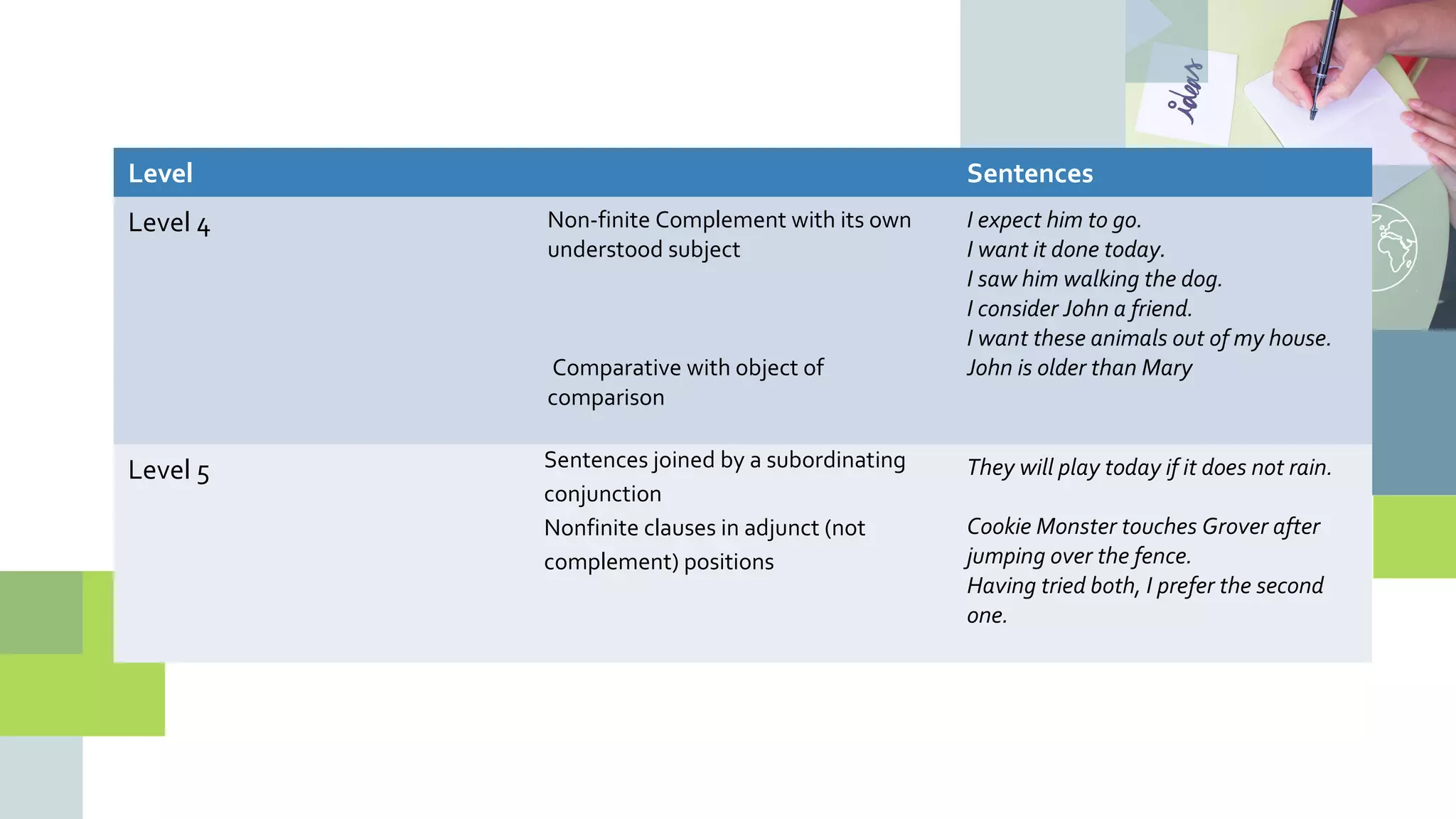
Level Sentences
Level 4 Non-finite Complement with its own
understood subject
Comparative with object of
comparison
I expect him to go.
I want it done today.
I saw him walking the dog.
I consider John a friend.
I want these animals out of my house.
John is older than Mary
Level 5 Sentences joined by a subordinating
conjunction
Nonfinite clauses in adjunct (not
complement) positions
They will play today if it does not rain.
Cookie Monster touches Grover after
jumping over the fence.
Having tried both, I prefer the second
one.
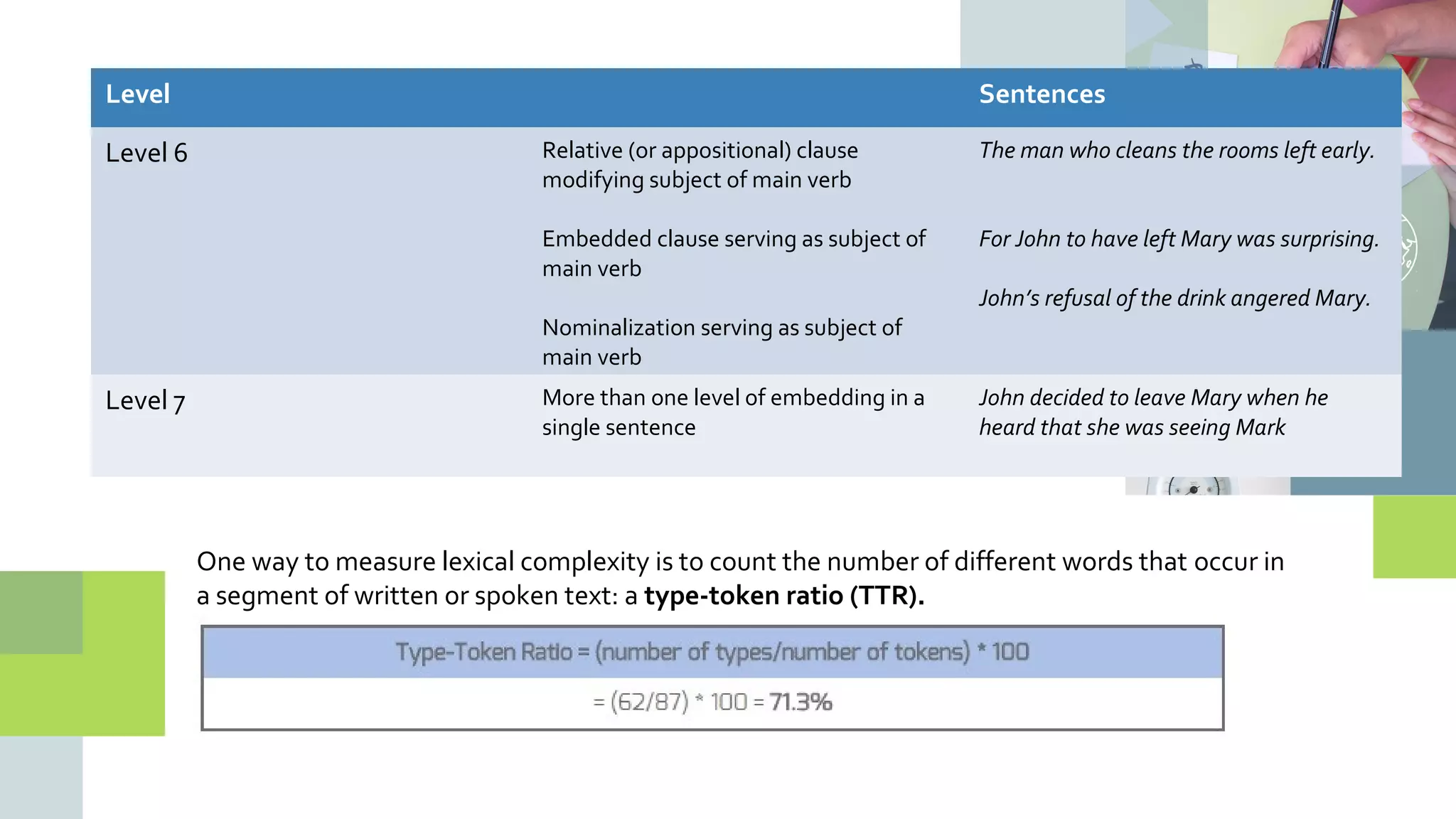
Level Sentences
Level 6 Relative (or appositional) clause
modifying subject of main verb
Embedded clause serving as subject of
main verb
Nominalization serving as subject of
main verb
The man who cleans the rooms left early.
For John to have left Mary was surprising.
John’s refusal of the drink angered Mary.
Level 7 More than one level of embedding in a
single sentence
John decided to leave Mary when he
heard that she was seeing Mark
One way to measure lexical complexity is to count the number of different words that occur in
a segment of written or spoken text: a type-token ratio (TTR).
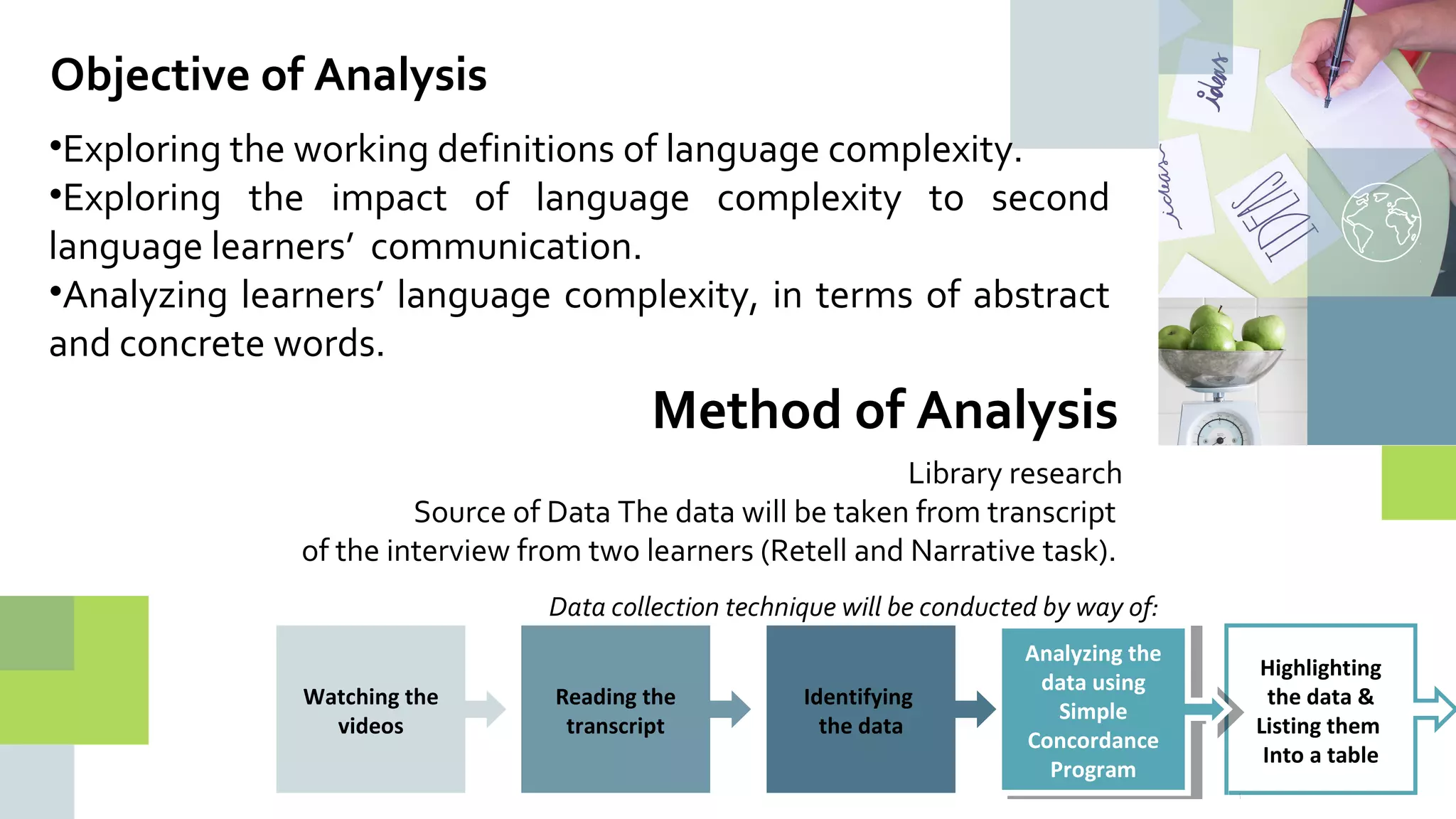
•Exploring the working definitions of language complexity.
•Exploring the impact of language complexity to second
language learners’ communication.
•Analyzing learners’ language complexity, in terms of abstract
and concrete words.
Objective of Analysis
Library research
Source of Data The data will be taken from transcript
of the interview from two learners (Retell and Narrative task).
Method of Analysis
Highlighting
the data &
Listing them
Into a table
Analyzing the
data using
Simple
Concordance
Program
Analyzing the
data using
Simple
Concordance
Program
Identifying
the data
Reading the
transcript
Watching the
videos
Data collection technique will be conducted by way of:
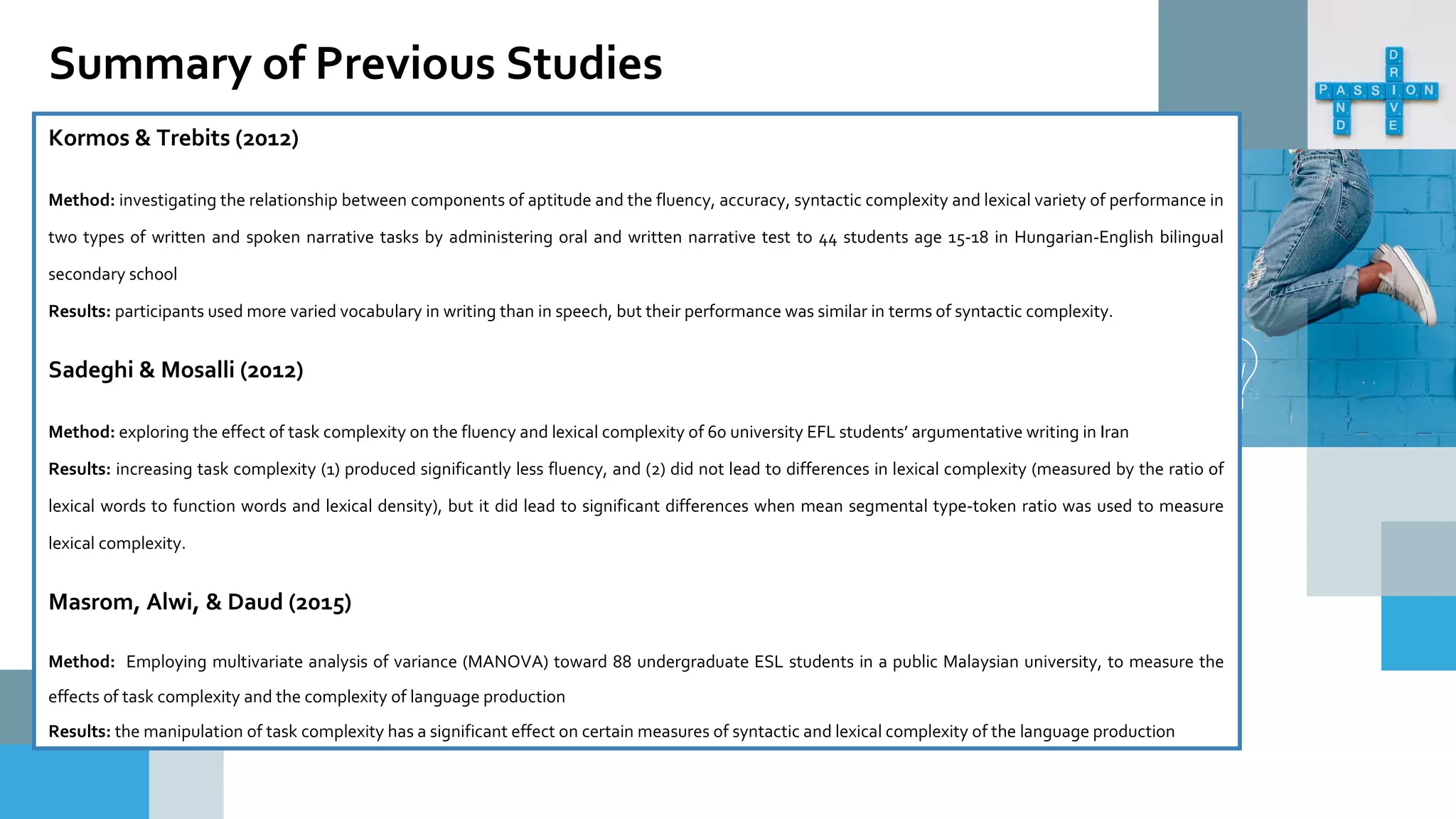
Kormos & Trebits (2012)
Method: investigating the relationship between components of aptitude and the fluency, accuracy, syntactic complexity and lexical variety of performance in
two types of written and spoken narrative tasks by administering oral and written narrative test to 44 students age 15-18 in Hungarian-English bilingual
secondary school
Results: participants used more varied vocabulary in writing than in speech, but their performance was similar in terms of syntactic complexity.
Sadeghi & Mosalli (2012)
Method: exploring the effect of task complexity on the fluency and lexical complexity of 60 university EFL students’ argumentative writing in Iran
Results: increasing task complexity (1) produced significantly less fluency, and (2) did not lead to differences in lexical complexity (measured by the ratio of
lexical words to function words and lexical density), but it did lead to significant differences when mean segmental type-token ratio was used to measure
lexical complexity.
Masrom, Alwi, & Daud (2015)
Method: Employing multivariate analysis of variance (MANOVA) toward 88 undergraduate ESL students in a public Malaysian university, to measure the
effects of task complexity and the complexity of language production
Results: the manipulation of task complexity has a significant effect on certain measures of syntactic and lexical complexity of the language production
Summary of Previous Studies
Data Analysis
*fillers are NOT included
Retell Task
Chun
81 word vocabularies-5=76
261 words-19=242
Type Token Ratio= 76/242x100= 31%
Line   Complexity 
5 ...he want to uh take a ride? 1
7 ..uh yeah take a ride but and he just do this.. 2
1 to 2 when he got up and he found he's [lake], uh, he's late... 2
9 ...the driver want to take him to school so he geti in the car. 1
12 he just want to clean the windshield uh and then but but he think... 1
16 he was surprise to find the boy in his car 1
  TOTAL 8
Concrete Words Abstract Words
Bus catch
Money Winter
School Agree
Windshield Clean
Student Missed
Car Gesture
Late
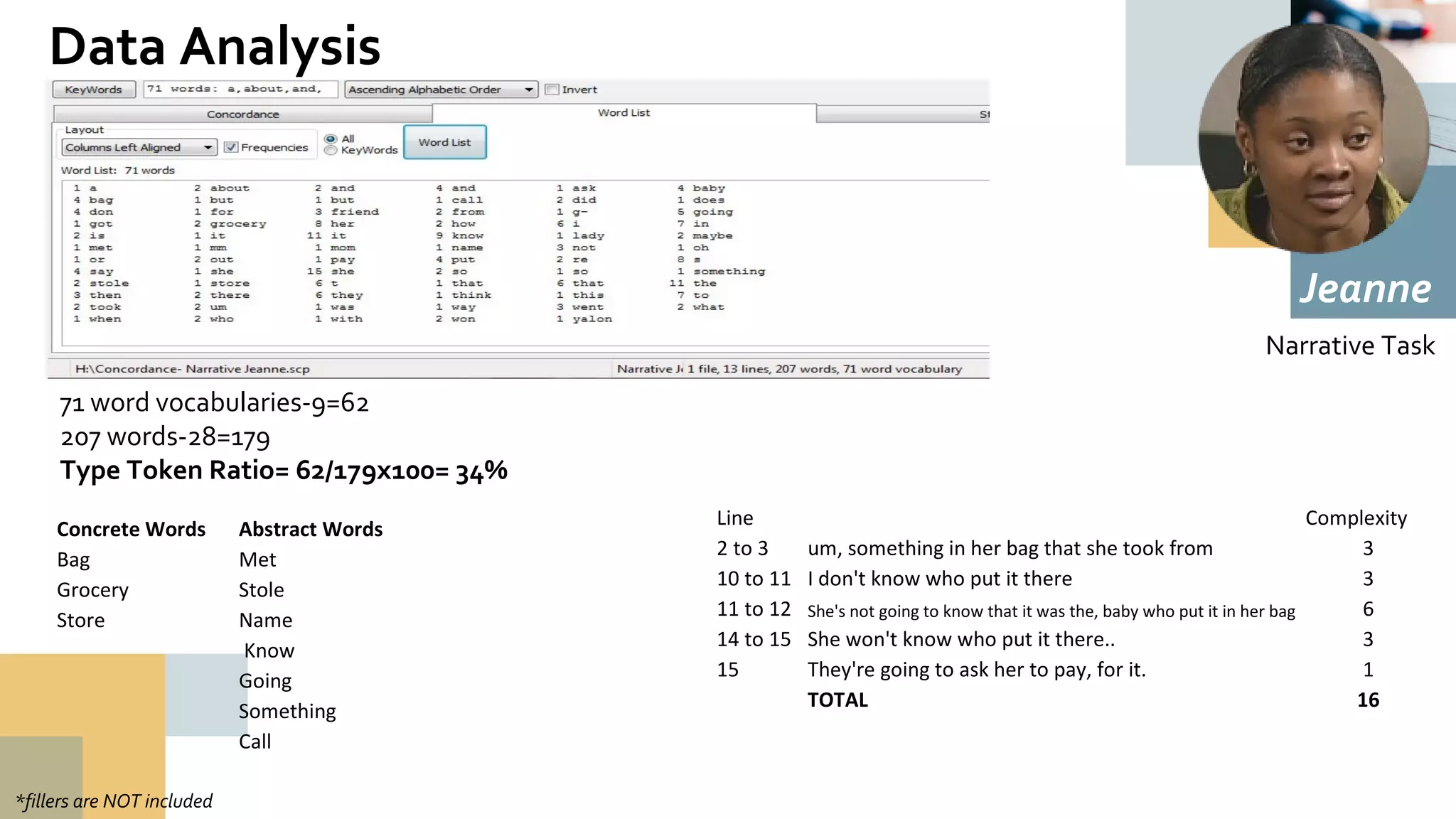
Data Analysis
*fillers are NOT included
Narrative Task
Jeanne
71 word vocabularies-9=62
207 words-28=179
Type Token Ratio= 62/179x100= 34%
Line   Complexity 
2 to 3 um, something in her bag that she took from 3
10 to 11 I don't know who put it there 3
11 to 12 She's not going to know that it was the, baby who put it in her bag  6
14 to 15 She won't know who put it there.. 3
15 They're going to ask her to pay, for it. 1
  TOTAL 16
Concrete Words Abstract Words
Bag Met
Grocery Stole
Store Name
 Know
Going
Something
Call
Findings and Discussion
Conclusion
•Chun has 31% of Type Token Ratio in Retell Task
•Chun gets 8 points of lexical complexity
•Chun uses more concrete words than Jeanne
•Jeanne has 34% of Type Token Ratio in Narrative Task
•Jeanne gets 16 points of lexical complexity
•Jeanne uses less concrete words than Chun
Jeanne has more lexical complexity than Chun based on the Type Token
Ratio and Lexical Complexity. Furthermore, Jeanne uses less concrete
words than Chun.
Although the use of abstract words between Chun & Jeanne are equal, Jeanne uses less
concrete words than Chun
CAL (2015). Components of language complexity. Retrieved from: http://www.cal.org/adultspeak/assessment/complexity.html
CARLA (2015). Overview of complexity of learner language. University of Minnesota.
Retrieved from: http://www.carla.umn.edu/learnerlanguage/complexity.html
Covington, M. A., He, C., Brown, C., Naci, L., & Brown, J. (2006). How complex is that sentence? A proposed revision of the
Rosenberg and Abbeduto D-Level Scale.
Kormos, J. & Trebits, A. (2012). The role of task complexity, modality and aptitude in narrative task performance. A journal of
research in language studies 62(2), 1-34.
Masrom, U. K., Alwi, N. A. N. M., & Daud, N. S. M. (2015). The effects of task complexity on the complexity of the second
language
written production. Journal of second language teaching and research 4(1), 38-66.
Sadeghi, K. & Mosalli, Z. (2012). The effect of task complexity on fluency and lexical complexity of EFL Learners’ argumentative
writing. International journal of applied linguistics & English literature 1(4), 53-65.
Tarone, E. & Swierzbin, B. (2009). Exploring learner language. Oxford: Oxford University Press.
www.sltinfo.com/type-token-ratio/
References

Analyzing language complexity of Chinese and African Learners

  • 1.
    Analyzing language complexity ofChinese and African Learners Presenters: Agung Diah Wulandari // Ardiansyah // Eka Uliyanti // Paula Kristanti
  • 2.
    • Most communicativetasks generally refer to what Cummins (1981, 2000) has called social language and academic language, the first referring to basic interpersonal communication. This kind of language generally typifies a relatively concrete and, observable utterance, e.g. the speech about things, people, and actions, and is generally supported by a considerable amount of contextual information (e.g., visual information about people and places). In this language, a lot of information can also be conveyed nonverbally to support and clarify our verbal communication (CARLA, 2015, para. 1). • The latter, is typically a more complex called as Academic language, due to its differences and the possibility to develop its meaning independently (without being contextualized). Academic language proficiency is the ability to use cognitively demanding language (e.g. abstract nouns and complex syntax) as a tool for critical thinking, and it typically is used in situations where there may be comparatively little contextual support to aid in the sending and receiving of information (CARLA, 2015, para. 1) Introduction
  • 3.
    • language complexityrefers to how the students organizes and elaborates their speech. Language complexity generally varies based on the topic of discussion (CAL, 2015, para. 1-2). • For example: the use of one word or phrase in a certain situation (e.g., What languages do you speak?), or the use of strings of sentences which are typically complex in different situation (e.g., Do you think it’s important to keep up with the news? Why/Why not?). (CAL, 2015, para. 1-2) What is language complexity?
  • 4.
    • Language Complexity/ Cognitive complexity is related to complexity in language, both sentence structure and lexicon (CARLA, 2015, para. 1-2 ). • In functional linguistics perspective (Schleppegrell, 2004) certain utterance can be identified in terms of language forms that function to express a wide range of logical relationships in academic discourse. One such logical relationship occurs when one states an inference and the facts that support that inference (CARLA, 2015, para. 1-2 ).
  • 5.
    Typically the inferenceis framed using an abstract noun, such as ‘wealth’, while the facts may be realized as concrete nouns, such as car, nice house, or satellite dish. Linguistic forms are also needed to link inferences to supporting facts (Lackstrom, 1981, cited in CARLA, 2015, para. 1).
  • 6.
    • Tarone &Swierzbin (2009, p. 87) propose that native speakers of English could possibly show the above concept by way of producing evidence in support of their inferences using phrases like ‘just based on’, ‘from looking at these’, ‘because’. • In short, Biber (2006) states that academic language typically includes an increased variety in the lexicon, such as the use of rare and/or abstract nouns; very complex noun phrases with multiple levels of embedding; and an increased occurrence of relative, adverbial and complement clauses (in Tarone & Swierzbin (2009, p. 87).
  • 7.
    The syntactic andlexical variety that is characteristic of academic language is more cognitively demanding. In addition, the lack of contextual support puts pressure on the speaker to be more precise, to make sure the listener understands. Only at higher levels of proficiency do language learners appear to master the more complex registers and uses of the language (CARLA, 2015, para. 1-2).
  • 8.
    Level Sentences Level ISimple sentences, including questions Sentences with auxiliaries and semi- auxiliaries Simple elliptical (incomplete) sentences The dog barked. Did the dog bark? Where are you going? This may have solved it. He is going to take the bus. The dog over there. He did. Level 2 Infinitive or -ing complement with same subject as main clause Try to brush her hair. Try brushing her hair. I felt like turning it. Level 3 Relative (or appositional) clause modifying object of main verb Nominalization in object position Finite clause as object of main verb Subject extraposition The man scolded the boy who stole the bicycle. Why can’t you understand his rejection of the offer? John knew that Mary was angry. Remember where it is? was surprising for John to have left Mary D-Level Scale by Covington et al (2006)
  • 9.
    Level Sentences Level 4Non-finite Complement with its own understood subject Comparative with object of comparison I expect him to go. I want it done today. I saw him walking the dog. I consider John a friend. I want these animals out of my house. John is older than Mary Level 5 Sentences joined by a subordinating conjunction Nonfinite clauses in adjunct (not complement) positions They will play today if it does not rain. Cookie Monster touches Grover after jumping over the fence. Having tried both, I prefer the second one.
  • 10.
    Level Sentences Level 6Relative (or appositional) clause modifying subject of main verb Embedded clause serving as subject of main verb Nominalization serving as subject of main verb The man who cleans the rooms left early. For John to have left Mary was surprising. John’s refusal of the drink angered Mary. Level 7 More than one level of embedding in a single sentence John decided to leave Mary when he heard that she was seeing Mark One way to measure lexical complexity is to count the number of different words that occur in a segment of written or spoken text: a type-token ratio (TTR).
  • 11.
    •Exploring the workingdefinitions of language complexity. •Exploring the impact of language complexity to second language learners’ communication. •Analyzing learners’ language complexity, in terms of abstract and concrete words. Objective of Analysis Library research Source of Data The data will be taken from transcript of the interview from two learners (Retell and Narrative task). Method of Analysis Highlighting the data & Listing them Into a table Analyzing the data using Simple Concordance Program Analyzing the data using Simple Concordance Program Identifying the data Reading the transcript Watching the videos Data collection technique will be conducted by way of:
  • 12.
    Kormos & Trebits(2012) Method: investigating the relationship between components of aptitude and the fluency, accuracy, syntactic complexity and lexical variety of performance in two types of written and spoken narrative tasks by administering oral and written narrative test to 44 students age 15-18 in Hungarian-English bilingual secondary school Results: participants used more varied vocabulary in writing than in speech, but their performance was similar in terms of syntactic complexity. Sadeghi & Mosalli (2012) Method: exploring the effect of task complexity on the fluency and lexical complexity of 60 university EFL students’ argumentative writing in Iran Results: increasing task complexity (1) produced significantly less fluency, and (2) did not lead to differences in lexical complexity (measured by the ratio of lexical words to function words and lexical density), but it did lead to significant differences when mean segmental type-token ratio was used to measure lexical complexity. Masrom, Alwi, & Daud (2015) Method: Employing multivariate analysis of variance (MANOVA) toward 88 undergraduate ESL students in a public Malaysian university, to measure the effects of task complexity and the complexity of language production Results: the manipulation of task complexity has a significant effect on certain measures of syntactic and lexical complexity of the language production Summary of Previous Studies
  • 13.
    Data Analysis *fillers areNOT included Retell Task Chun 81 word vocabularies-5=76 261 words-19=242 Type Token Ratio= 76/242x100= 31% Line   Complexity  5 ...he want to uh take a ride? 1 7 ..uh yeah take a ride but and he just do this.. 2 1 to 2 when he got up and he found he's [lake], uh, he's late... 2 9 ...the driver want to take him to school so he geti in the car. 1 12 he just want to clean the windshield uh and then but but he think... 1 16 he was surprise to find the boy in his car 1   TOTAL 8 Concrete Words Abstract Words Bus catch Money Winter School Agree Windshield Clean Student Missed Car Gesture Late
  • 14.
    Data Analysis *fillers areNOT included Narrative Task Jeanne 71 word vocabularies-9=62 207 words-28=179 Type Token Ratio= 62/179x100= 34% Line   Complexity  2 to 3 um, something in her bag that she took from 3 10 to 11 I don't know who put it there 3 11 to 12 She's not going to know that it was the, baby who put it in her bag  6 14 to 15 She won't know who put it there.. 3 15 They're going to ask her to pay, for it. 1   TOTAL 16 Concrete Words Abstract Words Bag Met Grocery Stole Store Name  Know Going Something Call
  • 15.
    Findings and Discussion Conclusion •Chunhas 31% of Type Token Ratio in Retell Task •Chun gets 8 points of lexical complexity •Chun uses more concrete words than Jeanne •Jeanne has 34% of Type Token Ratio in Narrative Task •Jeanne gets 16 points of lexical complexity •Jeanne uses less concrete words than Chun Jeanne has more lexical complexity than Chun based on the Type Token Ratio and Lexical Complexity. Furthermore, Jeanne uses less concrete words than Chun. Although the use of abstract words between Chun & Jeanne are equal, Jeanne uses less concrete words than Chun
  • 16.
    CAL (2015). Componentsof language complexity. Retrieved from: http://www.cal.org/adultspeak/assessment/complexity.html CARLA (2015). Overview of complexity of learner language. University of Minnesota. Retrieved from: http://www.carla.umn.edu/learnerlanguage/complexity.html Covington, M. A., He, C., Brown, C., Naci, L., & Brown, J. (2006). How complex is that sentence? A proposed revision of the Rosenberg and Abbeduto D-Level Scale. Kormos, J. & Trebits, A. (2012). The role of task complexity, modality and aptitude in narrative task performance. A journal of research in language studies 62(2), 1-34. Masrom, U. K., Alwi, N. A. N. M., & Daud, N. S. M. (2015). The effects of task complexity on the complexity of the second language written production. Journal of second language teaching and research 4(1), 38-66. Sadeghi, K. & Mosalli, Z. (2012). The effect of task complexity on fluency and lexical complexity of EFL Learners’ argumentative writing. International journal of applied linguistics & English literature 1(4), 53-65. Tarone, E. & Swierzbin, B. (2009). Exploring learner language. Oxford: Oxford University Press. www.sltinfo.com/type-token-ratio/ References