Interference
Interference
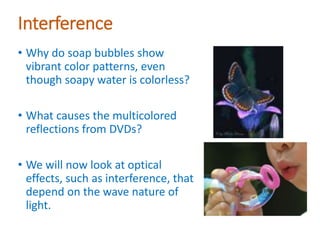
• Why do soap bubbles show
vibrant color patterns, even
though soapy water is colorless?
• What causes the multicolored
reflections from DVDs?
• We will now look at optical
effects, such as interference, that
depend on the wave nature of
light.
Waves
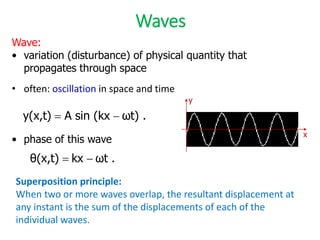
Wave:
• variation (disturbance) of physical quantity that
propagates through space
y(x,t) A sin (kx ωt) .
 
• phase of this wave
θ(x,t) kx ωt .
 
y
x
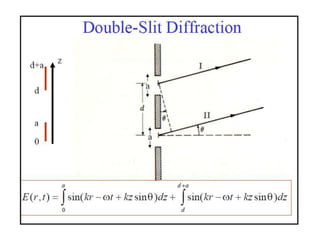
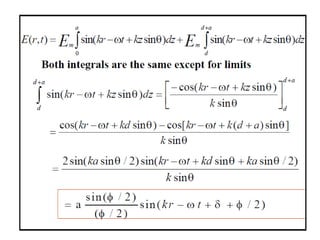
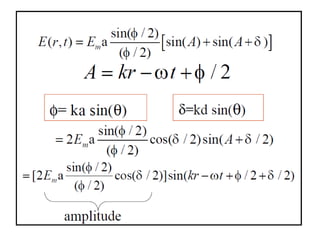
• often: oscillation in space and time
Superposition principle:
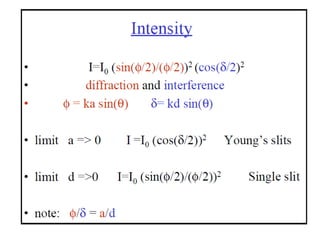
When two or more waves overlap, the resultant displacement at
any instant is the sum of the displacements of each of the
individual waves.
Constructive and destructive interference
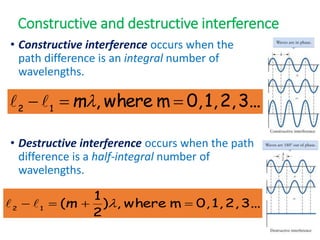
• Constructive interference occurs when the
path difference is an integral number of
wavelengths.
• Destructive interference occurs when the path
difference is a half-integral number of
wavelengths.
3...
2,
1,
0,
m
where
,
1
2


 
m


3...
2,
1,
0,
m
where
,
)
2
1
(
1
2



 
m


Interference Requirements
• Need two (or more) waves
• Must have same frequency
• Must be coherent (i.e. waves must have definite phase relation)
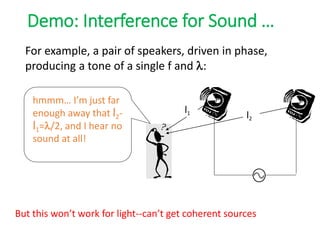
Demo: Interference for Sound …
For example, a pair of speakers, driven in phase,
producing a tone of a single f and :
l1
l2
But this won’t work for light--can’t get coherent sources
hmmm… I’m just far
enough away that l2-
l1=/2, and I hear no
sound at all!
Interference for Light …
• Can’t produce coherent light from separate
sources. (f  1014 Hz)
• Need two waves from single source taking
two different paths
– Two slits
– Reflection (thin films)
– Diffraction*
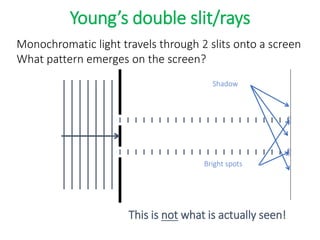
Young’s double slit/rays
Bright spots
Shadow
This is not what is actually seen!
Monochromatic light travels through 2 slits onto a screen
What pattern emerges on the screen?
Young’s double slit/Huygens
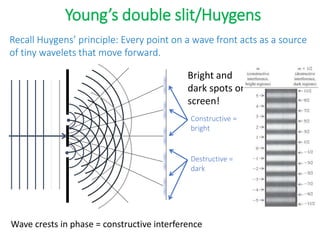
Recall Huygens’ principle: Every point on a wave front acts as a source
of tiny wavelets that move forward.
•
•
Wave crests in phase = constructive interference
Bright and
dark spots on
screen!
Constructive =
bright
Destructive =
dark
•
•
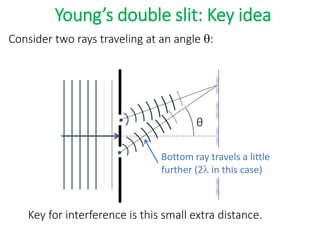
Young’s double slit: Key idea
Key for interference is this small extra distance.
Consider two rays traveling at an angle q:
θ
Bottom ray travels a little
further (2 in this case)
q
d
L2
L1
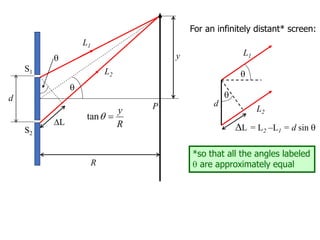
L = L2 –L1 = d sin q
For an infinitely distant* screen:
q
P
S2
S1
L
R
y
L1
L2
q
d
tan
y
R
q 
q
*so that all the angles labeled
q are approximately equal
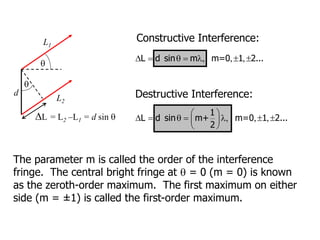
Destructive Interference:
Constructive Interference:
The parameter m is called the order of the interference
fringe. The central bright fringe at q = 0 (m = 0) is known
as the zeroth-order maximum. The first maximum on either
side (m = ±1) is called the first-order maximum.
q
d
L2
L1
L = L2 –L1 = d sin q
q
, , ,
  q    
L d sin m m=0 1 2...
, , ,
 
  q    
 
 
1
L d sin m+ m=0 1 2...
2
q
P
S2
S1
L
R
y
L1
L2
q
d
tan
y
R
q 
 q  q
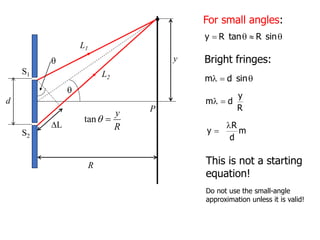
y R tan R sin
Bright fringes:
  q
m d sin
 
y
m d
R


R
y m
d
This is not a starting
equation!
Do not use the small-angle
approximation unless it is valid!
For small angles:
q
P
S2
S1
L
R
y
L1
L2
q
d
tan
y
R
q 
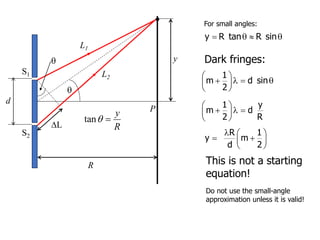
 q  q
y R tan R sin
Dark fringes:
This is not a starting
equation!
 
   q
 
 
1
m d sin
2
 
  
 
 
1 y
m d
2 R
  
 
 
 
R 1
y m
d 2
Do not use the small-angle
approximation unless it is valid!
For small angles:
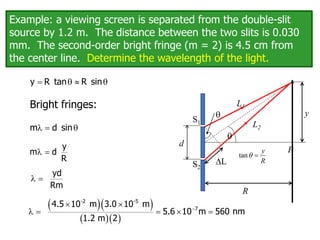
Example: a viewing screen is separated from the double-slit
source by 1.2 m. The distance between the two slits is 0.030
mm. The second-order bright fringe (m = 2) is 4.5 cm from
the center line. Determine the wavelength of the light.
 q  q
y R tan R sin
Bright fringes:
  q
m d sin
 
y
m d
R
 
yd
Rm
  
  

 
    
-2 -5
7
4.5 10 m 3.0 10 m
5.6 10 m 560 nm
1.2 m 2
q
P
S2
S1
L
R
y
L1
L2
q
tan
y
R
q 
d
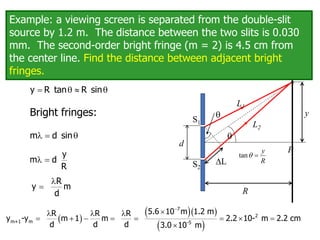
Example: a viewing screen is separated from the double-slit
source by 1.2 m. The distance between the two slits is 0.030
mm. The second-order bright fringe (m = 2) is 4.5 cm from
the center line. Find the distance between adjacent bright
fringes.
 q  q
y R tan R sin
Bright fringes:
  q
m d sin
 
y
m d
R


R
y m
d
 
  
 


  
       

7
2
m+1 m -5
5.6 10 m 1.2 m
R R R
y -y m 1 m 2.2 10- m 2.2 cm
d d d 3.0 10 m
q
P
S2
S1
L
R
y
L1
L2
q
tan
y
R
q 
d
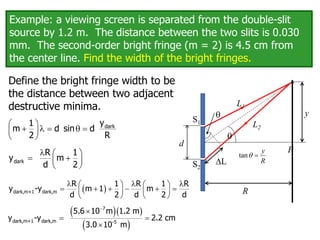
Example: a viewing screen is separated from the double-slit
source by 1.2 m. The distance between the two slits is 0.030
mm. The second-order bright fringe (m = 2) is 4.5 cm from
the center line. Find the width of the bright fringes.
Define the bright fringe width to be
the distance between two adjacent
destructive minima.
 
   q 
 
 
dark
y
1
m d sin d
2 R
  
 
 
 
dark
R 1
y m
d 2
  
 


 

7
dark,m+1 dark,m -5
5.6 10 m 1.2 m
y -y 2.2 cm
3.0 10 m
q
P
S2
S1
L
R
y
L1
L2
q
tan
y
R
q 
 
  
   
     
   
   
dark,m+1 dark,m
R 1 R 1 R
y -y m 1 m
d 2 d 2 d
d
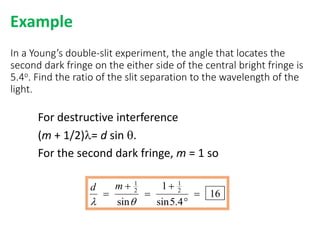
In a Young’s double-slit experiment, the angle that locates the
second dark fringe on the either side of the central bright fringe is
5.4o. Find the ratio of the slit separation to the wavelength of the
light.
For destructive interference
(m + 1/2)= d sin q.
For the second dark fringe, m = 1 so
d m
 q






1
2
1
2
1
5 4
sin sin .
16
Example
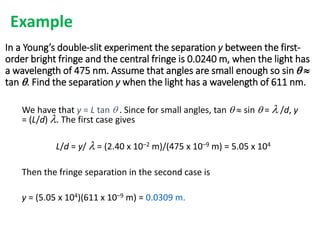
In a Young’s double-slit experiment the separation y between the first-
order bright fringe and the central fringe is 0.0240 m, when the light has
a wavelength of 475 nm. Assume that angles are small enough so sin q 
tan q. Find the separation y when the light has a wavelength of 611 nm.
We have that y = L tan q . Since for small angles, tan q  sin q =  /d, y
= (L/d) . The first case gives
L/d = y/  = (2.40 x 10⁻² m)/(475 x 10–9 m) = 5.05 x 10⁴
Then the fringe separation in the second case is
y = (5.05 x 10⁴)(611 x 10–9 m) = 0.0309 m.
Example
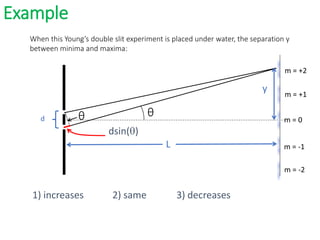
Example
1) increases 2) same 3) decreases
θ
d
L
dsin(q)
θ m = 0
m = +1
m = -1
m = -2
m = +2
y
When this Young’s double slit experiment is placed under water, the separation y
between minima and maxima:
Example
In the Young double slit experiment, is it possible to see interference
maxima when the distance between slits is smaller than the
wavelength of light?
1) Yes 2) No
R or L
d
y
r1
r2
q
P
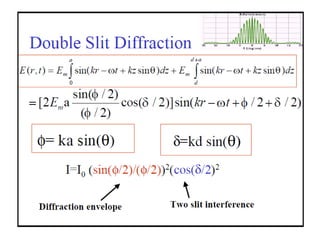
Intensity in Double Slit Interference Pattern
This expression can be transformed using:
sin  + sin  = 2 [sin ( + ) / 2] [cos ( - ) / 2]
with  = t and  = t + 
The electric field at P is E = E1 + E2
E = EP sin (t) + EP sin (t + )
E = EP [sin (t) + sin (t + )]
E = 2 Ep cos ( /2) sin (t +  /2)
R or L
d
y
r1
r2
q
P
Intensity in Double Slit Interference Pattern
The electric field at P is E = E1 + E2
E = 2 Ep cos ( /2) sin (t +  /2)
Path difference is d sin q   / 2 = d sin q /     2
d sin q

E = 2 EP cos [ d sin q / ] sin (t +  /2)
Intensity in Double Slit Interference Pattern
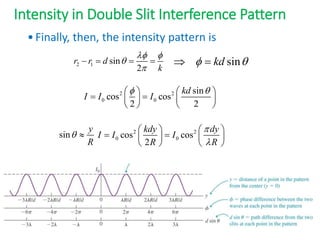
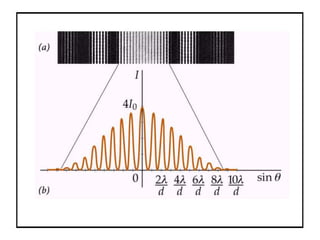
•Finally, then, the intensity pattern is
2 1 sin
2
r r d
k
 
q

    sin
kd
 q
 
2 2
0 0
sin
cos cos
2 2
kd
I I I
 q
   
 
   
   
sin
y
R
q  2 2
0 0
cos cos
2
kdy dy
I I I
R R


   
 
   
   
θ
d
L
θ
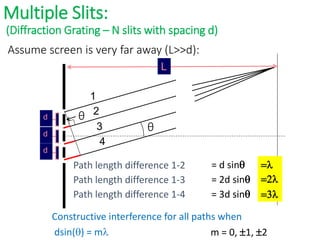
Multiple Slits:
(Diffraction Grating – N slits with spacing d)
Assume screen is very far away (L>>d):
d
d
Path length difference 1-2 = d sinq
Path length difference 1-3 = 2d sinq
Path length difference 1-4 = 3d sinq

2
3
1
2
3
4
Constructive interference for all paths when
dsin(q) = m m = 0, 1, 2
θ
d
L
θ
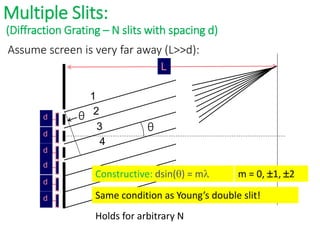
Multiple Slits:
(Diffraction Grating – N slits with spacing d)
Assume screen is very far away (L>>d):
d
d
1
2
3
4
m = 0, 1, 2
Holds for arbitrary N
d
d
d
Constructive: dsin(q) = m
Same condition as Young’s double slit!
θ
d
L
θ
d
1
2
3
Example
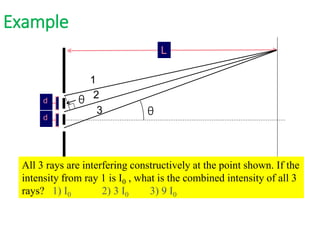
All 3 rays are interfering constructively at the point shown. If the
intensity from ray 1 is I0 , what is the combined intensity of all 3
rays? 1) I0 2) 3 I0 3) 9 I0
θ
d
L
θ
d
1
2
3
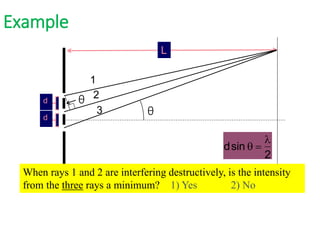
Example
When rays 1 and 2 are interfering destructively, is the intensity
from the three rays a minimum? 1) Yes 2) No
dsin q 

2

3

2
3

2

3
2
3

2
dsin q 
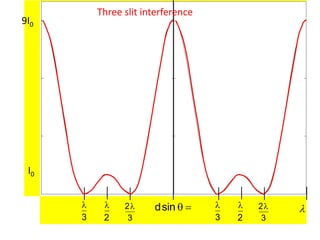
Three slit interference
I0
9I0
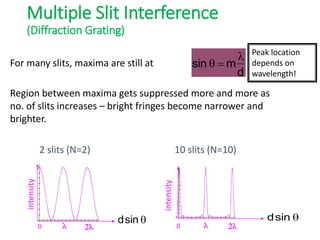
For many slits, maxima are still at sin q  m

d
Region between maxima gets suppressed more and more as
no. of slits increases – bright fringes become narrower and
brighter.
10 slits (N=10)
dsin q
intensity
 2
0
2 slits (N=2)
dsin q
intensity
 2
0
Multiple Slit Interference
(Diffraction Grating)
Peak location
depends on
wavelength!
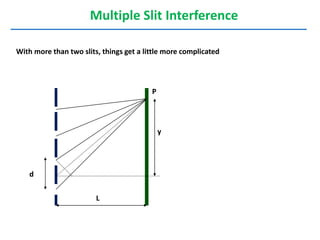
With more than two slits, things get a little more complicated
L
d
y
P
Multiple Slit Interference
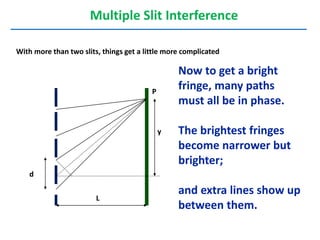
With more than two slits, things get a little more complicated
L
d
y
P
Now to get a bright
fringe, many paths
must all be in phase.
The brightest fringes
become narrower but
brighter;
and extra lines show up
between them.
Now to get a bright
fringe, many paths
must all be in phase.
The brightest fringes
become narrower but
brighter;
and extra lines show up
between them.
Multiple Slit Interference
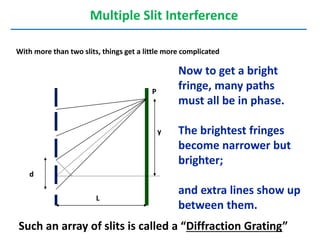
With more than two slits, things get a little more complicated
L
d
y
P
Such an array of slits is called a “Diffraction Grating”
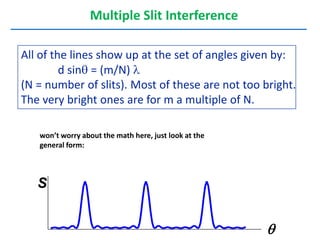
All of the lines show up at the set of angles given by:
d sinq = (m/N) 
(N = number of slits). Most of these are not too bright.
The very bright ones are for m a multiple of N.
won’t worry about the math here, just look at the
general form:
S
q
Multiple Slit Interference
Thin Film Interference
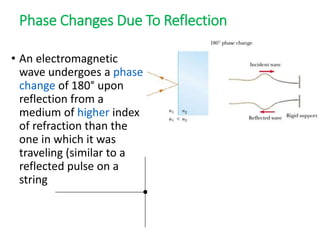
Phase Changes Due To Reflection
• An electromagnetic
wave undergoes a phase
change of 180° upon
reflection from a
medium of higher index
of refraction than the
one in which it was
traveling (similar to a
reflected pulse on a
string
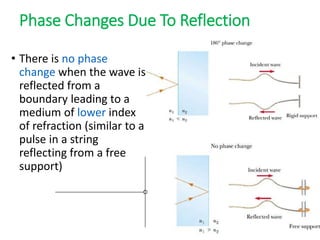
Phase Changes Due To Reflection
• There is no phase
change when the wave is
reflected from a
boundary leading to a
medium of lower index
of refraction (similar to a
pulse in a string
reflecting from a free
support)
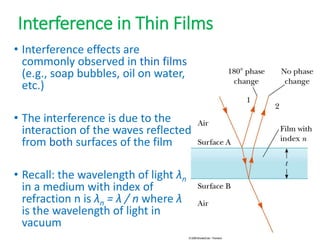
Interference in Thin Films
• Interference effects are
commonly observed in thin films
(e.g., soap bubbles, oil on water,
etc.)
• The interference is due to the
interaction of the waves reflected
from both surfaces of the film
• Recall: the wavelength of light λn
in a medium with index of
refraction n is λn = λ / n where λ
is the wavelength of light in
vacuum
Interference in Thin Films
• Recall: an electromagnetic wave
traveling from a medium of index
of refraction n1 toward a medium
of index of refraction n2
undergoes a 180° phase change
on reflection when n2 > n1 and
there is no phase change in the
reflected wave if n2 < n1
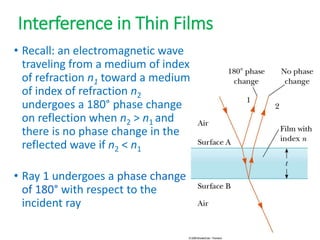
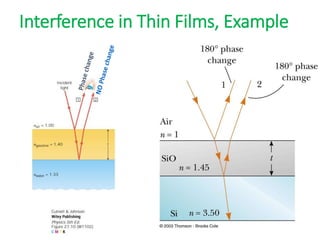
• Ray 1 undergoes a phase change
of 180° with respect to the
incident ray
Interference in Thin Films
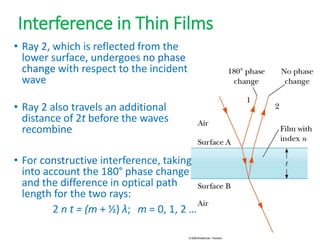
• Ray 2, which is reflected from the
lower surface, undergoes no phase
change with respect to the incident
wave
• Ray 2 also travels an additional
distance of 2t before the waves
recombine
• For constructive interference, taking
into account the 180° phase change
and the difference in optical path
length for the two rays:
2 n t = (m + ½) λ; m = 0, 1, 2 …
Interference in Thin Films
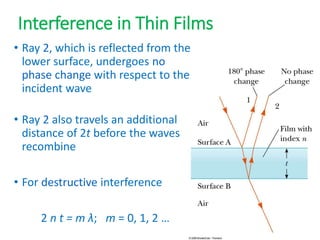
• Ray 2, which is reflected from the
lower surface, undergoes no
phase change with respect to the
incident wave
• Ray 2 also travels an additional
distance of 2t before the waves
recombine
• For destructive interference
2 n t = m λ; m = 0, 1, 2 …
Interference in Thin Films
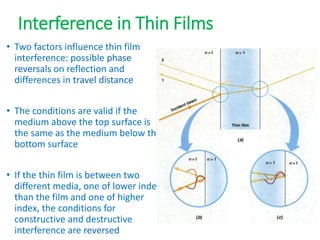
• Two factors influence thin film
interference: possible phase
reversals on reflection and
differences in travel distance
• The conditions are valid if the
medium above the top surface is
the same as the medium below the
bottom surface
• If the thin film is between two
different media, one of lower index
than the film and one of higher
index, the conditions for
constructive and destructive
interference are reversed
Interference in Thin Films, Example
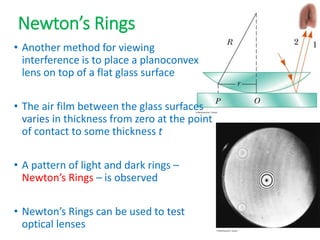
Newton’s Rings
• Another method for viewing
interference is to place a planoconvex
lens on top of a flat glass surface
• The air film between the glass surfaces
varies in thickness from zero at the point
of contact to some thickness t
• A pattern of light and dark rings –
Newton’s Rings – is observed
• Newton’s Rings can be used to test
optical lenses
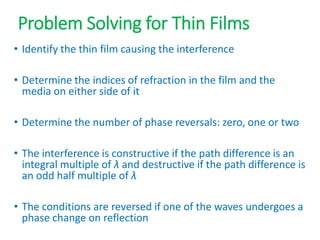
Problem Solving for Thin Films
• Identify the thin film causing the interference
• Determine the indices of refraction in the film and the
media on either side of it
• Determine the number of phase reversals: zero, one or two
• The interference is constructive if the path difference is an
integral multiple of λ and destructive if the path difference is
an odd half multiple of λ
• The conditions are reversed if one of the waves undergoes a
phase change on reflection
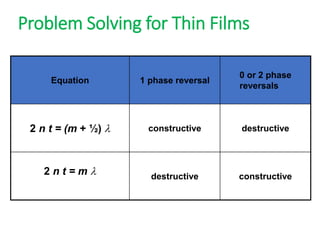
Problem Solving for Thin Films
Equation 1 phase reversal
0 or 2 phase
reversals
2 n t = (m + ½)  constructive destructive
2 n t = m  destructive constructive
Interference in Thin Films
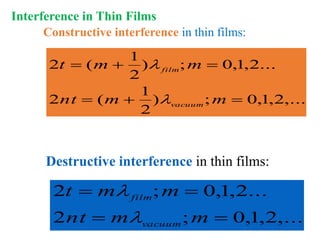
Constructive interference in thin films:
,...
2
,
1
,
0
;
2
...
2
,
1
,
0
;
2




m
m
nt
m
m
t
vacuum
film


,...
2
,
1
,
0
;
)
2
1
(
2
...
2
,
1
,
0
;
)
2
1
(
2






m
m
nt
m
m
t
vacuum
film


Destructive interference in thin films:
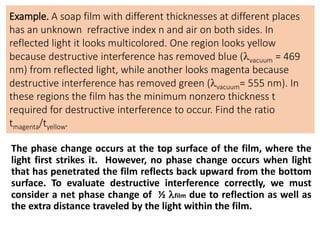
Example. A soap film with different thicknesses at different places
has an unknown refractive index n and air on both sides. In
reflected light it looks multicolored. One region looks yellow
because destructive interference has removed blue (vacuum = 469
nm) from reflected light, while another looks magenta because
destructive interference has removed green (vacuum= 555 nm). In
these regions the film has the minimum nonzero thickness t
required for destructive interference to occur. Find the ratio
tmagenta/tyellow.
The phase change occurs at the top surface of the film, where the
light first strikes it. However, no phase change occurs when light
that has penetrated the film reflects back upward from the bottom
surface. To evaluate destructive interference correctly, we must
consider a net phase change of ½ film due to reflection as well as
the extra distance traveled by the light within the film.
##. Solution
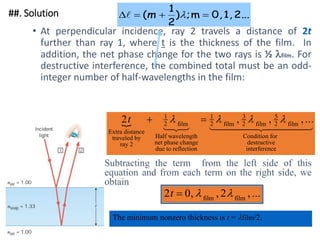
• At perpendicular incidence, ray 2 travels a distance of 2t
further than ray 1, where t is the thickness of the film. In
addition, the net phase change for the two rays is ½ film. For
destructive interference, the combined total must be an odd-
integer number of half-wavelengths in the film:
• Subtracting the term from the left side of this
equation and from each term on the right side, we
obtain
2 1
2
1
2
3
2
5
2
t
Extra distance
traveled by
ray 2
film
Half wavelength
net phase change
due to reflection
film film film
Condition for
destructive
interference
 

  

 

 
   
, , , ...
2 0 2
t  , , ,...
 
film film
The minimum nonzero thickness is t = film/2.
.
2..
1,
0,
m
;
)
2
1
( 


 
m

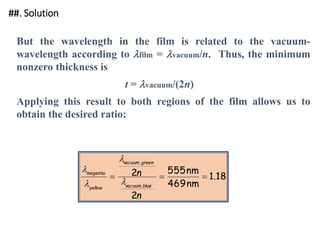
But the wavelength in the film is related to the vacuum-
wavelength according to film = vacuum/n. Thus, the minimum
nonzero thickness is
t = vacuum/(2n)
Applying this result to both regions of the film allows us to
obtain the desired ratio:
##. Solution
18
.
1
nm
469
nm
555
2
2
,
,



n
n
blue
vacuum
green
vacuum
yellow
magenta




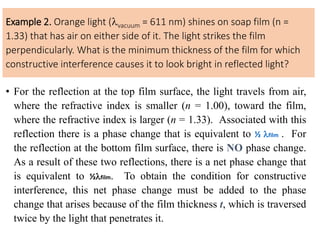
Example 2. Orange light (vacuum = 611 nm) shines on soap film (n =
1.33) that has air on either side of it. The light strikes the film
perpendicularly. What is the minimum thickness of the film for which
constructive interference causes it to look bright in reflected light?
• For the reflection at the top film surface, the light travels from air,
where the refractive index is smaller (n = 1.00), toward the film,
where the refractive index is larger (n = 1.33). Associated with this
reflection there is a phase change that is equivalent to ½ film . For
the reflection at the bottom film surface, there is NO phase change.
As a result of these two reflections, there is a net phase change that
is equivalent to ½film. To obtain the condition for constructive
interference, this net phase change must be added to the phase
change that arises because of the film thickness t, which is traversed
twice by the light that penetrates it.
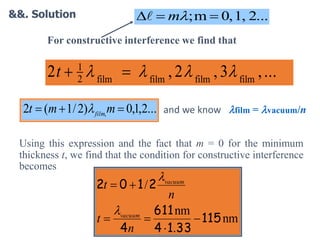
For constructive interference we find that
Using this expression and the fact that m = 0 for the minimum
thickness t, we find that the condition for constructive interference
becomes
&&. Solution
2 2 3
1
2
t  
   
film film film film
, , ,...
...
2
,
1
,
0
)
2
/
1
(
2 , 

 m
m
t film
 and we know film = vacuum/n
nm
.
nm
/
115
33
1
4
611
4
2
1
0
2






n
t
n
t
vacuum
vacuum


.
2..
1,
0,
m
; 

 
m

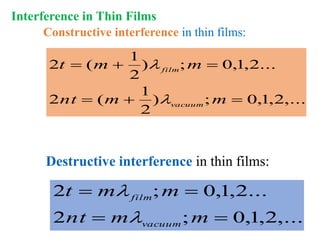
Interference in Thin Films
Constructive interference in thin films:
,...
2
,
1
,
0
;
2
...
2
,
1
,
0
;
2




m
m
nt
m
m
t
vacuum
film


,...
2
,
1
,
0
;
)
2
1
(
2
...
2
,
1
,
0
;
)
2
1
(
2






m
m
nt
m
m
t
vacuum
film


Destructive interference in thin films:
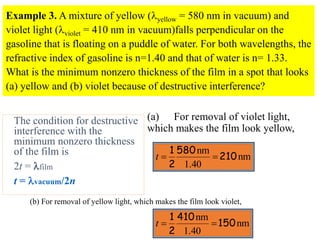
Example 3. A mixture of yellow (yellow = 580 nm in vacuum) and
violet light (violet = 410 nm in vacuum)falls perpendicular on the
gasoline that is floating on a puddle of water. For both wavelengths, the
refractive index of gasoline is n=1.40 and that of water is n= 1.33.
What is the minimum nonzero thickness of the film in a spot that looks
(a) yellow and (b) violet because of destructive interference?
The condition for destructive
interference with the
minimum nonzero thickness
of the film is
2t = film
t = vacuum/2n
(a) For removal of violet light,
which makes the film look yellow,
nm
1.40
nm
210
580
2
1


t
(b) For removal of yellow light, which makes the film look violet,
nm
1.40
nm
150
410
2
1


t
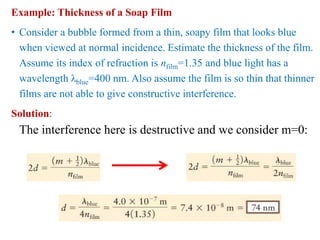
Example: Thickness of a Soap Film
• Consider a bubble formed from a thin, soapy film that looks blue
when viewed at normal incidence. Estimate the thickness of the film.
Assume its index of refraction is nfilm=1.35 and blue light has a
wavelength λblue=400 nm. Also assume the film is so thin that thinner
films are not able to give constructive interference.
Solution:
The interference here is destructive and we consider m=0:
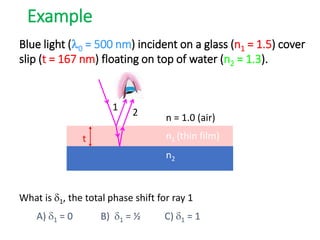
Example
n1 (thin film)
n2
n = 1.0 (air)
t
1 2
Blue light (0 = 500 nm) incident on a glass (n1 = 1.5) cover
slip (t = 167 nm) floating on top of water (n2 = 1.3).
A) d1 = 0 B) d1 = ½ C) d1 = 1
What is d1, the total phase shift for ray 1
Is the interference constructive or destructive or neither?
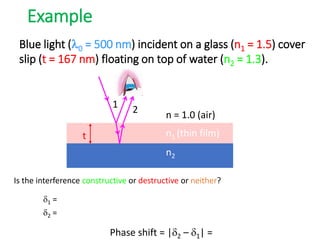
Example
n1 (thin film)
n2
n = 1.0 (air)
t
1 2
Blue light (0 = 500 nm) incident on a glass (n1 = 1.5) cover
slip (t = 167 nm) floating on top of water (n2 = 1.3).
d1 =
d2 =
Phase shift = |d2 – d1| =
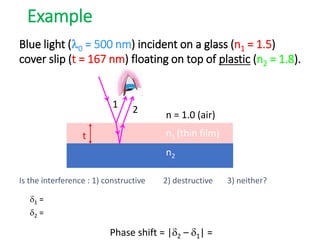
Example
n1 (thin film)
n2
n = 1.0 (air)
t
1 2
Blue light (0 = 500 nm) incident on a glass (n1 = 1.5)
cover slip (t = 167 nm) floating on top of plastic (n2 = 1.8).
d1 =
d2 =
Phase shift = |d2 – d1| =
Is the interference : 1) constructive 2) destructive 3) neither?
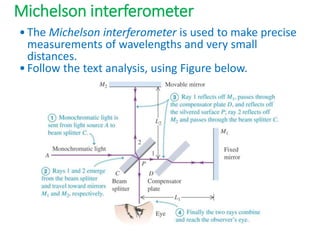
Michelson interferometer
•The Michelson interferometer is used to make precise
measurements of wavelengths and very small
distances.
•Follow the text analysis, using Figure below.
Diffraction
Diffraction
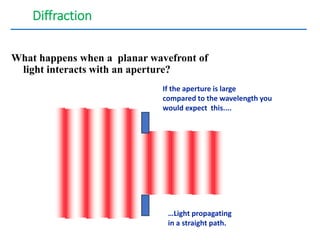
What happens when a planar wavefront of
light interacts with an aperture?
If the aperture is large
compared to the wavelength you
would expect this....
…Light propagating
in a straight path.
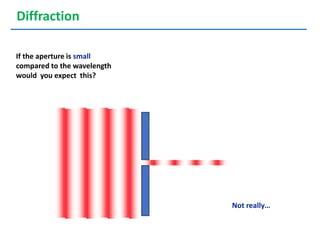
If the aperture is small
compared to the wavelength
would you expect this?
Diffraction
Not really…
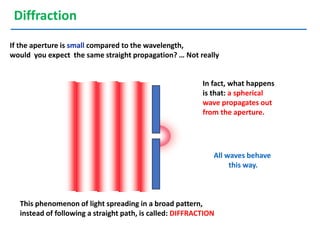
In fact, what happens
is that: a spherical
wave propagates out
from the aperture.
All waves behave
this way.
Diffraction
This phenomenon of light spreading in a broad pattern,
instead of following a straight path, is called: DIFFRACTION
If the aperture is small compared to the wavelength,
would you expect the same straight propagation? … Not really
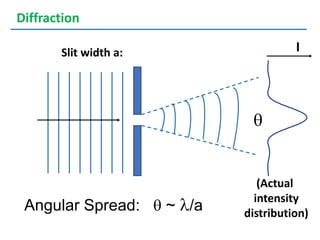
Angular Spread: q ~ /a
Slit width a:
q
I
(Actual
intensity
distribution)
Diffraction
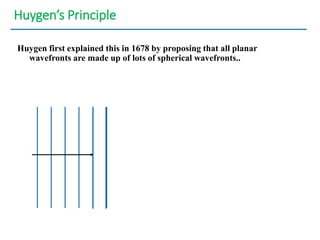
Huygen’s Principle
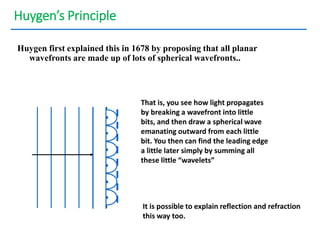
Huygen first explained this in 1678 by proposing that all planar
wavefronts are made up of lots of spherical wavefronts..
Huygen’s Principle
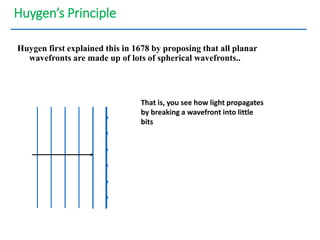
Huygen first explained this in 1678 by proposing that all planar
wavefronts are made up of lots of spherical wavefronts..
That is, you see how light propagates
by breaking a wavefront into little
bits
Huygen’s Principle
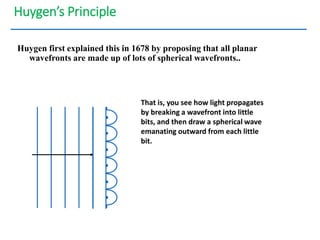
Huygen first explained this in 1678 by proposing that all planar
wavefronts are made up of lots of spherical wavefronts..
That is, you see how light propagates
by breaking a wavefront into little
bits, and then draw a spherical wave
emanating outward from each little
bit.
Huygen’s Principle
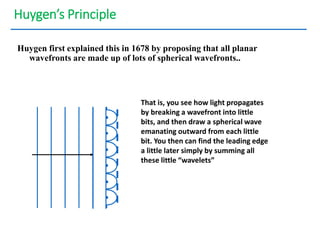
Huygen first explained this in 1678 by proposing that all planar
wavefronts are made up of lots of spherical wavefronts..
That is, you see how light propagates
by breaking a wavefront into little
bits, and then draw a spherical wave
emanating outward from each little
bit. You then can find the leading edge
a little later simply by summing all
these little “wavelets”
Huygen’s Principle
Huygen first explained this in 1678 by proposing that all planar
wavefronts are made up of lots of spherical wavefronts..
That is, you see how light propagates
by breaking a wavefront into little
bits, and then draw a spherical wave
emanating outward from each little
bit. You then can find the leading edge
a little later simply by summing all
these little “wavelets”
It is possible to explain reflection and refraction
this way too.
Diffraction at Edges
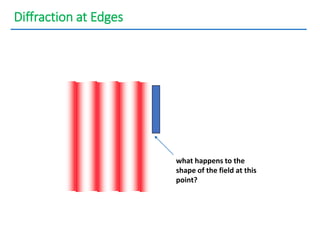
what happens to the
shape of the field at this
point?
Diffraction at Edges
I
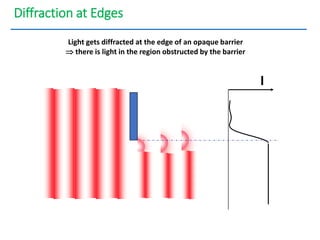
Light gets diffracted at the edge of an opaque barrier
 there is light in the region obstructed by the barrier
Diffraction
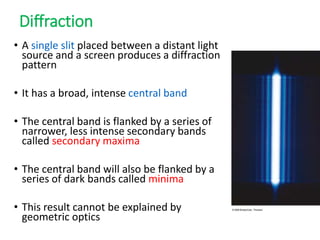
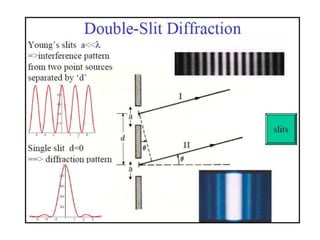
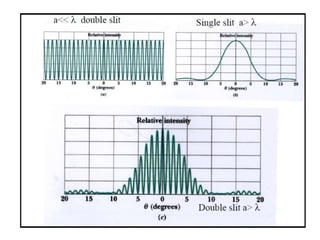
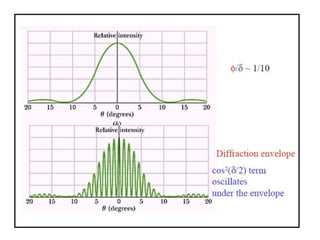
• A single slit placed between a distant light
source and a screen produces a diffraction
pattern
• It has a broad, intense central band
• The central band is flanked by a series of
narrower, less intense secondary bands
called secondary maxima
• The central band will also be flanked by a
series of dark bands called minima
• This result cannot be explained by
geometric optics
Single Slit Diffraction
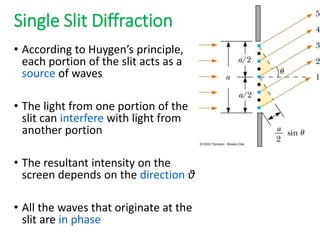
• According to Huygen’s principle,
each portion of the slit acts as a
source of waves
• The light from one portion of the
slit can interfere with light from
another portion
• The resultant intensity on the
screen depends on the direction θ
• All the waves that originate at the
slit are in phase
Single Slit Diffraction
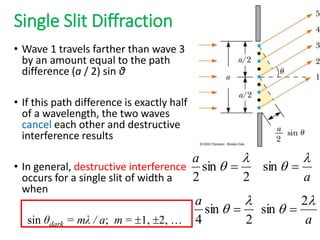
• Wave 1 travels farther than wave 3
by an amount equal to the path
difference (a / 2) sin θ
• If this path difference is exactly half
of a wavelength, the two waves
cancel each other and destructive
interference results
• In general, destructive interference
occurs for a single slit of width a
when
sin θdark = mλ / a; m = 1, 2, …
2
sin
2

q 
a
a

q 
sin
a

q
2
sin 
2
sin
4

q 
a
Single Slit Diffraction
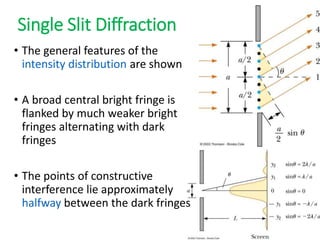
• The general features of the
intensity distribution are shown
• A broad central bright fringe is
flanked by much weaker bright
fringes alternating with dark
fringes
• The points of constructive
interference lie approximately
halfway between the dark fringes
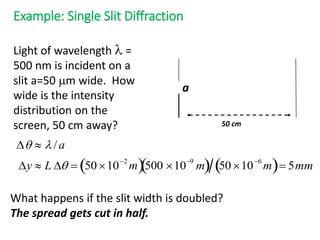
Example: Single Slit Diffraction
a
50 cm
Light of wavelength  =
500 nm is incident on a
slit a=50 mm wide. How
wide is the intensity
distribution on the
screen, 50 cm away?
q   /a
y  L q  50 102
m
 500 109
m
  50 106
m
  5mm
What happens if the slit width is doubled?
The spread gets cut in half.
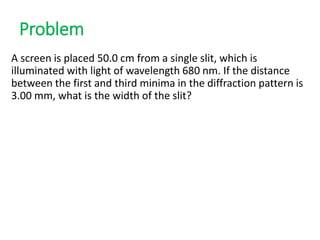
Problem
A screen is placed 50.0 cm from a single slit, which is
illuminated with light of wavelength 680 nm. If the distance
between the first and third minima in the diffraction pattern is
3.00 mm, what is the width of the slit?
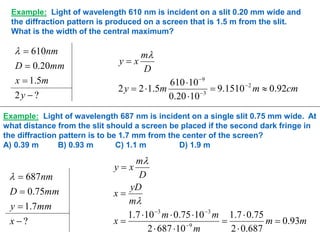
Example: Light of wavelength 610 nm is incident on a slit 0.20 mm wide and
the diffraction pattern is produced on a screen that is 1.5 m from the slit.
What is the width of the central maximum?
cm
m
m
y
D
m
x
y
92
.
0
1510
.
9
10
20
.
0
10
610
5
.
1
2
2 2
3
9











?
2
5
.
1
20
.
0
610




y
m
x
mm
D
nm

Example: Light of wavelength 687 nm is incident on a single slit 0.75 mm wide. At
what distance from the slit should a screen be placed if the second dark fringe in
the diffraction pattern is to be 1.7 mm from the center of the screen?
A) 0.39 m B) 0.93 m C) 1.1 m D) 1.9 m
m
m
m
m
m
x
m
yD
x
D
m
x
y
93
.
0
687
.
0
2
75
.
0
7
.
1
10
687
2
10
75
.
0
10
7
.
1
9
3
3

















?
7
.
1
75
.
0
687




x
mm
y
mm
D
nm

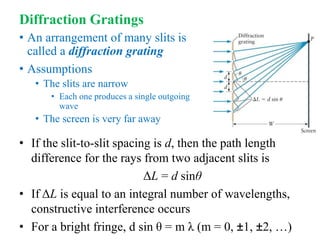
Diffraction Gratings
• An arrangement of many slits is
called a diffraction grating
• Assumptions
• The slits are narrow
• Each one produces a single outgoing
wave
• The screen is very far away
• If the slit-to-slit spacing is d, then the path length
difference for the rays from two adjacent slits is
ΔL = d sinθ
• If ΔL is equal to an integral number of wavelengths,
constructive interference occurs
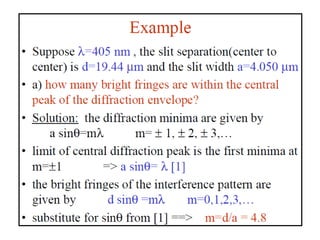
• For a bright fringe, d sin θ = m λ (m = 0, ±1, ±2, …)
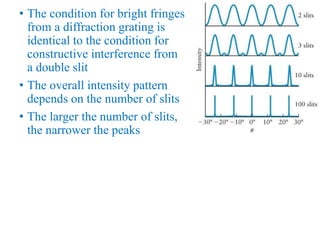
• The condition for bright fringes
from a diffraction grating is
identical to the condition for
constructive interference from
a double slit
• The overall intensity pattern
depends on the number of slits
• The larger the number of slits,
the narrower the peaks
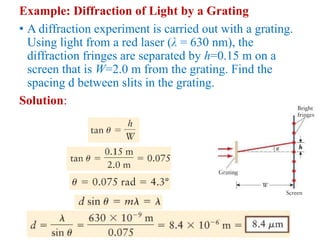
Example: Diffraction of Light by a Grating
• A diffraction experiment is carried out with a grating.
Using light from a red laser (λ = 630 nm), the
diffraction fringes are separated by h=0.15 m on a
screen that is W=2.0 m from the grating. Find the
spacing d between slits in the grating.
Solution:

AN INTRODUCTION TO ENGINEERRING Optics.pptx

  • 1.
  • 2.
    Interference • Why dosoap bubbles show vibrant color patterns, even though soapy water is colorless? • What causes the multicolored reflections from DVDs? • We will now look at optical effects, such as interference, that depend on the wave nature of light.
  • 3.
    Waves Wave: • variation (disturbance)of physical quantity that propagates through space y(x,t) A sin (kx ωt) .   • phase of this wave θ(x,t) kx ωt .   y x • often: oscillation in space and time Superposition principle: When two or more waves overlap, the resultant displacement at any instant is the sum of the displacements of each of the individual waves.
  • 4.
    Constructive and destructiveinterference • Constructive interference occurs when the path difference is an integral number of wavelengths. • Destructive interference occurs when the path difference is a half-integral number of wavelengths. 3... 2, 1, 0, m where , 1 2     m   3... 2, 1, 0, m where , ) 2 1 ( 1 2      m  
  • 5.
    Interference Requirements • Needtwo (or more) waves • Must have same frequency • Must be coherent (i.e. waves must have definite phase relation)
  • 6.
    Demo: Interference forSound … For example, a pair of speakers, driven in phase, producing a tone of a single f and : l1 l2 But this won’t work for light--can’t get coherent sources hmmm… I’m just far enough away that l2- l1=/2, and I hear no sound at all!
  • 7.
    Interference for Light… • Can’t produce coherent light from separate sources. (f  1014 Hz) • Need two waves from single source taking two different paths – Two slits – Reflection (thin films) – Diffraction*
  • 8.
    Young’s double slit/rays Brightspots Shadow This is not what is actually seen! Monochromatic light travels through 2 slits onto a screen What pattern emerges on the screen?
  • 9.
    Young’s double slit/Huygens RecallHuygens’ principle: Every point on a wave front acts as a source of tiny wavelets that move forward. • • Wave crests in phase = constructive interference Bright and dark spots on screen! Constructive = bright Destructive = dark
  • 10.
    • • Young’s double slit:Key idea Key for interference is this small extra distance. Consider two rays traveling at an angle q: θ Bottom ray travels a little further (2 in this case)
  • 11.
    q d L2 L1 L = L2–L1 = d sin q For an infinitely distant* screen: q P S2 S1 L R y L1 L2 q d tan y R q  q *so that all the angles labeled q are approximately equal
  • 12.
    Destructive Interference: Constructive Interference: Theparameter m is called the order of the interference fringe. The central bright fringe at q = 0 (m = 0) is known as the zeroth-order maximum. The first maximum on either side (m = ±1) is called the first-order maximum. q d L2 L1 L = L2 –L1 = d sin q q , , ,   q     L d sin m m=0 1 2... , , ,     q         1 L d sin m+ m=0 1 2... 2
  • 13.
    q P S2 S1 L R y L1 L2 q d tan y R q   q q y R tan R sin Bright fringes:   q m d sin   y m d R   R y m d This is not a starting equation! Do not use the small-angle approximation unless it is valid! For small angles:
  • 14.
    q P S2 S1 L R y L1 L2 q d tan y R q   q q y R tan R sin Dark fringes: This is not a starting equation!      q     1 m d sin 2          1 y m d 2 R          R 1 y m d 2 Do not use the small-angle approximation unless it is valid! For small angles:
  • 15.
    Example: a viewingscreen is separated from the double-slit source by 1.2 m. The distance between the two slits is 0.030 mm. The second-order bright fringe (m = 2) is 4.5 cm from the center line. Determine the wavelength of the light.  q  q y R tan R sin Bright fringes:   q m d sin   y m d R   yd Rm               -2 -5 7 4.5 10 m 3.0 10 m 5.6 10 m 560 nm 1.2 m 2 q P S2 S1 L R y L1 L2 q tan y R q  d
  • 16.
    Example: a viewingscreen is separated from the double-slit source by 1.2 m. The distance between the two slits is 0.030 mm. The second-order bright fringe (m = 2) is 4.5 cm from the center line. Find the distance between adjacent bright fringes.  q  q y R tan R sin Bright fringes:   q m d sin   y m d R   R y m d                      7 2 m+1 m -5 5.6 10 m 1.2 m R R R y -y m 1 m 2.2 10- m 2.2 cm d d d 3.0 10 m q P S2 S1 L R y L1 L2 q tan y R q  d
  • 17.
    Example: a viewingscreen is separated from the double-slit source by 1.2 m. The distance between the two slits is 0.030 mm. The second-order bright fringe (m = 2) is 4.5 cm from the center line. Find the width of the bright fringes. Define the bright fringe width to be the distance between two adjacent destructive minima.      q      dark y 1 m d sin d 2 R          dark R 1 y m d 2           7 dark,m+1 dark,m -5 5.6 10 m 1.2 m y -y 2.2 cm 3.0 10 m q P S2 S1 L R y L1 L2 q tan y R q                         dark,m+1 dark,m R 1 R 1 R y -y m 1 m d 2 d 2 d d
  • 18.
    In a Young’sdouble-slit experiment, the angle that locates the second dark fringe on the either side of the central bright fringe is 5.4o. Find the ratio of the slit separation to the wavelength of the light. For destructive interference (m + 1/2)= d sin q. For the second dark fringe, m = 1 so d m  q       1 2 1 2 1 5 4 sin sin . 16 Example
  • 19.
    In a Young’sdouble-slit experiment the separation y between the first- order bright fringe and the central fringe is 0.0240 m, when the light has a wavelength of 475 nm. Assume that angles are small enough so sin q  tan q. Find the separation y when the light has a wavelength of 611 nm. We have that y = L tan q . Since for small angles, tan q  sin q =  /d, y = (L/d) . The first case gives L/d = y/  = (2.40 x 10⁻² m)/(475 x 10–9 m) = 5.05 x 10⁴ Then the fringe separation in the second case is y = (5.05 x 10⁴)(611 x 10–9 m) = 0.0309 m. Example
  • 20.
    Example 1) increases 2)same 3) decreases θ d L dsin(q) θ m = 0 m = +1 m = -1 m = -2 m = +2 y When this Young’s double slit experiment is placed under water, the separation y between minima and maxima:
  • 21.
    Example In the Youngdouble slit experiment, is it possible to see interference maxima when the distance between slits is smaller than the wavelength of light? 1) Yes 2) No
  • 22.
    R or L d y r1 r2 q P Intensityin Double Slit Interference Pattern This expression can be transformed using: sin  + sin  = 2 [sin ( + ) / 2] [cos ( - ) / 2] with  = t and  = t +  The electric field at P is E = E1 + E2 E = EP sin (t) + EP sin (t + ) E = EP [sin (t) + sin (t + )] E = 2 Ep cos ( /2) sin (t +  /2)
  • 23.
    R or L d y r1 r2 q P Intensityin Double Slit Interference Pattern The electric field at P is E = E1 + E2 E = 2 Ep cos ( /2) sin (t +  /2) Path difference is d sin q   / 2 = d sin q /     2 d sin q  E = 2 EP cos [ d sin q / ] sin (t +  /2)
  • 24.
    Intensity in DoubleSlit Interference Pattern •Finally, then, the intensity pattern is 2 1 sin 2 r r d k   q      sin kd  q   2 2 0 0 sin cos cos 2 2 kd I I I  q               sin y R q  2 2 0 0 cos cos 2 kdy dy I I I R R                
  • 25.
    θ d L θ Multiple Slits: (Diffraction Grating– N slits with spacing d) Assume screen is very far away (L>>d): d d Path length difference 1-2 = d sinq Path length difference 1-3 = 2d sinq Path length difference 1-4 = 3d sinq  2 3 1 2 3 4 Constructive interference for all paths when dsin(q) = m m = 0, 1, 2
  • 26.
    θ d L θ Multiple Slits: (Diffraction Grating– N slits with spacing d) Assume screen is very far away (L>>d): d d 1 2 3 4 m = 0, 1, 2 Holds for arbitrary N d d d Constructive: dsin(q) = m Same condition as Young’s double slit!
  • 27.
    θ d L θ d 1 2 3 Example All 3 raysare interfering constructively at the point shown. If the intensity from ray 1 is I0 , what is the combined intensity of all 3 rays? 1) I0 2) 3 I0 3) 9 I0
  • 28.
    θ d L θ d 1 2 3 Example When rays 1and 2 are interfering destructively, is the intensity from the three rays a minimum? 1) Yes 2) No dsin q   2
  • 29.
  • 30.
    For many slits,maxima are still at sin q  m  d Region between maxima gets suppressed more and more as no. of slits increases – bright fringes become narrower and brighter. 10 slits (N=10) dsin q intensity  2 0 2 slits (N=2) dsin q intensity  2 0 Multiple Slit Interference (Diffraction Grating) Peak location depends on wavelength!
  • 31.
    With more thantwo slits, things get a little more complicated L d y P Multiple Slit Interference
  • 32.
    Multiple Slit Interference Withmore than two slits, things get a little more complicated L d y P Now to get a bright fringe, many paths must all be in phase. The brightest fringes become narrower but brighter; and extra lines show up between them.
  • 33.
    Now to geta bright fringe, many paths must all be in phase. The brightest fringes become narrower but brighter; and extra lines show up between them. Multiple Slit Interference With more than two slits, things get a little more complicated L d y P Such an array of slits is called a “Diffraction Grating”
  • 34.
    All of thelines show up at the set of angles given by: d sinq = (m/N)  (N = number of slits). Most of these are not too bright. The very bright ones are for m a multiple of N. won’t worry about the math here, just look at the general form: S q Multiple Slit Interference
  • 35.
  • 36.
    Phase Changes DueTo Reflection • An electromagnetic wave undergoes a phase change of 180° upon reflection from a medium of higher index of refraction than the one in which it was traveling (similar to a reflected pulse on a string
  • 37.
    Phase Changes DueTo Reflection • There is no phase change when the wave is reflected from a boundary leading to a medium of lower index of refraction (similar to a pulse in a string reflecting from a free support)
  • 38.
  • 39.
    Interference in ThinFilms • Interference effects are commonly observed in thin films (e.g., soap bubbles, oil on water, etc.) • The interference is due to the interaction of the waves reflected from both surfaces of the film • Recall: the wavelength of light λn in a medium with index of refraction n is λn = λ / n where λ is the wavelength of light in vacuum
  • 40.
    Interference in ThinFilms • Recall: an electromagnetic wave traveling from a medium of index of refraction n1 toward a medium of index of refraction n2 undergoes a 180° phase change on reflection when n2 > n1 and there is no phase change in the reflected wave if n2 < n1 • Ray 1 undergoes a phase change of 180° with respect to the incident ray
  • 41.
    Interference in ThinFilms • Ray 2, which is reflected from the lower surface, undergoes no phase change with respect to the incident wave • Ray 2 also travels an additional distance of 2t before the waves recombine • For constructive interference, taking into account the 180° phase change and the difference in optical path length for the two rays: 2 n t = (m + ½) λ; m = 0, 1, 2 …
  • 42.
    Interference in ThinFilms • Ray 2, which is reflected from the lower surface, undergoes no phase change with respect to the incident wave • Ray 2 also travels an additional distance of 2t before the waves recombine • For destructive interference 2 n t = m λ; m = 0, 1, 2 …
  • 43.
    Interference in ThinFilms • Two factors influence thin film interference: possible phase reversals on reflection and differences in travel distance • The conditions are valid if the medium above the top surface is the same as the medium below the bottom surface • If the thin film is between two different media, one of lower index than the film and one of higher index, the conditions for constructive and destructive interference are reversed
  • 44.
    Interference in ThinFilms, Example
  • 45.
    Newton’s Rings • Anothermethod for viewing interference is to place a planoconvex lens on top of a flat glass surface • The air film between the glass surfaces varies in thickness from zero at the point of contact to some thickness t • A pattern of light and dark rings – Newton’s Rings – is observed • Newton’s Rings can be used to test optical lenses
  • 46.
    Problem Solving forThin Films • Identify the thin film causing the interference • Determine the indices of refraction in the film and the media on either side of it • Determine the number of phase reversals: zero, one or two • The interference is constructive if the path difference is an integral multiple of λ and destructive if the path difference is an odd half multiple of λ • The conditions are reversed if one of the waves undergoes a phase change on reflection
  • 47.
    Problem Solving forThin Films Equation 1 phase reversal 0 or 2 phase reversals 2 n t = (m + ½)  constructive destructive 2 n t = m  destructive constructive
  • 48.
    Interference in ThinFilms Constructive interference in thin films: ,... 2 , 1 , 0 ; 2 ... 2 , 1 , 0 ; 2     m m nt m m t vacuum film   ,... 2 , 1 , 0 ; ) 2 1 ( 2 ... 2 , 1 , 0 ; ) 2 1 ( 2       m m nt m m t vacuum film   Destructive interference in thin films:
  • 49.
    Example. A soapfilm with different thicknesses at different places has an unknown refractive index n and air on both sides. In reflected light it looks multicolored. One region looks yellow because destructive interference has removed blue (vacuum = 469 nm) from reflected light, while another looks magenta because destructive interference has removed green (vacuum= 555 nm). In these regions the film has the minimum nonzero thickness t required for destructive interference to occur. Find the ratio tmagenta/tyellow. The phase change occurs at the top surface of the film, where the light first strikes it. However, no phase change occurs when light that has penetrated the film reflects back upward from the bottom surface. To evaluate destructive interference correctly, we must consider a net phase change of ½ film due to reflection as well as the extra distance traveled by the light within the film.
  • 50.
    ##. Solution • Atperpendicular incidence, ray 2 travels a distance of 2t further than ray 1, where t is the thickness of the film. In addition, the net phase change for the two rays is ½ film. For destructive interference, the combined total must be an odd- integer number of half-wavelengths in the film: • Subtracting the term from the left side of this equation and from each term on the right side, we obtain 2 1 2 1 2 3 2 5 2 t Extra distance traveled by ray 2 film Half wavelength net phase change due to reflection film film film Condition for destructive interference                 , , , ... 2 0 2 t  , , ,...   film film The minimum nonzero thickness is t = film/2. . 2.. 1, 0, m ; ) 2 1 (      m 
  • 51.
    But the wavelengthin the film is related to the vacuum- wavelength according to film = vacuum/n. Thus, the minimum nonzero thickness is t = vacuum/(2n) Applying this result to both regions of the film allows us to obtain the desired ratio: ##. Solution 18 . 1 nm 469 nm 555 2 2 , ,    n n blue vacuum green vacuum yellow magenta    
  • 52.
    Example 2. Orangelight (vacuum = 611 nm) shines on soap film (n = 1.33) that has air on either side of it. The light strikes the film perpendicularly. What is the minimum thickness of the film for which constructive interference causes it to look bright in reflected light? • For the reflection at the top film surface, the light travels from air, where the refractive index is smaller (n = 1.00), toward the film, where the refractive index is larger (n = 1.33). Associated with this reflection there is a phase change that is equivalent to ½ film . For the reflection at the bottom film surface, there is NO phase change. As a result of these two reflections, there is a net phase change that is equivalent to ½film. To obtain the condition for constructive interference, this net phase change must be added to the phase change that arises because of the film thickness t, which is traversed twice by the light that penetrates it.
  • 53.
    For constructive interferencewe find that Using this expression and the fact that m = 0 for the minimum thickness t, we find that the condition for constructive interference becomes &&. Solution 2 2 3 1 2 t       film film film film , , ,... ... 2 , 1 , 0 ) 2 / 1 ( 2 ,    m m t film  and we know film = vacuum/n nm . nm / 115 33 1 4 611 4 2 1 0 2       n t n t vacuum vacuum   . 2.. 1, 0, m ;     m 
  • 54.
    Interference in ThinFilms Constructive interference in thin films: ,... 2 , 1 , 0 ; 2 ... 2 , 1 , 0 ; 2     m m nt m m t vacuum film   ,... 2 , 1 , 0 ; ) 2 1 ( 2 ... 2 , 1 , 0 ; ) 2 1 ( 2       m m nt m m t vacuum film   Destructive interference in thin films:
  • 55.
    Example 3. Amixture of yellow (yellow = 580 nm in vacuum) and violet light (violet = 410 nm in vacuum)falls perpendicular on the gasoline that is floating on a puddle of water. For both wavelengths, the refractive index of gasoline is n=1.40 and that of water is n= 1.33. What is the minimum nonzero thickness of the film in a spot that looks (a) yellow and (b) violet because of destructive interference? The condition for destructive interference with the minimum nonzero thickness of the film is 2t = film t = vacuum/2n (a) For removal of violet light, which makes the film look yellow, nm 1.40 nm 210 580 2 1   t (b) For removal of yellow light, which makes the film look violet, nm 1.40 nm 150 410 2 1   t
  • 56.
    Example: Thickness ofa Soap Film • Consider a bubble formed from a thin, soapy film that looks blue when viewed at normal incidence. Estimate the thickness of the film. Assume its index of refraction is nfilm=1.35 and blue light has a wavelength λblue=400 nm. Also assume the film is so thin that thinner films are not able to give constructive interference. Solution: The interference here is destructive and we consider m=0:
  • 57.
    Example n1 (thin film) n2 n= 1.0 (air) t 1 2 Blue light (0 = 500 nm) incident on a glass (n1 = 1.5) cover slip (t = 167 nm) floating on top of water (n2 = 1.3). A) d1 = 0 B) d1 = ½ C) d1 = 1 What is d1, the total phase shift for ray 1
  • 58.
    Is the interferenceconstructive or destructive or neither? Example n1 (thin film) n2 n = 1.0 (air) t 1 2 Blue light (0 = 500 nm) incident on a glass (n1 = 1.5) cover slip (t = 167 nm) floating on top of water (n2 = 1.3). d1 = d2 = Phase shift = |d2 – d1| =
  • 59.
    Example n1 (thin film) n2 n= 1.0 (air) t 1 2 Blue light (0 = 500 nm) incident on a glass (n1 = 1.5) cover slip (t = 167 nm) floating on top of plastic (n2 = 1.8). d1 = d2 = Phase shift = |d2 – d1| = Is the interference : 1) constructive 2) destructive 3) neither?
  • 60.
    Michelson interferometer •The Michelsoninterferometer is used to make precise measurements of wavelengths and very small distances. •Follow the text analysis, using Figure below.
  • 61.
  • 62.
    Diffraction What happens whena planar wavefront of light interacts with an aperture? If the aperture is large compared to the wavelength you would expect this.... …Light propagating in a straight path.
  • 63.
    If the apertureis small compared to the wavelength would you expect this? Diffraction Not really…
  • 64.
    In fact, whathappens is that: a spherical wave propagates out from the aperture. All waves behave this way. Diffraction This phenomenon of light spreading in a broad pattern, instead of following a straight path, is called: DIFFRACTION If the aperture is small compared to the wavelength, would you expect the same straight propagation? … Not really
  • 65.
    Angular Spread: q~ /a Slit width a: q I (Actual intensity distribution) Diffraction
  • 66.
    Huygen’s Principle Huygen firstexplained this in 1678 by proposing that all planar wavefronts are made up of lots of spherical wavefronts..
  • 67.
    Huygen’s Principle Huygen firstexplained this in 1678 by proposing that all planar wavefronts are made up of lots of spherical wavefronts.. That is, you see how light propagates by breaking a wavefront into little bits
  • 68.
    Huygen’s Principle Huygen firstexplained this in 1678 by proposing that all planar wavefronts are made up of lots of spherical wavefronts.. That is, you see how light propagates by breaking a wavefront into little bits, and then draw a spherical wave emanating outward from each little bit.
  • 69.
    Huygen’s Principle Huygen firstexplained this in 1678 by proposing that all planar wavefronts are made up of lots of spherical wavefronts.. That is, you see how light propagates by breaking a wavefront into little bits, and then draw a spherical wave emanating outward from each little bit. You then can find the leading edge a little later simply by summing all these little “wavelets”
  • 70.
    Huygen’s Principle Huygen firstexplained this in 1678 by proposing that all planar wavefronts are made up of lots of spherical wavefronts.. That is, you see how light propagates by breaking a wavefront into little bits, and then draw a spherical wave emanating outward from each little bit. You then can find the leading edge a little later simply by summing all these little “wavelets” It is possible to explain reflection and refraction this way too.
  • 71.
    Diffraction at Edges whathappens to the shape of the field at this point?
  • 72.
    Diffraction at Edges I Lightgets diffracted at the edge of an opaque barrier  there is light in the region obstructed by the barrier
  • 73.
    Diffraction • A singleslit placed between a distant light source and a screen produces a diffraction pattern • It has a broad, intense central band • The central band is flanked by a series of narrower, less intense secondary bands called secondary maxima • The central band will also be flanked by a series of dark bands called minima • This result cannot be explained by geometric optics
  • 74.
    Single Slit Diffraction •According to Huygen’s principle, each portion of the slit acts as a source of waves • The light from one portion of the slit can interfere with light from another portion • The resultant intensity on the screen depends on the direction θ • All the waves that originate at the slit are in phase
  • 75.
    Single Slit Diffraction •Wave 1 travels farther than wave 3 by an amount equal to the path difference (a / 2) sin θ • If this path difference is exactly half of a wavelength, the two waves cancel each other and destructive interference results • In general, destructive interference occurs for a single slit of width a when sin θdark = mλ / a; m = 1, 2, … 2 sin 2  q  a a  q  sin a  q 2 sin  2 sin 4  q  a
  • 76.
    Single Slit Diffraction •The general features of the intensity distribution are shown • A broad central bright fringe is flanked by much weaker bright fringes alternating with dark fringes • The points of constructive interference lie approximately halfway between the dark fringes
  • 77.
    Example: Single SlitDiffraction a 50 cm Light of wavelength  = 500 nm is incident on a slit a=50 mm wide. How wide is the intensity distribution on the screen, 50 cm away? q   /a y  L q  50 102 m  500 109 m   50 106 m   5mm What happens if the slit width is doubled? The spread gets cut in half.
  • 78.
    Problem A screen isplaced 50.0 cm from a single slit, which is illuminated with light of wavelength 680 nm. If the distance between the first and third minima in the diffraction pattern is 3.00 mm, what is the width of the slit?
  • 79.
    Example: Light ofwavelength 610 nm is incident on a slit 0.20 mm wide and the diffraction pattern is produced on a screen that is 1.5 m from the slit. What is the width of the central maximum? cm m m y D m x y 92 . 0 1510 . 9 10 20 . 0 10 610 5 . 1 2 2 2 3 9            ? 2 5 . 1 20 . 0 610     y m x mm D nm  Example: Light of wavelength 687 nm is incident on a single slit 0.75 mm wide. At what distance from the slit should a screen be placed if the second dark fringe in the diffraction pattern is to be 1.7 mm from the center of the screen? A) 0.39 m B) 0.93 m C) 1.1 m D) 1.9 m m m m m m x m yD x D m x y 93 . 0 687 . 0 2 75 . 0 7 . 1 10 687 2 10 75 . 0 10 7 . 1 9 3 3                  ? 7 . 1 75 . 0 687     x mm y mm D nm 
  • 94.
    Diffraction Gratings • Anarrangement of many slits is called a diffraction grating • Assumptions • The slits are narrow • Each one produces a single outgoing wave • The screen is very far away • If the slit-to-slit spacing is d, then the path length difference for the rays from two adjacent slits is ΔL = d sinθ • If ΔL is equal to an integral number of wavelengths, constructive interference occurs • For a bright fringe, d sin θ = m λ (m = 0, ±1, ±2, …)
  • 95.
    • The conditionfor bright fringes from a diffraction grating is identical to the condition for constructive interference from a double slit • The overall intensity pattern depends on the number of slits • The larger the number of slits, the narrower the peaks
  • 96.
    Example: Diffraction ofLight by a Grating • A diffraction experiment is carried out with a grating. Using light from a red laser (λ = 630 nm), the diffraction fringes are separated by h=0.15 m on a screen that is W=2.0 m from the grating. Find the spacing d between slits in the grating. Solution: