INTERFERENCE OF LIGHT
Interference of Sound :
A simple experiment shows what happens when
two sets of sound waves meet. Two
loudspeakers are connected to a single signal
generator. They each produce sound waves of
same wavelength. When we walk around in the
space in front of the loudspeakers, we hear the
resultant effect.
The loudspeakers are emitting waves that are in
phase because both are connected to the signal
Generator. At some points, the two waves arrive
in phase with one another and with equal
amplitude. So the resultant wave has twice the
amplitude of a single wave. We hear a loud
sound and we call it constructive interference.
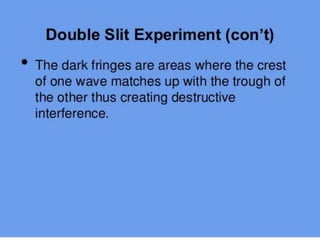
At other points, the two waves arrive completely
out of phase ( phase difference 1800) with one
another. So the resultant wave has zero amplitude.
at this point, we expect silence. This is called
destructive interference. If the waves are
neither perfectly out of step nor perfectly in step,
the resultant wave has amplitude less than the
loudest point.
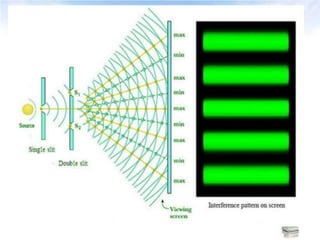
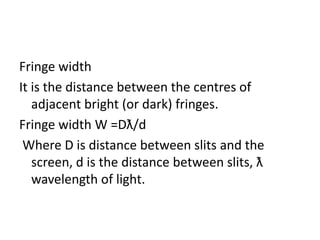
Fringe width
It is the distance between the centres of
adjacent bright (or dark) fringes.
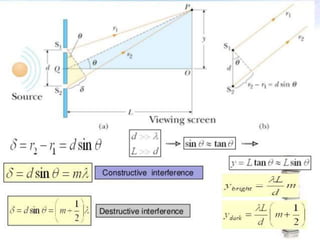
Fringe width W =Dƛ/d
Where D is distance between slits and the
screen, d is the distance between slits, ƛ
wavelength of light.
Condition for constructive interference
Path difference =nƛ where n = 0,1,2,3 ----
Condition for destructive interference
Path difference = (n+1/2)ƛ
INTERFERENCE OF LIGHT.pptx

INTERFERENCE OF LIGHT.pptx

  • 1.
  • 2.
    Interference of Sound: A simple experiment shows what happens when two sets of sound waves meet. Two loudspeakers are connected to a single signal generator. They each produce sound waves of same wavelength. When we walk around in the space in front of the loudspeakers, we hear the resultant effect.
  • 3.
    The loudspeakers areemitting waves that are in phase because both are connected to the signal Generator. At some points, the two waves arrive in phase with one another and with equal amplitude. So the resultant wave has twice the amplitude of a single wave. We hear a loud sound and we call it constructive interference.
  • 4.
    At other points,the two waves arrive completely out of phase ( phase difference 1800) with one another. So the resultant wave has zero amplitude. at this point, we expect silence. This is called destructive interference. If the waves are neither perfectly out of step nor perfectly in step, the resultant wave has amplitude less than the loudest point.
  • 16.
    Fringe width It isthe distance between the centres of adjacent bright (or dark) fringes. Fringe width W =Dƛ/d Where D is distance between slits and the screen, d is the distance between slits, ƛ wavelength of light.
  • 17.
    Condition for constructiveinterference Path difference =nƛ where n = 0,1,2,3 ---- Condition for destructive interference Path difference = (n+1/2)ƛ