Interactive
Teaching
Strategies
Objectives:
• To identify the different
learning styles
• To explore how interactive
teaching strategies support
all learners
• To share practical ideas for
whole class teaching
Learning Styles
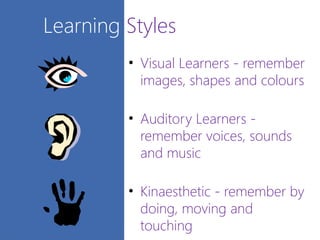
• Visual Learners - remember
images, shapes and colours
• Auditory Learners -
remember voices, sounds
and music
• Kinaesthetic - remember by
doing, moving and
touching
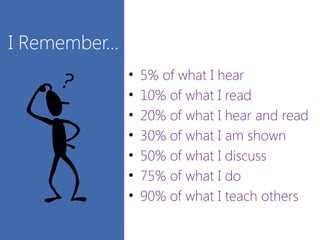
I Remember...
• 5% of what I hear
• 10% of what I read
• 20% of what I hear and read
• 30% of what I am shown
• 50% of what I discuss
• 75% of what I do
• 90% of what I teach others
Interactive
Teaching
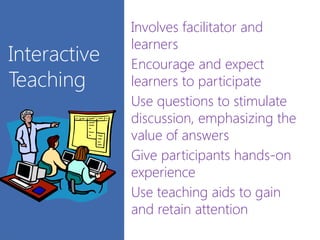
Involves facilitator and
learners
Encourage and expect
learners to participate
Use questions to stimulate
discussion, emphasizing the
value of answers
Give participants hands-on
experience
Use teaching aids to gain
and retain attention
Where to
Start… Start with clear learning
objectives/outcomes
Follow an outline and
provide copies to
participants
Increase
Participation
Research shows people will:
Listen for only 15-20 minutes
without a break
Learn more when given an
opportunity to process what
they are learning
Retain more if they review
or use the information
immediately after learning it
Lecturing Lecture is the duct-tape of the
teaching world
Lecturing delivers “concepts”
It delivers a lot of information
in a short amount of time
Conveys information that is
difficult to present in another
way
Avoid Over
Use Because
In a lecture the learners are
passive
Doesn’t guarantee
understanding, no
feedback from learners
Easily bores the audience
unless well prepared
Points to Keep
in Mind
Lowest retention value of all
teaching techniques
Make more interactive by
involving the group by
frequently stopping and asking
questions
Strive for a 30% / 70%
Split 30% lecture/ 70% active
discussion
Why use
facilitation
rather than
lecture?
Participants like to be
actively involved
Participants want to share
knowledge and ideas
You don’t have to be an
expert and answer all
questions
Keeps group’s attentive and
involved
Working in
Groups Work groups are the
workhorse of interactive
teaching
Work groups should be
standard in every class
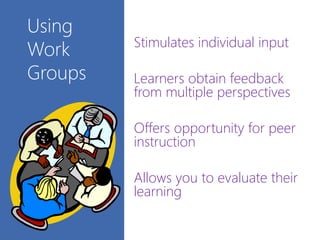
Using
Work
Groups
Stimulates individual input
Learners obtain feedback
from multiple perspectives
Offers opportunity for peer
instruction
Allows you to evaluate their
learning
How to
Utilize
Work
Groups
Explain the procedure
Form groups
Describe task
Specify a time limit
Ask for scribes
Recommend a process
How to
Utilize
Work
Groups
Monitor progress
Act as a timekeeper &
answer questions
Have groups report to
entire group
Process the information
When to Use
Group Work
Warm ups
Practice Session
Review
Break Up Lectures
Complete assignments
Incorporating
Interactivity
As you select activities,
consider the learners’ wants
and needs, number of
participants, size and layout
of the room
Ask yourself:
“What am I trying to
teach these people?”
“Do I want them to
share ideas and learn
from each other?”
“Do I want them to
internalize something
on their own?”
“Do I want to test their
knowledge?”
Incorporating
Interactivity
Plan a variety of activities
into the session to help
participants stay interested
Incorporating
Interactivity
Interactive
Techniques
The instructor can easily and
quickly assess if students have
really mastered the material
Students are revived from their
passivity of merely listening to
a lecture and instead become
attentive and engaged,
Summary
• Telling is not teaching, nor is
listening learning.
• Interactive teaching is a
two-way process of active
participant engagement
with each other, the
facilitator, and the content.
•
Summary
The most effective learning
involves leading students
to a point of reflection on
content

Interactive Teaching

  • 1.
  • 2.
    Objectives: • To identifythe different learning styles • To explore how interactive teaching strategies support all learners • To share practical ideas for whole class teaching
  • 3.
    Learning Styles • VisualLearners - remember images, shapes and colours • Auditory Learners - remember voices, sounds and music • Kinaesthetic - remember by doing, moving and touching
  • 4.
    I Remember... • 5%of what I hear • 10% of what I read • 20% of what I hear and read • 30% of what I am shown • 50% of what I discuss • 75% of what I do • 90% of what I teach others
  • 5.
    Interactive Teaching Involves facilitator and learners Encourageand expect learners to participate Use questions to stimulate discussion, emphasizing the value of answers Give participants hands-on experience Use teaching aids to gain and retain attention
  • 6.
    Where to Start… Startwith clear learning objectives/outcomes Follow an outline and provide copies to participants
  • 7.
    Increase Participation Research shows peoplewill: Listen for only 15-20 minutes without a break Learn more when given an opportunity to process what they are learning Retain more if they review or use the information immediately after learning it
  • 8.
    Lecturing Lecture isthe duct-tape of the teaching world Lecturing delivers “concepts” It delivers a lot of information in a short amount of time Conveys information that is difficult to present in another way
  • 9.
    Avoid Over Use Because Ina lecture the learners are passive Doesn’t guarantee understanding, no feedback from learners Easily bores the audience unless well prepared
  • 10.
    Points to Keep inMind Lowest retention value of all teaching techniques Make more interactive by involving the group by frequently stopping and asking questions Strive for a 30% / 70% Split 30% lecture/ 70% active discussion
  • 11.
    Why use facilitation rather than lecture? Participantslike to be actively involved Participants want to share knowledge and ideas You don’t have to be an expert and answer all questions Keeps group’s attentive and involved
  • 12.
    Working in Groups Workgroups are the workhorse of interactive teaching Work groups should be standard in every class
  • 13.
    Using Work Groups Stimulates individual input Learnersobtain feedback from multiple perspectives Offers opportunity for peer instruction Allows you to evaluate their learning
  • 14.
    How to Utilize Work Groups Explain theprocedure Form groups Describe task Specify a time limit Ask for scribes Recommend a process
  • 15.
    How to Utilize Work Groups Monitor progress Actas a timekeeper & answer questions Have groups report to entire group Process the information
  • 16.
    When to Use GroupWork Warm ups Practice Session Review Break Up Lectures Complete assignments
  • 17.
    Incorporating Interactivity As you selectactivities, consider the learners’ wants and needs, number of participants, size and layout of the room
  • 18.
    Ask yourself: “What amI trying to teach these people?” “Do I want them to share ideas and learn from each other?” “Do I want them to internalize something on their own?” “Do I want to test their knowledge?” Incorporating Interactivity
  • 19.
    Plan a varietyof activities into the session to help participants stay interested Incorporating Interactivity
  • 20.
    Interactive Techniques The instructor caneasily and quickly assess if students have really mastered the material Students are revived from their passivity of merely listening to a lecture and instead become attentive and engaged,
  • 21.
    Summary • Telling isnot teaching, nor is listening learning. • Interactive teaching is a two-way process of active participant engagement with each other, the facilitator, and the content. •
  • 22.
    Summary The most effectivelearning involves leading students to a point of reflection on content

Editor's Notes

  • #3 Talk through the aims for the session.
  • #4 Expand on the powerpoint notes: Visual Learners Learn best when they can use pictures, mind maps, diagrams, flow charts, visual artefacts, key words, display, TV, video camera, ICT, posters… Auditory Learners Learn best through sound, discussions (paired or groups), tapes, debates, rhymes, repetition, drama, music, explanation, ICT… Kinaesthetic Learner Learn best through movement or touch, ICT, experiments, trips, sequencing, placing events on a timeline, physical movement, role play, brain gym..
  • #5 Bring the session to a conclusion by reminding participants of how children learn, using the above list. This list is also presented as a poster in the pack.
  • #7 Start with clear learning objectives/outcomes Helps you plan session and helps participants by providing clear view of the session’s direction Follow an outline and provide copies to participants Periodically refer to the learning outcomes during the session to remind everyone where you are and prevent people from getting lost
  • #8 Research shows people will: Listen for only 15-20 minutes without a break Learn more when given an opportunity to process what they are learning Retain more if they review or use the information immediately after learning it
  • #12 because learners can address questions as well
  • #21 These techniques have multiple benefits: (and plan to dedicate more time to it, if necessary), and the process of measuring student understanding in many cases is also practice for the material - Students are revived from their passivity of merely listening to a lecture and instead become attentive and engaged, two prerequisites for effective learning. - These techniques are often perceived as “fun”, yet they are frequently more effective than lectures at enabling student learning.
  • #22 You must engage students in learning activities that lead to a higher level of understanding and result in the participant's ability to apply what he learned on the class
  • #23 Keep in mind, however, that interactivity is a means to a greater end – participant learning. What does this mean to me? How can I use this? Is this better than what I'm doing now? This reflection is the goal of interactivity.